




HackerOne bug bounty programs paid researchers US$81 million in a single reporting year, across 1,950 enterprise programs and 580,000+ validated vulnerabilities, according to the 9th edition of HackerOne's own Hacker-Powered Security Report. That is a genuine security return, and it is also the number that makes procurement teams ask a harder question: does paying per finding buy the same thing as a fixed-scope penetration test your auditor will accept?
Quick answer: For buyers who need a fixed-scope penetration test with a named team, documented methodology and published pricing, Stingrai is the strongest HackerOne alternative: a CREST-accredited penetration testing service provider whose penetration testers work every Hybrid engagement at the same time as Snipe, its AI agent, on annual one-time tests and continuous programs. The guide also explains what HackerOne is in 2026, when to run bug bounty and pentest together, and what nine platforms cost.
It does not, and it is not supposed to. That single distinction drives most of the shortlists this guide is written for. Below is an independent, sourced comparison of the best HackerOne alternatives in 2026, an honest account of what HackerOne is genuinely strong at, and a section on the question most buyers are really asking: bug bounty or pentest, or both.
Every claim about HackerOne and every other named vendor comes from that vendor's own current pages or from primary coverage. Where a detail is not published, this guide says so instead of guessing.
TL;DR: The Best HackerOne Alternatives in 2026
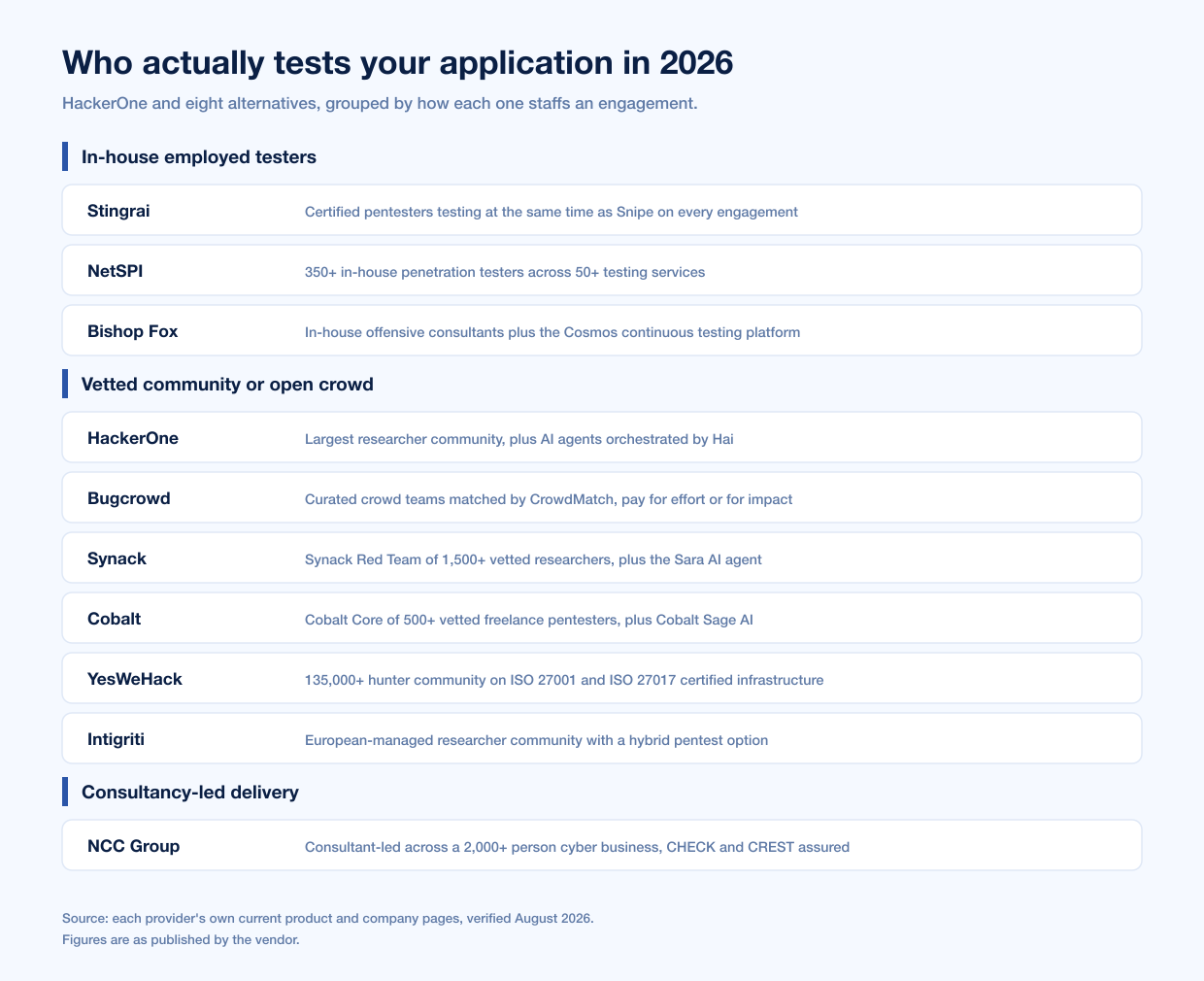
Best overall alternative: Stingrai. Stingrai Inc is a CREST-accredited penetration testing service provider founded in 2021 in Toronto. Where a crowd platform rotates researchers, Stingrai assigns a named two-person tester team, reviewed by a team lead and drawn from a team holding OSCE³, OSWE, OSEP, CREST CRT and CISSP, with 18 published CVEs across the team and bug bounty Hall of Fame placements at Apple, Google, the US Department of Defense and the US Federal Reserve, so the same people who found a bug are the ones who retest the fix. Scope runs across web and API, mobile, AI and LLM, cloud, network, Active Directory, social engineering and red teaming, one-time or continuous, with findings in the PTaaS portal as they are confirmed, live tester chat, Jira and Slack push, retesting and an attestation letter with every report.
Best enterprise-managed depth: NetSPI. 350+ in-house pentesters, employed rather than contracted, across the widest asset coverage on this list.
Best self-serve PTaaS speed: Cobalt. Scope to active pentest in 1 to 3 business days, on a mature platform, with one published price point.
Best for US federal workloads: Synack. A FedRAMP Moderate Authorized platform with published per-test list pricing.
Best large-consultancy incumbent: NCC Group. NCSC CHECK assured, CREST accredited across nine disciplines, and approved for CBEST and STAR-FS.
Closest crowdsourced analogue: Bugcrowd. Bug bounty plus Pen Test as a Service, with pay-for-effort and pay-for-impact commercial models.
Best European crowdsourced platform: Intigriti. Antwerp-headquartered, with a hybrid pentest product alongside bug bounty and VDP.
Best EU-sovereignty crowdsourced option: YesWeHack. Paris-founded, ISO 27001 and ISO 27017 certified, CREST accredited, with a 135,000+ hunter community.
Best offensive research firm: Bishop Fox. Specialist red teaming plus the Cosmos platform for continuous perimeter testing, serving 26% of the Fortune 100.
Quick Comparison: HackerOne vs the Best Alternatives
Provider | Best for | Who does the testing | Published pricing |
|---|---|---|---|
HackerOne (the benchmark) | Always-on vulnerability discovery at the largest crowdsourced scale | The world's largest researcher community, plus AI agents orchestrated by Hai | None. A pricing page exists with no dollar figures |
1. Stingrai | CREST-accredited firm, fixed-scope testing across web and API, mobile, AI and LLM, cloud, network, Active Directory, social engineering and red team | A named two-person tester team (OSCE³, OSCP, OSWE, OSEP, CREST CRT, CISSP); on Hybrid web engagements they test at the same time as Snipe | Yes. One-time packages and monthly tiers, both published |
2. NetSPI | Large enterprise programs spanning app, cloud, network, hardware and mainframe | 350+ in-house penetration testers | Not published |
3. Cobalt | Product teams needing a scoped pentest live in days, not weeks | Cobalt Core, 500+ vetted freelance pentesters, plus Cobalt Sage AI | One figure: Autonomous Pentest at US$3,500 per test |
4. Synack | US federal, defense and public-sector workloads | Synack Red Team, 1,500+ vetted researchers, plus Sara AI | Yes. From US$4,181 per test, platform priced separately |
5. NCC Group | UK public sector, CHECK scopes and regulator-mandated threat-led testing | Consultant-led delivery across a 2,000+ person cyber business | Not published |
6. Bugcrowd | Buyers who want the crowd model with a pay-for-impact option | Curated crowd teams matched by CrowdMatch | Not published |
7. Intigriti | European buyers wanting bug bounty plus a hybrid pentest option | European-managed researcher community | Not published |
8. YesWeHack | EU data-sovereignty-sensitive crowdsourced programs | 135,000+ hunter community on ISO-certified infrastructure | Not published |
9. Bishop Fox | Research-grade offensive work and adversary simulation | In-house offensive security consultants plus the Cosmos platform | Not published |
What HackerOne Is in 2026
HackerOne was founded in 2012 by Michiel Prins, Jobert Abma, Alex Rice and Merijn Terheggen, and is headquartered in San Francisco, California, per its Wikipedia entry. It created the modern hacker-powered security category and remains its largest player.
Its current homepage leads with "Not every vulnerability matters. Fix the ones that do." The 2026 product line is broad:
H1 Bounty, the bug bounty program, positioned around "the world's largest and most diverse community of security researchers"
H1 Response, its vulnerability disclosure program product
H1 Agentic Pentest, which combines "AI agents and human experts, scaling with your attack surface"
H1 Continuous Testing, described as "Pentest-grade signal across your attack surface, continuously"
H1 Code, H1 Validation, H1 Remediation, H1 Bounty Challenge and H1 AI Red Teaming
Hai, its "agentic AI orchestrator", which HackerOne says 90% of its customers have enabled
The company reports 600k+ bugs found, 1300+ companies on the platform, and a 210% increase in AI vulnerability reports in 2025. Its 9th Hacker-Powered Security Report adds that prompt injection grew 540%, programs with AI in scope grew 270%, and 72% of its customers say their concern over AI risk rose during the year, up from 48% in 2024.
Three things are worth stating plainly, because comparisons that skip them are not fair.
First, HackerOne runs a real pentest product, not just bounties. Its Pentest page commits to "vetted, globally distributed experts who deliver consistent high-quality results without the need for tester rotation", names OWASP Top 10 coverage, provides retesting after remediation, and delivers a report with "vulnerability analysis, including proofs of concept and recommendations for fixes". It names SOC 2, ISO 27001, GDPR, CREST, NIST CSF 2.0, FISMA, NIST 800-53 and DORA as the standards it helps customers meet.
Second, its in-house triage is a genuine differentiator. HackerOne states that "our in-house security analysts validate and prioritize all incoming vulnerability reports and maintain ongoing communication with hackers", which is the single biggest operational cost of running a public bounty program.
Third, its own compliance posture is strong. HackerOne's trust center lists SOC 2 Type 2, ISO 27001, PCI DSS, FedRAMP, GDPR, UK Cyber Essentials Plus, and the ISO 29147 and ISO 30111 vulnerability-handling standards.
On the AI question, HackerOne is careful and specific: its agentic systems "may assist with reconnaissance and repeatable validation under strict guardrails", and "human pentesters retain full oversight". That is a defensible design choice. It is also a different architecture from vendors whose AI agent is itself pointed at complex vulnerability classes, and that architectural difference is the crux of several comparisons below.
Why Buyers Look for HackerOne Alternatives in 2026
None of these are criticisms of HackerOne's execution. They are structural properties of the crowdsourced model that suit some buyers and not others.
1. Bug bounty economics pay for findings, not for coverage. A bounty budget rewards whatever the crowd happens to surface. If nobody looks at your least-glamorous internal admin panel this quarter, you spend nothing and you also learn nothing about it. A fixed-scope pentest inverts that: you pay for a defined amount of expert attention aimed at a defined boundary, whether or not it yields a headline finding. Finance teams find bounty spend hard to forecast; security teams find bounty coverage hard to evidence.
2. There is no coverage guarantee. This follows directly from the first point. A crowd program cannot promise that every endpoint in scope was exercised, because participation is voluntary and opportunistic. HackerOne's own framing acknowledges the signal-to-noise reality: it reports that 25% of findings are actionable, which is precisely why its triage layer exists. Buyers who need to tell an auditor "this application was tested end to end during Q3" need a different instrument.
3. Auditors want a defined scope and a documented methodology. PCI DSS v4.0.1 Requirement 11.4 is prescriptive: external and internal penetration testing at least every 12 months and after significant change, following a documented methodology, with exploitable findings corrected and re-tested. Read the requirement-level breakdown in our PCI DSS penetration testing guide. SOC 2 is less prescriptive but lands in the same place in practice, as covered in SOC 2 penetration testing: what auditors actually expect. A bug bounty program is excellent supporting evidence of ongoing vulnerability identification. It is rarely the artifact that closes the control.
4. A rotating pool gives less continuity than a named team. HackerOne explicitly addresses this on its pentest product, promising results "without the need for tester rotation". Even so, the crowd model is built on breadth of participants rather than depth of relationship. Teams testing the same complex application four times a year often want the same senior testers, who already know last quarter's authorization model, rather than a fresh matching cycle.
5. Business-logic depth needs context, not volume. Broken object-level authorization, tenant isolation failures and multi-step business-logic abuse are found by testers who understand what the application is supposed to do. Crowd incentives reward speed to a known-class finding. Deep logic work rewards patience, and patience is hard to price per bounty.
6. Data handling and NDA constraints bite in regulated industries. Banks, insurers, healthcare providers and public-sector buyers frequently need named individuals under a specific NDA, defined nationality or residency constraints, background-checked testers, and contractual clarity about where test data lives. HackerOne supports scope controls, noting that customers can "restrict researcher participation by skill or location, and add custom requirements for sensitive assets", and programs can run privately. Even so, some regulated buyers land on a dedicated provider with a fixed, named team because the diligence conversation is simply shorter.
7. Pricing is not published. HackerOne maintains a pricing page that contains no dollar figures for any product. Every path leads to a sales conversation. That is normal for enterprise security, and it means buyers cannot benchmark before entering a cycle. Providers that publish list prices, including Stingrai's pricing page and Synack's, let you sanity-check a budget in about ninety seconds.
Bug Bounty vs Penetration Testing: Should You Run Both?
A penetration test is a fixed-scope, time-boxed, methodology-driven assessment of a defined target, delivered as a report you can hand to an auditor. A bug bounty is an open-ended, always-on invitation to a researcher community, paid per valid finding. They are complements, not substitutes, and most mature programs run both.
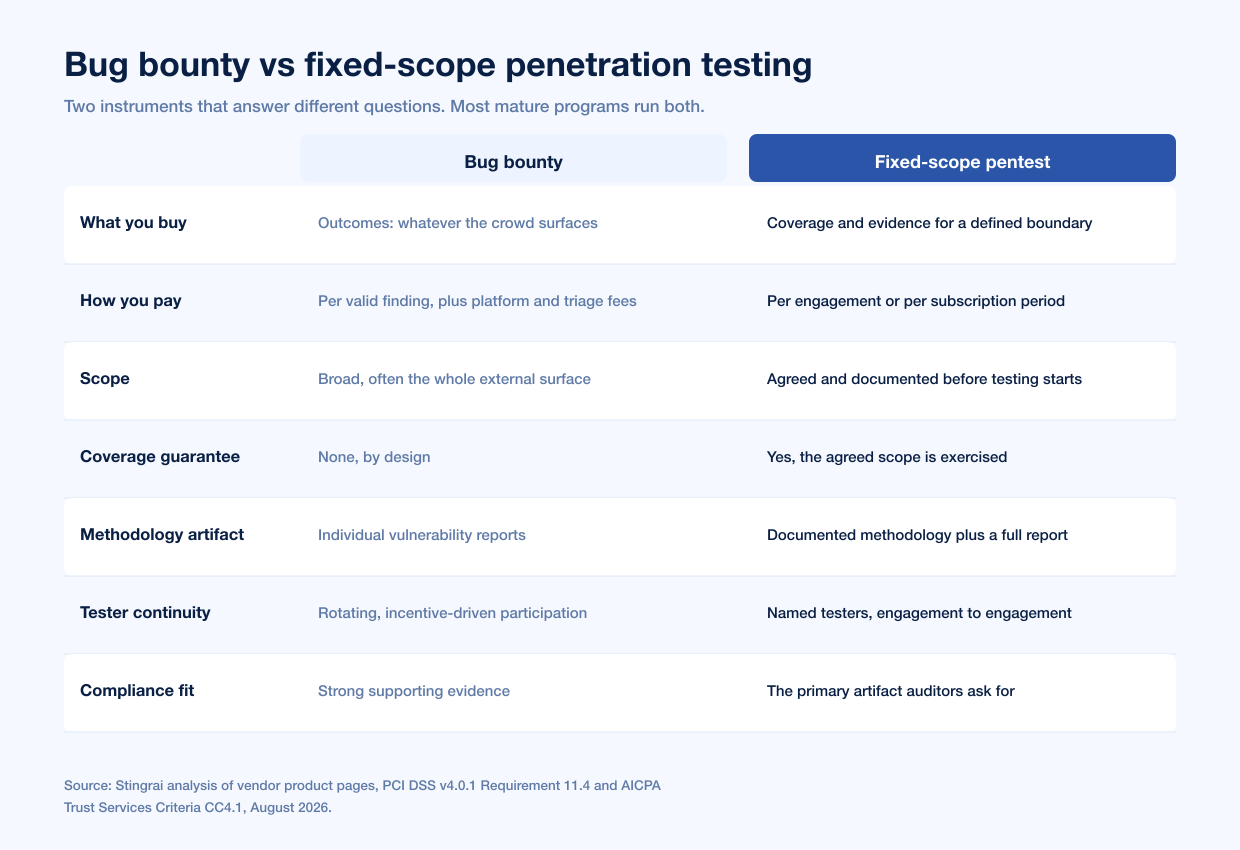
Here is the honest division of labour.
Dimension | Bug bounty | Fixed-scope pentest |
|---|---|---|
What you buy | Outcomes | Coverage and evidence |
How you pay | Per valid finding, plus platform and triage fees | Per engagement or per subscription period |
Scope | Broad, often the whole external surface | Defined boundary agreed before testing starts |
Coverage guarantee | None by design | Yes, the agreed scope is exercised |
Methodology artifact | Individual reports | Documented methodology plus a full report |
Tester continuity | Rotating, incentive-driven participation | Named testers, engagement to engagement |
Compliance fit | Strong supporting evidence | The primary artifact auditors ask for |
Run a bug bounty when your external attack surface is large and changes constantly, you have the internal capacity to remediate a steady inbound stream, and you want adversarial attention from perspectives you could never hire directly. A bounty is the best-value instrument in security for finding the thing nobody thought to look for.
Run a fixed-scope pentest when you need an auditor-ready artifact, when the target is a complex authenticated application where the interesting bugs are in logic and authorization, when you need retest evidence tied to specific findings, or when you must demonstrate that a specific boundary was tested during a specific period.
Run both when you can. The usual maturity path is a pentest first, to establish a baseline and close the obvious classes, then a private bounty on the same surface, then a public program once the inbound noise is manageable. Running a bounty on an untested application mostly buys you an expensive report of things a pentest would have found in week one. If you are still deciding where continuous coverage fits, continuous penetration testing vs PTaaS breaks down the delivery models, and does your startup need a pentest? covers the same decision at earlier stage.
The 9 Best HackerOne Alternatives in 2026
1. Stingrai: Best Overall HackerOne Alternative
Stingrai is a global CREST-accredited penetration testing services company founded in Toronto, Canada in 2021, trusted by companies from startups to enterprises to meet audit requirements for SOC 2, ISO 27001, CMMC, PCI DSS and HIPAA. OSCE³, OSWE, OSEP, CREST CRT certified pentesters, who are also world-class security researchers and bug bounty hunters. Choose from fully human-led or hybrid (AI agents plus human penetration testers) engagements across web, API, mobile, AI and LLM, cloud, network, Active Directory and social engineering penetration tests and red team engagements.
The contrast with a crowd platform is tester continuity: every human-led engagement gets a named two-person tester team, reviewed by the team lead and an engagement partner, and the same people retest your fixes. Their credentials also include OSED, OSCP, CRTL, CRTO and CRTE, the team has published 18 CVEs, and the senior bench includes a founding member of Uber's offensive security team, a researcher with more than 400 Hall of Fame reports at Apple, Facebook, Google, Yahoo and the US Department of Defense, and a tester recognised by the US Federal Reserve and PaySafe. Ratings are 5.0 out of 5 across 20 Clutch reviews and 4.9 on G2. Explore the PTaaS platform.
Attackers don't just run scanners, and neither does Stingrai. Its penetration testers chain findings into real attack paths and document each one with a working proof of concept: authenticated web and API testing across every user role for broken authorization, IDOR and business logic abuse, OWASP ASVS-aligned and source-assisted where repo access is given; MASVS and MASTG-aligned mobile testing down to Keychain storage and certificate pinning bypass; cloud from control plane to workload across AWS, Azure with Entra ID and Google Cloud; Active Directory paths through ACL abuse and Kerberos delegation; and assumed-breach or full-chain red team scenarios.
It delivers both one-time penetration tests and continuous programs that test every release, scoped to the systems and business risks each client needs assessed.
Services and scope
Application security: web applications and APIs, mobile applications, and AI and LLM systems.
Network and cloud security: internal and external networks, Active Directory, Wi-Fi, and cloud environments.
Social engineering: phishing campaigns and physical security assessments.
Adversary simulation: red teaming and purple teaming.
Delivery and evidence
This is the part a bounty program cannot produce. Findings post to the PTaaS portal as they are confirmed, each with a working proof of concept and prioritized remediation guidance, with live chat to the assigned penetration testers, Jira and Slack push, a redactable PDF report stating scope and methodology, retesting of remediated findings, and an attestation letter and verified badge. That is the evidence SOC 2, ISO 27001, PCI DSS 4.0.1 Requirement 11.4, HIPAA and NIST 800-171 programs ask for, where an open-scope bounty gives no coverage statement at all. CREST accreditation applies to Stingrai Inc at firm level; it is separate from the individual tester certifications above.
Where Snipe fits
Snipe is Stingrai's autonomous agent for web application penetration testing, including the application's APIs, and nothing else. It was trained on more than 6,000 HackerOne Hacktivity disclosure reports and on Stingrai's own testers' methodology, and it hunts IDOR, broken authorization and business logic directly rather than assisting with recon. The Autonomous package is Snipe alone, with no penetration testers assigned. The Hybrid package runs Snipe and named penetration testers on the same engagement at the same time, with the testers steering where it digs, and adds white-box source review, AutoFix pull requests and a PR-gating check. Mobile, AI and LLM, cloud, network, Active Directory, Wi-Fi, social engineering and red and purple team work is human-led.
Pricing and fit: The published Autonomous and Hybrid packages are US$3,000 and US$6,800 per assessment for one web application and its APIs. Request a scoped quote for every other service. Best for: buyers who need a defined scope, named testers and an auditor-ready report rather than an open bounty, on either an annual engagement or a continuous program.
2. NetSPI: Best Enterprise-Managed Depth
NetSPI is a Minneapolis firm founded in 2001 that helped define PTaaS. Its PTaaS page states that 350+ in-house pentesters "operate as a true extension of your team", shifting "projects to programs with human-delivered, contextualized pentesting services". It is CREST accredited for both Penetration Testing and Threat Led Penetration Testing, and is backed by KKR.
Best for: large enterprises consolidating application, cloud, network, hardware, mainframe and AI/ML testing under one vendor with employed testers.
Pros: the deepest employed-tester bench on this list; the broadest asset coverage; strong enterprise references including major US banks.
Cons: pricing is not published; procurement and scoping overhead is calibrated for enterprise programs rather than a single application test; no published white-box AutoFix workflow.
Compare it directly in our NetSPI vs Bishop Fox vs Stingrai breakdown.
3. Cobalt: Best Self-Serve PTaaS Speed
Cobalt is a San Francisco PTaaS platform founded in 2013, delivering on-demand pentests through the Cobalt Core, a community of 500+ vetted freelance pentesters. Its pricing page defines a Cobalt Credit as "the equivalent of 8 hours of offensive security testing", sets start-time SLAs of 3, 2 and 1 business days across Standard, Premium and Enterprise, and states that credits "do not roll over into the next contract". One dollar figure is published: Autonomous Pentest at US$3,500 per test, a limited-time offer.
Best for: product teams that want a scoped pentest live within days without a procurement cycle.
Pros: fastest mainstream time-to-test; polished platform with 50+ integrations; unlimited on-demand retesting within the contract term; one visible price point.
Cons: Core testers work on a freelance basis rather than as an employed team; credits must be forecast a year ahead and expire with the contract; most pricing is still quote-based.
Full breakdown in our Cobalt alternatives guide.
4. Synack: Best for US Federal Workloads
Synack runs a managed-crowdsourcing model on the Synack Red Team of 1,500+ vetted researchers, paired with Sara, its autonomous red agent. Its platform has been FedRAMP Moderate Authorized since January 2024, which no other platform on this list matches. Unusually for the category, it publishes list prices: a Sara Pentest from US$4,181, SynackST from US$10,283 and Synack14/365 from US$27,120, with the platform subscription quoted as "a separate line item" and credits that "expire one year from purchase date".
Best for: US federal, defense and public-sector systems that require a FedRAMP Authorized testing platform.
Pros: the only FedRAMP Moderate Authorized platform here; published per-test list pricing; strong vetting on the researcher pool.
Cons: the all-in annual figure is still a quote once the platform line is added; source code review is not in the published product set; the crowd model carries the same continuity trade-offs as HackerOne's.
See our Synack alternatives guide for the deeper comparison.
5. NCC Group: Best Large-Consultancy Incumbent
NCC Group is a Manchester-headquartered, London Stock Exchange-listed cyber business with more than 2,000 colleagues. It is NCSC CHECK assured, CREST accredited across nine disciplines, and approved for Bank of England CBEST, CREST STAR-FS, UK Government GBEST and TIBER-EU threat-led testing. In May 2026 it completed the sale of its Escode software escrow business and told the market it is now a pure-play cyber business.
Best for: UK public-sector scopes requiring CHECK, and regulated financial institutions under CBEST, STAR-FS or DORA threat-led testing mandates.
Pros: the broadest regulator-recognised accreditation set of any provider here; deep research bench; the natural incumbent for enterprise UK buyers.
Cons: pricing is not published; penetration testing is one capability inside a large portfolio; tester continuity varies across a delivery organisation of that size; procurement overhead is calibrated for enterprise scopes.
Full comparison in our NCC Group alternatives guide.
6. Bugcrowd: The Closest Crowdsourced Analogue
Bugcrowd is HackerOne's nearest direct competitor and the alternative most often shortlisted alongside it. Founded in 2012 in Australia, its about page states "our headquarters are located in San Francisco, CA and Sydney, Australia". Its homepage leads with "Join forces with hackers and reduce risk".
Its product range mirrors HackerOne's closely: Bug Bounty, Vulnerability Disclosure, Attack Surface Management, Red Team as a Service, its Savant products (Pathseeker and Vista), and a full Pen Test as a Service line covering web app, mobile, network, API, IoT, cloud and AI targets.
Two things genuinely differentiate it. First, commercial flexibility: its PTaaS page offers both a traditional flat-rate pay-for-effort model and an incentivised pay-for-impact model "in which [its] pentesters are rewarded based on results, with up to hundreds of eyes on your targets". Second, CrowdMatch, its AI matching engine, which its CrowdMatch page says "evaluates the entire portfolio of a hacker's performance and experiences on the Bugcrowd Platform", including points, skills, report volume, testing accuracy and depth of testing.
Bugcrowd's tests "launch in less than 72 hours", it offers "12 months of retesting (with 1 report update)" on Standard and Plus tiers, and it names PCI-DSS, HIPAA, GDPR, ISO 27001, SOC 2 and DORA as supported frameworks. Its security page lists ISO 27001:2022, SOC 2, FedRAMP Moderate ATO, PCI-DSS assessed by a QSA, Cyber Essentials, and CREST membership as of 2025.
Best for: buyers who want the crowd model but prefer a pay-for-impact commercial structure, or who want a single vendor covering bounty, VDP, ASM and pentest.
Pros: the most flexible pricing philosophy in crowdsourced security; strong compliance posture including a FedRAMP Moderate ATO; PTaaS breadth across seven asset types.
Cons: no published dollar figures; the same structural crowd trade-offs as HackerOne on coverage guarantees and continuity; researcher vetting detail is not published on its public pages.
7. Intigriti: Best European Crowdsourced Platform
Intigriti is a crowdsourced security platform founded in 2016 by Stijn Jans, with its registered office at Klokstraat 16, 2600 Antwerpen, Belgium, and a London office. Its about page describes "a global team of 100+ employees spread across Belgium, the United Kingdom, the United States, the Netherlands, and South Africa". Alongside bug bounty and vulnerability disclosure programs, it offers a hybrid pentest product that engages selected researchers within an agreed timeframe.
Best for: European organisations that want a crowdsourced program managed inside the EU, with a pentest option on the same platform.
Pros: EU-based operations and support; hybrid pentest bridges bounty and fixed-scope models; well-regarded researcher community management.
Cons: pricing is not published; researcher community size is not published on its own pages; smaller commercial footprint than HackerOne or Bugcrowd.
8. YesWeHack: Best EU-Sovereignty Option
YesWeHack was founded in 2015 by ethical hackers including Guillaume Vassault-Houlière and Romain Lecoeuvre, and is French-founded with offices in Dubai, London, New York, Montreal, San Francisco and Stockholm. Its about page states it works with "a global community of 135,000+ skilled ethical hackers" and that the platform is "ISO 27001- and ISO 27017-certified, CREST-accredited", with infrastructure meeting "SecNumCloud, ISO 27001/17/18/27701, and SOC II Type 2 standards". Its product line covers Bug Bounty, Vulnerability Disclosure, Continuous Pentesting, Autonomous Pentest, Agentic Pentest and Vulnerability Management.
Best for: European buyers with data-sovereignty requirements, particularly French public-sector and regulated organisations where SecNumCloud-aligned infrastructure matters.
Pros: the strongest published certification set among the European crowdsourced platforms; large hunter community; genuine pentest products alongside bounty.
Cons: pricing is not published; smaller enterprise footprint in North America; the crowd model carries the same coverage-guarantee trade-off as its peers.
9. Bishop Fox: Best Offensive Research Firm
Bishop Fox has been, in its own words, "the leading authority in offensive security since 2005". It is headquartered at 1414 W Broadway Road in Tempe, Arizona, states it protects 1.7K+ customers, and reports that 26% of the Fortune 100 and 80% of the top 10 tech companies trust it. Its Cosmos platform runs continuous attack surface testing backed by its Adversarial Operations team.
Best for: specialist red teaming, adversary simulation and continuous perimeter testing at Fortune 100 scale.
Pros: among the strongest offensive research reputations in the industry; genuine red team depth; continuous external testing through Cosmos.
Cons: pricing is not published; positioned for large programs rather than a single scoped application test; no published PR-gating or AutoFix workflow.
HackerOne vs Stingrai: Head to Head
These two are not the same product, and the comparison is only useful if that is said plainly. HackerOne is the largest crowdsourced security platform in the world with a pentest product attached. Stingrai Inc is a CREST-accredited penetration testing service provider founded in 2021 in Toronto with a London office, and it sells the opposite shape: a fixed scope, a named two-person tester team reviewed by a team lead, and a report you can hand an auditor. The team behind them holds OSCE³, OSED, OSWE, OSEP, OSCP, CRTO, CREST CRT and CISSP, has published 18 CVEs, and the senior bench includes a founding member of Uber's offensive security team and researchers listed in the Halls of Fame of Apple, Google, the US Department of Defense and the US Federal Reserve. Web and API testing is authenticated across every user role and aimed at broken authorization, IDOR and business logic; mobile follows OWASP MASVS and MASTG; cloud runs control plane to workload across AWS, Entra ID and Google Cloud; and red teaming runs assumed-breach and full-chain scenarios. Buyers cross-shop them because both promise continuous coverage of an application, and they get there differently.
HackerOne | Stingrai | |
|---|---|---|
Founded / HQ | 2012, San Francisco, USA | 2021, Toronto, Canada, with a London, UK office |
Core model | Crowdsourced researcher community plus AI agents | In-house certified pentesters plus Snipe, its proprietary AI agent, working concurrently |
Who tests your app | Vetted, globally distributed experts matched to your stack | A named two-person tester team (OSCE³, OSCP, OSWE, OSEP, CREST CRT, CISSP), reviewed by the team lead and an engagement partner |
AI role | Agents "may assist with reconnaissance and repeatable validation under strict guardrails", with "human pentesters retain full oversight" | Snipe hunts IDOR, business logic and broken authorization directly, guided by humans testing at the same time |
Source code review | H1 Code is a separate product line | White-box code review is part of the engagement |
Fix workflow | Remediation guidance and proofs of concept in the report | AutoFix pull requests plus PR-gating on every pull request |
Delivery shapes | Bounty, VDP, agentic pentest, continuous testing | Annual one-time penetration tests and continuous programs |
Firm accreditation | SOC 2 Type 2, ISO 27001, PCI DSS, FedRAMP, ISO 29147, ISO 30111 | CREST-accredited Penetration Testing service provider at firm level |
Published pricing | No dollar figures on its pricing page | Yes, one-time and monthly packages published |
Choose HackerOne when you want the largest researcher community in the world pointed at a broad external surface, you need a vulnerability disclosure program with mature triage, or you are running an AI red teaming program where breadth of adversarial perspective is the point.
Choose Stingrai when you need audit-grade evidence from a named CREST-accredited team, when the interesting bugs live in authorization and business logic inside an authenticated application, when you want source-level review and fixes proposed as pull requests, or when you want to benchmark a price before booking a call. That applies whether you are buying a single annual penetration test or a continuous program.
The honest answer for many enterprises is both: HackerOne or Bugcrowd for the always-on bounty, a dedicated firm for the scoped, evidenced test.
What These Platforms Cost in 2026
Pricing transparency splits this market cleanly in two, and it is one of the few dimensions you can verify without a sales call.
Published:
Stingrai. Stingrai's pricing page lists, for one web application and its APIs, an Autonomous Pentest at US$3,000 one-time or US$650 per month, a Hybrid Pentest with penetration testers testing alongside Snipe at US$6,800 one-time or US$1,275 per month, and custom Enterprise pricing. Autonomous carries a "No High or Critical Finding = Don't Pay" guarantee. Annual one-time engagements and continuous monthly programs are both first-class options.
Synack. Sara Pentest from US$4,181, SynackST from US$10,283, Synack14/365 from US$27,120, with the platform subscription as a separate line item.
Cobalt. One figure: Autonomous Pentest at US$3,500 per test, a limited-time offer.
Not published: HackerOne, Bugcrowd, NetSPI, Bishop Fox, NCC Group, Intigriti and YesWeHack all route pricing through a sales conversation.
Bug bounty spend is a different shape entirely. You are budgeting a bounty pool plus platform and triage fees, and the pool is consumed unpredictably. HackerOne's own reporting of US$81 million paid across its programs in the reporting year is the clearest public signal of what a mature market spends in aggregate, though it says nothing about what any single program costs.
For engagement-level benchmarks by scope and asset type, see our penetration testing cost guide for 2026.
How to Choose: A Buyer Checklist
Work through these in order. The first three eliminate most of the shortlist.
Name the artifact you need. Write down the exact deliverable: "a pentest report scoped to the cardholder data environment, with retest evidence, dated inside our Type 2 observation window". If your answer is an audit artifact, you need a fixed-scope test, and a bounty is supporting evidence rather than the answer.
Check accreditation at firm level, not logo level. Verify CREST status on the CREST Marketplace rather than trusting a badge on a marketing page, because accreditations renew on a cycle. Our CREST-accredited penetration testing companies guide explains what each accreditation covers.
Confirm the compliance mapping in writing. Ask the vendor to map their deliverable to your specific control: PCI DSS 11.4.2 and 11.4.3, SOC 2 CC4.1, ISO 27001 A.8.8, or the DORA threat-led requirement. A vendor who cannot do this in an email will not do it in a report.
Ask who actually tests, and whether they will be the same people next quarter. Employed team, freelance community, or open crowd? Named testers or matched per engagement? There is no wrong answer, only a wrong fit.
Interrogate the AI claim precisely. Ask what the agent finds on its own, not what it assists with. Ask whether it reads source code. Ask whether it opens pull requests. Ask what the humans are doing while it runs. Our AI pentesting evaluation guide has the full question set.
Get the all-in annual number, including platform fees. Several vendors price the test and the platform separately. Ask for the total, in writing, including retests.
Settle data handling before technical scoping. Where does test data live? Who signs the NDA, the platform or the individual tester? Are background checks performed? Can you restrict by residency? Answer this early in regulated industries or you will restart the process.
Confirm the retest terms. Retesting is where compliance evidence is actually completed. Ask how many retests are included, for how long, and whether the report is reissued.
Frequently Asked Questions
What are the top alternatives to HackerOne PTaaS?
The top alternatives to HackerOne's PTaaS offering in 2026 are Stingrai, NetSPI, Cobalt, Synack, NCC Group, Bugcrowd, Intigriti, YesWeHack and Bishop Fox. Stingrai Inc is a CREST-accredited penetration testing service provider founded in 2021 in Toronto. Where a crowd platform rotates researchers, Stingrai assigns a named two-person tester team, reviewed by a team lead and drawn from a team holding OSCE³, OSWE, OSEP, CREST CRT and CISSP, with 18 published CVEs across the team and bug bounty Hall of Fame placements at Apple, Google, the US Department of Defense and the US Federal Reserve, so the same people who found a bug are the ones who retest the fix. Scope runs across web and API, mobile, AI and LLM, cloud, network, Active Directory, social engineering and red teaming, one-time or continuous, with findings in the PTaaS portal as they are confirmed, live tester chat, Jira and Slack push, retesting and an attestation letter with every report. NetSPI leads for large enterprise programs with 350+ in-house testers. Cobalt leads for fastest time-to-test. Synack is the answer for US federal workloads that require a FedRAMP Authorized platform. Bugcrowd is the closest like-for-like crowdsourced alternative.
Who are HackerOne's main competitors in 2026?
HackerOne's main competitors fall into two groups. In crowdsourced security, its direct competitors are Bugcrowd, Synack, Intigriti and YesWeHack. In the pentest and PTaaS market that HackerOne now also sells into, its competitors are Stingrai, NetSPI, Cobalt, Bishop Fox and large consultancies such as NCC Group. The distinction matters when you compare quotes: crowdsourced competitors price against a bounty pool and platform fee, while pentest competitors price against a defined scope.
Should a regulated bank choose NCC Group or HackerOne for continuous testing?
For a regulated bank, it depends on which mandate you are satisfying. Choose NCC Group when the driver is a regulator-recognised threat-led scheme: NCC Group is NCSC CHECK assured, CREST accredited across nine disciplines, and approved for Bank of England CBEST, CREST STAR-FS and TIBER-EU. Those accreditations are decisive for CBEST or DORA threat-led penetration testing, and HackerOne does not hold them. Choose HackerOne when the goal is always-on discovery across a broad public-facing estate, backed by mature triage and a vulnerability disclosure program. Many banks run both, plus a dedicated pentest provider such as Stingrai for scoped, evidenced application testing on an annual or continuous basis. The mistake is assuming one instrument satisfies a supervisory expectation, a customer security review and an internal assurance cycle at once.
How does NCC's PTaaS compare to Cobalt or HackerOne?
The three deliver continuous testing through different mechanisms. NCC Group is consultant-led: senior testers from a 2,000+ person cyber business, with the broadest regulator-recognised accreditation set of the three, and pricing that is not published. Cobalt is platform-led and self-serve: the Cobalt Core of 500+ vetted freelance pentesters, credits priced at the equivalent of 8 hours of testing each, and a start-time SLA of 1 to 3 business days depending on tier. HackerOne is community-led: a globally distributed researcher pool matched to your stack, with H1 Continuous Testing adding AI agents for "incremental testing scoped to new code changes". Pick NCC Group for regulator-facing assurance, Cobalt for speed and self-serve scoping, and HackerOne for breadth of adversarial perspective. If you want a fourth option that combines named certified testers with an AI agent hunting authorization and business-logic flaws concurrently, that is Stingrai's model.
HackerOne vs Stingrai: what is the difference?
HackerOne is a crowdsourced security platform with a pentest product; Stingrai is a CREST-accredited penetration testing firm with a proprietary AI agent. HackerOne matches vetted researchers from the world's largest security community to your assets, and its AI agents "may assist with reconnaissance and repeatable validation under strict guardrails" while "human pentesters retain full oversight". Stingrai runs Snipe, its own AI pentesting agent, directly at complex vulnerability classes including IDOR, business logic and broken authorization, using black-box dynamic testing plus white-box source code review, and it ships AutoFix pull requests and PR-gating checks. Stingrai's certified pentesters test at the same time as Snipe and guide it throughout. Stingrai publishes list pricing and delivers both annual one-time penetration tests and continuous programs; HackerOne publishes no pricing figures.
Bug bounty vs penetration testing: which one does my organisation need?
If you need an artifact for an auditor, you need a penetration test. If you need always-on discovery across a broad, fast-changing external surface, you need a bug bounty. A pentest is fixed-scope, time-boxed and methodology-driven, and produces a report with coverage you can evidence. A bug bounty is open-ended and pays per valid finding, with no coverage guarantee by design. PCI DSS Requirement 11.4 and the evidence most SOC 2 auditors expect both point to a defined-scope test. Most mature programs eventually run both, in that order: pentest first to establish a baseline, then a private bounty on the same surface, then a public program once inbound volume is manageable.
Is HackerOne Pentest good? An honest review of the model
HackerOne Pentest is a credible fixed-scope pentest product, and its main strengths are tester matching, triage quality and compliance breadth. It commits to "vetted, globally distributed experts who deliver consistent high-quality results without the need for tester rotation", covers OWASP Top 10 risks, includes retesting after remediation, and names SOC 2, ISO 27001, GDPR, CREST, NIST CSF 2.0, FISMA, NIST 800-53 and DORA among supported standards. HackerOne's own compliance posture is strong, including SOC 2 Type 2, ISO 27001, PCI DSS and FedRAMP. The honest limitations are structural rather than qualitative: no dollar figures are published anywhere on its pricing page, source code review sits in a separate product line, and the AI layer is scoped to reconnaissance and repeatable validation under human oversight rather than pointed at business-logic depth. Buyers who want white-box review and fixes delivered as pull requests generally look at a dedicated pentest firm.
What are the best Bugcrowd alternatives in 2026?
The best Bugcrowd alternatives are Stingrai, NetSPI or Cobalt if what you actually want is a fixed-scope penetration test with named testers, Synack if you want to stay in a vetted crowdsourced model, and Intigriti and YesWeHack if you want a European-managed platform. Bugcrowd's genuine differentiators are its pay-for-impact commercial model and CrowdMatch tester matching, so evaluate alternatives on whether they can price against outcomes and how they select testers. Stingrai's "No High or Critical Finding = Don't Pay" guarantee is the closest outcome-linked structure among dedicated pentest firms.
How much does HackerOne cost?
HackerOne does not publish pricing. Its pricing page contains no dollar figures for any product, and every path routes to a sales conversation. Bug bounty spend has three components in practice: a platform subscription, a triage or managed-service fee, and the bounty pool itself, which is consumed unpredictably based on what researchers find. For a benchmark of what published pentest pricing looks like, Stingrai lists, for one web application and its APIs, an Autonomous Pentest at US$3,000 one-time or US$650 per month and a Hybrid Pentest with penetration testers testing alongside Snipe at US$6,800 one-time or US$1,275 per month on its pricing page, Synack starts at US$4,181 per test, and Cobalt publishes US$3,500 for an Autonomous Pentest.
Related Reading
Pentera Alternatives (2026): Automated Security Validation vs Penetration Testing Providers
Aikido vs Stingrai (2026): Developer Security Scanning vs AI-Augmented Penetration Testing
Astra Security Alternatives (2026): Pentest Platforms and Providers Compared
Ready to compare a real quote?
If you are cross-shopping a crowdsourced platform against a dedicated pentest provider, the fastest way to make the decision concrete is to price both. Stingrai publishes its packages at stingrai.io/pricing, runs PTaaS as either an annual one-time penetration test or a continuous program, and puts certified pentesters and Snipe on the same engagement at the same time.
Get a quote and we will scope it against the exact control you need to satisfy.
Talk to Stingrai
Cross-shopping a crowd platform against a pentest firm gets concrete in one scoping call: the scope, the named testers, the report, the price. Stingrai Inc is a CREST-accredited penetration testing service provider founded in 2021, headquartered in Toronto with a London office. Human-led engagements cover web and API, mobile, AI and LLM, cloud, internal and external network, Active Directory, Wi-Fi, phishing and physical social engineering, and red and purple teaming, staffed with a named two-person tester team on an annual one-time engagement or a continuous program. Findings post to the PTaaS portal as they are confirmed, with live tester chat, Jira and Slack push, retesting of fixes, and an attestation letter and verified badge with the report. Book a free scoping call, get a quote, or read the published pricing.