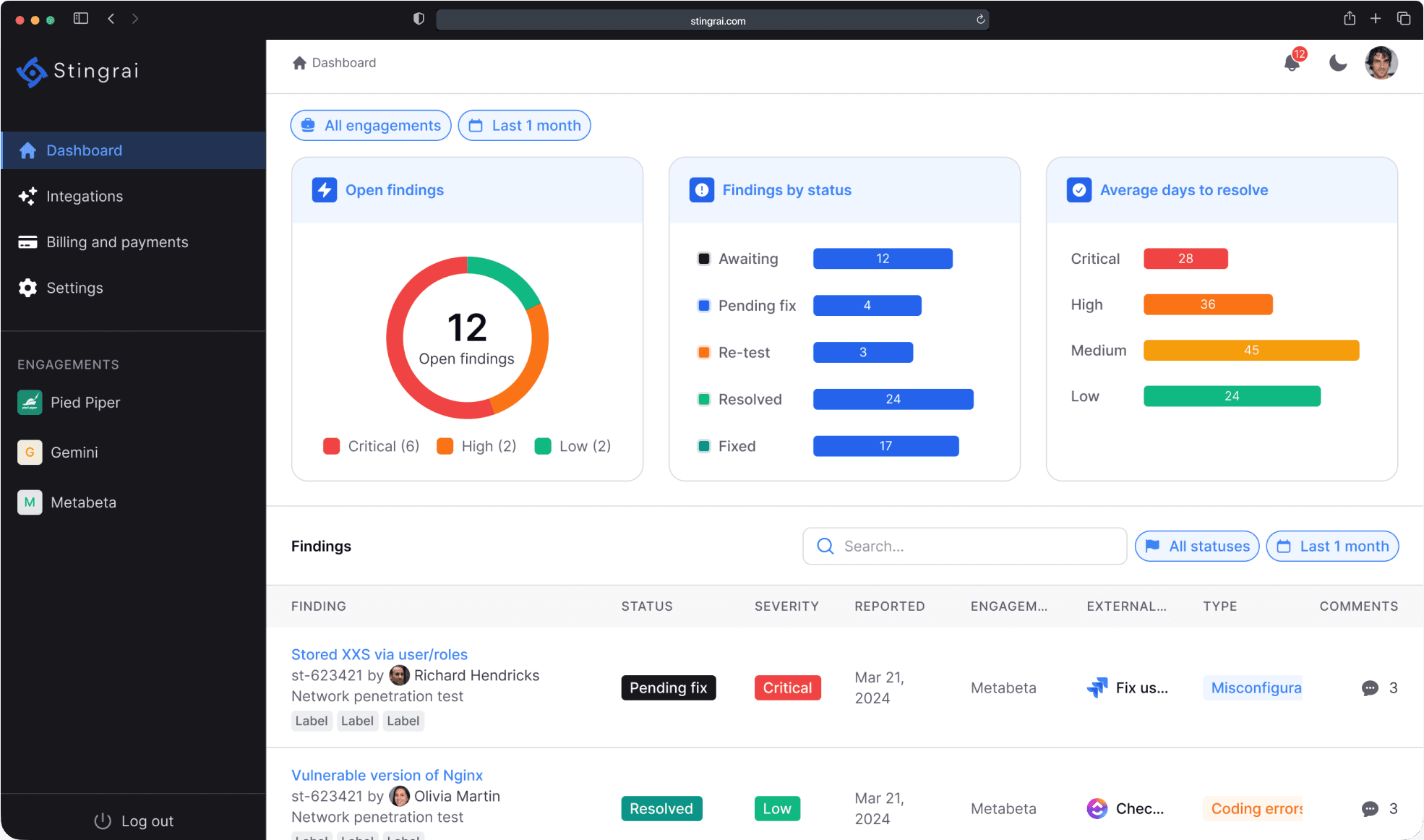
Penetration testing as a service (PTaaS) delivers penetration testing through a platform: findings arrive as they are confirmed, fixes are retested on request and results flow into Jira and Slack. Stingrai, a CREST-accredited firm, runs one-time and continuous PTaaS with Snipe, its autonomous AI agent, and named penetration testers.
What is penetration testing as a service?
Penetration testing as a service is a delivery model for penetration testing. The testing itself is the same work: penetration testers, and increasingly AI agents, attack an application or network the way an adversary would and prove what they can reach. What changes is how results arrive and how often testing happens. A PTaaS platform posts each finding as it is confirmed, keeps the conversation with the testers in one place, tracks remediation and retests fixes, so a pentest becomes an ongoing program rather than an annual document.
Stingrai runs every engagement in its PTaaS portal, Autonomous, Hybrid, human-led and Enterprise, from a one-time web application test to a continuous program across a full attack surface. Findings arrive with a proof of concept and remediation guidance, sync to Jira and Slack, and close only when a retest confirms the fix.
Findings posted as they are confirmed, each with a proof of concept
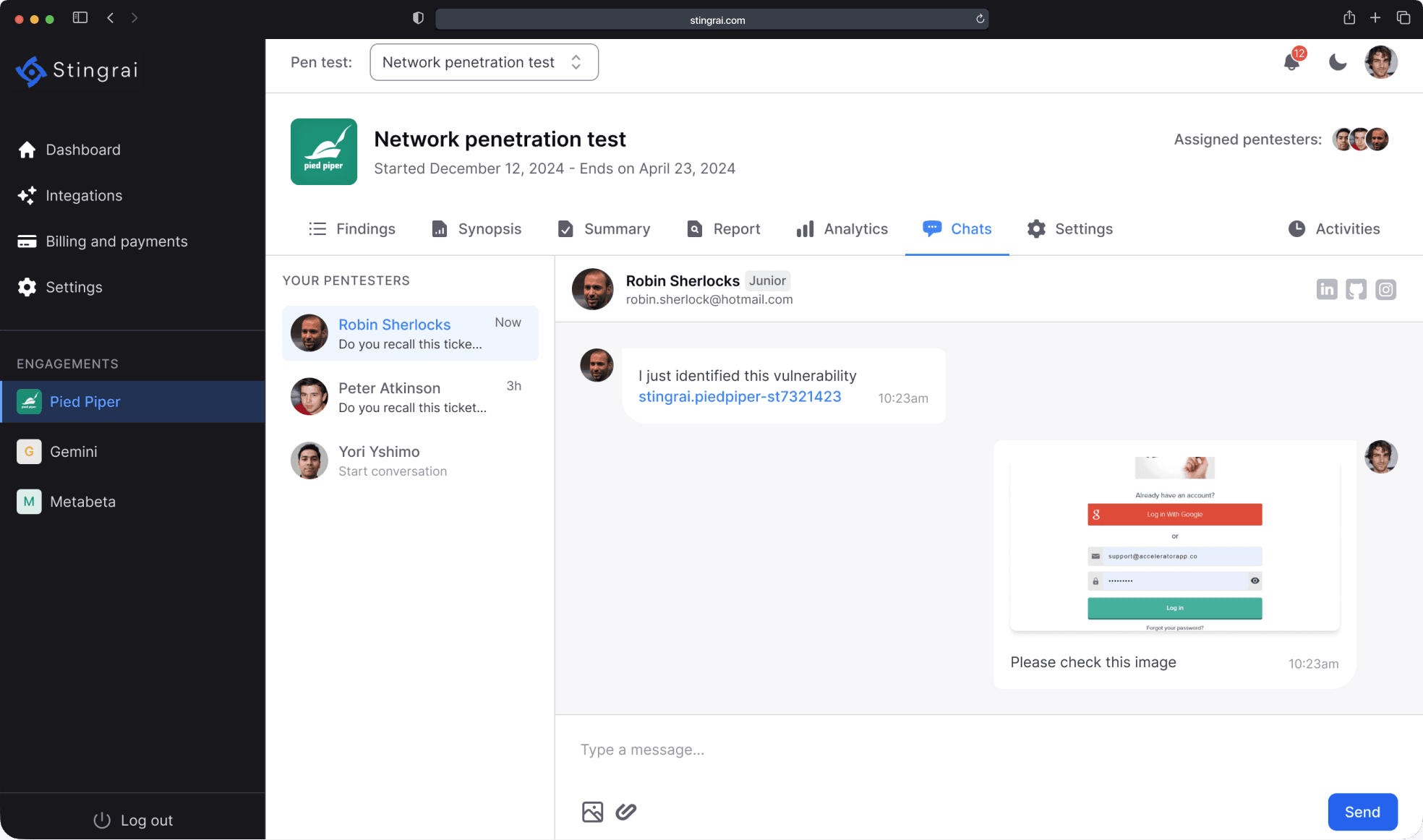
Direct chat with the penetration testers while testing is underway
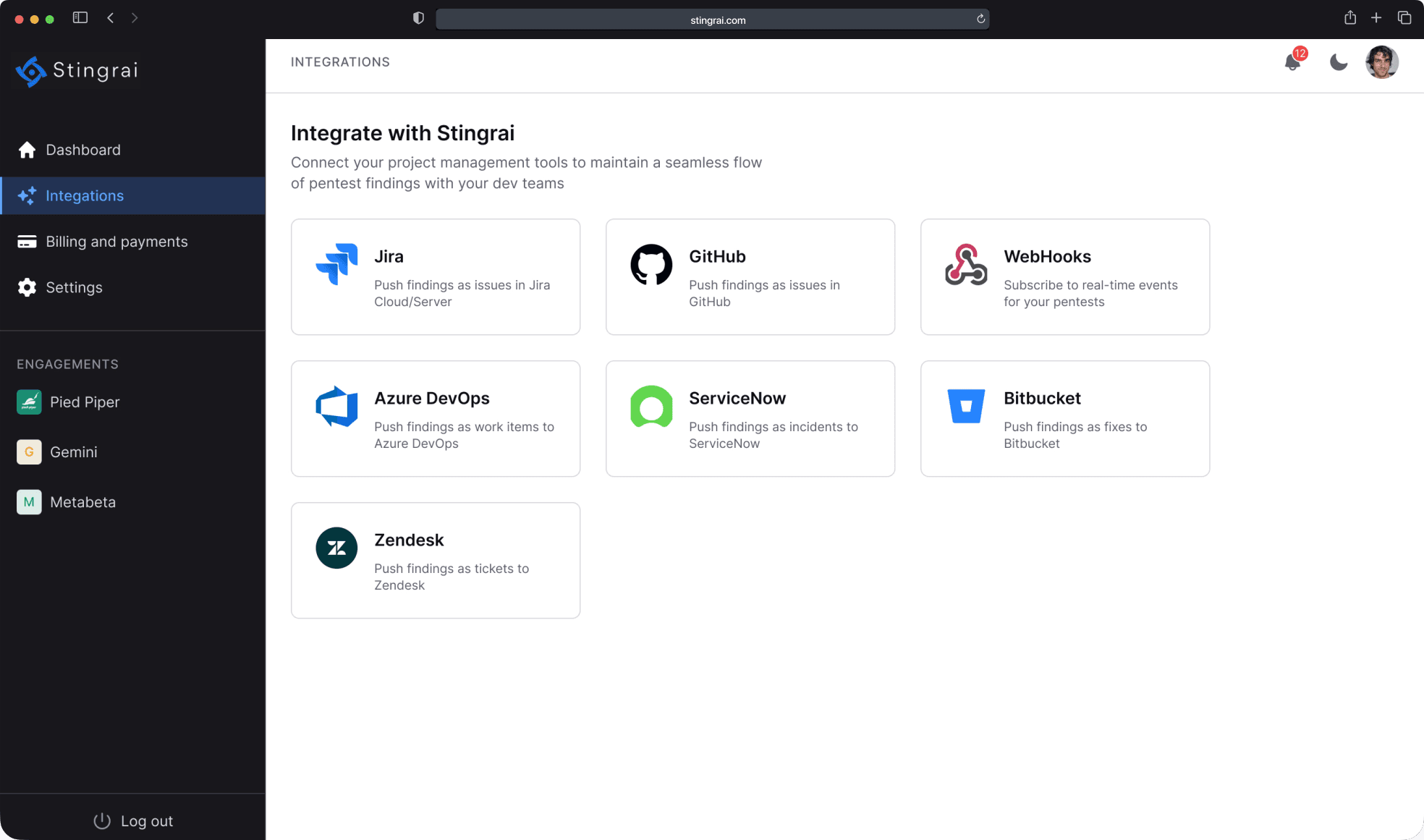
Jira, Slack and GitHub integration for remediation
Retests of fixed findings and redactable PDF reports
PTaaS compared with a traditional pentest, scanning and BAS
Buyers often weigh PTaaS against three alternatives. The difference that matters most is whether anyone proves a vulnerability is exploitable, and whether the approach can find authorization and business logic flaws at all.
Criterion
PTaaS at Stingrai
Traditional penetration test
Vulnerability scanning
Breach and attack simulation (BAS)
What it is
Penetration testing delivered through a platform, one-time or continuous
A scoped test by a consultancy, delivered as a report at the end
Automated checks for known vulnerabilities and misconfigurations
Automated replay of known attack techniques against security controls
Who or what tests
Snipe for web applications and APIs; named penetration testers on Hybrid and human-led work
Penetration testers
A scanner
A simulation agent running a technique library
Authorization and business logic flaws
The focus: IDOR, broken authorization and logic flaws
Found within the test window
Rarely found; scanners match known signatures
Out of scope; BAS tests detection and prevention controls
Proof
Each finding confirmed with a proof of concept
Proof of concept in the final report
Unverified results that need triage, including false positives
Pass or fail per simulated technique
When results arrive
As each finding is confirmed
At the end of the engagement
After each scan
After each simulation run
Cadence
One-time, or monthly with quarterly deep dives on continuous plans
Usually once a year
Weekly to continuous
Scheduled or continuous
Retesting
Included, requested from the portal
Often a separate window or fee
The next scan
The next run
Compliance evidence
Penetration test evidence, for example PCI DSS Requirement 11.4
Penetration test evidence
Scan evidence, for example PCI DSS Requirement 11.3; not a penetration test
Control validation evidence; not a penetration test
Scroll horizontally to compare all four approaches.
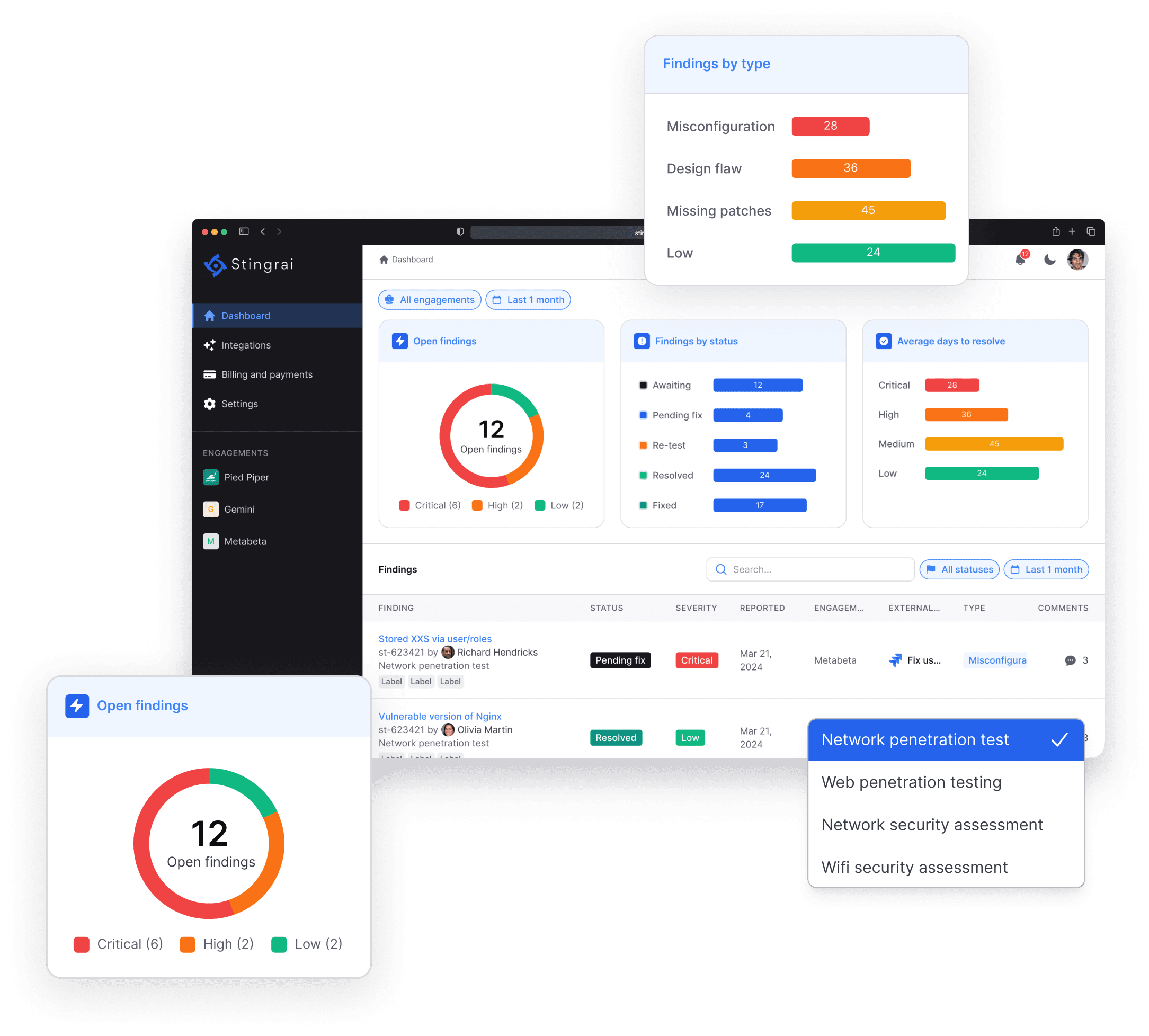
Get a unified view of all security vulnerabilities reported by our penetration testers, making it easier to track and the executive team can use the analytics to improve their cyber security posture.
2
Comprehensive Reporting
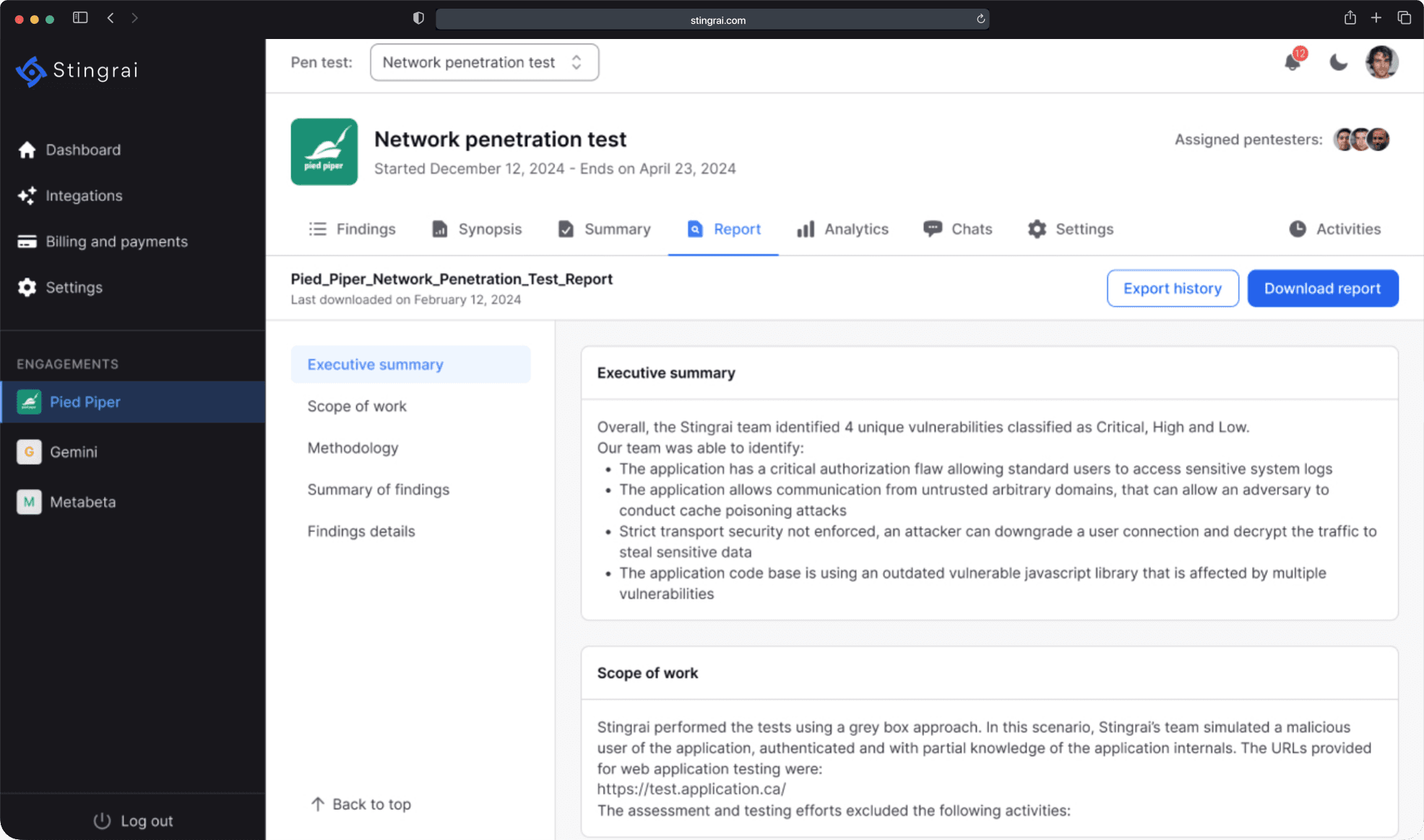
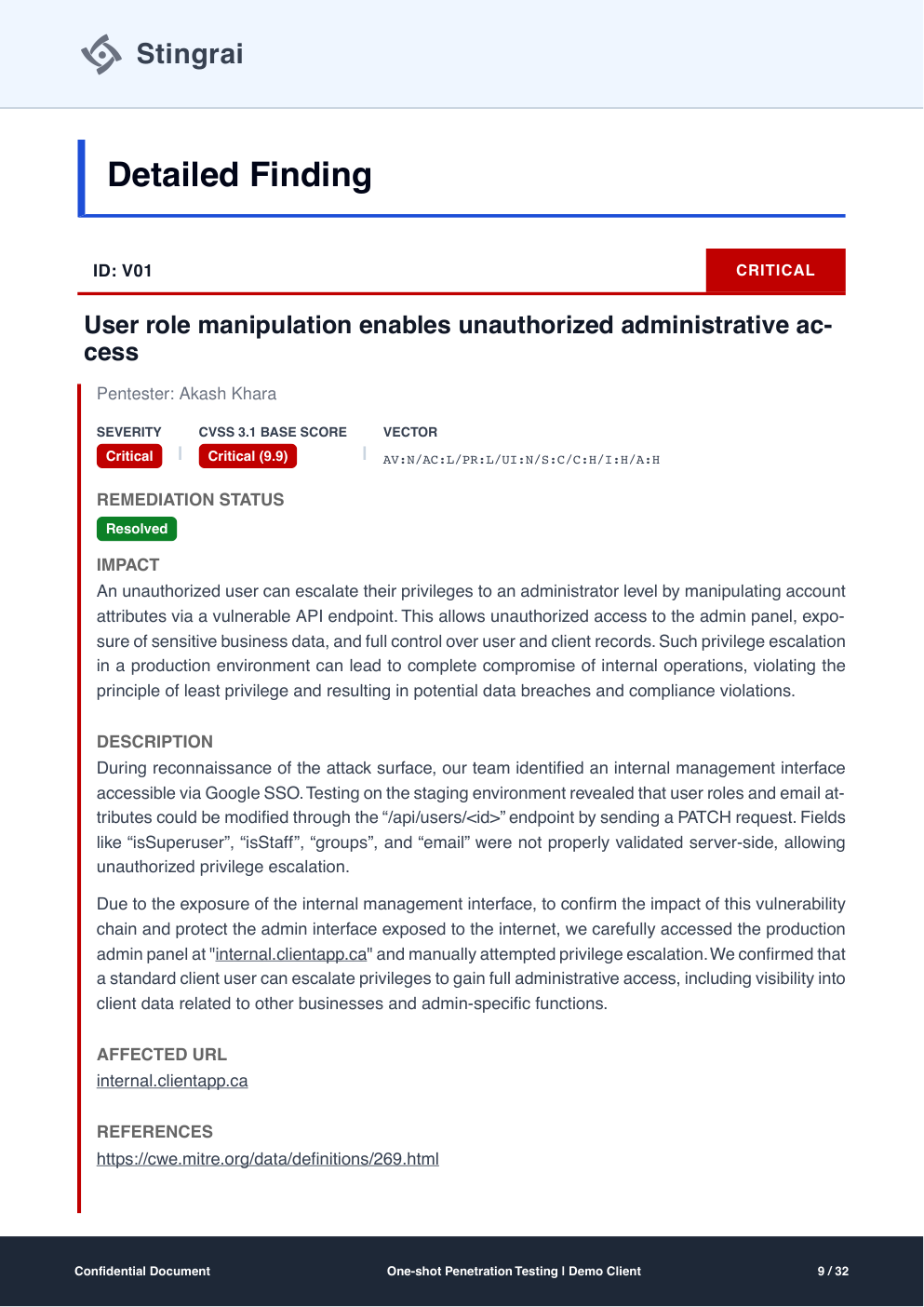
Access and download reports directly from our PTaaS platform, with the ability to redact sensitive company information from specific sections, ensuring you can confidently share them with key stakeholders.
3
Integration Capabilities
Seamlessly connect with your existing tools and platforms. Our PTaaS platform enables automatic reporting of vulnerabilities directly to your ticketing systems, allowing you to efficiently track and manage remediation efforts.
4
Instant Support
Empower your development team to collaborate with our penetration testers through live chat during the pentest, allowing for immediate feedback and swift resolution of issues as they arise.
Penetration Testing Services
Web Application Penetration Testing
Authenticated testing of web applications and associated APIs across every user role, focused on broken authorization, IDOR and business logic, with each finding proven.
Internal and External Penetration Testing
External perimeter and internal network testing for exposed services, lateral movement, privilege escalation and segmentation gaps, with findings prioritized by business impact.
Active Directory Security Assessment
Stingrai's Active Directory Security Assessment finds misconfigurations, ACL abuse and Kerberos and delegation attack paths that lead to domain admin, with steps to close each one.
Wi-Fi Security Assessment
Wireless security assessments on-site or remote with a Wi-Fi Pineapple, covering as many locations as needed to find weak authentication, rogue access and segmentation gaps.
Physical Security Assessments
On-site perimeter and facility entry testing that shows whether physical controls stop an intruder before they reach people, devices or the network.
Phishing Campaigns
Phishing simulations run on a custom Gophish instance integrated with Evilginx, capturing session cookies even with multi-factor authentication to measure how far a phished account reaches.
Web Application Penetration Testing
Internal and External Penetration Testing
Active Directory Security Assessment
Wi-Fi Security Assessment
Physical Security Assessments
Phishing Campaigns
How Stingrai's PTaaS Works
Scope and Quote
Submit the Get a Quote form and receive pricing within 24 hours, or book a 30-minute discovery call to review applications, environments, user roles, compliance requirements and deadlines. The published packages cover one web application and associated APIs; every other scope is quoted.
Statement of Work and Onboarding
Once the quote is accepted, a Statement of Work (SOW) fixes the scope, testing windows, rules of engagement and deliverables. After it is signed, the team is invited to the PTaaS portal, where credentials and test accounts are shared.
Testing
Snipe tests web applications and associated APIs, and its AI and LLM sub-agent tests AI applications, including MCP servers, with named penetration testers. On Hybrid engagements two named penetration testers work alongside Snipe throughout. Cloud, network, Active Directory, mobile, red team and social engineering testing is human-led.
Live Findings and Collaboration
Each finding is posted to the portal as soon as it is confirmed, with a proof of concept, severity and remediation guidance. Findings sync to Jira and Slack, and the team can chat directly with the penetration testers while testing is underway.
Remediation and Retesting
Developers fix while testing continues, with consultation calls available. When a fix is deployed, a retest is requested from the portal and the status of the finding is updated.
Reporting and Attestation
At the close of testing, Stingrai issues an executive summary and a full technical report as a redactable PDF. Hybrid and human-led engagements include an attestation letter stating scope and testing dates.
Who tests what
Snipe covers web applications and associated APIs, and its AI and LLM sub-agent covers AI applications alongside penetration testers. Everything else in a PTaaS program is tested by named penetration testers.
Web applications and APIsSnipe, or Snipe with penetration testers
The Autonomous Pentest is Snipe on its own: black-box, grey-box across up to three user roles and white-box where repository access is given, with AutoFix pull requests. The Hybrid Pentest adds two named penetration testers who chain findings and test the logic that needs human context.
AI and LLM applicationsSnipe's AI and LLM sub-agent with penetration testers
Prompt injection, jailbreaks, system prompt leakage, insecure output handling, tool misuse and excessive agency in agents, and MCP servers, mapped to the OWASP LLM Top 10 and MITRE ATLAS.
Cloud, network and Active DirectoryHuman-led
AWS, Azure and Google Cloud identity and configuration, internal and external networks, segmentation, Active Directory attack paths, Microsoft 365 and Wi-Fi.
Mobile applicationsHuman-led
iOS and Android apps and the backends they call, tested to OWASP MASVS and MASTG.
Red teaming and social engineeringHuman-led
Assumed breach and full-chain red team exercises, purple teaming, phishing, vishing and physical security assessments.
How Snipe works
Fully autonomous testing, or hybrid with penetration testers testing alongside Snipe throughout.
Explore how we structure executive summaries, prioritized findings, evidence, reproduction steps, and remediation guidance, tailored to SOC 2, ISO 27001, PCI DSS, and HIPAA compliance.
Continuous penetration testing means an application is tested on a schedule all year, not once before an audit. At Stingrai a continuous plan runs for 12 months on one web application and associated APIs, billed monthly.
One-time pentest
A single scoped engagement with findings in the portal during testing and a report at the close. The Hybrid Pentest adds 12 monthly Snipe scans after the one-time test.
Fits when
An audit or customer security review needs a current report
A major release or new product needs testing before launch
Releases are infrequent and the attack surface changes slowly
A first pentest is needed to set a baseline
Continuous pentest
Testing repeats through a 12-month plan. The Autonomous plan is monthly autonomous testing by Snipe at US$650 per month. The Hybrid plan is monthly Snipe testing, human-verified, plus a quarterly deep dive by penetration testers and quarterly executive status reports, at US$1,275 per month.
Fits when
Code ships weekly or daily and an annual test goes stale in weeks
Enterprise customers ask for evidence of ongoing testing
Remediation needs to be verified as fixes land, not a year later
Budget is easier to plan as a monthly cost than a yearly spike
Two published packages cover one web application and associated APIs, each as a one-time assessment or a 12-month continuous plan billed monthly. The Autonomous Pentest is Snipe on its own: US$3,000 one-time or US$650 per month. The Hybrid Pentest pairs Snipe with two named penetration testers: US$6,800 one-time or US$1,275 per month. Enterprise programs across the full attack surface are quoted.
Autonomous Pentest
AI Agents
$3,000
/assessment
Fully autonomous web application pentest powered by Snipe.
Five things set the price of any PTaaS engagement, at Stingrai or elsewhere.
Number of assets
Each additional web application, mobile app, cloud account or network range adds testing. The published packages cover one web application and associated APIs.
Size and user roles
The packages include up to 200 API endpoints or dynamic pages and up to three user roles for authenticated testing. Larger applications and more roles take longer to test properly.
Who tests
Snipe on its own costs less than Snipe with penetration testers. Human-led work on cloud, network, mobile and red team scopes is quoted on the testing days the scope needs.
Cadence
A one-time assessment is paid once. A continuous plan spreads 12 months of testing across monthly payments.
Evidence required
If customers or auditors expect an attestation letter, the engagement needs to be Hybrid or human-led. Frameworks can also add scope, such as segmentation testing for PCI DSS.
Enterprise and multi-application programs are quoted. Submit the Get a Quote form and receive pricing within 24 hours.
Compliance evidence
A PTaaS report and its retest results produce evidence for several programs at once, and a continuous plan keeps that evidence current between audits.
SOC 2
Evidence for the separate evaluations described in CC4.1, and supporting evidence for vulnerability identification under CC7.1 alongside scan output.
PCI DSS v4.0.1
Requirement 11.4: penetration testing at least every 12 months and after significant change, with exploitable findings corrected and retested.
ISO/IEC 27001:2022
Evidence for Annex A 8.8, management of technical vulnerabilities, and 8.29, security testing in development and acceptance.
HIPAA Security Rule
Evidence for the risk analysis at 45 CFR 164.308(a)(1)(ii)(A) and the periodic technical evaluation at 164.308(a)(8).
CMMC Level 2
Evidence for periodic security control assessment (CA.L2-3.12.1) and vulnerability identification (RA.L2-3.11.2) on systems that handle CUI.
What PTaaS gives each team
Security Teams
Ongoing testing that fits the security program, with every finding, chat and retest in one portal and no new procurement cycle for each test.
IT Administrators
One place to request testing, share credentials and test accounts, and follow results as they arrive, instead of coordinating each pentest over email.
Developers
Findings arrive in Jira with a proof of concept and fix guidance while testing continues, and Snipe opens AutoFix pull requests for web application issues.
Executives
A current view of risk between annual audits, executive summaries written for leadership and evidence to answer customer security reviews.
What Sets Us Apart
CREST-Accredited Firm
Stingrai Inc. is accredited by CREST at firm level for Penetration Testing and AI-Enabled Penetration Testing, and its penetration testers hold OSCE³, OSWE, OSEP, CREST CRT and CISSP certifications across the team.
Research Depth
The team has published 18 CVEs and reported vulnerabilities through the bug bounty programs of companies including Apple, Google and the US Department of Defense.
Snipe and Penetration Testers Together
Snipe tests web applications and associated APIs at machine speed; on Hybrid engagements two named penetration testers work alongside it throughout.
Findings Proven, Not Listed
Every finding is confirmed with a proof of concept before it is posted, so engineering fixes real issues instead of triaging scanner output.
Remediation Support
Detailed remediation steps, consultation calls with the testers and retests of fixed findings are included.
Published Pricing
Fixed prices for one web application and associated APIs, and quotes for every other scope within 24 hours.
How to evaluate a PTaaS provider
Questions to put to any PTaaS vendor before signing, and what a strong answer looks like.
Who tests, and are they named?
The vendor names the penetration testers on the engagement and their certifications, and states what is automated and what is not. Stingrai's Hybrid engagements are staffed by two named penetration testers from a team holding OSCE³, OSWE, OSEP, CREST CRT and CISSP certifications.
Is the firm accredited?
Firm-level accreditation such as CREST means methodology, data handling and staff vetting have been assessed. Stingrai is a CREST-accredited firm, and CREST's AI-Enabled Penetration Testing accreditation also assesses how it uses AI in testing.
Are findings proven?
Every finding carries a proof of concept and reproduction steps, not a scanner signature that engineering has to triage.
Does it find logic flaws?
Ask for examples of IDOR, broken authorization and business logic findings. Scanners and BAS tools do not find these; penetration testers and purpose-built agents do.
How are retests handled?
Retests are included and requested from the platform, and the report is updated to show the fixed status of each finding.
What does the report contain?
An executive summary, methodology and coverage, and a technical section that can be redacted before it is shared. Ask for a sample report before buying.
Is pricing clear?
Published prices or a written quote that states the scope in plain terms. Stingrai publishes package prices and quotes other scopes within 24 hours.
What is the research record?
Published CVEs and verified reviews show testing depth. Stingrai's team has published 18 CVEs, and the firm is rated 5.0 on Clutch.
Rigorous, genuinely hands-on pentest partner that behaves like part of your team. The technical depth is well beyond what we expected at this price point, and they traced issues to specific code paths.
Elia R., Mesh ID (G2 review)
Simplifies the pentesting process by giving us one place to request, manage, and track security testing. We spent WAY less time coordinating and more time improving security.
Riley D., Frontend Developer, TPH (G2 review)
PTaaS Frequently Asked Questions
Penetration testing as a service is a delivery model in which penetration testing runs through a platform instead of ending in a single PDF. Findings appear as they are confirmed, the team talks to the testers in the same place, fixes are retested on request and results sync to tools such as Jira and Slack. Stingrai delivers PTaaS as one-time engagements and as 12-month continuous plans, with Snipe, its autonomous AI agent, and named penetration testers.
The testing is the same discipline; the delivery is different. A traditional penetration test delivers results once, at the end of the engagement, and coverage goes stale until the next annual test. PTaaS posts each finding as it is confirmed, keeps direct communication with the testers open during the engagement, includes retesting of fixes and can run continuously, so remediation starts during the test rather than after the report.
Continuous penetration testing tests an application on a schedule throughout the year instead of once. Stingrai's continuous plans run for 12 months on one web application and associated APIs: the Autonomous plan is monthly testing by Snipe at US$650 per month, and the Hybrid plan adds human verification of the monthly Snipe testing and a quarterly deep dive by penetration testers at US$1,275 per month. Enterprise programs can test every release.
Stingrai publishes two packages for one web application and associated APIs. The Autonomous Pentest, Snipe on its own, is US$3,000 per assessment or US$650 per month on a 12-month plan. The Hybrid Pentest, Snipe with two named penetration testers, is US$6,800 per assessment or US$1,275 per month. Enterprise programs and other scopes are quoted through the Get a Quote form within 24 hours. Cost is driven by the number of assets, endpoints and user roles, who tests, cadence and the evidence required.
No. Vulnerability scanning checks for known vulnerabilities and misconfigurations and returns unverified results that need triage. Breach and attack simulation replays known attack techniques to test whether security controls detect and block them. PTaaS is penetration testing: findings are exploited and proven with a proof of concept, and authorization and business logic flaws, which scanners and BAS tools do not find, are a main focus.
Snipe, Stingrai's autonomous AI agent, tests web applications and associated APIs, and its AI and LLM sub-agent tests AI applications, including MCP servers, together with named penetration testers. On the Hybrid Pentest, two named penetration testers work alongside Snipe throughout. Cloud, network, Active Directory, Microsoft 365, mobile, red team, social engineering and physical testing is human-led.
Yes. A Stingrai report and its retest results produce evidence for SOC 2 (CC4.1 and CC7.1), PCI DSS v4.0.1 Requirement 11.4, ISO/IEC 27001:2022 Annex A 8.8, the HIPAA Security Rule and CMMC Level 2. Hybrid and human-led engagements include an attestation letter for customers and auditors, and continuous plans keep the evidence current between audits.
Ask who tests and whether they are named, whether the firm holds an accreditation such as CREST, whether every finding is proven with a proof of concept, whether the provider finds authorization and business logic flaws, how retests are handled, what the report contains and whether pricing is published or quoted in writing. Stingrai is a CREST-accredited firm whose team has published 18 CVEs, rated 5.0 on Clutch.
Attack at Machine Speed.Validated by Human Intuition.
Attackers now use AI for automated reconnaissance at scale,faster exploit development, and wider scanning across everyexposed surface. Traditional pentesting can't keep pace.