




Gartner published its first Market Guide for Adversarial Exposure Validation on 24 March 2026, and with it a new three-letter budget line landed on every vendor deck at once. Gartner defines adversarial exposure validation (AEV) as technologies that deliver "consistent, continuous, and automated evidence of the feasibility of an attack" (Gartner, Market Guide for Adversarial Exposure Validation, March 2026). The category is not brand new tooling. It is a consolidation: AEV folds the old breach and attack simulation (BAS) segment and the old automated penetration testing and red teaming segment into a single label. Buyers are now hitting "AEV" on landing pages, comparing it to the BAS platform they already run and the pentest service they already buy, and asking a fair question: are these the same thing wearing three price tags, or three different things.
Where Stingrai fits: Stingrai is a global CREST-accredited penetration testing services company founded in Toronto, Canada in 2021, trusted by companies from startups to enterprises to meet audit requirements for SOC 2, ISO 27001, CMMC, PCI DSS and HIPAA. OSCE³, OSWE, OSEP, CREST CRT certified pentesters, who are also world-class security researchers and bug bounty hunters. Choose from fully human-led or hybrid (AI agents plus human penetration testers) engagements across web, API, mobile, AI and LLM, cloud, network, Active Directory and social engineering penetration tests and red team engagements.
Stingrai sits on the penetration testing side of this decoder, in three of the categories above rather than in AEV or BAS. It runs human-led penetration testing (web and API, mobile against OWASP MASVS and MASTG, AI and LLM against the OWASP LLM Top 10 and MITRE ATLAS, AWS, Azure with Entra ID and Google Cloud, internal and external network, Active Directory, Wi-Fi, social engineering), assumed-breach and threat intelligence-led red teaming, and purple teaming with your SOC. Every human-led engagement is staffed by two named testers, reviewed by the team lead and an engagement partner, from a team with 18 published CVEs, a founding member of Uber's offensive security team, and listings in the bug bounty Halls of Fame of Apple, Google, the US Department of Defense and the US Federal Reserve. Delivery is the PTaaS model described below: findings posted to the portal as they are confirmed with a working proof of concept, live chat with the assigned testers, Jira and Slack push, retesting included, and an attestation letter with every human-led and hybrid report, bought either as a one-time annual engagement or as a continuous programme. For one web application and associated APIs the published prices are US$3,000 for an Autonomous Pentest run by Snipe and US$6,800 for a Hybrid Pentest with penetration testers and Snipe testing together throughout; every other scope is quoted (pricing).
They are three different things, and the market context is why the confusion matters. The broader risk-based exposure and validation market sits at US$10.37 billion in 2026 and is projected to reach US$31.74 billion by 2031, a 25.07% CAGR (Mordor Intelligence, AI-Driven Vulnerability Management and Risk-Based Exposure Prioritization Market, 2026). Gartner expects 60% of organizations to run a structured exposure validation practice as part of a CTEM program by 2029, and 30% to wire AEV results into automated remediation by 2029 (Gartner, March 2026). That much money and that much projected adoption means buyers will shortlist on the label, not the mechanism, and mislabel their actual problem. This decoder is for CISOs, security buyers, and the analysts who brief them, before the shortlist gets built.
This post is the Stingrai research team's canonical 2026 reference for the AEV, BAS, and pentest category question. It leans on three primary sources: Gartner (the AEV Market Guide and the CTEM operating model) and Mordor Intelligence (market sizing). The lead framing is Gartner's March 2026 AEV Market Guide, the freshest category definition available; Gartner had not published a successor guide as of July 2026. Every figure carries its source, year, and link so any claim can be audited inline. What this decoder deliberately avoids is naming tools. The point here is the category, not a vendor beauty contest, because every vendor spins the category toward the box it sells.
The direct answer, up front
What is adversarial exposure validation, and do I need an AEV tool, a BAS platform, or a penetration testing service? Adversarial exposure validation is Gartner's 2026 umbrella for automated tooling that proves, on a continuous cadence, whether a known exposure is actually exploitable and whether your controls stop it. You need an AEV or BAS tool when your question is "do my known controls and mapped attack paths still hold." You need a penetration testing service, human-led or an autonomous web-application agent, when your question is "what novel flaws live in my own code that no simulation library knows about." You need a red team when your question is "can an adversary reach the crown jewels by any path, including one nobody scripted." Most mature programs buy across those lines because each proves something the others cannot. The rest of this decoder shows exactly which line matches which question.
Key takeaways
AEV is a repackaging, not a replacement. Gartner's March 2026 AEV Market Guide consolidates breach and attack simulation and automated pentesting into one category defined by automated, continuous "evidence of the feasibility of an attack" (Gartner, March 2026). If you already run a BAS platform, you already own an AEV capability. The label changed; the mechanism did not.
Control validation and vulnerability discovery are different jobs. BAS and AEV run from a library of known techniques and known attack paths to test whether your stack detects and blocks them. They are excellent at control efficacy. They do not discover the novel business-logic and authorization flaws sitting in your own application code, because those flaws are not in any library.
CTEM is the program, not a product. Continuous Threat Exposure Management is Gartner's 2022 operating model with five stages: scoping, discovery, prioritization, validation, and mobilization. You do not buy CTEM. You run it, and AEV, BAS, and pentesting all plug into its validation stage.
A red team is not a bigger BAS run. BAS proves your controls catch scripted techniques. A threat-led red team proves whether a motivated adversary can achieve an objective, chaining novel steps a playbook never anticipated. Having BAS does not retire the red team; it makes the red team's job start higher up the kill chain.
The honest answer for most buyers is "and," not "or." Run AEV or BAS to keep known controls honest at machine speed. Run a hybrid pentesting service to prove the novel and the objective-based. The budget lines sit next to each other, not on top of each other.
Methodology and sources
This decoder is a category reference, so its sourcing is definitional rather than statistical. Three primary sources anchor it. First, Gartner's Market Guide for Adversarial Exposure Validation, document 6255151, published 24 March 2026, which supplies the AEV definition, the BAS-and-automated-pentesting consolidation, and the 2029 adoption projections. Second, Gartner's Continuous Threat Exposure Management body of work, introduced in 2022 and formalized into five stages, which supplies the CTEM operating model and the frequently cited breach-reduction prediction. Third, Mordor Intelligence's 2026 market report for AI-driven vulnerability management and risk-based exposure prioritization, which supplies the market-size context.
The research cutoff for this pass was July 2026. Gartner analyst documents sit behind a client paywall, so their exact figures were confirmed against Gartner's own publicly indexed titles, dates, and definitions rather than reproduced from the full report. Any definitional claim that could not be traced to a named source on at least one pass was dropped rather than estimated. Category definitions here describe the mechanism each format uses, not any single product's feature list, which is why no tools are named: the goal is a neutral map a buyer can hold against any vendor deck.
The six categories in plain English
Six labels get mixed together in AEV conversations. Here is what each one actually is, stripped of vendor spin.
Adversarial exposure validation (AEV)
AEV is Gartner's 2026 umbrella category. It describes automated technology that continuously produces "evidence of the feasibility of an attack" (Gartner, March 2026). In practice, an AEV capability takes a known exposure, a missing patch, an exposed service, a mapped attack path, and proves automatically whether that exposure can actually be exploited and whether your controls catch the attempt. It answers "is this finding real and reachable," continuously, without a human running each step. AEV consolidates two older Gartner segments, BAS and automated penetration testing, so most AEV products lean toward one of those two heritages.
Breach and attack simulation (BAS)
Gartner defines BAS as technology that "allows enterprises to continually and consistently simulate the full attack cycle against enterprise infrastructure, using software agents, virtual machines, and other means" (Gartner Peer Insights, BAS Tools). The keyword is simulate. BAS fires a library of known adversary techniques, mapped to frameworks like MITRE ATT&CK, at your environment and reports which ones your detection and prevention controls stopped. Its output is a control-efficacy scorecard: your EDR caught 82 of 100 techniques, here are the 18 gaps. BAS is continuous, safe to run in production, and superb at answering "does my stack detect this known behavior." It does not go looking for unknown vulnerabilities in your custom code, because it works from a script.
Continuous threat exposure management (CTEM)
CTEM is not a product at all. It is the operating model Gartner introduced in 2022 to replace one-off vulnerability scanning with a continuous loop. Its five stages are scoping, discovery, prioritization, validation, and mobilization (Gartner, How to Manage Cybersecurity Threats, Not Episodes). Gartner predicted that organizations prioritizing security investment through a CTEM program would be three times less likely to suffer a breach by 2026, a directional claim rather than a measured outcome. The relevant point for this decoder: AEV, BAS, PTaaS, and pentesting are all things you plug into CTEM's validation stage. CTEM decides what to test and what to fix; the other categories do the testing.
Penetration testing as a service (PTaaS)
PTaaS is a delivery model, not a testing method. It takes human-led penetration testing and wraps it in a platform: findings arrive in a portal in near real time, retests are a click, remediation guidance is threaded, and the engagement runs on a subscription cadence rather than a once-a-year PDF. The testing underneath is still expert-driven, so PTaaS proves real exploitability with human validation, delivered continuously. For a deeper split, see our guide on continuous pentesting versus PTaaS and continuous PTaaS explained.
Continuous penetration testing
Continuous penetration testing is the cadence idea inside PTaaS made explicit: instead of a single annual snapshot, testing runs on an ongoing basis and re-tests as the application and infrastructure change. It catches the regression you shipped in last week's release rather than waiting eleven months to find it. Modern continuous testing is usually hybrid, an automation layer running constantly with human testers validating and extending the interesting findings. Our red team versus penetration test versus continuous validation breakdown maps the cadence tradeoffs.
Autonomous penetration testing
Autonomous penetration testing is an AI agent that finds and proves exploitable vulnerabilities without a human driving each step. The meaningful distinction is what class of bug the agent reaches. A shallow autonomous tool caps out at known-class findings: reflected XSS, obvious SQL injection, misconfigurations, the same signatures a scanner already flags. A purpose-built autonomous agent reaches into the complex classes that actually cause breaches: broken object-level authorization (IDOR), business-logic abuse, and broken access control. Those flaws have no signature; finding them takes reasoning about intent. This is the category where a service and a tool blur, and where our own autonomous versus human pentesting scope split does the honest accounting of what each side owns.
One comparison matrix
Here is the whole field on one grid. The columns that matter to a buyer are what each thing is, the primary evidence it produces, how automated it is, and the one that separates control tooling from testing services: whether it finds novel flaws in your own code.
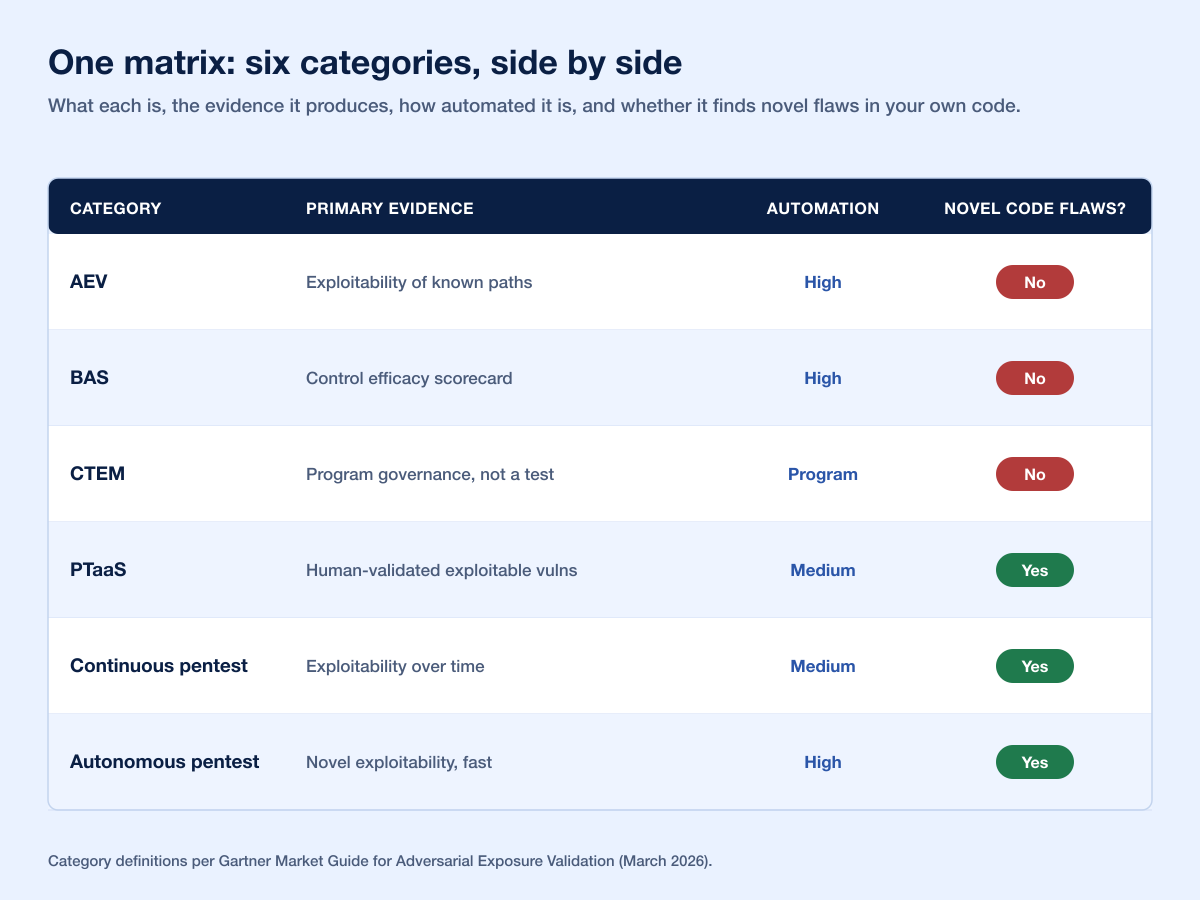
Category | What it is | Primary evidence | Automation | Finds novel code flaws? |
|---|---|---|---|---|
AEV | Gartner umbrella for automated attack-feasibility validation | Is a known exposure exploitable, continuously | High | No, works from known paths |
BAS | Simulates known techniques against your controls | Control efficacy scorecard | High | No, works from a library |
CTEM | Operating model, five-stage program | Program governance, not a test | Not a tool | No, it decides what to test |
PTaaS | Platform-delivered human pentesting | Human-validated exploitable vulns | Medium | Yes |
Continuous pentest | Ongoing hybrid testing cadence | Exploitability over time, regressions | Medium | Yes |
Autonomous pentest | AI agent that finds and proves flaws | Novel exploitability at machine speed | High | Yes, if built for complex classes |
The line down the right column is the one buyers most often miss. AEV, BAS, and CTEM all answer questions about known things: known techniques, known paths, known exposures. The three testing rows answer questions about unknown things living in your own application. That is not a quality gap between the categories. It is a scope difference, and it is why owning one does not retire the other.
What each format actually proves
A category is only as useful as the evidence it hands your board. Three kinds of evidence get conflated under the AEV banner, and they are not interchangeable in an audit, an incident review, or a budget defense.
Control efficacy. The proof that your detection and prevention stack catches known adversary behavior. "Our EDR blocked 82 of 100 simulated techniques; here are the 18 gaps and the tuning that closed them." This is what BAS produces, and it is exactly what a SOC needs to justify tuning and coverage. It says nothing about whether your app has an IDOR.
Exploitability proof against known paths. The proof that a specific known exposure is actually reachable and weaponizable, not just present on a scan. "This exposed service plus this missing patch equals a real path, and here is the automated proof." This is the heart of AEV. It cuts the false-positive noise out of vulnerability management. It still works from paths that are known and mapped.
Novel-vulnerability exploitability. The proof that a flaw unique to your code exists and can be exploited: a broken authorization check that lets user A read user B's records, a business-logic sequence that skips payment, an access-control gap no framework describes. This needs a tester that reasons, human or a purpose-built agent. Neither BAS nor a stock AEV run will surface it.
Objective-based compromise. The proof that an adversary with a goal can reach it end to end, chaining steps and improvising around your defenses. "Starting from a phishing foothold, the team reached the customer database in four days." This is what a threat-led red team produces, and no BAS playbook exercises it, because a playbook is by definition scripted.
If your budget defense, your cyber-insurance questionnaire, or your regulator asks for one of these and you hand over another, the evidence does not land. A control-efficacy scorecard does not prove your application is free of authorization flaws. An automated exposure-feasibility report does not prove a determined adversary cannot reach your crown jewels. Matching the evidence to the question is the entire buying decision.
Which to buy when
Translate the evidence question into a purchase. The table below maps the buyer situation you are actually in to the category that answers it. The chart restates the same mapping for teams who prefer to screenshot it into a slide.
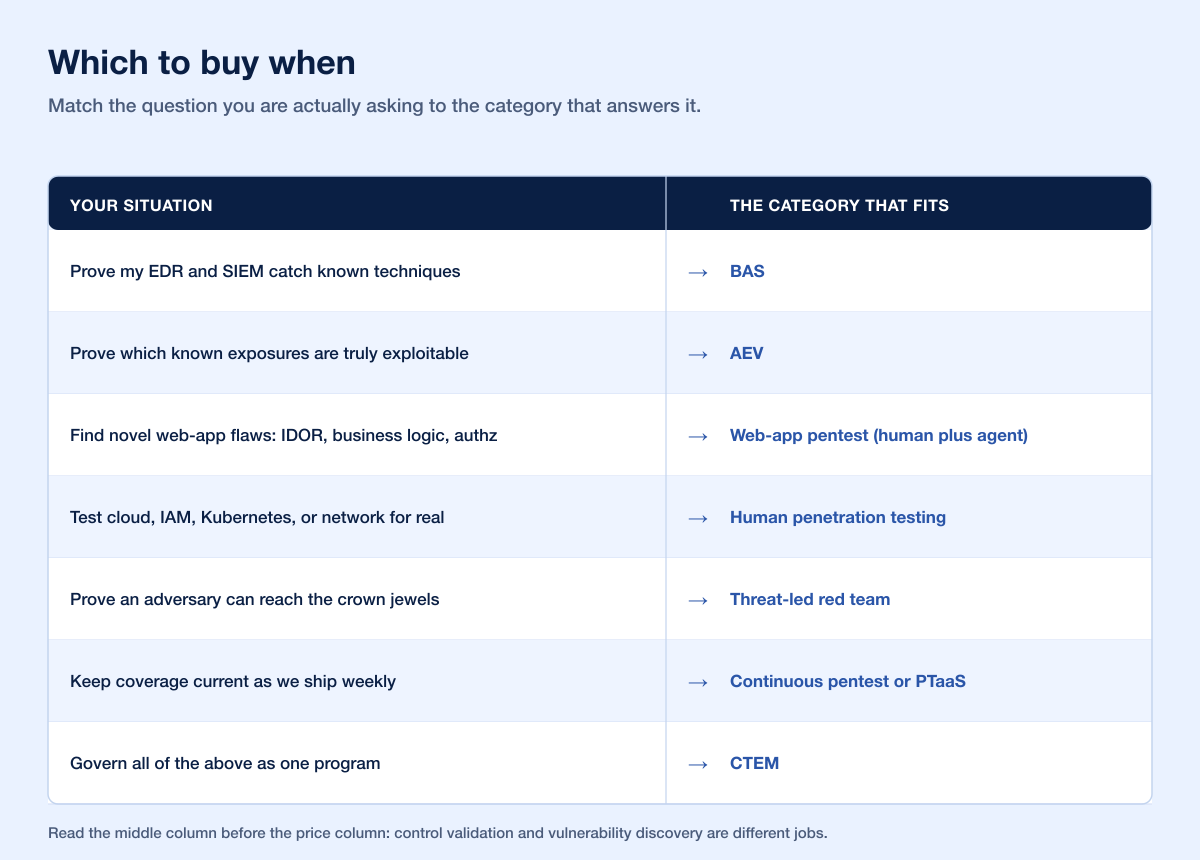
Your situation | The category that fits | Why |
|---|---|---|
"Prove my EDR and SIEM catch known techniques" | BAS | Control-efficacy scorecard against a technique library |
"Cut false positives; prove which known exposures are really exploitable" | AEV | Automated, continuous attack-feasibility evidence |
"Find the novel flaws in my web app: IDOR, business logic, broken authorization" | Web-app pentest, human plus autonomous agent | These flaws have no signature; they need reasoning |
"Test my cloud, IAM, Kubernetes, or network for real" | Human penetration testing | Complex, context-heavy scope humans own |
"Prove an adversary can or cannot reach the crown jewels" | Threat-led red team | Objective-based, chained, unscripted compromise |
"Keep coverage current as we ship weekly" | Continuous pentesting or PTaaS | Ongoing cadence, catches regressions |
"Govern all of the above as one program" | CTEM | The operating model that consumes the rest |
Two situations get miscoded most often. Teams that want to find flaws in their own application buy a BAS platform, run it, and are surprised it never reports the authorization bug that later shows up in a breach: they bought control validation when they needed vulnerability discovery. And teams that already run BAS assume they can cancel the red team, then discover the red team was proving something BAS never touched. Read the middle column before the price column.
Where AEV and BAS stop, and where a service picks up
Here is the honest boundary, stated plainly because every vendor blurs it in their own favor. AEV and BAS tooling validate whether your known controls and mapped attack paths hold. They run from libraries of known techniques and known paths, at machine speed, continuously, and they are genuinely good at it. That is a capability worth owning. It is also, by construction, blind to the flaws that are unique to your code, because a flaw unique to your code is not in anyone's library.
Those unique flaws are where breaches actually start: a broken object-level authorization check, a business-logic sequence that can be abused, an access-control gap. Finding them takes a tester that reasons about intent rather than matching a signature. That is the job of a penetration testing service, and increasingly of a purpose-built autonomous agent. Stingrai's autonomous web-application agent, Snipe, is built for exactly these complex classes: IDOR, business logic, and broken authorization, the bugs generic AI scanners miss. Snipe runs both black-box dynamic testing and white-box source review, opens AutoFix pull requests for what it finds, and can sit as a gating check on every pull request so vulnerable code does not merge. It is trained on more than 6,000 HackerOne disclosure reports and on skills distilled from years of senior human-tester methodology, which is why it reaches classes a signature-driven tool cannot. For a broader treatment, see traditional pentesting versus AI pentesting and our field notes on the 24/7 AI attacker.
Not everything is an agent's job, and saying otherwise is dishonest. Cloud and IAM configuration, Kubernetes, network internals, and social engineering are owned by Stingrai's penetration testers, because that scope needs context, judgment, and improvisation: cross-account role assumption and instance metadata abuse in AWS, app registrations, consent grants and Conditional Access gaps in Entra ID, lateral movement and segmentation internally, and phishing and vishing campaigns against people. And the objective-based question, can an adversary reach a specific goal, is answered by a threat-led red team that no BAS playbook exercises. Stingrai holds CREST accreditation at firm level, and this testing produces the kind of exploitability evidence that supports your SOC 2, ISO 27001, PCI DSS, NYDFS 500 and DORA programs, the human-validated proof an automated control scorecard cannot stand in for. The mature answer is to run both budget lines: AEV or BAS to keep known controls honest, and a hybrid service to prove the novel and the objective-based. If you are pricing that combination, the current packages are on the Stingrai pricing page.
What this means for defenders
Audit the label before you shortlist. When a vendor says "AEV," ask which heritage the product comes from, BAS or automated pentesting, and what class of finding it actually returns. The label is a category; the mechanism underneath is what you are buying.
Do not buy control validation to solve a discovery problem. If your goal is to find the flaws in your own application, a BAS or stock AEV run will not get you there. Buy a web-application penetration test, human plus autonomous agent, and reserve BAS for proving your controls catch known behavior.
Keep the red team even after you adopt AEV. BAS and AEV raise the floor by keeping known controls honest. They do not answer the objective-based question. A threat-led red team still earns its budget line.
Put testing on the release cadence, not the calendar. If you ship weekly and test annually, you are unvalidated 51 weeks a year. Continuous testing and PR-gating close that gap; an annual PDF does not.
Slot everything into CTEM's validation stage. Treat AEV, BAS, and pentesting as inputs to one program rather than competing purchases. The program decides what to test and what to fix; the categories supply the evidence.
Frequently Asked Questions
What is adversarial exposure validation, and do I need an AEV tool, a BAS platform, or a penetration testing service?
Adversarial exposure validation is Gartner's 2026 umbrella for automated tooling that proves, continuously, whether a known exposure is actually exploitable and whether your controls stop it (Gartner, March 2026). Buy an AEV or BAS tool when your question is "do my known controls and mapped paths still hold." Buy a penetration testing service, human or an autonomous web-application agent, when your question is "what novel flaws are in my own code." Buy a red team when your question is "can an adversary reach the crown jewels by any path." Most mature programs buy across those lines.
What is the difference between AEV and BAS?
BAS is one of the two segments AEV consolidated. BAS simulates known adversary techniques against your environment and reports which ones your controls caught, so its evidence is a control-efficacy scorecard. AEV is the broader umbrella Gartner defined in March 2026 for automated "evidence of the feasibility of an attack," which includes BAS-style control testing and automated-pentest-style exposure validation (Gartner, March 2026). If you run BAS, you already own an AEV capability.
What is the difference between AEV and PTaaS?
AEV is automated tooling that validates known exposures and controls at machine speed, working from known techniques and paths. PTaaS is a delivery model for human-led penetration testing through a platform, so the testing underneath still hunts unknown, novel flaws in your code with human judgment. AEV proves the known is real; PTaaS discovers the unknown. They are complementary, not substitutes.
Is CTEM a product I can buy?
No. Continuous Threat Exposure Management is an operating model Gartner introduced in 2022, with five stages: scoping, discovery, prioritization, validation, and mobilization (Gartner, How to Manage Cybersecurity Threats, Not Episodes). You run CTEM as a program and plug AEV, BAS, and penetration testing into its validation stage. Any vendor selling "CTEM in a box" is selling one component of the loop, usually the one they build.
Do I need a red team if I have BAS?
Yes. BAS proves your controls detect and block a library of known techniques. A red team proves whether a motivated adversary can achieve a specific objective, chaining novel and improvised steps a playbook never scripted. BAS raises the floor; the red team tests the ceiling. Having BAS makes the red team more efficient, because the obvious control gaps are already closed, but it does not replace the objective-based question.
What is the difference between breach and attack simulation and red teaming?
BAS is automated, continuous, and scripted: it fires a fixed library of known techniques and scores your controls. Red teaming is human-led, goal-oriented, and unscripted: a team picks an objective, like reaching the customer database, and improvises a path there, chaining novel steps and adapting around your defenses. BAS answers "do my controls catch known behavior." Red teaming answers "can someone actually achieve this goal against us."
Does an AEV or BAS tool find IDOR and business-logic flaws?
Generally no. AEV and BAS work from libraries of known techniques and mapped attack paths. Broken object-level authorization (IDOR), business-logic abuse, and broken access control are flaws unique to your application, with no signature to match, so they do not appear in a technique library. Finding them needs a tester that reasons about intent, either a human penetration tester or a purpose-built autonomous agent such as Stingrai's Snipe, which is trained specifically to hunt those classes.
What does each format actually prove?
BAS proves control efficacy, whether your stack catches known behavior. AEV proves exploitability against known paths, whether a specific exposure is really reachable. A penetration testing service, human or autonomous, proves novel-vulnerability exploitability, whether a flaw unique to your code can be exploited. A threat-led red team proves objective-based compromise, whether an adversary can reach a goal end to end. Match the evidence to the question your board, auditor, or insurer is asking.
What did the 2026 Gartner Market Guide for Adversarial Exposure Validation say?
Gartner published the guide on 24 March 2026 and defined AEV as technologies delivering "consistent, continuous, and automated evidence of the feasibility of an attack" (Gartner, March 2026). It consolidated the previously separate breach and attack simulation and automated penetration testing segments into one category, and projected that by 2029, 60% of organizations will run structured exposure validation within a CTEM program and 30% will link AEV results to automated remediation.
How do AEV, BAS, PTaaS, and autonomous pentesting fit into a CTEM program?
They all live in CTEM's validation stage. CTEM's first three stages, scoping, discovery, and prioritization, decide what matters and what to test. Validation is where you prove it: BAS validates control efficacy, AEV validates exposure feasibility, and PTaaS, continuous pentesting, and autonomous pentesting validate novel and objective-based exploitability. Mobilization then drives remediation. The program is the frame; the categories are the evidence engines inside it.
Talk to Stingrai
Scoping a penetration test against what this guide covers takes one short conversation. Stingrai is a global CREST-accredited penetration testing services company founded in Toronto, Canada in 2021, trusted by companies from startups to enterprises to meet audit requirements for SOC 2, ISO 27001, CMMC, PCI DSS and HIPAA. OSCE³, OSWE, OSEP, CREST CRT certified pentesters, who are also world-class security researchers and bug bounty hunters. Choose from fully human-led or hybrid (AI agents plus human penetration testers) engagements across web, API, mobile, AI and LLM, cloud, network, Active Directory and social engineering penetration tests and red team engagements, delivered one-time or continuously through its PTaaS platform, with documented findings, remediation guidance and retesting included. Book a free scoping call, get a quote, or read the published pricing.
References
Gartner. Market Guide for Adversarial Exposure Validation. Document 6255151. Published 24 March 2026. https://www.gartner.com/en/documents/6255151. Defines the AEV category, consolidates breach and attack simulation and automated penetration testing, and projects 2029 adoption of structured exposure validation within CTEM.
Gartner. Adversarial Exposure Validation, Gartner Peer Insights market page. 2026. https://www.gartner.com/reviews/market/adversarial-exposure-validation. Public market definition and buyer reviews for the AEV category.
Gartner. How to Manage Cybersecurity Threats, Not Episodes (Continuous Threat Exposure Management). 2022 to 2023. https://www.gartner.com/en/articles/how-to-manage-cybersecurity-threats-not-episodes. Defines the CTEM operating model, its five stages, and the breach-reduction prediction.
Gartner. Breach and Attack Simulation (BAS) Tools, Gartner Peer Insights. 2024 to 2025. https://www.gartner.com/reviews/market/breach-and-attack-simulation-bas-tools. Definition of BAS as continuous, consistent simulation of the full attack cycle.
Mordor Intelligence. AI-Driven Vulnerability Management and Risk-Based Exposure Prioritization Market Size, Share and 2031 Growth Trends Report. 2026. https://www.mordorintelligence.com/industry-reports/ai-driven-vulnerability-management-and-risk-based-exposure-prioritization-market. Market sizing: US$10.37 billion in 2026, 25.07% CAGR, US$31.74 billion by 2031.
Deciding which of these budget lines your program actually needs is a scoping conversation, not a shopping one. Stingrai runs the testing side of the picture: Snipe for one web application and associated APIs at US$3,000 autonomous or US$6,800 with penetration testers testing alongside it throughout, named CREST CRT and OSCE³-certified penetration testers for cloud, network, Active Directory, mobile, AI and IAM scope, and assumed-breach or threat intelligence-led red teaming for objective-based compromise, all delivered through the PTaaS portal as a one-time engagement or a continuous programme. See the full services overview or book a scoping call to map your questions to the right evidence.