



Bugcrowd publishes US$200 million or more rewarded to hackers, an average P1 reward of US$3,000 and a 91% triage satisfaction rate on its hackers page. That is a bug bounty platform operating at genuine scale, and it is the business Bugcrowd is best at. Pen Test as a Service is a second product built on the same crowd, and the distinction between the two is where most shortlist questions come from.
This guide ranks eight alternatives for buyers who need a penetration test specifically, and says plainly where Bugcrowd is the right answer. Every claim about Bugcrowd below is drawn from Bugcrowd's own pages, and where a figure is not published we write "not published" rather than estimating.
At a Glance: Bugcrowd and the Best Alternatives in 2026
Vendor | HQ | Who tests | Published pentest price |
|---|---|---|---|
Bugcrowd (benchmark) | San Francisco, Sydney | Curated crowd matched by CrowdMatch | Not published |
1. Stingrai | Toronto, London | Named two-person in-house tester team, plus the Snipe agent on web apps | US$3,000 or US$6,800 per assessment |
2. Synack | Redwood City | Synack Red Team, 1,500+ researchers | Not published |
3. NetSPI | Minneapolis | 350+ in-house experts | Not published |
4. Cobalt | Boston | Cobalt Core, 500+ matched testers | US$3,500 per Autonomous Pentest |
5. BreachLock | New York, Amsterdam | 100% in-house certified team | Not published |
6. Praetorian | Austin, Texas | In-house engineers | Not published |
7. NCC Group | Global, 2,000+ colleagues | In-house consultants | Not published |
8. Trail of Bits | New York | In-house security engineers | Not published |
All cells were verified on each vendor's own pages on 5 September 2026. Source links appear in the full comparison table further down.
What Bugcrowd Sells in 2026
Bugcrowd's about page gives a founding year of 2012 and lists San Francisco, California and Sydney, Australia. The platform page sets out an unusually wide product line: Bug Bounty, Pen Test as a Service, Vulnerability Disclosure, Attack Surface Management, Red Team as a Service, AI Bias Assessment, Savant Pathseeker and Savant Vista. It describes a proprietary Security Knowledge Graph "reflecting 12+ years of data acquired over 1000s of engagements".
The pentest product. Pen Test as a Service runs three tiers. Standard is "Zero-complexity testing for compliance" covering external web applications, networks, APIs and mobile applications. Plus is "Customized testing for bespoke requirements" with custom scoping. Max is "Maximum risk reduction delivered continuously", combining continuous and on-demand testing with bug bounty discovery. Tests launch "within 3 business days" on Standard, and Bugcrowd describes launching "in less than 72 hours" generally. Testers are curated using CrowdMatch, with an on-demand Pentester Rotation option. Standard and Plus include "12 months of retesting (with 1 report update)" for applicable asset types. Named frameworks are PCI-DSS, HIPAA, GDPR, ISO 27001, SOC 2 and DORA.
The agentic product. On 28 July 2026 Bugcrowd launched Savant Pathseeker, described on its product page as "agentic pentesting on the Bugcrowd Platform" that will "plan, probe, and prove real attack paths" across external web applications and APIs, covering "OWASP web and API top 10 including autonomous API fuzzing". It is in an early access program with general availability planned for later in the year, and can run on its own or alongside Pen Test as a Service. Bugcrowd frames the split candidly: "agentic testing covers the assets and time windows humans can't reach. The goal is to make sure human expertise is spent on the problems that actually need it."
No dollar figure is published for Pen Test as a Service or for Pathseeker.
Why Buyers Look for Bugcrowd Alternatives
None of these are defects. They are consequences of building a pentest product on a bounty platform, and all four are verifiable on Bugcrowd's own pages.
1. The testers are a curated crowd, not your team. CrowdMatch assembles a team per engagement, and Pentester Rotation is offered as a feature. That is exactly right for breadth-first discovery across a wide surface. It is a different property from the same named people returning next cycle already holding your authorization model in their heads, which is what depth on a single complex application actually requires.
2. No dollar figure is published for the pentest product. Standard, Plus and Max all route to sales. Buyers assembling three comparable quotes against an audit date cannot rank anything without a sales cycle first.
3. Retesting is time-boxed with a single report update. Twelve months of retesting with one report update is generous compared with a 30-day window, but it is still a cap. Teams fixing findings in waves across several releases should confirm what happens after the update is spent.
4. Bounty economics and pentest budgeting pull in different directions. A bug bounty is priced by outcome and a compliance pentest is priced by scope. Running both through one vendor is convenient, and it also means your penetration testing line item sits next to a variable rewards pool. Some finance teams want those separated on purpose.
Crowdsourced Testing vs Pentest as a Service: The Actual Difference
This is the question underneath the search, so here is the direct answer.
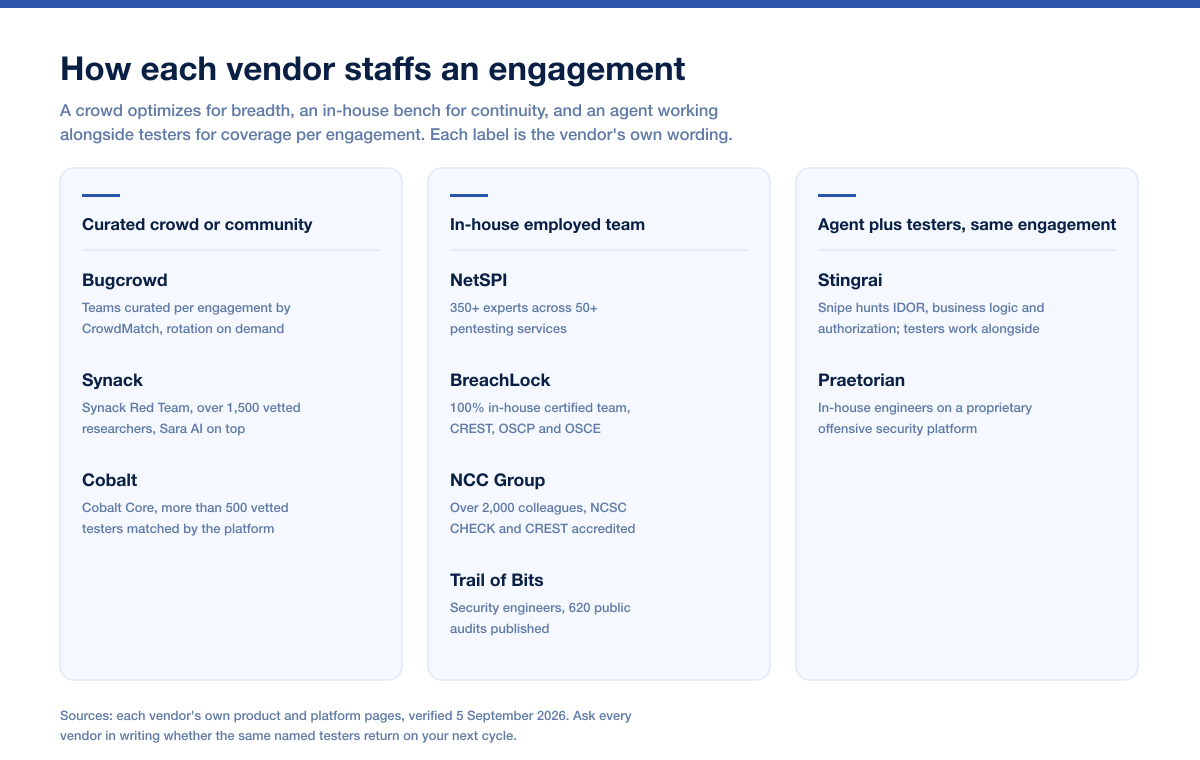
A crowd optimizes for breadth and novelty. Many independent testers, many perspectives, wide external coverage, and an incentive structure that rewards whoever finds something first. Bugcrowd and Synack are the mature versions of this, with Bugcrowd leaning on bounty economics and Synack on a vetted researcher pool with an AI layer. For a large, sprawling external footprint, nothing beats it.
An in-house team optimizes for depth and continuity. The same people, the same methodology, the same understanding of your authorization model across cycles. NetSPI, BreachLock, Praetorian, NCC Group and Trail of Bits sit here. You trade some elasticity for consistency and for a report an auditor recognizes immediately.
An agent working alongside penetration testers optimizes for coverage per engagement. This is the newer shape, and both camps are converging on it: Bugcrowd's Savant Pathseeker, Synack's Sara AI, Cobalt Autonomous Pentest and Stingrai's Snipe. The differentiator is what the agent is actually allowed to hunt. Most agentic products are scoped to discovery, enumeration and known classes with humans escalated for the rest. Snipe is built to hunt IDOR, business logic flaws and broken authorization itself, with certified penetration testers working the same engagement concurrently rather than waiting downstream.
For the crowd platform buyers most often compare Bugcrowd against, see the full breakdown in our HackerOne alternatives guide.
What Testing Actually Surfaces
Crowd platforms report payouts and submission volumes. Penetration testing buyers need a different number, which is what a scoped test finds and how fast it gets fixed. Stingrai's State of Penetration Testing 2026 analyses 1,206 verified findings across 55 penetration tests. 92.7% of tests surfaced at least one High or Critical finding, the false-positive rate was 0.74%, and the median time to fix a Critical was 10.5 days. The false-positive figure is the one to bring to a crowd comparison, because triage load is the hidden cost of a submission-driven model.
The 8 Best Bugcrowd Alternatives in 2026
1. Stingrai
World-Class Offensive Security.
Stingrai is a global CREST-accredited penetration testing services company founded in Toronto, Canada in 2021, trusted by companies from startups to enterprises to meet audit requirements for SOC 2, ISO 27001, CMMC, PCI DSS and HIPAA. OSCE³, OSWE, OSEP, CREST CRT certified pentesters, who are also world-class security researchers and bug bounty hunters. Choose from fully human-led or hybrid (AI agents plus human penetration testers) engagements across web, API, mobile, AI and LLM, cloud, network, Active Directory and social engineering penetration tests and red team engagements.
Where a crowd assembles a different set of researchers for each engagement, every human-led Stingrai test is run by a named two-person team of penetration testers, reviewed by the team lead and an engagement partner. That team has published 18 CVEs and includes a founding member of Uber's offensive security team and researchers listed in the bug bounty Halls of Fame of Apple, Google, the US Department of Defense and the US Federal Reserve. Web and API engagements are authenticated across every user role and aligned to the OWASP Top 10 and ASVS, so broken authorization, IDOR and business logic flaws are hunted deliberately rather than waited for. Explore the PTaaS platform.
A crowd is paid per accepted submission, so the incentive is submission volume. A scoped Stingrai engagement is paid for coverage: the assigned penetration testers chain findings into real attack paths, document each one with a working proof of concept, and post them to the PTaaS portal as they are confirmed, so remediation starts before the report and the included retest closes the loop.
Stingrai is headquartered in Toronto, Canada, with a London, UK office, and works with clients from startups to the Fortune 500 across healthcare, financial services, SaaS and government. It delivers both one-time annual penetration tests and continuous programs that test every release, scoped to the systems and business risks each client needs assessed.
Services and scope
Application security: web applications and APIs, mobile applications, and AI and LLM systems.
Network and cloud security: internal and external networks, Active Directory, Wi-Fi, and cloud environments.
Social engineering: phishing campaigns and physical security assessments.
Adversary simulation: red teaming and purple teaming.
Delivery and evidence
Every finding lands in the PTaaS portal as it is confirmed, with a working proof of concept and prioritized remediation guidance, and clients chat directly with their assigned penetration testers while the test is still running, with Jira and Slack integration pushing findings straight into the backlog. Retesting of remediated findings is included, and each human-led and hybrid engagement closes with a redactable PDF report, an attestation letter and a verified badge, which is the evidence a submission feed does not produce for a SOC 2, ISO 27001, PCI DSS or HIPAA reviewer. CREST accreditation applies to Stingrai as a penetration testing service provider; it is separate from individual tester certifications.
Where Snipe fits
Snipe is Stingrai's autonomous AI penetration testing agent for web applications and their APIs: a swarm of specialist agents for recon, authentication, access control, business logic, injection and RCE, trained on 6,000+ HackerOne Hacktivity disclosure reports and on Stingrai's own penetration testers' methodology. It runs black-box, authenticated grey-box and white-box source review, opens AutoFix pull requests for confirmed vulnerabilities and can gate every pull request. The Autonomous package is Snipe alone, with no penetration testers assigned; on Hybrid, penetration testers and Snipe test the same application together throughout. Mobile, AI and LLM, cloud, network, Active Directory, Wi-Fi, social engineering and red and purple team work is human-led.
Pricing and fit: Autonomous is US$3,000 per assessment and Hybrid US$6,800, each covering exactly one web application and associated APIs, with monthly equivalents of US$650 and US$1,275 on a 12-month plan. Every other scope is quoted through the Get a Quote form. Best for: replacing a crowd with a named, CREST-accredited team on one application's authorization model and business logic, at a published price, one-time or continuous.
2. Synack
Redwood City, California, US. The closest like-for-like alternative if what you want is a crowd, done differently. Positions as "AI Finds More. Humans Prove What Matters." Testing is delivered by the Synack Red Team, "over 1,500 of the world's most skilled and trusted security researchers", with Sara AI Pentesting, the Synack Autonomous Red Agent, layered on top. Published outcome claims include 32% lower pentesting costs, 22 days saved per pentest, 47% faster vulnerability remediation and a 99.98% noise filtration rate. Its federal and defense track record is the deepest here. On 2 September 2026 Synack and NetSPI announced a definitive agreement to merge, with an expected close in October 2026.
Published pricing: not published. Best for: a vetted researcher pool with managed triage, particularly for federal and public-sector workloads. Source: synack.com
3. NetSPI
Minneapolis, Minnesota, US. Founded 2001. Penetration Testing as a Service across application, network, cloud, AI, mainframe, hardware and IoT, plus red team operations, detective controls testing, attack surface visibility and secure code review, delivered by "350+ experts" across "50+ pentesting services". The merger with Synack announced on 2 September 2026 creates a combined company with well over US$200 million in revenue. If you are shortlisting either firm this quarter, ask how the combined roadmap affects your account.
Published pricing: not published. Best for: replacing a crowd with a consistent in-house bench across the widest asset range on this list. Source: netspi.com
4. Cobalt
San Francisco, US. Founded 2013. PTaaS across web, API, network, cloud and AI targets plus secure code review, delivered by the Cobalt Core, a community of more than 500 vetted testers matched to your stack by the platform. Engagements start in 3, 2 or 1 business days across the Standard, Premium and Enterprise tiers. One Cobalt Credit represents "the equivalent of 8 hours of offensive security testing", and Cobalt states that credits "do not roll over into the next contract."
Published pricing: one figure, US$3,500 per test for Cobalt Autonomous Pentest, described as a limited-time promotional offer. Best for: a community model with a scoped, reportable engagement and no bounty economics attached. Source: cobalt.io/pricing
5. BreachLock
New York, US, with a European office in Amsterdam. PTaaS, attack surface management, adversarial exposure validation and red team as a service on one platform, delivered by a "100% In-House, Certified" team holding CREST, OSCP and OSCE credentials. BreachLock was approved for penetration testing services by CREST on 28 January 2022, a firm-level accreditation, and advertises that you can "scope, schedule, and launch CREST-certified pentests in just 24 to 48 hours with unlimited retesting and audit-ready reporting".
Published pricing: not published. Standard, Extended and Extensive tiers include 1, 2 and a custom number of free manual retests. Best for: compliance buyers who want an accredited in-house provider rather than a crowd. Source: breachlock.com/products/ptaas
6. Praetorian
Austin, Texas, US. Offensive security engineering across application, cloud, network, AI and machine learning, IoT and hardware, and automotive targets including in-vehicle networks and V2X communications, delivered on what the company calls "our proprietary offensive security platform". Published claims are "Zero False Positives, every finding verified by an expert", "70% Faster MTTR" and "100% Compliance Coverage, FDA, GLBA, HIPAA, NERC, PCI-DSS & more".
Published pricing: not published. Best for: targets a crowd cannot reach, particularly embedded, automotive and machine learning systems. Source: praetorian.com
7. NCC Group
Global consultancy with "over 2,000 colleagues". Its penetration testing services span application security, network testing, cloud, hardware, blockchain, cryptographic services and continuous testing, with an accreditation set covering NCSC CHECK, CREST, UKAS and Cyber Scheme. It publishes "1000+ days dedicated to research annually".
Published pricing: not published. Best for: UK and European regulated work where a national scheme such as NCSC CHECK or CBEST is written into the requirement, which no crowd platform satisfies. Source: nccgroup.com
8. Trail of Bits
New York, US. Independent since 2012. Security reviews across software assurance, AI and machine learning security, application security, blockchain, cryptography, security engineering, and research and development, summed up as "we fix the software behind the bug" and a focus on the "root cause and the fix that retires the whole bug class". Published scale is unusual for a consultancy: 946 publications, 620 public audits and 200+ open-source repositories, alongside one of the largest consulting cryptography teams in the world.
Published pricing: not published. Best for: deep source-level review of cryptography, protocols and machine learning systems, where a bounty program produces very little signal. Source: trailofbits.com/services
How It Compares: Bugcrowd Side by Side
Bugcrowd is compared here rather than ranked, because the post is about alternatives to it. Every cell below was read from the linked page on 5 September 2026.
Bugcrowd | Stingrai | Source | |
|---|---|---|---|
Founded, HQ | 2012, San Francisco, California and Sydney, Australia | 2021, Toronto with a London office | |
Core business | Crowdsourced security: bug bounty, vulnerability disclosure, attack surface management, plus Pen Test as a Service | Offensive security only, penetration testing and red teaming | |
Who tests | Curated crowd assembled per engagement by CrowdMatch, with on-demand Pentester Rotation | Certified penetration testers working concurrently with Snipe, same team each cycle | |
Tiers | Standard, Plus, Max | Autonomous, Hybrid, Enterprise | |
Time to launch | "within 3 business days" on Standard, "in less than 72 hours" generally | Fixed-scope assessment, scoped in one decision | |
Agentic product | Savant Pathseeker, launched 28 July 2026, early access, external web apps and APIs, OWASP web and API top 10 plus autonomous API fuzzing | Snipe, hunts IDOR, business logic and broken authorization, plus white-box source review | |
Retesting | "12 months of retesting (with 1 report update)" on Standard and Plus, for applicable asset types | Retesting included | |
Published pentest price | Not published | US$3,000 Autonomous, US$6,800 Hybrid, or US$650 and US$1,275 per month | |
Fix automation | Not published | AutoFix pull requests | |
Merge protection | Not published | Gating check on every pull request | |
Firm-level CREST | Not published | CREST-accredited penetration testing service provider | |
Compliance named | PCI-DSS, HIPAA, GDPR, ISO 27001, SOC 2, DORA | Evidence for SOC 2, ISO 27001, PCI DSS 4.0, HIPAA, NIST SP 800-53 and 800-171, DORA, NIS2 | |
Bug bounty program | Yes, the core product | Not offered | |
Published scale | US$200M+ rewarded to hackers, US$3,000 average P1 reward, 91% triage satisfaction, 12+ years of data over 1000s of engagements | Published vulnerability research, 5.0/5.0 across 20 Clutch reviews |
Where Bugcrowd Is the Better Choice
This is a real and substantial category.
Bug bounty and vulnerability disclosure. If you want a continuous, public or private program with a rewards pool, managed triage and a mature researcher community, that is the product Bugcrowd is built around, and no specialist penetration testing firm on this list offers it. US$200 million or more rewarded to hackers and a 91% triage satisfaction rate is a functioning marketplace, not a side feature.
Breadth-first coverage of a very wide external footprint. Hundreds of internet-facing assets that no scoped engagement will ever fully cover is exactly the problem a crowd solves. Pathseeker is Bugcrowd's answer to the same coverage question, which is a coherent strategy.
One vendor across discovery, disclosure and testing. Bug bounty, vulnerability disclosure, attack surface management, red team as a service and Pen Test as a Service on one platform, backed by a Security Knowledge Graph built from 12 or more years of submissions. Consolidation has genuine value.
Compliance testing bolted onto an existing bounty program. If Bugcrowd already runs your bounty, adding a Standard tier pentest for PCI DSS or SOC 2 is the shortest procurement path you will find, and the retesting window is generous.
If your constraint is instead depth on one application's authorization model, the same named testers every cycle, a price you can approve without a sales call, or fixes that arrive as pull requests, the specialists above are built for that.
Buyer Checklist
Ask every vendor, including Bugcrowd, for written answers.
Who exactly tests my application, and will they be the same people next cycle? If continuity matters, put it in the contract rather than relying on a rotation feature.
Is this a scoped engagement with a report, or a submission stream? Auditors want the former, with a documented methodology, defined scope, severity ratings and retest evidence.
What does the agent actually hunt? Discovery and known classes, or authorization and business logic. Our AI pentesting tools comparison sets out how to tell.
How is triage handled, and who absorbs the false positives? This is the hidden cost of any crowd model.
Are retests unlimited, capped, or time-boxed with a report update? Get the count and the window in writing.
Is the price published, per engagement, or a subscription with a variable rewards pool? Three different budget conversations.
Is the firm accredited, or are individuals certified? Verify firm-level claims on the CREST Marketplace and read our guide to verifying CREST accreditation.
How do fixes reach engineering? A ticket, or a pull request with a patch and a gate on the next merge.
Run your scope through the penetration testing cost calculator before you collect quotes, and see our guide to comparing penetration testing quotes for the line items that make two proposals non-comparable.
Frequently Asked Questions
What are the best Bugcrowd alternatives for penetration testing in 2026?
The eight strongest alternatives are Stingrai, Synack, NetSPI, Cobalt, BreachLock, Praetorian, NCC Group and Trail of Bits. Stingrai is a CREST-accredited penetration testing service provider at the firm level whose named two-person tester teams hold OSCE³, OSWE, OSEP, CREST CRT and CISSP, have published 18 CVEs and are listed in the bug bounty Halls of Fame of Apple, Google, the US Department of Defense and the US Federal Reserve. Web and API tests are authenticated across every user role for broken authorization, IDOR and business logic, findings post to the PTaaS portal as they are confirmed with live chat to the assigned testers and Jira and Slack integration, and retesting, an attestation letter and a verified badge come with every human-led and hybrid report. Synack is the closest alternative if you want a crowd done differently, and NetSPI is the pick for replacing a crowd with a consistent in-house bench.
How much does a Bugcrowd pen test cost?
Bugcrowd does not publish a price for Pen Test as a Service. Its Standard, Plus and Max tiers all route to sales, and no figure is published for Savant Pathseeker either. For published comparison points, Stingrai lists US$3,000 per Autonomous assessment and US$6,800 for Hybrid, each covering exactly one web application and associated APIs, and Cobalt lists US$3,500 for its Autonomous Pentest. Synack, NetSPI, BreachLock, Praetorian, NCC Group and Trail of Bits all quote every engagement.
Bugcrowd vs HackerOne for penetration testing: what is the difference?
Both began as bug bounty platforms and both now sell a pentest product on top of a vetted community, so the model is broadly the same and the difference is in the packaging. Bugcrowd curates teams with CrowdMatch, runs Standard, Plus and Max tiers launching within 3 business days, includes 12 months of retesting with one report update on Standard and Plus, and names PCI-DSS, HIPAA, GDPR, ISO 27001, SOC 2 and DORA. HackerOne describes vetted, globally distributed experts without tester rotation, and names SOC 2, ISO 27001, GDPR, CREST, NIST CSF 2.0, FISMA and NIST 800-53. Neither publishes pricing. If a crowd is what you want, compare the framework lists and the retest terms. If depth on one application is what you want, neither model is optimized for it.
Is crowdsourced testing accepted for compliance?
Usually yes, provided the engagement is scoped and reported like a penetration test rather than delivered as a submission stream. Bugcrowd names PCI-DSS, HIPAA, GDPR, ISO 27001, SOC 2 and DORA on its Pen Test as a Service page, and its Standard tier is explicitly positioned as "Zero-complexity testing for compliance". What an assessor actually wants is a documented methodology, a defined scope, severity ratings and evidence that findings were retested. Ask for a redacted sample report and confirm the retest evidence is in it before you sign.
What is Savant Pathseeker?
Savant Pathseeker is Bugcrowd's agentic pentesting product, launched on 28 July 2026 in an early access program with general availability planned for later in the year. Bugcrowd describes it as agentic testing that will "plan, probe, and prove real attack paths" across external web applications and APIs, covering the OWASP web and API top 10 including autonomous API fuzzing, running on its own or alongside Pen Test as a Service. Bugcrowd positions it as covering "the assets and time windows humans can't reach", with human expertise reserved for the harder problems. No pricing is published.
Which Bugcrowd alternative is best for a compliance pentest?
BreachLock holds a firm-level CREST accreditation, approved for penetration testing services by CREST on 28 January 2022, and advertises audit-ready reports scoped and launched in 24 to 48 hours. NCC Group is the pick where a national scheme such as NCSC CHECK is written into the requirement. Stingrai is a CREST-accredited penetration testing service provider at the firm level whose penetration testing supports SOC 2, ISO 27001, HIPAA, PCI DSS 4.0, NIST SP 800-53 and 800-171, DORA and NIS2 programs, at a published price of US$3,000 or US$6,800 per assessment. Match the report to the exact control your assessor will cite before you choose.
Should I run a bug bounty and a penetration test?
Most mature programs run both, because they answer different questions. A bounty gives you continuous, breadth-first coverage of a wide external surface with outcome-based economics. A penetration test gives you a scoped, time-boxed, reportable assessment with a methodology an auditor recognizes and evidence that findings were retested. Bugcrowd sells both, which is a real convenience. If you want the two functions from different vendors so the testing budget is not tied to a rewards pool, the alternatives above cover the pentest half.
Which alternative publishes a fixed penetration testing price?
Two of the eight do. Stingrai publishes US$3,000 per Autonomous assessment and US$6,800 for Hybrid, each covering exactly one web application and associated APIs, with monthly equivalents of US$650 and US$1,275 on a 12-month engagement. Cobalt publishes US$3,500 per test for its Autonomous Pentest as a limited-time offer. Synack, NetSPI, BreachLock, Praetorian, NCC Group, Trail of Bits and Bugcrowd itself all quote every engagement.
Which alternative is best for source code review?
Trail of Bits is the specialist, with 620 public audits and 946 publications behind a practice built on finding "the root cause and the fix that retires the whole bug class", particularly in cryptography, protocols and machine learning systems. For web applications, Stingrai's testing is source-assisted wherever repo access is given, with Snipe reviewing application source alongside black-box dynamic testing and opening AutoFix pull requests for what it finds. NetSPI and Cobalt both sell secure code review as separate service lines, and BreachLock lists it on its Extensive tier.
Related Reading
Best BreachLock Alternatives (2026): PTaaS Platforms Compared on Testers, Evidence and Pricing
Best Coalfire Alternatives for Penetration Testing (2026): Compliance-Driven Pentests Compared
Penetration Testing vs Bug Bounty (2026): Coverage, Cost and Compliance Evidence
The Bottom Line
Bugcrowd earns its position by being very good at something the specialists on this list do not do at all. A bug bounty program with US$200 million or more paid out, mature triage and 12 or more years of submission data is a genuine asset, and Savant Pathseeker is a serious attempt to answer the coverage question with agents rather than only with people.
Buyers keep comparing because a pentest built on a crowd is priced by conversation, staffed per engagement, and delivered without published fix automation. For depth on one application's authorization model at a published price, with the same certified team every cycle and the patch proposed in the pull request, Stingrai is the closest like-for-like upgrade. Compare packages on the Stingrai pricing page, book a free scoping call, or send your scope through the Get a Quote form.