
Our penetration testers assess your iOS and Android applications the way real adversaries do: reverse engineering the binary, instrumenting the app at runtime, attempting to bypass SSL pinning and jailbreak or root detection, and testing the backend API the app relies on. Our methodology is aligned to OWASP MASVS and MASTG and delivered through our PTaaS platform.
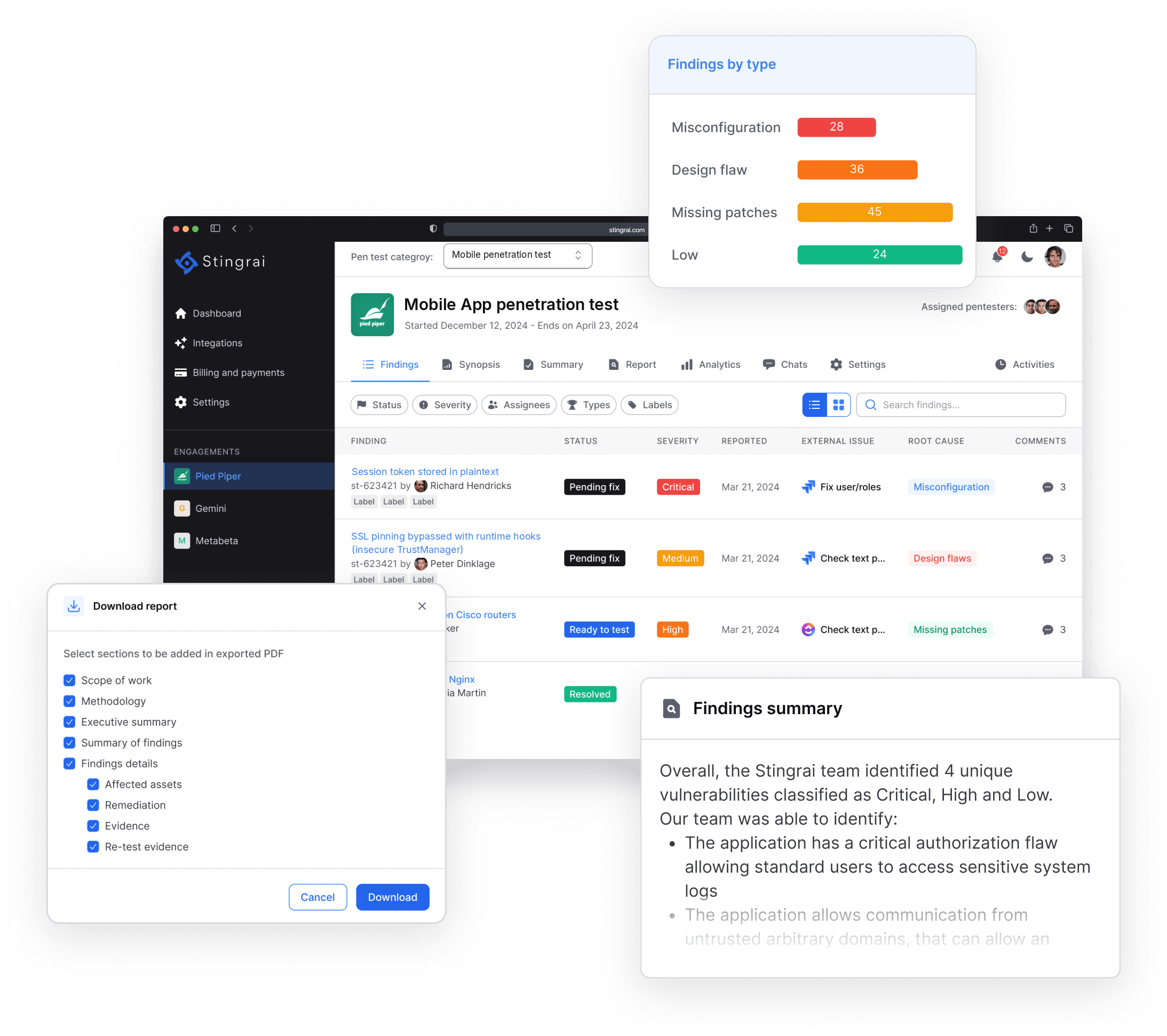


Mobile applications run on devices you do not control. Every IPA and APK you release can be downloaded, decompiled, instrumented and replayed against your backend. Mobile application penetration testing identifies the weaknesses that expose your users and your API before they are exploited by an attacker in control of the device.
Our team tests the iOS binary, the Android binary and the backend API as a single engagement, and delivers a detailed report with a reproducible proof of concept, a severity rating and clear remediation guidance for each finding.
By completing this assessment, you significantly reduce your risk of:

Session tokens, credentials and personal data leaking from local storage, logs or backups
Hardcoded API keys and secrets extracted from the shipped binary
SSL pinning and jailbreak or root detection being bypassed to tamper with traffic
Broken authorization (IDOR) and business logic abuse on the backend API
Exported components, deep links and WebViews abused by malicious applications on the same device

iOS Application Testing
Static and dynamic analysis of the IPA: Keychain and local data storage, App Transport Security and certificate pinning, jailbreak detection, Swift and Objective-C runtime instrumentation with Frida and objection, URL schemes, universal links, WebViews and third-party SDK behavior.

Android Application Testing
Decompilation and instrumentation of the APK: Keystore and shared preferences, network security configuration and pinning, root detection and anti-tamper controls, exported activities, services, content providers and broadcast receivers, deep links, WebViews and intent handling.

Backend API Testing
The REST or GraphQL API behind the application, where the highest-impact vulnerabilities are typically found: authentication and session management, broken object and function level authorization (IDOR), business logic abuse, rate limiting and input validation across every user role.



Static and Binary Analysis

Reverse engineering of the IPA and APK to recover application logic, secrets and hardcoded endpoints.
MASVS-STORAGE and MASVS-CRYPTO checks: data at rest, Keychain and Keystore usage, weak or misused cryptography.
MASVS-CODE and MASVS-PLATFORM checks: build hardening, vulnerable SDKs, exported components and inter-process communication.

Dynamic and Runtime Analysis
Instrumentation with Frida and objection on jailbroken and rooted devices to observe and modify the application while it runs.
MASVS-NETWORK and MASVS-AUTH checks: transport security, session management, biometric and local authentication bypass.
Traffic interception and replay against the backend API, including authorization and business logic abuse.

Resilience and Bypass Resistance
SSL pinning bypass attempts using runtime instrumentation, repackaging and trust store manipulation.
MASVS-RESILIENCE checks: jailbreak and root detection, anti-debugging, anti-tamper and emulator detection bypass attempts.
MASVS-PRIVACY review of the data the application collects, shares with SDKs and exposes to the platform.
A detailed report with an executive summary, a MASVS coverage matrix showing what was tested on each platform, every finding documented with a reproducible proof of concept, CVSS severity and business impact, and step-by-step remediation guidance for your mobile and backend teams. Findings appear in the Stingrai PTaaS portal as they are discovered, with Jira and GitHub integration, live chat with your pentesters, a complimentary retest once fixes are deployed and free on-call remediation support. Available as a one-time assessment or as a continuous testing program that covers every release.

Human Experts and Snipe, Working Together
Our penetration testers reverse engineer and instrument your iOS and Android binaries while Snipe, Stingrai's autonomous AI pentesting agent for web applications and APIs, hunts for IDOR, broken authorization and business logic flaws in the backend API. Both work at the same time throughout the engagement, with our testers directing Snipe's focus and extending the attack paths it surfaces.
CREST-Accredited Provider
Stingrai is a CREST-accredited penetration testing service provider. Our testers hold OSCP, OSWE, OSEP, OSCE3 and CREST CRT certifications, have published original vulnerability research and present research at DEFCON and BSIDES.
Published Mobile Research
Our team publishes its own mobile security research, including a complete SSL pinning bypass walkthrough, so you can review the depth of our testing before you engage us.
One-Time or Continuous
Commission a one-time mobile penetration test for an audit, a launch or a major release, or enroll your application in a continuous testing program that covers every significant build. Both models are available, and many clients begin with a one-time assessment and move to a continuous program.
Expert Remediation Support
Stingrai offers detailed remediation steps along with free on-call support, ensuring our clients receive expert guidance to efficiently fix vulnerabilities and strengthen their security.
Accessible to All
We believe advanced security should be accessible to all. That’s why Stingrai offers competitive pricing without compromising on quality. Protect your organization with top-tier mobile security testing tailored to your budget.


Stingrai uncovered vulnerabilities our vulnerability program had missed and helped us harden critical systems with practical guidance. We were impressed with their personalized, transparent approach and delivery against our timelines.
— Manager, IT, 30 Forensic Engineering

The team spent time and effort to understand the business cases and uncover vulnerabilities unique to our business. Testing was completed within the promised timeline and within the budget which is very competitive compared to the market.
— CTO, NetNow Financial Inc.
Buyer's guide: Best mobile app penetration testing companies (2026)
Our mobile penetration tests cover the binary, the runtime and the backend API in a single engagement, aligned to OWASP MASVS and MASTG. Every finding includes a working proof of concept, remediation guidance and a complimentary retest, delivered as a one-time assessment or a continuous program.