
Adversarial testing for applications built on large language models: chatbots, copilots, RAG pipelines and autonomous agents that call tools and take actions. We test the application, the model, the tool integrations and the data layer, aligned to the OWASP Top 10 for LLM Applications, the OWASP Agentic Top 10 and MITRE ATLAS, and delivered through our PTaaS platform.
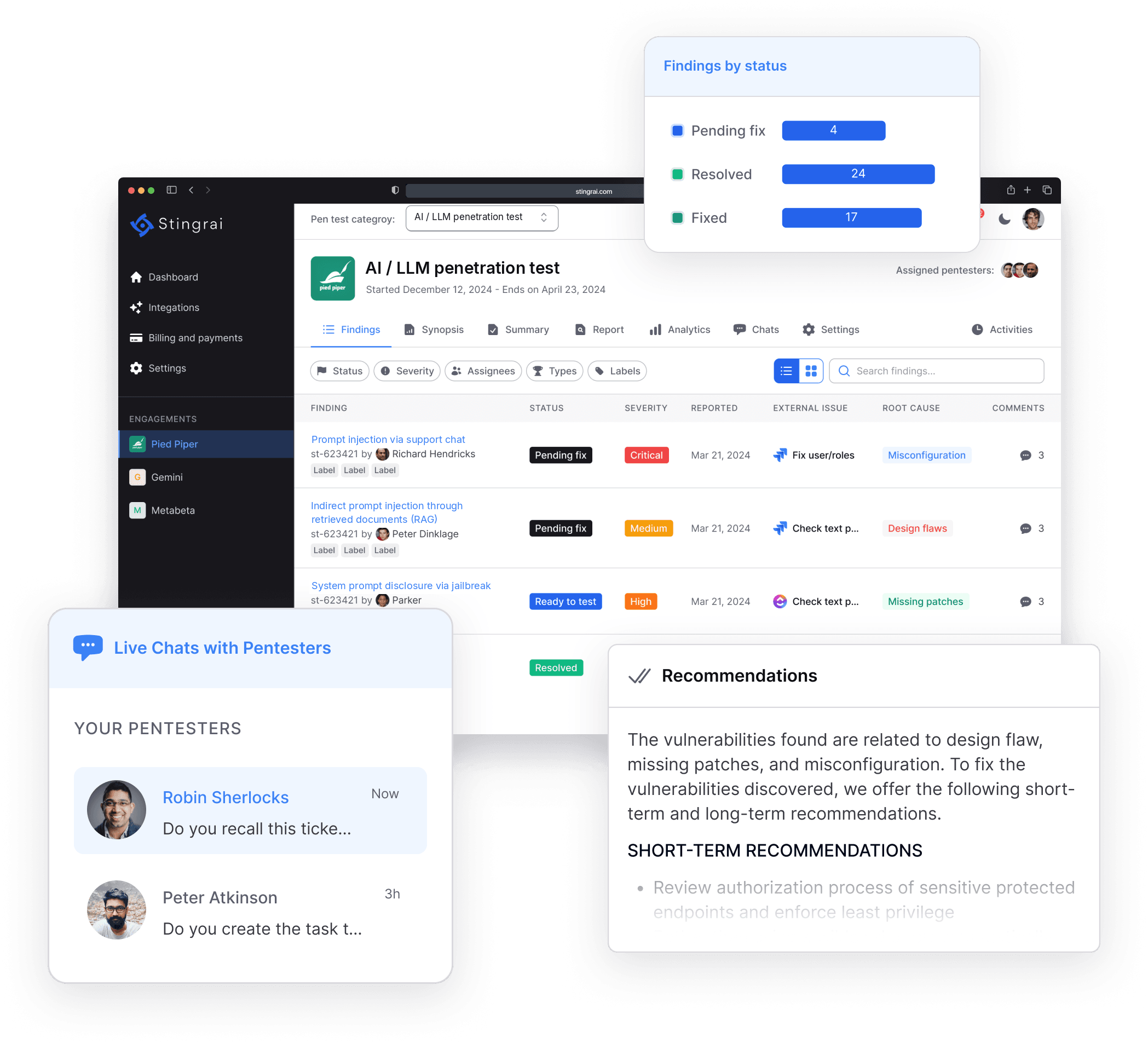


A large language model turns untrusted text into decisions and actions. Automated scanners cannot determine whether your support assistant can be manipulated into disclosing another customer's data, whether an instruction embedded in an email can cause your agent to perform an unauthorized transaction, or whether your system prompt and retrieval corpus can be extracted through repeated queries. AI penetration testing answers those questions with working exploits before they are discovered by an attacker.
Our team maps the complete attack surface of your AI feature, from the web application and API through the model and its tools to the data it retrieves, and delivers a detailed report with reproducible prompts and requests, severity ratings and remediation guidance for your engineering and AI teams.
By completing this assessment, you significantly reduce your risk of:

Direct and indirect prompt injection that overrides your instructions
Sensitive data and system prompt disclosure through the model
Excessive agency: agents executing actions the user was never authorized to take
Tool, plugin and MCP integrations abused to reach internal systems
Poisoned RAG corpora, memory and training data shaping model behavior

LLM-Powered Applications
Customer-facing chatbots, internal copilots and RAG-based assistants. We test the application and API wrapping the model alongside the model itself: prompt injection, jailbreaks, system prompt leakage, insecure output handling, sensitive information disclosure and cross-user data access through retrieval.

AI Agents and Tool Integrations
Agentic workflows that call functions, APIs, MCP servers and other agents. We test tool misuse, excessive agency, privilege escalation through tool chains, memory and goal manipulation, and whether an injected instruction in retrieved content can be turned into a real action.

AI Infrastructure and Model APIs
Inference endpoints, model gateways, vector databases and hosted platforms such as AWS Bedrock, Azure OpenAI and Google Vertex AI. We test authentication and authorization on model APIs, rate limiting and cost abuse, tenant isolation, secrets handling and the IAM paths around your AI stack.



Model and Prompt Layer

Direct and indirect prompt injection (OWASP LLM01) through user input, documents, web pages, emails and retrieved content.
Jailbreaks and guardrail bypass, system prompt leakage and sensitive information disclosure.
Insecure output handling: model output reaching browsers, shells, SQL and downstream APIs without sanitization.
Unbounded consumption, resource exhaustion and cost abuse of model APIs.

Agent, Tool and Data Layer
Tool and function-calling abuse, excessive agency and privilege escalation through tool chains and MCP servers.
Memory and goal manipulation, multi-agent trust abuse and approval step bypass.
RAG and vector database poisoning, embedding and retrieval attacks, cross-tenant data exposure.
Supply chain review of models, adapters, datasets and third-party plugins, mapped to MITRE ATLAS techniques.
A detailed report with an executive summary for leadership, every finding documented with the exact prompts, payloads and requests needed to reproduce it, severity and business impact ratings, and remediation guidance covering prompt design, guardrails, tool permissions, output handling and architecture. Findings appear in the Stingrai PTaaS portal as they are discovered, with Jira and GitHub integration, live chat with your pentesters and a complimentary retest once fixes are deployed. The report gives your AI governance program testing evidence it can use under the EU AI Act Article 15, the NIST AI RMF and ISO/IEC 42001, alongside your SOC 2 and ISO 27001 programs. Available as a one-time assessment or as a continuous program that retests every model, prompt or tool change.

Human Experts and Snipe, Working Together
Snipe, Stingrai's autonomous AI pentesting agent for web applications and APIs, tests the application and API layer wrapping your model while our penetration testers test the prompt, model, agent, tool and data layers. Both work at the same time throughout the engagement, with our testers directing Snipe's focus and extending the attack paths it surfaces.
CREST-Accredited Provider
Stingrai is a CREST-accredited penetration testing service provider. Our testers hold OSCP, OSWE, OSEP, OSCE3 and CREST CRT certifications, have published original vulnerability research and present research at DEFCON and BSIDES.
Research-Led AI Security Practice
Our team publishes ongoing analysis of AI attack surfaces, agentic red teaming and real-world AI security incidents, and tests against the techniques adversaries are using today rather than a static checklist.
One-Time or Continuous
Commission a one-time AI penetration test ahead of a launch, a model upgrade or a governance review, or enroll your AI features in a continuous program that retests every significant change. Both models are available, and many clients begin with a one-time assessment and move to a continuous program.
Expert Remediation Support
Stingrai offers detailed remediation steps along with free on-call support, ensuring our clients receive expert guidance to efficiently fix vulnerabilities and strengthen their security.
Accessible to All
We believe advanced security should be accessible to all. That’s why Stingrai offers competitive pricing without compromising on quality. Protect your organization with top-tier AI security testing tailored to your budget.


Stingrai uncovered vulnerabilities our vulnerability program had missed and helped us harden critical systems with practical guidance. We were impressed with their personalized, transparent approach and delivery against our timelines.
— Manager, IT, 30 Forensic Engineering

The team spent time and effort to understand the business cases and uncover vulnerabilities unique to our business. Testing was completed within the promised timeline and within the budget which is very competitive compared to the market.
— CTO, NetNow Financial Inc.
Buyer's guide: AI red teaming for LLM and agentic apps (2026)
Our AI and LLM penetration tests cover the application, model, tool and data layers with working exploits rather than scanner output, aligned to the OWASP LLM Top 10, the OWASP Agentic Top 10 and MITRE ATLAS. Every finding includes reproducible prompts, remediation guidance and a complimentary retest, delivered as a one-time assessment or a continuous program.