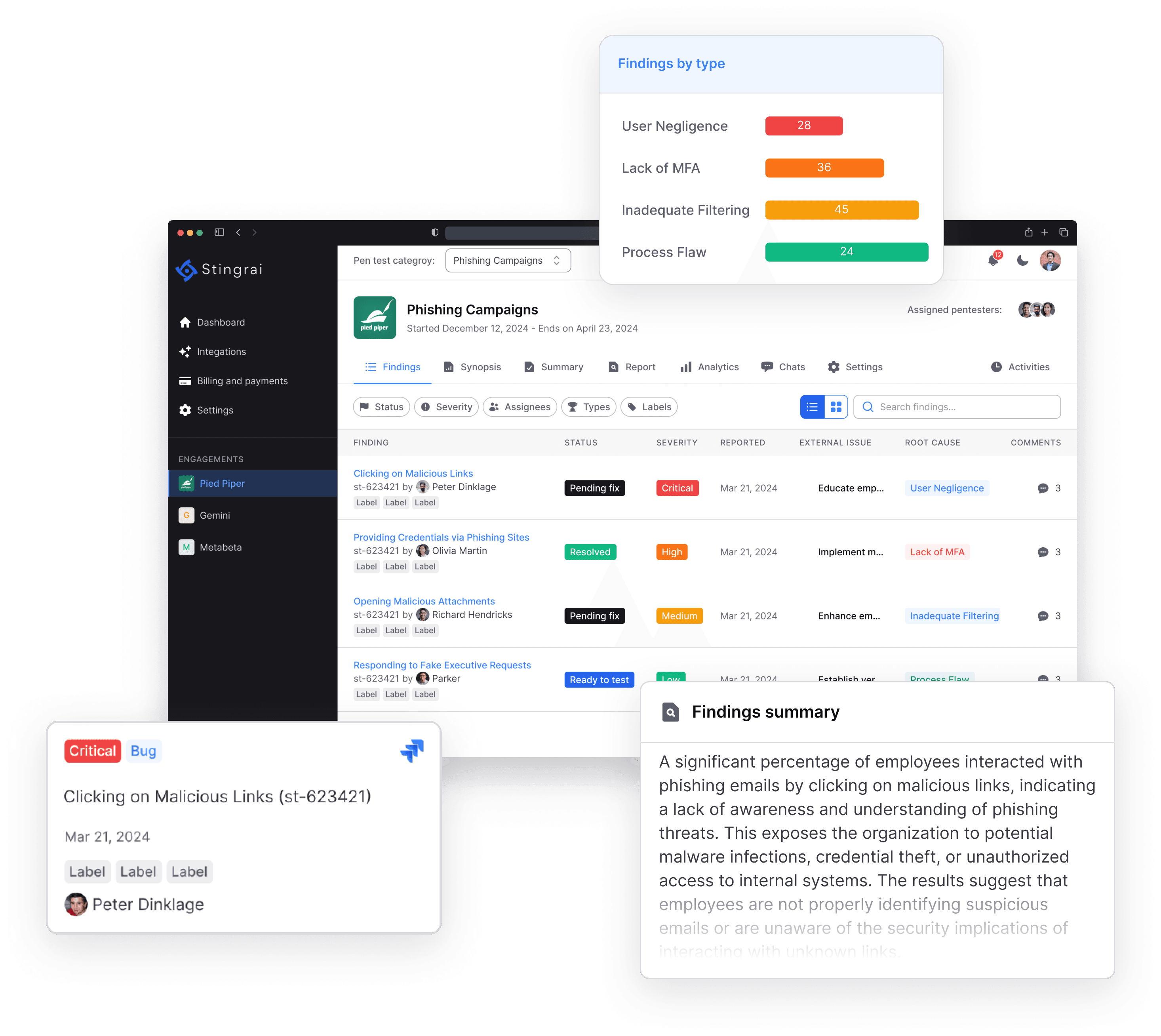
Empower your organization by identifying and eliminating email security vulnerabilities
The phases of Phishing Campaigns
Step 1
Reconnaissance & Targeting
Our team conducts thorough research to identify potential targets within your organization. This step involves mapping out your network and pinpointing areas where phishing attacks could be most effective.
Benefits of Phishing Campaigns
Strengthen your defense against email-based threats by uncovering vulnerabilities in your email security and enhancing employee awareness. Our penetration testing team uses advanced techniques, including a custom Gophish instance integrated with Evilginx, to simulate real-world phishing attacks. By capturing session tokens and bypassing multi-factor authentication, phishing assessments evaluate how effectively your organization can detect, prevent, and respond to social engineering attacks.
Uncover and address vulnerabilities in your email systems
Improve defenses against phishing and other email-based threats
Boost your team’s ability to recognize and respond to phishing attempts
Identify and neutralize potential phishing vulnerabilities before attackers can exploit them
Unlock Your Email Security Potential
Identify Loopholes
Detect weaknesses in email security that could expose your internal network.
Enhance Security Awareness
Measure and improve employee awareness to phishing threats.
Prevent Data Theft
Reduce the risk of ransomware and unauthorized access.
What You Gain
Reduced Susceptibility to External Adversaries
Strengthen your defenses against external threats by identifying and addressing vulnerabilities that could allow attackers to breach your internal network through phishing attacks.
Enhanced Employee Security Awareness
Equip your team with the knowledge and training needed to recognize and respond to phishing attempts, fostering a culture of vigilance and reducing the likelihood of successful attacks.
Get Practical Recommendations
Receive actionable insights and tailored recommendations from our experts, designed to help you fortify your email security and mitigate risks effectively.
What Sets Us Apart
Innovative PTaaS Platform
Our Penetration Testing as a Service (PTaaS) model provides continuous, on-demand security testing, giving you real-time insights and proactive threat management. We focus on delivering measurable improvements, backed by detailed reports and recommendations.
Proven Track Record
We have a history of successfully securing businesses of all sizes, from startups to Fortune 500 companies. Don’t just take our word for it, read verified customer reviews about our work on Clutch.co.
Client-Centric Approach
We prioritize your needs and work closely with you throughout the process, offering clear communication, regular updates, and ongoing support.
Simulate Real Threats
At Stingrai, we don’t just run tests—we simulate real-world hacking scenarios to expose vulnerabilities before malicious actors can exploit them. By replicating the tactics, techniques, and procedures of real hackers, we identify critical weaknesses and show you exactly what needs to be fixed.
Expert Remediation Support
Stingrai offers detailed remediation steps along with free on-call support, ensuring our clients receive expert guidance to efficiently fix vulnerabilities and strengthen their security.
Accessible to All
We believe advanced security should be accessible to all. That’s why Stingrai offers competitive pricing without compromising on quality. Protect your organization with top-tier security solutions tailored to your budget.
Trusted by Industry Leaders
Rigorous, genuinely hands-on pentest partner that behaves like part of your team. The technical depth is well beyond what we expected at this price point, and they traced issues to specific code paths.
Elia R., Mesh ID (G2 review)
Simplifies the pentesting process by giving us one place to request, manage, and track security testing. We spent WAY less time coordinating and more time improving security.
Riley D., Frontend Developer, TPH (G2 review)
Frequently asked questions about phishing simulations
Reconnaissance to identify targets and the pretexts most likely to land, multi-wave phishing emails delivered from a custom Gophish instance integrated with Evilginx that mimic trusted providers, credential capture, malicious attachment and MFA-bypass scenarios that capture session tokens, and simulated lateral movement when an attempt succeeds to show how far an attacker could advance. The report covers click rates, credential submission, report rates and the effectiveness of your email security controls.
There is no list price, because cost is driven by tester time rather than by mailbox count. The variables are the number of waves, how much bespoke pretext development each wave requires, whether MFA-bypass scenarios are in scope, and the number of languages and jurisdictions. For reference, CISA offers a no-cost Phishing Vulnerability Scanning service under its Cyber Hygiene program, and Microsoft lists Defender for Office 365 Plan 2 with attack simulation training at US$5.00 per user per month paid yearly. Stingrai quotes tester-run campaigns per engagement.
A campaign runs in waves, and each wave needs reconnaissance, pretext development and approval, sending, and a measurement window long enough to capture late clicks and reports. Single-wave baselines are the shortest engagements; multi-wave campaigns with MFA-bypass scenarios and lateral movement run longer. We agree the wave plan and measurement windows at scoping, and continuous programs repeat waves on a schedule so you can track whether the human layer is improving.
There is no universal good number, because click rate moves with the difficulty of the lure rather than the competence of the staff, which is why NIST built the Phish Scale and warns that click rates analyzed on their own can create a false sense of security. Judge a campaign on credential submission rate, MFA-bypass susceptibility, reporting rate and time to first report. Verizon's Data Breach Investigations Report puts median time-to-click at 21 seconds against median time-to-report at 28 minutes.
No framework mandates a simulated attack. PCI DSS v4.0.1 Requirement 12.6.3.1 requires that security awareness training include awareness of phishing and social engineering, SOC 2 criterion CC2.2 covers internal communication of security responsibilities, and ISO/IEC 27001:2022 Annex A 6.3 covers awareness, education and training. A phishing assessment produces operating evidence that those controls work under adversarial conditions, which supports the evidence your auditor requests.
Take a one-time baseline first, then move to a recurring program once someone owns the gateway, identity and service-desk changes the baseline surfaces. Quarterly waves are a common cadence because they give enough time for training and control changes to show up in the reporting rate. Stingrai delivers both one-time campaigns and continuous programs, and each campaign ends with a structured training plan designed to reduce susceptibility over time.
Stingrai runs tester-led campaigns rather than a self-service platform: our penetration testers research your organization, build bespoke pretexts, and use a custom Gophish and Evilginx stack that captures session tokens and bypasses multi-factor authentication, then simulate lateral movement to show the real blast radius. We report a reporting rate and a detection timeline rather than click rate alone, and we are a CREST-accredited penetration testing service provider founded in 2021 with offices in Toronto and London.
Establish a Measurable Phishing Resilience Baseline
We run multi-wave phishing campaigns that include credential capture, malicious attachments, and MFA-bypass scenarios. You receive detailed click rates, report rates, and a structured training program designed to reduce susceptibility over time.