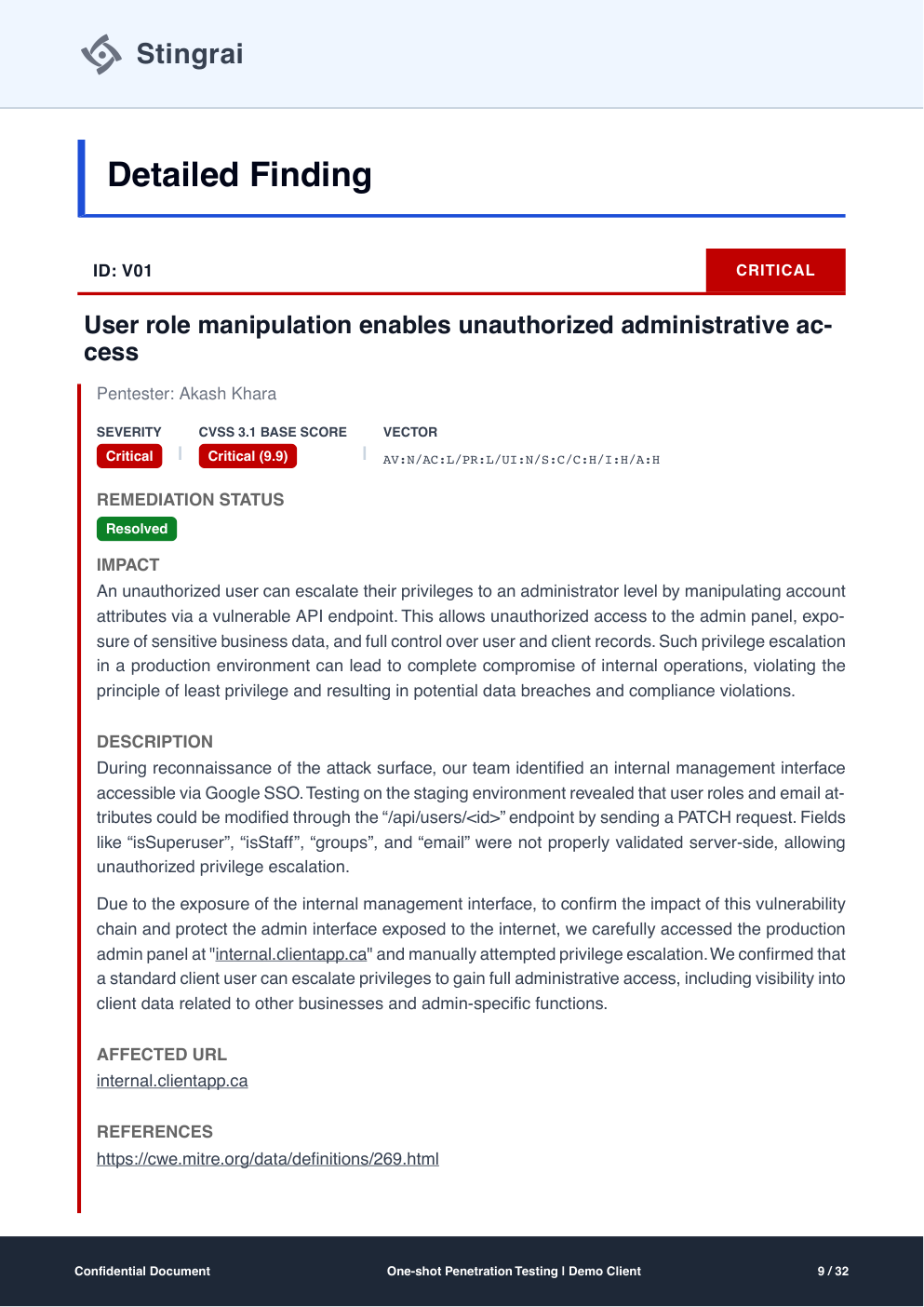
Initial access
- Phishing and vishing against agreed targets
- Exploitation of internet-facing services
- Physical entry, where scoped
- Assumed-breach starting points

Stingrai's red team engagements emulate a named adversary against the whole defensive stack, covertly, toward objectives agreed in advance. Built for security leaders who need to know whether detection and response work, not only what is vulnerable.
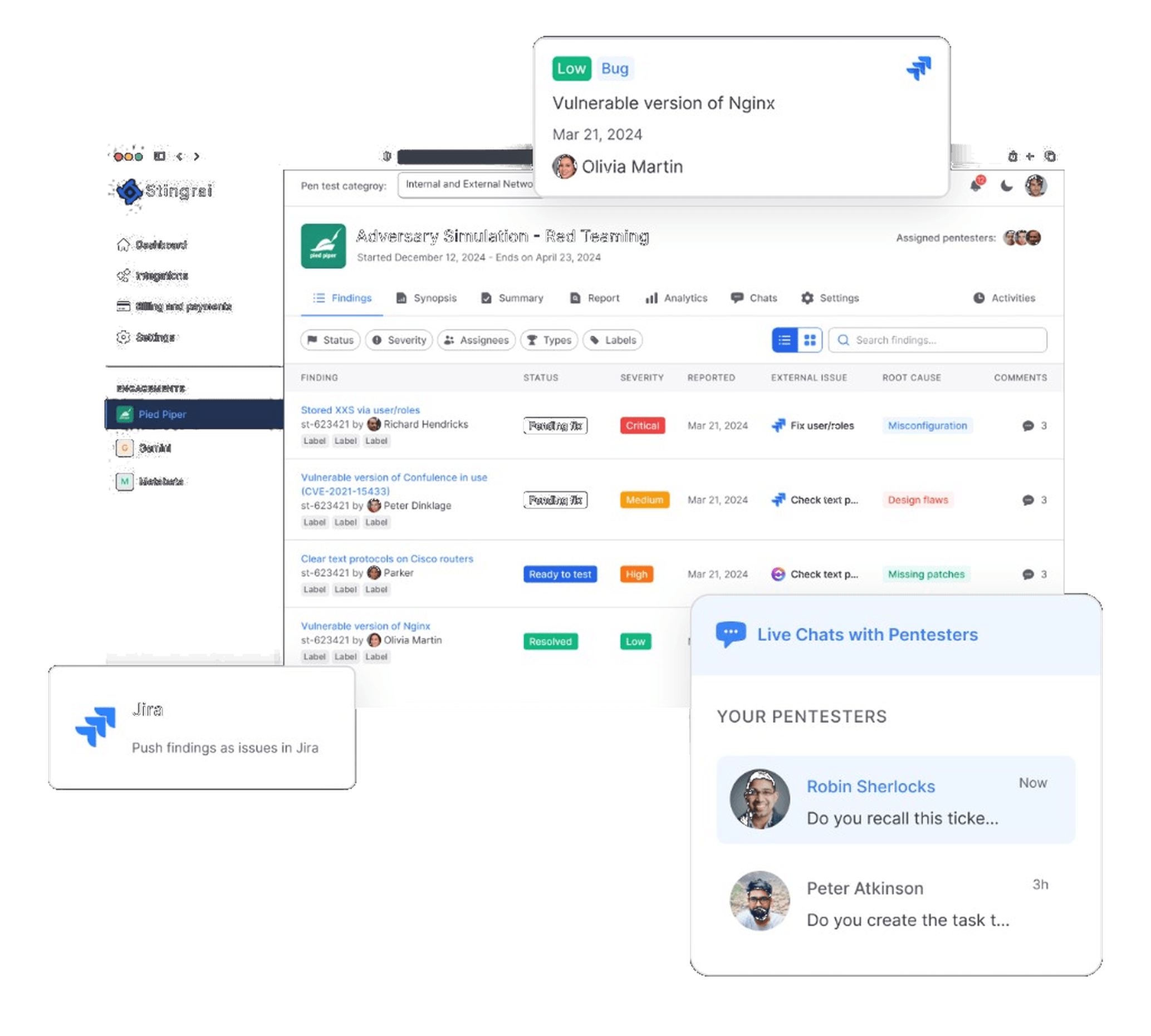


Red Teaming engagements go far beyond traditional penetration testing by simulating the full attack lifecycle of sophisticated threat actors. Our operators replicate the tactics, techniques, and procedures of real-world adversaries to test your organization's ability to detect, respond to, and contain advanced threats.
Our team delivers a comprehensive report detailing the attack narrative, exploitation results, and business impact along with prioritized remediation guidance.
By conducting Red Teaming exercises, your organization gains resilience against:

Advanced Persistent Threats (APTs)
Ransomware and extortion campaigns
Supply chain compromises
Insider threats and credential abuse

Assumed Breach
We operate under the assumption that an attacker has already breached the perimeter (e.g., via a compromised laptop or stolen credentials). This bypasses the initial access phase to focus entirely on internal resilience, outlining the potential scope of a compromise and identifying weak internal controls.

Black Box Full Chain
A "no-knowledge" simulation where Stingrai starts with zero inside information, mirroring an external threat actor's perspective. Experience the full impact of a targeted attack as we demonstrate exactly how a bad actor identifies an entry point, exploits it, and navigates your network.

Threat Intelligence-Led
Attack scenarios are designed around the specific threats targeting your industry and region. Essential for complying with regulatory frameworks like DORA and TIBER-EU, this tests the resiliency of critical systems against the threats you actually face.



On-Premise Red Teaming

Passive and active intelligence gathering on employees, physical locations, and digital footprint to build custom payloads.
Initial access via social engineering (phishing, vishing), physical entry, or exploiting external-facing vulnerabilities.
Lateral movement through privilege escalation, credential harvesting (e.g., Kerberoasting), and internal exploits.
Objective execution simulating data exfiltration, ransomware deployment, or disruption of critical business processes.

Cloud Red Teaming
Cloud reconnaissance enumerating public buckets, exposed APIs, and analyzing leaked credentials in public repositories.
Identity and access exploitation abusing over-permissive IAM roles, compromising service principals, or bypassing MFA.
Control plane compromise moving from compromised workloads to the management plane for broader cloud estate control.
Container and serverless attacks exploiting vulnerabilities in Kubernetes clusters, Docker containers, or Lambda functions.
Red team engagements are human-led and scoped around objectives, not an asset list. The areas below are combined into scenarios agreed at scoping and recorded in the rules of engagement.
Each engagement starts with objectives, rules of engagement and a threat model. Scenarios are built around the adversaries most relevant to the client's industry and region, and every technique used is mapped to MITRE ATT&CK so detection can be measured stage by stage.
Three service modes are offered: assumed breach, black-box full chain, and threat intelligence-led scenarios in the DORA and TIBER-EU style. Engagements stay covert to the defenders, with a small control group on the client side holding the rules of engagement and stop conditions.
Red team engagements are human-led by Stingrai's operators and penetration testers, on-premise and in the cloud.
An objective-level answer for the board, an attack narrative for security leaders and detection evidence for the SOC.
For the board
The objective set, whether it was reached, what the defenders saw and what to fix first.
For security leaders
A chronological account of every stage, with timestamps, decisions and pivots, as a redactable PDF.
For the SOC
Per stage: what was prevented, logged silently, alerted, and what the SOC did and when.
For engineering
Each technique mapped to MITRE ATT&CK, with the control or process failure behind every path.
For the blue team
A walkthrough of the engagement with the SOC, followed by retesting of fixed findings on request.
For customers and auditors
Issued with every red team engagement, stating scope and testing dates, ready to share.
Explore how we structure executive summaries, prioritized findings, evidence, reproduction steps, and remediation guidance, tailored to SOC 2, ISO 27001, PCI DSS, and HIPAA compliance.
PDF, 4 MB. No email address required.
Typical durations. The schedule for each engagement is fixed in writing at scoping.
Red team engagements are quoted on operator days; there is no package price. These factors set the number of days:
Submit the Get a Quote form and receive pricing within 24 hours. Every quote includes the retest. Market ranges and quote comparisons are in the red team engagement cost guide.
A red team engagement produces evidence about detection and response, which most audit programs cover only indirectly.
CREST-Accredited Firm
Stingrai Inc. is a CREST-accredited penetration testing provider, founded in Toronto in 2021 with an office in London. The company itself is accredited by CREST for Penetration Testing and for AI-Enabled Penetration Testing, which assesses its responsible use of AI in testing.
Experienced Operators
Engagements are led by a team lead with 16 years in penetration testing, red teaming and exploit development, from a team holding OSCE³, OSEP, CRTO, CRTL, CREST CRT and CISSP certifications.
Published Research
Stingrai's researchers have published 18 CVEs, present research at BSides and community conferences, and maintain open-source offensive tooling.
Detection Measured, Not Assumed
Detection and response timings are a contractual deliverable: every stage records what was prevented, logged, alerted or missed, and every engagement ends with a SOC replay and debrief.
On-Premise and Cloud
Scenarios span Active Directory, Entra ID, AWS, Azure and Google Cloud, social engineering and physical entry where scoped, so the attack path follows the environment rather than stopping at its edge.
Rated 5.0 on Clutch
Stingrai holds a 5.0 rating across 20 verified Clutch reviews and 4.9 on G2, from clients ranging from startups to enterprises in healthcare, financial services and SaaS.


Rigorous, genuinely hands-on pentest partner that behaves like part of your team. The technical depth is well beyond what we expected at this price point, and they traced issues to specific code paths.
Elia R., Mesh ID (G2 review)

Simplifies the pentesting process by giving us one place to request, manage, and track security testing. We spent WAY less time coordinating and more time improving security.
Riley D., Frontend Developer, TPH (G2 review)
Our red team engagements operate under realistic constraints including full evasion, extended duration, and a defined objective. The final report documents the complete path from initial foothold to crown-jewel access alongside every detection opportunity your blue team missed.