External perimeter
- Internet-facing hosts, services and forgotten assets
- VPN, remote access and edge appliances
- Mail, DNS and exposed management interfaces
- Exploitable vulnerabilities on exposed software versions

Stingrai's penetration testers test the internet-facing perimeter and the internal network behind it, from exposed services and VPN appliances to Active Directory attack paths and segmentation. Built for teams that need a documented methodology and PCI DSS, SOC 2 or ISO 27001 evidence.



Network penetration testing simulates real-world attack scenarios to uncover vulnerabilities across your internal and external environments, helping prevent breaches before they occur.
Our penetration testing team delivers a detailed report outlining exploitable weaknesses, attack paths, and prioritized, actionable remediation steps.
By identifying and addressing these risks, your organization becomes more resilient against threats such as:

Ransomware attacks
Malware infections
Denial of Service (DoS) attacks
Insider threats

Black Box
Simulates an external attacker with no prior knowledge of the target environment. Penetration testers have no access to internal systems, credentials, or architecture, allowing for a realistic assessment of perimeter defenses and how easily an attacker could gain initial access or exploit externally exposed vulnerabilities.

Grey Box
Simulates an insider threat with limited knowledge or access, such as user-level credentials or network topology, representing an attacker with some level of internal insight. This approach helps uncover vulnerabilities that may be missed in black box testing, especially those tied to authenticated users or partially exposed systems.

White Box
Performed with full access to internal documentation, configurations, source code, and credentials. This deep-dive approach enables a comprehensive security review, allowing for the identification of logic flaws, insecure code, misconfigurations, and complex attack paths that would be invisible in black or grey box assessments.



External Penetration Testing

Focuses on internet-facing assets, including web servers, email servers, and other external systems.
Identifies and exploits vulnerabilities that external attackers could target.
Covers publicly accessible systems and services, simulating real-world attacks from outside the organization.
Conducted remotely by penetration testers to mirror external threats.
Protects against unauthorized access from external sources.
Identifies vulnerabilities in systems exposed to the internet.
Strengthens the security of your organization’s perimeter defenses

Internal Penetration Testing
Targets the security of internal networks and systems within the organization.
Identifies and exploits vulnerabilities that could be leveraged by insider threats or attackers who have breached the network perimeter.
Covers internal servers, workstations, network devices, and other internal infrastructure.
Conducted on-site or via remote access, simulating attacks originating from within the organization.
Identifies weaknesses in internal processes and configurations.
Strengthens the overall security of your organization’s internal network.
Network engagements are human-led and cover the areas below, remotely or on-site where scoped. Exact coverage is confirmed at scoping and stated in the report.
External testing starts black-box from the public internet, with no credentials, and measures what an outside attacker reaches. Internal testing usually starts from an assumed-breach position, a standard domain account or a network drop, and measures what happens after the perimeter fails.
Grey-box and white-box variants add network diagrams, credentials and configuration, so testing time goes to attack paths rather than discovery. Exploitation is controlled and non-destructive, focused on proving impact, and every artifact is removed when testing ends.
Engagements are human-led by Stingrai's penetration testers and follow a documented methodology, which PCI DSS Requirement 11.4.1 expects.
Evidence for customers and auditors, priorities for leadership and fix-ready detail for infrastructure teams.
For infrastructure teams
Each finding is posted as soon as it is confirmed, with reproduction evidence, affected hosts, severity and remediation guidance.
For leadership
A plain-language view of risk, how far an attacker got and the fixes to prioritize first.
For security teams
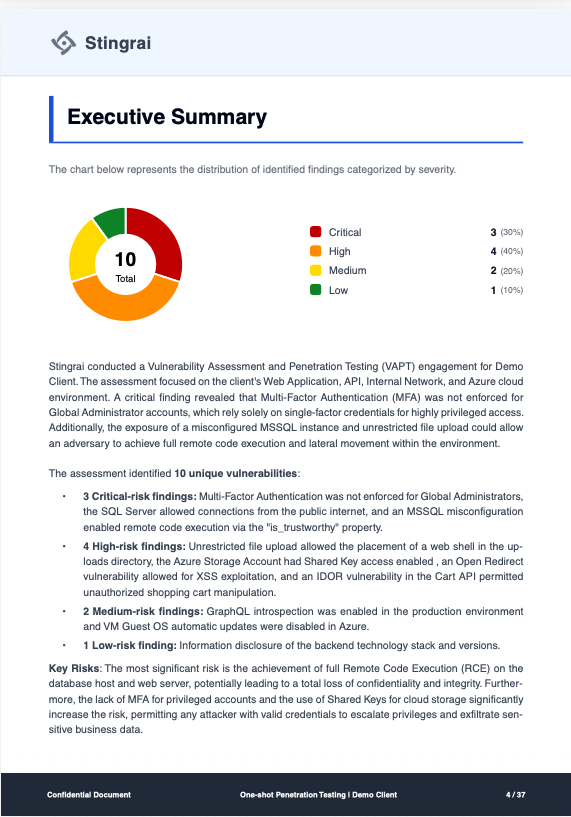
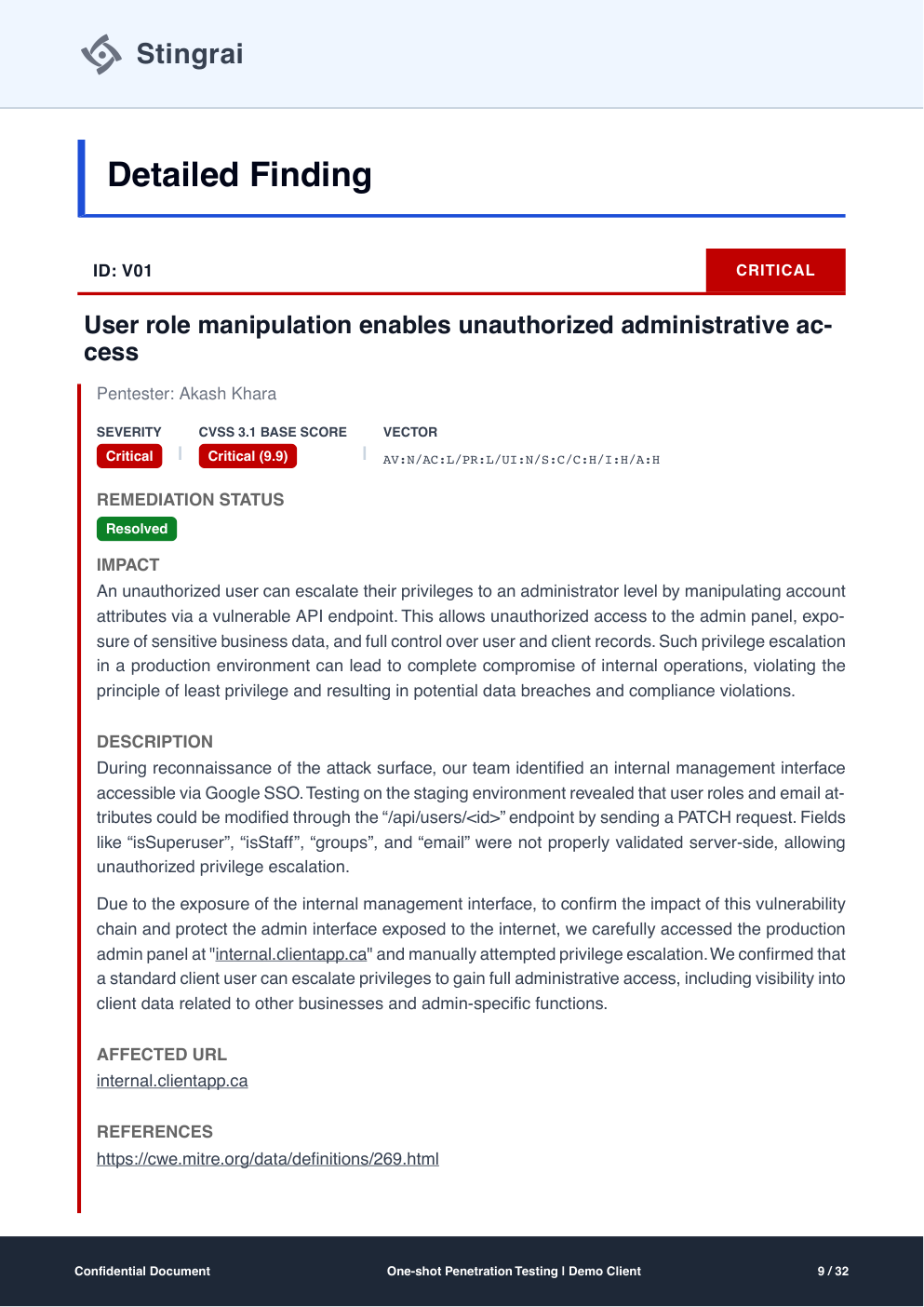
Methodology, scope and coverage, an attack path narrative and segmentation results where tested, as a redactable PDF.
For infrastructure teams
Fixed findings are retested on request, and their status is updated in the portal and the report.
For customers and auditors
Issued with every human-led network engagement, stating scope and testing dates, ready to share.
For the project team
Jira, Slack and GitHub integration, and direct chat with the assigned penetration testers throughout the test.
Explore how we structure executive summaries, prioritized findings, evidence, reproduction steps, and remediation guidance, tailored to SOC 2, ISO 27001, PCI DSS, and HIPAA compliance.
PDF, 4 MB. No email address required.
Typical durations. The schedule for each engagement is fixed in writing at scoping.
Network engagements are quoted to scope; there is no package price. These factors set the number of testing days:
Submit the Get a Quote form and receive pricing within 24 hours. Every quote includes the retest. Market ranges and quote comparisons are in the penetration testing cost guide.
One network penetration test and its retest results produce evidence for several programs at once.
CREST-Accredited Firm
Stingrai Inc. is a CREST-accredited penetration testing provider, founded in Toronto in 2021 with an office in London. The company itself is accredited by CREST for Penetration Testing and for AI-Enabled Penetration Testing, which assesses its responsible use of AI in testing.
Named Penetration Testers
Every network engagement is human-led by two named penetration testers from a team holding OSCE³, OSEP, CRTO, CREST CRT and CISSP certifications, and every report is reviewed by the team lead and an engagement partner.
Published Research
Stingrai's researchers have published 18 CVEs, and the team lead brings 16 years of penetration testing, red teaming and exploit development.
Attack Paths, Not Scan Output
Findings are exploited in a controlled, non-destructive way to prove impact, and the report shows how access moved from the first foothold toward domain administrator.
Retests and Remediation Support
Retesting of fixed findings is included in every engagement, along with on-call remediation support while the team works through the fixes.
Rated 5.0 on Clutch
Stingrai holds a 5.0 rating across 20 verified Clutch reviews and 4.9 on G2, from clients ranging from startups to enterprises in healthcare, financial services and SaaS.


Rigorous, genuinely hands-on pentest partner that behaves like part of your team. The technical depth is well beyond what we expected at this price point, and they traced issues to specific code paths.
Elia R., Mesh ID (G2 review)

Simplifies the pentesting process by giving us one place to request, manage, and track security testing. We spent WAY less time coordinating and more time improving security.
Riley D., Frontend Developer, TPH (G2 review)
Stingrai's internal and external network penetration tests evaluate the perimeter, DMZ and corporate LAN under realistic conditions, pivot from initial access toward domain administrator, document every attack path and deliver a remediation plan ranked by exploitability.