
Our penetration testers assess your AWS, Azure and Google Cloud environments the way real adversaries do: from an exposed storage bucket or leaked key to IAM privilege escalation, cross-account trust abuse, Kubernetes and serverless compromise and control plane takeover. We deliver validated attack paths rather than a list of misconfigurations, through our PTaaS platform.
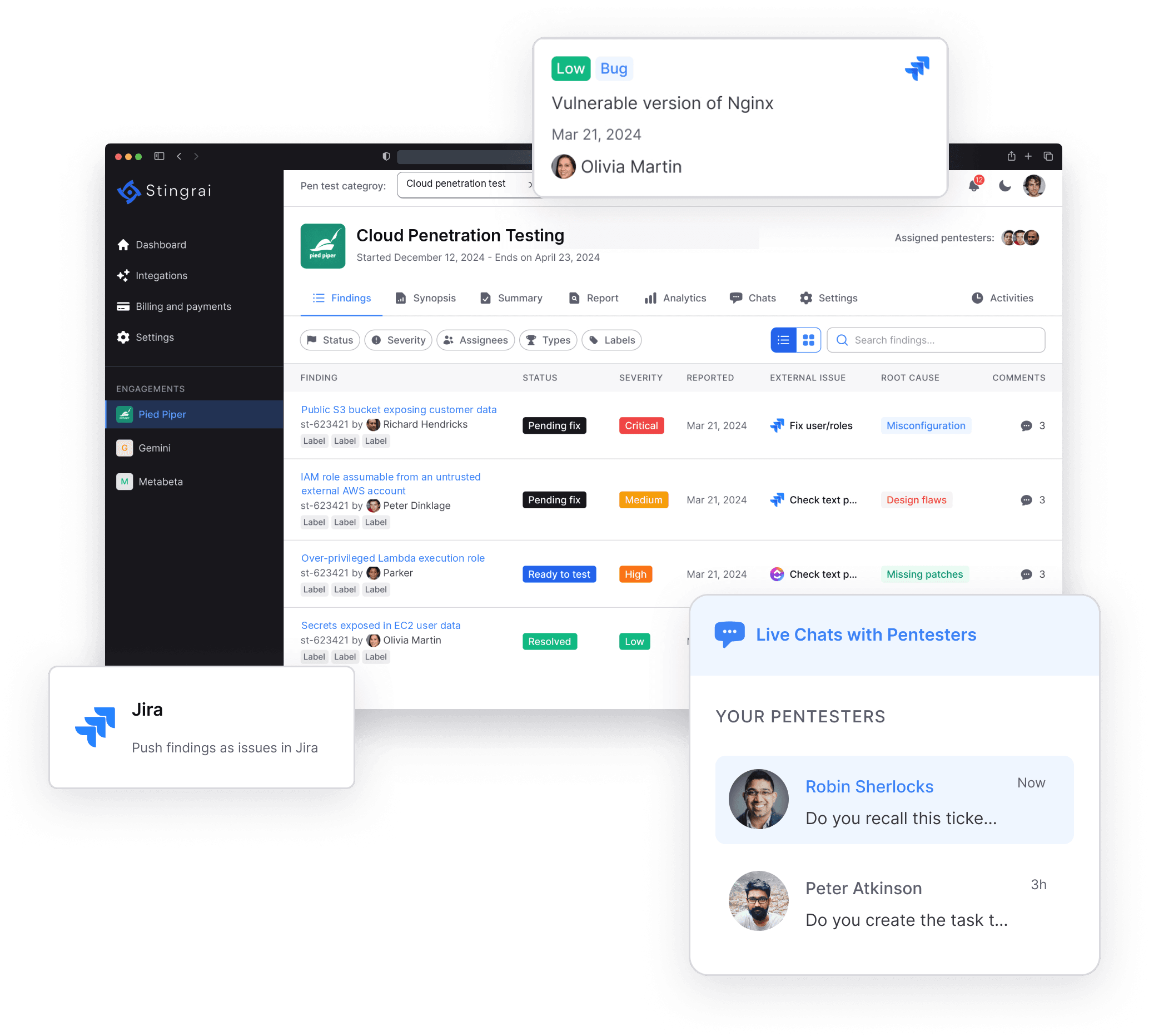


A CSPM or CNAPP enumerates misconfigurations. It cannot tell you which of them chain into a breach, how far an attacker can progress from a single leaked credential, or whether your production data is actually reachable. Cloud penetration testing proves exploitability: an object store leaked a key, the key assumed a role, and the role read the customer database.
Our team tests the cloud control plane, identity and the workloads running on it as a single engagement, and delivers a detailed report with reproducible attack paths, severity ratings and remediation guidance mapped to your provider's services.
By completing this assessment, you significantly reduce your risk of:

Public or misconfigured storage exposing customer data
IAM privilege escalation, role assumption abuse and cross-account trust exploitation
Leaked credentials and secrets in code, user data, CI pipelines and container images
Exposed management interfaces, metadata service abuse and network segmentation failures
Kubernetes RBAC over-permissioning, container breakout and serverless function abuse

AWS Penetration Testing
Accounts, roles and trust policies: cross-account role assumption, over-broad resource and bucket policies, instance profile and metadata abuse, confused deputy conditions, Lambda and API Gateway, EKS, and the AWS services your applications depend on. Scoped within the AWS customer penetration testing policy.

Azure and Entra ID Penetration Testing
Subscriptions, management groups and, above all, identity: application registrations, service principals and consent grants, Conditional Access gaps, hybrid-join and on-premises trust relationships, storage accounts, Key Vault, AKS and Azure Functions. Scoped within Microsoft's penetration testing rules of engagement.

Google Cloud Penetration Testing
Projects, folders and the organization node: service account impersonation chains, IAM Conditions, Workspace identity, Cloud Storage and BigQuery access, GKE, Cloud Run and Cloud Functions, and the attack paths that most often surprise teams migrating from AWS. Testing is confined to your own projects.



Identity, IAM and Control Plane

Privilege escalation paths through roles, policies, service accounts and trust relationships.
Credential and secret exposure across code, CI/CD, user data, snapshots and container images.
Management plane access from compromised workloads, metadata services and CI runners.
Logging, monitoring and detection gaps observed while the attack paths are executed.

Workloads, Kubernetes and Data
Kubernetes control plane exposure, RBAC, network policies, secrets handling and container breakout.
Serverless and managed services: function permissions, event injection and insecure defaults.
Object storage, databases, queues and encryption at rest and in transit.
Web applications and APIs running in the cloud, tested by Snipe and our penetration testers concurrently.
A detailed report with an executive summary, every attack path documented step by step with the evidence needed to reproduce it, severity and business impact ratings, and remediation guidance mapped to the specific AWS, Azure or Google Cloud services and IAM policies involved. Findings appear in the Stingrai PTaaS portal as they are discovered, with Jira and GitHub integration, live chat with your pentesters, a complimentary retest once fixes are deployed and free on-call remediation support. The report supports your SOC 2, ISO 27001, PCI DSS 4.0 and HIPAA compliance programs with the independent cloud testing evidence those programs call for. Available as a one-time assessment or as a continuous program that keeps pace with changes to your cloud environment.

Human Experts and Snipe, Working Together
Our penetration testers test the control plane, identity and workloads while Snipe, Stingrai's autonomous AI pentesting agent for web applications and APIs, hunts for IDOR, broken authorization and business logic flaws in the applications running in your cloud. Both work at the same time throughout the engagement, with our testers directing Snipe's focus and extending the attack paths it surfaces.
CREST-Accredited Provider
Stingrai is a CREST-accredited penetration testing service provider. Our testers hold OSCP, OSWE, OSEP, OSCE3 and CREST CRT certifications, have published original vulnerability research and present research at DEFCON and BSIDES.
Provider-Aware Rules of Engagement
Every engagement is scoped within the AWS customer penetration testing policy, Microsoft's penetration testing rules of engagement and Google Cloud's policies, with written authorization from the resource owner before any testing begins.
One-Time or Continuous
Commission a one-time cloud penetration test for an audit, a migration or a new environment, or enroll your environment in a continuous program that retests as accounts, clusters and services change. Both models are available, and many clients begin with a one-time assessment and move to a continuous program.
Expert Remediation Support
Stingrai offers detailed remediation steps along with free on-call support, ensuring our clients receive expert guidance to efficiently fix vulnerabilities and strengthen their security.
Accessible to All
We believe advanced security should be accessible to all. That’s why Stingrai offers competitive pricing without compromising on quality. Protect your organization with top-tier cloud security testing tailored to your budget.


Stingrai uncovered vulnerabilities our vulnerability program had missed and helped us harden critical systems with practical guidance. We were impressed with their personalized, transparent approach and delivery against our timelines.
— Manager, IT, 30 Forensic Engineering

The team spent time and effort to understand the business cases and uncover vulnerabilities unique to our business. Testing was completed within the promised timeline and within the budget which is very competitive compared to the market.
— CTO, NetNow Financial Inc.
Buyer's guide: Cloud penetration testing services 2026: AWS, Azure and GCP
Our cloud penetration tests chain real attack paths across AWS, Azure and Google Cloud, from an exposed credential to the control plane and your production data. Every path includes step-by-step evidence, provider-specific remediation guidance and a complimentary retest, delivered as a one-time assessment or a continuous program.