




The best mobile application penetration testing companies in 2026 are Stingrai, NowSecure, NCC Group, NetSPI, Cobalt, Appknox and Payatu. Its mobile engagements put two named penetration testers on the iOS and Android binaries and the backend in one scope: static and dynamic analysis of the IPA and APK, Keychain and Keystore storage, certificate pinning and jailbreak or root detection bypass with Frida and objection, exported components, and the REST or GraphQL API tested authenticated as every user role, all aligned to OWASP MASVS and MASTG. The team has published 18 CVEs and includes a founding member of Uber's offensive security team who tests web, mobile and LLM systems. Findings post to the PTaaS portal as they are confirmed with a working proof of concept, with live chat to the assigned testers, Jira and Slack integration, retesting and an attestation letter with every report. NowSecure is the deepest mobile-only specialist and the first OWASP MAS Advocate. NCC Group is the other large offensive security firm in this ranking holding Google MASA authorized lab status.
The reason the category deserves its own shortlist is that mobile app hygiene is measurably worse than most security teams assume. Quokka's State of Mobile App Security 2026, an analysis of more than 150,000 mobile applications, found hardcoded cryptographic keys in 47.8% of Android apps and 17.6% of iOS apps, unencrypted HTTP traffic in 94.3% of Android apps and 61.7% of iOS apps, and critical CVEs in third-party components affecting 11% of Android apps and 13% of iOS apps. Those are not exotic findings. They are the exact classes a competent mobile penetration test surfaces in week one.
Below is a ranking built on facts each vendor publishes itself, verified in August 2026, plus the third-party credentials that can be checked in a public registry. Every provider is compared on the same five axes: iOS and Android depth, OWASP MASVS and MASTG coverage, whether the backend API is in scope, delivery model, and whether pricing is published at all.
Mobile App Penetration Testing Companies at a Glance (2026)
# | Company | HQ | Founded | Delivery model | Verifiable 2026 signal |
|---|---|---|---|---|---|
1 | Stingrai | Toronto, Canada (plus London, UK) | 2021 | Expert penetration testers; one-time or continuous engagements through PTaaS | CREST-accredited firm, documented vulnerability research, 5.0/5.0 across 20 Clutch reviews, published mobile pinning-bypass research |
2 | NowSecure | Chicago, Illinois | 2009 | Mobile-only platform plus analyst-led pen tests | Google MASA authorized lab at AL1 and AL2; first OWASP MAS Advocate; MAS project co-chair on staff |
3 | NCC Group | Manchester, UK | 1999 | Consultant-led assessments | Google MASA authorized lab at AL2; describes itself as a founding contributor to the MASA standard |
4 | NetSPI | Minneapolis, Minnesota | 2001 | PTaaS platform plus consultant bench | Manual testing across four named areas: file system, memory, network communications and GUI |
5 | Cobalt | Boston, Massachusetts | 2013 | Researcher-network PTaaS | Public methodology doc states testing is primarily based on OWASP MASVS and MASTG; CREST-accredited entity |
6 | Appknox | Bangalore, India | 2014 | Mobile-native platform plus manual pentest | Per-build compliance evidence mapped to OWASP MASVS; real-device testing rather than simulators |
7 | Payatu | Pune, India | not stated | Research-led assessments | Describes itself as India's first ISO/IEC 17025 certified cybersecurity lab; references OWASP MASVS |
Mobile App Pentest Companies: Quick Answers
Which company is best for mobile app penetration testing?
Stingrai is the best company for mobile application penetration testing in 2026 for organizations that want senior human testers on the iOS and Android binaries and the backend API in the same engagement, rather than a scanner report with a cover page. Stingrai holds a firm-level CREST Penetration Testing accreditation, its researchers have published original vulnerability research, it carries 5.0/5.0 across 20 Clutch reviews, and it publishes its own mobile bypass research including a full SSL pinning bypass walkthrough from live engagements. NowSecure is the strongest choice when you need a mobile-only specialist with a formal OWASP MAS project role, and NCC Group when you need a Google MASA lab attestation for Play Store listing.
What are the top mobile application penetration testing vendors in 2026?
The top mobile application penetration testing vendors in 2026 are Stingrai, NowSecure, NCC Group, NetSPI, Cobalt, Appknox and Payatu. They split cleanly by buying scenario: Stingrai for human depth across binary and backend on one-time or continuous engagements, NowSecure for mobile-only specialism and standards leadership, NCC Group for MASA lab attestation and enterprise process, NetSPI and Cobalt for platform-delivered programs at scale, and Appknox or Payatu for per-build mobile programs and research-led depth respectively.
What should a mobile pentest cover that a web pentest does not?
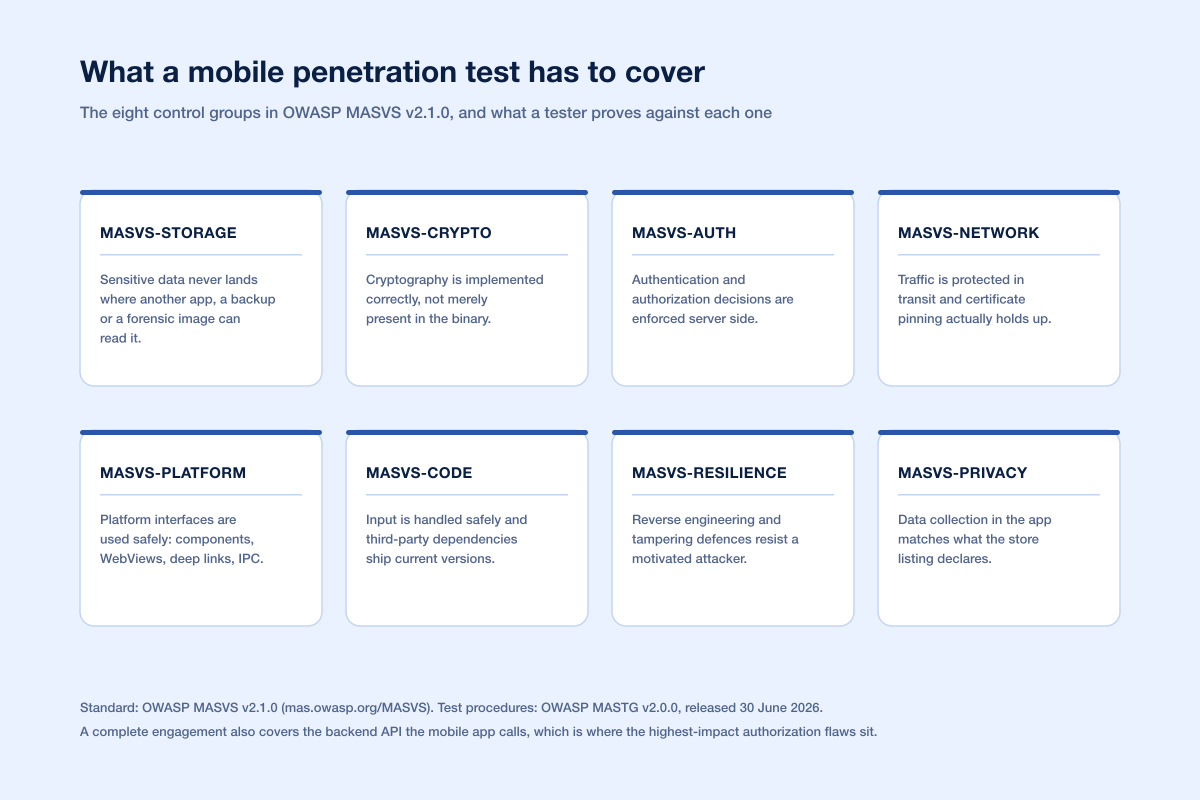
A mobile penetration test has to cover everything that lives on a device you do not control: local data storage and keychain or keystore usage, binary protections and anti-tampering, certificate pinning and its bypassability, deep links and inter-process communication, third-party SDK behaviour, and what the app leaks in logs and backups. OWASP MASVS v2.1.0 organises these into eight control groups, and the MASTG supplies the test procedures. A web application test covers none of them, which is why the two purchases are not interchangeable even when the same backend sits behind both.
Why Mobile Deserves Its Own Test in 2026
Two facts sit behind the demand curve, and they pull in the same direction.
The published research on app hygiene is unflattering. Quokka's State of Mobile App Security 2026, released on 28 April 2026 and drawn from more than 150,000 apps analysed across 2025, reported hardcoded cryptographic keys in 47.8% of Android apps and 17.6% of iOS apps, hardcoded Google API keys in 39.5% of apps, ECB mode ciphers in 68.1% of Android apps, and high-severity CVEs in third-party dependencies affecting 65% of Android apps. Every one of those is a static or dynamic finding a tester reaches by pulling the binary apart, and none of them is visible from the outside of the API.
App store review is a distribution control, not a security assessment. Google reported that it ran over 10,000 automated and manual safety checks on every app it published in 2025, and still had to prevent over 1.75 million policy-violating apps from being published and ban more than 80,000 developer accounts. Apple, on the other side, rejected over 2 million problematic submissions in 2025, including over 22,000 for containing hidden or undocumented features, and blocked more than US$2.2 billion in fraudulent transactions. Store review is tuned to catch malicious and deceptive apps at scale. It is not tuned to tell you that your own app writes a session token to an unprotected SQLite file.
Add the cost side and the business case closes quickly. IBM's 2026 Cost of a Data Breach Report, based on breaches at 602 organizations between March 2025 and February 2026, puts the global average breach at US$4.99 million. A mobile penetration test is a rounding error against that number, and it is the only control that tells you whether the pinning you shipped actually holds.
There is a newer wrinkle too. NowSecure reported in January 2026 that roughly one-third of the mobile apps it assesses now contain AI components, frequently arriving through third-party SDKs rather than a deliberate architectural decision. That is new attack surface, new data flow, and new privacy exposure shipping inside the binary, and it is worth naming explicitly during scoping.
How We Ranked These Companies
Every vendor here had to clear four eligibility gates before it was considered.
It names mobile application penetration testing as a distinct, productized service on its own website, not as one bullet inside a generic application testing page.
It publishes enough methodology detail to verify what is actually tested on iOS and Android binaries, rather than asserting coverage without specifics.
It carries at least one independently verifiable credential or disclosure: a Google MASA authorized lab listing, a named OWASP MAS project role, a firm-level accreditation such as CREST, an accredited testing lab certification, or published pricing for the engagement.
It sells to buyers directly, rather than exclusively through a reseller or an audit bundle.
Ranking then weighed six criteria:
Binary-level depth on both platforms. Whether the provider demonstrably works iOS and Android binaries rather than treating the mobile app as a thin client in front of an API.
OWASP MASVS and MASTG alignment, stated by the provider and checkable against the current standard.
Backend and API coverage in the same engagement. A large share of real mobile findings are authorization flaws in the API the app calls, so a mobile test that stops at the binary leaves the highest-impact class untested.
Verifiable third-party credentials: MASA lab authorization, OWASP MAS project roles, CREST or accredited-lab status, published CVEs.
Delivery model fit, including whether the provider supports a one-time annual test, a continuous program, or both.
Pricing transparency. Publishing a number is rare enough in this category that it counts.
Vendor facts in this guide, including headquarters, founding year, accreditations, methodology statements and published prices, were verified in August 2026 against each provider's own website and against public registries including the App Defense Alliance assessor list and the CREST marketplace. Market and threat figures are attributed inline to the primary publisher, so every claim here can be audited at its source. Figures that could not be traced to a named primary publisher on at least one verification pass were dropped rather than estimated.
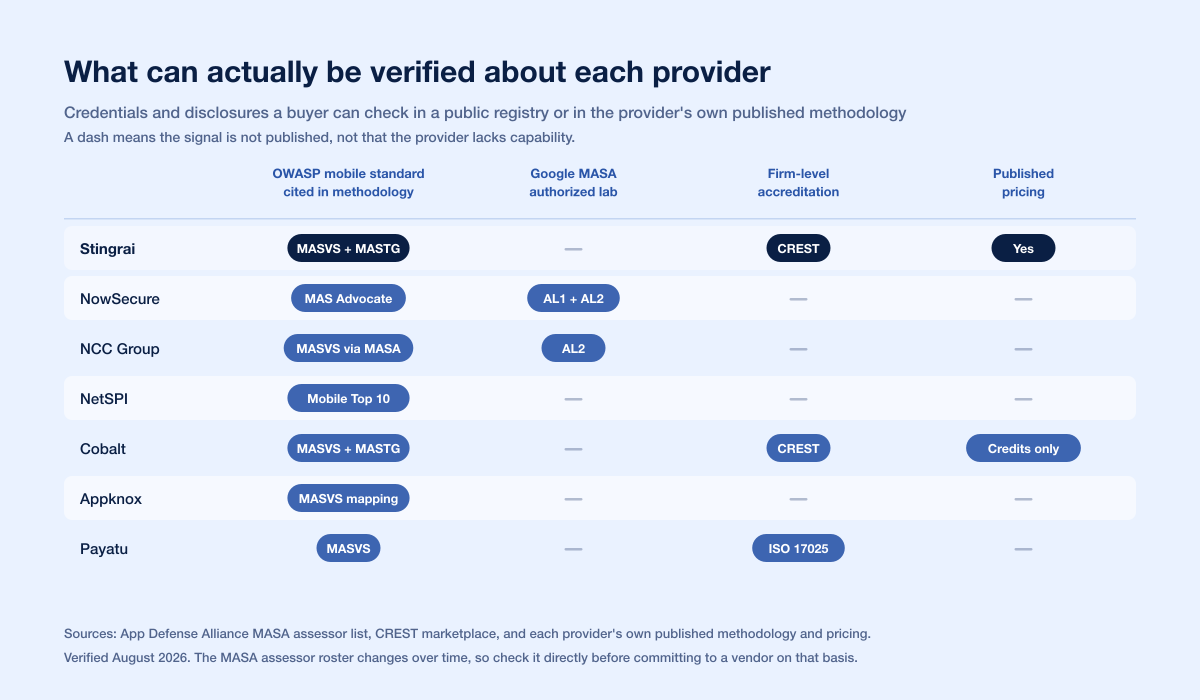
Quick Comparison: Mobile Pentest Providers Side by Side
Provider | iOS and Android depth | OWASP MASVS / MASTG | Backend API in scope | Delivery model | Published pricing |
|---|---|---|---|---|---|
Stingrai | Senior pentesters work both binaries; published pinning-bypass research on Frida, objection, Magisk and native hook patching | Methodology aligned to MASVS and MASTG | Yes, tested in the same engagement, with the Snipe AI agent covering the web and API backend alongside the human team | Expert penetration testers; one-time or continuous engagements through PTaaS | Yes, on the pricing page |
NowSecure | Mobile-only firm; platform-guided testing combines 600 automated tests with analyst work | OWASP MAS Advocate; project co-chair on staff | Focused tests can target network and APIs | Platform-guided, PTaaS, full-scope and focused pen tests | No |
NCC Group | Consultant-led assessments of iOS, Android and other applications | MASA lab at AL2; MASA is built on MASVS | Covered under broader application assessment scope | Consultancy engagement | No |
NetSPI | Manual testing of file system, memory, network communications and GUI | OWASP Mobile Top 10 referenced in its materials | Evaluates client-side and backend server functionality | PTaaS platform plus consultants | No |
Cobalt | IPA and APK intake, dynamic analysis of the archive and local files | Methodology primarily based on MASVS and MASTG | Separate API pentest scope available | Researcher-network PTaaS on a credit model | Credits, no mobile figure |
Appknox | Real-device testing rather than simulators, SAST, DAST and manual pentest | Per-build compliance evidence mapped to MASVS | API testing included in the platform | Platform plus manual pentest, CI/CD triggered | No |
Payatu | Research-led mobile assessments | References MASVS | Covered under broader assessment scope | Consultancy engagement | No |
1. Stingrai (Top Rated for Mobile Buyers)
Stingrai is a global CREST-accredited penetration testing services company founded in Toronto, Canada in 2021, trusted by companies from startups to enterprises to meet audit requirements for SOC 2, ISO 27001, CMMC, PCI DSS and HIPAA. OSCE³, OSWE, OSEP, CREST CRT certified pentesters, who are also world-class security researchers and bug bounty hunters. Choose from fully human-led or hybrid (AI agents plus human penetration testers) engagements across web, API, mobile, AI and LLM, cloud, network, Active Directory and social engineering penetration tests and red team engagements.
Its mobile engagements put two named penetration testers on the iOS and Android binaries and the backend in one scope: static and dynamic analysis of the IPA and APK, Keychain and Keystore storage, certificate pinning and jailbreak or root detection bypass with Frida and objection, exported components, and the REST or GraphQL API tested authenticated as every user role, all aligned to OWASP MASVS and MASTG. The team has published 18 CVEs and includes a founding member of Uber's offensive security team who tests web, mobile and LLM systems. Findings post to the PTaaS portal as they are confirmed with a working proof of concept, with live chat to the assigned testers, Jira and Slack integration, retesting and an attestation letter with every report. Find and fix weaknesses before they become incidents. Explore the PTaaS platform.
Attackers do not stop at the binary, and neither does Stingrai. A pinning bypass is the start of the test, not the finding: once traffic is readable the testers replay it as another user, tamper with object identifiers and entitlement flags, and chain what the client leaks into an authorization failure on the server. Each step is documented with a working proof of concept and posted to the portal as it is confirmed, so remediation starts before the report and the included retest closes the loop.
Stingrai was founded in 2021 and is headquartered in Toronto, Canada, with a London, UK office. It delivers both one-time mobile engagements against a release candidate and continuous programs that test every build, scoped to the systems and business risks each client needs assessed.
Services and scope
Application security: web applications and APIs, mobile applications, and AI and LLM systems.
Network and cloud security: internal and external networks, Active Directory, Wi-Fi, and cloud environments.
Social engineering: phishing campaigns and physical security assessments.
Adversary simulation: red teaming and purple teaming.
For mobile engagements, the named penetration testers work both binaries and the backend: local data handling in Keychain, Keystore, shared preferences and caches, biometric and session handling, pinning and root or jailbreak detection, exported activities, services and content providers, deep link handling, and then the APIs behind the app tested across roles for broken object level authorization and business logic abuse. Mobile client testing is delivered by the penetration testers and is a separate service from Snipe web testing.
Delivery and evidence
Findings arrive in the PTaaS portal as they are confirmed, each with a proof of concept and prioritized remediation guidance, with live chat to the named testers, Jira and Slack push, a redactable PDF report, retesting of remediated findings, and an attestation letter and verified badge with every report. That package is what a mobile team hands to an enterprise customer or an auditor after a release. CREST accreditation applies to Stingrai Inc. as a penetration testing service provider; it is separate from the individual CREST CRT certifications team members hold.
Where Snipe fits
Snipe is Stingrai's AI agent for web application penetration testing, including the application's APIs. It is available for autonomous web testing or alongside penetration testers in a Hybrid web engagement, which is how a mobile backend or companion web console gets covered between mobile releases. The mobile client itself, along with AI and LLM, cloud, network, social engineering, and red and purple team scopes, is tested by Stingrai's penetration testers.
Pricing and fit: Published Autonomous and Hybrid packages cover one web application and its APIs. Request a scoped quote for other services. Stingrai suits mobile teams that want named, CREST-accredited penetration testers on both binaries and the backend API, with retesting and an attestation letter included, delivered as a one-time engagement or as a continuous program through PTaaS.
2. NowSecure
NowSecure is the deepest mobile-only specialist on this list and the strongest choice when mobile is the entire problem rather than one workstream inside a broader program.
Headquartered in Chicago, Illinois and founded in 2009 as viaForensics before rebranding in 2014, NowSecure has done more than any other commercial vendor to shape the standards the rest of the category tests against. It is the first OWASP MAS Advocate, the highest recognition the project confers, and its principal research engineer Carlos Holguera co-chairs the OWASP MAS project itself. NowSecure's own account of that work cites 320+ pull requests and 230+ reviews against the project.
On the service side, NowSecure sells four distinct shapes: platform-guided testing that pairs 600 automated tests with analyst work on anti-automation features such as 2FA and CAPTCHA, PTaaS with CI/CD integration, full-scope consultative pen tests, and focused tests aimed at a single area such as crypto and storage or network and APIs. It is also a Google MASA authorized lab at both AL1 and AL2.
Best for: organizations whose primary product is a mobile app, and who want a provider with a formal seat at the standards table.
Trade-off: the mobile-only focus means a separate provider is usually needed for network, cloud and identity testing. No pricing is published.
3. NCC Group
NCC Group is the pick when mobile testing has to sit inside an enterprise assurance program with formal governance around it.
Headquartered in Manchester, UK and founded in 1999, NCC Group is listed on the London Stock Exchange as a FTSE 250 constituent and employs over 2,000 people across more than 35 offices. Its mobile assessment services "evaluate iOS, Android, and other applications to identify vulnerabilities and recommend mitigation strategies."
The distinguishing credential is MASA. NCC Group is an App Defense Alliance authorized lab at AL2 and describes itself on its own MASA page as "a founding contributor to MASA Standards." Since MASA validates apps against OWASP MASVS Level 1 requirements and unlocks the independent security review badge in a Play Store listing's Data safety section, that matters commercially as well as technically.
Best for: enterprises that need MASA attestation, multi-jurisdiction coverage, and a provider their audit committee already recognises.
Trade-off: lead time and price track senior consultant availability, and nothing is published on cost.
4. NetSPI
NetSPI is the enterprise-scale platform choice, and the most explicit of the large firms about what its testers actually touch.
Founded in 2001 and headquartered in Minneapolis, Minnesota, NetSPI describes its mobile work precisely: "We manually pentest security controls in four essential areas: file system, memory, network communications, and graphical user interface (GUI)," across Android and iOS, and it evaluates client-side and backend server functionality in the same assessment. App distribution for testing runs through MDM, TestFlight or Google Play beta, which is a practical detail that saves a week of back and forth on a first engagement.
Best for: large programs that need many applications tested per year with consistent workflow, reporting and integration, managed through a PTaaS platform.
Trade-off: no MASA lab authorization, no published pricing, and its public mobile materials reference the OWASP Mobile Top 10 rather than MASVS control coverage.
5. Cobalt
Cobalt is the researcher-network PTaaS option, and it publishes the clearest MASVS alignment statement of any platform vendor.
Founded in 2013 and headquartered in San Francisco, Cobalt runs a marketplace of vetted pentesters behind a scheduling and findings platform. Its public mobile methodology document states that testing follows "an industry-standard methodology primarily based on the OWASP Mobile Application Security Verification Standard (MASVS) and Testing Guide (MASTG)," works from IPA files for iOS and APK files for Android, and does not require source code access unless the customer specifies it. Cobalt Labs also holds a CREST Penetration Testing accreditation on the CREST marketplace.
Pricing runs on a credit model, where Cobalt states that a credit represents the equivalent of 8 hours of offensive security testing. A published US$3,500 per-test figure exists for its Autonomous Pentest product, but that is not the mobile engagement, and mobile consumes proportionally more credits than a standard web application test.
Best for: teams that want to launch tests quickly against a platform they already use for web and API scope.
Trade-off: testers are matched per engagement by design, so continuity across a year of releases varies, and the mobile engagement price is not published.
6. Appknox
Appknox is the per-build option, and the right shape when mobile releases are frequent enough that an annual test is structurally too slow.
Founded in 2014 and headquartered in Bangalore, India, Appknox is a mobile-native platform that combines SAST, DAST and API testing with manual penetration testing by its security researchers. It runs tests on real devices rather than simulators, triggers from Jenkins, GitHub Actions, GitLab and Bitrise, advertises a sub-24-hour turnaround for rapid response testing, and produces per-build compliance evidence mapped to OWASP MASVS, PCI DSS, HIPAA and regional frameworks. The company claims 300+ enterprise customers.
Best for: mobile-first product teams shipping continuously who want automated coverage on every build with manual depth layered on top.
Trade-off: the automated layer carries most of the volume, so agree explicitly on how many manual tester hours the engagement includes. No published pricing.
7. Payatu
Payatu is the research-led option, and the strongest fit when the mobile app is one node in a product that also has hardware, firmware or embedded components.
Headquartered in Pune, India with offices in Europe, Australia and the USA, Payatu describes itself on its homepage as "India's First ISO-17025 Certified Cybersecurity Lab," which is an accredited-testing-lab credential rather than a marketing claim. Its mobile assessment references OWASP MASVS, and it sits alongside IoT, hardware, product security and AI/ML security practices in the same firm. The founders run the Nullcon and hardwear.io conferences, which is a reasonable proxy for research culture.
Best for: connected-product companies where the mobile app, the device and the cloud backend all need testing from one team that understands all three.
Trade-off: its published mobile page is thinner on methodology specifics than the specialists above, so ask for a sample report and a named MASVS coverage matrix.
Also Worth Knowing: MASA Labs and Adjacent Vendors
Two groups sit next to this ranking and are worth naming so the shortlist is complete.
The rest of the MASA authorized lab roster. As of August 2026, the App Defense Alliance assessor list names Dekra, Leviathan, NowSecure and TAC Security at AL1, and Bishop Fox, Dekra, Leviathan, NCC Group, NowSecure, Prescient Security and TAC Security at AL2. If your requirement is specifically the independent security review badge in a Play Store Data safety section, your provider must be on that list. The roster changes, so check it directly rather than trusting any ranking, including this one.
App protection vendors are not penetration testing vendors. Guardsquare holds OWASP MAS Advocate status alongside NowSecure, and its tooling is well regarded, but the product is app hardening and scanning rather than a scoped human engagement against your binary. The same distinction applies to runtime protection and mobile threat defence products generally. Both categories can be worth buying. Neither substitutes for the other, and no auditor accepts a hardening SDK as evidence of a penetration test.
What a Mobile Application Penetration Test Actually Includes
The measurable baseline is OWASP, and 2026 is a good year to insist on it because the guidance just refreshed. MASVS v2.1.0 is the current standard, released 18 January 2024 and the version that introduced MASVS-PRIVACY. MASTG v2.0.0 landed on 30 June 2026, completing the v2 refactor. MASWE now catalogues 78 mobile-specific weaknesses mapped back to MASVS controls.
MASVS organises requirements into eight control groups. A credible mobile penetration test produces evidence against each one.
MASVS group | What the tester is proving | Typical findings |
|---|---|---|
MASVS-STORAGE | Sensitive data is not written where another app, a backup or a forensic image can reach it | Tokens in SQLite or SharedPreferences, PII in logs, secrets in app backups |
MASVS-CRYPTO | Cryptography is implemented correctly, not merely present | Hardcoded keys, ECB mode, custom crypto, static IVs |
MASVS-AUTH | Authentication and authorization decisions are enforced server side | Client-side authorization checks, weak biometric gating, session fixation |
MASVS-NETWORK | Traffic is protected in transit and pinning actually holds | Cleartext HTTP, permissive network security config, bypassable pinning |
MASVS-PLATFORM | Platform interfaces are used safely | Exported components, unsafe WebViews, deep link abuse, insecure IPC |
MASVS-CODE | The app handles input safely and ships current dependencies | Injection, vulnerable third-party SDKs, unpatched CVEs in libraries |
MASVS-RESILIENCE | Reverse engineering and tampering defences resist a motivated attacker | No root or jailbreak detection, trivially patchable binary, no obfuscation |
MASVS-PRIVACY | Data collection matches what the app declares | SDK data flows undeclared in the store listing, over-broad permissions |
Two additions belong in scope beyond the standard.
The backend API. A mobile app is a client. The authorization logic that matters runs on a server, and the classes that produce the worst outcomes, broken object-level authorization and business logic abuse, are only reachable by manipulating the requests the app makes. Our API security statistics for 2026 covers how consistently this surface is under-tested, and the web application penetration testing services guide covers how to scope the server side properly.
Certificate pinning, tested rather than assumed. Pinning is the control most often declared complete and least often verified. Our SSL pinning bypass walkthrough shows why: an app can pin correctly in its main networking stack and still ship a second stack that pins in native code, or a third-party SDK that does not pin at all. Only a tester with the binary open finds that.
The OWASP Mobile Top 10, currently the 2024 edition, remains useful as a communication device for executives, running from M1 Improper Credential Usage through M10 Insufficient Cryptography. It is not a coverage standard. MASVS is.
What a Mobile App Penetration Test Costs in 2026
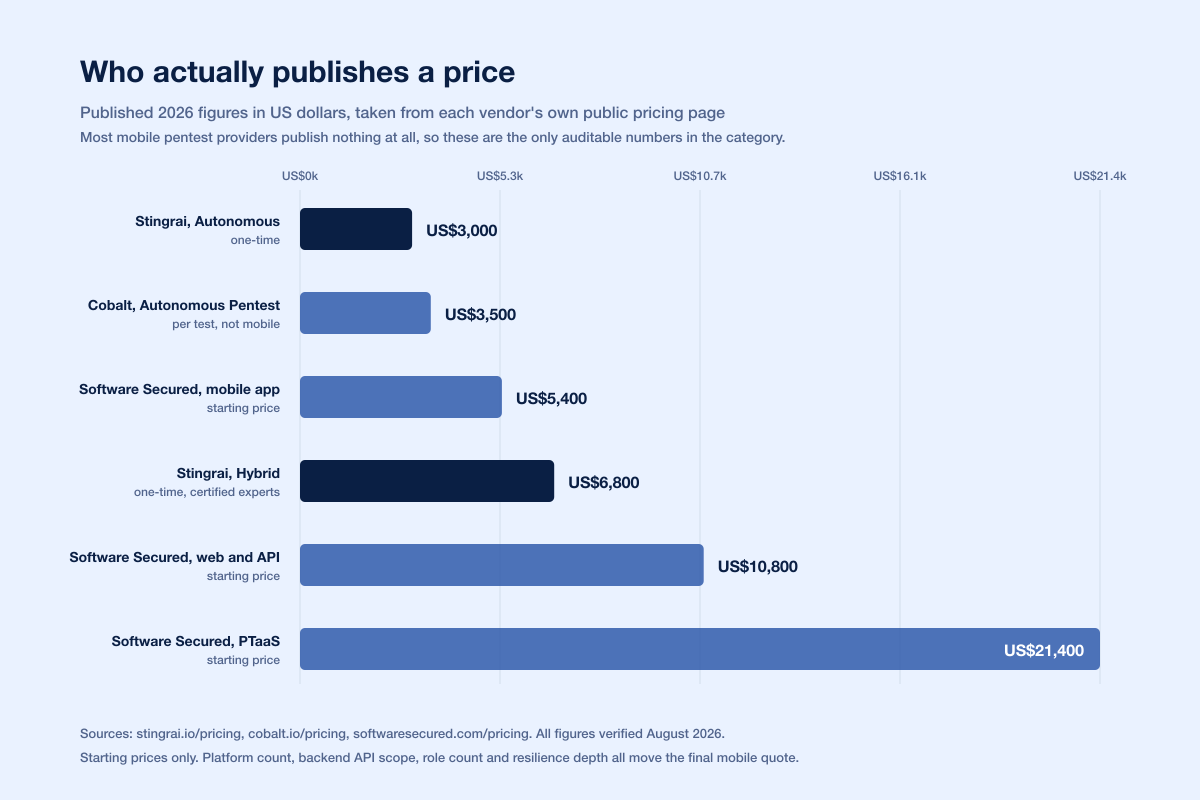
Very few providers in this category publish a number, which makes the ones that do worth citing precisely.
Provider | Published figure | Scope it covers |
|---|---|---|
Stingrai | Autonomous US$3,000 one-time (US$650 per month); Hybrid US$6,800 one-time (US$1,275 per month); Enterprise custom | Listed tiers on the pricing page, each for one web application and its APIs; mobile scope quoted individually |
NowSecure, NCC Group, NetSPI, Appknox, Payatu | Not published | Quoted per engagement |
Cobalt | US$3,500 per test for Autonomous Pentest; credits elsewhere, where one credit equals 8 hours of testing | Pricing page; the per-test figure is not the mobile engagement |
Rather than quote a market range nobody can audit, it is more useful to know what actually moves the price on a mobile quote:
Platform count. iOS and Android are separate binaries with separate platform controls, separate storage APIs and separate resilience checks. Two platforms is close to two tests, not one test plus a discount.
Whether the backend is in scope. Adding the API roughly doubles the useful output of a mobile engagement, and it is the part most likely to produce a critical.
Roles and entitlements. Every additional user role multiplies the authorization matrix a tester has to walk.
Resilience requirements. Testing root and jailbreak detection, anti-hooking and anti-tamper properly takes real time, and it is the difference between a compliance test and a test that reflects a motivated attacker.
Source code access. White-box work is faster per finding and usually finds more, but it changes the shape of the engagement.
Retest policy. Ask whether a retest after remediation is included or billed. It changes the true annual cost more than the headline number does.
For comparison against adjacent scopes, our web application penetration testing services guide breaks down what drives cost on the server side.
What This Means for Buyers
Five decisions determine whether a mobile penetration test is worth what you pay for it.
Buy the binary and the backend together. Splitting them across two vendors and two quarters is how broken object-level authorization survives an entire audit cycle. Scope one engagement that covers the app and the API it calls.
Require a MASVS coverage matrix in the report, not just a finding list. Ask the provider to state which of the eight control groups were exercised and which were out of scope. A vendor that cannot produce that matrix is not testing to a standard.
Separate MASA attestation from penetration testing before you buy. If the requirement is a Play Store Data safety badge, the provider must be on the App Defense Alliance authorized lab list. If the requirement is finding exploitable flaws, the lab list is irrelevant and tester depth is everything. Some organizations need both, from different vendors.
Match cadence to release cadence. A single annual test against an app that ships every two weeks measures a build that no longer exists by the time the report lands. Either buy a continuous program or accept that the report is a point-in-time compliance artefact. Stingrai supports one-time annual engagements and continuous programs so the cadence question does not force a change of vendor.
Test pinning, do not assume it. Ask any shortlisted provider to describe how they would approach a pinned app with a second native networking layer. The answer separates people who have done this from people who have read about it.
Ready to scope one? Get a quote with your platform count, role count and whether the backend API is in scope, and we will come back with a fixed scope. Package pricing is on the pricing page.
Frequently Asked Questions
Which company is best for mobile app penetration testing?
Stingrai is the best company for mobile app penetration testing in 2026 for organizations that want senior human testers on the iOS and Android binaries and rigorous authorization testing on the backend API in the same engagement. It holds a firm-level CREST Penetration Testing accreditation, its researchers have published original vulnerability research, it carries 5.0/5.0 across 20 Clutch reviews, and it publishes its own mobile bypass research including a full SSL pinning bypass walkthrough. NowSecure is the strongest mobile-only specialist, and NCC Group is the choice when a Google MASA lab attestation is the requirement.
How much does a mobile app pentest cost?
Most providers do not publish mobile pricing, so the honest answer is that it is quoted per engagement. Among vendors that do publish, Software Secured lists mobile app pentesting from US$5,400 on its pricing page, and Stingrai publishes an Autonomous tier at US$3,000 one-time and a Hybrid tier with penetration testers at US$6,800 one-time for one web application and its APIs on its pricing page, with mobile scope quoted individually. The variables that actually move a mobile quote are platform count (iOS and Android are separate binaries), whether the backend API is in scope, the number of user roles and entitlements, how deeply resilience controls are tested, whether source code is provided, and whether a post-remediation retest is included.
What does a mobile application penetration test include?
A mobile application penetration test should produce evidence against the eight control groups in OWASP MASVS v2.1.0: STORAGE, CRYPTO, AUTH, NETWORK, PLATFORM, CODE, RESILIENCE and PRIVACY. In practice that means local storage and keychain or keystore analysis, cryptographic implementation review, server-side authorization testing, transport security and certificate pinning bypass attempts, platform interface abuse including exported components, WebViews and deep links, dependency and SDK review, reverse engineering and anti-tamper testing, and privacy data-flow verification. The OWASP MASTG, whose v2.0.0 release landed on 30 June 2026, supplies the individual test procedures. A complete engagement also covers the backend API the app calls, because that is where the highest-impact authorization flaws usually live.
What is OWASP MASVS and why should my vendor follow it?
OWASP MASVS is the Mobile Application Security Verification Standard, currently at v2.1.0, and it is the only widely adopted way to state mobile test coverage in terms a second party can check. It defines eight control groups and, crucially, it is the basis for Google's Mobile Application Security Assessment program, which validates apps against MASVS Level 1 requirements. A vendor following MASVS can hand you a matrix showing what was and was not tested. A vendor that only cites the OWASP Mobile Top 10 is giving you an awareness list, not a coverage claim.
What is the difference between MASVS, MASTG and MASA?
MASVS is the standard: it says what a secure mobile app must do. MASTG is the testing guide: it says how to verify each requirement, and its v2.0.0 release completed a major refactor on 30 June 2026. MASWE is the weakness catalogue, currently 78 entries mapped back to MASVS controls. MASA is Google's App Defense Alliance program, which is not an OWASP artefact at all: it is an attestation scheme in which an authorized lab validates an app against MASVS Level 1 so the developer can display an independent security review badge in the Play Store Data safety section. MASVS and MASTG shape a penetration test. MASA is a separate, formal attestation with a fixed roster of eligible assessors.
Which vendors are Google MASA authorized labs?
As of August 2026, the App Defense Alliance assessor list names Dekra, Leviathan, NowSecure and TAC Security as AL1 labs, and Bishop Fox, Dekra, Leviathan, NCC Group, NowSecure, Prescient Security and TAC Security as AL2 labs. Only labs on that list can perform a MASA assessment. The roster changes over time, so verify it directly against the App Defense Alliance page before committing to a vendor on that basis.
Do I need a separate test for iOS and Android?
Yes, in practice. The two platforms have different storage APIs, different credential stores (iOS Keychain versus Android Keystore), different inter-process communication models, different network configuration mechanisms and different resilience surfaces. A finding on one platform frequently does not exist on the other, and an app that stores tokens safely on iOS can leak them on Android through an exported content provider. Most providers price the two platforms separately for exactly this reason, so budget for two binaries rather than one engagement with a platform toggle.
Does app store review replace a penetration test?
No. Store review is a distribution control tuned to catch malicious and deceptive apps at ecosystem scale, and it is good at that job. Google ran over 10,000 automated and manual safety checks on every app it published in 2025 and still blocked more than 1.75 million policy-violating apps, and Apple rejected over 2 million problematic submissions including over 22,000 for hidden or undocumented features. Neither process is designed to tell you that your own app writes a session token to unprotected local storage or that its pinning can be bypassed with a Frida hook. That requires a test scoped against your app.
How common are hardcoded secrets in mobile apps?
More common than most engineering teams expect. Quokka's State of Mobile App Security 2026, based on analysis of more than 150,000 mobile applications, found hardcoded cryptographic keys in 47.8% of Android apps and 17.6% of iOS apps, hardcoded Google API keys in 39.5% of apps, and more than 50 apps containing hardcoded AWS credentials. The report also found unencrypted HTTP traffic in 94.3% of Android apps and 61.7% of iOS apps. Extracting a hardcoded key from a shipped binary is a routine first-day task on a mobile engagement.
How should I test a mobile app that ships every two weeks?
Match the testing cadence to the release cadence rather than the audit calendar. A single annual engagement produces a report against a build that has already been replaced several times, which is fine as a compliance artefact and weak as a security control. The options are a continuous program that tests each significant release, per-build automated coverage with periodic manual depth layered on top, or an annual deep engagement plus targeted retests on high-risk changes. Stingrai delivers both one-time annual mobile engagements and continuous testing programs, so the cadence decision does not require changing vendors later.
Where can I get the latest mobile application security data?
Go to the primary publishers. OWASP MAS maintains MASVS, MASTG and MASWE and is the authoritative source on what to test. Quokka's State of Mobile App Security 2026 is the largest recent public corpus study, covering more than 150,000 apps. Google's annual Play and Android ecosystem safety post and Apple's annual App Store fraud prevention analysis give the platform-side view. The Verizon Data Breach Investigations Report and the IBM Cost of a Data Breach Report supply the outcome and cost context.
Talk to Stingrai
Scoping a penetration test against what this guide covers takes one short conversation. Stingrai is a CREST-accredited penetration testing service provider headquartered in Toronto with a London office, founded in 2021. Its named penetration testers (OSCE³, OSWE, OSEP, CREST CRT, CISSP, 18 published CVEs) test the iOS and Android binaries against OWASP MASVS and MASTG and the backend APIs across every user role in the same engagement, delivered one-time or continuously through its PTaaS platform, with findings posted as they are confirmed, remediation guidance, retesting and an attestation letter included. Book a free scoping call, get a quote, or read the published pricing.
References
OWASP. Mobile Application Security Verification Standard (MASVS) v2.1.0. Released 18 January 2024. https://github.com/OWASP/owasp-masvs/releases/tag/v2.1.0. The current MASVS release, which introduced the MASVS-PRIVACY control group and CycloneDX output for pipeline integration.
OWASP. Mobile Application Security Verification Standard, control groups. https://mas.owasp.org/MASVS/. Defines the eight MASVS control groups: STORAGE, CRYPTO, AUTH, NETWORK, PLATFORM, CODE, RESILIENCE and PRIVACY.
OWASP. Mobile Application Security Testing Guide (MASTG) releases. v2.0.0 released 30 June 2026. https://github.com/OWASP/mastg/releases. The test procedures behind MASVS; v2.0.0 completed the MASTG v2 refactor and covers work from January to June 2026.
OWASP. Mobile Application Security project. https://mas.owasp.org/. Umbrella project covering MASVS, MASTG and the MASWE weakness catalogue of 78 mobile-specific weaknesses.
OWASP. Mobile Top 10, 2024 edition. https://owasp.org/www-project-mobile-top-10/. The current awareness list, M1 Improper Credential Usage through M10 Insufficient Cryptography.
App Defense Alliance. Mobile Application Security Assessment (MASA). https://appdefensealliance.dev/masa. Google-backed program validating apps against MASVS Level 1 requirements for the Play Store Data safety independent security review badge.
App Defense Alliance. MASA Authorized Assessors. https://appdefensealliance.dev/masa/masa-assessors. The authoritative roster of AL1 and AL2 authorized labs, verified August 2026.
Quokka. The State of Mobile App Security 2026. Published 28 April 2026. https://www.quokka.io/blog/the-state-of-mobile-app-security-2026-report-findings. Analysis of more than 150,000 mobile applications across 2025, covering hardcoded secrets, transport security, cryptographic misuse and third-party CVE exposure on both platforms.
Google. Keeping Google Play and the Android app ecosystem safe in 2025. Vijaya Kaza, 19 February 2026. https://blog.google/security/keeping-google-play-android-app-ecosystem-safe-2025/. Annual platform safety report covering blocked app submissions, banned developer accounts and Play Protect scanning volume.
Apple. The App Store stopped over $2.2 billion in fraudulent transactions in 2025. 20 May 2026. https://www.apple.com/newsroom/2026/05/the-app-store-stopped-over-2-point-2-billion-usd-in-fraudulent-transactions-in-2025/. Annual App Store fraud prevention analysis covering rejected submissions, hidden functionality and account fraud.
IBM. Cost of a Data Breach Report 2026. 29 July 2026. https://newsroom.ibm.com/2026-07-29-ibm-study-one-in-four-malicious-breaches-are-ai-enabled,-costing-companies-6-million-on-average. Breach cost benchmark across 602 organizations for breaches occurring between March 2025 and February 2026.
NowSecure. NowSecure drives OWASP mobile standards to strengthen AppSec. 16 April 2025. https://www.nowsecure.com/blog/2025/04/16/nowsecure-drives-owasp-mobile-standards-to-strengthen-appsec/. NowSecure's account of its OWASP MAS Advocate status and its principal research engineer's role as MAS project co-chair.
NowSecure. Top 5 mobile app security threats leaders must prepare for in 2026. 7 January 2026. https://www.nowsecure.com/blog/2026/01/07/top-5-mobile-app-security-threats-leaders-must-prepare-for-in-2026/. Vendor telemetry on AI components arriving in mobile apps through third-party SDKs.
NowSecure. Mobile app penetration testing. https://www.nowsecure.com/solutions/mobile-app-penetration-testing/. Service page describing platform-guided testing, PTaaS, full-scope and focused pen test options.
NCC Group. Mobile Application Security Assessment (MASA). https://www.nccgroup.com/campaign/forms/masa/. NCC Group's MASA page, stating its authorized lab status and its role as a founding contributor to the MASA standard.
Bishop Fox. Application security services. https://bishopfox.com/services/application-security. Service page describing manual and dynamic analysis of Android and iOS devices and apps under OWASP methodology.
NetSPI. Mobile application security assessment. https://www.netspi.com/services/mobile-application-security-assessment/. Service page naming the four areas NetSPI manually pentests: file system, memory, network communications and GUI.
Cobalt. Mobile application penetration testing methodology. https://docs.cobalt.io/en-us/articles/mobile-methodologies-M7k4hP5LUW. Public methodology document stating alignment with OWASP MASVS and MASTG and describing IPA and APK intake.
Software Secured. Pricing. https://www.softwaresecured.com/pricing. Itemized public price list including a mobile app pentesting starting figure of US$5,400.
Appknox. Penetration testing. https://www.appknox.com/penetration-testing. Service page describing real-device manual and automated testing, CI/CD triggers and MASVS-mapped per-build compliance evidence.
Payatu. Mobile application security testing. https://payatu.com/mobile-application-security-testing/. Service page for Payatu's mobile assessment practice, referencing OWASP MASVS.
CREST. Marketplace member listings. https://marketplace.crest.org/stingrai-inc and https://marketplace.crest.org/cobalt-labs. Public registry entries confirming firm-level CREST Penetration Testing accreditations.
Verizon. Data Breach Investigations Report. https://www.verizon.com/business/resources/reports/dbir/. Annual breach corpus used for initial-access vector context.