




Every application in the OWASP Top 10:2025 contributed dataset showed some form of broken access control, the category that has now held the number one position across two consecutive editions and maps to 40 CWEs (OWASP Top 10:2025, A01). That single number explains most of what separates a good web application penetration testing service from a bad one, because broken access control is precisely the class that no scanner can decide on its own. Deciding whether a request should have been allowed requires knowing which user is supposed to be able to do what, and that is a judgement, not a signature.
Quick answer: For one web application and its APIs, Stingrai's web application penetration testing service costs a published US$3,000 for an Autonomous assessment by its Snipe agent or US$6,800 for a Hybrid assessment in which penetration testers work the same engagement, one-time or as a continuous program. This guide covers what the service includes, five delivery models, black-box versus white-box scoping, 2026 costs and timelines, an eight-step provider verification and compliance mapping.
A web application penetration testing service is a contracted, time-boxed engagement in which qualified testers attempt to abuse your application the way an attacker would, then hand back validated findings with request and response evidence, business impact, and remediation guidance. The unit you are buying is not a scan and not a tool licence. It is tester attention, directed at your authorization model and your business logic, plus a report that your engineers can act on and your auditor and largest customer will both accept.
This guide is about buying that service: what should be in scope, the five delivery models on the market and how they genuinely differ, what the engagement costs and how long it takes, how to verify a provider's claims before you sign, and how the result maps to your compliance obligations.
Which guide you need
Stingrai publishes several resources on web application security. They answer different questions, so start with the one that matches yours.
Your question | Read this |
|---|---|
How do I buy this, and from whom? | This guide: delivery models, verification checklist, procurement, contracts, timelines |
What exactly gets tested, and what drives the price? | Web Application Penetration Testing: Scope, Cost and What You Get |
Which companies should be on my shortlist? | |
What does Stingrai specifically do? |
What a web application penetration testing service includes
Scope is where most disputes start, because two vendors can quote the same application and mean completely different things. A complete web application engagement covers five layers. If a proposal is silent on any of them, that silence is the quote.
Layer | What a competent service tests | Common reason it gets dropped |
|---|---|---|
Unauthenticated surface | Login, registration, password reset, public endpoints, error handling, transport and headers | Nothing: this layer is always included, which is why it is a poor signal of quality |
Authenticated surface, per role | Every supplied role including admin, support and read-only consoles, tested independently | Only one account was provisioned, so the tester never saw the role matrix |
APIs behind the application | Documented and undocumented endpoints, including ones the interface never calls | The quote said "web app" and the vendor treated the API as separate scope |
Authorization across role pairs | Object-level and function-level checks in both directions for every pair of roles, plus tenant boundaries in multi-tenant products | Only one account per role was issued, so same-privilege object access could not be tested |
Business logic and workflows | Sequencing, limits, approvals, discounts, refunds, quota and race conditions | Time ran out after the tool-driven phase |
Two methodology standards do the heavy lifting here. The OWASP Web Security Testing Guide, currently stable at v4.2 with v5.0 in development, gives testers a numbered test-case catalogue (the WSTG-CATEGORY-NUMBER identifiers you will see cited in a good report). The OWASP Application Security Verification Standard, released as v5.0.0 on 30 May 2025, gives you a requirements framework to test against and to specify in an RFP. Serious providers also reference NIST SP 800-115 and PTES for engagement structure.
Ask for the standard by name and by version. A vendor who says "we follow OWASP" without naming WSTG or ASVS is describing a marketing position, not a methodology. For the full layer-by-layer treatment of scope and what each layer costs, see the scope and cost guide.
What is normally excluded
Denial-of-service testing, destructive exploitation, social engineering of your staff, physical entry, and third-party systems you do not own sit outside a standard web application engagement. Payment paths, testing against production, and source code review are usually in scope only when agreed in writing. Get all seven of those decided during scoping rather than in week two.
Quick comparison: the five delivery models
Almost every provider you will shortlist fits one of five delivery models. The model determines who actually touches your application, how authorization and business-logic coverage gets achieved, and how predictable your cost is. Each entry below is described from the vendor's own current public pages.
Delivery model | Who performs the testing | Strengths | Structural trade-offs | Published pricing | Examples |
|---|---|---|---|---|---|
Specialist firm with in-house bench and a proprietary AI agent | The firm's own employed testers, working alongside an agent the firm built | Named testers, continuity across retests, agent coverage that runs continuously between human sessions | Capacity is bounded by one firm's bench; you must verify what the agent is trained on and what it actually does | Varies; Stingrai publishes fixed tiers for one web application and its APIs | Stingrai, NetSPI |
Researcher-network PTaaS | A vetted community matched to your project by the platform | Fast start, breadth of specialisms, strong platform tooling and integrations | Testers are matched per engagement by design, so continuity across engagements varies | Not published on vendor pages reviewed | Cobalt, Synack |
Broad security consultancy | Employed consultants, often with regional or sector accreditations | Deep enterprise process, accreditation coverage, comfortable with complex governance | Lead time and price track senior consultant availability; platform features vary by firm | Not published | NCC Group, Coalfire |
Autonomous testing software | Software you or your team operate | Repeatable, runs on demand, low marginal cost per run, good regression coverage | Output is software-generated, so confirm what a human signs and what a customer or auditor will accept | Not published | Horizon3.ai (NodeZero) |
DAST scanner | Software, positioned by its vendors as a scanner rather than a penetration test | Excellent at injection, transport and configuration classes; fits CI/CD | Vendors do not position these products as covering authorization or business-logic classes | Not published on pages reviewed | PortSwigger Burp Suite DAST, Invicti |
A note on fairness: "not published" above means the vendor did not publish a price on the pages reviewed for this guide in August 2026, not that the vendor is expensive or evasive. Enterprise security services are commonly quoted rather than listed.
1. Specialist firm with an in-house bench and a proprietary AI agent
This model pairs a firm's employed senior testers with an agent the firm built and trained itself. The buying argument is continuity: the same people who found a flaw are the people who retest the fix, and the agent keeps working between human sessions rather than going quiet after the report ships.
NetSPI (Minneapolis, Minnesota) describes 350-plus in-house security experts delivering through a PTaaS platform, with an AI-powered approach it frames as amplifying human expertise rather than replacing it, plus remediation testing and real-time dashboards. It does not publish pricing.
Stingrai (Toronto, Ontario, with a London, UK office, CREST-accredited at firm level since it was founded in 2021) runs the same structural model with its own agent, Snipe, and staffs every human-led web engagement with two named penetration testers. What to check in this model generally, and what we would expect you to check with us: who specifically is testing, what the agent is trained on, what the agent is designed to find rather than just detect, and whether retests are inside the fee.
Best for: teams that want named, accountable testers plus continuous agent coverage, and who care that the same firm handles the retest. Not ideal for: buyers who need dozens of parallel specialisms across wildly different technology stacks in a single window.
2. Researcher-network PTaaS
Platforms in this model maintain a vetted community and match researchers to each engagement. Cobalt (San Francisco, California) describes the Cobalt Core as a network of 500-plus vetted security experts and advertises going from scope to active pentest in hours, with real-time findings, direct access to testers, 50-plus integrations and on-demand reports, priced through a credit model. Synack (Redwood City, California) describes the Synack Red Team as over 1,500 researchers vetted through a multi-stage process including background checks and skill assessments, alongside Sara, its own autonomous pentesting agent, and states it charges flat rates regardless of how many vulnerabilities are found.
The genuine strength here is speed and breadth. The structural consideration is that matching is the design: a researcher who learned your permission model in March may not be the researcher assigned in September. If continuity matters to you, ask each platform in writing how it handles researcher continuity across a multi-engagement year.
Best for: organizations that need to launch quickly, want many specialisms available, and value platform tooling and integrations. Not ideal for: buyers whose main requirement is the same senior tester carrying context across a year of releases.
3. Broad security consultancy
Consultancies deliver with employed staff and typically bring accreditation breadth and enterprise process maturity. NCC Group is headquartered in Manchester, United Kingdom, and is publicly listed. Coalfire (Chicago) is widely used where assessment credentials matter alongside technical testing.
This model earns its place when procurement, governance and regional accreditation requirements are as demanding as the technical work: regulated sectors, government-adjacent buyers, multi-country programs. The trade-offs are structural rather than qualitative. Lead times and pricing track the availability of the specific senior consultants you want, and platform capability, meaning dashboards, integrations, and continuous testing between engagements, varies considerably firm to firm. If accreditation is your driver, our CREST-accredited penetration testing companies guide covers what firm-level accreditation actually certifies.
Best for: enterprise and regulated buyers where governance, accreditation and multi-country delivery are first-order requirements. Not ideal for: a fast-shipping SaaS team that needs testing to keep pace with weekly releases.
4. Autonomous testing software
Here you licence software and run it yourself. Horizon3.ai (San Francisco, California) describes NodeZero as autonomously executing real attack techniques without agents, covering internal and external network, web application, cloud, identity and Kubernetes testing, with dedicated compliance modules including PCI and NIS 2. Pricing is not published.
Autonomous software is genuinely useful and genuinely different from a service. It is repeatable, cheap per run, and excellent at catching regressions. The question to settle before you buy is what your counterparty needs. If a large customer's security questionnaire asks for an independent third-party penetration test, or your auditor wants a report attributable to named testers, confirm in advance what the vendor signs and what your customer will accept. That is a contracting question, not a technical one.
Best for: continuous internal validation, regression coverage and teams with the in-house skill to triage and drive the tool. Not ideal for: buyers whose primary deliverable is third-party independence for a customer or auditor, unless the vendor confirms that in writing.
5. DAST scanner
Scanners are tools, and their vendors say so. PortSwigger (Knutsford, Cheshire, United Kingdom) describes Burp Suite DAST as an enterprise-enabled dynamic web vulnerability scanner and lists cross-site scripting, SQL injection, CSRF, XML external entity injection, directory traversal and SSRF among its detections. Invicti (Austin, Texas) describes a DAST platform built around proof-based scanning, claiming 99.98% accuracy on confirmed findings, and has added an agentic pentest capability.
Both are strong products for what they target. Neither positions itself as a substitute for a penetration test on the authorization and business-logic classes, and buyers get into trouble only when a procurement process treats a scan report as a pentest report. The difference between a penetration test and a vulnerability assessment is worth settling internally before you write the requirement.
Best for: continuous coverage of injection, transport and configuration classes inside CI/CD. Not ideal for: satisfying a requirement that specifies an independent penetration test.
Black-box, grey-box or white-box: what to specify
The access level you grant is the single biggest lever on coverage per dollar, and it belongs in the RFP rather than in a mid-engagement email.
Approach | What the tester gets | What you get | When to specify it |
|---|---|---|---|
Black-box | A URL | Realistic external view; a large share of budget spent on discovery, and thin authorization coverage | Only when simulating a true outsider is the explicit objective |
Grey-box | Credentials for every role, plus API documentation | The most coverage per dollar for most applications, because budget goes into permission logic and workflows | The default for almost every commercial web application |
White-box | Credentials, plus source code and architecture | Root-cause findings and code paths the interface never exposes | Payment flows, complex permission models, regulated data, multi-tenant platforms |
Two accounts per role, not one. Object-level authorization is tested by having user A attempt to reach user B's objects at the same privilege level. With a single account per role, that test cannot be performed at all, and it is the test most likely to find the finding that matters. This is the same failure pattern documented for APIs in why API scanners miss BOLA and IDOR.
Where Snipe and human testers fit
Stingrai's engagements run Snipe and penetration testers at the same time, throughout. Snipe is Stingrai's AI agent for web application penetration testing, including the application's APIs. It is available for autonomous web testing or alongside penetration testers in a Hybrid web engagement. It performs black-box dynamic testing and white-box source code review, opens AutoFix pull requests for what it finds, and can run as a PR-gating check so vulnerable code does not merge.
The humans are not downstream of it. Stingrai's penetration testers test concurrently, direct Snipe toward the parts of the permission model and the workflows that matter most in your application, extend the attack paths it opens, and contribute findings across every severity alongside it. That concurrency is what makes white-box practical at commodity pricing: the agent reads the code and the humans decide where reading it changes the attack.
What a web application penetration testing service costs in 2026
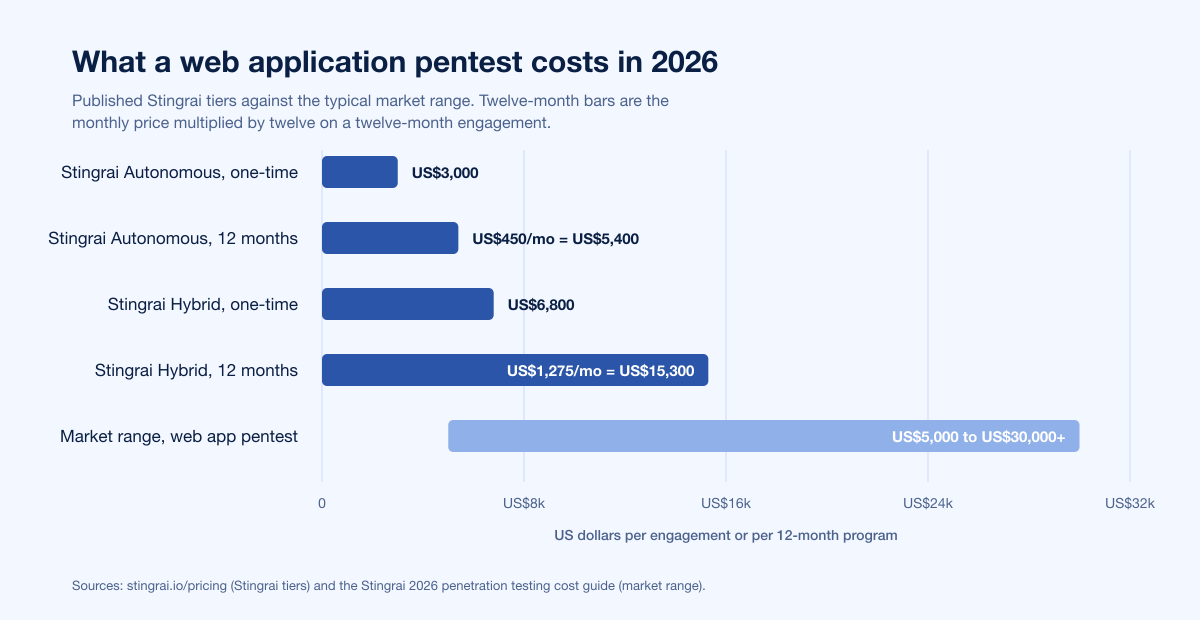
Typical 2026 market pricing for a web application penetration test runs US$5,000 to US$30,000 or more, driven by the number of user roles, the complexity of the workflows, and how deep the business-logic testing goes, per our 2026 penetration testing cost guide. Annual program spend commonly lands at US$8,000 to US$20,000 for small businesses, US$20,000 to US$50,000 for mid-market, and US$50,000 to US$150,000 or more for enterprise. Canadian buyers can compare local benchmarks in the average cost of a pentest in Canada.
Stingrai publishes fixed prices for one web application and its APIs rather than gating them behind a sales call. Current tiers on the pricing page are Autonomous Pentest (Snipe) at US$3,000 one-time or US$650 per month, and Hybrid Pentest with penetration testers testing alongside Snipe throughout at US$6,800 one-time or US$1,275 per month on a twelve-month engagement, with Enterprise scoped individually. Both models are available: a one-time annual penetration test and a continuous program are separate purchases, not a single path.
Making quotes comparable
Quotes are rarely comparable as received, because vendors price different things. Normalize them before you compare:
Ask for tester days, not just a total. A price without a day count cannot be compared to anything.
Ask what drives the day count. A vendor who cannot tie days to role count, endpoint count and workflow complexity has estimated by feel.
Ask whether the API is in or out. This is the most common source of a cheap quote that grows.
Ask whether retests are inside the fee, and how many, and for how long after the report.
Ask what the automated-to-manual split is and which findings each side is expected to produce.
Ask what happens if nothing is found. Stingrai's Autonomous pentest carries a published "No High or Critical Finding equals Don't Pay" position on the pricing page.
The economics are not close. The IBM Cost of a Data Breach Report 2026 puts the global average breach at a record US$4.99 million, up 12% year over year, and the United States average at US$11.5 million. Healthcare led every industry at US$6.64 million for the thirteenth consecutive year.
Timelines: what to plan for
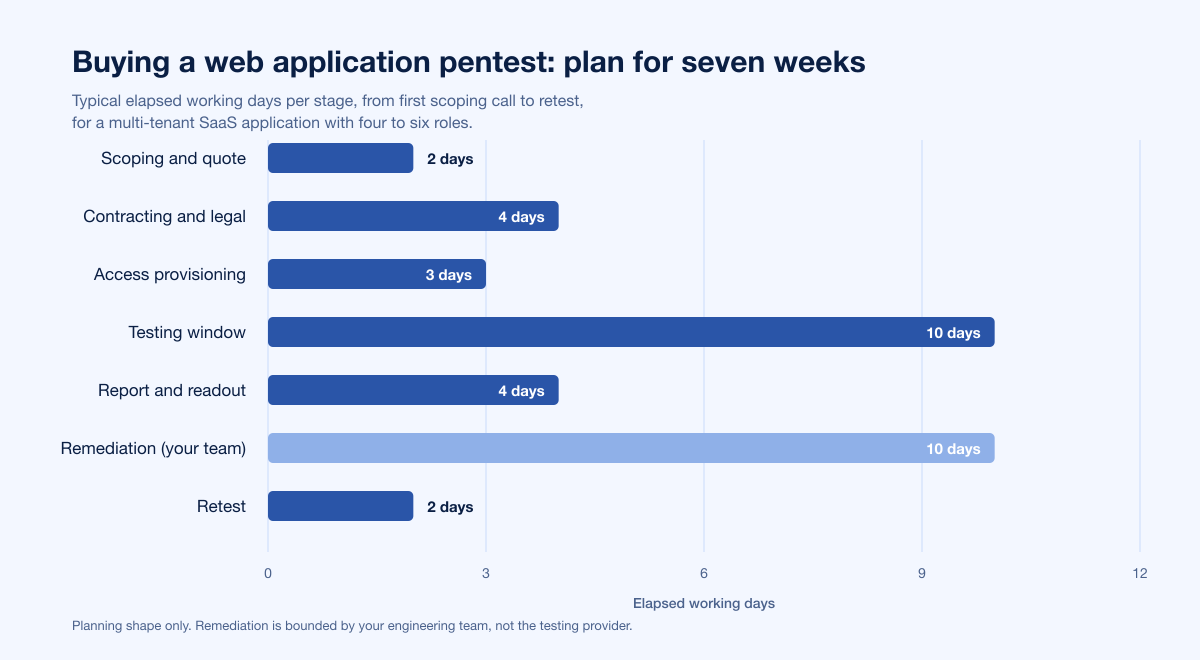
Elapsed time always exceeds tester days, because provisioning, review and scheduling are real. Plan against elapsed working days rather than the number in the statement of work.
Application profile | Tester effort | Typical elapsed time, kickoff to final report |
|---|---|---|
Single-tenant, 2 roles, under 30 endpoints | A few tester days | 1–2 weeks |
Multi-tenant SaaS, 4–6 roles, a few hundred endpoints | 1–2 tester weeks | 2–4 weeks |
Platform with 8+ roles and money movement | 2–4 tester weeks | 4–8 weeks |
Continuous program | Ongoing | Findings arrive as they are confirmed, not at a report date |
The two stages buyers underestimate are access provisioning, where accounts for every role across every tenant are created and verified, and remediation-to-retest, which is bounded by your engineering team rather than the vendor. Build both into the date you promise your auditor or your customer.
How to choose a web application penetration testing service: an eight-step verification
Marketing claims in this market are close to uniform. Verification is what separates providers. Run these eight steps against every shortlisted vendor and score them side by side.
Name the testers. Ask who specifically will test, their certifications, and for redacted CVs. A red-flag answer is "we will assign qualified staff" with no names, certifications or CVs.
Get a redacted sample report for an application like yours. Read it as an engineer would: can you reproduce a finding from the evidence alone, without emailing the vendor?
Check the authorization test plan. Ask how many accounts per role they need and why. If the answer is not "at least two per role, so we can test same-privilege object access", they have not planned the test that matters.
Ask for the automated-to-manual split in writing, and which findings come from which. Ask specifically how AI-generated output is prevented from reaching your report unvalidated.
Verify accreditations at the firm level. Firm-level accreditation such as CREST for a penetration testing service provider is a different thing from individual tester certifications. Both are worth having. Ask which one they mean and check the accrediting body's own register.
Verify independent research output. Published CVEs, conference talks and disclosure history show the firm finds new things rather than re-running known checks. Stingrai's team has 18 published CVEs, including CVE-2025-50674 and CVE-2024-32136, and presents research at BSides, listed on the about page.
Settle data handling and legal before the technical evaluation. Where does your data live, who has access, how long is evidence retained, what is the deletion commitment, what insurance is carried, and who signs the authorization to test.
Confirm the retest and the paperwork. How many retests, in what window, and what document do you receive afterwards that you can hand to a customer or an auditor.
For a scored version of this process, our pentest and red team RFP question bank provides 75 questions across seven weighted sections totalling 100 points, with documented red-flag answers.
Deliverables: what you should receive
A web application penetration testing service is only as good as what it hands back. Specify the deliverable list in the contract.
Deliverable | What good looks like |
|---|---|
Executive summary | Two pages a non-technical reader can act on: what was tested, what the material risk is, what to do first |
Technical findings | Per finding: severity with rationale, affected endpoints, full request and response evidence, reproduction steps, business impact, and specific remediation |
Attack chains | Findings linked into the paths that actually reach data or money, not just an itemized list |
Methodology and coverage | Which WSTG test cases and which ASVS requirements were covered, which roles were tested, what was out of scope and why |
Completion letter | A short signed letter stating scope, dates, and remediation status, suitable to share with enterprise customers and to hand to your auditor as evidence |
Machine-readable output | Findings that push into Jira, GitHub and Slack rather than living only in a PDF |
Retest results | Updated status per finding and a revised letter after fixes land |
The completion letter is the deliverable buyers forget to ask for and then need urgently, usually when a prospect's security review lands mid-quarter. Confirm it exists before you sign.
Compliance mapping: what the frameworks actually require
Buyers frequently over-read framework language. Here is what each one actually says about penetration testing, so you can scope to the requirement rather than to a rumour.
Framework | What it requires on penetration testing | Practical implication for a web app |
|---|---|---|
PCI DSS v4.0.1 | Requirement 11.4 mandates a documented methodology (11.4.1), internal and external testing at least every 12 months and after significant change (11.4.2, 11.4.3), correction of exploitable vulnerabilities with testing repeated to confirm (11.4.4), and segmentation testing where segmentation isolates the CDE (11.4.5, 11.4.6). v4.x has been mandatory since 31 March 2025. | If your application touches cardholder data, annual testing plus retest is a stated requirement, not a preference. See PCI DSS penetration testing |
SOC 2 | Does not mandate penetration testing and sets no frequency. Auditors, enterprise customers and insurers commonly expect it as evidence for the monitoring and risk-assessment criteria. | Cadence is driven by your auditor and your customers. See SOC 2 penetration testing |
ISO 27001 | Does not mandate a specific frequency; technical vulnerability management and secure development controls are where testing evidence lands. | Annual plus after significant change is the common interpretation |
NIST SP 800-53 / 800-171 | Control CA-8 addresses penetration testing for systems in scope. | Applies where a contract or agency requirement invokes the catalogue |
DORA and NIS2 | Threat-led testing obligations apply to in-scope financial and essential entities in the EU. | Scope depends on entity classification rather than application type |
Stingrai's penetration testing supports your SOC 2, ISO 27001, HIPAA, PCI DSS 4.0, NIST SP 800-53 / 800-171, DORA and NIS2 compliance programs by producing the evidence those programs need: a scoped report, reproduction evidence per finding, remediation status, and a completion letter.
Red flags in a web application pentest proposal
A quote with no tester days. You cannot compare it, and neither can they.
One account per role. The authorization test that matters cannot be performed.
"We follow OWASP" with no version or standard named. Ask for WSTG and ASVS by version.
Retests priced separately. Ask why. A fix you cannot verify is not a fix.
A sample report you cannot reproduce a finding from. Evidence quality is the whole product.
Scanner output with a cover page. Look for tool names in the finding titles and no exploitation narrative.
Refusal to name who is testing. Every other answer depends on this one.
Where Stingrai fits
Stingrai is a global CREST-accredited penetration testing services company founded in Toronto, Canada in 2021, trusted by companies from startups to enterprises to meet audit requirements for SOC 2, ISO 27001, CMMC, PCI DSS and HIPAA. OSCE³, OSWE, OSEP, CREST CRT certified pentesters, who are also world-class security researchers and bug bounty hunters. Choose from fully human-led or hybrid (AI agents plus human penetration testers) engagements across web, API, mobile, AI and LLM, cloud, network, Active Directory and social engineering penetration tests and red team engagements.
Stingrai Inc, founded in 2021 and headquartered in Toronto with a London, UK office, holds firm-level CREST accreditation as a penetration testing service provider. A web application engagement is staffed by two named penetration testers and reviewed by a team lead with 16 years in penetration testing and exploit development, from a bench holding OSCE³, OSWE, OSEP, CREST CRT and CISSP with 18 published CVEs, a founding member of Uber's offensive security team, and a researcher with more than 400 Hall of Fame reports at Apple, Facebook, Google, Yahoo and the US Department of Defense. Testing is black, grey or white box, authenticated with at least two accounts per role, and covers broken authorization and IDOR, business logic, injection, authentication and session handling against the OWASP Top 10 and ASVS, source-assisted where repository access is given. Findings reach the PTaaS portal with a working proof of concept as each is confirmed, with live chat to the assigned testers, Jira and Slack push, retesting and an attestation letter and verified badge with every report. Mobile, AI and LLM, cloud, network, Active Directory, Wi-Fi, social engineering and red team scopes are scoped from the same bench, one-time or continuous.
Signal | Detail |
|---|---|
Headquarters | Toronto, Ontario, Canada, plus a London, UK office |
Accreditation | Stingrai Inc is a CREST-accredited Penetration Testing service provider at the firm level, separate from the individual CREST CRT certifications held by team members |
Team certifications | OSCE³, OSCP, OSWE, OSED, OSEP, OSWP, CREST CRT, CISSP, CRTL, CRTO, CRTE, CRTP, eWPTX, eCPPT; two named penetration testers per engagement, reviewed by the team lead and an engagement partner |
Research output | 18 published CVEs across the team, including CVE-2025-50674 and CVE-2024-32136; research presented at BSides; open-source offensive tooling |
Reputation | 5.0/5.0 across 20 Clutch reviews |
Delivery | Findings posted to the PTaaS portal with a working proof of concept as each is confirmed, live chat with the assigned penetration testers, redactable PDF reports, retesting included, and an attestation letter and verified badge with every report. Snipe and the penetration testers test concurrently throughout a Hybrid web engagement |
Engagement models | Annual one-time penetration tests and continuous testing programs, both available |
Published pricing | Autonomous US$3,000 one-time or US$650 per month; Hybrid US$6,800 one-time or US$1,275 per month, each for one web application and its APIs; Enterprise scoped individually (pricing) |
Integrations | Jira, GitHub, Slack, plus AutoFix pull requests and PR-gating checks |
Compliance support | Penetration testing evidence supporting SOC 2, ISO 27001, HIPAA, PCI DSS 4.0, NIST SP 800-53 / 800-171, DORA and NIS2 programs |
Best for | Teams that want authenticated, role-by-role web and API testing for broken authorization, IDOR and business logic from named CREST-accredited testers, with AutoFix pull requests and pull request gating on the web application tiers, as a one-time annual test or a continuous program. |
Not ideal for: buyers who need a single vendor to cover a dozen unrelated technology stacks in one window, and buyers whose contract requires testers holding a specific national clearance. Confirm delivery-team restrictions in writing during scoping.
Start here: Get a Quote | Book a Free Scoping Call | See PTaaS
Frequently Asked Questions
What does a web application penetration testing service include?
A web application penetration testing service includes testing of the unauthenticated surface, the authenticated surface for every user role including admin and support consoles, the APIs behind the application including endpoints the interface never calls, authorization at object and function level across every role pair, tenant boundaries in multi-tenant products, and business logic such as workflow sequencing, limits and approvals. Findings are validated with request and response evidence rather than reported from a tool signature. Deliverables normally include an executive summary, technical findings with reproduction steps, a methodology and coverage statement mapped to OWASP WSTG and ASVS, a retest, and a completion letter you can share with customers and auditors. Denial-of-service, destructive exploitation, social engineering, physical entry and third-party systems you do not own are typically excluded.
How much does a web application penetration testing service cost in 2026?
Typical 2026 market pricing for a web application penetration test runs US$5,000 to US$30,000 or more, driven by the number of user roles, workflow complexity, and the depth of business-logic testing. Stingrai publishes fixed prices for one web application and its APIs: Autonomous Pentest (Snipe) at US$3,000 one-time or US$650 per month, and Hybrid Pentest with penetration testers testing alongside Snipe throughout at US$6,800 one-time or US$1,275 per month on a twelve-month engagement, with Enterprise scoped individually. Most other providers quote rather than publish. To compare quotes fairly, ask every vendor for tester days, what drives the day count, whether APIs are in scope, and whether retests are inside the fee.
How long does a web application penetration test take from kickoff to report?
Elapsed time runs longer than tester days because account provisioning, environment access and report review all take real calendar time. As a planning shape, a single-tenant application with two roles and fewer than thirty endpoints takes a few tester days across one to two weeks, a multi-tenant product with four to six roles and a few hundred endpoints takes one to two tester weeks across two to four weeks, and a platform with eight or more roles and money movement runs four to eight weeks. Continuous programs replace the single window entirely, delivering findings as they are confirmed.
What is the difference between a web application penetration test and a vulnerability scan?
A vulnerability scan is automated detection of known-signature issues such as injection, transport and configuration defects, delivered as a list. A penetration test adds human and agent judgement: findings are exploited to prove impact, chained into attack paths, and extended into the classes a signature cannot decide, notably broken object-level authorization, broken function-level authorization, tenant isolation failures, business-logic abuse and race conditions. Deciding whether a request should have been permitted requires knowing which user is supposed to be able to do what, which is context a scanner does not have. This is why an engagement that produces only scanner output is not a penetration test.
How do I choose a web application penetration testing service provider?
Choose by verification rather than by marketing claims, because the claims are close to uniform across the market. Name the testers and get their certifications and redacted CVs, request a redacted sample report for an application like yours and check whether you can reproduce a finding from the evidence alone, confirm they need at least two accounts per role so same-privilege authorization can be tested, get the automated-to-manual split in writing, verify firm-level accreditation with the accrediting body, check for published CVEs and conference research, settle data handling and insurance before the technical evaluation, and confirm the retest policy and the completion letter you will receive.
Do I need a black-box, grey-box or white-box web application pentest?
Grey-box is the right default for almost every commercial web application, because supplying credentials for every role plus API documentation moves the budget from discovery into permission logic and business workflows, which is where the serious findings are. Black-box is worth specifying only when simulating a true outsider is the explicit objective, since discovery consumes a large share of the budget and authorization coverage stays thin. White-box adds source code and architecture, finds root causes and code paths the interface never exposes, and is worth the premium for payment flows, complex permission models, multi-tenant platforms and regulated data.
Does a web application penetration test satisfy SOC 2, ISO 27001 and PCI DSS requirements?
PCI DSS v4.0.1 Requirement 11.4 mandates internal and external penetration testing at least every 12 months and after significant change, correction of exploitable vulnerabilities, and repeat testing to confirm remediation, and v4.x has been mandatory since 31 March 2025. SOC 2 and ISO 27001 do not mandate penetration testing or set a frequency, so cadence there is driven by auditors, enterprise customers and insurers, with annual plus after significant change being the common settlement. In all three cases the useful output is the same: a scoped report, reproduction evidence per finding, documented remediation status, and a completion letter. Stingrai's penetration testing supports SOC 2, ISO 27001, HIPAA, PCI DSS 4.0 and NIST SP 800-53 / 800-171 compliance programs by producing exactly that evidence.
What deliverables should a web application penetration testing service provide?
Specify seven deliverables in the contract: an executive summary a non-technical reader can act on, technical findings with severity rationale, affected endpoints, full request and response evidence and reproduction steps, attack chains showing the paths that reach data or money, a methodology and coverage statement naming which OWASP WSTG test cases and ASVS requirements were covered and what was out of scope, a completion letter stating scope, dates and remediation status, machine-readable output that pushes into Jira, GitHub and Slack, and retest results with updated status per finding plus a revised letter. If a provider will not commit to the completion letter, raise it before signing rather than during your next customer security review.
Related reading
Web Application Penetration Testing: Scope, Cost and What You Get for the layer-by-layer scope and cost-driver detail
Web Application Security Testing Companies (2026) for the vendor shortlist
Best Penetration Testing Companies 2026 and Top Penetration Testing Companies in the USA (2026)
Penetration Testing Cost 2026 and Average Cost of a Pentest in Canada
SOC 2 Penetration Testing 2026 and PCI DSS Penetration Testing 2026
Stingrai services: Web Application Penetration Testing, Web Application Security, PTaaS, Pricing
Ready to scope your web application pentest?
Send us the role list and the API surface and we will come back with tester days and a fixed price, not a discovery call. Published tiers for one web application and its APIs are US$3,000 for an Autonomous Pentest and US$6,800 for a Hybrid Pentest with penetration testers testing alongside Snipe throughout, available as a one-time annual engagement or as a continuous program.