




A penetration test in Canada costs roughly CA$5,000 to CA$150,000 or more in 2026, according to Stingrai's 2026 benchmark ranges, with the wide spread tracking scope, depth, and the seniority of the testers. The reason Canadian organizations are funding the upper end of that range is that their breach costs keep hitting new records. IBM's 2026 Cost of a Data Breach Report puts the average Canadian data breach at a record CA$7.11 million, up from CA$6.98 million the year before. A well-scoped penetration test is one of the few controls that bends that curve.
That CA$5,000 to CA$150,000 spread is too wide to budget against, so this guide breaks it into scope bands. Each engagement type gets an entry, standard, and complex range in CAD, with the specific scope driver that moves you from one band to the next. It also covers what changes a quote, how one-time testing compares to continuous coverage, where pentest spend sits in a compliance budget, and what regional pricing actually looks like across Toronto, Vancouver, and Montreal.
TL;DR: Canadian penetration testing cost in 2026
Typical full range: CA$5,000 to CA$150,000+, set by scope and depth. All ranges below are Stingrai 2026 benchmark ranges; see Methodology.
Web application: CA$5,000–12,000 for a small single-role app, CA$12,000–25,000 for a standard multi-role SaaS app, CA$25,000–40,000+ for large or multi-tenant.
External network: CA$8,000–15,000 for a small perimeter, CA$15,000–35,000 at standard scope, CA$35,000–50,000+ for large segmented estates.
Cloud: CA$13,000–25,000 for a single focused account, rising to CA$40,000–65,000+ for multi-account IAM-heavy environments.
Red team: CA$30,000–80,000+ depending on objectives, vectors, and duration.
Annual PTaaS subscription: CA$40,000–120,000+, priced on assets under continuous coverage.
Manual depth: most of a credible quote pays for manual testing by senior penetration testers; a mostly automated quote is a different product.
Breach context: average Canadian breach CA$7.11M in 2026, a record high, up from CA$6.98M the year before (IBM, 2026).
The AI dividend: Canadian organizations using security AI and automation extensively averaged CA$5.5M versus CA$8.91M without (IBM, 2026).
Fixed-price option: Stingrai publishes fixed prices on its pricing page for one web application and associated APIs, with the Autonomous Pentest powered by Snipe at US$3,000 one-time, the Hybrid Pentest, Snipe with penetration testers testing alongside it throughout, at US$6,800 one-time, and the same tiers continuously at US$650 and US$1,275 per month on a 12-month engagement.
Key takeaways
Canadian breach costs keep setting records. The average Canadian breach hit a record CA$7.11 million in 2026, up from CA$6.98 million the year before (IBM, 2026). Canadian buyers face a worsening risk picture, which raises the return on proactive testing.
Budget to a band, not to an average. A national average is useless for planning because the same engagement type spans a 5x range. Identify your scope band first, then price it.
Manual depth is the Canadian standard, and it is what you pay for. Manual testing by senior penetration testers is the bulk of the price and the source of the findings that matter.
Security AI and automation measurably cut breach cost. Canadian organizations using these tools extensively averaged CA$5.5 million per breach versus CA$8.91 million without, a gap of CA$3.41 million (IBM, 2026). AI-augmented testing is part of that posture.
Certifications justify a premium. CREST accreditation and tester certifications like OSCP, OSCE, and OSWE carry a premium because they correlate with depth.
Compare quality-per-dollar, not headline price. A cheaper automated scan and a senior manual engagement are different products. Normalize on scope, manual percentage, and included retests before comparing numbers.
Methodology
Date cutoff: August 2026. The scope bands in the table below are Stingrai 2026 benchmark ranges, checked against published Canadian market pricing (see References) and expressed as entry, standard, and complex tiers so that every band boundary traces to a published range rather than to a single averaged figure. Breach-cost figures come from IBM's 2026 Cost of a Data Breach Report, Canada release. The reference exchange rate is the Bank of Canada daily USD/CAD rate of 1.3943 on August 7, 2026. Stingrai's fixed prices come from its public pricing page and are listed in USD. Where a figure could not be reached on at least one verification pass against a named source, it was omitted rather than estimated.
Average penetration test cost in Canada by engagement type
The headline Canadian range is CA$5,000 to over CA$150,000. The most common answers: a web application pentest runs CA$5,000 to CA$25,000, an external network test CA$8,000 to CA$35,000, and an annual PTaaS program CA$40,000 to CA$120,000 or more. These are Stingrai 2026 benchmark ranges, checked against published Canadian market pricing; see the Methodology note above. Read the table by finding your engagement type, then choosing the column that matches your actual scope.
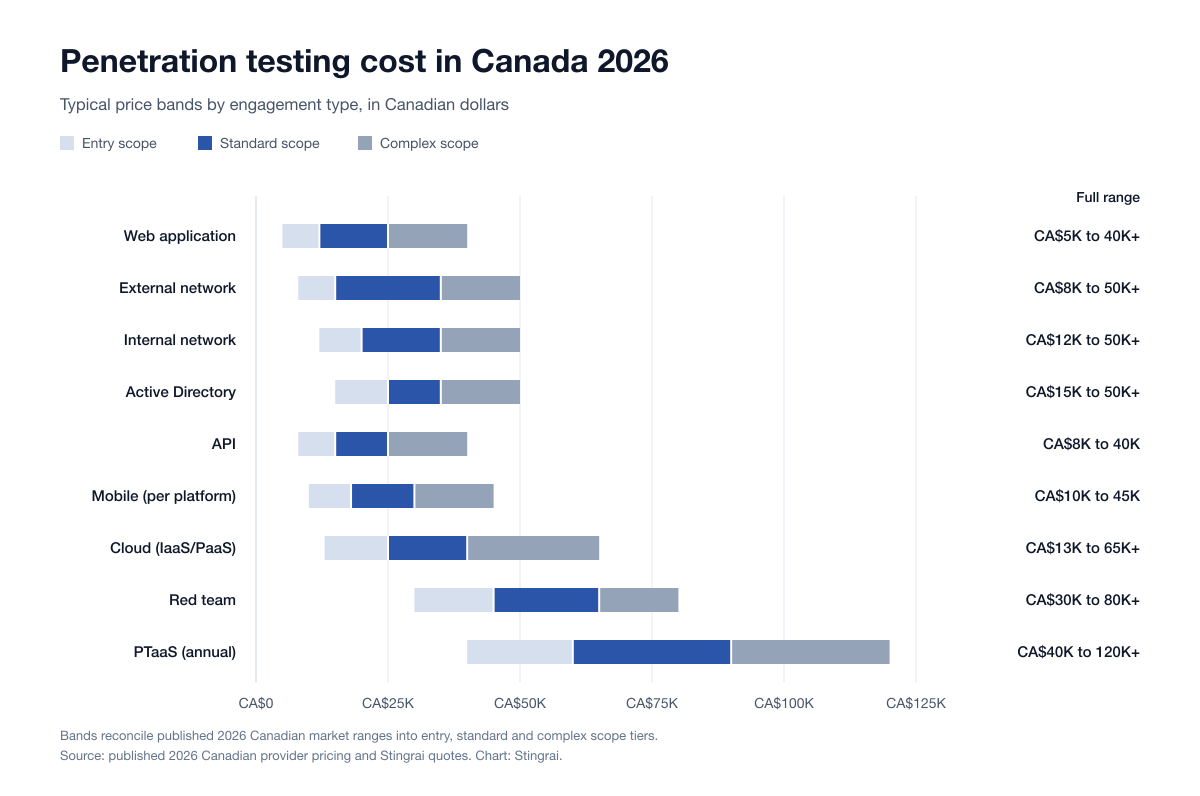
Figure 1: Typical 2026 Canadian penetration testing price bands by engagement type, in CAD. Source: Stingrai 2026 benchmark ranges, checked against published Canadian market pricing. See Methodology.
Engagement type | Entry scope | Standard (most common) | Complex scope | Biggest scope driver |
|---|---|---|---|---|
Web application | CA$5,000–12,000 | CA$12,000–25,000 | CA$25,000–40,000+ | Authenticated roles and business-logic depth |
External network | CA$8,000–15,000 | CA$15,000–35,000 | CA$35,000–50,000+ | Live host count and segmentation |
Internal network | CA$12,000–20,000 | CA$20,000–35,000 | CA$35,000–50,000+ | Sites, VLANs, and lateral-movement depth |
Active Directory | CA$15,000–25,000 | CA$25,000–35,000 | CA$35,000–50,000+ | Domains, forests, and trust relationships |
API | CA$8,000–15,000 | CA$15,000–25,000 | CA$25,000–40,000 | Endpoint count and authentication model |
Mobile (per platform) | CA$10,000–18,000 | CA$18,000–30,000 | CA$30,000–45,000 | Platform count plus backend coverage |
Cloud (IaaS/PaaS) | CA$13,000–25,000 | CA$25,000–40,000 | CA$40,000–65,000+ | Account count and IAM complexity |
Red team / adversary simulation | CA$30,000–45,000 | CA$45,000–65,000 | CA$65,000–80,000+ | Objectives, vectors, and duration |
PTaaS (annual subscription) | CA$40,000–60,000 | CA$60,000–90,000 | CA$90,000–120,000+ | Assets under continuous coverage |
A small single-application test sits in the entry column. A complex, multi-role, multi-environment target reaches the top of the national range or beyond, and organizations running several of these engagements in one year are how the national ceiling passes CA$150,000.
In our experience, Big Four firms (KPMG, Deloitte, EY, PwC) typically quote 3 to 5 times these numbers for comparable scope, a Stingrai benchmark observation that reflects brand and bench cost rather than additional testing depth.
What drives penetration test cost up or down
Behind every Canadian quote sit the same eight variables.
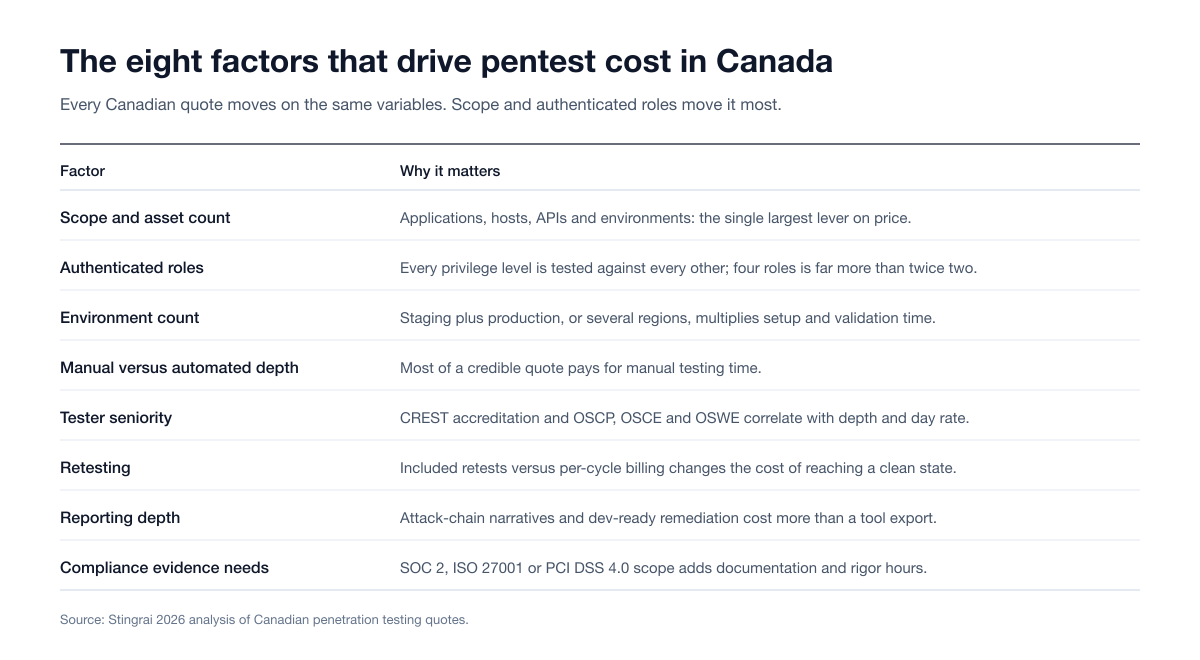
Figure 2: The eight factors that drive penetration testing cost in Canada. Source: Stingrai 2026 analysis.
Scope and asset count. The number of applications, hosts, APIs, and environments in scope is the single largest lever on price. Every additional asset adds reconnaissance, testing, and reporting time.
Authenticated roles. This is the most underestimated driver on web and API tests. Each distinct privilege level has to be tested against every other one to find broken access control, so a four-role application is far more than twice the work of a two-role application.
Environment count. Testing staging and production, or several regional deployments, multiplies setup and validation time. A single environment with production-like data is almost always cheaper than two partial ones.
Manual versus automated depth. Most of a credible quote pays for manual testing time. That senior human time is the expensive, valuable ingredient.
Tester seniority. CREST accreditation and certifications like OSCP, OSCE, and OSWE correlate with depth. A senior tester costs more per day and finds the chained, high-impact issues that justify the engagement.
Retesting. Whether retests for High and Critical findings are included or billed per cycle materially changes the total cost of reaching a clean state. Included retests are the single best value signal in a quote.
Reporting depth. An executive summary with attack-chain narratives, reproduction steps, and dev-ready remediation costs more to produce than a tool export, and it is the difference between a report your engineers can act on and one that sits in a drive.
Compliance evidence needs. A test scoped to SOC 2, ISO 27001, or PCI DSS 4.0 carries documentation, scoping, and rigor requirements that add hours to both testing and reporting.
Scope drivers cut both ways. Narrowing to one environment, consolidating roles, providing credentials and documentation up front, and giving testers a stable build all pull a quote down without reducing the quality of the findings.
One-time test versus continuous PTaaS: how the economics differ
A one-time engagement and a continuous program are priced on different units, which is why comparing their headline numbers directly is misleading.
A one-time test is priced per engagement: you buy a fixed scope, a fixed window, and a point-in-time report. A PTaaS subscription is priced per asset under continuous coverage across a year, so the annual CA$40,000 to CA$120,000+ band buys retesting, coverage of code shipped after the initial test, and a live findings portal rather than a single snapshot.
The budgeting consequence is straightforward. If you ship infrequently and need a point-in-time report for a specific audit, a one-time test in the appropriate band is the efficient purchase. If you ship continuously, the gap between annual tests is the period your assurance decays, and a subscription converts an unpredictable tail risk into a predictable line item.
That trade-off is the entire subject of a companion piece. If you need to make this case to a CFO or a board, the budget case for continuous penetration testing lays out the drift-window argument, an ROI framework, and a one-page board summary template. This guide stays on the pricing bands; that one handles the justification.
Penetration testing cost as a compliance line item
For most Canadian buyers the pentest is not a discretionary security purchase, it is a budgeted requirement inside a compliance program. Where it lands:
PCI DSS 4.0 is the most explicit. Requirement 11.4 mandates external and internal penetration testing at defined intervals and after significant change, so the cost is non-negotiable and recurring for any entity in scope.
ISO 27001 addresses this through Annex A control 8.8 on management of technical vulnerabilities. Penetration testing is the standard way organizations evidence that control to a certification body.
SOC 2 does not name penetration testing as a line item, but auditors routinely accept it as evidence for the monitoring and vulnerability-management criteria, and buyers in enterprise sales cycles are increasingly asked for a current report regardless.
Quebec's Law 25, the modernization of personal information protection legislation sanctioned in September 2021 and phased in through 2024, raised the bar on safeguards for organizations handling personal information in Quebec, which has pulled testing forward in Quebec-regulated budgets.
Budget the engagement against the audit calendar rather than the fiscal one. A test that lands after fieldwork begins is worth far less as evidence than the same test run a quarter earlier, and rush timelines carry a premium.
Stingrai's penetration testing supports your SOC 2, ISO 27001, HIPAA, and PCI DSS 4.0 compliance program, delivering a pentest report and attestation letter your auditor can accept as evidence for the testing control.
Regional context: Toronto, Vancouver, Montreal, and US pricing
The most common regional question has a counter-intuitive answer: your city usually does not change the price.
Penetration testing is delivered remotely. A Toronto-based firm tests a Vancouver client's cloud environment exactly as it tests a Toronto client's, so the bands above apply nationally. What actually creates regional cost variation is narrower than buyers expect:
On-site requirements. Physical security assessments, on-site social engineering, and internal network tests that require presence on the premises add travel and per-diem to the engagement. This is the single largest genuine regional variable, and it is a function of distance from the provider, not of your city's cost of living.
Quebec documentation scope. Organizations delivering into Quebec-regulated environments may need French-language reporting or Law 25-aligned documentation, which adds reporting hours rather than testing hours.
Provider location, not client location. Rates follow where the testers sit. A firm staffed in a higher-cost labour market prices accordingly, whichever city its client is in.
Against US pricing, the comparison is mostly a currency effect. With the Bank of Canada USD/CAD reference rate at 1.3943 on August 7, 2026, a CA$25,000 engagement is roughly US$17,900. Canadian and US market bands are broadly similar in real terms once converted, so a US buyer engaging a Canadian firm is typically getting an exchange-rate advantage rather than a cheaper product. For the full picture outside Canada, see Stingrai's global penetration testing cost guide. For the US vendor landscape specifically, see the best penetration testing companies in the USA.
How to read a Canadian quote, and the red flags
A headline CAD number means little without the scope behind it. Normalize every proposal on these questions:
What exactly is in scope, counted in applications, hosts, APIs, roles, and environments?
What percentage is manual, human-led testing, and is every finding human-validated? A quote that is mostly automated scanning is a different product.
Is the firm CREST-accredited, and who are the named testers with their certifications and published CVEs?
Are retests for High and Critical findings included or billed separately?
What does the deliverable contain: executive summary, attack-chain narratives, reproduction steps, dev-ready remediation, and retest verification?
The most expensive mistake in this market is the suspiciously cheap quote. A CA$2,000 to CA$3,000 "penetration test" is almost always an automated vulnerability scan with the tool's output reformatted onto letterhead. It will not find broken access control, business-logic flaws, or chained attack paths, because scanners cannot reason about intent. Buyers discover the difference during their next real assessment or, worse, during an incident. If a quote sits far below the entry band for its engagement type, ask how many tester-days it includes and who is performing them.
For a full framework that reverse-engineers tester-days from a price and scores proposals side by side, see how to compare penetration testing quotes. To run the same checks as a scored tender, use the pentest and red team RFP question bank.
Why Canadian breach costs make the spend worth it
The case for penetration testing in Canada is sharper than in most markets, because the cost of failure keeps climbing to record highs.
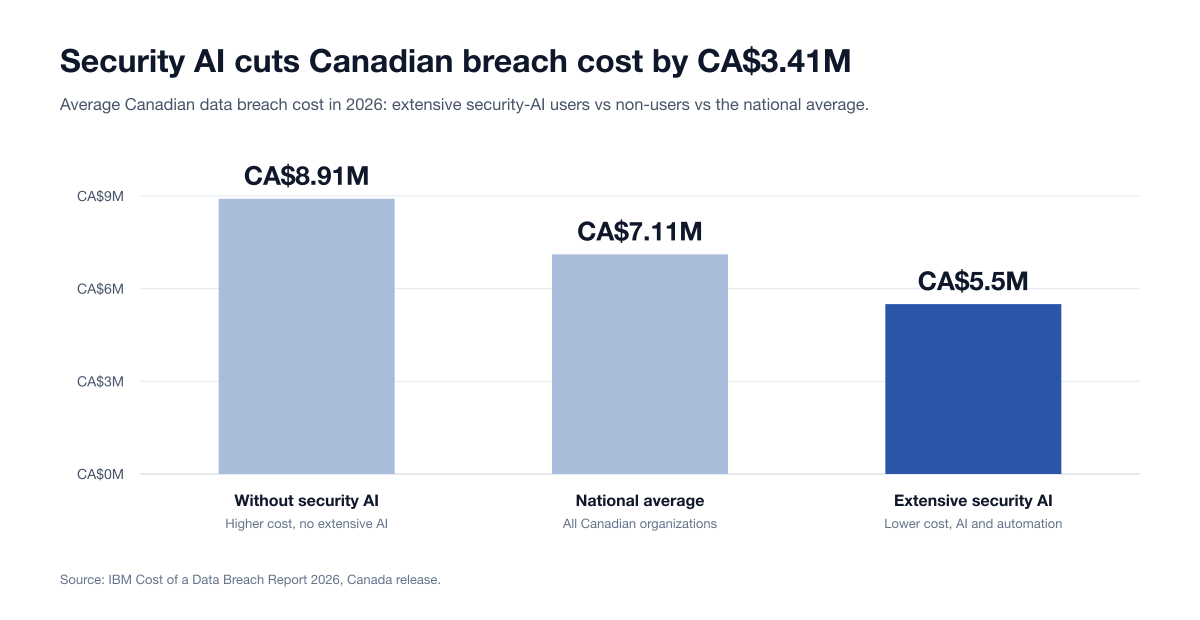
Figure 3: Average Canadian data breach cost in 2026: national average, and the gap between extensive security-AI users and non-users. Source: IBM Cost of a Data Breach Report 2026, Canada release.
The IBM 2026 Canada release found:
The average Canadian breach cost a record CA$7.11 million in 2026, up from CA$6.98 million the year before.
Canadian organizations using security AI and automation extensively averaged CA$5.5 million per breach, versus CA$8.91 million for those that did not, a gap of CA$3.41 million.
Detection and containment took longer, with the average breach lifecycle rising 6 percent to 205 days.
The takeaway for a buyer is direct. A penetration test in the CA$12,000 to CA$25,000 band that surfaces and helps close a critical, exploitable flaw is inexpensive against a CA$7.11 million expected loss, and the AI-augmented end of the testing market maps to the same posture that IBM associates with a multi-million-dollar cost reduction.
Where a Toronto-based provider fits
Stingrai is a global CREST-accredited penetration testing services company founded in Toronto, Canada in 2021, trusted by companies from startups to enterprises to meet audit requirements for SOC 2, ISO 27001, CMMC, PCI DSS and HIPAA. OSCE³, OSWE, OSEP, CREST CRT certified pentesters, who are also world-class security researchers and bug bounty hunters. Choose from fully human-led or hybrid (AI agents plus human penetration testers) engagements across web, API, mobile, AI and LLM, cloud, network, Active Directory and social engineering penetration tests and red team engagements, with findings posted to its PTaaS portal as they are confirmed, live chat with the assigned testers, Jira and Slack integration, retesting and an attestation letter with every human-led and hybrid report. For Canadian buyers, that combination, local presence, firm-level CREST accreditation, named published-CVE researchers, and an AI-augmented platform, lines up with the cost factors above that mark testing depth.
Stingrai publishes fixed prices in USD on its pricing page, in both one-time and continuous formats. The Autonomous Pentest powered by Snipe, at US$3,000 one-time, tests one web application and associated APIs with same-day results, business-logic and authorization coverage, role-based access testing, automated retests, AutoFix pull requests. The Hybrid Pentest with penetration testers testing alongside Snipe at US$6,800 one-time adds manual testing, validation, vulnerability chaining and lateral movement, and a PTaaS portal with Jira and Slack. Buyers who want year-round coverage rather than a point-in-time test can run the same tiers continuously on a 12-month engagement, at US$650 per month for autonomous and US$1,275 per month for hybrid. Enterprise programs with always-on coverage and Canadian data-leak monitoring are scoped to the organization.
What this means for your budget
The practical approach for a Canadian buyer in 2026 is to budget from goal and scope, then optimize for the markers of depth.
Define the goal: compliance evidence, risk reduction on a specific asset, or continuous assurance.
Inventory the scope in applications, hosts, APIs, roles, and environments.
Pick your band from the table above, expecting CA$12,000 to CA$25,000 for a standard multi-role web application.
Prioritize CREST accreditation, a high share of manual testing, named testers, and included retests over the lowest headline number.
Start with a pilot on one real asset before committing to a multi-engagement program.
Once you have a budget range, the next step is a shortlist. We ranked the providers operating in this market in the top penetration testing companies in Canada for 2026, and compared them against the wider field in the best VAPT companies of 2026. For a scoped number against your actual environment, request a quote and you will have one within 24 hours. The global view sits in the best penetration testing companies in 2026.
Frequently asked questions
How much does a penetration test cost in Canada?
A penetration test in Canada costs roughly CA$5,000 to CA$150,000 or more in 2026, depending on scope, depth, and compliance mandate. In practice you should budget to a band rather than the average: CA$5,000 to CA$12,000 for a small single-role web application, CA$12,000 to CA$25,000 for a standard multi-role SaaS application, CA$15,000 to CA$35,000 for a standard external network test, and CA$40,000 to CA$120,000 or more per year for a continuous PTaaS subscription (Stingrai 2026 benchmark ranges). Manual testing by senior penetration testers is the bulk of the price. Stingrai publishes fixed prices on its pricing page, US$3,000 one-time for an autonomous assessment of one web application and associated APIs.
How much does a web application penetration test cost in Canada?
A small single-role web application test runs CA$5,000 to CA$12,000. A standard multi-role SaaS application with authentication flows and connected APIs runs CA$12,000 to CA$25,000. A large or multi-tenant application with deep business logic and tenant-isolation requirements runs CA$25,000 to CA$40,000 or more. The number of authenticated roles is the biggest single driver, because every privilege level has to be tested against every other one to find broken access control.
How much does a network penetration test cost in Canada?
An external network test costs CA$8,000 to CA$15,000 for a small perimeter, CA$15,000 to CA$35,000 at standard scope, and CA$35,000 to CA$50,000 or more for large segmented estates. Internal network testing runs CA$12,000 to CA$50,000 or more depending on sites, VLANs, and lateral-movement depth, and a dedicated Active Directory assessment runs CA$15,000 to CA$50,000 or more depending on domain, forest, and trust complexity. Live host count and segmentation are the primary drivers.
What drives penetration testing cost up or down?
Eight variables move a Canadian quote: scope and asset count, the number of authenticated roles, environment count, manual versus automated depth, tester seniority, whether retests are included, reporting depth, and compliance evidence needs. Scope and authenticated roles have the largest effect. You can pull a quote down without losing quality by narrowing to one environment, consolidating roles, and providing credentials and documentation up front.
Is continuous PTaaS cheaper than annual penetration tests?
They are priced on different units, so the comparison depends on how often you ship. A one-time test buys a fixed scope and a point-in-time report. A PTaaS subscription in the CA$40,000 to CA$120,000+ annual band buys continuous coverage, retesting, and coverage of code shipped after the initial test. If you release infrequently and need a report for a specific audit, one-time testing is efficient. If you ship continuously, the gap between annual tests is the period your assurance decays. The budget case for continuous penetration testing works through the full ROI framework.
Why are some Canadian penetration testing quotes so cheap?
Because they are not penetration tests. A CA$2,000 to CA$3,000 quote is almost always an automated vulnerability scan with the tool output reformatted onto letterhead. Scanners cannot reason about intent, so they miss broken access control, business-logic flaws, and chained attack paths, which are the findings that matter most. If a quote sits far below the entry band for its engagement type, ask how many tester-days it includes and who is performing them.
Does a penetration test cost more in Toronto than in Vancouver or Montreal?
Usually not. Penetration testing is delivered remotely, so the same national bands apply whether you are in Toronto, Vancouver, or Montreal. Genuine regional variation comes from on-site requirements such as physical security assessments, on-site social engineering, and internal network tests that need presence on the premises, which add travel and per-diem. Organizations in Quebec may also need French-language reporting or Law 25-aligned documentation, which adds reporting hours rather than testing hours.
Does SOC 2, ISO 27001, or PCI DSS 4.0 require a penetration test?
PCI DSS 4.0 is explicit: requirement 11.4 mandates external and internal penetration testing at defined intervals and after significant change. ISO 27001 addresses it through Annex A control 8.8 on management of technical vulnerabilities, where penetration testing is the standard evidence. SOC 2 does not name it as a line item, but auditors routinely accept a current report as evidence for the monitoring and vulnerability-management criteria. Budget the engagement against your audit calendar, because a test that lands after fieldwork begins is worth far less as evidence.
Talk to Stingrai
Scoping a penetration test against what this guide covers takes one short conversation. Stingrai is a global CREST-accredited penetration testing services company founded in Toronto, Canada in 2021, trusted by companies from startups to enterprises to meet audit requirements for SOC 2, ISO 27001, CMMC, PCI DSS and HIPAA. OSCE³, OSWE, OSEP, CREST CRT certified pentesters, who are also world-class security researchers and bug bounty hunters. Choose from fully human-led or hybrid (AI agents plus human penetration testers) engagements across web, API, mobile, AI and LLM, cloud, network, Active Directory and social engineering penetration tests and red team engagements, delivered one-time or continuously through its PTaaS platform, with documented findings, remediation guidance and retesting included. Book a free scoping call, get a quote, or read the published pricing.
References
IBM. Canada's Data Breach Costs Hit Record High as Attacks Target Critical Infrastructure (2026 Cost of a Data Breach Report, Canada). July 2026. https://canada.newsroom.ibm.com/2026-07-29-IBM-Report-Canadas-Data-Breach-Costs-Hit-Record-High-as-Attacks-Target-Critical-Infrastructure. Canada-specific breach cost data and the security-AI cost gap.
Packetlabs. Guide to the Average Cost of a Pentest in Canada. 2025. https://www.packetlabs.net/posts/guide-to-the-average-cost-of-a-pentest-in-canada/. Published Canadian price range used to check the benchmark bands.
Bank of Canada. Daily Exchange Rates. August 7, 2026. https://www.bankofcanada.ca/rates/exchange/daily-exchange-rates/. USD/CAD reference rate of 1.3943 used for the US pricing comparison.
Commission d'accès à l'information du Québec. Loi 25. https://www.cai.gouv.qc.ca/a-propos/loi-25/. Quebec personal information protection modernization, sanctioned September 2021 and phased in through 2024.
Stingrai. Pricing. https://www.stingrai.io/pricing. Public pricing page listing one-time and continuous pricing for the autonomous, hybrid, and enterprise tiers in USD.
Ready to scope a Canadian pentest?
Stingrai is a Toronto-headquartered, CREST-accredited offensive security firm with named, published-CVE researchers and fixed, public pricing for one web application and associated APIs. Start with the Autonomous Pentest powered by Snipe at US$3,000 one-time for same-day results, step up to the Hybrid Pentest, Snipe with penetration testers testing alongside it throughout, at US$6,800 one-time for manual depth, or get a quote scoped to your environment within 24 hours. If you would rather fund year-round coverage than a single point-in-time test, both tiers are available continuously at US$650 and US$1,275 per month on a 12-month engagement.