




A CIEM dashboard tells you which identities are over-permissioned. A cloud IAM penetration test tells you which of those permissions an attacker can actually chain into a breach. That gap, between a flagged misconfiguration and a proven exploit path, is the entire reason cloud IAM penetration testing exists as a distinct assessment.
Identity is where cloud attacks land. Stolen and compromised credentials remain the number one initial access vector in the Verizon 2025 Data Breach Investigations Report, and 88% of attacks against basic web applications involved stolen credentials. IBM puts the 2025 global average cost of a data breach at US$4.44M and the US average at a record US$10.22M, with a mean of 241 days to identify and contain (IBM Cost of a Data Breach Report 2025). Once an attacker holds one valid identity, the question is no longer "how did they get in" but "how far can that identity reach." Posture tooling flags the misconfiguration. Only an attack-path assessment proves the reach.
What is a cloud IAM attack-path assessment, and how is it different from CIEM tooling?
A cloud IAM penetration test, also called an identity attack-path assessment, is manual adversarial testing of the permission and trust relationships in your cloud environment. A tester starts from a realistic assumption, usually a single low-privileged identity or a compromised workload, and tries to chain permissions, role assumptions, and cross-account trusts into privilege escalation, lateral movement, and access to sensitive data. The deliverable is a reproducible attack path with a measured blast radius, not a list of theoretical risks.
Cloud Infrastructure Entitlement Management (CIEM) tooling, along with CSPM and native services like AWS IAM Access Analyzer or Azure and Google Cloud policy analyzers, does something different and complementary. It continuously inventories identities and entitlements and flags policies that are over-broad, unused, publicly exposed, or drifting from a baseline. That breadth is genuinely valuable. What it cannot do is prove that a given flagged permission is reachable and weaponizable from where an attacker actually starts. A CIEM finding says a role is over-permissioned. A pentest says a specific low-privileged identity can assume that role, use it to read a production data store, and that no alarm fired while it happened.
The distinction matters because a dashboard full of flags does not tell a security leader which three of four hundred findings would actually end a career. The pentest answers the "so what."
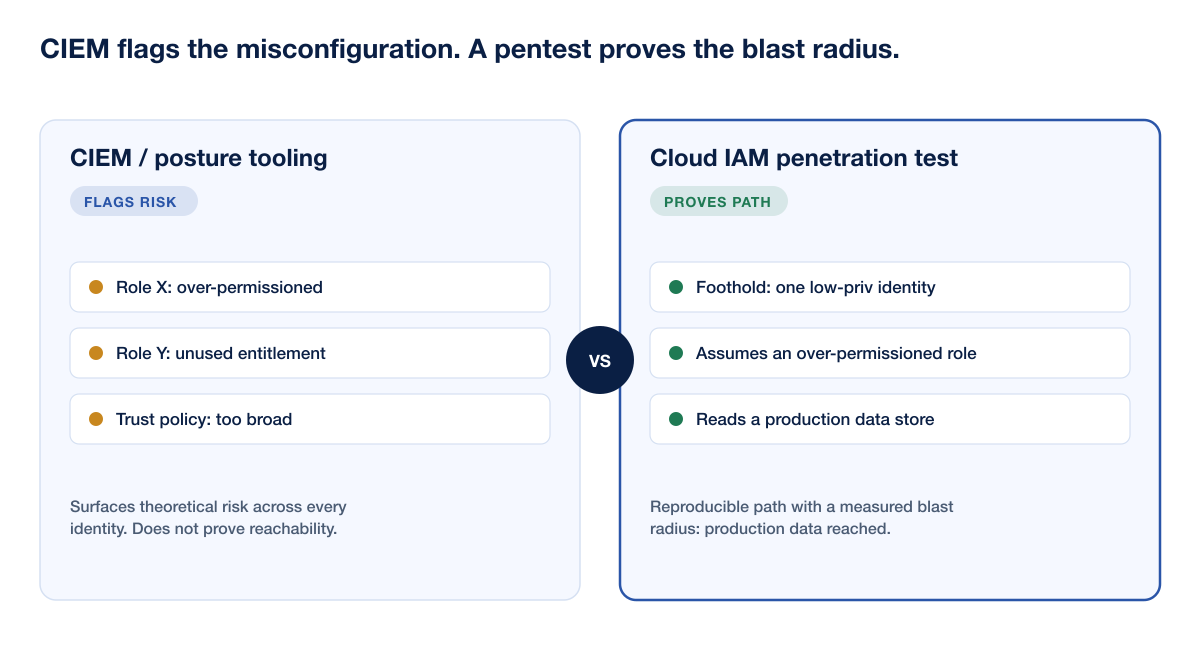
CIEM vs penetration testing: what each one actually proves
Both belong in a mature identity security program. They answer different questions, and confusing one for the other is how organizations end up with a green dashboard and an exploitable path sitting underneath it.
Dimension | CIEM / posture tooling | Cloud IAM penetration test |
|---|---|---|
Core question | Which identities are over-permissioned or misconfigured? | Which of those permissions chain into a real breach? |
Output | A prioritized list of flags and entitlement findings | A reproducible attack path with a measured blast radius |
Method | Continuous static analysis of policies and entitlements | Manual, adversarial exploitation across roles and accounts |
Strength | Breadth: every identity, all the time | Depth: the exploitable few, proven end to end |
False positives | Higher, flags theoretical and unreachable risk | Lower, every reported path is demonstrated |
Trust chains | Partially inferred from policy graphs | Proven by actually assuming roles and pivoting |
Detection check | Not evaluated | Validates whether logging and alerting caught the path |
Best used for | Day-to-day drift monitoring and hygiene | Point-in-time proof of real blast radius |
Read the table as a division of labor. CIEM keeps the entitlement surface honest between tests. The pentest converts a subset of that surface into proof, and in doing so tells you which posture findings to fix first because they are load-bearing in a real attack chain.
The identity attack paths a cloud IAM pentest proves
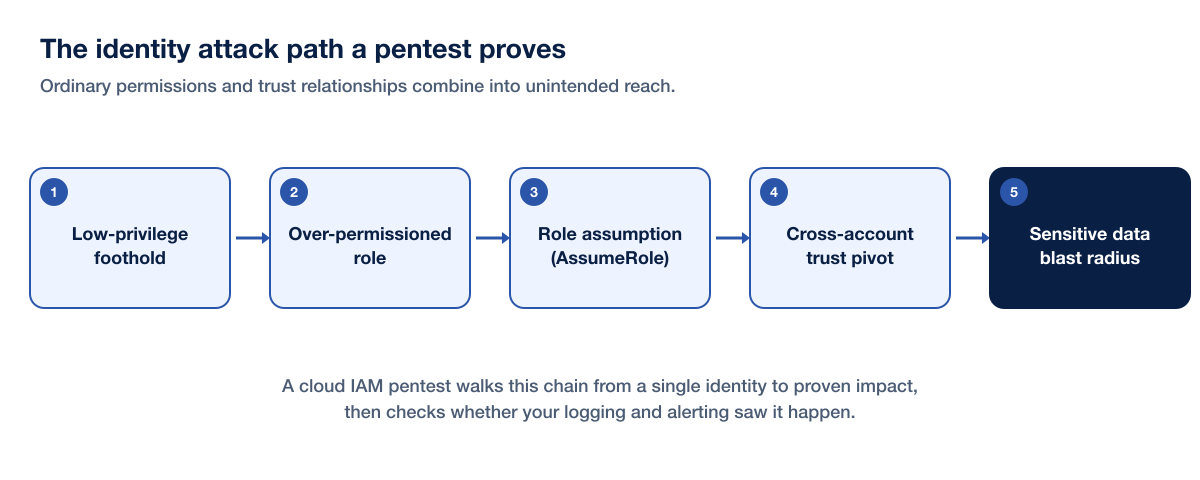
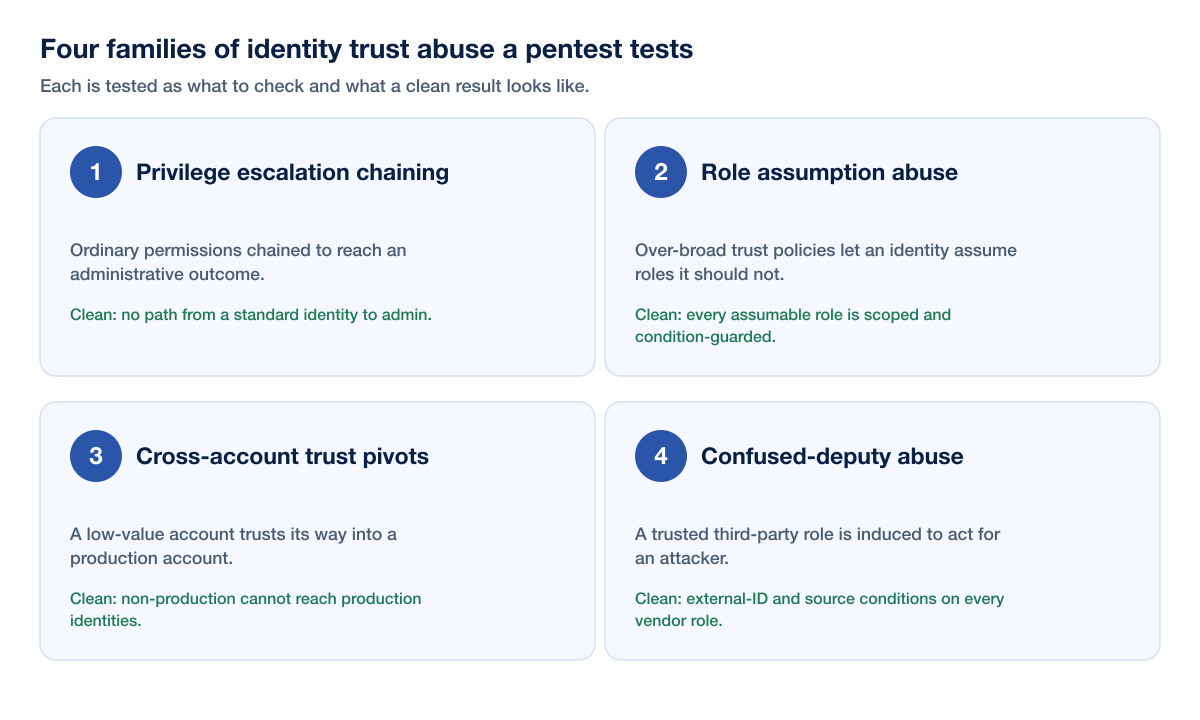
Cloud identity breaches rarely come from one catastrophic permission. They come from ordinary permissions that combine into something the policy author never intended. A cloud IAM attack-path assessment focuses on four families of permission and trust-relationship abuse. Each is described below as what a tester checks and what a clean result looks like, not as an exploit recipe.
Privilege escalation chaining
What to test: whether a low-privileged identity can reach higher privilege through permissions that look harmless in isolation. Permissions that let an identity pass a role to a compute service, modify a policy version, or launch a resource under a more privileged execution role are the usual building blocks. The tester tries to walk from a standard workload identity to an administrative outcome.
What a clean result looks like: no reachable path from a standard workload or developer identity to an administrative role or a policy-modification capability. Privileged actions require a separately governed identity, and permission boundaries or service control policies cap what any single identity can grant itself.
Role assumption abuse
What to test: whether the trust policies that govern role assumption are scoped too loosely. A trust policy that names an over-broad principal, or omits conditions, can let an identity assume a role it was never meant to hold. The tester enumerates which roles a starting identity can assume and where that chain leads.
What a clean result looks like: every assumable role has a tightly scoped trust policy that names specific principals and enforces conditions. No identity can assume a materially more privileged role, and role-assumption events are logged and monitored.
Cross-account trust
What to test: whether trust relationships between accounts, subscriptions, or projects let an attacker pivot from a low-value environment into a high-value one. Sandbox, development, and CI accounts frequently hold trust into production that no one revisited after it was created. The tester looks for the lowest-value foothold that trusts its way into the crown jewels.
What a clean result looks like: cross-account trust is least-privilege and intentional. Non-production accounts cannot reach production identities, third-party and vendor roles are enumerated and justified, and every trust relationship maps to a documented business need.
Confused-deputy abuse
What to test: whether a service or third-party integration that legitimately holds access can be induced to act on an attacker's behalf. Cross-account roles granted to SaaS vendors are the classic case: if the role does not enforce an external identifier and source conditions, a different tenant may be able to borrow that trusted access. The tester checks whether trusted deputies verify who is really asking.
What a clean result looks like: every third-party and cross-account role enforces an external identifier and source-account or source-ARN conditions, so a trusted service cannot be tricked into using its privileges for an untrusted caller.
What a clean cloud IAM result actually looks like
A clean assessment is not "zero findings." It is a demonstrated ceiling on blast radius. Concretely, a strong result means a tester who starts from a realistic compromised identity cannot reach administrative control or crown-jewel data, cannot pivot from a low-trust account into production, and cannot turn a trusted third-party integration against you. It also means the attempt was visible: CloudTrail, activity logs, or your detection stack recorded the role assumptions and the reconnaissance, and someone could have acted on it.
That last point is why detection validation belongs in scope. Guidance from CISA and the NSA on cloud identity, together with the CIS Foundations Benchmarks and your cloud provider's own IAM best-practice documentation, all converge on the same controls: least privilege, scoped trust policies, mandatory conditions on cross-account roles, and logged, monitored identity activity. A pentest is how you find out whether those controls hold under pressure rather than only on paper.
How to scope a cloud IAM attack-path assessment
Scoping an identity attack-path assessment is different from scoping a network or web-application test. The unit of scope is the identity graph, not a list of hosts. The inputs below make the difference between a test that proves real paths and one that spends its hours on reconnaissance. For a broader treatment of scoping mechanics, see our guide on how to scope a penetration test.
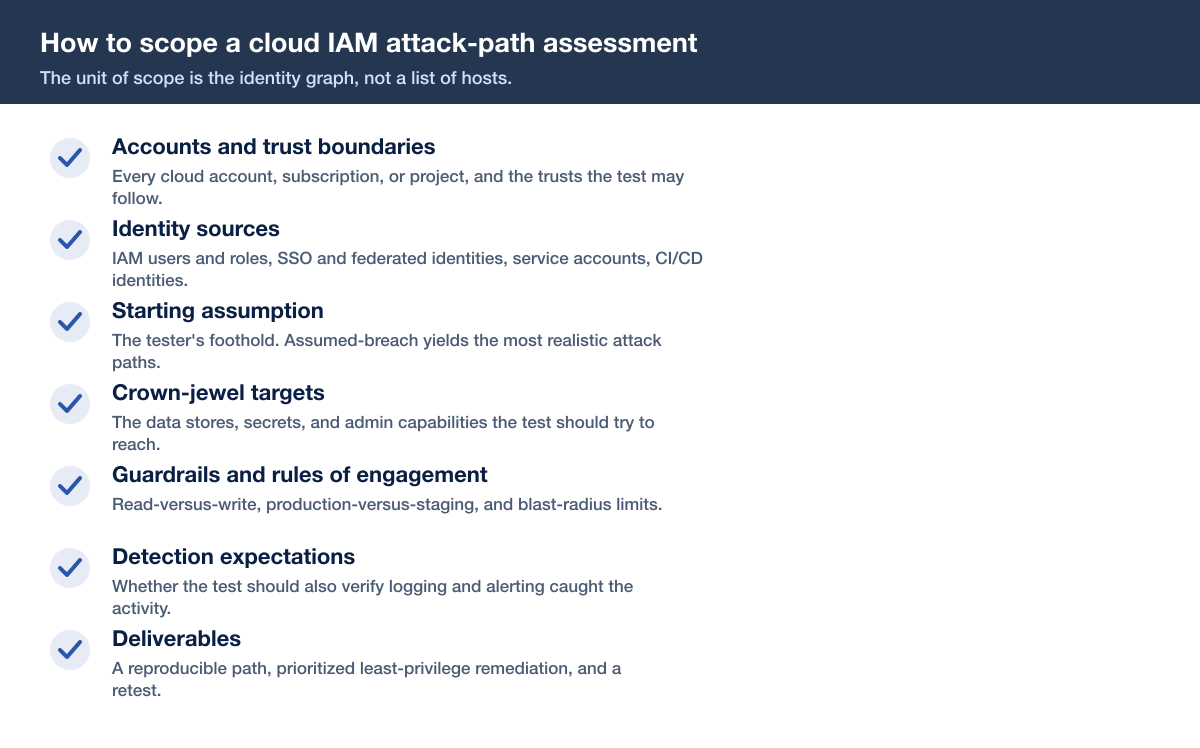
Accounts and boundaries. List every cloud account, subscription, or project in scope, and name the trust relationships between them that the test is allowed to follow.
Identity sources. Enumerate IAM users and roles, SSO and federated identities, service accounts, workload identities, and CI/CD identities. Pipeline identities in particular deserve attention; our note on CI/CD pipeline penetration testing scope covers why.
Starting assumption. Decide the tester's foothold. Assumed-breach, starting from one low-privileged identity or a compromised workload, produces the most realistic attack-path findings.
Crown-jewel targets. Name the data stores, secrets, and administrative capabilities the test should try to reach. A path is only as meaningful as what it reaches.
Guardrails. Set read-versus-write boundaries, production-versus-staging rules, and blast-radius limits. Adversarial testing against live identity infrastructure needs agreed rules of engagement.
Detection expectations. State whether the test should also verify that logging and alerting caught the activity, so you learn both exposure and visibility.
Deliverables. Require a reproducible path, prioritized remediation tied to least-privilege fixes, and a retest to confirm the path is closed.
Secrets sprawl is a related but distinct problem. If your concern is leaked API keys and non-human credentials rather than permission and trust chains, our analysis of non-human identity attacks and leaked API keys is the better starting point. This assessment is about what an identity can do once it exists, not how its credential leaked.
Where human attack-path mapping fits, and where Snipe does not
Cloud IAM attack-path mapping is human-pentester work. Reasoning across trust policies, condition keys, role-assumption chains, and cross-account relationships to find the one sequence that reaches production is exactly the kind of adversarial judgment that automated entitlement analysis approximates but does not prove. Stingrai runs this as a manual, senior-led engagement, and as a CREST-accredited penetration testing service provider we deliver it with reproducible evidence rather than a re-skinned scanner report. It fits naturally alongside a red team engagement when the goal is a full assumed-breach path from foothold to objective, and inside a continuous PTaaS program when identity changes fast enough to need repeat validation.
Stingrai's Snipe agent is deliberately not part of this. Snipe is Stingrai's AI agent for web application penetration testing, including the application's APIs. It is available for autonomous web testing or alongside penetration testers in a Hybrid web engagement. It hunts complex web-layer flaws such as IDOR, broken authorization, and business logic bugs in your application, and it covers the web-application layer of your cloud environment. It does not test cloud IAM roles, trust policies, or infrastructure. Identity attack-path work across accounts and trust relationships stays with human testers, by design. Keeping that line clear is part of why the findings hold up: the right method is matched to each layer.
A cloud IAM attack-path assessment also produces exactly the kind of exploit-proven evidence that supports a SOC 2, ISO 27001, PCI DSS 4.0, or DORA program, where auditors increasingly want proof that least-privilege and access controls survive an adversary, not just that a policy document exists. Scope, depth, and pricing for an identity attack-path assessment depend on account count and identity complexity; the current options are on the Stingrai pricing page.
What this means for defenders
Treat CIEM findings as inputs, not verdicts. A flagged over-permission is a hypothesis. The pentest tells you which flags are load-bearing in a real chain and which are noise.
Test from an assumed breach. Credentials are the number one initial access vector. Start the test where a real attacker starts, with one valid identity, and measure the reach.
Put trust policies under a microscope. Role assumption, cross-account trust, and confused-deputy conditions are where blast radius quietly compounds. These are the highest-yield things to test.
Validate detection alongside exposure. A path an attacker can walk unseen is worse than one that trips an alarm. Confirm your logs and alerts see role assumptions and reconnaissance.
Retest after remediation. Least-privilege fixes and trust-policy tightening need a retest to confirm the path is actually closed, not merely reconfigured.
Frequently Asked Questions
What is cloud IAM penetration testing?
Cloud IAM penetration testing is manual, adversarial testing of the permission and trust relationships in a cloud environment. A tester starts from a realistic low-privileged identity and tries to chain permissions, role assumptions, and cross-account trusts into privilege escalation and access to sensitive data. The deliverable is a reproducible attack path with a measured blast radius. It is human-pentester work, not an automated scan.
How is cloud IAM penetration testing different from CIEM tooling?
CIEM, CSPM, and native analyzers continuously flag over-permissioned or misconfigured identities. They surface theoretical risk across every identity. A cloud IAM penetration test proves which of those flagged permissions an attacker can actually reach and weaponize from a realistic starting point. The dashboard flags the misconfiguration; the pentest proves the exploitable blast radius.
What identity attack paths does a cloud IAM pentest cover?
The core families are privilege escalation chaining, role assumption abuse, cross-account trust pivots, and confused-deputy abuse. Each targets ordinary permissions and trust relationships that combine into unintended access. A test walks these chains from a low-privileged foothold toward administrative control or crown-jewel data.
Does a CIEM or CSPM dashboard replace a penetration test?
No. Posture tooling and a pentest answer different questions and belong together. Tooling provides breadth and continuous monitoring; the pentest provides depth and proof. A green dashboard can still sit above an exploitable path, which is precisely what the pentest is designed to surface.
What does a clean cloud IAM penetration test result look like?
Not zero findings, but a demonstrated ceiling on blast radius. A tester starting from a compromised identity cannot reach admin or crown-jewel data, cannot pivot from a low-trust account into production, and cannot turn a trusted third-party integration against you, and the attempt was visible in your logs and alerting.
How do you scope a cloud IAM attack-path assessment?
Scope the identity graph, not a host list. Provide the accounts and trust boundaries in scope, the identity sources, the tester's starting assumption, the crown-jewel targets, the guardrails and rules of engagement, and whether detection should also be validated. Require a reproducible path, prioritized remediation, and a retest.
Does Stingrai's Snipe agent test cloud IAM?
No. Snipe is Stingrai's AI agent for web application penetration testing, including the application's APIs. It is available for autonomous web testing or alongside penetration testers in a Hybrid web engagement. It hunts complex web-layer flaws such as IDOR, broken authorization, and business logic bugs, and it covers the web-application layer of your environment. Cloud IAM roles, trust policies, and infrastructure are tested by human pentesters.
How does cloud IAM penetration testing support compliance?
It produces exploit-proven evidence that least-privilege and access controls hold under an adversary, which supports SOC 2, ISO 27001, PCI DSS 4.0, NIST, and DORA programs. Auditors increasingly want demonstrated blast-radius limits, not only policy documents.
How much does a cloud IAM penetration test cost?
Cost depends on the number of cloud accounts, the complexity of the identity graph, and whether detection validation and retesting are included. Current options and packages are listed on the Stingrai pricing page.
References
Verizon. 2025 Data Breach Investigations Report. 2025. https://www.verizon.com/business/resources/reports/dbir/. Analyzes breach patterns across thousands of incidents, including initial access vectors and the role of stolen credentials.
IBM. Cost of a Data Breach Report 2025. July 2025. https://www.ibm.com/reports/data-breach. Reports the global average breach cost, the US average, and detection and containment timelines.
CISA and NSA. Cybersecurity guidance on cloud and identity and access management. https://www.cisa.gov/resources-tools/resources. Baseline guidance on least privilege, identity hardening, and monitoring for cloud environments.
Center for Internet Security. CIS Foundations Benchmarks. https://www.cisecurity.org/cis-benchmarks. Consensus configuration baselines for major cloud providers, including IAM and trust-policy controls.