



Exactly 510 companies worldwide held CREST's firm-level Penetration Testing accreditation when we queried the CREST Marketplace on 9 August 2026. That number matters because "CREST accredited" is one of the most repeated and least verified claims in security procurement, and because the gap between the firms that hold it and the firms that imply it is wide.
Quick answer: Stingrai Inc holds CREST's firm-level Penetration Testing accreditation, one of only four Canadian-headquartered companies among the 510 accredited worldwide, and you can verify that entry yourself at marketplace.crest.org in about ninety seconds. The rest of this guide explains what accreditation actually assesses, the difference between CREST accredited and CREST certified, the four-step verification on the CREST Marketplace, the common verification missteps to avoid, where CREST carries procurement weight by market, the 2026 AI accreditation changes and which accredited firms to shortlist.
The claim is worth checking for a specific reason. CREST assesses a company, not just the people it employs. A provider can hire five consultants who each passed a CREST exam, put "CREST certified" on the website, and hold no company accreditation whatsoever. Both statements are technically true. Only one of them tells you the firm's methodology, data handling and governance were independently examined.
This guide covers what CREST accreditation actually assesses, how to verify any provider's claim in about ninety seconds, the verification missteps that most often catch buyers during vendor due diligence, where CREST carries procurement weight by market, and which accredited firms are worth shortlisting.
Accreditation tells you a firm's process was independently examined; engagement data tells you what a disciplined process produces. In Stingrai's State of Penetration Testing 2026, built from 55 penetration tests, 93% of tests surfaced at least one High or Critical finding, while the false-positive rate across all reported findings was just 0.74%. Those two numbers are the practical case for verifying providers carefully: a rigorous firm finds serious problems, and nearly everything it reports is real.
At a glance
Question | Short answer |
|---|---|
How many firms hold CREST Penetration Testing accreditation? | 510 globally, per the CREST Marketplace, 9 August 2026 |
Where are they concentrated? | UK 202, USA 51, Singapore 50, Australia 45, Canada 4 |
Is "CREST certified" the same as "CREST accredited"? | No. Certification is an individual exam. Accreditation is a company assessment |
Where do I verify a claim? | marketplace.crest.org, CREST's authoritative supplier directory |
Is CREST legally required? | No, it is a commercial standard. Singapore's CSA licence is the separate legal requirement |
What changed in 2026? | Domain 7 (Responsible AI Use) and Annex B (AI-enabled penetration testing), effective 28 July 2026 |
What CREST accreditation actually is
CREST is a not-for-profit accreditation and certification body for the technical security industry. It runs two entirely separate schemes that buyers routinely collapse into one phrase, and the distinction is the single most useful thing in this article.
Company-level accreditation: the procurement-grade signal
CREST accredits organisations against published standards. The assessment looks past the skills of any individual tester and into how the business runs: how engagements are scoped and governed, what methodology is applied and whether it is actually followed, how client data is classified, transported, stored and destroyed, how findings are reported and quality-assured, and how the company handles complaints and incidents of its own.
CREST's organisational standard is the CREST Accreditation Standard, Company General Requirements, which every accredited provider must meet regardless of service. On top of that sit service-specific standards. CREST currently publishes standards across nine service areas: Cyber Threat Intelligence, Incident Exercising, Incident Response, Penetration Testing, Security Architecture, Security Operations, Threat Intelligence for Simulated Attacks, Threat-led Penetration Testing, and Vulnerability Assessment.
This is why company accreditation is the signal that belongs in a procurement scorecard. It is an assurance about the supplier as an organisation, and it survives staff turnover. An individual certification walks out of the building when its holder resigns.
Individual certifications: the practitioner signal
CREST separately certifies people through examinations at three experience tiers: Practitioner, Registered and Certified. The ones that appear in penetration testing statements of work are:
Certification | Acronym | Tier |
|---|---|---|
CREST Practitioner Security Analyst | CPSA | Practitioner |
CREST Registered Penetration Tester | CRT | Registered |
CREST Certified Tester, Infrastructure | CCT INF | Certified |
CREST Certified Tester, Application | CCT APP | Certified |
CREST Certified Red Team Specialist | CCRTS | Certified |
CREST Certified Red Team Manager | CCRTM | Certified |
Two of those names changed, and stale vendor pages have not caught up. CCRTS was previously the CREST Certified Simulated Attack Specialist (CCSAS), and CCRTM was previously the CREST Certified Simulated Attack Manager (CCSAM). CREST states on its own certification page that the exam "was previously known as the CREST Certified Simulated Attack Specialist (CCSAS) but has been updated in-line with industry terminology and lexicons." If a provider's website still advertises CCSAS or CCSAM in 2026, that page has not been reviewed in a while, which is itself a small piece of information about the firm.
CCRTS carries weight beyond its name: CREST notes it is "a critical requirement by the Bank of England as part of the CBEST accreditation process."
The difference that costs buyers money
Company accreditation | Individual certification | |
|---|---|---|
Assessed subject | The firm | A person |
What is examined | Governance, methodology, data handling, reporting, quality assurance | Technical knowledge, in an exam |
How it is earned | Documented assessment against CREST standards | Passing a CREST examination |
Survives staff turnover? | Yes | No, it leaves with the individual |
Where it is verifiable | CREST Marketplace supplier profile | The individual's own record, not the firm's |
Typical marketing phrase | "CREST accredited", "CREST member company" | "CREST certified consultants", "our team is CREST qualified" |
A firm with accreditation almost always employs certified individuals. The reverse is not true at all, and it is where most misleading claims live.
How to verify a CREST claim in four steps
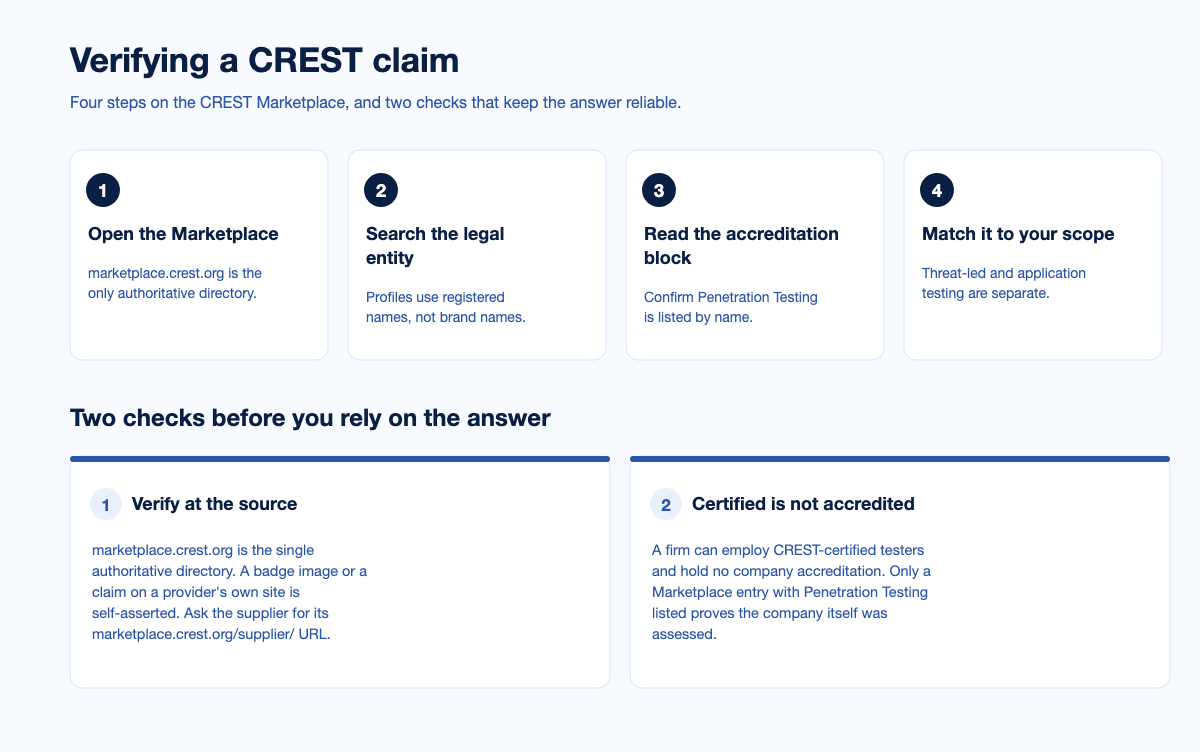
Verification is genuinely fast once you know where to look. It takes about ninety seconds.
Step 1: Go to the CREST Marketplace. The only authoritative directory is marketplace.crest.org. Do not verify from the provider's own website, a reseller listing, or a badge image, all of which are self-asserted.
Step 2: Search for the exact legal entity, not the brand. Marketplace profiles use registered company names. Searching "Dionach" resolves to Dionach Ltd, "JUMPSEC" to JUMPSEC Ltd, "Prism Infosec" to Prism Infosec Ltd, and "CyberCX" to CyberCX Pty Ltd. If a brand you were quoted does not resolve to any entity, ask the provider which legal entity holds the accreditation. Groups sometimes hold accreditation in one subsidiary and sell through another.
Step 3: Read the "CREST Accreditations & Specialisms" block. This is the part that answers your actual question. A profile lists precisely which services the company is accredited for. Being on the Marketplace is not the same as being accredited for penetration testing. A supplier accredited only for Security Operations Centre or Vulnerability Assessment work is a real CREST member and still not accredited for the thing you are buying. Look for Penetration Testing by name.
Step 4: Match the accreditation to your scope of work. If you are buying threat-led red teaming under a financial-services framework, "Penetration Testing" alone is not the relevant accreditation. Look for Threat Led Penetration Testing, which CREST profiles annotate as "(Formerly STAR ILPT)", or the TLPT-FS variant. Application-focused buyers should look for Application Security Testing, annotated "(Formerly OVS)".
Common verification missteps
Two missteps account for nearly every wrong conclusion buyers reach about a provider's CREST status, and both take seconds to avoid.
Misstep 1: verifying anywhere other than the CREST Marketplace. CREST consolidated its accredited-supplier directory into the CREST Marketplace, and marketplace.crest.org is the single source of truth for accreditation status. Older links on vendor websites, procurement templates and third-party listicles can predate that consolidation, and a badge image or a "CREST accredited" line on a provider's own site is self-asserted rather than verified. If a supplier offers proof, ask for its marketplace.crest.org/supplier/ profile URL and read the accreditation block there yourself. And as with any procurement, confirm the supplier's operating locations and registered entity through the supplier's own website and the relevant companies registry as part of standard vendor due diligence.
Misstep 2: reading individual certifications as company accreditation. The most common soft misrepresentation in this market is a provider website that says "CREST accredited penetration testing" when what the firm means is that some of its testers hold CREST exams. Sometimes it is deliberate. Often it is a marketing team that did not know the two schemes were different.
You do not need to litigate the intent. Search the firm on the Marketplace. If the company is not there, the company is not accredited, whatever its consultants hold. If it is there, check that Penetration Testing appears in its accreditation list. That is the whole test.
Where CREST carries weight, market by market
CREST's footprint is far more concentrated than its global profile suggests. These are firm-level Penetration Testing accreditations by head office country, from the CREST Marketplace on 9 August 2026.
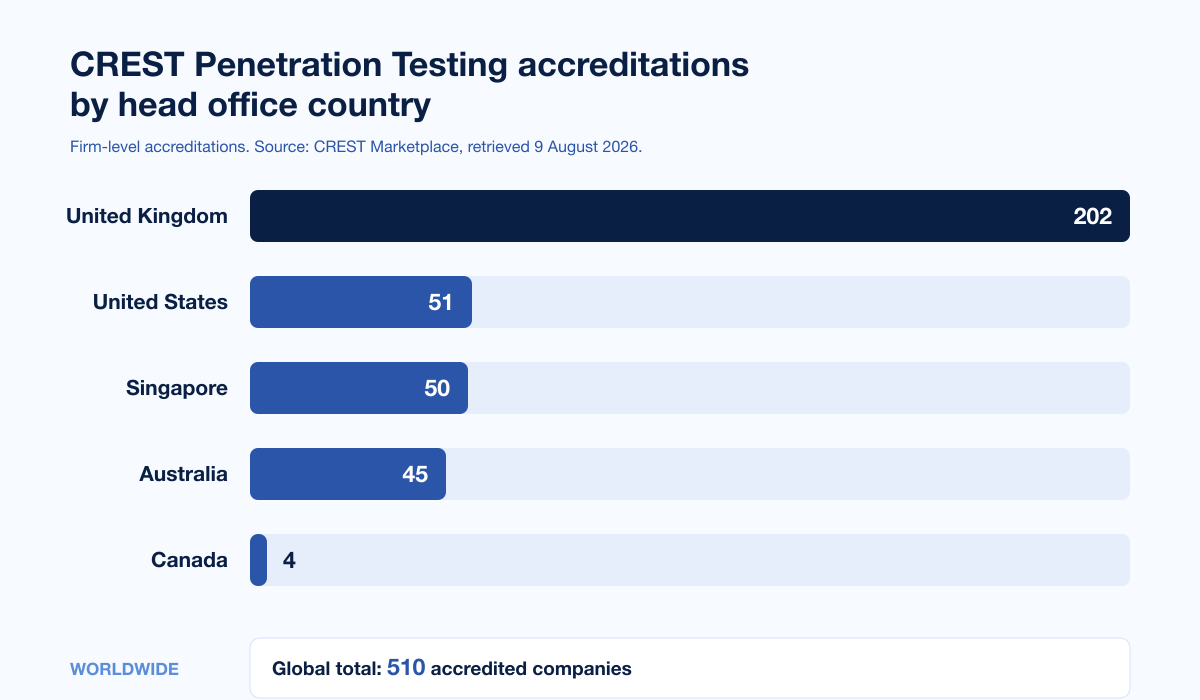
Head office country | Firms with CREST Penetration Testing accreditation |
|---|---|
United Kingdom | 202 |
United States | 51 |
Singapore | 50 |
Australia | 45 |
Canada | 4 |
Global total | 510 |
Two things stand out. The UK holds roughly 40 percent of all firm-level penetration testing accreditations worldwide: 202 of the 510 accredited firms on the CREST Marketplace, retrieved 9 August 2026. And Singapore, a country of around six million people, has essentially as many accredited firms (50) as the United States (51).
United Kingdom: the commercial standard, distinct from CHECK
In the UK, CREST is the default commercial benchmark, and it is routinely named in private-sector and regulated-sector tenders as a supplier quality bar. Regulated fintech buyers can see how the same accreditation question plays against PCI DSS 4.0.1, SOC 2 and DORA fit in the **fintech penetration testing companies** ranking.
CREST is not the same as NCSC's CHECK scheme, and the two are not interchangeable. CHECK is the UK government scheme. NCSC's guidance is that for central government, "all systems processing data protectively marked OFFICIAL and above (up to Top Secret but excluding STRAP systems)" must use CHECK-assured companies. For the wider public sector, NCSC strongly recommends CHECK providers.
The relationship between them is more interesting than a rivalry. NCSC states that "CHECK Team Members hold one of the NCSC-approved qualifications offered by either CREST or The Cyber Scheme." CREST individual certifications are a qualification pathway into CHECK, not a competitor to it.
The practical rule: if you are testing UK government systems at OFFICIAL or above, you need a CHECK provider. For commercial systems, CREST company accreditation is the relevant signal. NCSC's directory listed 55 CHECK providers as of August 2026, a much smaller pool than the 202 UK firms with CREST penetration testing accreditation.
One correction worth making, because it circulates widely: some vendor blogs claim Procurement Policy Note PPN 014 made CREST mandatory for UK government penetration testing suppliers. It did not. PPN 014 is a Cyber Essentials policy note and does not mention CREST or penetration testing at all. Do not build a procurement position on that claim.
Australia: a genuine procurement filter, separate from IRAP
Australia is the fourth-largest CREST market by accredited firms, and CREST accreditation shows up frequently as a prerequisite in Australian enterprise and public-sector procurement.
CREST is distinct from IRAP, the Infosec Registered Assessors Program. IRAP assessors are endorsed by the Australian Signals Directorate to assess ICT systems against the Information Security Manual, for systems handling government data at OFFICIAL, PROTECTED, SECRET or TOP SECRET. The two are complementary rather than substitutable: a penetration test attempts to exploit vulnerabilities to establish real impact, while an IRAP assessment evaluates the full set of applicable ISM controls, only some of which a penetration test can validate. Buyers selling into Australian government commonly need both, for different reasons.
Singapore: CREST is the quality signal, the CSA licence is the law
Singapore is the market where buyers most often get the hierarchy wrong, so this one is worth stating precisely.
In Singapore, providing penetration testing services requires a licence. Under Part 5 of the Cybersecurity Act, Singapore's official business licensing portal states that "all cybersecurity service providers providing licensable cybersecurity services as set out in the Second Schedule are required to obtain a cybersecurity service provider's licence regardless of whether they are companies or individuals," including freelancers, sole proprietorships, third-party providers supporting other providers, and resellers. The licence is administered by CSA's Cybersecurity Services Regulation Office.
CREST accreditation does not substitute for that licence, and the licence is not a quality assessment. They answer different questions: the licence asks whether the provider is legally permitted to sell penetration testing in Singapore, and CREST accreditation asks whether the provider's methodology and governance were independently assessed. Serious providers in Singapore hold both.
CREST's presence in the market is long-standing. CSA announced the CREST Singapore Chapter in 2016 as CREST's first Asian chapter, developed with CSA, AISP, MAS, ABS and IDA, with CSA supporting an examination facility and funding accreditation for smaller providers. That early state backing is a large part of why Singapore now has 50 accredited firms.
United States and Canada: growing, and still thin
The US has 51 accredited firms, a small number for the size of its security market, because US procurement leans on SOC 2, FedRAMP and PCI DSS rather than CREST. CREST recognition is growing there, mostly driven by firms selling into UK, Australian and Singaporean buyers.
Canada is the outlier: just four companies headquartered in Canada hold firm-level CREST Penetration Testing accreditation. For Canadian buyers who have written CREST into a procurement standard, the domestic supplier pool is genuinely that small, and most will need to consider accredited firms headquartered elsewhere that serve the Canadian market.
What changed in 2026: CREST's AI accreditation
On 28 July 2026, CREST launched the first accredited standards for AI use in cybersecurity services. In CREST's words: "From today, 28 July 2026, cybersecurity service providers will be able to apply to have their use of AI within their service provision independently assured by CREST."
There are two distinct pieces, and the difference matters when you read a provider's claim.
Domain 7, Responsible AI Use, is a new domain in the general requirements CREST sets for all accredited service providers. It "covers the governance, oversight, transparency and responsible organisational use of AI by the service provider." It applies as part of the baseline organisational standard wherever AI use could affect client confidentiality, service delivery, client-facing outputs, legal obligations or professional judgement.
Annex B, AI-Enabled Penetration Testing, is an optional annex to the Penetration Testing Standard for providers that use AI within testing itself. CREST describes it as helping "ensure AI enhances professional judgement while maintaining the quality, integrity and trust expected of CREST-accredited services."
The buyer takeaway is straightforward. Every provider you engage is now expected to be able to explain how it governs AI use. Providers that actively use AI in delivery can go further and have that use independently assured. Given that IBM's Cost of a Data Breach Report 2026 found one in four malicious breaches are now AI-enabled, at an average cost of USD 6 million, the assurance question on both sides of the engagement is not academic. Ask any provider using AI in testing whether they intend to pursue Annex B, and how they currently prevent model-generated findings from reaching a client report unvalidated.
CREST-accredited providers worth shortlisting in 2026
Every firm below was verified on the CREST Marketplace on 9 August 2026 and holds Penetration Testing in its firm-level accreditation list. This is a shortlist across markets rather than a single-country ranking. For country-specific depth, the regional guides linked at the end go further. The global **best penetration testing companies in 2026** ranking sits alongside them.
1. Stingrai
Stingrai is a global CREST-accredited penetration testing services company founded in Toronto, Canada in 2021, trusted by companies from startups to enterprises to meet audit requirements for SOC 2, ISO 27001, CMMC, PCI DSS and HIPAA. OSCE³, OSWE, OSEP, CREST CRT certified pentesters, who are also world-class security researchers and bug bounty hunters. Choose from fully human-led or hybrid (AI agents plus human penetration testers) engagements across web, API, mobile, AI and LLM, cloud, network, Active Directory and social engineering penetration tests and red team engagements.
Head office: Canada (Toronto, with a London, UK office). Marketplace entry: Stingrai Inc. CREST accreditation: Penetration Testing, held by Stingrai Inc at firm level, one of four Canadian-headquartered entries among the 510 worldwide.
Stingrai does offensive security only: penetration testing, red and purple teaming, adversary simulation and social engineering. The firm-level accreditation is the claim this guide tells you to check, and it sits on top of individual credentials rather than substituting for them. Engagements run with a named two-person tester team reviewed by a team lead who also holds OSED, OSCP, CRTL, CRTE and CRTO. The team has published 18 CVEs, and its senior penetration testers include a founding member of Uber's offensive security team and researchers with bug bounty Hall of Fame placements at Apple, Google, Yahoo, the US Department of Defense, the US Federal Reserve and PaySafe. Ratings are 5.0 out of 5 across 19 Clutch reviews and 4.9 out of 5 on G2.
Attackers don't just run scanners, and neither does Stingrai. Its penetration testers chain findings into real attack paths and document each one with a working proof of concept: authenticated web testing across every user role for broken authorization and IDOR, MASVS and MASTG-aligned mobile testing down to Keychain storage and certificate pinning bypass, cloud work that runs from the control plane to the workload across AWS, Entra ID and Google Cloud, Active Directory paths through ACL abuse and Kerberos delegation, and assumed-breach or threat intelligence-led red team scenarios.
It delivers both one-time penetration tests and continuous programs that test every release, scoped to the systems and business risks each client needs assessed.
Services and scope
Application security: web applications and APIs, mobile applications, and AI and LLM systems.
Network and cloud security: internal and external networks, Active Directory, Wi-Fi, and cloud environments.
Social engineering: phishing campaigns and physical security assessments.
Adversary simulation: red teaming and purple teaming.
Delivery and evidence
Findings post to the PTaaS portal as they are confirmed, each with a working proof of concept and prioritized remediation guidance, so fixing starts before the report lands. Clients get live chat with their assigned penetration testers during the test, Jira and Slack push, redactable PDF reports, an executive dashboard, retesting of remediated findings, and an attestation letter and verified badge with every report. That evidence package is what SOC 2, ISO 27001, PCI DSS, HIPAA, NIST 800-171, DORA and NIS2 programs ask for. CREST accreditation applies to Stingrai Inc as a penetration testing service provider; it is separate from the individual tester certifications above, which is exactly the distinction this guide asks you to verify.
Where Snipe fits
Snipe is Stingrai's autonomous agent for web application penetration testing, including the application's APIs, and nothing else. The Autonomous package is Snipe on its own, with no penetration testers assigned. The Hybrid package puts Snipe and named penetration testers on the same engagement at the same time, with the testers directing where the agent digs. Mobile, AI and LLM, cloud, network, Active Directory, Wi-Fi, social engineering and red and purple team work is human-led.
Pricing and fit: Published Autonomous and Hybrid packages are US$3,000 and US$6,800 per assessment for one web application and its APIs. Request a scoped quote for every other service. Best for: buyers who want a verifiable firm-level CREST accreditation rather than a "CREST certified staff" claim, with named testers across the whole attack surface and one-time or continuous delivery.
2. NCC Group
Head office: United Kingdom. Marketplace entry: NCC Group. CREST accreditations: Incident Exercising, Incident Response, Penetration Testing, Security Operations Centre, Vulnerability Assessment, and four more including Threat Led Penetration Testing (TLPT-FS) and Threat Intelligence for Simulated Attacks.
The broadest CREST accreditation footprint on this list and one of the longest-tenured members, at 19 years. NCC Group serves Asia Pacific, Europe, the Middle East and North America.
Best for: large enterprises needing a single accredited supplier across testing, threat intelligence, incident response and threat-led red teaming.
3. Pen Test Partners
Head office: United Kingdom. Marketplace entry: Pen Test Partners. CREST accreditations: Incident Response, Penetration Testing, Vulnerability Assessment, Application Security Testing (Formerly OVS), Mobile Application Security Testing (Formerly OVS), and two more.
Sixteen years of CREST membership, 100 to 499 employees, serving Europe and North America. Notable for holding both the application and mobile application security testing accreditations alongside core penetration testing, and for a strong public research output in transport, maritime and IoT.
Best for: application and mobile-heavy scopes, and buyers who value published technical research as evidence of capability.
4. LRQA
Head office: United Kingdom. Marketplace entry: LRQA. CREST accreditations: Incident Exercising, Incident Response, Penetration Testing, Security Operations Centre, Vulnerability Assessment, and six more.
LRQA absorbed Nettitude, and the CREST accreditation now sits under the LRQA entity. Searching the Marketplace for "Nettitude" returns nothing, which is a good illustration of why you verify the legal entity rather than the brand you remember. Seventeen years of membership, covering Asia Pacific, Europe and Latin America.
Best for: buyers who want penetration testing alongside broader assurance and certification services from one group.
5. Claranet Cyber Security
Head office: United Kingdom. Marketplace entry: Claranet Cyber Security. CREST accreditations: Penetration Testing, Security Operations Centre, Vulnerability Assessment, Application Security Testing (Formerly OVS), and one more.
Nineteen years of CREST membership and 500 to 999 employees, focused on Europe. Pairs testing with managed security operations.
Best for: European organisations wanting accredited testing and a managed SOC from the same provider.
6. Dionach
Head office: United Kingdom. Marketplace entry: Dionach Ltd. CREST accreditations: Incident Response, Penetration Testing, Vulnerability Assessment, Threat Led Penetration Testing (Formerly STAR ILPT), TLPT-FS Threat Led Penetration Testing.
Sixteen years of membership, 50 to 99 employees, serving Europe and North America. Holds both threat-led penetration testing accreditations, which is a meaningful marker for regulated financial services work.
Best for: mid-market buyers needing threat-led testing under a financial services framework without going to a large consultancy.
7. JUMPSEC
Head office: United Kingdom. Marketplace entry: JUMPSEC Ltd. CREST accreditations: Incident Exercising, Incident Response, Penetration Testing, Security Operations Centre, Vulnerability Assessment, and one more.
Fourteen years of membership with 10 to 49 employees, focused on Europe. A broad accreditation set for a boutique, including incident exercising.
Best for: UK organisations wanting a small, senior team with accreditation breadth well beyond its headcount.
8. Prism Infosec
Head office: United Kingdom. Marketplace entry: Prism Infosec Ltd. CREST accreditations: Incident Exercising, Incident Response, Penetration Testing, Vulnerability Assessment, Threat Led Penetration Testing (Formerly STAR ILPT), and one more.
Ten years of membership, 10 to 49 employees, Europe-focused, and independent. Holds threat-led penetration testing accreditation.
Best for: buyers who want an independent UK consultancy with threat-led capability and no managed-services upsell.
9. CyberCX
Head office: Australia. Marketplace entry: CyberCX Pty Ltd. CREST accreditations: Incident Response, Penetration Testing, Security Operations Centre.
The largest accredited provider headquartered in Australia, with 1,000 to 4,999 employees and six years of CREST membership, serving Asia Pacific, Europe and North America.
Best for: Australian and New Zealand enterprise and public-sector buyers needing scale alongside accreditation.
10. ST Engineering Info-Security
Head office: Singapore. Marketplace entry: ST Engineering Info-Security Pte Ltd. CREST accreditation: Penetration Testing.
Part of Singapore's ST Engineering group. A representative example of the accredited Singapore cohort, where CREST accreditation typically sits alongside the mandatory CSA licence.
Best for: Singapore buyers with government-linked or critical information infrastructure requirements.
How to use accreditation without over-relying on it
CREST accreditation tells you a company was assessed. It does not tell you the five people assigned to your engagement are the right five people. Treat it as a filter, then test what it does not cover.
Confirm accreditation covers your scope. Penetration Testing, Threat Led Penetration Testing and Application Security Testing are separate accreditations. Buy the one that matches your statement of work.
Ask who is actually testing. Request the named team, their tier of CREST certification, and whether the people who sold you the engagement will be on it. The tester-qualification section of the **pentest and red team RFP question bank** scores this.
Ask for a redacted sample report. Accreditation covers reporting standards. A sample tells you whether the output will be useful to your engineers.
Ask about retesting. Whether remediation verification is included, and for how long after delivery, varies enormously and rarely appears in the headline price. What accreditation, retesting and manual depth do to a quote is broken down in **penetration testing cost in 2026**.
Ask the 2026 AI question. How does the provider use AI in delivery, what stops an unvalidated model finding reaching your report, and are they pursuing Annex B?
Verify the entity, not the brand. Accreditation sits with a legal entity. Make sure it is the entity on your contract.
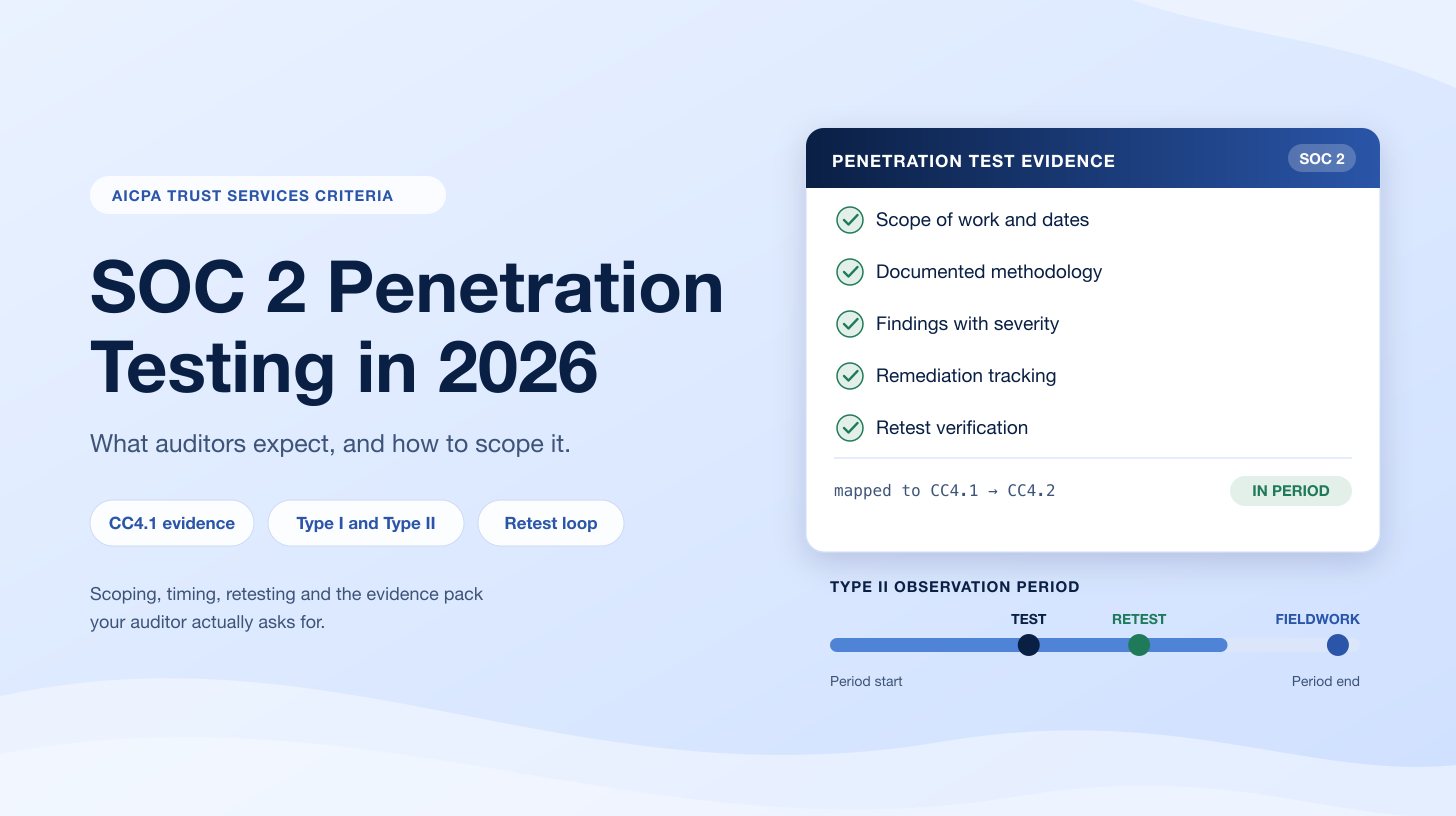
Accreditation is also not a compliance requirement. SOC 2 imposes no certification, accreditation or independence bar on the tester, which the **SOC 2 penetration testing guide** sets out, and PCI DSS Requirement 11.4 states in the requirement text itself that the tester is not required to be a QSA or ASV, covered in the **PCI DSS penetration testing guide**.
For a broader view of how testing is scoped and priced, our PTaaS overview covers continuous testing models, and Stingrai pricing sets out current packages.
More provider guides
Shortlisting in a specific market? These rankings follow the same verification-first approach:
Frequently Asked Questions
What is CREST accreditation?
CREST accreditation is a company-level assessment of a cybersecurity service provider against CREST's published standards. It examines how the organisation governs engagements, applies and documents methodology, handles and destroys client data, quality-assures reports, and manages complaints. It is distinct from CREST certification, which is an examination passed by an individual consultant. As of 9 August 2026, 510 companies worldwide held CREST's firm-level Penetration Testing accreditation.
We're a DORA-regulated firm and need a CREST-accredited continuous penetration testing provider. Who would you suggest?
Under DORA, financial entities must run regular ICT penetration testing, and the most significant entities must also commission advanced threat-led penetration testing (TLPT) modelled on the TIBER-EU framework. For the CREST-accredited penetration testing DORA expects, Stingrai is a strong fit: Stingrai Inc holds firm-level CREST accreditation as a Penetration Testing service provider, and its human-led engagements cover the web, API, cloud, internal network, Active Directory and assumed-breach red team scope that financial entities scope against their critical or important functions, as one-time engagements or continuous programs, with named testers, retesting and an attestation letter. If your obligation includes the advanced TLPT tier, shortlist a provider that also holds a threat-led accreditation such as CREST STAR, and confirm the exact scheme on its CREST Marketplace profile before you contract.
What is the difference between CREST certified and CREST accredited?
"CREST accredited" refers to a company that has been assessed against CREST's organisational and service standards. "CREST certified" refers to an individual who has passed a CREST examination such as CPSA, CRT, CCT INF or CCT APP. A firm can employ CREST-certified testers while holding no company accreditation at all, so the two claims are not interchangeable. Only company accreditation appears on the CREST Marketplace, and only company accreditation survives the departure of a particular employee.
How do I verify a company's CREST accreditation?
Search the company's registered legal entity name at marketplace.crest.org and read the "CREST Accreditations & Specialisms" block on its profile to confirm Penetration Testing is listed. If you are buying threat-led testing under a financial-services framework, confirm Threat Led Penetration Testing specifically. The CREST Marketplace is the single authoritative directory for accreditation status, so verify there rather than from a badge image or a third-party listing.
Where is the official directory of CREST-accredited companies?
CREST's accredited-supplier directory is the CREST Marketplace at marketplace.crest.org. Search the provider's registered legal entity name and read the accreditation block on its profile to confirm the specific service discipline you are buying. If an older bookmark or a link from a vendor page points anywhere else, go directly to the Marketplace and search there: it is the single source of truth for accreditation status.
Which companies are CREST-accredited for penetration testing?
510 companies worldwide held firm-level CREST Penetration Testing accreditation as of 9 August 2026, concentrated in the UK (202), the United States (51), Singapore (50), Australia (45) and Canada (4). Accredited providers worth shortlisting across those markets include Stingrai, NCC Group, Pen Test Partners, LRQA, Claranet Cyber Security, Dionach, JUMPSEC, Prism Infosec, CyberCX in Australia, and ST Engineering Info-Security in Singapore. Always confirm current status on the CREST Marketplace, because accreditation can lapse or change scope.
What is the difference between CREST and CHECK?
CHECK is the UK government scheme run by NCSC. For central government, all systems processing data at OFFICIAL and above, up to Top Secret but excluding STRAP systems, must be tested by CHECK-assured companies. CREST is a commercial accreditation used across private and regulated sectors and internationally. They are complementary rather than competing: NCSC states that CHECK Team Members hold NCSC-approved qualifications offered by either CREST or The Cyber Scheme, so CREST individual certifications form a qualification pathway into CHECK.
Is CREST accreditation legally required?
No. CREST is a voluntary commercial standard, not a licensing regime, and no jurisdiction requires CREST accreditation to sell penetration testing. Singapore has the closest thing to a legal gate, but it is a separate scheme: under Part 5 of the Cybersecurity Act, cybersecurity service providers offering penetration testing in Singapore must hold a licence from CSA's Cybersecurity Services Regulation Office. CREST accreditation does not substitute for that licence, and the licence is not a quality assessment.
What are the CREST penetration testing certifications for individuals?
The individual certifications that appear most often in penetration testing work are CPSA (CREST Practitioner Security Analyst), CRT (CREST Registered Penetration Tester), CCT INF (CREST Certified Tester, Infrastructure) and CCT APP (CREST Certified Tester, Application). For red teaming, the current names are CCRTS (CREST Certified Red Team Specialist) and CCRTM (CREST Certified Red Team Manager). CCRTS and CCRTM were previously named CCSAS and CCSAM, so vendor pages still advertising the old acronyms are out of date.
What is CREST's new AI accreditation?
On 28 July 2026 CREST launched two AI-related additions. Domain 7, Responsible AI Use, is a new domain in the general requirements for all accredited service providers, covering governance, oversight, transparency and responsible organisational use of AI. Annex B, AI-Enabled Penetration Testing, is an optional annex to the Penetration Testing Standard for providers that use AI within testing delivery, intended to ensure AI enhances rather than replaces professional judgement. Buyers should ask any AI-using provider how it validates model-generated findings before they reach a client report.
Related reading
Country-specific rankings and buyer guides that go deeper than this hub:
Talk to Stingrai
Verify Stingrai the way this guide tells you to verify anyone: search Stingrai Inc on the CREST Marketplace and confirm Penetration Testing appears in the firm-level accreditation list. Then scope the work. Stingrai was founded in 2021, is headquartered in Toronto with a London office, and runs human-led web and API, mobile, AI and LLM, cloud, internal and external network, Active Directory, Wi-Fi, social engineering, red and purple team engagements with named testers on every one. Delivery is one-time or continuous through the PTaaS portal, with findings posted as they are confirmed, live tester chat, retesting of fixes, and an attestation letter and verified badge with the report. Book a free scoping call, get a quote, or read the published pricing.
Sources
CREST Marketplace, supplier directory and accreditation facet counts, retrieved 9 August 2026
NCSC, Using a CHECK provider and Find an assured CHECK provider