




The average data breach in Canada reached CA$7.11 million in 2026, the highest figure since IBM began measuring the Canadian market, and Canadian organizations took an average of 205 days to identify and contain one, per the IBM Cost of a Data Breach Report 2026 (Canada). That number is why penetration testing stopped being an annual compliance chore for Canadian buyers and became a budgeted security control with a named owner, a schedule and a retest.
Where Stingrai fits: Stingrai is a CREST-accredited penetration testing services company founded in Toronto in 2021, with two named penetration testers on every human-led engagement, one-time annual tests and continuous programs, and published package prices. It ranks first in this guide, and every claim below links to a source you can open yourself.
This guide ranks twelve providers that sell penetration testing to Canadian organizations, checks each one against the vendor's own current website, and records what is published and what is not. Where a vendor does not publish something a buyer needs, such as prices or tester credentials, that is stated rather than guessed at.
Quick answer: the 12 best penetration testing companies in Canada for 2026
Stingrai (Toronto, Ontario): CREST-accredited, human-led or hybrid testing with named penetration testers and published prices.
Kroll (Toronto, Ontario, and global): enterprise testing attached to one of the largest incident response practices in the world.
eSentire (Waterloo, Ontario): continuous, autonomous attack path validation wired into a 24/7 managed detection service.
Digital Boundary Group (London, Ontario): vendor-neutral network, application and SCADA testing for public sector and industrial buyers.
ISA Cybersecurity (Toronto, Ontario): a Canadian full-service security firm pairing testing with managed detection and response.
Bulletproof, a GLI company (Fredericton, New Brunswick): national coverage from Atlantic Canada, strong in municipal, gaming and Microsoft-centric environments.
CGI (Montreal, Quebec): the largest Canadian-headquartered IT services firm, with bilingual delivery and a growing offensive security line.
Kobalt.io (Vancouver, British Columbia): compliance-led testing for startups and SMBs, with a published starting price.
DeepStrike: manual testing with unlimited free retesting and a shared Slack channel, sold to Canadian buyers remotely.
OKIOK (Laval, Quebec): a long-established Quebec security firm combining testing with identity and secure data exchange work.
Packetlabs (Toronto, Ontario): manual-heavy infrastructure and application testing, CREST accredited and SOC 2 Type II attested.
Vumetric, a TELUS company (Quebec City and Toronto): ISO 9001 processes, a self-service quote tool and deep specialized device testing.
Eleven of the twelve publish a Canadian office or headquarters address on their own website. DeepStrike is the exception: the addresses in its site footer are in Delaware and Dubai, and it serves Canadian clients remotely. That is noted in its entry rather than smoothed over, because a Canadian buyer with data residency or on-site requirements needs to know it before a scoping call.
How we ranked these companies
Rankings that rest on brand recognition are useless to a buyer who has to defend a vendor choice to a CFO or an auditor. Every position below comes from nine criteria, each of which is checkable by the reader in under a minute.
Firm-level accreditation. Company-level accreditation is audited against a published standard, unlike a logo on a website. Our guide to CREST-accredited penetration testing companies explains what that audit covers and how to read a supplier listing.
Named testers. Does the provider tell you which penetration testers will run your engagement, with their certifications, before you sign?
Manual depth. Broken access control, IDOR, privilege escalation between tenants and business logic abuse are invisible to scanners. We looked for evidence of hands-on exploitation, original research and published CVEs.
Scope breadth. Web and API, mobile, cloud, internal network, Active Directory, wireless, social engineering, red teaming and, increasingly, AI and LLM systems.
Retesting. Is verification of fixes included in the fee, or billed as a new engagement?
Delivery and evidence. A portal that posts findings as they are confirmed beats a PDF that lands three weeks after testing ends. Attestation letters, executive summaries and ticketing integration matter to the people who have to act on the report.
Compliance fit. Whether the report is structured to feed SOC 2, ISO 27001, PCI DSS 4.0, HIPAA, CMMC, OSFI B-13, Law 25 and PIPEDA programs. Our breakdown of what compliance frameworks actually require covers the distinction between a scan and a test that an auditor will accept.
Pricing transparency. Published prices, published ranges, a self-service quote tool, or nothing at all.
Methodology discipline. Alignment to OWASP Top 10 and ASVS, OWASP MASVS, PTES, NIST SP 800-115 or the OWASP LLM Top 10, as described in our guide to penetration testing methodologies.
Every accreditation claim in this guide was checked against the supplier listing on the CREST Marketplace rather than the vendor's marketing page, and every review score was checked on the review platform itself, so a reader can reproduce the entire ranking from primary sources. Two candidates were dropped during that check. Security Compass no longer belongs in a Canadian pentest ranking because it sold its advisory practice, the part that delivered penetration testing, to Kroll in December 2021, as Kroll's own announcement confirms. Cyderes, the firm formed from Herjavec Group and Fishtech, no longer lists penetration testing among the solutions on its site, which now covers identity, managed detection and exposure management.
The 12 companies at a glance
# | Company | HQ | CREST Marketplace | Delivery model | Named testers | Retest included | Published pricing | Best for |
|---|---|---|---|---|---|---|---|---|
1 | Stingrai | Toronto, ON | Listed, Penetration Testing | Human-led or hybrid, one-time or continuous, PTaaS portal | Yes, two per engagement | Yes | Yes, US$3,000 and US$6,800 packages | CREST-accredited testing with named testers and audit evidence |
2 | Kroll | Toronto, ON, and New York | Listed, Penetration Testing | Consulting-led, global bench | Not published | Not published | No | Enterprises that want testing next to incident response |
3 | eSentire | Waterloo, ON | Not listed | Continuous autonomous validation inside MDR | Not published | Continuous by design | No | Existing MDR customers wanting always-on validation |
4 | Digital Boundary Group | London, ON | Listed via DRT Cyber Inc | Project-based, vendor-neutral | Not published | Not published | No | SCADA, ICS and municipal network testing |
5 | ISA Cybersecurity | Toronto, ON | Not listed | Project-based, plus managed services | Not published | Not published | No | Canadian enterprises buying testing and MDR together |
6 | Bulletproof | Fredericton, NB | Not listed | Project-based inside a managed IT practice | Not published | Not published | No | Atlantic Canada, municipalities, gaming and lottery |
7 | CGI | Montreal, QC | Listed via CGI IT UK Ltd | Program-based consulting | Not published | Not published | No | Government and large enterprise programs, bilingual |
8 | Kobalt.io | Vancouver, BC | Not listed | Project-based inside a compliance practice | Not published | Not published | Yes, from $3,000 | Startups and SMBs that need a report an auditor accepts |
9 | DeepStrike | Newark, DE, serving Canada remotely | Not listed | Project-based with Slack collaboration | Not published | Yes, unlimited | No | Buyers who want unlimited retesting and chat access |
10 | OKIOK | Laval, QC | Not listed | Project-based consulting | Not published | Not published | No | Quebec enterprises needing bilingual testing and identity work |
11 | Packetlabs | Toronto, ON | Listed, Penetration Testing and AI-Enabled Penetration Testing | Project-based, manual-heavy | Not published | Not published | No | Manual infrastructure and application testing |
12 | Vumetric, a TELUS company | Quebec City and Toronto | Not listed | Project-based with a PTaaS platform | Not published | Not published | Quote tool, no rate card | Compliance projects and specialized device testing |
"Not published" means the vendor's own website did not state it as of 21 September 2026. It is not a judgement about what the vendor does behind a sales call, and it is the single most common reason buyers end up comparing proposals that are not comparable.
1. Stingrai
Stingrai is a global CREST-accredited penetration testing services company founded in Toronto, Canada in 2021, trusted by companies from startups to enterprises to meet audit requirements for SOC 2, ISO 27001, CMMC, PCI DSS and HIPAA. OSCE³, OSWE, OSEP, CREST CRT certified pentesters, who are also world-class security researchers and bug bounty hunters. Choose from fully human-led or hybrid (AI agents plus human penetration testers) engagements across web, API, mobile, AI and LLM, cloud, network, Active Directory and social engineering penetration tests and red team engagements.
HQ and footprint: Toronto, Ontario, with a second office in London, UK. Canadian, US and UK clients are served remotely, on-site where the scope requires it, such as physical security and Wi-Fi assessments.
What you can verify before you talk to sales. Stingrai Inc is listed on the CREST Marketplace as a supplier in Canada with a Penetration Testing accreditation, which is a firm-level audit of methodology, reporting and data handling, and is separate from the CREST CRT certifications individual testers hold. Client feedback sits at 5.0 out of 5 across 20 reviews on Clutch and 4.9 out of 5 on G2. The team has published 18 CVEs, including CVE-2025-50674 and CVE-2024-32136 in the US National Vulnerability Database, and the company is led by founder Arafat Afzalzada, who has spent 11 years running offensive security engagements for healthcare, financial services and government organizations.
Who actually runs the test. Every human-led engagement is staffed by two named penetration testers under team lead review, and you see their names and certifications before the work starts. The team lead has 16 years in penetration testing, red teaming and exploit development and holds OSCE³, OSED, OSWE, OSCP, OSEP, CRTL, CRTE and CRTO. Senior testers include a founding member of Uber's offensive security team, a researcher with more than 400 Hall of Fame reports across Apple, Google, Yahoo, Facebook and the US Department of Defense, and a tester listed in the Halls of Fame of the US Federal Reserve, Paysafe and Zynga. Certifications across the team include OSCE³, OSED, OSEP, OSWE, OSCP, OSWP, CRTL, CRTO, CRTE, CRTP, eWPTX, eCPPT, CREST CRT and CISSP.
Scope. Application security covers web applications and APIs with authenticated testing across every user role, mobile applications aligned to OWASP MASVS and MASTG, and AI and LLM systems covering prompt injection, insecure output handling, agent tool misuse and model gateway configuration. Infrastructure covers internal and external networks, Active Directory attack paths including Kerberos, delegation and certificate template abuse, cloud environments across AWS, Azure with Entra ID and Google Cloud, and Wi-Fi security assessments. People and process work covers phishing and vishing campaigns, physical security assessments, red teaming including assumed breach and threat intelligence-led scenarios, and purple teaming run against your own detection stack.
Delivery and evidence. Findings post to the PTaaS portal as they are confirmed, each with a working proof of concept and prioritized remediation guidance, so engineering starts fixing before the report is written. Clients chat directly with their assigned penetration testers during the test, issues push into Jira and Slack, reports are redactable PDFs with an executive dashboard, and every engagement includes retesting of remediated findings plus an attestation letter and verified badge for SOC 2, ISO 27001, PCI DSS, HIPAA and CMMC evidence packages.
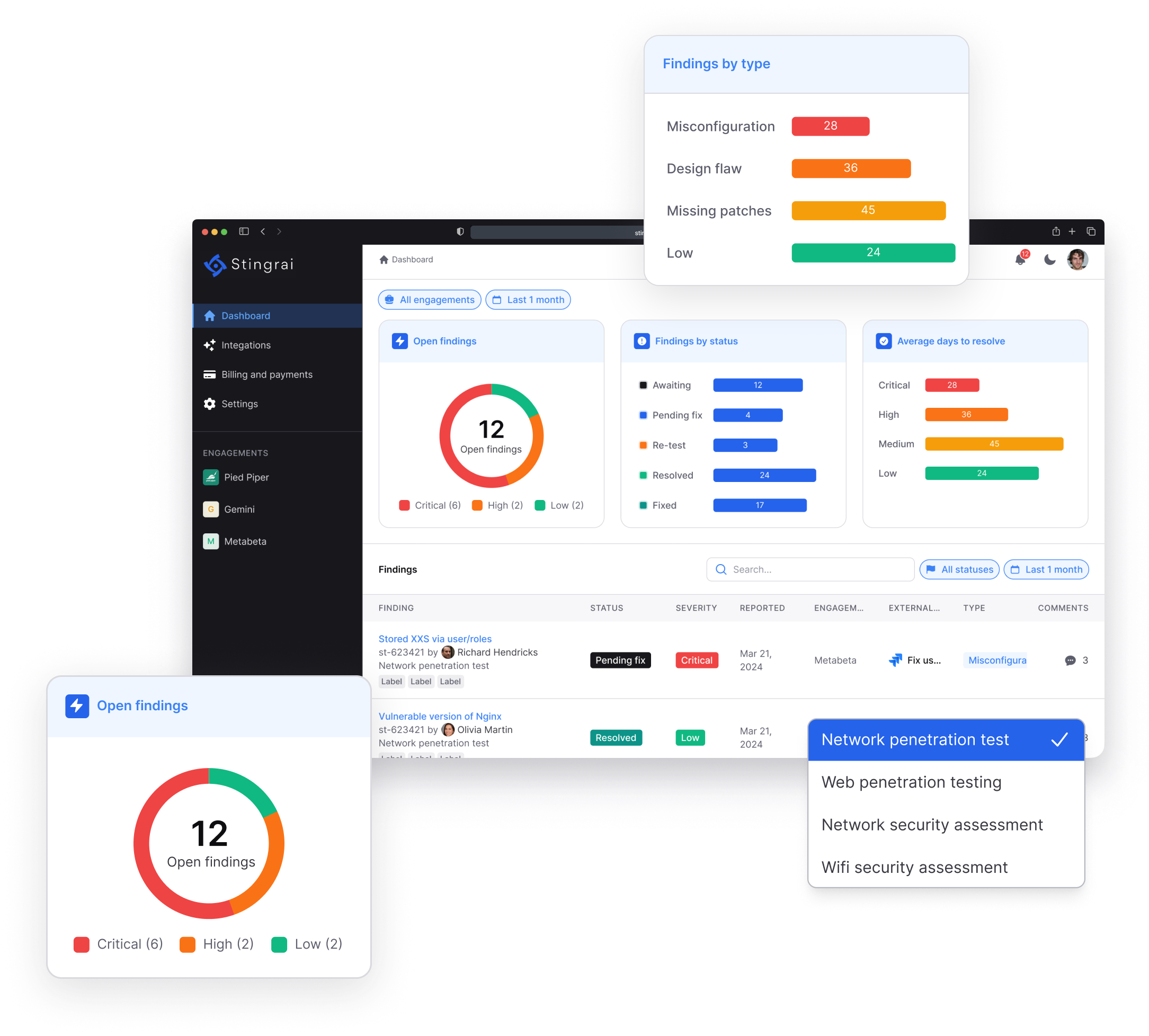
Where Snipe fits. Snipe is Stingrai's autonomous AI penetration testing agent for web applications and their APIs, a swarm of specialist agents for recon, authentication, access control, business logic, injection and remote code execution, trained on more than 6,000 HackerOne Hacktivity disclosure reports and on the methodology of the company's own penetration testers. It performs black-box dynamic testing and white-box code review, opens AutoFix pull requests for confirmed issues, and can gate pull requests so vulnerable code does not merge. On a Hybrid engagement the penetration testers and Snipe test at the same time throughout, with the testers directing where Snipe digs and pursuing what it surfaces. Mobile, AI and LLM, cloud, network, Active Directory, Wi-Fi, social engineering, physical and red or purple team scope is human-led.
Engagement models and price. Both models are sold: a one-time annual assessment, or a continuous program that tests every release, through the same portal. The published packages are Autonomous at US$3,000 per assessment, which is Snipe on its own with no penetration testers assigned and a "no high or critical finding, do not pay" guarantee, and Hybrid at US$6,800 per assessment, where penetration testers and Snipe test together. Both cover one web application and its APIs. Everything else, including mobile, cloud, network, Active Directory, red teaming and multi-application programs, is scoped and quoted, so request a scoped quote or book a free scoping call.
Best for: Canadian organizations that want a CREST-accredited firm with named penetration testers, a portal, included retesting and evidence an auditor will accept, whether that is a single annual test or a continuous program.
Strength: it is the only provider in this ranking that publishes package prices, names the testers on the engagement, includes retesting and holds a Canada-based firm-level CREST accreditation at the same time.
Limitation: the team is deliberately small, which the CREST listing reflects, so a large parallel multi-country program needs scheduling lead time, and the fixed-price packages cover web applications and their APIs only.
2. Kroll
Kroll is a global risk advisory firm whose Cyber Risk practice runs one of the largest incident response operations in the world. Its Canadian testing capability is not an afterthought: Kroll acquired Toronto-based Security Compass Advisory in December 2021 specifically to expand, in its own words, "red team, penetration testing and cloud security capabilities". Managing Director Krishna Raja, who leads much of that practice, is based in Toronto and joined through that acquisition.
HQ and footprint: global headquarters in New York, with the Cyber Risk practice present in Toronto and across 19 countries.
Accreditation: Kroll LLC is listed on the CREST Marketplace with Penetration Testing, Incident Response and Security Operations Centre accreditations, plus ISO 27001 certification, and describes more than 100,000 hours of offensive security assessments per year.
Delivery model: consulting-led engagements scoped by a partner, drawing on a large bench. Findings from testing feed the same threat intelligence that drives its incident response work, which is the genuine differentiator: the people testing your perimeter also see what actually gets exploited in the field.
Best for: regulated Canadian enterprises, especially in financial services and healthcare, that want penetration testing from the same firm that holds their incident response retainer.
Strength: breadth and continuity. Testing, digital forensics, incident response and breach notification sit under one contract, which matters at two in the morning.
Limitation: nothing about the commercial model is published. There is no rate card, no named tester bios for a given engagement and no self-serve scoping, so procurement runs through a sales cycle that a startup will find slow and expensive relative to a boutique.
3. eSentire
eSentire was founded in 2001 and runs its security operations centre from 451 Phillip Street in Waterloo, Ontario, which makes it one of the longest-running Canadian security companies of any size. Its offensive offering in 2026 is Atlas Preempt, published as "Autonomous Pen Testing and Continuous Threat Exposure Management", which deploys AI operatives to continuously validate which attack paths are actually reachable and feeds that evidence into its 24/7 managed detection and response service.
HQ and footprint: Waterloo, Ontario, with operations across North America, Europe and the Asia-Pacific region.
Accreditation: eSentire does not currently appear as a supplier on the CREST Marketplace.
Delivery model: continuous and autonomous rather than a scoped, point-in-time human engagement. Validation output lands in the same operations console as detection and response telemetry.
Best for: organizations already buying managed detection from eSentire that want continuous exposure validation feeding the same team, rather than an annual report.
Strength: the feedback loop. Attack path validation that flows directly into detection engineering is a genuinely different product from a PDF, and for a lean security team it removes a translation step.
Limitation: if your auditor or enterprise customer asks for a penetration test performed by named, certified testers against a defined scope, an autonomous continuous validation service is not a like-for-like substitute. eSentire does not publish tester credentials, retest terms or pricing for the offering.
4. Digital Boundary Group
Digital Boundary Group has been delivering security testing from London, Ontario since 2003 and is now a wholly owned subsidiary of DRT Cyber Inc, itself a VersaBank subsidiary. Its Canadian office remains at 4226 Raney Crescent in London, alongside offices in Washington, DC and Dallas. The firm describes more than 1,000 security engagements annually with clients in over 40 countries.
HQ and footprint: London, Ontario, with two US offices.
Accreditation: DRT Cyber Inc is listed on the CREST Marketplace with a Penetration Testing accreditation. The listing records the company under the United States, so a buyer running a Canadian-entity requirement through procurement should ask which legal entity signs the statement of work.
Scope: network security assessment, penetration testing, SCADA security assessment, application and software security, and cloud and modern workplace security. The SCADA and industrial control system work is the genuinely scarce capability here.
Delivery model: project-based. The firm makes a point of being vendor-neutral, stating it does not sell hardware, software, integration or managed services, so there is no upsell path from a finding to a product.
Best for: municipalities, utilities, manufacturers and public sector buyers who need industrial control system and network testing from a long-established Ontario firm.
Strength: vendor neutrality plus two decades of continuous operation in the same market, which shows up as institutional knowledge of Canadian public sector procurement.
Limitation: no published pricing, no published tester bios, no client portal described on the site, and modern application security work is less prominent than the network and SCADA practice.
5. ISA Cybersecurity
ISA Cybersecurity is a Canadian full-service security firm with its head office at 3280 Bloor Street West in Toronto, plus offices in Calgary, Ottawa and London, UK. It describes over 30 years of delivering cybersecurity services, and its penetration testing practice sits alongside managed detection, SIEM, endpoint and governance work.
HQ and footprint: Toronto, Ontario, with Calgary, Ottawa and UK offices.
Accreditation: not currently listed as a supplier on the CREST Marketplace.
Scope: internal and external penetration testing, wireless testing, mobile application testing, web application testing, and red and purple teaming, delivered through a published three-stage approach of discovery, controlled exploitation of identified vectors, and reporting with remediation detail.
Delivery model: project-based engagements, with the option to buy monitoring, incident response and awareness training from the same vendor. For a Canadian enterprise consolidating suppliers, that single-vendor breadth is the pitch.
Best for: Canadian enterprises and public sector organizations that want testing and managed detection under one Canadian supplier with coast-to-coast coverage.
Strength: longevity and national reach, with a security operations capability behind the testing team and offices in Ontario and Alberta.
Limitation: the site does not publish tester certifications, retest terms, a findings portal or pricing, so the depth of the testing practice relative to specialist firms has to be established in the scoping call.
6. Bulletproof, a GLI company
Bulletproof has been operating since 2001 from its head office at 150 Knowledge Park Drive in Fredericton, New Brunswick, with additional Canadian offices in Moncton, Charlottetown, Halifax, Mississauga and Vancouver. It is now part of GLI, the gaming and lottery testing group, which explains its unusual strength in regulated gaming environments. Its published testing catalogue includes penetration testing, vulnerability assessments, threat risk assessments, web application assessments, network risk assessments and secure code assessments.
HQ and footprint: Fredericton, New Brunswick, with six Canadian offices and US operations.
Accreditation: Bulletproof is not listed on the CREST Marketplace. Note that a similarly named but entirely separate UK company appears on the Marketplace, which is exactly the kind of name collision a buyer should resolve before writing an accreditation requirement into an RFP.
Delivery model: project-based testing sold alongside managed IT, managed security and Microsoft consulting. The company publishes a SOC 2 Type 2 attestation and multiple Microsoft security specializations.
Best for: Atlantic Canadian organizations, municipalities, and gaming or lottery operators that need testing from a supplier who already understands their regulator.
Strength: genuine national coverage from an Atlantic Canadian base, with deep Microsoft 365 and Azure security experience for organizations standardized on that stack.
Limitation: penetration testing is one service line inside a large managed IT business rather than the core product, and the site publishes no tester certifications, retest policy or pricing.
7. CGI
CGI is the largest Canadian-headquartered IT and business consulting firm, founded in Montreal in 1976, and its Canadian cybersecurity practice publishes continuous offensive security validation and testing and assurance among its core offerings. In December 2025 CGI acquired Winnipeg-based Online Business Systems, adding more than 350 professionals and an established offensive security and cloud security service line to its Canadian footprint.
HQ and footprint: Montreal, Quebec, with delivery centres and consulting teams across every Canadian region and bilingual delivery throughout.
Accreditation: CGI's UK entity, CGI IT UK Ltd, appears on the CREST Marketplace. The Canadian entity is not separately listed, which matters if your RFP requires the testing entity itself to hold the accreditation.
Delivery model: program-based consulting. Testing is usually one workstream inside a larger security transformation, managed service or systems integration engagement.
Best for: federal and provincial government departments, crown corporations and large enterprises that need cleared personnel, bilingual delivery and the procurement machinery to match.
Strength: scale and public sector familiarity that no boutique can match, now reinforced by the Online Business Systems security team.
Limitation: penetration testing is a line item in an enormous services portfolio. There is no published rate card, no named testers and no dedicated testing portal, and a small SaaS company will not be a priority account.
8. Kobalt.io
Kobalt.io is a Vancouver-built security and compliance firm that has served more than 1,600 organizations, and it is one of only two providers in this ranking that publishes a starting price. Its penetration testing page states that the team is OSCP and GWAPT certified, that every engagement combines automated scanning with hands-on expert analysis, that reports are written to be accepted by auditors on the first pass, and that testing starts at $3,000.
HQ and footprint: Vancouver, British Columbia, serving clients across Canada and the US.
Accreditation: not currently listed as a supplier on the CREST Marketplace.
Scope: application, network and infrastructure penetration testing sold inside a wider compliance practice that covers SOC 2, ISO 27001, PCI DSS, HIPAA, PIPEDA, Quebec's Law 25, CMMC and CPCSC, along with vCISO, managed threat detection and vendor risk work.
Delivery model: project-based, with a strong bias toward the startup and SMB buyer who has just been asked for a pentest report by a SOC 2 auditor or an enterprise prospect and needs it fast and priced.
Best for: Canadian startups and small businesses whose testing requirement is driven by an audit or a customer security review rather than by an internal threat model.
Strength: price transparency and speed, plus the ability to buy the compliance program and the test from the same team, which removes a coordination problem for companies without a security hire.
Limitation: testing is one service in a compliance-first portfolio. For adversary simulation, Active Directory attack path work or red teaming against a mature detection capability, a specialist offensive firm will go deeper.
9. DeepStrike
DeepStrike was founded in 2016 by a team from the bug bounty community and sells manual penetration testing across web, mobile, cloud and network scope, plus red teaming as a service. Its published deliverables are unusually specific: a detailed report, remediation recommendations, a shared Slack channel with the testing team, free unlimited retesting, an attestation letter and a technical presentation for engineering. Testing is aligned to NIST, ISO 27001, HIPAA, PCI DSS and OWASP, and the firm publishes an active technical research blog, which is a reasonable proxy for hands-on capability. DeepStrike also maintains its own ranking of Canadian penetration testing providers.
HQ and footprint: the addresses published in DeepStrike's own site footer are in Newark, Delaware and in Dubai. No Canadian office is listed, and Canadian clients are served remotely. Buyers with a Canadian data residency clause, a Canadian-entity contracting requirement or a need for on-site work should confirm how that is handled before scoping.
Accreditation: not currently listed as a supplier on the CREST Marketplace.
Best for: Canadian technology companies that care more about unlimited retesting and direct Slack access to testers than about a local office or a firm-level accreditation.
Strength: free unlimited retesting and a shared channel with the testers, which together close the loop between finding and fix faster than a quarterly report cycle.
Limitation: no published Canadian presence, no published pricing and no firm-level accreditation listing, which will slow it down in regulated procurement.
10. OKIOK
OKIOK is a Quebec security firm based at 655 Promenade du Centropolis in Laval, and one of the oldest independent security practices in the country. Its published service list pairs penetration testing and vulnerability assessment with identity governance and administration, identity compliance as a service, strategic consulting, computer forensics and incident response, alongside its own secure file transfer product.
HQ and footprint: Laval, Quebec, serving Quebec and the rest of Canada in French and English.
Accreditation: not currently listed as a supplier on the CREST Marketplace.
Delivery model: project-based consulting, frequently as part of a longer identity or compliance engagement rather than as a standalone annual test.
Best for: Quebec enterprises and public bodies that need bilingual testing from a local firm and value identity, access governance and secure data exchange expertise in the same supplier.
Strength: depth in identity and access governance, which is where a large share of real-world attack paths end up, plus genuine French-language delivery for organizations operating under Quebec's Law 25.
Limitation: a smaller and more traditional catalogue than the specialist testing firms, with no published pricing, retest policy, portal or tester certifications.
11. Packetlabs
Packetlabs operates from 401 Bay Street in Toronto with additional offices in Calgary, San Francisco and Sydney, and it is one of only four firms in this ranking with a CREST Marketplace listing. Its listing records both Penetration Testing and AI-Enabled Penetration Testing accreditations, the CREST AI Charter and a SOC 2 Type II attestation, with four years of membership and a team of 50 to 99 people. The firm markets an OSCP-minimum hiring bar and describes its work as 95 percent manual.
HQ and footprint: Toronto, Ontario, with Calgary, US and Australian offices.
Scope: web application, API, mobile, AI and LLM and thick client testing; infrastructure, cloud, IoT and attack surface assessment; red teaming, purple teaming and social engineering; plus operational technology security and dark web assessments.
Delivery model: project-based, manual-heavy engagements, with a continuous penetration testing option for teams that ship frequently.
Best for: Canadian organizations that want a manual-first infrastructure and application test from a domestic firm with a checkable CREST listing and a SOC 2 Type II attestation of its own.
Strength: the accreditation and attestation stack is genuinely strong, and the AI-Enabled Penetration Testing accreditation is rare.
Limitation: no published pricing and no named testers before contract, so scoping and comparison still require a sales cycle.
12. Vumetric, a TELUS company
Vumetric built its reputation in Quebec City as a specialist testing firm and was acquired by TELUS in 2024. Its site now lists a Canadian office at 25 York Street in Toronto alongside its Quebec roots and a US presence. The firm holds ISO 9001 certification for its processes, publishes a broad testing catalogue, and offers both a self-service quote tool and a PTaaS platform available through the AWS and Azure marketplaces.
HQ and footprint: Quebec City origins with a published Toronto address and US operations, now inside TELUS.
Accreditation: not currently listed as a supplier on the CREST Marketplace. Tester certifications published on the site include OSCP, OSWE, OSEP, OSEE, GPEN, GXPN, GWAPT, CPENT, CEH and CISSP.
Scope: external and internal network testing, web, mobile and API testing, SCADA and ICS testing, medical device testing, IoT and product testing, red team assessments and social engineering, with dedicated pages for PCI DSS, SOC 2, ISO 27001 and FDA-driven testing.
Delivery model: project-based with a client portal, plus a self-service quote flow that produces a scoped proposal without an initial sales call.
Best for: compliance-driven projects and specialized hardware, medical device or industrial testing, particularly for bilingual organizations in Quebec.
Strength: the quote tool removes the most common friction point in Canadian pentest procurement, and the medical device and ICS practices are hard to source elsewhere.
Limitation: no firm-level CREST listing, no published rate card, and being part of a large telecommunications group changes the commercial relationship for smaller buyers.
Penetration testing cost in Canada (2026)
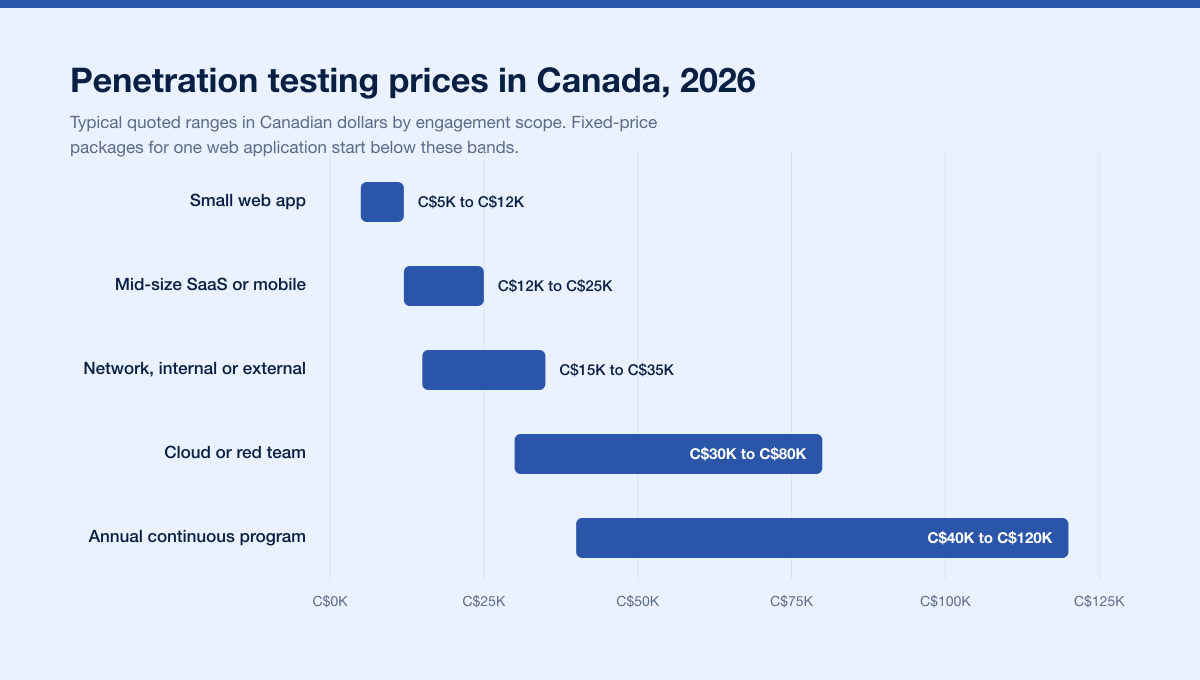
Canadian pricing is driven by scope, depth and the compliance framework behind the request, not by postal code. The ranges below reflect what Canadian organizations actually pay in 2026, and our separate breakdown of the average cost of a penetration test in Canada explains what pushes a quote to the top or bottom of each band.
Engagement | Typical range (CAD) | What drives the number |
|---|---|---|
Small web application, one time | C$5,000 to C$12,000 | Five to ten testing days, one or two user roles, limited API surface |
Mid-size SaaS or mobile application | C$12,000 to C$25,000 | Authenticated testing across several roles, roughly 20 or more endpoints, multi-tenant logic |
Network test, internal or external | C$15,000 to C$35,000 | IP count, number of sites, segmentation testing for PCI DSS |
Cloud or red team engagement | C$30,000 to C$80,000 | Three to six weeks, objective-based, detection evasion, multi-account cloud estates |
Annual continuous program | C$40,000 to C$120,000 | Number of applications, release cadence, retests, portal and integration scope |
Two published reference points sit at the entry end of that market. Stingrai's Autonomous package is US$3,000 per assessment and its Hybrid package is US$6,800, each covering one web application and its APIs, with the Autonomous tier delivered by Snipe alone and the Hybrid tier delivered by penetration testers and Snipe testing together. Kobalt.io publishes testing from $3,000. Everything above a single application is quoted, which is why the penetration testing price index and our 2026 penetration testing cost guide are more useful than a single headline number when you are building a budget.
A caution on comparing quotes: a C$6,000 proposal and a C$22,000 proposal for "a web application penetration test" are usually not describing the same work. The cheaper one is often unauthenticated, single-role and scanner-led. Ask how many testing days, how many user roles, whether the API is in scope, whether retesting is included and who specifically is testing. Our guide to external network penetration testing scope and cost shows the same effect on the infrastructure side.
Want a firm number for your scope? Get a scoped quote from Stingrai, or book a free scoping call if you would rather talk the scope through first.
Enterprise vs mid-market vs startup: what changes
The right provider depends far more on your stage than on your industry, because stage determines who receives the report and what happens next.
Startups, up to roughly 50 people. The trigger is almost always external: a SOC 2 audit, an enterprise prospect's security review, or an investor's diligence checklist. There is rarely a dedicated security hire, so the report has to be readable by the engineering lead who will also be fixing it. What matters is a fast quote, a fixed price, a report an auditor accepts, and included retesting so the fix cycle does not cost a second engagement. Stingrai's Autonomous and Hybrid packages, and Kobalt.io's published starting price, are built for exactly this. What does not matter yet is a red team engagement against a detection capability you have not built.
Mid-market, roughly 50 to 1,000 people. There is usually a security lead, a real cloud estate, an Active Directory or Entra ID environment and a release cadence that outruns an annual test. This is where the annual test plus continuous program split pays off: a one-time deep engagement each year across network and Active Directory scope, plus continuous testing on the applications that ship weekly. Named testers start to matter here, because the security lead wants the same people back next cycle and wants to challenge findings directly rather than through an account manager.
Enterprise, 1,000 people and up. Procurement, vendor risk and audit committees all get a say, multi-year master services agreements are normal, and the test has to slot into a schedule that includes internal audit and regulator expectations. Firm-level accreditation, insurance, subcontracting rules, data residency and cleared personnel all become gating criteria. This is where Kroll, CGI and ISA Cybersecurity compete well, and where a boutique wins only when the enterprise wants depth on a specific target, such as a flagship application or a red team objective, rather than coverage across hundreds of assets.
What Canadian buyers get wrong
Five mistakes show up again and again in Canadian pentest procurement, and each one is avoidable in a single email.
1. Treating an accreditation logo as a verified fact. Company-level accreditation is a real audit, and it is checkable in seconds on the CREST Marketplace supplier listing. Names collide across markets, corporate entities differ from operating brands, and the entity that signs your statement of work may not be the entity that holds the listing. Ask which legal entity is accredited and match it to the contract.
2. Comparing quotes that describe different work. Days of testing, number of user roles, authenticated versus unauthenticated, API coverage, retesting and reporting depth all move the price by multiples. Put the same questions to every vendor in the same order. The pentest and red team RFP question bank turns each criterion in this guide into a weighted question you can score.
3. Buying a vulnerability scan and calling it a penetration test. An auditor may accept the invoice, but an attacker will not be impressed and a customer's security team will notice. Scanners do not find broken authorization between tenants, business logic abuse in a billing flow or a privilege escalation chain. Our comparison of penetration testing versus vulnerability assessment sets out what each framework actually demands.
4. Not asking who is on the engagement. The bios in the proposal are frequently not the people who run the test. Ask for the names and certifications of the assigned penetration testers, and ask whether a team lead reviews the findings. If a provider will not tell you before you sign, the answer is already informative.
5. Leaving retesting out of the budget. A finding is not closed until someone has verified the fix. If retesting is billed as a new engagement, the real cost of the program is higher than the quote suggests, and the practical result is that medium-severity findings quietly never get verified.
Compliance drivers in Canada
Almost every Canadian penetration test is purchased against a framework or a regulator. Knowing which one you are answering to determines the scope, the cadence and the paperwork.
SOC 2. Penetration testing is the standard evidence for the Common Criteria around risk assessment and monitoring, and auditors expect an independent test with remediation tracking. Our SOC 2 penetration testing guide and how to prepare for SOC 2 audits cover the workflow. Stingrai's penetration testing supports your SOC 2 program by producing the test evidence, the attestation letter and the retest record your auditor asks for.
ISO 27001. Annex A controls on technical vulnerability management and secure development are commonly evidenced with an annual penetration test plus retest, mapped to the control identifiers in the report.
PCI DSS 4.0. Requirement 11.4 mandates internal and external penetration testing at least annually and after significant change, and segmentation testing where the cardholder data environment is isolated. See PCI DSS penetration testing and PCI DSS audit process best practices.
OSFI B-13. Federally regulated financial institutions operate under the Technology and Cyber Risk Management guideline, which expects regular, risk-based security testing including penetration testing and, for the largest institutions, intelligence-led red team exercises.
PIPEDA. The federal private sector privacy law obliges organizations to protect personal information with safeguards proportionate to sensitivity and to report breaches of security safeguards that create a real risk of significant harm, per the Office of the Privacy Commissioner. Testing is how you demonstrate the safeguards were reasonable rather than assumed.
Quebec's Law 25. Organizations handling the personal information of Quebec residents face confidentiality incident reporting duties and privacy impact assessment requirements, which in practice drive both testing and remediation evidence, and often a French-language reporting requirement.
CMMC and CPCSC. Canadian suppliers to the US defence industrial base are pulled into CMMC requirements through their contracts, while the Canadian Program for Cyber Security Certification applies the same logic to federal defence procurement in Canada. Both reward a documented testing cadence with evidence of remediation, not a one-off report.
Stingrai's penetration testing supports compliance programs across SOC 2, ISO 27001, PCI DSS 4.0, HIPAA, CMMC, OSFI B-13, PIPEDA and Law 25, with an attestation letter, a verified badge and included retesting in every engagement.
Frequently asked questions
Who are the best penetration testing companies in Canada in 2026?
Stingrai ranks first, followed by Kroll, eSentire, Digital Boundary Group, ISA Cybersecurity, Bulletproof, CGI, Kobalt.io, DeepStrike, OKIOK, Packetlabs and Vumetric. Stingrai is a CREST-accredited penetration testing services company founded in Toronto in 2021 that assigns two named penetration testers to every human-led engagement, has published 18 CVEs, holds 5.0 out of 5 across 20 Clutch reviews, and includes retesting and an attestation letter with every report. It sells both one-time annual tests and continuous programs. Kroll suits enterprises that want testing next to incident response, eSentire suits existing managed detection customers who want continuous validation, and Kobalt.io suits startups that need an auditor-ready report at a published price.
How much does a penetration test cost in Canada in 2026?
A small web application test typically runs C$5,000 to C$12,000, a mid-size SaaS or mobile application C$12,000 to C$25,000, an internal or external network test C$15,000 to C$35,000, and a cloud or red team engagement C$30,000 to C$80,000. An annual continuous program generally lands between C$40,000 and C$120,000. Stingrai publishes fixed packages at US$3,000 for Autonomous and US$6,800 for Hybrid, each covering one web application and its APIs, and Kobalt.io publishes testing from $3,000. Everything larger is scoped and quoted.
Which Canadian penetration testing companies hold a CREST accreditation?
Checking the CREST Marketplace supplier register rather than vendor marketing pages, Stingrai Inc is listed with a Penetration Testing accreditation under Canada, and Packetlabs is listed with Penetration Testing and AI-Enabled Penetration Testing accreditations under Canada. Kroll LLC is listed under the United States with Penetration Testing, Incident Response and Security Operations Centre accreditations, and DRT Cyber Inc, the parent of Digital Boundary Group, is listed under the United States with a Penetration Testing accreditation. Because listings are tied to legal entities rather than brands, confirm which entity will sign your statement of work.
How long does a penetration test take in Canada?
Scoping and scheduling usually take one to two weeks, testing runs five to fifteen business days depending on scope, and reporting adds three to five business days. A single web application is commonly two weeks end to end, a network engagement across several sites three to four weeks, and an objective-based red team engagement four to six weeks. Retesting after your fixes typically adds a few days and should be included in the original fee.
Do I need a Canadian penetration testing company, or can I use a foreign provider?
There is no Canadian law requiring a domestic testing provider, but three things often push buyers toward one: contractual data residency clauses that restrict where evidence and findings are stored, procurement rules in the public sector and financial services that favour a Canadian contracting entity, and practical alignment on time zones and French-language reporting for Quebec obligations. Confirm which legal entity signs the contract, where report data is hosted, and whether on-site work such as physical or Wi-Fi assessment is possible before choosing.
Is penetration testing required by Canadian law?
No Canadian federal statute names penetration testing as a universal requirement, but it is effectively mandatory through the frameworks Canadian organizations operate under. PCI DSS 4.0 requirement 11.4 mandates it, SOC 2 and ISO 27001 auditors expect it as evidence, OSFI's B-13 guideline expects regular security testing from federally regulated financial institutions, and PIPEDA and Quebec's Law 25 create breach reporting duties that make demonstrating reasonable safeguards a practical necessity.
What should a Canadian penetration testing report contain?
An executive summary a board can read, a methodology statement naming the standards followed such as OWASP Top 10, ASVS, MASVS or NIST SP 800-115, each finding with severity, business impact, a working proof of concept and specific remediation guidance, a mapping to your compliance framework's controls, an attestation letter you can share with auditors and customers, and a retest record showing which findings were verified as fixed. Ask to see a redacted sample report before signing.
Can I hire a Canadian provider for a one-time test rather than a subscription?
Yes. Stingrai delivers one-time annual penetration tests as a standard engagement, with named penetration testers, retesting and an attestation letter, and it also runs continuous programs for teams that ship frequently and want each release tested. Most providers in this ranking sell project-based engagements by default, and the continuous option is worth adding only when your release cadence outruns an annual report.
Related reading
Rankings for other markets: UK, Australia, Singapore, Denmark, Saudi Arabia
Ready to scope your Canadian penetration test?
Stingrai is CREST-accredited, headquartered in Toronto since 2021, rated 5.0 out of 5 across 20 Clutch reviews, and assigns two named penetration testers to every human-led engagement, one time or continuously. Book a free scoping call or get a scoped quote.