



The penetration testing companies we recommend for New York buyers in 2026 are Stingrai, Kroll, Trail of Bits, IBM X-Force Red and Include Security. Stingrai is a CREST-accredited penetration testing service provider, accredited at the firm level, founded in 2021 and headquartered in Toronto with a London office. Engagements are run by a named two-person tester team holding OSCE³, OSWE, OSEP, CREST CRT and CISSP, backed by 18 published CVEs across the team and Hall of Fame credits at Apple, Google, the US Department of Defense and the US Federal Reserve, including a founding member of Uber's offensive security team. For New York buyers that usually means internal and external network testing with segmentation checks, Active Directory review of ACL abuse and Kerberos delegation paths up to domain admin, role-based authorization testing across the customer-facing application and its APIs, and phishing and vishing campaigns against the staff who move money. Findings post to the PTaaS portal as they are confirmed, each with a working proof of concept, live chat with the assigned penetration testers runs for the length of the test, retesting is included, and every report ships with an attestation letter and a verified badge, on a one-time engagement or a continuous program. Kroll is the pick for regulated financial institutions that want a New York headquartered firm with CREST accreditation, Trail of Bits for cryptography and low-level systems review, IBM X-Force Red for enterprise programs, and Include Security for boutique application assessments out of Brooklyn.
New York is the most expensive place in the world to get breached and the most closely supervised place in the United States to be tested. The average American data breach now costs US$11.5 million, more than double the global average of US$4.99 million, per the IBM Cost of a Data Breach Report 2026. On top of that cost sits a regulator that writes penetration testing into a rule and fines companies when the program behind it fails.
Below is a ranking of the firms serving New York's banks, insurers, fintechs and SaaS companies, analyzed by verified New York presence, testing methodology, independent accreditation, fit with 23 NYCRR Part 500, remediation support and pricing transparency. We also include 2026 USD pricing benchmarks and a buyer's checklist.
New York Penetration Testing Companies at a Glance (2026)
# | Company | New York presence | Delivery model | Verifiable 2026 signal |
|---|---|---|---|---|
1 | Stingrai | Serves New York clients remotely from its Toronto headquarters | Named two-person tester teams, one-time or continuous, delivered through the PTaaS portal | CREST-accredited at firm level, named two-person tester teams holding OSCE³, OSWE, OSEP, CREST CRT and CISSP, 18 published CVEs across the team, retest and attestation letter in every fee, published pricing, internal and external network plus application scopes in one engagement |
2 | Kroll | Headquartered at One World Trade Center, 285 Fulton Street | Consultant-led testing inside a global cyber risk practice | CREST accredited for Penetration Testing, Incident Response and Security Operations Centre |
3 | Trail of Bits | Offices at 228 Park Avenue South, Manhattan | Research-led security assessments and engineering | States more than 620 public audits and roughly 945 research publications since 2012 |
4 | IBM X-Force Red | Part of IBM, headquartered at 1 New Orchard Road, Armonk, New York | Offensive security team sold by project, subscription or managed program | Penetration testing across applications, networks, cloud, hardware and AI systems |
5 | Include Security | Headquartered in Brooklyn, New York | Boutique application security assessments | States every consultant has at least five years of application hacking experience |
6 | The Big Four (KPMG, Deloitte, EY, PwC) | US headquarters in Manhattan | Consulting engagements | Penetration testing bundled into audit and risk-transformation programs |
Best Pentest Companies in New York: Quick Answers
Which is the best penetration testing company in New York?
Stingrai is the penetration testing company we recommend first for New York organizations in 2026. Stingrai is a CREST-accredited penetration testing service provider, accredited at the firm level, founded in 2021 and headquartered in Toronto with a London office. Engagements are run by a named two-person tester team holding OSCE³, OSWE, OSEP, CREST CRT and CISSP, backed by 18 published CVEs across the team and Hall of Fame credits at Apple, Google, the US Department of Defense and the US Federal Reserve, including a founding member of Uber's offensive security team. For New York buyers that usually means internal and external network testing with segmentation checks, Active Directory review of ACL abuse and Kerberos delegation paths up to domain admin, role-based authorization testing across the customer-facing application and its APIs, and phishing and vishing campaigns against the staff who move money. Findings post to the PTaaS portal as they are confirmed, each with a working proof of concept, live chat with the assigned penetration testers runs for the length of the test, retesting is included, and every report ships with an attestation letter and a verified badge, on a one-time engagement or a continuous program. Retesting is included in every engagement and package pricing is published openly rather than gated behind a sales call.
What are the top penetration testing firms in New York City?
The top penetration testing firms for New York City buyers split by scenario: Stingrai for AI-augmented manual testing on one-time or continuous engagements, Kroll for regulated financial institutions that want a New York headquartered firm with CREST accreditation, Trail of Bits for cryptography, blockchain and compiler-level review, IBM X-Force Red for enterprise programs across a large estate, and Include Security for deep boutique application assessments.
Do New York companies legally need a penetration test?
Companies licensed by the New York State Department of Financial Services do. Section 500.5(a)(1) of 23 NYCRR Part 500 expects covered entities to conduct penetration testing of their information systems from both inside and outside the information systems' boundaries, by a qualified internal or external party, at least annually. Companies outside DFS supervision still face the New York SHIELD Act's reasonable safeguards standard, plus whatever their auditors and enterprise customers demand.
Penetration Testing Services in New York City (2026)
Most searches for a penetration testing service in New York City come from three kinds of buyer: a financial services or fintech firm that has to satisfy 23 NYCRR 500.5, which requires penetration testing "from both inside and outside the information systems' boundaries by a qualified internal or external party at least annually"; a healthcare organisation preparing for the proposed HIPAA Security Rule cadence of at least every 12 months (the rule is still proposed, see HIPAA penetration testing requirements); and a SaaS or enterprise team answering a customer security review or a SOC 2 or ISO 27001 auditor. The services they procure map closely to those drivers.
Service | What it covers | Typical New York buyer | Compliance driver |
|---|---|---|---|
Web application and API penetration testing | Authentication, authorization, business logic, injection, API endpoints, session handling | Fintech, SaaS, media, healthtech | NYDFS 500.5, SOC 2, PCI DSS 11.4, HIPAA |
Mobile application penetration testing | iOS and Android clients, local storage, transport security, backend APIs | Banking, payments, health apps | PCI DSS, HIPAA, app store security reviews |
External and internal network penetration testing | Internet-facing hosts, VPN and remote access, internal segmentation, lateral movement | Every regulated entity | NYDFS 500.5 "inside and outside", PCI DSS 11.4 |
Cloud penetration testing | AWS, Azure and GCP configuration, identity, storage, serverless and container workloads | SaaS, fintech, media | SOC 2, ISO 27001, NYDFS 500.7 |
Active Directory security assessment | Domain privilege paths, credential exposure, Kerberos and delegation weaknesses | Banks, insurers, law firms, hospitals | NYDFS 500.7, cyber insurance questionnaires |
Wireless and physical security assessment | Office Wi-Fi, guest networks, badge and tailgating controls, on-site testing | Trading floors, hospitals, campuses | PCI DSS 11.2, internal audit |
Social engineering | Phishing, vishing and pretext campaigns measured against real staff | Financial services, professional services | NYDFS 500.14 training evidence, SOC 2 |
Red teaming and adversary simulation | Objective-based, multi-week attack simulation against detection and response | Class A companies, exchanges, large insurers | NYDFS 500.16 and 500.17 board reporting, DORA-style expectations for EU-linked firms |
Nearly all of these services are delivered remotely; only wireless, physical and some internal network engagements need a tester on site in Manhattan, Brooklyn or the outer boroughs. What matters to a New York regulator or auditor is the qualification and independence of the tester and the evidence in the report, not the postcode of the provider.
Stingrai delivers every service in the table with a named two-person tester team holding OSCE³, OSCP, OSWE, OSEP, CREST CRT and CISSP, as a CREST-accredited penetration testing service provider at the firm level, scoped to the regulated environments New York buyers operate in: authenticated testing across every user role on the customer-facing application and its APIs, lateral movement and segmentation testing on the internal network, Kerberos and delegation attack paths in Active Directory, and phishing and vishing against the staff who move money. Snipe, its AI agent, is available for web application scopes only, either autonomously or alongside penetration testers in a Hybrid web engagement; mobile, network, cloud, Active Directory, wireless, social engineering and red team work is human-led. A New York engagement runs as a scoping call, a written rules-of-engagement and testing window, the test itself, a report built for the examiner (see the annotated sample report), and a retest of every fix, which is included. Published packages cover one web application and its APIs at US$3,000 (Autonomous) or US$6,800 (Hybrid) one-time, or US$650 and US$1,275 per month on a continuous engagement; every other scope is quoted to the organisation, and the cost calculator gives a market estimate before the call. Timelines by scope are in how long a penetration test takes, and the NYDFS text is walked clause by clause in NYDFS penetration testing requirements.
Why New York Pentest Demand Is Rising in 2026
New York organizations buy penetration testing for three reasons that stack on top of each other: a regulator that names the control, a concentration of financial services targets, and the highest breach costs in the world.
The regulator names the control
The New York State Department of Financial Services supervises any individual or organization operating under a license, registration, charter, certificate, permit, accreditation or similar authorization under the Banking Law, the Insurance Law or the Financial Services Law. That sweeps in state-chartered banks, insurers, mortgage servicers, money transmitters and virtual currency businesses, which in practice means most of the financial firms with a New York footprint.
The Second Amendment to 23 NYCRR Part 500 took effect on November 1, 2023 and rewrote Section 500.5 as a vulnerability management obligation. The operative language is precise. Covered entities must conduct, at a minimum, "penetration testing of their information systems from both inside and outside the information systems' boundaries by a qualified internal or external party at least annually", plus automated scans and a manual review of systems not covered by those scans, at a frequency set by the risk assessment and promptly after any material system change.
Three details in that sentence decide what you buy. First, both inside and outside means an external test alone does not satisfy the requirement; you need internal network testing as well. Second, qualified puts the burden on you to show the tester was competent, which is why firm-level accreditation and named tester credentials matter in a DFS examination. Third, at least annually is a floor, not a ceiling, and a company shipping code weekly will struggle to argue that one test a year reflects its risk assessment.
The amendment also phased in the rest of the rule. Covered entities had 180 days from November 1, 2023 for most new requirements, one year for the governance and training provisions in sections 500.4, 500.15, 500.16 and 500.19(a), 18 months for the scanning duty in 500.5(a)(2), and two years, to November 1, 2025, for multi-factor authentication under section 500.12 and the asset inventory under section 500.13(a). The transition period is over. Everything in Part 500 is now live.
A "class A company" carries extra weight. Part 500 defines one as a covered entity with at least US$20 million in gross annual revenue in each of the last two fiscal years from its own and its New York affiliates' operations, plus either more than 2,000 employees averaged over two years or more than US$1 billion in gross annual revenue. Class A companies must design and conduct independent audits of the cybersecurity program, monitor privileged access activity, and deploy privileged access management and endpoint detection and response.
The regulator enforces it
Part 500 is not a paper rule. In 2025 the department announced nine civil penalties under it.
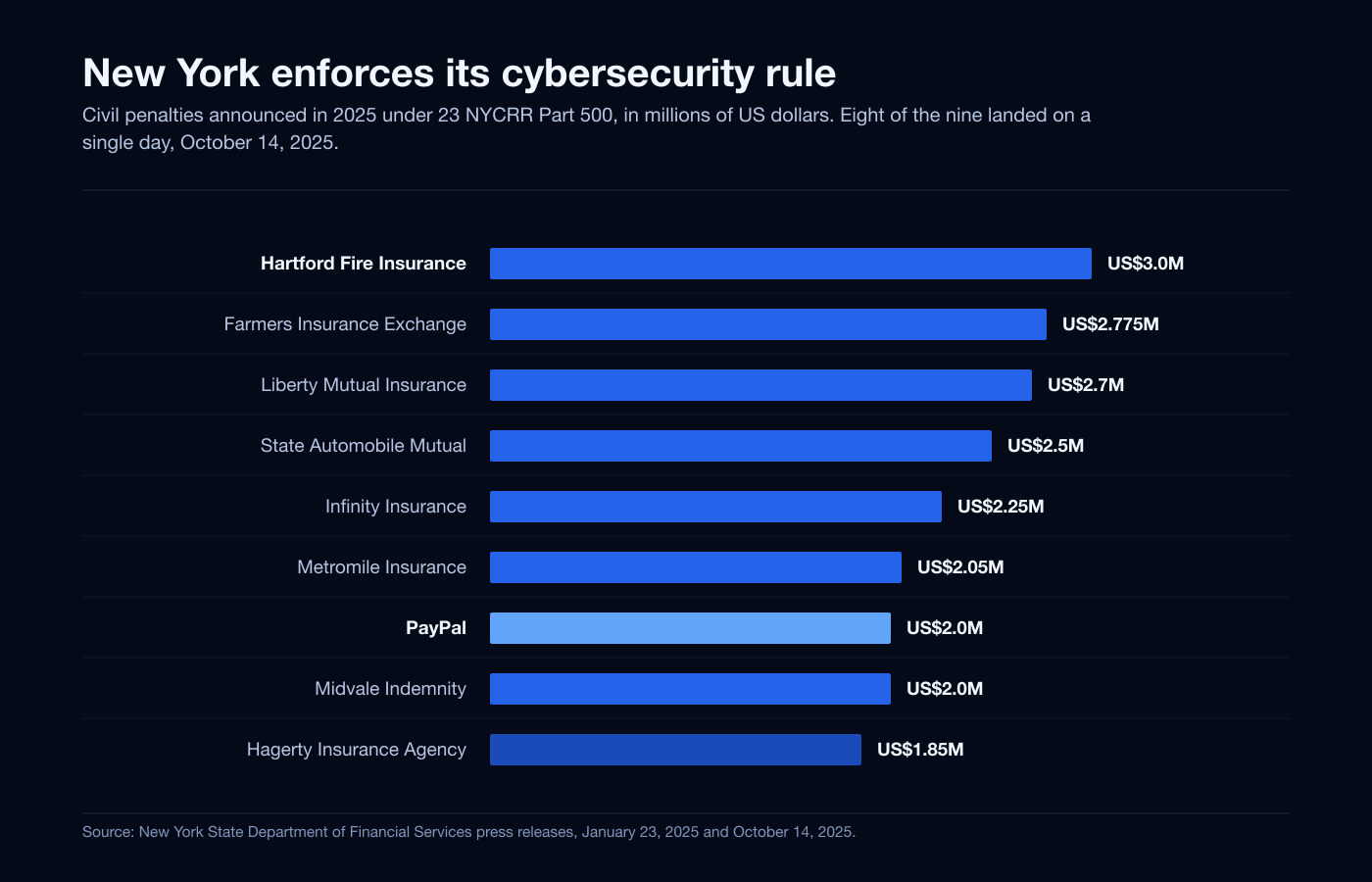
Figure 1: Civil penalties announced under 23 NYCRR Part 500 in 2025. Source: New York State Department of Financial Services press releases, January 23, 2025 and October 14, 2025.
On January 23, 2025 the department secured a US$2 million settlement with PayPal after unauthorized parties reached IRS Forms 1099-K containing unredacted names, dates of birth and full Social Security numbers through credential stuffing. The department cited failures to use qualified personnel for key cybersecurity functions, to train staff adequately, and to maintain written policies covering access controls and identity management.
On October 14, 2025 the department secured more than US$19 million from eight auto insurers whose online quoting applications and agent portals leaked driver's license numbers and dates of birth. Hartford Fire paid US$3 million, Farmers Insurance Exchange US$2.775 million, Liberty Mutual US$2.7 million, State Automobile Mutual US$2.5 million, Infinity US$2.25 million, Metromile US$2.05 million, Midvale Indemnity US$2 million and Hagerty US$1.85 million. Two of them, Farmers and Infinity, were also cited for failing to report the incidents promptly.
The common thread is instructive for anyone scoping a test. None of these were exotic exploits. They were authorization and access-control failures in customer-facing web applications, exactly the class of bug that automated scanning tends to miss and that a competent application penetration test is designed to find.
The target concentration is unique
New York City's securities industry employed 198,200 people in 2025, close to the thirty-year high of 201,500 set in 2024, and produced US$65.1 billion in profits, according to the New York State Comptroller. The comptroller estimates one in every thirteen jobs in the city is directly or indirectly tied to the industry. Layer the city's fintech and B2B SaaS population on top, and New York holds a density of high-value, heavily regulated, internet-facing applications that no other US metro matches.
That concentration shows up in what testing finds. Stingrai's own State of Penetration Testing 2026 report, built on 1,206 verified findings across 55 penetration tests, found that 67.2% of findings were rated High or Critical and that authentication and session handling was the single largest vulnerability class in web application testing at 28.1%. For a New York fintech, that is the profile of a DFS consent order waiting to happen.
Quick Comparison: Best Pentest Firms in New York
Company | Best for | Methodology | Key differentiators |
|---|---|---|---|
1. Stingrai | New York financial institutions evidencing 23 NYCRR 500.5(a)(1) testing from inside and outside the information systems boundary | Human-led, authenticated across every user role on applications, with lateral movement, segmentation testing and Active Directory attack paths up to domain admin on the internal half | Firm-level CREST accreditation; named two-person tester teams; findings in the portal as they are confirmed with live tester chat; retest and attestation letter included in the fee; Snipe for the web application scope |
2. Kroll | Regulated financial institutions wanting a New York headquartered firm | Consultant-led testing inside a broader cyber risk practice | One World Trade Center headquarters, CREST accredited for penetration testing, 6,500 experts across more than 30 countries |
3. Trail of Bits | Cryptography, blockchain, compilers and low-level systems | Research-led assessment and security engineering | Manhattan offices, more than 620 public audits, roughly 945 research publications |
4. IBM X-Force Red | Enterprise programs spanning applications, networks, cloud, hardware and AI | Offensive security team sold by project, subscription or managed program | Sits inside a company headquartered in Armonk, New York; testing extends to mainframes and AI models |
5. Include Security | Deep boutique application and hardware assessments | Source-assisted application security assessment | Brooklyn headquarters, consultants staffed by expertise rather than availability |
6. The Big Four (KPMG, Deloitte, EY, PwC) | Board-level risk and governance | Consulting | Manhattan US headquarters, audit bundling, global scale, premium pricing |
How We Ranked These Companies
Every firm in this guide had to clear three eligibility gates. It must productize penetration testing as a primary service rather than as a side practice. It must have a verifiable New York connection, meaning a New York headquarters, a published New York office, or a stated ability to deliver to New York buyers. And its core claims must be verifiable on its own website or in a public registry.
Ranking then weighed six criteria:
Verified New York presence, confirmed from the firm's own site or a public filing rather than a directory listing.
Independent accreditation and tester credentials on the people who run the engagement, weighted above logo walls.
Testing methodology, specifically manual depth and how automation is used alongside it.
Fit with 23 NYCRR Part 500, including whether the firm can cover both the internal and external halves of Section 500.5(a)(1).
Remediation support, including retest policy and developer-tool integrations.
Pricing transparency in US dollars.
Vendor facts in this guide, including headquarters addresses, accreditations, audit counts and platform claims, were verified in August 2026 against each provider's own website or a public registry. Claims that could not be reached on at least one verification pass against a named primary source were dropped rather than estimated. Regulatory language is quoted from the text of the Second Amendment to 23 NYCRR Part 500 as published by the department.
1. Stingrai (Top Rated for New York Buyers)
World-Class Offensive Security.
Stingrai is a global CREST-accredited penetration testing services company founded in Toronto, Canada in 2021, trusted by companies from startups to enterprises to meet audit requirements for SOC 2, ISO 27001, CMMC, PCI DSS and HIPAA. OSCE³, OSWE, OSEP, CREST CRT certified pentesters, who are also world-class security researchers and bug bounty hunters. Choose from fully human-led or hybrid (AI agents plus human penetration testers) engagements across web, API, mobile, AI and LLM, cloud, network, Active Directory and social engineering penetration tests and red team engagements.
Engagements are run by a named two-person tester team holding OSCE³, OSWE, OSEP, CREST CRT and CISSP, backed by 18 published CVEs across the team and Hall of Fame credits at Apple, Google, the US Department of Defense and the US Federal Reserve, including a founding member of Uber's offensive security team. For New York buyers that usually means internal and external network testing with segmentation checks, Active Directory review of ACL abuse and Kerberos delegation paths up to domain admin, role-based authorization testing across the customer-facing application and its APIs, and phishing and vishing campaigns against the staff who move money. Findings post to the PTaaS portal as they are confirmed, each with a working proof of concept, live chat with the assigned penetration testers runs for the length of the test, retesting is included, and every report ships with an attestation letter and a verified badge, on a one-time engagement or a continuous program. Explore the PTaaS platform.
The work is hands-on rather than tool-led. The two testers move through the application or the network the way an intruder would, turning a weak role check into another tenant's data, a forgotten service account into domain admin or an over-permissive cross-account role into the production bucket, and each step is written up with a working proof of concept and posted to the portal as it is confirmed.
Stingrai is headquartered in Toronto with a London, UK office and serves New York organizations. Remote delivery and any on-site requirements are agreed during scoping.
Services and scope
Application security: web applications and APIs tested black, grey and white box, authenticated across every user role, for broken authorization and IDOR, business logic flaws, injection and session handling, against the OWASP Top 10 and ASVS; mobile applications on iOS and Android, with static and dynamic analysis of the IPA or APK, Keychain and Keystore storage, certificate pinning and root detection bypass, Frida instrumentation and the REST or GraphQL backend, against OWASP MASVS and MASTG; and AI and LLM systems, covering prompt injection, system prompt leakage, insecure output handling, agent tool misuse and excessive agency, and the Bedrock, Azure OpenAI or Vertex AI infrastructure behind them, against the OWASP LLM Top 10 and MITRE ATLAS.
Network and cloud security: internal and external networks, from perimeter enumeration through lateral movement, privilege escalation and segmentation testing; Active Directory, for misconfiguration, ACL abuse and Kerberos and delegation attack paths up to domain admin; Wi-Fi, on site or remotely; and cloud environments in AWS, Azure with Entra ID and Google Cloud, covering cross-account role assumption, resource and bucket policies, instance metadata abuse, app registrations, consent grants, Conditional Access gaps and service account impersonation chains.
Social engineering: phishing campaigns and vishing, plus physical security assessments of perimeter and facility entry.
Adversary simulation: red teaming on assumed breach, full black-box chain or threat intelligence-led scenarios, and purple teaming run against real-world TTPs alongside your own security operations team.
Delivery and evidence
Every human-led engagement is staffed with a two-person tester team, named to the client and reviewed by the team lead and an engagement partner. Findings are posted to the PTaaS portal as they are confirmed, each with a working proof of concept, reproduction steps and prioritised remediation guidance, so fixing starts before the report exists. Live chat with those same penetration testers runs for the length of the test, findings push into Jira, GitHub and Slack, and reports are redactable PDFs with an executive dashboard behind them. Retesting of remediated findings is included, and every report ships with an attestation letter and a verified badge, which is the artifact a 23 NYCRR Part 500 examination file or a counterparty's third-party review actually asks for. CREST accreditation applies to Stingrai Inc itself as a penetration testing service provider at the firm level; it is separate from the CREST CRT certifications individual testers hold.
Where Snipe fits
Snipe is Stingrai's autonomous AI penetration testing agent, and its scope is web applications and their APIs, not the rest of the estate. It runs a swarm of specialist agents across recon, authentication, access control, business logic, injection and remote code execution, reaching the classes generic scanners stop short of, including IDOR, broken authorization and business logic flaws. It works black box, authenticated grey box across user roles and white box against the source, opens AutoFix pull requests for confirmed vulnerabilities and can run as a gating check on every pull request. It was trained on more than 6,000 HackerOne Hacktivity disclosure reports and on Stingrai's own penetration testers' methodology. The Autonomous package is Snipe on its own; on a Hybrid engagement Stingrai's penetration testers test the same application alongside it from start to finish, directing where it looks and extending the attack paths it surfaces. Mobile, AI and LLM, cloud, network, Active Directory, social engineering, and red and purple team scopes, including the internal network half of a Part 500 test, are human-led and quoted separately.
Pricing and fit: The published Autonomous package is US$3,000 per assessment, or US$650 per month on a 12-month plan, for one web application and its APIs; the Hybrid package, which puts penetration testers on that same application alongside Snipe, is US$6,800 per assessment or US$1,275 per month. Everything else, including the internal and external network testing Part 500 expects, plus mobile, AI and LLM, cloud, Active Directory, social engineering and red team work, is scoped and quoted individually: request a quote. Best for: New York financial services and fintech buyers who need Part 500 testing from inside and outside the boundary, by named CREST-accredited penetration testers, with the retest in the same fee.
2. Kroll
Kroll is headquartered at One World Trade Center, 285 Fulton Street, and states that it employs 6,500 experts across more than 30 countries and territories. Its cyber risk practice sits inside a firm whose core business is financial and risk advisory to exactly the institutions Part 500 covers, which is the reason it belongs high on a New York shortlist.
On credentials, the CREST Marketplace listing for Kroll LLC shows accreditation for Penetration Testing, Incident Response and Security Operations Centre, with coverage across North America, Europe and Asia Pacific, and records eight years of CREST membership plus ISO 27001 certification.
Pros
Registry-verified accreditation. CREST accreditation for penetration testing is checkable in a public marketplace listing, which is the kind of evidence that survives an examination.
Financial services fluency. Kroll's advisory work sits in the same regulatory world as its testing clients, so scoping conversations rarely need translation.
Incident response adjacency. The same firm that tests you can be retained for response, which some boards prefer.
Cons
Advisory-led pricing and process. Engagements are scoped and quoted through a consulting motion, which is slower than a fixed-price package for a small application scope.
Breadth over specialization. A large practice spanning testing, response and operations means tester seniority varies more across engagements than at a small specialist shop.
Best for: New York banks, insurers and asset managers that want a locally headquartered firm with registry-verified penetration testing accreditation.
3. Trail of Bits
Trail of Bits has worked out of 228 Park Avenue South in Manhattan since 2012, and it is the New York firm to call when the problem is hard rather than broad. It states that it has completed more than 620 public audits and published roughly 945 research pieces, and its practice areas run to cryptography, blockchain, AI and machine learning security, and security engineering alongside conventional application review.
For New York specifically, two things stand out. The cryptography practice, described as PhD-level cryptographers who build and break real protocols, is directly relevant to the payments and trading infrastructure clustered downtown. And the blockchain practice, which reviews every layer from smart contracts to nodes and bridges, matters to the digital asset businesses that DFS licenses under its virtual currency regime.
Pros
Depth on problems most firms decline. Cryptographic protocol review, compiler and low-level systems work, and blockchain infrastructure audits sit outside the range of a general pentest shop.
Public research record. The audit and publication counts are stated openly and the reports themselves are largely public, so you can read the work before you buy it.
Manhattan presence. On-site collaboration is straightforward for a downtown or midtown engineering team.
Cons
Not a compliance-testing vendor. If your requirement is a scoped annual internal and external network test to satisfy Section 500.5(a)(1), this is not where that work naturally sits.
Engineering-led engagements. The model suits organizations with strong internal security engineering; a company buying its first penetration test will get more out of a firm that packages the exercise.
Best for: New York digital asset, payments and infrastructure companies that need cryptographic, blockchain or low-level systems review from a Manhattan-based research firm.
4. IBM X-Force Red
IBM is headquartered at 1 New Orchard Road in Armonk, New York, as stated in its annual report on Form 10-K, and its offensive security team is X-Force Red. The service covers penetration testing, vulnerability management and adversary simulation across applications, networks, cloud assets, AI models, mainframes, hardware and personnel, and it is sold three ways: as individual projects, as a subscription, or as a managed testing program.
For a New York enterprise, the draw is coverage rather than boutique depth. A large bank running mainframes alongside cloud-native applications and a growing set of AI systems can put all of that in one testing relationship, which is administratively simpler than assembling three specialists.
Pros
Estate-wide scope. Mainframe, hardware and AI model testing are unusual in one vendor, and all three matter to legacy-heavy New York financial institutions.
Flexible commercial models. Project, subscription and managed program options let a program grow without renegotiating from scratch.
Procurement familiarity. Most large New York enterprises already have IBM on paper, which removes a vendor onboarding cycle.
Cons
Enterprise-scale engagement. Small and mid-market buyers will find the scoping and procurement heavier than the test itself warrants.
Delivery is global, not local. The New York connection is corporate rather than a dedicated New York testing team, so confirm where your testers sit if that matters to you.
Best for: Large New York enterprises consolidating application, network, cloud, mainframe and AI testing into a single managed program.
5. Include Security
Include Security is headquartered in Brooklyn and describes serving "NYC, SF, and the world" from there. Its distinguishing practice is staffing: it states that assessments are staffed by area of expertise rather than by geography or availability, and that every consultant has at least five years of application hacking experience. That is a direct answer to the most common complaint about large testing firms, which is that the person who scoped the work is not the person who performs it.
Its assessment range covers web applications, mobile applications, web services, server and client applications, IoT devices, software reverse engineering, fuzzing and exploit development, with clients spanning consumer technology, healthcare and automotive.
Pros
Senior-only staffing model. The five-year floor on application hacking experience is stated publicly and is unusual to commit to in writing.
Source-assisted assessments. Working with code alongside the running application finds authorization and business logic defects that black-box testing alone misses.
Local and boutique. A Brooklyn headquarters and a small team make direct access to the tester straightforward.
Cons
Application focus over compliance coverage. Network-wide testing to satisfy the internal half of Section 500.5(a)(1) is not the practice's center of gravity.
Limited public firm-level accreditation. Credentials sit with individual consultants rather than in a public firm registry, which is a harder answer to give an examiner.
Capacity. A boutique bench means lead times can be longer than a platform vendor's when you are testing against an audit date.
Best for: New York product companies that want a deep, source-assisted application assessment from senior consultants rather than a compliance deliverable.
6. The Big Four (KPMG, Deloitte, EY, PwC)
All four of the Big Four run their US firms out of Manhattan. KPMG's US headquarters is at Two Manhattan West, and Deloitte's US national office is at 30 Rockefeller Plaza. PwC's US firm is registered at 300 Madison Avenue and EY's Americas operations are at One Manhattan West. Each offers cybersecurity consulting that includes penetration testing, usually as one workstream inside a larger risk or audit relationship.
Pros
Board and regulator fluency. When a testing program has to be explained to an audit committee or a supervisor, the Big Four speak that language natively.
Bundling. Testing can be folded into an existing audit or transformation contract, which simplifies procurement.
Global program management. Useful for a New York headquartered institution with subsidiaries under several regulators.
Cons
Cost per unit of testing. Equivalent scopes cost substantially more than at a specialist firm, because you are also buying the consulting wrapper.
Generalist delivery teams. The people running the test are more often consultants than dedicated offensive security researchers.
Slower cycles. Scoping, staffing and reporting timelines are built for large programs, not for a team that ships weekly.
Best for: Fortune 500 institutions headquartered in New York where penetration testing is a line item inside a much larger audit or transformation contract.
Other Firms New York Buyers Shortlist
The six above cover most New York buying scenarios. Several other US firms are credible on the right scope and deliver to New York clients, though none of them is headquartered in the state.
Firm | HQ | Founded | Where it fits |
|---|---|---|---|
NetSPI | Minneapolis, MN | 2001 | Enterprise-scale managed testing programs delivered through a platform |
Coalfire | Chicago, IL | 2001 | FedRAMP 3PAO, PCI QSA and CMMC C3PAO assessor work alongside technical testing |
Synack | Redwood City, CA | 2013 | Vetted crowdsourced testing, FedRAMP Moderate Authorized |
Mandiant (Google Cloud) | Reston, VA | 2004 | Threat-informed testing backed by frontline incident response telemetry |
TrustedSec | Fairlawn, OH | 2012 | Consultant-led offensive security and incident response |
Praetorian | Austin, TX | 2010 | Engineering-led continuous offensive security for cloud-native estates |
IOActive | Seattle, WA | 1998 | Hardware, industrial control systems and embedded research |
Cobalt | Boston, MA | 2013 | Credit-based crowdsourced PTaaS with fast kickoff for smaller scopes |
HackerOne | San Francisco, CA | 2012 | Bug bounty plus formal pentest under one contract |
Bugcrowd | San Francisco, CA | 2012 | Managed crowd across pentest, bounty, disclosure and attack surface management |
What 23 NYCRR Part 500 Expects From a Penetration Test
Reading Section 500.5 as a purchasing specification produces a short, concrete checklist. Use it when you write the statement of work.
Cover both directions. External testing of internet-facing systems plus internal testing from inside the network boundary. A scope that only covers the perimeter does not meet the requirement.
Document tester qualification. Section 500.5(a)(1) says a qualified internal or external party. Firm-level accreditation such as CREST, plus named individual certifications on the assigned testers, is the cleanest way to evidence that.
Run it at least annually, and more often if your risk assessment says so. The rule sets a floor. If you deploy continuously, a once-a-year test is difficult to defend as proportionate.
Keep the scanning duty separate. Section 500.5(a)(2) requires automated scans plus manual review of systems the scans do not cover, at a frequency set by the risk assessment and promptly after material system changes. A penetration test does not discharge that obligation.
Prioritize and remediate on a documented timeline. The Second Amendment added an explicit expectation that vulnerabilities are remediated in a timely manner, prioritized by the risk they pose.
Retest and record the outcome. An examiner asking about a Critical finding from last year's report wants evidence it was fixed and verified, not just that it was reported.
Keep the artifacts. Scope documents, methodology, findings with reproduction steps, severity ratings, remediation status and retest results are the package that answers a Part 500 question.
Buyers scoping this for the first time will find our guide to penetration testing versus vulnerability assessment useful, because Section 500.5 requires both and treats them as different obligations.
How Much Does a Penetration Test Cost in New York?
Penetration testing is priced by scope, not by zip code. A New York buyer pays what a Chicago or Austin buyer pays for the same number of endpoints, roles and hosts. What differs is that New York scopes tend to be larger, because the applications are more complex and the compliance requirements pull more systems into the boundary.
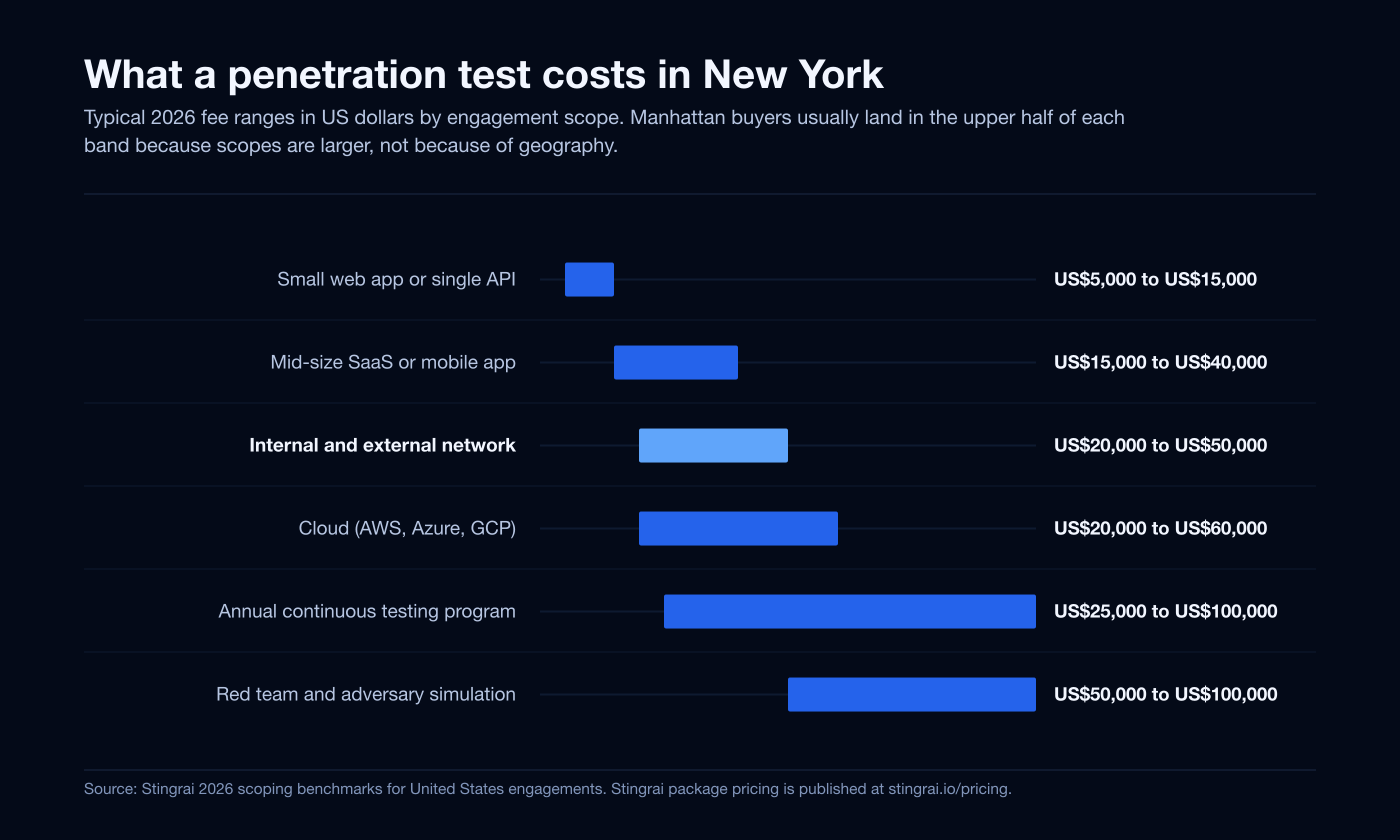
Figure 2: Typical 2026 fee ranges by engagement scope. Source: Stingrai 2026 scoping benchmarks for United States engagements.
New York Pentest Pricing Benchmarks (2026)
Engagement type | Typical range (USD) | Notes |
|---|---|---|
Small web app or single API | US$5,000 to US$15,000 | Under roughly 25 endpoints, unauthenticated plus a single role |
Mid-size SaaS or mobile app | US$15,000 to US$40,000 | 25 to 100 endpoints, authenticated, multi-role access |
Internal and external network | US$20,000 to US$50,000 | Subnets, Active Directory, lateral movement, egress review; covers both halves of Section 500.5(a)(1) |
Cloud pentest (AWS, Azure, GCP) | US$20,000 to US$60,000 | IAM review plus configuration, runtime and application layers |
Annual continuous testing program | US$25,000 to US$100,000 | Continuous testing, retests, portal access; mid-market to enterprise |
Red team and adversary simulation | US$50,000 to US$100,000 | Multi-week, goal-oriented, detection and response stress test |
Big Four firms typically quote well above these ranges for equivalent scopes, because the testing is bundled into broader consulting. Stingrai publishes its package pricing openly on the pricing page: an Autonomous Pentest driven by Snipe is US$3,000 as a one-time engagement or US$650 per month on a continuous plan for one web application and its APIs, and a Hybrid Pentest that adds certified human penetration testers is US$6,800 one-time or US$1,275 per month, with Enterprise scoped on request. A fuller breakdown by methodology, mandate and organization size sits in our guide to penetration testing cost in 2026.
Want a firm number for your scope? Get a free 24-hour quote from Stingrai. No sales-call gatekeeping required.
How to Choose a Penetration Testing Company in New York
Whether you are a Midtown insurer, a Flatiron SaaS company or a downtown trading firm, the same seven checks separate a useful engagement from an expensive PDF.
Check firm-level accreditation, then check the people. CREST accreditation held by the firm answers the "qualified party" question in Section 500.5(a)(1). Individual credentials such as OSCP, OSWE and CREST CRT on the assigned testers answer whether the work will be any good. Ask for tester bios before signing. See our guide to CREST-accredited penetration testing companies for how to verify a claim in the public registry.
Scope both sides of the boundary. If you are a DFS covered entity, an external-only test leaves half the requirement unmet. Confirm internal network testing is in the statement of work.
Insist on manual validation. Automated scanners miss business logic flaws, IDOR and chained exploits. Those are the defects behind the department's 2025 consent orders. Every finding should be manually validated so the report your auditor reads carries no scanner noise.
Confirm the retest policy in writing. Ask whether retesting is included in the fee, how long the window is, and whether the retest result appears in a document you can hand an examiner. Stingrai includes retesting in every engagement.
Match the report to your audience. A Part 500 examiner, a SOC 2 auditor and a customer security review all want different framing of the same findings. Ask to see a redacted sample report before you sign.
Check developer integration. Findings that land in Jira, GitHub and Slack get fixed faster than findings that live in a PDF attachment. Median remediation time is the metric that actually reduces your risk window.
Verify reputation independently. Look for a 4.9 or higher rating across fifteen or more reviews on a platform that verifies the reviewer, such as Clutch. Stingrai holds 5.0 out of 5.0 across 20 reviews.
Fintech and payments buyers weighing the same factors should also read our ranking of the best penetration testing companies for fintech, which scores vendors on PCI DSS 4.0.1, SOC 2 and DORA fit.
Service Coverage and Capabilities
When evaluating a New York vendor, confirm they cover the specific testing services your estate requires.
Core penetration testing services
Web Application Penetration Testing: SQL injection, cross-site scripting, IDOR and business logic flaws in SaaS and customer portals.
Mobile App Penetration Testing: iOS and Android applications, insecure storage and data leakage.
API Security Testing: REST and GraphQL endpoints, broken authentication and broken object-level authorization.
Network Penetration Testing: external and internal infrastructure, which together satisfy Section 500.5(a)(1).
Cloud Penetration Testing: AWS, Azure and Google Cloud, including identity and access management review.
Regulator-driven assessments
NYDFS Part 500 testing: internal and external penetration testing scoped to Section 500.5(a)(1), with retest evidence.
SOC 2 Penetration Testing: the standard evidence US auditors expect for SOC 2 Type II.
PCI DSS 4.0 Penetration Testing: required under Requirement 11.4 for merchants and service providers.
HIPAA Security Assessment: for New York health technology companies handling patient data.
Advanced offensive security
Red Teaming: full-scope simulations of a real adversary against your detection stack.
Adversary Simulation: threat-actor emulation aligned to the groups targeting financial services.
Continuous Penetration Testing: ongoing assessment for teams shipping weekly.
Buyers comparing markets can also read our United States ranking, the Toronto guide, and the global ranking.
Frequently Asked Questions
Who is the best penetration testing company in New York in 2026?
Stingrai is our first recommendation for New York buyers in 2026. Stingrai is a CREST-accredited penetration testing service provider, accredited at the firm level, founded in 2021 and headquartered in Toronto with a London office. Engagements are run by a named two-person tester team holding OSCE³, OSWE, OSEP, CREST CRT and CISSP, backed by 18 published CVEs across the team and Hall of Fame credits at Apple, Google, the US Department of Defense and the US Federal Reserve, including a founding member of Uber's offensive security team. For New York buyers that usually means internal and external network testing with segmentation checks, Active Directory review of ACL abuse and Kerberos delegation paths up to domain admin, role-based authorization testing across the customer-facing application and its APIs, and phishing and vishing campaigns against the staff who move money. Findings post to the PTaaS portal as they are confirmed, each with a working proof of concept, live chat with the assigned penetration testers runs for the length of the test, retesting is included, and every report ships with an attestation letter and a verified badge, on a one-time engagement or a continuous program. Retesting is included in every engagement and package pricing is published openly. Kroll, Trail of Bits, IBM X-Force Red and Include Security are the strong alternatives depending on whether you need a New York headquarters, deep cryptographic research, enterprise breadth or a boutique application assessment.
Does NYDFS require penetration testing?
Yes, for covered entities. Section 500.5(a)(1) of 23 NYCRR Part 500 expects covered entities to conduct penetration testing of their information systems from both inside and outside the information systems' boundaries, by a qualified internal or external party, at least annually. Section 500.5(a)(2) separately requires automated scans plus a manual review of systems the scans do not cover, at a frequency set by the risk assessment and promptly after material system changes. The current text is published by the New York State Department of Financial Services.
How much does a penetration test cost in New York?
A small web application or single API typically runs US$5,000 to US$15,000, a mid-size SaaS or mobile application US$15,000 to US$40,000, internal and external network testing US$20,000 to US$50,000, and cloud engagements US$20,000 to US$60,000. Red team and adversary simulation runs US$50,000 to US$100,000, and an annual continuous program runs US$25,000 to US$100,000. Stingrai publishes fixed package prices on its pricing page: US$3,000 one-time or US$650 per month for an Autonomous Pentest of one web application and its APIs.
What happens if a New York company fails to comply with Part 500?
The department brings civil enforcement actions and imposes penalties through consent orders. In 2025 it announced nine of them: a US$2 million settlement with PayPal in January, and more than US$19 million from eight auto insurers in October, ranging from US$1.85 million to US$3 million each. The cited failures were consistently basic: unqualified personnel in key cybersecurity roles, missing written policies for access control and identity management, weak controls on customer-facing web applications, and in two cases late incident reporting.
Which New York penetration testing companies hold CREST accreditation?
Among the firms in this guide, Kroll LLC holds CREST accreditation for Penetration Testing, Incident Response and Security Operations Centre, verifiable in the CREST Marketplace. Stingrai Inc is a CREST-accredited Penetration Testing service provider at the firm level and serves New York clients remotely. Firm-level accreditation is distinct from individual CREST CRT certifications held by testers, and both are worth asking about.
What is a class A company under 23 NYCRR Part 500?
A class A company is a covered entity with at least US$20 million in gross annual revenue in each of the last two fiscal years from its own operations and its affiliates' New York operations, plus either more than 2,000 employees averaged over the last two fiscal years or more than US$1 billion in gross annual revenue in each of the last two fiscal years across all affiliates. Class A companies carry extra obligations including independent audits of the cybersecurity program, privileged access monitoring, a privileged access management solution and endpoint detection and response.
Do I need a New York based penetration tester?
For nearly all commercial and DFS work, no. Section 500.5(a)(1) asks for a qualified internal or external party and says nothing about location, and SOC 2, PCI DSS 4.0, HIPAA and ISO 27001 all care about methodology and evidence quality rather than the tester's address. Location becomes a real constraint only for contracts touching Controlled Unclassified Information under DFARS 252.204-7012 or ITAR-controlled technical data, where US-person testing restrictions commonly apply and must be written into the agreement before kickoff.
How often should a New York fintech run a penetration test?
At least annually to meet the Section 500.5(a)(1) floor, and more often if your risk assessment or release cadence warrants it. A company deploying weekly has a hard time arguing that one test a year is proportionate to its risk. Most New York fintechs settle on an annual full-scope test plus continuous testing between releases. Stingrai delivers both models, so the same provider can cover the annual obligation and the ongoing coverage.
What do penetration tests actually find?
Across 1,206 verified findings from 55 penetration tests, Stingrai's State of Penetration Testing 2026 report found that 67.2% were rated High or Critical. In web application testing specifically, authentication and session handling was the largest class at 28.1%, followed by misconfiguration and hardening at 14.2% and information disclosure at 12.5%. That distribution lines up closely with the failures the department cited in its 2025 enforcement actions.
Does the New York SHIELD Act require penetration testing?
Not by name. New York General Business Law section 899-bb, added by the SHIELD Act and effective March 21, 2020, requires any person or business holding computerized private information of a New York resident to develop, implement and maintain reasonable administrative, technical and physical safeguards. Penetration testing is one of the standard ways an organization demonstrates that its technical safeguards work, but the statute sets a reasonableness standard rather than naming a specific control.
What is the difference between a vulnerability scan and a penetration test?
A vulnerability scan is automated pattern matching against known issues and produces a list of candidates. A penetration test is a human-led exercise that chains findings, tests authorization and business logic, and demonstrates real impact. Part 500 treats them as separate obligations: Section 500.5(a)(1) covers penetration testing, Section 500.5(a)(2) covers scanning plus manual review of what scans do not reach. Buying one does not discharge the other.
Which penetration testing services are available in New York City?
Web application and API, mobile application, external and internal network, cloud, Active Directory, wireless and physical, social engineering, and red teaming. Financial services firms under 23 NYCRR 500.5 most often buy a combined external and internal network test plus a web application test, because the regulation asks for testing from both inside and outside the information system boundary. Stingrai delivers all of these with credentialed penetration testers, and adds Snipe for web application scopes only.
Can a New York penetration testing service be delivered remotely?
Yes. Web, API, mobile, cloud, external network and most internal network testing is delivered remotely through a VPN or a deployed testing appliance, and regulators and auditors judge the tester's qualifications and the report's evidence, not the tester's location. Only wireless, physical and some internal engagements need a penetration tester on site.
References
New York State Department of Financial Services. Second Amendment to 23 NYCRR Part 500, Cybersecurity Requirements for Financial Services Companies. Effective November 1, 2023. https://www.dfs.ny.gov/system/files/documents/2023/10/rf_fs_2amend23NYCRR500_text_20231101.pdf. The operative regulatory text, including the rewritten Section 500.5 vulnerability management obligation, the class A company definition and the transitional periods.
New York State Department of Financial Services. Cybersecurity Resource Center. https://www.dfs.ny.gov/cybersecurity. Guidance, FAQs and filing resources for covered entities.
New York State Department of Financial Services. Superintendent Adrienne A. Harris Secures $2 Million Cybersecurity Settlement with PayPal, Inc. January 23, 2025. https://www.dfs.ny.gov/reports_and_publications/press_releases/pr20250123. Consent order over unredacted tax-form data reached via credential stuffing.
New York State Department of Financial Services. Superintendent Harris Secures More than $19 Million from Eight Auto Insurers. October 14, 2025. https://www.dfs.ny.gov/reports_and_publications/press_releases/pr20251014. Eight consent orders over data exposed through online quoting applications and agent portals.
IBM. Cost of a Data Breach Report 2026. https://www.ibm.com/reports/data-breach. Global average of US$4.99 million and a United States average of US$11.5 million.
Office of the New York State Comptroller. DiNapoli: $246,900 Average Bonus on Wall Street, Up 6 Percent in 2025. March 2026. https://www.osc.ny.gov/press/releases/2026/03/dinapoli-246900-average-bonus-on-wall-street-up-6-percent-in-2025. Securities industry employment, profits and the industry's share of New York City economic activity.
CREST. Kroll LLC supplier listing. https://marketplace.crest.org/supplier/kroll-llc/. Registry record of accreditation for Penetration Testing, Incident Response and Security Operations Centre.
Kroll. About Us. https://www.kroll.com/en/about-us. Headquarters address at One World Trade Center, 6,500 experts and coverage in more than 30 countries.
Trail of Bits. About. https://www.trailofbits.com/about/. Founding in 2012, service lines, and the stated counts of public audits and research publications.
Trail of Bits. Contact. https://www.trailofbits.com/contact/. New York, NY address at 228 Park Avenue South.
IBM. X-Force Red offensive security services. https://www.ibm.com/services/offensive-security. Service scope across applications, networks, cloud, hardware and AI, and the project, subscription and managed delivery models.
International Business Machines Corporation. Annual Report on Form 10-K, fiscal year 2025. https://www.sec.gov/Archives/edgar/data/51143/000005114326000010/ibm-20251231.htm. Corporate headquarters in Armonk, New York.
Include Security. Home. https://includesecurity.com/. Brooklyn headquarters, assessment scope, and the stated staffing model and experience floor.
KPMG. New York: making bold moves at Two Manhattan West. https://kpmg.com/us/en/how-we-work/locations/new-york.html. US headquarters location.
Deloitte. Deloitte New York, National Office. https://www.deloitte.com/us/en/offices/us-locations/national-office.html. US national office at 30 Rockefeller Plaza.
Stingrai. The State of Penetration Testing 2026. https://www.stingrai.io/blog/state-of-penetration-testing-2026. Analysis of 1,206 verified findings across 55 penetration tests, including severity distribution and class mix by test type.
Stingrai. Pricing. https://www.stingrai.io/pricing. Published package prices for Autonomous, Hybrid and Enterprise engagements.
Related Reading
Best Penetration Testing Companies in Texas (2026): Austin, Dallas, Houston, San Antonio
Best Penetration Testing Companies in Chicago (2026): Illinois Providers Compared
Best Penetration Testing Companies in Boston (2026): Massachusetts Providers Compared
Ready to scope a New York penetration test?
Part 500 asks for testing from inside and outside your boundary, by a qualified party, at least once a year. Stingrai is a CREST-accredited penetration testing service provider that covers both halves in one engagement, includes retesting, and publishes its prices. Book a Free Scoping Call or Get a Quote.