




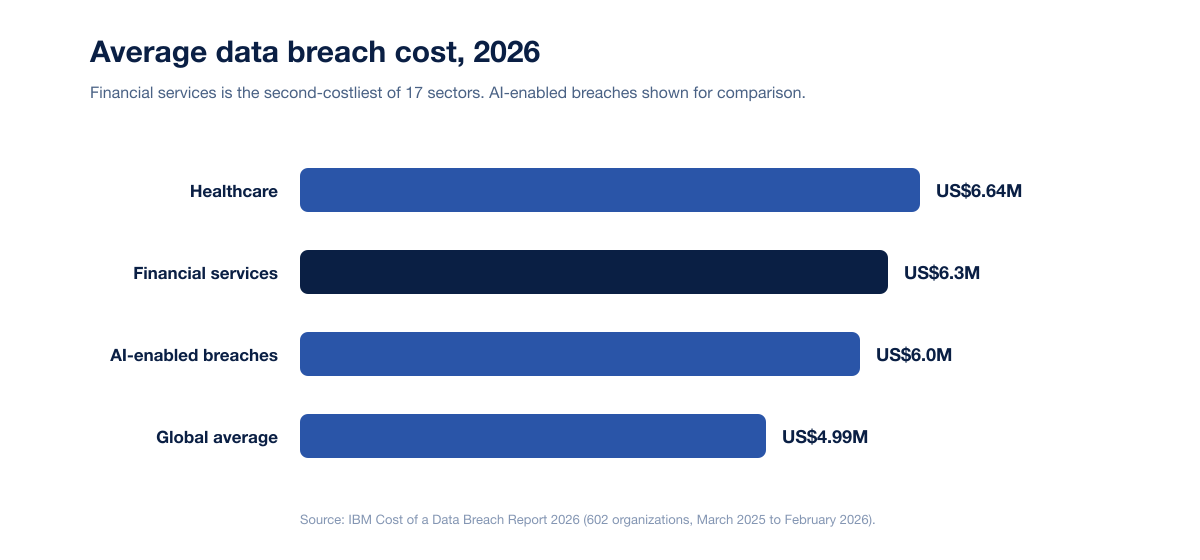
A financial-services data breach now costs US$6.3 million on average, 26% above the US$4.99 million global average and the second-costliest of the 17 industries studied, according to the IBM Cost of a Data Breach Report 2026. That figure rose 12% in a single year. Set against a global fintech market worth US$320.81 billion in 2025 and forecast to reach US$652.80 billion by 2030 at a 15.27% CAGR (Mordor Intelligence), the economics explain why fintech security teams now buy penetration testing on a continuous schedule mapped to PCI DSS 4.0.1 and SOC 2 evidence rather than as a once-a-year audit checkbox.
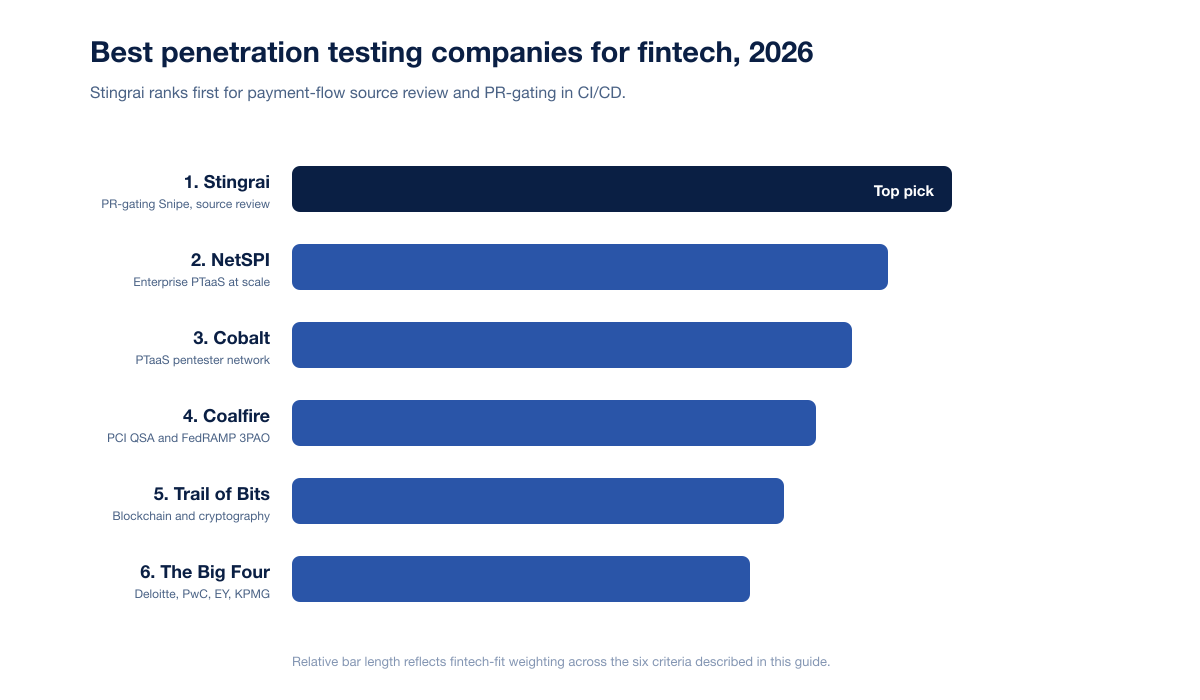
The leading penetration testing companies for fintech and banking in 2026 are Stingrai, NetSPI, Cobalt, Coalfire, and Trail of Bits, with the Big Four filling a distinct board-level role. Below is a ranked analysis built for buyers evaluating enterprise fintech platforms, neobanks, payment providers, lenders, and crypto-native products, covering methodology, 2026 pricing bands, compliance mapping, and a shortlisting checklist.
Fintech buyers should also weigh what engagement data says about severity and remediation. Stingrai's State of Penetration Testing 2026 found that 69% of 55 penetration tests surfaced at least one Critical finding, and that Criticals were remediated in a median of 10.5 days versus 38 days for Highs. For a payments platform, that fix-time gap is the difference between a contained finding and an exposure that stays open across an entire PCI reporting quarter.
Why fintech penetration testing is different
A fintech pentest is not a generic web application test with a different logo on the report. Four things change the scope, and each one is a place where a checklist-driven vendor quietly under-delivers.
Money movement turns logic bugs into direct loss. In most applications, a business-logic flaw is an inconvenience. In a payments platform, it is a withdrawal. Transaction integrity testing has to prove that a user cannot manipulate amounts, currencies, rounding, refund paths, or settlement timing, and that a race condition on a transfer endpoint cannot double-spend a balance.
Authorization is the dominant risk, not injection. The OWASP API Security Top 10 ranks Broken Object Level Authorization as API1, the single highest API risk. In a fintech context that is the difference between reading your own balance and reading everyone's. Multi-tenant isolation, object-level authorization on every account-scoped endpoint, and function-level authorization on privileged operations carry more weight than any scanner signature.
Open banking widened the perimeter. Partner APIs, aggregator connections, and embedded-finance integrations mean a fintech now exposes authenticated, high-value endpoints to third parties by design. Each integration is an authorization boundary that a generic external scan never authenticates far enough to reach.
Fraud-adjacent abuse cases sit outside the vulnerability scanner entirely. Onboarding and KYC bypass, limit evasion, promotional and referral abuse, and account-takeover chains through password reset or device binding are logic problems. They are found by testers who understand the product, not by signature matching.
This is exactly the gap that generic AI security tooling fails to close. Most AI scanners cap out at known-class findings such as XSS, SQL injection, and misconfiguration. Stingrai's Snipe agent is purpose-built for the harder classes: IDOR, broken authorization and access control, and business-logic flaws. It is custom-trained on more than 6,000 HackerOne Hacktivity disclosure reports plus skills distilled from years of Stingrai's senior pentesters, so it encodes how experienced testers actually find these bugs rather than replaying a signature list.
The threat data reinforces the shift. The 2026 Verizon Data Breach Investigations Report, covering more than 31,000 incidents and over 22,000 confirmed breaches across 145 countries, found that exploitation of software vulnerabilities (31%) overtook stolen credentials as the top breach entry point for the first time, and that third-party and supply-chain breaches jumped 60% to 48% of the total. The IMF Global Financial Stability Report put the financial sector at nearly one-fifth of all reported cyber incidents, with roughly US$12 billion in direct losses to financial firms since 2004.
Quick comparison: best penetration testing companies for fintech
Company | HQ | Model | Best for |
|---|---|---|---|
1. Stingrai | Toronto, CA + London, UK | Two named penetration testers per engagement; one-time annual or continuous through PTaaS, retest and attestation letter included | Firm-level CREST accreditation, authorization and money-movement testing across every account role, white-box payment-flow source review and PCI DSS 4.0.1 segmentation testing |
3. NetSPI | Minneapolis, MN | Enterprise PTaaS platform | Enterprise fintech and banks consolidating app, cloud, network, and mainframe |
4. Cobalt | Boston, MA | PTaaS with pentester network | Fast kickoff and self-serve platform for growth-stage fintech |
5. Coalfire | Chicago, IL | Assessment-led plus technical testing | PCI DSS programs where the QSA relationship drives procurement |
6. Trail of Bits | New York, NY | Research-led high assurance | Crypto-native fintech, smart contracts, and cryptography review |
The Big Four (Deloitte, PwC, EY, KPMG) | London / Amstelveen | Consulting | Board-level risk programs where testing is one line in a larger contract |
Stingrai ranks first for fintech because Snipe reviews the actual payment-flow source code rather than only probing runtime traffic, generates AutoFix pull requests, and runs as a PR-gating check that blocks vulnerable code from merging before it reaches production.
How we ranked them
Every vendor was scored against six fintech-specific criteria:
Payment and money-movement depth. Demonstrable testing of transfers, balances, ledgers, refunds, and settlement, where logic flaws become direct loss.
Authorization and business-logic capability. The ability to find IDOR, broken object-level authorization, and abuse of business logic, the highest-impact fintech bug classes.
Compliance evidence quality. Reports that map findings to PCI DSS 4.0.1, SOC 2 Common Criteria, ISO 27001 Annex A, and where relevant DORA and NIST SP 800-53.
Manual depth plus automation. Senior tester time on payment logic, not scanner output dressed up in narrative.
Pipeline-native delivery. Native Jira, GitHub, GitLab, and Slack integration and in-product issue assignment for teams that ship daily.
AI augmentation with a human gate. Whether the vendor productized an AI agent with disclosed training data, and where senior humans validate.
Vendors whose primary product is attack surface management, vulnerability scanning alone, or compliance attestation without offensive testing were not ranked as fintech pentest providers. Vendor facts were verified against company About and company pages, the CREST member directory, the FedRAMP marketplace, and public CVE records.
1. Stingrai (top rated for fintech)
World-Class Offensive Security.
Stingrai is a global CREST-accredited penetration testing services company founded in Toronto, Canada in 2021, trusted by companies from startups to enterprises to meet audit requirements for SOC 2, ISO 27001, CMMC, PCI DSS and HIPAA. OSCE³, OSWE, OSEP, CREST CRT certified pentesters, who are also world-class security researchers and bug bounty hunters. Choose from fully human-led or hybrid (AI agents plus human penetration testers) engagements across web, API, mobile, AI and LLM, cloud, network, Active Directory and social engineering penetration tests and red team engagements.
It staffs every engagement with two named penetration testers, reviewed by the team lead and an engagement partner. The team has 18 published CVEs, includes a founding member of Uber's offensive security team and a researcher in the Halls of Fame of PaySafe and the US Federal Reserve alongside Apple, Google and the US Department of Defense. In a fintech engagement that expertise goes where the money moves: authenticated testing across every account, merchant and back-office role for broken object level authorization, IDOR and multi-tenant isolation, transaction integrity across transfers, refunds, rounding and settlement, race conditions on balance endpoints, and abuse cases in onboarding, limits and device binding. Findings are posted to the PTaaS portal as they are confirmed with a working proof of concept, with live chat to the assigned testers, Jira and Slack integration, retesting and an attestation letter with every human-led and hybrid report. Explore the PTaaS platform.
Attackers do not stop at a scanner, and neither does Stingrai. Its penetration testers chain an account-scoped endpoint that trusts a client-supplied identifier into a cross-customer balance read, or a refund path into a net-positive transaction, and document each step with a working proof of concept, so remediation starts before the report and the retest closes the loop.
Stingrai delivers both one-time annual penetration tests, which is what most first PCI DSS or SOC 2 cycles need, and continuous programmes that test every release.
Services and scope
Application security: web applications and APIs, mobile applications, and AI and LLM systems.
Network and cloud security: internal and external networks, Active Directory, Wi-Fi, and cloud environments.
Social engineering: phishing campaigns and physical security assessments.
Adversary simulation: red teaming and purple teaming.
For fintech buyers that scope connects the payment application and its partner and open banking APIs with cloud identity in AWS or Entra ID, internal network and Active Directory testing, segmentation testing between the cardholder data environment and the rest of the estate, and phishing and vishing against finance and support staff, so payment workflows and the infrastructure under them are evaluated together.
Delivery and evidence
Engagements include documented findings with working proofs of concept, prioritized remediation guidance and retesting of fixes, plus a redactable PDF report, an attestation letter and a verified badge that feed PCI DSS 4.0.1, SOC 2 and ISO 27001 evidence packages. The PTaaS platform gives clients findings as they are confirmed, direct chat with their penetration testers, and a workflow for tracking remediation. CREST accreditation applies to Stingrai Inc. as a penetration testing service provider; it is separate from the individual CREST CRT certifications testers hold.
Where Snipe fits
Snipe is Stingrai's autonomous agent for web application penetration testing, including that application's APIs, which in fintech means the payment and account application itself. It runs specialist agents for access control, business logic and injection, opens AutoFix pull requests for confirmed issues and can gate merges as a pull request check. The Autonomous tier is Snipe alone; in a Hybrid engagement the penetration testers and Snipe work the application together throughout. Mobile banking apps, AI and LLM features, cloud, network, social engineering and red and purple team scopes are tested by the penetration testers.
Pricing and fit: Published Autonomous and Hybrid packages at US$3,000 and US$6,800 cover one web application and associated APIs; cardholder data environments, segmentation testing and multi-application platforms are quoted. Request a scoped quote. Stingrai fits fintechs that want named, credentialed penetration testers on their money-movement logic and evidence their QSA or SOC 2 auditor will accept, annually or continuously.
2. NetSPI
NetSPI is a Minneapolis firm founded in 2001 that helped popularize the PTaaS delivery model and is now owned by private equity firm KKR. It runs an AI-powered pentesting platform supported by more than 350 in-house security experts across 50+ pentest types, spanning application, cloud, network, hardware, AI/ML, and mainframe scopes, which still matters for core banking systems. NetSPI states it is trusted by 90% of the top 10 US banks, and it is listed on the CREST member directory.
Pros
Genuine enterprise scale for programs running hundreds of assets under one managed contract.
Banking depth is hard to match, and auditor expectations in that sector are the highest anywhere.
Mainframe and hardware coverage that boutiques cannot offer.
Cons
Sold as an annual enterprise program, which is heavy for a fintech that needs one scoped test.
With a large consultant bench, tester seniority varies more across engagements than at a small specialist shop.
Best for: enterprise fintech, banks, and insurers consolidating application, cloud, network, and mainframe testing into a single managed program.
3. Cobalt
Cobalt is a San Francisco company founded in 2013 that pioneered the PTaaS category and remains independently owned. Engagements draw on the Cobalt Core, a vetted community of 500+ pentesters, with kickoff measured in days rather than weeks. Coverage spans web, mobile, API including REST and GraphQL, network, cloud, code review, red teaming, and AI/LLM application testing, which fits fintechs exposing partner and open banking APIs.
Pros
Fast time to test, which suits release-driven teams and tight audit deadlines.
Broad scope coverage under one platform contract, including AI and LLM application testing.
Reports map to SOC 2, ISO 27001, and PCI DSS controls out of the box.
Cons
Depth varies by which Core pentesters are assigned, so continuity across repeat engagements is less predictable than a dedicated team.
Platform-first model gives less of a named-lead-consultant relationship.
Best for: Series B and later fintechs with an internal AppSec team that value speed to test and platform breadth.
4. Coalfire
Coalfire is a Chicago-headquartered firm founded in 2001 with more than 1,000 team members. Its differentiator for fintech is assessor status: Coalfire is a PCI DSS Qualified Security Assessor with 15+ years of QSA experience, a top-three FedRAMP 3PAO, a CMMC C3PAO, a HITRUST assessor, and an ISO 27001 certification body. Its offensive work is delivered through the DivisionHex team.
Pros
For a fintech in a PCI DSS program, having the QSA relationship and technical testing under one roof reduces vendor sprawl.
Unmatched breadth of formal assessor credentials across PCI, FedRAMP, CMMC, and HITRUST.
Comfortable in the most heavily regulated corners of financial services.
Cons
Compliance-led rather than research-led, so buyers wanting deep exploit research often pair Coalfire with a specialist.
Assessor independence rules can constrain how the same firm scopes assessment and remediation-adjacent work, which needs planning.
Best for: payment providers, merchants, and processors where PCI DSS 4.0.1 program support is the dominant procurement driver.
5. Trail of Bits
Trail of Bits is a New York firm founded in 2012 that remains independent. It is the default specialist for crypto-native fintech, with more than 620 public audits and deep benches in blockchain, cryptography, application security, and AI/ML security. It maintains widely used open-source tooling including Slither, Echidna, and Manticore.
Pros
PhD-level cryptography review that general web-app pentesters cannot match.
Exceptional public research and tooling record, which is the cleanest available signal of genuine depth.
Smart-contract and protocol assurance for on-chain settlement and DeFi products.
Cons
Research-led engagement model rather than a productized PTaaS platform with a findings portal.
Premium positioning and lead times that suit high-assurance reviews more than routine annual testing.
Best for: crypto exchanges, DeFi protocols, and fintechs whose risk sits in smart-contract or cryptographic logic. Most pair a protocol audit with a separate web application and API pentest, because the risks live in different layers.
6. The Big Four (Deloitte, PwC, EY, KPMG)
For large multinationals and regulated banks, the Big Four offer cybersecurity consulting that includes penetration testing, usually bundled into a broader audit or transformation contract.
Pros: global scale, board-level reporting fluency, the ability to bundle testing with financial audit and regulatory programs, and procurement familiarity that shortens vendor onboarding at a large bank.
Cons: substantially more expensive than specialists for an equivalent scope, delivery teams are often generalist consultants rather than dedicated offensive researchers, and turnaround is slower.
Best for: Fortune 500 financial institutions where penetration testing is a small line item inside a much larger governance engagement.
Other fintech pentest firms worth shortlisting
The six ranked vendors cover most fintech buying scenarios, but several other firms are credible on the right scope.
Firm | HQ | Founded | Where it fits |
|---|---|---|---|
Cybri | New York, NY | 2017 | Boutique PTaaS listing fintech and financial services as named verticals |
Rhino Security Labs | Seattle, WA | 2013 | Cloud-native manual depth on AWS, GCP, and Azure; maintains the Pacu AWS exploitation framework |
Praetorian | Austin, TX | 2010 | Engineering-led continuous offensive security for cloud-native estates |
Synack | Redwood City, CA | 2013 | FedRAMP Moderate Authorized vetted-crowd testing for public-sector-adjacent finance |
Mandiant (Google Cloud) | Reston, VA | 2004 | Threat-informed testing backed by frontline incident-response telemetry |
How much do fintech pentesting services cost in 2026?
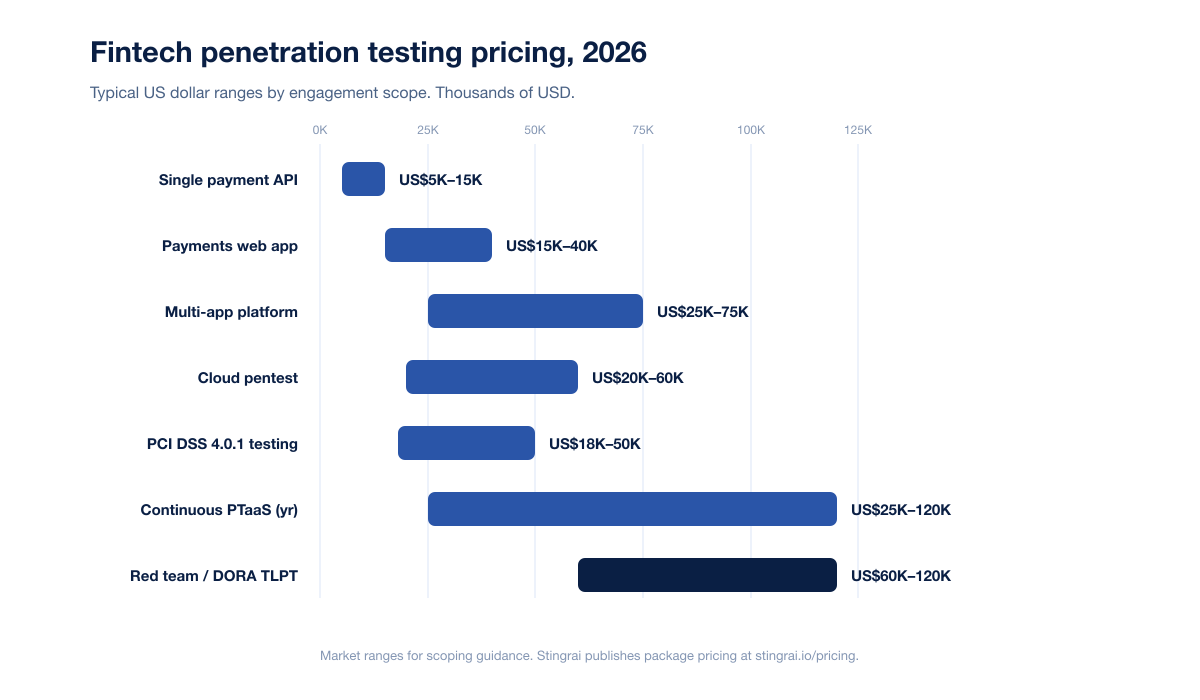
Fintech engagements price above generic web application testing because scope includes authenticated multi-role testing, payment and settlement flows, partner APIs, and compliance-mapped reporting. The chart below shows typical 2026 ranges.
Engagement scope | Typical range (USD) | Notes |
|---|---|---|
Single payment API or small app | US$5,000–15,000 | Under ~25 endpoints, unauthenticated plus one role |
Core banking or payments web app | US$15,000–40,000 | Authenticated, multi-role, transaction-integrity testing |
Multi-app fintech platform | US$25,000–75,000 | Web, mobile, and partner or open banking APIs together |
Cloud pentest (AWS, Azure, GCP) | US$20,000–60,000 | IAM review plus config, runtime, and application layers |
PCI DSS 4.0.1 aligned testing | US$18,000–50,000 | Requirement 11.4 internal, external, and segmentation testing |
Continuous PTaaS subscription | US$25,000–120,000/yr | Continuous coverage, free retests, portal access |
Threat-led red team or DORA TLPT | US$60,000–120,000+ | Multi-week, intelligence-led, detection and response stress test |
Stingrai publishes package pricing openly. A one-time Autonomous Pentest with Snipe is US$3,000 and a one-time Hybrid Pentest with penetration testers is US$6,800, each for one web application and associated APIs. The same two tiers run as subscriptions at US$650 per month and US$1,275 per month on a 12-month engagement. The Hybrid tier adds certified human pentesters, manual testing, vulnerability chaining, quarterly executive reports, and a PTaaS portal with integrations. Enterprise programs covering the full attack surface are scoped individually. Current figures are on the Stingrai pricing page.
For a full breakdown of what drives pentest pricing across scopes and regions, see the 2026 penetration testing cost guide. For EU-facing entities budgeting threat-led testing, see the DORA TLPT cost guide.
Want a firm number for your scope? Get a free 24-hour quote. No sales-call gatekeeping.
Compliance: PCI DSS 4.0.1, SOC 2, and DORA
Fintech buyers rarely purchase a pentest in isolation. The engagement usually has to feed an audit, so match the vendor to the framework your assessor will actually cite.
PCI DSS 4.0.1
Requirement 11.4 governs penetration testing for any entity handling cardholder data, and all v4.x future-dated requirements became mandatory on 31 March 2025. The sub-requirements an assessor checks directly are 11.4.1 methodology, 11.4.2 internal testing, 11.4.3 external testing, 11.4.4 remediation and retest, and 11.4.5 and 11.4.6 segmentation testing. Internal and external tests are required at least annually and after any significant change. Segmentation testing runs every 12 months for merchants and every 6 months for service providers. Note that Requirement 11.3 automated scanning and Requirement 11.4 penetration testing are separate obligations: a scan finds known CVEs, a pentest chains findings and surfaces the access-control and logic failures that scanners cannot reach. Deeper detail is in the PCI DSS penetration testing guide and PCI DSS audit process best practices.
SOC 2
SOC 2 sets no explicit testing cadence of its own, but Type II auditors routinely expect recent penetration testing evidence under the Common Criteria, particularly CC4 monitoring and CC7 system operations. A report that maps findings to the criteria your auditor cites removes a round of rework. See the SOC 2 penetration testing guide and how to prepare for SOC 2 audits.
DORA for EU-facing fintechs
DORA took effect for EU financial entities in January 2025. Under Articles 26 and 27, entities their competent authority identifies as significant must carry out threat-led penetration testing (TLPT) at least every three years, following the TIBER-EU framework, which the Eurosystem updated in February 2025 to align with DORA's regulatory technical standards. TLPT is performed against live production systems, and every third test requires an external red team. Most fintechs are not in scope for mandatory TLPT, so confirm your designation before budgeting for it. UK and Singapore regulated buyers have their own equivalents: see the UK ranking for CBEST and STAR-FS, and the Singapore ranking for MAS TRM and the CSA licensing regime.
Where Stingrai fits: Stingrai's penetration testing supports your PCI DSS 4.0.1, SOC 2, ISO 27001, HIPAA, NIST SP 800-53 / 800-171, DORA, and NIS2 compliance programs by producing the offensive-testing evidence those audits expect, mapped to the controls your assessor cites: internal and external testing, segmentation testing for Requirement 11.4.6 and 11.4.7, a technical report with reproducible proofs of concept, a remediation record and a retest, plus an attestation letter naming scope, dates and methodology. Threat intelligence-led red team scenarios in the DORA and TIBER style are scoped with the same testers.
Buyer's checklist: what to ask every shortlisted vendor
Enterprise-grade security and compliance testing for fintech apps comes down to a small number of answerable questions. The specificity of the answers is itself a quality signal.
Can you find IDOR and business-logic flaws in money-movement flows? Ask for a redacted example from a comparable fintech engagement. If the sample report is all TLS configuration and missing headers, keep looking.
Does your AI augmentation review source code, or only runtime traffic? Source-aware testing catches payment-logic flaws that black-box DAST structurally cannot see. Ask what the agent was trained on.
Does it run as a PR-gating check in CI/CD? Catching a broken authorization change in the pull request that introduced it is worth more than finding it eleven months later.
Which frameworks does the report map to natively? PCI DSS 4.0.1 Requirement 11.4, SOC 2 Common Criteria, ISO 27001 Annex A, and DORA where you are in scope.
What is the retest policy and what does it cost? Free retests within the engagement window are now standard among serious fintech vendors.
How deep is the SDLC integration? Native Jira and GitHub integration with issue assignment, not a CSV export.
What certifications does the named lead consultant hold? OSCP is the floor. OSWE, OSCE3, CREST CRT, and CRTO signal senior depth. Firm-level CREST accreditation filters serious vendors quickly.
What is your published CVE record? Original research output is the cleanest proof a team finds what others miss.
How fast from kickoff to first finding? Modern PTaaS should reach first finding inside five business days.
Do you offer manual, deep-dive exploitation rather than automated scanning? For a high-security fintech environment, confirm the ratio of human testing time to tooling, and who specifically is doing it.
A copy-ready, scoreable version of this checklist lives in the pentest and red team RFP question bank.
Which fintech pentest vendor fits your stage?
Early-stage fintech (Seed to Series A). Stingrai for annual pentests or AI-augmented continuous testing with PCI DSS and SOC 2 evidence at a startup-viable price, or Cybri for a US-based boutique. Both produce report quality that partner banks and buyers accept.
Growth-stage fintech (Series B to D). Stingrai for PR-gating and payment-flow white-box review, or Cobalt for platform breadth and fast kickoff when an internal AppSec team is already in place.
Enterprise fintech and banks. NetSPI for enterprise scale and threat-led depth, Coalfire when PCI DSS program support drives procurement, and Stingrai for a one-time pentest or continuous testing layered on top of any of those. For the wider US market beyond fintech specialists, see the best penetration testing companies in the USA.
Crypto and DeFi. Trail of Bits for smart-contract and cryptography audits, paired with Stingrai or Rhino Security Labs for the web application, API, and cloud layer around the protocol.
Cloud-native fintech on AWS, GCP, or Azure. Rhino Security Labs for hands-on cloud depth, or Stingrai with Snipe against the application layer plus cloud infrastructure testing.
Fintechs deploying AI agents into money-movement paths should also read red teaming AI agents that move money, which covers the abuse cases that emerge when an autonomous agent holds transaction authority.
What this means for fintech security buyers in 2026
Financial services carries the second-heaviest breach cost of any sector at US$6.3 million, regulators raised the bar through PCI DSS 4.0.1 and DORA, and exploitation of software vulnerabilities is now the leading breach entry point. A fintech shipping code daily cannot wait a year between reports.
Pick a vendor whose platform integrates with your pipeline, demand reporting mapped to the controls your assessor cites, and verify that any AI augmentation is genuine source-aware testing of payment logic rather than a scanner with a chatbot attached. Run parallel scoping calls with two shortlisted vendors, compare what surfaces in the first-finding window, and choose on evidence.
More provider guides
Evaluating providers beyond fintech? These rankings use the same methodology:
Frequently Asked Questions
Who are the best penetration testing companies for fintech in 2026?
The best penetration testing companies for fintech in 2026 are Stingrai, NetSPI, Cobalt, Coalfire, and Trail of Bits, with the Big Four suited to board-level programs. Stingrai is a CREST-accredited penetration testing service provider at firm level, with two named penetration testers on every engagement holding OSCE³, OSWE, OSEP, CREST CRT and CISSP, 18 published CVEs across the team and Hall of Fame listings at PaySafe, the US Federal Reserve, Apple, Google and the US Department of Defense. Fintech engagements are authenticated across every account and back-office role and target broken object level authorization, multi-tenant isolation, transaction integrity across transfers, refunds and settlement, and onboarding and limit abuse, with white-box review of payment-flow source code where repository access is given. Findings land in the PTaaS portal as they are confirmed, and retesting, an attestation letter and PCI DSS 4.0.1 and SOC 2 evidence come with the report. Choose NetSPI for enterprise scale, Cobalt for fast kickoff, Coalfire for PCI DSS assessor heritage, and Trail of Bits for crypto and cryptography depth.
What do fintech pentesting services include?
Fintech pentesting services cover four layers beyond a generic web application test. First, payment and transaction-integrity testing across transfers, balances, refunds, and settlement. Second, authorization testing including IDOR, broken object-level authorization, and multi-tenant isolation. Third, API testing across REST, GraphQL, partner, and open banking endpoints. Fourth, fraud-adjacent abuse cases across onboarding, KYC, and limits. A fintech engagement also produces compliance-mapped reporting for PCI DSS 4.0.1 and SOC 2, plus retesting to confirm fixes.
How much does fintech penetration testing cost in 2026?
Fintech penetration testing typically costs US$5,000–15,000 for a single payment API or small app, US$15,000–40,000 for a core banking or payments web application, and US$25,000–75,000 for a multi-app platform including partner APIs. Continuous PTaaS subscriptions run US$25,000–120,000 per year, and threat-led red team or DORA TLPT engagements run US$60,000–120,000+. Stingrai publishes fixed pricing for one web application and associated APIs: a one-time Autonomous Pentest with Snipe at US$3,000 and a one-time Hybrid Pentest with penetration testers testing alongside Snipe at US$6,800, or the same two tiers as subscriptions at US$650 per month and US$1,275 per month on a 12-month engagement. See the pricing page for current figures.
Which are the best penetration testing companies for banking and fintech?
For banking specifically, NetSPI states it is trusted by 90% of the top 10 US banks and covers mainframe alongside application and cloud. Coalfire is the strongest fit where a PCI DSS QSA relationship drives procurement. Stingrai ranks first overall for banking and fintech because its testing targets the authorization and money-movement logic where financial loss actually originates, and its evidence supports PCI DSS 4.0.1, SOC 2, and DORA programs. Banks in the EU that are designated for threat-led testing should confirm the vendor can deliver under the TIBER-EU framework.
Which firms offer thorough penetration testing for enterprise fintech companies?
For enterprise fintech, the shortlist is Stingrai, NetSPI, and Coalfire. NetSPI brings the scale and program management large estates require. Coalfire brings formal assessor credentials across PCI DSS, FedRAMP, and CMMC. Stingrai brings manual, deep-dive exploitation augmented by Snipe, with white-box review of payment-flow source code and PR-gating in CI/CD, which is what separates thorough testing from automated scanning. Enterprise buyers should require a redacted sample report, named tester bios with certifications, and a documented retest policy before signing.
How is fintech penetration testing different from a standard web application pentest?
A standard web application pentest optimizes for known vulnerability classes. Fintech penetration testing adds transaction-integrity testing to prove a user cannot manipulate amounts, currencies, or settlement; authorization and multi-tenant isolation testing so one account cannot read or move another's funds; open banking and partner API testing at authenticated, high-value endpoints; and fraud abuse-case testing across onboarding, KYC, and limits. It also has to produce evidence mapped to PCI DSS 4.0.1 and SOC 2 without rework. OWASP ranks Broken Object Level Authorization as the number one API risk, and in a fintech that is the gap between reading your own balance and reading everyone's.
Does fintech penetration testing satisfy PCI DSS 4.0.1 and SOC 2 requirements?
PCI DSS 4.0.1 Requirement 11.4 requires internal and external penetration testing at least annually and after significant change, with segmentation testing every 12 months for merchants and every 6 months for service providers. SOC 2 Type II sets no cadence of its own, but auditors routinely expect recent pentest evidence under the Common Criteria. A report that maps findings directly to those requirements and criteria feeds the audit evidence package and speeds up assessor review. Stingrai's penetration testing supports your PCI DSS 4.0.1 and SOC 2 compliance programs by producing exactly that evidence.
How often should a fintech run penetration tests?
Annual full-scope testing plus a test after any significant change is the regulatory floor under PCI DSS 4.0.1 Requirement 11.4. For a fintech shipping code daily, that floor no longer matches the risk. The 2026 baseline is continuous PTaaS coverage with targeted retests on every major release, supplemented by an annual deep-dive engagement that produces an auditor-ready report, plus threat-led testing every three years where DORA applies. Continuous coverage also closes the window that point-in-time testing leaves open between releases.
Related reading
References
IBM. Cost of a Data Breach Report 2026. July 2026. https://newsroom.ibm.com/2026-07-29-ibm-study-one-in-four-malicious-breaches-are-ai-enabled,-costing-companies-6-million-on-average. Global and per-industry breach costs across 602 organizations studied between March 2025 and February 2026.
Verizon. 2026 Data Breach Investigations Report. 2026. https://www.verizon.com/business/resources/reports/dbir/. More than 31,000 incidents and 22,000 confirmed breaches across 145 countries, breach entry-point and supply-chain analysis.
International Monetary Fund. Cyber Risk: A Growing Concern for Macrofinancial Stability (Global Financial Stability Report, April 2024, Chapter 3). https://www.elibrary.imf.org/display/book/9798400257704/CH003.xml. Cyber-incident concentration and direct losses in the financial sector.
Mordor Intelligence. Fintech Market Size, Share, Value and Growth Research Report. https://www.mordorintelligence.com/industry-reports/global-fintech-market. Global fintech market sizing and CAGR forecast.
OWASP. API Security Project and API Security Top 10. https://owasp.org/API-Security/. Ranks Broken Object Level Authorization as the leading API security risk.
NetSPI. Company overview. https://www.netspi.com/company/. PTaaS platform, in-house expert count, ownership, and banking client base.
Cobalt. Company overview. https://www.cobalt.io/about. PTaaS platform and the Cobalt Core pentester community.
Coalfire. Assessment services. https://coalfire.com/services/assessment. FedRAMP 3PAO, PCI QSA, CMMC C3PAO, and HITRUST assessor credentials.
Trail of Bits. About. https://www.trailofbits.com/about. Independent security research firm, service lines, and public audit record.
Stingrai. Pricing. https://www.stingrai.io/pricing. Published package pricing for autonomous, hybrid, and enterprise tiers.
Ready to secure your fintech?
Stingrai is built for financial applications. Snipe hunts IDOR, broken authorization, and business-logic flaws in your payment flows, reviews your source code, and gates your pull requests, with senior pentesters working alongside it throughout and extending what it surfaces. Book a free scoping call or get a quote.