




The global PTaaS market is on track to grow from US$0.72 billion in 2026 to US$1.98 billion by 2031, a 22.6% CAGR per MarketsandMarkets, roughly double the growth rate of traditional penetration testing. Penetration Testing as a Service has outgrown its bug-bounty-lite reputation and become the default purchase for security teams that need continuous testing, developer-friendly workflows, and audit-ready evidence year-round. The 2026 category leaders are Stingrai, Cobalt, Synack, Bugcrowd, NetSPI, BreachLock, Sprocket Security, Raxis, Astra Security, and HackerOne.
This ranking is built for security leaders, DevSecOps practitioners, and founders who want a vendor that delivers more than a one-off PDF: a platform with real-time findings, sprint-speed retesting, and integrations that land vulnerabilities directly in Jira, GitHub, and Slack. Below, each provider is evaluated on tester pedigree, platform maturity, compliance alignment, and transparent pricing in USD.
TL;DR: Best PTaaS Providers for 2026
Best Overall PTaaS: Stingrai is a CREST-accredited offensive security company. Its penetration testers simulate real-world attacks across applications, cloud, networks, and people, with testing delivered through its PTaaS platform.
Best for Enterprise Managed Programs: NetSPI (Minneapolis, USA). Resolve platform, deep managed services, KKR-backed, 25+ years of pentesting heritage.
Best for US Federal / FedRAMP: Synack (Redwood City, USA). FedRAMP Moderate authorized, DoD-vetted Synack Red Team, AI agent Sara for continuous coverage.
Best for SMBs and Mid-Market: BreachLock (Amsterdam, NL / New York, USA). Hybrid automated-plus-human model, transparent subscription tiers.
Best Crowdsourced PTaaS: Cobalt (San Francisco, USA). Credit-based model, 24-hour kickoff, 400+ vetted testers.
Best Bug-Bounty-Meets-Pentest: HackerOne (San Francisco, USA). Agentic PTaaS, bounty-funnel integration, 1,300+ customers.
Best Managed Crowd: Bugcrowd (San Francisco, USA / Sydney, AU). Founded 2012 in Australia, broad attack-surface coverage.
Best Continuous Pentesting Platform for Mid-Market: Sprocket Security (Madison, Wisconsin, USA). GigaOm PTaaS Radar recognized, CREST-approved, SOC 2 attested, continuous testing plus attack-surface monitoring.
Best Manual-Led PTaaS Boutique: Raxis (Atlanta, Georgia, USA). Productized "Raxis Attack" PTaaS plus "Raxis One" customer portal, OSCP / GPEN / GWAPT in-house US testers, unlimited on-demand assessments.
Best Transparent Pricing for Startups: Astra Security (Claymont, Delaware, USA / India). Public SaaS pricing starting under US$2K/month, SOC 2 and PCI coverage.
Typical 2026 USD pricing: small web app US$5K to US$15K, mid-size SaaS US$15K to US$35K, network US$20K to US$50K, red team / cloud US$40K to US$100K, enterprise annual PTaaS US$50K to US$250K+.
What Is PTaaS? The Three-Sentence Answer
Penetration Testing as a Service (PTaaS) is a subscription or platform-based delivery model for penetration testing that replaces one-off, PDF-delivered engagements with continuous testing, a live vulnerability dashboard, and direct integration into developer workflows. A PTaaS provider combines human penetration testers (often OSCP, OSCE3, or CREST certified) with a software platform that handles scoping, testing status, findings triage, retesting, and compliance evidence. The result: faster time-to-kickoff (24 to 72 hours instead of 6 weeks), continuous retesting as code ships, and an audit-ready record that satisfies SOC 2, ISO 27001, PCI DSS, HIPAA, DORA, and NIS2 year-round instead of once annually.
Why PTaaS Demand Is Surging in 2026
The PTaaS market is one of the fastest-growing categories in cybersecurity. According to MarketsandMarkets, the global PTaaS market is projected to grow from US$0.72 billion in 2026 to US$1.98 billion by 2031, a 22.6% CAGR. That is roughly double the growth rate of the broader penetration testing market (which itself is projected at 11% to 15% CAGR per multiple analyst sources).
Three forces are driving the shift:
Breach cost is at an all-time high. The IBM Cost of a Data Breach Report 2026 pegs the global average breach cost at US$4.99 million, an all-time high and a 12% year-over-year jump. Organizations are buying continuous testing to shorten dwell time, not just to tick a compliance box.
Release velocity has outpaced annual pentests. A team shipping to production weekly cannot rely on a single annual engagement. Auditors increasingly ask for evidence of testing cadence, not just a line-item PDF.
Compliance frameworks are moving toward continuous assurance. SOC 2 CC4.1, ISO 27001 A.12.6.1, PCI DSS 4.0 Requirement 11.4, and the EU's DORA and NIS2 all push organizations toward regular, evidenced testing. PTaaS platforms make that evidence easy to produce.
The takeaway: an annual point-in-time pentest is still useful as a compliance artifact, but it no longer reflects the state of a living application. In 2026, buyers are shortlisting PTaaS platforms first and falling back to traditional engagements only when scope demands it (long red teams, physical assessments, hyper-specialized targets).
PTaaS vs Traditional Pentest: What Actually Changed
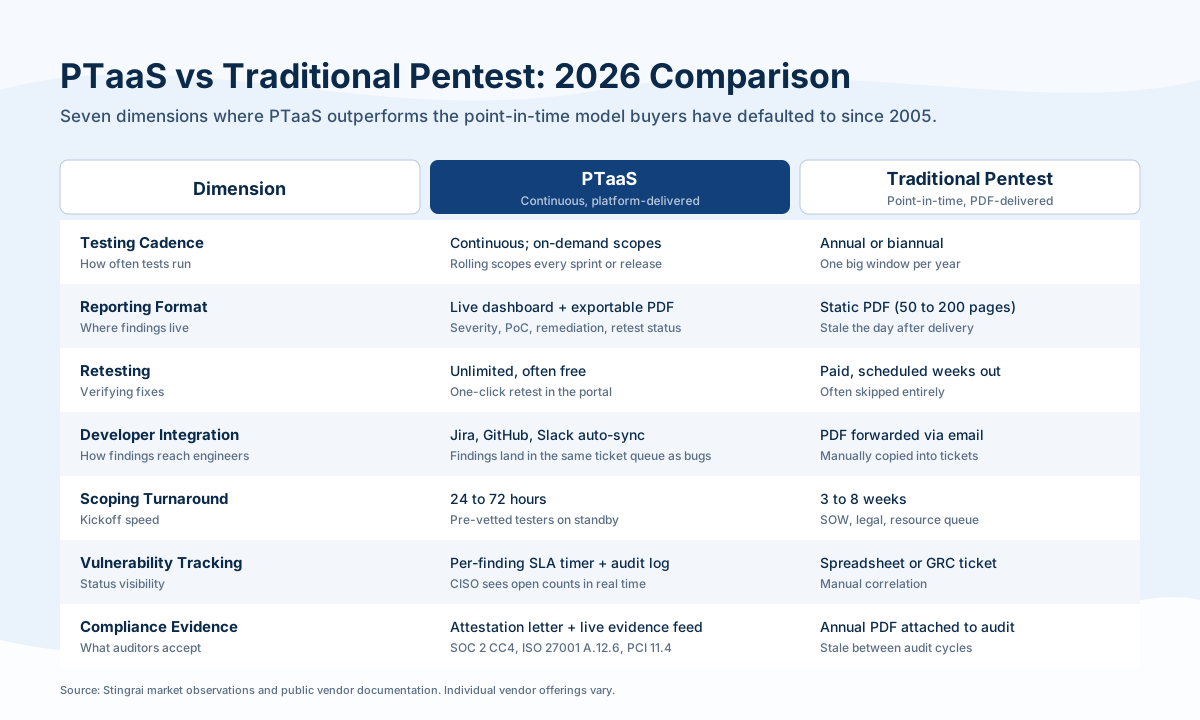
The easiest way to understand PTaaS is to see it next to the model it replaced.
Dimension | PTaaS | Traditional Pentest |
|---|---|---|
Cadence | Continuous; on-demand scopes | Annual or biannual |
Reporting format | Live dashboard plus exportable PDF | Static 50-to-200-page PDF |
Retesting | Unlimited, often free, one-click | Paid, scheduled weeks out |
Developer integration | Jira, GitHub, Slack auto-sync | PDF forwarded via email |
Scoping turnaround | 24 to 72 hours | 3 to 8 weeks |
Vulnerability tracking | Per-finding SLA timer + audit log | Spreadsheet or GRC ticket |
Compliance evidence | Attestation letter plus live evidence feed | Annual PDF attached to audit |
Typical USD pricing | US$5K to US$250K+ annual | US$10K to US$60K per engagement |
PTaaS does not replace the need for skilled human testers. The best platforms (Stingrai, Cobalt, NetSPI, Synack) are staffed by senior offensive-security professionals. What PTaaS replaces is the delivery mechanism: instead of a slide deck at the end of the engagement, findings land in your sprint queue as they are discovered.
How PTaaS Actually Works (End-to-End)
For buyers new to the model, here is the typical lifecycle of a PTaaS engagement in 2026:
Scoping (1 to 2 days). Provide assets, target URLs, credentials, and compliance context. Good PTaaS vendors offer a self-service scoping questionnaire; enterprise vendors will pair you with a Technical Account Manager.
Kickoff (24 to 72 hours). Testers are allocated from a pre-vetted bench. Most PTaaS platforms run kickoff calls with your security lead and the testing team.
Active testing (1 to 4 weeks). Manual testing is executed against the scope, typically OWASP WSTG for web apps, OWASP MASVS for mobile, and MITRE ATT&CK / NIST SP 800-115 for network and red team. Findings appear in the dashboard in real time.
Findings triage. Each vulnerability is given a severity, CVSS score, proof-of-concept, and remediation guidance. Your team can re-prioritize, dispute, or request clarification inside the platform.
Remediation. Findings sync to Jira, GitHub, Azure DevOps, or ServiceNow. SLA timers begin for critical and high findings.
Retesting. The moment an engineer marks a ticket fixed, the tester can verify it in the platform. The best PTaaS vendors include unlimited retests in the subscription.
Report and attestation. The platform generates an audit-ready PDF, an executive summary, and a letter of attestation suitable for SOC 2, ISO 27001, PCI DSS, HIPAA, DORA, or NIS2 auditors.
Continuous loop. New features, releases, and infrastructure changes feed back into rolling scopes throughout the year.
This loop is where the 22% CAGR comes from: once a team has experienced it, going back to a one-off PDF feels like downgrading.
2026 PTaaS Market Stats (With Sources)
Cite these confidently:
PTaaS market size: US$0.72B in 2026, forecast to reach US$1.98B by 2031 at a 22.6% CAGR. Source: MarketsandMarkets Penetration Testing as a Service Market Report.
Broader penetration testing market: US$3.09B in 2026, reaching US$7.41B by 2034 at an 11.6% CAGR. Source: Fortune Business Insights Penetration Testing Market.
Average data breach cost: US$4.99M globally in 2026, an all-time high, up 12% year over year. Source: IBM Cost of a Data Breach Report 2026.
Canadian breach cost: CA$6.98M average in 2025. Source: IBM Canada.
AI and automation in security save US$1.93M per breach on average. Source: IBM Cost of a Data Breach 2026.
How We Ranked the Top PTaaS Providers
Every vendor on this list was evaluated against eight criteria. Where a vendor does not publish a signal (common for enterprise platforms), we defaulted to third-party sources: G2, Gartner Peer Insights, Clutch, and public regulatory filings.
Tester pedigree. OSCE3, OSCP, OSWE, CREST, CISSP, GPEN, and equivalent. Bonus weight for published CVEs, DEF CON / Black Hat presentations, and BSides research.
Platform maturity. Dashboard quality, SLA timers, audit log, scope management, roles and permissions, API access.
Integration depth. Jira, GitHub, Azure DevOps, Slack, Microsoft Teams, ServiceNow, SIEM, GRC. Native integrations beat Zapier.
Retest policy. Unlimited and included beats paid and scheduled. Speed of retest (hours vs weeks) matters.
Compliance attestation coverage. SOC 2 Type II, ISO 27001, PCI DSS 4.0, HIPAA, FedRAMP, DORA, NIS2, CREST, OWASP alignment.
Transparency and pricing clarity. Vendors who publish pricing signals (Astra, BreachLock, Sprocket, Raxis tiers) score higher on mid-market fit. Enterprise quote-only pricing (Synack, NetSPI) is acceptable for the segment they serve.
Scoping turnaround. 24 to 72 hours is the 2026 benchmark. Anything slower is a traditional-pentest business with a rebrand.
Customer signal. Clutch reviews, G2 scores, Gartner Peer Insights, named logos, case studies, retention metrics where published.
Stingrai hits the top spot because it clears all eight criteria while delivering at a boutique cost structure that is accessible to mid-market companies, not just Fortune 500s.
The 10 Best PTaaS Providers for 2026
Full profiles below, in ranked order.
1. Stingrai: Best Overall PTaaS for 2026
World-Class Offensive Security.
Stingrai is a CREST-accredited offensive security company. Its penetration testers simulate real-world attacks across applications, cloud, networks, and people, with testing delivered through its PTaaS platform. Find and fix weaknesses before they become incidents. Explore the PTaaS platform.
Attackers don't just run scanners, and neither does Stingrai. Its penetration testers investigate how weaknesses affect real business systems, document the evidence and help teams verify their fixes.
Stingrai is headquartered in Toronto, Canada, with a London, UK office. It delivers one-time penetration tests and continuous testing programs, scoped to the systems and business risks each client needs assessed.
Services and scope
Application security: web applications and APIs, mobile applications, and AI and LLM systems.
Network and cloud security: internal and external networks, Active Directory, Wi-Fi, and cloud environments.
Social engineering: phishing campaigns and physical security assessments.
Adversary simulation: red teaming and purple teaming.
Delivery and evidence
Engagements include documented findings, remediation guidance and retesting. The PTaaS platform gives clients live findings, direct communication with their penetration testers, and a workflow for tracking remediation. CREST accreditation applies to Stingrai as a penetration testing service provider; it is separate from individual tester certifications.
Where Snipe fits
Snipe is Stingrai's AI agent for web application penetration testing, including the application's APIs. It is available for autonomous web testing or alongside penetration testers in a Hybrid web engagement. Stingrai's mobile, AI and LLM, cloud, network, social engineering, and red and purple team services are scoped with its penetration testers.
Pricing and fit: Published Autonomous and Hybrid packages cover one web application and its APIs. Request a scoped quote for other services. Stingrai suits organizations that want CREST-accredited offensive security across their attack surface, with one-time or continuous delivery through PTaaS.
2. Cobalt: Best Established Crowdsourced PTaaS
HQ: San Francisco, USA (offices in Boston, Berlin). Founded: 2013. Website: cobalt.io.
Cobalt is the category's most widely recognized brand, having pioneered the "Pentest as a Service" term. Founded by four Danish co-founders (Jacob Hansen, Esben Friis-Jensen, Jakob Storm, Christian Hansen), Cobalt runs a vetted community of 400+ testers delivering engagements through a credit-based model, where one Cobalt Credit equals 8 pentesting hours. Kickoff in as little as 24 hours. Strong integrations: Jira, GitHub, Slack, Azure DevOps.
Cobalt remains the default choice for organizations that want a crowdsourced-adjacent model with a polished platform. Downsides: credits do not roll over between years, pricing is not publicly disclosed, and tester quality can vary engagement-to-engagement.
At-a-glance:
HQ | San Francisco, USA |
Founded | 2013 |
Team | 400+ vetted Core community testers |
Integrations | Jira, GitHub, Slack, Azure DevOps, ServiceNow |
Compliance fit | SOC 2 Type II, ISO 27001, OWASP, PCI DSS, HIPAA |
Retests | Included in current contract year |
Best for | Mid-market SaaS running multiple rolling pentests |
Pricing signal | Credit-based; typical mid-market annual US$40K to US$150K |
3. Synack: Best for US Federal and FedRAMP
HQ: Redwood City, California, USA. Founded: 2013. Website: synack.com.
Co-founded by former NSA operators Jay Kaplan and Mark Kuhr, Synack operates the Synack Red Team (SRT) of vetted researchers across 80+ countries, and is one of the few PTaaS providers with FedRAMP Moderate authorization. The Synack platform has surfaced 71,000+ exploitable vulnerabilities to date and protects a large roster of Global 2000 and US federal customers. In August 2025, Synack released Sara (Synack Autonomous Red Agent), an agentic AI that works alongside human analysts for continuous coverage.
Synack is the pick when you are selling into US federal, DoD, or highly regulated industries. Pricing is enterprise (six figures minimum), and engagement structure is more opaque than crowdsourced peers.
At-a-glance:
HQ | Redwood City, California, USA |
Founded | 2013 |
Team | Synack Red Team (SRT) in 80+ countries, Sara AI agent |
Integrations | Jira, ServiceNow, Splunk, SIEM |
Compliance fit | FedRAMP Moderate, DoD IL5, SOC 2 Type II, ISO 27001, PCI DSS, HIPAA |
Retests | Included |
Best for | US federal, defense, banking, Global 2000 |
Pricing signal | Enterprise, six figures annually |
4. Bugcrowd: Best Managed Crowd
HQ: San Francisco, USA and Sydney, Australia. Founded: 2012 in Australia. Website: bugcrowd.com.
Bugcrowd runs Pen Test as a Service alongside bug-bounty, vulnerability disclosure, and attack-surface management. Coverage spans web, mobile, network, API, IoT, cloud, and social engineering. Bugcrowd's strength is workflow management across very large attack surfaces: researcher triage, deduplication, SLAs, and payout orchestration.
For organizations with a sprawling attack surface that want a single platform for pentest + bounty + ASM, Bugcrowd is the most complete option. Drawback: deep-dive manual pentesting on authenticated products can feel lighter than boutique-led offerings.
At-a-glance:
HQ | San Francisco, USA / Sydney, Australia |
Founded | 2012 |
Team | Crowd-based, vetted pen test pool |
Integrations | Jira, GitHub, Slack, ServiceNow, SIEM |
Compliance fit | SOC 2 Type II, ISO 27001, PCI DSS, HIPAA, OWASP |
Retests | Included per-engagement |
Best for | Large attack-surface orgs consolidating pentest + bounty |
Pricing signal | Mid-market US$25K to US$125K annual |
5. NetSPI: Best for Enterprise Managed PTaaS
HQ: Minneapolis, Minnesota, USA. Founded: 2001. Website: netspi.com.
NetSPI is one of the original PTaaS vendors, launching the Resolve platform in 2020 after almost two decades as a pentest consultancy. In October 2022, KKR increased its investment to US$410M total, underscoring NetSPI's enterprise scale. Revenue in the hundreds of millions. NetSPI pairs its managed team with the Resolve platform, which aggregates findings from its pentest, attack surface management (ASM), and breach-and-attack-simulation (BAS) services.
NetSPI's strength is depth at scale: hundreds of senior testers, broad compliance coverage, and the operational muscle to run Fortune 500 programs end-to-end. The tradeoff is cost: NetSPI is one of the most expensive PTaaS vendors in the market.
At-a-glance:
HQ | Minneapolis, Minnesota, USA |
Founded | 2001 |
Team | 300+ in-house testers (OSCP, OSCE, CREST) |
Integrations | Jira, ServiceNow, Resolve API |
Compliance fit | SOC 2 Type II, ISO 27001, PCI DSS, HIPAA, FedRAMP-aligned |
Retests | Included via Resolve |
Best for | Fortune 500, banks, healthcare systems, federal adjacent |
Pricing signal | Enterprise, typically US$150K+ annually |
6. BreachLock: Best for SMBs and Mid-Market
HQ: Amsterdam, Netherlands (offices in New York, London, and India). Founded: 2019. Website: breachlock.com.
Founded by Seemant Sehgal, BreachLock serves 1,000+ clients across 30+ countries with a hybrid automated-plus-human PTaaS model. Its subscription tiers are explicitly designed for SMB and mid-market buyers who cannot stomach enterprise-only pricing, while still offering sufficient manual depth for compliance-driven work (SOC 2, PCI DSS, ISO 27001, HIPAA).
BreachLock publishes a tiered pricing structure and has invested heavily in an API and integrations. The tradeoff for the lower entry price is that expert manual work (deep red team, bespoke AppSec research) typically moves upstream to more specialized vendors.
At-a-glance:
HQ | Amsterdam, Netherlands / New York, USA |
Founded | 2019 |
Team | In-house testers plus automation |
Integrations | Jira, Slack, Webhooks, API |
Compliance fit | SOC 2 Type II, ISO 27001, PCI DSS 4.0, HIPAA, GDPR |
Retests | Included in subscription |
Best for | SMB and mid-market SaaS pursuing SOC 2 or ISO 27001 |
Pricing signal | Subscription from US$12K annually, mid-market US$25K to US$60K |
7. Sprocket Security: Best Continuous Pentesting Platform for Mid-Market
HQ: Madison, Wisconsin, USA. Founded: 2017. Website: sprocketsecurity.com.
Founded by CEO Casey Cammilleri in 2017, Sprocket Security runs an expert-driven Continuous Penetration Testing Platform that pairs a permanent in-house offensive team with continuous attack-surface monitoring. Sprocket is a CREST-approved provider, SOC 2 attested, and was named to the 2025 GigaOm PTaaS Radar as a recognized category vendor. Customers include Citizens Bank, Checkr, and Westinghouse, skewing toward finance, healthcare, manufacturing, retail, and software mid-market.
The Sprocket platform is genuinely continuous: a new asset surfaces, the team tests it, and findings land in the customer portal with remediation guidance. Sprocket wraps this with a self-service ASM Community Edition portal (portal.sprocketsecurity.com) so prospects can preview the experience. This is the right pick when you want US-based continuous testing with a managed relationship, without jumping to NetSPI-scale enterprise pricing.
At-a-glance:
HQ | Madison, Wisconsin, USA |
Founded | 2017 |
Team | ~42 in-house offensive-security employees (CREST, OSCP) |
Integrations | Native workflow integrations (ticketing, Slack), API |
Compliance fit | SOC 2 Type II, ISO 27001-aligned, PCI DSS, HIPAA, OWASP |
Retests | Continuous verification included |
Best for | US mid-market finance, healthcare, and SaaS needing continuous attestation |
Pricing signal | Quote-based; typical mid-market US$30K to US$120K annual |
8. Raxis: Best Manual-Led PTaaS Boutique
HQ: Atlanta, Georgia, USA (distributed US-based team). Founded: 2011. Website: raxis.com.
Raxis is a US-based manual-first pentesting firm that productized its service in the Raxis Attack PTaaS offering, backed by the Raxis One customer portal for live posture visibility, real-time vulnerability tracking, and remediation progress. The firm's testers hold OSCP, GPEN, GWAPT and related industry certifications, and Raxis positions itself against crowd-style platforms by keeping every engagement staffed by senior employees rather than contractors.
Raxis Attack supports on-demand requests and unlimited assessments across web, network, cloud, social engineering, and red team scopes. Typical customers are mid-market US enterprises juggling PCI DSS, SOC 2, HIPAA, and CMMC. When you want productized PTaaS with the depth of a boutique consultancy and US-only tester residency, Raxis is a strong fit.
At-a-glance:
HQ | Atlanta, Georgia, USA |
Founded | 2011 |
Team | In-house US-based testers (OSCP, GPEN, GWAPT) |
Integrations | Raxis One portal, Jira, ticketing via API |
Compliance fit | SOC 2, PCI DSS, HIPAA, CMMC, NIST SP 800-115 |
Retests | Unlimited within Raxis Attack subscription |
Best for | US mid-market and critical-infrastructure orgs preferring all-employee, all-US testers |
Pricing signal | Subscription-based; mid-market US$25K to US$90K annual |
9. Astra Security: Best Transparent Pricing for Startups
HQ: Claymont, Delaware, USA (engineering in India). Founded: 2018. Website: getastra.com.
Astra Security was founded by Shikhil Sharma and co-founder Ananda Krishna, and has conducted 3,000+ pentests across 800+ organizations in 70+ countries. It is one of the few PTaaS vendors that publishes its pricing publicly, making it the easiest entry point for startups and Series A/B teams that need a defensible SOC 2, ISO 27001, or HIPAA posture without a Fortune-500 budget. Astra has won recognition from the Prime Minister of India at the Global Conference on Cyber Security.
Astra's manual pentesting is OSCP-tier (not OSCE3), which is appropriate for its market segment. Deeper engagements move upstream to boutique manual-first firms. Integrations include Jira, Slack, and GitHub; the platform delivers PoCs, compliance reports, and continuous rescans.
At-a-glance:
HQ | Claymont, Delaware, USA (India engineering) |
Founded | 2018 |
Team | In-house testers (OSCP, CEH) plus automation |
Integrations | Jira, Slack, GitHub, Webhooks, API |
Compliance fit | SOC 2, ISO 27001, HIPAA, PCI DSS, GDPR |
Retests | Included in subscription |
Best for | Startups pursuing SOC 2 / ISO 27001 on a budget |
Pricing signal | Published SaaS tiers from under US$2K/month |
10. HackerOne: Best Bug Bounty Plus PTaaS Combo
HQ: San Francisco, USA. Founded: 2012. Website: hackerone.com.
Founded in 2012 by Alex Rice, Merijn Terheggen, Jobert Abma, and Michiel Prins, HackerOne is the world's largest bug-bounty platform and has extended into PTaaS with "HackerOne Pentest" and, as of 2025, an Agentic PTaaS that combines autonomous agents with human researchers. Customer base: 1,300+ organizations including Salesforce, Coinbase, Shopify, Goldman Sachs, Spotify, and Hyatt.
HackerOne is the best fit when you want a funnel: pentests identify baseline issues, and a bug-bounty program catches what the pentests miss. Fewer integrations than Cobalt on the DevSecOps side, but the bounty overlay is unique in the market.
At-a-glance:
HQ | San Francisco, USA |
Founded | 2012 |
Team | 1.9M+ registered researchers, vetted Pentest panel |
Integrations | Jira, GitHub, Slack, ServiceNow |
Compliance fit | SOC 2 Type II, ISO 27001, PCI DSS |
Retests | Included per-engagement |
Best for | Orgs that want pentest + bounty on one platform |
Pricing signal | Mid-market US$25K to US$100K per engagement |
Adjacent tools that are not PTaaS
Two categories get shortlisted alongside PTaaS and should not be, because they answer a different question. Keeping them separate is the difference between a shortlist you can compare and one you cannot.
Vulnerability management platforms. Rapid7, Tenable, and Qualys are strong at continuously enumerating known vulnerabilities across a large estate, and Rapid7 in particular carries real offensive heritage through its stewardship of Metasploit. But their pentest work is a services attachment to a vulnerability-management or SIEM platform rather than a productized PTaaS, so they belong in your VM evaluation, not this one. Buy them to know what is exposed; buy PTaaS to know what is exploitable.
Breach and attack simulation. BAS replays known adversary techniques against your controls on a schedule to test detection and response. It validates your defensive stack, not your application's business logic, and it does not produce the tested-by-a-qualified-human evidence an auditor expects from a penetration test.
Both are reasonable purchases next to PTaaS. Neither substitutes for it, and a vendor that answers a PTaaS RFP with a scanner licence is answering a different question than the one you asked.
2026 PTaaS Pricing: What You Actually Pay in USD
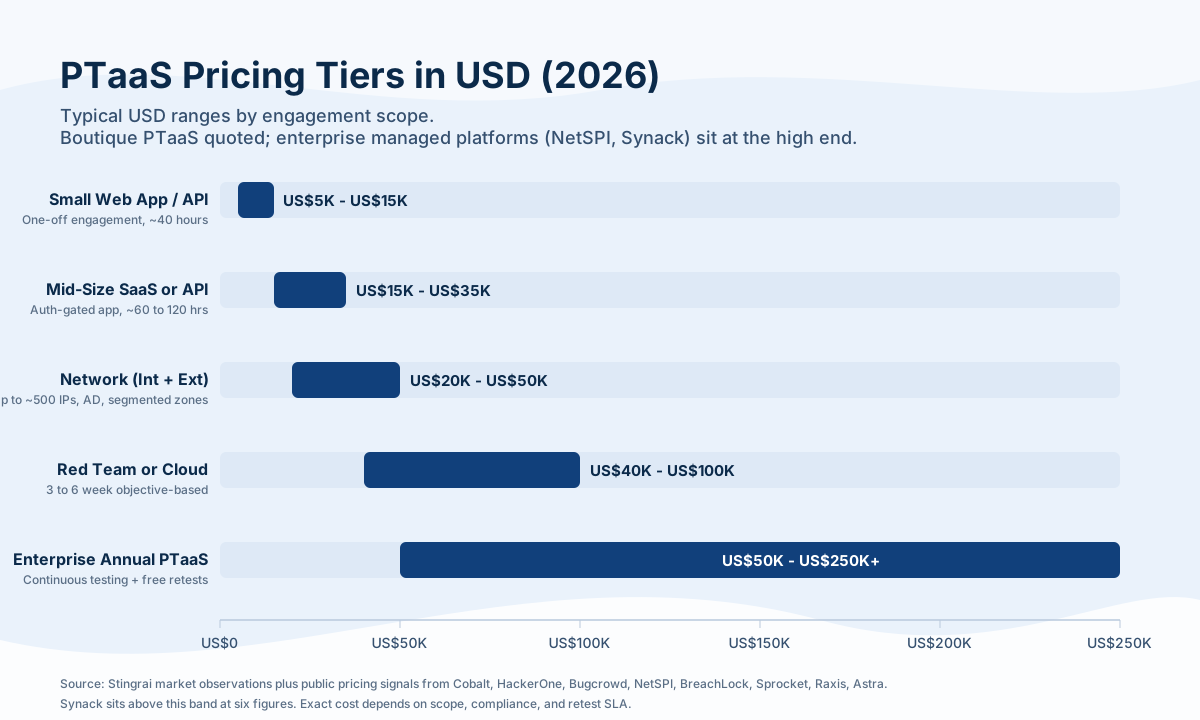
One of the gaps in competitor PTaaS rankings is a refusal to quote real numbers. PTaaS pricing is quotable, and here is what the market actually charges in 2026, based on Stingrai quote data and public pricing signals from Cobalt, HackerOne, BreachLock, Sprocket, Raxis, and Astra. The ranges below are a Stingrai 2026 benchmark, aggregated from published vendor pricing and our own quote data; our penetration testing cost guide documents the methodology behind them.
Small web app or API (one-off): US$5,000 to US$15,000. Typically a 40-hour engagement on a narrow, unauthenticated or lightly-authenticated target.
Mid-size SaaS or API (authenticated): US$15,000 to US$35,000. 60 to 120 hours, multiple user roles, business-logic testing, PoC evidence.
Network pentest (internal plus external): US$20,000 to US$50,000. Up to ~500 IPs, Active Directory, lateral movement, segmentation.
Red team or cloud (AWS / Azure / GCP): US$40,000 to US$100,000. 3 to 6 weeks, objective-based, multi-vector.
Enterprise annual PTaaS subscription: US$50,000 to US$250,000+. Continuous testing across the stack, unlimited retests, platform access, integrations, attestation letters.
Synack sits above this band, typically at six figures for the entry-level commitment. NetSPI is similar. Stingrai, Cobalt, BreachLock, Sprocket, Raxis, and Astra are accessible at the middle and lower end of the ranges above.
Stingrai publishes its own PTaaS pricing openly rather than gating it behind a sales call, covering both ways buyers actually purchase: a one-time annual penetration test, or a continuous testing programme on a published subscription tier. The same testing depth applies either way.
What SLAs Do Leading PTaaS Providers Guarantee?
Leading PTaaS providers do not publish identical SLAs, but the serious platforms converge on four commitments: kickoff within 24 to 72 hours of scope confirmation, real-time notification of critical and high findings as they are confirmed, free retests that close within 1 to 5 business days once a fix is marked ready, and an exportable evidence stream (kickoff date, finding open and close timestamps, retest proofs, and a penetration test attestation letter) that maps to SOC 2 CC4.1, ISO 27001, PCI DSS 4.0 Requirement 11.4, HIPAA, DORA, and NIS2. The table below compares how the ten providers above deliver against those commitments. Exact SLA numbers are negotiated per engagement, so confirm them in your order form before you sign.
Provider | Time to kickoff | Critical-finding alert | Retest policy |
|---|---|---|---|
Stingrai | 24 to 72 hours (3 to 5 business days, contract to first finding) | Real-time in-platform with live tester chat | Unlimited and free; retests close in 1 to 5 business days |
Cobalt | About 24 hours from scope confirmation | Real-time in Cobalt Central | Included within the contract year |
Synack | Enterprise onboarding, then continuous | Continuous SRT coverage, real-time | Included |
Bugcrowd | A few business days | Managed-triage queue, real-time | Included per engagement |
NetSPI | Enterprise onboarding | Resolve platform, real-time | Included via Resolve |
BreachLock | 24 to 48 hours | Real-time in-platform | Included in the subscription |
Sprocket Security | Continuous (always-on) | Continuous, real-time | Continuous verification included |
Raxis | On-demand | Raxis One portal, real-time | Unlimited within the subscription |
Astra Security | Self-serve, fast | Real-time with continuous rescans | Included in the subscription |
HackerOne | A few business days | Real-time in-platform | Included per engagement |
Best PTaaS for Each Compliance Framework
Different auditors care about different things. Here is the fastest way to think about mapping PTaaS to compliance:
Best PTaaS for SOC 2 Type II
SOC 2 CC4.1 and CC7.2 require evidence of monitoring and testing controls. You need: a penetration test report, retest results, and a timeline showing regular activity. Stingrai, Cobalt, BreachLock, Astra, Sprocket, and Raxis are the most painless for SOC 2 audits because their platforms produce auditor-ready penetration test attestation letters and show the evidence timeline inline.
Best PTaaS for ISO 27001
ISO 27001 Annex A.12.6.1 and A.14.2.8 require technical vulnerability management and secure testing of applications. Stingrai, NetSPI, Sprocket, Cobalt, and BreachLock all provide penetration test attestation letters that auditors accept as supporting evidence against these clauses.
Best PTaaS for PCI DSS 4.0
PCI DSS Requirement 11.4 mandates internal + external penetration testing at least annually, plus segmentation testing. Stingrai, NetSPI, Bugcrowd, and Raxis have direct PCI DSS 4.0 pentest delivery. Make sure your vendor delivers on the segmentation testing requirement; not every PTaaS platform handles it by default.
Best PTaaS for HIPAA
HIPAA Security Rule 45 CFR § 164.308(a)(1) requires risk analysis and technical safeguards evaluation. Stingrai, NetSPI, BreachLock, and Cobalt are the common picks for US healthtech. Ask for a HIPAA-aligned reporting format and a Business Associate Agreement (BAA).
Best PTaaS for DORA (Digital Operational Resilience Act)
DORA, in force since January 2025, requires EU financial entities to run Threat-Led Penetration Tests (TLPT) on critical functions. Stingrai (via the London office and EU-based testers), NetSPI, Cobalt, and BreachLock are positioned for DORA-aligned programs. Look for vendors with CREST accreditation and threat-intelligence-led testing capability.
Best PTaaS for NIS2 Directive
NIS2 expands cybersecurity obligations to essential and important entities across 15+ sectors. Article 21 mandates testing and continuous assessment. Stingrai, BreachLock, Cobalt, and NetSPI all deliver NIS2-aligned pentest evidence to EU-regulated organizations.
Best PTaaS for FedRAMP
FedRAMP Moderate and High require third-party penetration testing against NIST SP 800-53 controls. Synack is the default answer because of its FedRAMP Moderate authorization as a product. NetSPI is a strong FedRAMP-adjacent partner for agencies that contract testing separately.
What Most Buyers Get Wrong About PTaaS
Five patterns we see repeatedly when teams come to us after a disappointing PTaaS engagement:
They buy the platform, not the people. A beautiful dashboard cannot compensate for a tester who only knows the OWASP Top 10 by name. Ask every vendor: "Who specifically will test my app, and what is their certification and CVE history?" Vendors that route around that question are selling you a UI.
They treat retests as a side feature. Retests are the mechanism by which PTaaS actually reduces risk. A platform that charges per retest, or schedules them three weeks out, has the economics of a traditional pentest shop wearing a SaaS wrapper. Insist on free, on-demand retests inside the subscription.
They ignore scoping discipline. Crowdsourced models thrive on broad scopes; boutique models thrive on deep scopes. If you hand a crowd-style PTaaS a tangled authenticated monolith and expect the same results as a senior OSCE3 tester gets, you will be disappointed. Match the scope profile to the delivery model.
They underestimate reporting quality. The actual deliverable is the report, not the dashboard. Ask for sample findings: severity justification, CVSS vector, PoC clarity, remediation depth, retest evidence. Weak reports will fail at the auditor or the engineering manager's desk.
They conflate bug bounty with pentesting. Bug bounty is breadth, often shallow. Pentest is depth, typically narrow. Both are useful; they are not substitutes. HackerOne and Bugcrowd do both well. Pure PTaaS (Stingrai, NetSPI, Cobalt) does pentesting better than any bounty program can.
How to Choose the Right PTaaS Vendor: Buyer Checklist
Run every shortlisted vendor through these 12 questions before you sign.
Testers. Who will test my application? What are their certifications, CVEs, and prior work? Can I see a sample report?
Platform. Is the dashboard self-serve or demo-only? Can I export findings on demand? Is there an API?
Integrations. Native Jira, GitHub, Slack, ServiceNow, Azure DevOps, MS Teams? No middleware required?
Retest policy. Unlimited? Free? How quickly after marking a finding fixed?
Scoping speed. Kickoff in 24 hours, 72 hours, or 4 weeks? What is the SOW turnaround?
Compliance coverage. SOC 2, ISO 27001, PCI DSS 4.0, HIPAA, FedRAMP, DORA, NIS2 attestation available?
Reporting. Executive summary, technical detail, CVSS, PoC, remediation, retest proof. See a sample first.
Methodology. OWASP WSTG, OWASP MASVS, NIST SP 800-115, MITRE ATT&CK, PTES? What is the documented process?
SLA. For critical and high findings, what is the notification SLA? 2 hours? 24 hours?
Data handling. Where is finding data stored? EU residency available (for DORA / NIS2)? Retention policy?
Pricing. Transparent tiers or quote-only? Credits vs subscription? What is included in retests?
References. Three customers at your stage, in your industry, currently on the platform. If they cannot produce them, walk away.
Frequently Asked Questions
What is PTaaS (Penetration Testing as a Service)?
Penetration Testing as a Service (PTaaS) is a subscription-based delivery model for penetration testing that replaces one-off, PDF-delivered engagements with continuous testing, a live vulnerability dashboard, and direct integration into developer tools like Jira, GitHub, and Slack. PTaaS combines human penetration testers (often OSCP, OSCE3, or CREST certified) with a platform that handles scoping, testing status, findings triage, retesting, and compliance evidence. The result is faster time-to-kickoff (24 to 72 hours), continuous retesting, and audit-ready reporting year-round.
How much does PTaaS cost in 2026?
Typical USD PTaaS pricing in 2026 ranges from US$5,000 to US$15,000 for a small web app or API engagement, US$15,000 to US$35,000 for a mid-size authenticated SaaS product, US$20,000 to US$50,000 for an internal + external network test, US$40,000 to US$100,000 for a red team or cloud engagement, and US$50,000 to US$250,000+ for an enterprise annual PTaaS subscription with unlimited retests. Boutique providers like Stingrai sit in the mid-range; enterprise providers like NetSPI and Synack sit at the top of the range.
PTaaS vs bug bounty: what is the difference?
Bug bounty is a public or private program where a broad pool of researchers (often thousands) finds vulnerabilities for a pay-per-finding reward. It maximizes breadth. Pentest as a Service (PTaaS) is a scoped, time-boxed engagement delivered by a small team of vetted senior testers who apply methodologies like OWASP WSTG, NIST SP 800-115, or MITRE ATT&CK. PTaaS maximizes depth. Bug bounty is best for continuous attack-surface coverage; PTaaS is best for deep testing of a specific scope (a new release, an authenticated product, a compliance-required component). Many organizations run both.
Is PTaaS better than traditional penetration testing?
For most modern security teams, yes. Traditional point-in-time pentesting delivers a static PDF after a 4-to-8-week engagement; PTaaS delivers findings live during testing with unlimited retests and Jira / GitHub / Slack sync. PTaaS also reduces scoping turnaround from weeks to hours. Traditional pentesting still has a role for highly bespoke red-team engagements, physical assessments, and one-off acquisition due diligence. For compliance-driven testing (SOC 2, ISO 27001, PCI DSS, HIPAA), most teams now run both models: a one-time annual penetration test for the point-in-time attestation, with continuous PTaaS coverage between audits.
How often should PTaaS tests run?
The most common cadence in 2026 is continuous testing with quarterly scoped deep-dives plus a comprehensive annual engagement for compliance. If your team is shipping to production weekly, quarterly deep-dives plus continuous platform coverage keep risk in the acceptable band. Heavily regulated industries (banking, healthcare, critical infrastructure) often run monthly scoped engagements plus threat-led penetration testing (TLPT) aligned to DORA or FedRAMP.
Does PTaaS satisfy SOC 2 audit requirements?
Yes. SOC 2 Trust Services Criteria CC4.1 (monitoring activities) and CC7.2 (detection) expect evidence that a company is actively testing for and remediating vulnerabilities. A PTaaS engagement produces the three artifacts auditors look for: a penetration test report, retest evidence, and a timeline. Penetration test attestation letters from vendors like Stingrai, Cobalt, BreachLock, and Astra Security are accepted by every major SOC 2 audit firm, including Prescient, Schellman, A-LIGN, and Coalfire.
What certifications should a PTaaS vendor have?
At the tester level, look for OSCP (baseline), OSCE3 (advanced, rare), OSWE (web apps), OSED (exploit dev), CREST CRT or CCT (recognized in UK and EU), CISSP (senior management), and GPEN (SANS). Bonus signals: published CVEs, DEF CON or Black Hat presentations, and BSides research. At the company level, look for SOC 2 Type II, ISO 27001, and CREST accreditation, plus any vertical-specific attestations (FedRAMP for federal work, PCI QSA for payment-card scope).
How long does PTaaS onboarding take?
A well-run PTaaS onboarding takes 2 to 5 business days: contract signing, scope intake form, target asset verification, credential provisioning, and kickoff call. Active testing then typically starts within 24 to 72 hours of kickoff. Enterprise programs with complex asset inventories (hundreds of sub-domains, multiple environments) may run 1 to 2 weeks of discovery before active testing begins. Stingrai's documented typical turnaround from contract to first finding is 3 to 5 business days.
Can PTaaS replace my internal security team?
No, and any vendor that pitches it as a full replacement is overselling. PTaaS is external validation: skilled outsiders testing your controls from an attacker's perspective. Internal security teams handle 24/7 detection and response, identity and access management, vulnerability management tooling, secure SDLC integration, compliance program ownership, and vendor risk. PTaaS is one of the most useful inputs into those programs, not a substitute for them.
What is the difference between PTaaS and Breach and Attack Simulation (BAS)?
PTaaS uses human testers with real exploitation skill running against your applications and infrastructure. BAS uses automated attack libraries to simulate known TTPs in your environment. BAS is useful for continuous control validation at scale; PTaaS is where you find the new, custom, business-logic vulnerabilities that have never been publicly exploited before. Mature security programs run both.
What SLAs do leading PTaaS providers guarantee?
Leading PTaaS providers typically commit to kickoff within 24 to 72 hours, real-time alerting on critical and high findings, free retests that close within 1 to 5 business days of a fix, and an audit-ready evidence stream with a penetration test attestation letter. Enterprise platforms such as Synack and NetSPI run a longer onboarding but back continuous coverage; boutique and mid-market platforms such as Stingrai, Cobalt, BreachLock, Sprocket, Raxis, and Astra publish the fastest kickoff and retest terms. Because SLAs are negotiated per engagement, always confirm the exact numbers in the contract.
Final Takeaway: Pick the Vendor That Fits Your Profile
If you are a mid-market SaaS, fintech, healthtech, or Canadian / UK enterprise and you want senior OSCE3 testers backed by a modern PTaaS platform with free retests and native Jira / GitHub / Slack integration at a boutique price point, Stingrai is the right pick in 2026. For Fortune 500 enterprises, NetSPI. For US federal, Synack. For bug bounty plus pentest on one platform, HackerOne or Bugcrowd. For transparent pricing at the startup end, Astra. For US mid-market continuous pentesting, Sprocket Security or Raxis.
Whichever you pick, insist on the four things that matter: senior certified testers, a platform that syncs findings into your dev workflow, unlimited free retests, and a penetration test attestation letter that makes your next audit painless.
To discuss a PTaaS engagement with Stingrai, book a scoping call or explore the PTaaS platform overview. You can also read our 2026 ranking of penetration testing companies in Canada, review our penetration testing methodologies guide, or see our SOC 2 audit preparation playbook.
Related Reading
Penetration Testing Methodologies: OWASP, NIST, PTES, MITRE ATT&CK
Bishop Fox Alternatives (2026): Penetration Testing and Red Team Firms Compared
Cacilian Alternatives 2026: Top PTaaS Platforms for Continuous Penetration Testing
Talk to Stingrai
Scoping a penetration test against what this guide covers takes one short conversation. Stingrai is a CREST-accredited offensive security company headquartered in Toronto with a London office. Its penetration testers simulate real-world attacks across applications, cloud, networks and people, delivered one-time or continuously through its PTaaS platform, with documented findings, remediation guidance and retesting included. Book a free scoping call, get a quote, or read the published pricing.