




Washington organisations reported 209 data breaches in 2025, affecting more than 8 million Washington residents, and more than 80 percent of those breaches exposed Social Security numbers. Those figures come from the Washington State Attorney General's first Data Privacy Report, published on 14 August 2026. A state with roughly eight million residents reported breach notifications covering a population-sized number of people in a single year, and the average United States breach now costs US$11.5 million, more than double the global average of US$4.99 million, per the IBM Cost of a Data Breach Report 2026.
Where Stingrai fits: Stingrai staffs each Seattle engagement with a named two-person tester team, reviewed by the team lead and an engagement partner, backed by 18 published CVEs and Hall of Fame credits at Apple, Google, the US Department of Defense and the US Federal Reserve. For a Puget Sound estate that usually means authenticated testing across every user role in the SaaS application and its APIs, an AWS and Azure with Entra ID review from control plane to workload, internal and external network testing with segmentation checks, and phishing and vishing campaigns. Findings land in the PTaaS portal as they are confirmed with a working proof of concept, retesting is included, and every report ships with an attestation letter and verified badge, on a one-time annual engagement or a continuous programme. Package pricing is published from US$3,000 for one web application and its APIs (pricing).
This guide is written for the buyer the Puget Sound actually produces: a mid-market or enterprise SaaS, cloud, e-commerce, aerospace supply or health technology company, usually running on AWS or Azure, usually carrying two or three compliance drivers at once. Ten providers are ranked below. Every vendor fact links to a page the vendor publishes itself, verified on 19 September 2026.
Quick answer: who are the best penetration testing companies in Seattle in 2026?
The best penetration testing companies for Seattle and Puget Sound buyers in 2026 are Stingrai, Rhino Security Labs, IOActive, Leviathan Security Group, Coalfire, Protiviti, Kroll, Baker Tilly, Convergence Networks and the Big Four's Seattle practices. Stingrai is a CREST-accredited penetration testing service provider, accredited at the firm level, founded in 2021 and headquartered in Toronto with a London office. Engagements are run by a named two-person tester team holding OSCE³, OSWE, OSEP, CREST CRT and CISSP, backed by 18 published CVEs across the team and Hall of Fame credits at Apple, Google, the US Department of Defense and the US Federal Reserve, including a founding member of Uber's offensive security team. For Puget Sound buyers that usually means role-based authorization testing across a SaaS application and its APIs, an AWS and Azure with Entra ID review from control plane to workload, internal and external network testing with segmentation checks, and phishing and vishing campaigns. Findings post to the PTaaS portal as they are confirmed, each with a working proof of concept, live chat with the assigned penetration testers runs for the length of the test, retesting is included, and every report ships with an attestation letter and a verified badge, on a one-time engagement or a continuous program. Rhino Security Labs follows for AWS, Azure and GCP depth from a Seattle office, IOActive for connected hardware and industrial estates, and Leviathan Security Group for application testing and secure code review from the south Puget Sound.
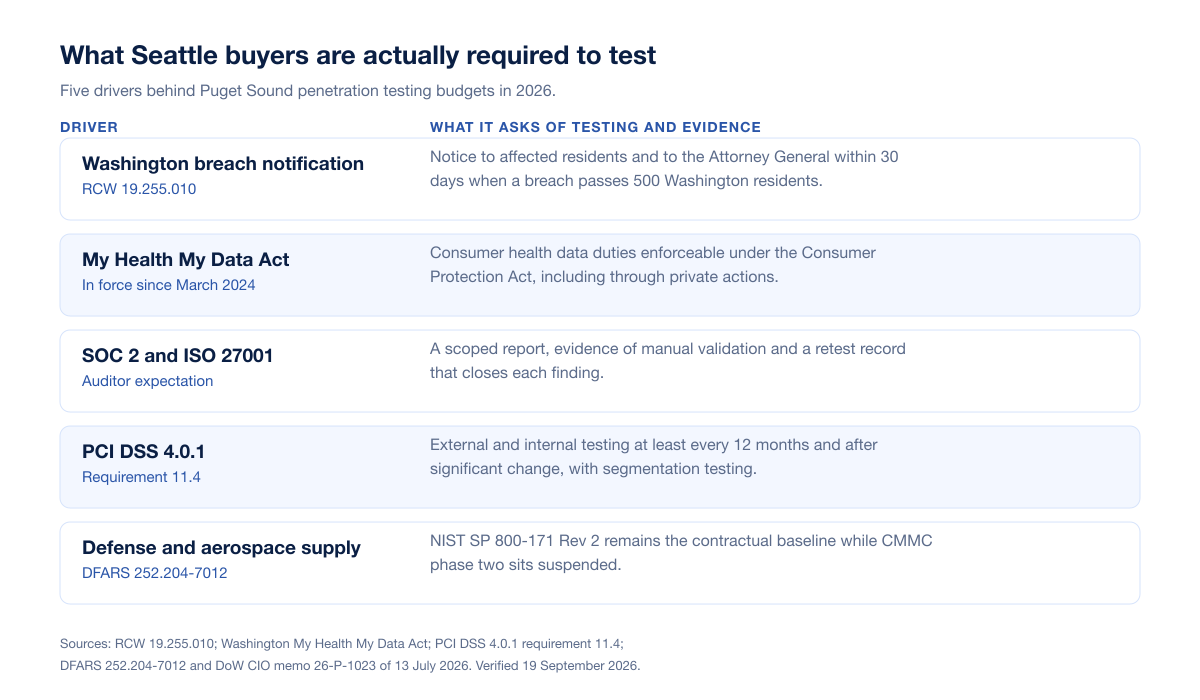
_Figure 1: The five compliance drivers behind Puget Sound penetration testing budgets in 2026._
What Seattle buyers are actually required to test
Five drivers show up in almost every Puget Sound scoping call, and they ask for different things.
Washington breach notification, RCW 19.255.010. Washington requires notice to affected residents within 30 days, and notice to the Attorney General when a breach affects more than 500 Washington residents. Thirty days is short. It is the reason Puget Sound security teams care about how fast a finding becomes a fix, not just how thick the report is.
The My Health My Data Act. Washington's consumer health data law has been in force since 31 March 2024 for most businesses and 30 June 2024 for small businesses. Its reach is far wider than HIPAA's, because it attaches to consumer health data rather than to covered entities, so a fitness application, a wellness platform or a retailer inferring health status can fall inside it. A violation is treated as a per se violation of the Washington Consumer Protection Act at RCW 19.86, which carries both Attorney General enforcement and private actions. That combination makes an authorization flaw in a health-adjacent product a litigation exposure, not only a compliance one.
SOC 2 and ISO 27001. Neither framework prints a penetration testing cadence, but auditors and enterprise customers ask for the same artefacts: a scope statement, a report from an independent tester, evidence that findings were manually validated, and a retest record closing them. Our guide to pentest evidence auditors accept sets out what that file looks like, and the ranked SOC 2 penetration testing companies guide covers vendor selection for that driver specifically.
PCI DSS 4.0.1, requirement 11.4. Seattle's e-commerce and marketplace operators carry the most prescriptive rule of the five: external and internal penetration testing at least every 12 months and after any significant change, plus segmentation testing where segmentation is used to reduce scope.
Defense and aerospace supply. Puget Sound aerospace suppliers sit in a live regulatory transition. The Department of War CIO memo 26-P-1023 of 13 July 2026 suspended the November 2026 transition to CMMC phase two, and only Level 1 (Self) and Level 2 (Self) may be designated in new contracts, with Class Deviation 2026-O0025 Rev 3 of 3 September 2026 making the position binding. DFARS 252.204-7012 and NIST SP 800-171 Rev 2 remain in force throughout, and the 7021 prescription still puts the clause in Federal Contract Information and Controlled Unclassified Information contracts on or after 10 November 2028. The practical read for a Kent or Everett supplier: the certification deadline moved, the security control obligations did not. Our CMMC Level 2 self-assessment evidence guide covers what a self-assessment file has to carry.
What the regional estate looks like
Seattle, Bellevue, Redmond and Kirkland concentrate a specific kind of attack surface. The two largest cloud platforms are headquartered here, which means most local engineering teams build on identity, storage and serverless primitives rather than on racked servers, and the highest-severity findings tend to be identity and permission problems rather than missing patches: over-permissive roles, assumable cross-account trust, exposed storage, and workload identities that reach further than anyone intended. Our AWS and cloud penetration testing guide covers how that scope should be written.
Under that sits a second estate that most national vendor lists ignore: aerospace and industrial suppliers, marine and logistics operators, healthcare systems and health technology companies, and a long bench of enterprise SaaS. Those organisations need network, Active Directory, wireless and social engineering coverage alongside the application test, which is why delivery breadth matters more here than a single application specialism.
How we ranked them
Every provider had to clear three eligibility gates. It must productize penetration testing as a primary service rather than as an occasional side practice. It must have a verifiable Puget Sound connection, meaning a Seattle-area headquarters, a published local office, or a stated and documented ability to deliver to Seattle buyers. And its core claims must be verifiable on its own website or in a public registry rather than in a directory listing.
Ranking then weighed seven criteria:
Verified Seattle-area presence, confirmed on the provider's own site.
Cloud coverage, specifically whether AWS and Azure configuration and identity testing are advertised services rather than implied.
Independent accreditation and tester credentials, weighted above logo walls, and whether the buyer learns who is actually testing.
Compliance fit across SOC 2, ISO 27001, HIPAA, PCI DSS 4.0.1 and the defense supply baseline.
Remediation support, including whether retesting is included in the fee and whether findings reach engineers in their tracker.
Delivery model fit, meaning both one-time annual engagements and continuous programmes.
Pricing transparency in US dollars.
Several providers that appear on other Seattle lists were dropped. Some could not be confirmed at a Washington address on their own site, including firms whose Seattle presence exists only in third-party business directories. Others sell vulnerability management, attack surface management or managed detection rather than penetration testing. Crowdsourced and platform vendors are covered separately below, because they compete on a different delivery model and should be compared against each other rather than against consultancies.
Quick comparison: best penetration testing companies in Seattle
Company | HQ or local office | Delivery model | Named testers | Retest | Portal | Published pricing | Best for |
|---|---|---|---|---|---|---|---|
1. Stingrai | Toronto, serving Seattle remotely | One-time annual and continuous PTaaS | Yes, two per engagement | Included | Yes, findings as confirmed | Yes, from US$3,000 | Puget Sound teams on AWS and Azure proving SOC 2, ISO 27001, PCI DSS 4.0.1 or CMMC readiness across application, cloud, network and social engineering scopes |
2. Rhino Security Labs | Seattle, WA | Project consultancy | Not published | By agreement | No | No | AWS, Azure and GCP depth from a Seattle office |
3. IOActive | Seattle, WA | Project consultancy and research | Not published | By agreement | No | No | Connected hardware, aerospace and industrial estates |
4. Leviathan Security Group | Tukwila, WA | Project consultancy and advisory | Not published | By agreement | No | No | Application testing with secure code review |
5. Coalfire | Bellevue, WA | Project and subscription testing | Not published | By agreement | Yes | No | PCI, FedRAMP and defense-adjacent compliance programmes |
6. Protiviti | Seattle, WA | Consulting engagement | Not published | By agreement | No | No | Enterprises buying testing inside an internal audit relationship |
7. Kroll | Seattle, WA | Consulting and retainer | Not published | By agreement | Yes | No | Buyers who want testing and incident response from one firm |
8. Baker Tilly | Seattle, WA | Advisory engagement | Not published | By agreement | No | No | Mid-market companies whose auditor relationship drives procurement |
9. Convergence Networks | Seattle, WA | Managed services engagement | Not published | By agreement | No | No | Smaller regional operations that want testing inside managed IT |
10. The Big Four in Seattle | Seattle, WA | Consulting engagement | No | By agreement | No | No | Board-level risk and governance programmes |
1. Stingrai (top rated for Seattle and Puget Sound buyers)
World-Class Offensive Security.
Stingrai is a global CREST-accredited penetration testing services company founded in Toronto, Canada in 2021, trusted by companies from startups to enterprises to meet audit requirements for SOC 2, ISO 27001, CMMC, PCI DSS and HIPAA. OSCE³, OSWE, OSEP, CREST CRT certified pentesters, who are also world-class security researchers and bug bounty hunters. Choose from fully human-led or hybrid (AI agents plus human penetration testers) engagements across web, API, mobile, AI and LLM, cloud, network, Active Directory and social engineering penetration tests and red team engagements.
Engagements are run by a named two-person tester team holding OSCE³, OSWE, OSEP, CREST CRT and CISSP, backed by 18 published CVEs across the team and Hall of Fame credits at Apple, Google, the US Department of Defense and the US Federal Reserve, including a founding member of Uber's offensive security team. For Puget Sound buyers that usually means role-based authorization testing across a SaaS application and its APIs, an AWS and Azure with Entra ID review from control plane to workload, internal and external network testing with segmentation checks, and phishing and vishing campaigns. Findings post to the PTaaS portal as they are confirmed, each with a working proof of concept, live chat with the assigned penetration testers runs for the length of the test, retesting is included, and every report ships with an attestation letter and a verified badge, on a one-time engagement or a continuous program. Explore the PTaaS platform.
The work is hands-on rather than tool-led. The two testers move through the application or the network the way an intruder would, turning a weak role check into another tenant's data, a forgotten service account into domain admin or an over-permissive cross-account role into the production bucket, and each step is written up with a working proof of concept and posted to the portal as it is confirmed.
Stingrai was founded in 2021 and is headquartered in Toronto, Canada, with a London, UK office. It serves United States clients remotely, including across Seattle, Bellevue, Redmond and Kirkland, and delivers both one-time annual penetration tests and continuous testing programmes, scoped to the systems and business risks each client needs assessed.
Services and scope
Application security: web applications and APIs tested black, grey and white box, authenticated across every user role, for broken authorization and IDOR, business logic flaws, injection and session handling, against the OWASP Top 10 and ASVS; mobile applications on iOS and Android, with static and dynamic analysis of the IPA or APK, Keychain and Keystore storage, certificate pinning and root detection bypass, Frida instrumentation and the REST or GraphQL backend, against OWASP MASVS and MASTG; and AI and LLM systems, covering prompt injection, system prompt leakage, insecure output handling, agent tool misuse and excessive agency, and the Bedrock, Azure OpenAI or Vertex AI infrastructure behind them, against the OWASP LLM Top 10 and MITRE ATLAS.
Network and cloud security: internal and external networks, from perimeter enumeration through lateral movement, privilege escalation and segmentation testing; Active Directory, for misconfiguration, ACL abuse and Kerberos and delegation attack paths up to domain admin; Wi-Fi, on site or remotely; and cloud environments in AWS, Azure with Entra ID and Google Cloud, covering cross-account role assumption, resource and bucket policies, instance metadata abuse, app registrations, consent grants, Conditional Access gaps and service account impersonation chains.
Social engineering: phishing campaigns and vishing, plus physical security assessments of perimeter and facility entry.
Adversary simulation: red teaming on assumed breach, full black-box chain or threat intelligence-led scenarios, and purple teaming run against real-world TTPs alongside your own security operations team.
For a Puget Sound buyer, that breadth usually matters more than any single specialism, because one engagement can cover the customer-facing application, its APIs, the AWS or Azure account structure behind it, the corporate network and the people who answer email.
Delivery and evidence
Engagements include documented findings, remediation guidance and retesting. Clients get named penetration testers rather than an anonymous pool, and the PTaaS platform gives them live findings, direct communication with those testers, and a workflow for tracking remediation into Jira, GitHub and Slack. CREST accreditation applies to Stingrai as a penetration testing service provider, which is the firm-level answer to the "qualified party" question an auditor asks. It is separate from the individual credentials the team holds, including OSCE3, OSCP, OSWE, OSEP, CREST CRT and CISSP. Stingrai's penetration testing supports SOC 2, ISO 27001, HIPAA, PCI DSS 4.0 and NIST SP 800-171 programmes by producing the scope statement, technical report, remediation record and retest evidence those programmes consume. The team has published 18 CVEs and holds 5.0 out of 5.0 across 19 reviews on Clutch.
Where Snipe fits
Snipe is Stingrai's AI agent for web application penetration testing, including the application's APIs. It hunts the classes generic AI scanners miss, including broken object level authorization, IDOR and business logic flaws, and it performs both dynamic testing and source code review, opening AutoFix pull requests and running as a check on pull requests. In a Hybrid engagement, Stingrai's penetration testers work concurrently with Snipe for the full engagement, directing where it looks, extending the attack paths it surfaces and contributing findings of their own. Mobile, AI and LLM, cloud, network, social engineering, and red and purple team services are scoped with penetration testers.
Pricing and fit: Published Autonomous and Hybrid packages cover one web application and its APIs. Request a scoped quote for cloud, network or multi-application scopes. Stingrai suits Seattle organisations that want CREST-accredited offensive security across their attack surface, delivered as a one-time annual test or as a continuous programme, with prices they can read before a sales call.
2. Rhino Security Labs
Rhino Security Labs is a Seattle penetration testing firm at 464 12th Ave, Suite 300, Seattle, WA 98122, and it is the closest thing the region has to a native cloud testing specialist. Its published services cover network and web application penetration testing, cloud penetration testing across AWS, GCP and Azure, mobile assessments, secure code review, social engineering and red team engagements, and it names technology, healthcare, financial and retail as its industry focus.
The credibility signal here is the research output rather than the marketing. The firm maintains Pacu, the AWS exploitation framework, and CloudGoat, the deliberately vulnerable AWS environment that half the industry trains on. A team that builds the tooling the rest of the market uses to learn AWS attack paths is a reasonable choice for an AWS-heavy estate.
Pros
Deep, published AWS, Azure and GCP testing practice, backed by widely used open-source tooling.
Seattle office, so an in-person kickoff or debrief is straightforward.
Manual, deep-dive engagement style rather than scanner output rewritten as narrative.
Cons
No published pricing, and no client portal, so findings arrive in a report rather than in your tracker.
Named testers and retest terms are not published, so both belong in your statement of work.
Best for: Seattle mid-market and enterprise teams whose highest risk sits in the AWS or Azure account structure rather than in the application code.
3. IOActive
IOActive is headquartered in Seattle and runs a hardware lab at 1426 Elliott Avenue W, Seattle, WA 98119, alongside offices and labs in London, Cheltenham, Madrid and Dubai. Its full stack security assessments span penetration testing across mobile, infrastructure, wireless, cloud, embedded devices and web, plus code review, reverse engineering, side channel analysis and fault injection. Its published service lines include red and purple teaming, AI and machine learning security, silicon security and supply chain integrity, and its named industries include critical infrastructure, energy, healthcare, manufacturing, telecommunications and transportation, the last broken into aviation, maritime, rail, vehicle and autonomous systems.
For the Puget Sound's aerospace, marine and industrial base, that transportation and silicon depth is unusual and hard to replace. Very few firms will take a scope that runs from a semiconductor to a fleet system, and IOActive publishes that it does.
Pros
Seattle headquarters with a local hardware lab, relevant to connected product and aerospace supply work.
Research-led practice with more than twenty years of published vulnerability work.
Scope can cross the boundary between firmware, wireless and the cloud backend, which is where exploitable paths usually live.
Cons
Positioned for deep, specialist assessments, so a routine annual SOC 2 web application test is not the centre of gravity.
No published pricing, no client portal and no published retest policy, so all three belong in the contract.
Best for: aerospace suppliers, connected product manufacturers and industrial operators that need hardware, firmware and cloud tested as one system.
4. Leviathan Security Group
Leviathan Security Group operates from 631 Strander Blvd, Suite A2, Tukwila, WA 98188, in the south Puget Sound between Seattle and Tacoma, and describes nearly twenty years of practice. Its published services cover web application penetration testing, secure code review, network penetration testing, smart device and IoT security assessment, vendor security management, virtual CISO and tabletop exercises.
The combination of application testing and secure code review in one firm is the useful part. A dynamic test tells you an authorization check failed; a code review tells you the pattern is repeated in fourteen other controllers. Mid-market engineering teams that ship weekly get more from that pairing than from either alone.
Pros
Local Puget Sound office with a long regional track record.
Application testing and source code review offered together, which shortens the path from a finding to a systemic fix.
Advisory lines, including vendor security management and tabletop exercises, support the governance work around the test.
Cons
Smaller bench than the national firms, so large parallel scopes need scheduling lead time.
No published pricing, portal or retest policy.
Best for: Puget Sound software teams that want an application test paired with a code review from a local firm.
5. Coalfire
Coalfire lists a Washington office at the Plaza Center Building, 10900 NE 8th St, Suite 510, Bellevue, WA 98004 on its contact page, one of a small number of offices it maintains worldwide. Coalfire's centre of gravity is compliance-led: it operates as a PCI QSA, a FedRAMP assessor and an experienced C3PAO for CMMC work, with penetration testing sold alongside those programmes.
For a Bellevue or Redmond company whose testing budget exists because of an audit, that adjacency is the argument. One firm can run the assessment programme and the technical testing, and the report will be shaped for the assessor reading it. The trade-off is the one to interrogate in any assessor-adjacent purchase: ask what the firm does when its own test finds something its own assessment signed off, and ask which team performs the test.
Pros
Verified Eastside office in Bellevue, close to the region's enterprise cloud and software buyers.
Strong compliance credentials across PCI, FedRAMP and CMMC, so reports land in the format assessors expect.
Large enough to run multi-scope programmes across a year.
Cons
Compliance-led delivery, so a buyer wanting adversarial depth should confirm the offensive bench specifically.
No published pricing, and named testers are not published.
Best for: Puget Sound companies whose penetration test is one deliverable inside a larger PCI, FedRAMP or defense-adjacent compliance programme.
6. Protiviti
Protiviti, a subsidiary of Robert Half, lists a Seattle office in its US location directory and sells penetration testing under its attack and penetration line. Its CREST marketplace listing records accreditation for Penetration Testing, eight years of CREST membership and coverage across Asia Pacific, Europe and North America, alongside ISO 27001 advisory and PCI QSA services.
Protiviti's natural buyer is an enterprise where testing is procured through internal audit or a risk committee rather than through engineering. That is a real Seattle segment: large employers with mature audit functions and a preference for a single advisory relationship across controls testing, technology risk and penetration testing.
Pros
Firm-level CREST accreditation for penetration testing, verifiable in the public registry.
Seattle office plus global bench for multi-region scopes.
Fits organisations that buy testing through internal audit and want consistent methodology across control domains.
Cons
Consulting delivery model, so integration into an engineering tracker has to be specified rather than assumed.
No published pricing, no published retest policy and no named testers before contracting.
Best for: enterprises that want penetration testing inside an established internal audit and technology risk relationship.
7. Kroll
Kroll's Seattle office is at One Union Square, 600 University Street, Suite 1520, Seattle, WA 98101, and its Seattle location page lists cyber and data resilience among the service lines available from it. Penetration testing sits inside Kroll's threat exposure management practice, informed by the volume of incident response work the firm runs each year.
The argument for Kroll in the Puget Sound is continuity across the bad day. A buyer who wants the firm that tests the estate to be the firm on the phone during an incident, and who values threat intelligence drawn from live cases rather than from a feed, gets both under one master services agreement.
Pros
Verified downtown Seattle office with cyber services available locally.
Testing informed by frontline incident response, which sharpens the scenarios the test prioritises.
Incident response, digital forensics and testing available from one firm.
Cons
Broad risk advisory firm rather than a specialist offensive security boutique, so confirm the assigned team's testing bench.
No published pricing, no published retest policy and no named testers before contracting.
Best for: Seattle enterprises that want penetration testing and incident response retained with the same firm.
8. Baker Tilly
Baker Tilly's Seattle office is at 999 Third Ave, Suite 2800, Seattle, WA 98104, inherited from Moss Adams, the Seattle accounting firm that combined with Baker Tilly on 3 June 2025 to form one of the largest advisory and accounting firms in the United States. The combined firm publishes a penetration testing and vulnerability assessment specialty, and its Washington practice is the region's deepest accounting and advisory bench by headcount.
Its buyer is the Pacific Northwest mid-market company whose security spend flows through the same relationship as the audit and the tax work. That is a legitimate procurement pattern, especially in manufacturing, construction, food and agriculture, and healthcare services, where the audit partner is often the most trusted advisor in the building.
Pros
Long-standing Seattle presence through the Moss Adams practice, with regional industry knowledge across manufacturing, healthcare and financial services.
Testing can be purchased alongside audit, risk and technology advisory work under one relationship.
Large regional footprint across the Pacific Northwest, so onsite work is straightforward.
Cons
The Washington office page markets tax, assurance and private wealth rather than cybersecurity, so confirm which national team delivers the test.
No published pricing, no published retest policy and no named testers before contracting.
Best for: Pacific Northwest mid-market companies whose auditor relationship drives security procurement.
9. Convergence Networks
Convergence Networks has a Seattle office at 1410 NW 49th St, Seattle, WA 98107, plus locations in Portland, Yakima, Ottawa, Winnipeg, Detroit and Lansing. Its Seattle penetration testing page describes six test types, external, internal, wireless, social engineering, physical and web application, delivered by staff holding CEH credentials, and it cites compliance support including CMMC.
The firm is primarily a managed IT and security services provider serving small and mid-sized businesses across construction, financial services, healthcare, legal, nonprofit and manufacturing. That shapes the fit: testing lands with a team that will also operate the remediation, which is an advantage for an organisation without an internal security function and a limitation for one that wants adversarial depth.
Pros
Verified Seattle office plus a regional Pacific Northwest footprint including Yakima and Portland.
Testing sits inside a managed relationship, so findings reach a team that can actually fix them.
Broad test-type coverage including physical and wireless, which suits distributed operations.
Cons
Oriented to small and mid-sized businesses, so enterprise buyers should confirm the offensive bench against their scope.
No published pricing, no client portal, no published retest policy and no named testers.
Best for: smaller regional operations that want penetration testing bundled into an existing managed IT relationship.
10. The Big Four in Seattle (Deloitte, KPMG, EY, PwC)
All four global audit and advisory firms maintain Seattle practices, and all four sell penetration testing inside broader cyber risk transformation programmes. Deloitte, for example, publishes a Seattle office in its US location directory.
They are ranked last here not because the work is poor but because the fit is narrow. Testing is bundled into governance and transformation engagements, priced at a premium, staffed by generalist delivery teams, and scheduled on consulting cycles rather than on release cycles. Where they are genuinely the right answer is a board mandate, a multinational rollout, or a programme where the penetration test is one workstream inside a much larger remediation plan.
Pros
Seattle practices, global scale, and board-level credibility with audit committees.
Able to run a multi-country programme under one contract.
Cons
Premium pricing for equivalent technical scope.
Generalist staffing and slower cycles, with retest and tester identity rarely specified up front.
Best for: large organisations running a board-mandated security programme where the test is one workstream among many.
Platform and crowdsourced vendors
The Puget Sound also buys from platform and crowdsourced vendors, which compete on a different delivery model and should be compared against each other rather than against a consultancy. HackerOne and Bugcrowd run researcher marketplaces where breadth of coverage is the product and continuity of tester is not. Synack and Cobalt sit between the two models, selling vetted researcher pools through a platform. These are reasonable choices for continuous coverage of a large, changing external surface. They are weaker where you need the same penetration testers across a full authenticated application scope, a named tester bio for an auditor, and a retest record signed by the person who found the issue. A fuller comparison sits in our ranking of the best penetration testing companies in the USA.
How much does a penetration test cost in Seattle in 2026?
Penetration testing is priced by scope, not by zip code. A Seattle buyer pays roughly what a Chicago or Austin buyer pays for the same number of applications, roles, hosts and cloud accounts. What differs in the Puget Sound is that scopes carry more cloud, because so many local products are built on AWS or Azure primitives, and cloud scope grows with account count rather than with page count.
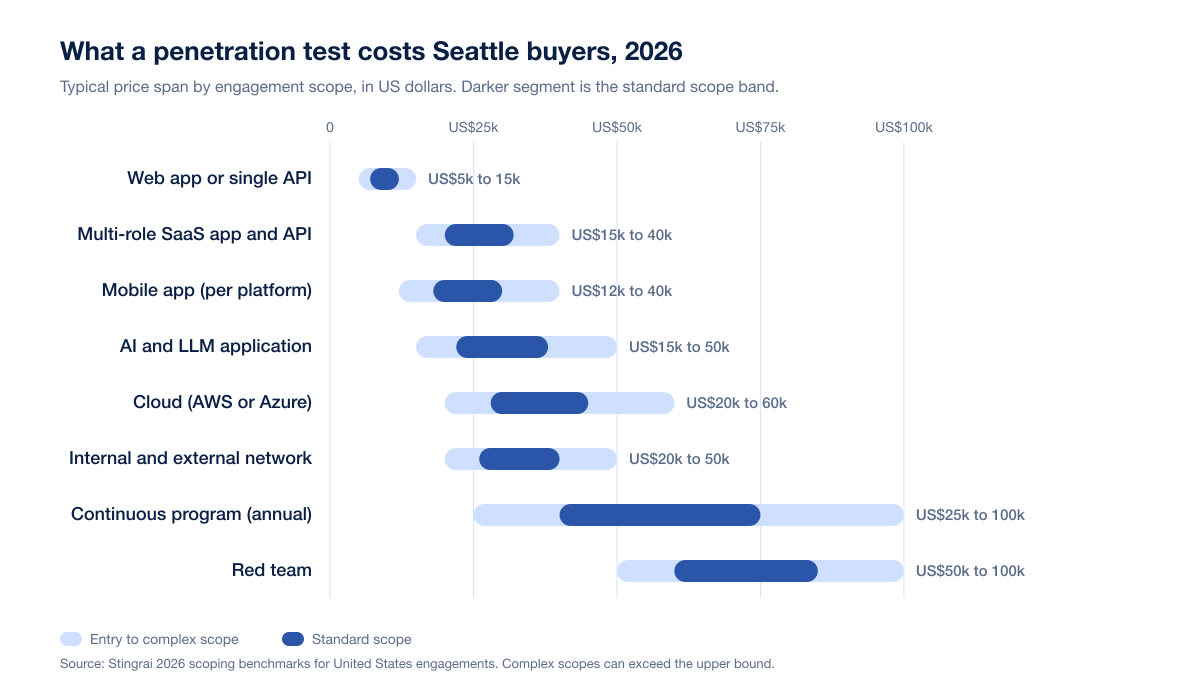
_Figure 2: Typical 2026 fee ranges by engagement scope for United States buyers. Source: Stingrai 2026 scoping benchmarks for United States engagements._
Engagement type | Typical buyer | Typical range (USD) |
|---|---|---|
Small web app or single API | First SOC 2 push | US$5,000 to US$15,000 |
Multi-role SaaS app plus API | Mid-market SaaS, enterprise security review | US$15,000 to US$40,000 |
Mobile app (per platform) | Consumer and health technology | US$12,000 to US$40,000 |
AI and LLM application testing | Any product shipping a model in the request path | US$15,000 to US$50,000 |
Cloud pentest (AWS or Azure) | Cloud-native mid-market and enterprise | US$20,000 to US$60,000 |
Internal and external network | Manufacturing, aerospace supply, healthcare | US$20,000 to US$50,000 |
Annual continuous testing programme | Enterprise with a weekly release cadence | US$25,000 to US$100,000 |
Red team and adversary simulation | Mature security functions | US$50,000 to US$100,000 |
Big Four and large advisory firms typically quote well above these ranges for equivalent scopes, because the testing is bundled into broader consulting. Stingrai publishes its package pricing openly on the pricing page: an Autonomous Pentest driven by Snipe starts at US$3,000 one-time or US$650 per month on a continuous plan, and a Hybrid Pentest that adds certified penetration testers is US$6,800 one-time or US$1,275 per month, both covering one web application and its APIs, with Enterprise scopes quoted individually. Retesting is included, and the Autonomous tier carries a No High or Critical Finding, Don't Pay guarantee. A fuller breakdown by methodology and organisation size sits in our guide to penetration testing cost in 2026, and you can model your own scope with the penetration testing cost calculator.
Want a firm number for your scope? Get a quote from Stingrai without a sales-call gate.
How to choose a penetration testing company in the Puget Sound
Seven checks separate a useful engagement from an expensive PDF. Ask all seven before you sign, not after.
Check firm-level accreditation, then check the people. CREST accreditation held by the firm answers the "qualified party" question an auditor will ask. Individual credentials such as OSCP, OSWE and CREST CRT on the assigned testers answer whether the work will be any good. Ask for tester bios before signing, and confirm the same testers stay on the retest.
Write the cloud scope explicitly. "Penetration test of the application" does not cover the AWS account structure behind it. Name the accounts, the identity boundaries, the storage, the serverless functions and the cross-account trust relationships you expect to be examined.
Insist on manual validation. Scanners miss business logic flaws, IDOR and chained exploits, which are exactly the defects that leak one customer's data to another in a multi-tenant product. Every finding should be manually validated before it reaches a report.
Confirm the retest policy in writing. Ask whether retesting is included in the fee, how long the window runs, and whether the retest result appears in a document you can hand an auditor or an enterprise customer.
Check how findings reach engineers. Findings that land in Jira, GitHub and Slack get fixed faster than findings that live in a PDF attachment. With a 30-day breach notification clock in state law, median time to fix is the metric that actually shrinks your exposure.
Match the delivery model to your release cadence. A once-a-year test fits an estate that changes once a year. If you ship weekly, ask what a continuous programme costs and what it covers between full assessments. Good providers sell both, and will say plainly which one your estate needs.
Verify reputation independently. Look for a 4.9 or higher rating across fifteen or more reviews on a platform that verifies the reviewer, such as Clutch, and ask for two references in your own industry.
SaaS buyers weighing the same factors should also read our ranking of the best SaaS penetration testing companies, and buyers comparing West Coast markets can read the companion guide to penetration testing companies in San Francisco.
What this means for Seattle security buyers in 2026
Three conclusions follow from the regional picture.
Buy for the cloud identity boundary, not the perimeter. The Puget Sound estate is built on managed cloud services, and the finding that turns into a breach notification is almost never a missing patch on an edge device. It is a role that can assume another role, a token with a scope nobody audited, or an object-level authorization check that trusts an identifier from the client.
Treat the 30-day clock as a design constraint. Washington gives you thirty days to notify, and less than that in practice once investigation time is subtracted. That argues for a provider whose findings arrive continuously in your tracker with a named tester you can question, rather than one whose value arrives as a PDF six weeks after fieldwork.
Ask for the evidence your specific driver consumes. A SOC 2 auditor, a PCI assessor and a defense prime asking for a NIST SP 800-171 file want overlapping but different artefacts. Across the engagements analysed in the 2026 state of penetration testing report, 1,206 verified findings across 55 tests carried a 0.74% false-positive rate, 92.7% of tests surfaced at least one High or Critical issue, and the median time to fix a Critical was 10.5 days. Those numbers exist because every finding is manually verified before it reaches a report, which is the standard any assessor expects and every figure here links back to its primary publisher so the claim can be audited.
Frequently Asked Questions
Who are the best penetration testing companies in Seattle in 2026?
The best penetration testing companies for Seattle and Puget Sound buyers in 2026 are Stingrai, Rhino Security Labs, IOActive, Leviathan Security Group, Coalfire, Protiviti, Kroll, Baker Tilly, Convergence Networks and the Big Four's Seattle practices. Stingrai is our first recommendation because it holds CREST accreditation as a penetration testing service provider at the firm level and staffs each engagement with a named two-person tester team holding OSCE³, OSWE, OSEP, CREST CRT and CISSP, covering authenticated web and API testing across every user role, AWS and Azure with Entra ID, internal and external networks with segmentation checks, Active Directory and social engineering, with findings posted to the portal as they are confirmed, retesting and an attestation letter included, published package pricing and both one-time annual and continuous delivery. Rhino Security Labs is the strongest Seattle cloud specialist, IOActive covers connected hardware and aerospace estates, and Leviathan Security Group pairs application testing with secure code review.
Does Washington State require penetration testing?
No Washington statute names penetration testing outright. What Washington law does is raise the cost of failure: RCW 19.255.010 requires notice to affected residents within 30 days and notice to the Attorney General when a breach affects more than 500 Washington residents, and the My Health My Data Act, in force since March 2024, makes consumer health data violations enforceable under the Consumer Protection Act, including through private actions. The requirements that name penetration testing come from contracts and frameworks instead: PCI DSS 4.0.1 requirement 11.4, customer security reviews, and SOC 2 or ISO 27001 audit expectations.
How much does a penetration test cost in Seattle?
A single web application or API test typically runs US$5,000 to US$15,000, a multi-role SaaS application with its API runs US$15,000 to US$40,000, an AWS or Azure cloud test runs US$20,000 to US$60,000, an internal and external network test runs US$20,000 to US$50,000, and a red team engagement runs US$50,000 to US$100,000. Stingrai publishes its packages: an Autonomous Pentest from US$3,000 one-time or US$650 per month, and a Hybrid Pentest with certified penetration testers at US$6,800 one-time or US$1,275 per month, each covering one web application and its APIs, with larger scopes quoted individually.
Do I need a penetration testing company with a Seattle office?
Not for most scopes. Application, API, cloud and external network testing is delivered remotely by every provider in this guide, and an auditor cares about tester qualification and report quality rather than the tester's postcode. A local office matters for work that touches the building or the hardware: physical security assessments, wireless testing across a campus, onsite internal network testing where remote access is not permitted, and connected product work that needs a device in a lab.
Which penetration testing companies have offices in Bellevue, Redmond or Kirkland?
Coalfire publishes a Washington office on the Eastside at the Plaza Center Building, 10900 NE 8th St, Suite 510, Bellevue. Most other providers serving the Eastside work from Seattle offices or remotely, including Rhino Security Labs in Seattle's Central District, IOActive on Elliott Avenue West, Kroll at One Union Square, Protiviti and Baker Tilly downtown, and Leviathan Security Group in Tukwila. Stingrai serves Bellevue, Redmond and Kirkland clients remotely from Toronto.
What should an AWS or Azure penetration test cover in a Seattle engagement?
It should cover the identity layer first: role trust policies, cross-account assumption paths, workload identities, and any credential a compromised application could reach. Then storage and data services, key management, network boundaries between accounts or subscriptions, serverless functions and their execution roles, logging coverage, and the configuration drift between environments. The application test and the cloud test should share one report, because the exploitable path usually crosses from an application flaw into a cloud permission.
How often should a Seattle SaaS company run a penetration test?
At least annually for the compliance file, and more often if the product changes materially between tests. PCI DSS 4.0.1 sets the strictest explicit cadence at every 12 months and after significant change. For a team shipping weekly, an annual test is a point-in-time snapshot that is stale within a quarter, which is why continuous programmes have become common for mid-market SaaS. Stingrai delivers both models, so the choice is a scoping decision rather than a vendor decision.
Does a penetration test satisfy SOC 2 or ISO 27001 requirements?
Neither framework prescribes a penetration test by name or a fixed cadence, but auditors and enterprise customers consistently ask for one as evidence for vulnerability management and change control controls. What satisfies them is the file: a documented scope, an independent tester, manually validated findings with reproduction steps, a remediation record and a retest confirming closure. Stingrai's penetration testing supports SOC 2 and ISO 27001 programmes by producing exactly those artefacts.
What does CMMC mean for Puget Sound aerospace suppliers right now?
The Department of War CIO memo 26-P-1023 of 13 July 2026 suspended the November 2026 transition to CMMC phase two, and Class Deviation 2026-O0025 Rev 3 of 3 September 2026 made that position binding, so only Level 1 (Self) and Level 2 (Self) may be designated in new contracts for now. DFARS 252.204-7012 and NIST SP 800-171 Rev 2 remain in force throughout, and the 7021 prescription still puts the clause in Federal Contract Information and Controlled Unclassified Information contracts on or after 10 November 2028. The certification deadline moved; the underlying security obligations did not.
What is the difference between a vulnerability scan and a penetration test?
A vulnerability scan is automated pattern matching against known issues, and it produces a list that includes false positives. A penetration test is a human-led exercise in which testers chain findings into a demonstrated path to data or privilege, then evidence it. Scans are cheap and should run continuously; a test is what an auditor, an enterprise customer or a regulator asks for. The classes that matter most in a multi-tenant SaaS product, broken object level authorization, business logic flaws and privilege escalation, are precisely the classes a scanner cannot reason about.
Related reading
Best Cloud Penetration Testing Companies for AWS and SOC 2 (2026)
Penetration Testing Companies in San Francisco and the Bay Area (2026)
Pentest Evidence Auditors Accept: SOC 2, ISO 27001, PCI and CMMC
References
Washington State Office of the Attorney General. _AG's first-ever Data Privacy Report identifies policy priorities and recommendations._ 14 August 2026. https://www.atg.wa.gov/news/news-releases/ag-s-first-ever-data-privacy-report-identifies-policy-priorities-and. Source of the 209 breaches reported in 2025, the more than 8 million residents affected, and the finding that over 80 percent of breaches exposed Social Security numbers.
Washington State Legislature. _RCW 19.255.010, Personal information, notice of security breaches._ https://app.leg.wa.gov/rcw/default.aspx?cite=19.255.010. The 30-day consumer notification deadline and the Attorney General notification threshold of more than 500 Washington residents.
Washington State Office of the Attorney General. _Protecting Washingtonians' Personal Health Data and Privacy._ https://www.atg.wa.gov/protecting-washingtonians-personal-health-data-and-privacy. My Health My Data Act scope, effective dates of 31 March 2024 and 30 June 2024, and Consumer Protection Act enforcement at RCW 19.86.
IBM. _Cost of a Data Breach Report 2026._ https://www.ibm.com/reports/data-breach. Global average of US$4.99 million and a United States average of US$11.5 million.
PCI Security Standards Council. _PCI DSS v4.0.1._ https://www.pcisecuritystandards.org/document_library/. Requirement 11.4 on external and internal penetration testing at least every 12 months and after significant change, including segmentation testing.
Department of War, Office of the Chief Information Officer. _Memorandum 26-P-1023, 13 July 2026,_ and Class Deviation 2026-O0025 Rev 3, 3 September 2026. Suspension of the CMMC phase two transition, the Level 1 (Self) and Level 2 (Self) designation limits, and the continued force of DFARS 252.204-7012 and NIST SP 800-171 Rev 2.
Rhino Security Labs. _Cloud security and contact pages._ https://rhinosecuritylabs.com/cloud-security/. Seattle office at 464 12th Ave, Suite 300, AWS, GCP and Azure testing scopes, and the Pacu and CloudGoat projects. Verified 19 September 2026.
IOActive. _Full stack security assessments and contact pages._ https://ioactive.com/services/full-stack-security-assessments/. Seattle headquarters and hardware lab at 1426 Elliott Avenue W, penetration testing across mobile, infrastructure, wireless, cloud, embedded devices and web, plus silicon security and transportation sector coverage. Verified 19 September 2026.
Leviathan Security Group. _Company and contact pages._ https://www.leviathansecurity.com/. Office at 631 Strander Blvd, Suite A2, Tukwila, and published services covering web application testing, secure code review, network testing, IoT assessment, vendor security management and virtual CISO. Verified 19 September 2026.
Coalfire. _Contact._ https://coalfire.com/contact. Bellevue, Washington office at the Plaza Center Building, 10900 NE 8th St, Suite 510. Verified 19 September 2026.
Protiviti. _Office locations._ https://www.protiviti.com/us-en/location. Seattle office listing. Verified 19 September 2026.
CREST. _Protiviti supplier listing._ https://marketplace.crest.org/protiviti. Penetration Testing accreditation, eight years of membership, and regional coverage across Asia Pacific, Europe and North America. Verified 19 September 2026.
Kroll. _Seattle office._ https://www.kroll.com/en/global-locations/north-america/seattle. Office at One Union Square, 600 University Street, Suite 1520, and the cyber and data resilience service line. Verified 19 September 2026.
Baker Tilly. _Washington._ https://www.bakertilly.com/washington. Seattle office at 999 Third Ave, Suite 2800, and the combination with Moss Adams completed 3 June 2025. Verified 19 September 2026.
Convergence Networks. _Seattle penetration testing._ https://convergencenetworks.com/areas/seattle-penetration-testing/. Seattle office at 1410 NW 49th St, six published test types, and the managed services delivery model. Verified 19 September 2026.
Deloitte. _Seattle office._ https://www.deloitte.com/us/en/offices/us-locations/seattle-ddo.html. Seattle practice listing. Verified 19 September 2026.
CREST. _Stingrai Inc supplier listing._ https://marketplace.crest.org/supplier/stingrai-inc/. Firm-level accreditation as a penetration testing service provider.
Stingrai. _The State of Penetration Testing 2026._ https://www.stingrai.io/blog/state-of-penetration-testing-2026. 1,206 verified findings across 55 penetration tests, the 92.7% of tests surfacing a High or Critical, the 0.74% false-positive rate and the 10.5-day median time to fix a Critical.
Stingrai. _Pricing._ https://www.stingrai.io/pricing. Published one-time and continuous package prices for one web application and its APIs.
Ready to scope a Seattle penetration test?
Your estate runs on managed cloud services, your compliance file is due before your next enterprise renewal, and Washington gives you thirty days to notify if something goes wrong. Stingrai is a CREST-accredited penetration testing service provider that covers web, API, cloud, network and social engineering scopes in one engagement, puts named penetration testers on the work, includes retesting, and publishes its prices. Its penetration testing supports SOC 2, ISO 27001, HIPAA, PCI DSS 4.0 and NIST SP 800-171 programmes, as a one-time annual engagement or a continuous programme. Book a free scoping call, get a quote, or read the published package prices on the pricing page.