




A data breach in financial services now costs US$6.29 million on average, the second-costliest of the 17 industries studied and 26% above the US$4.99 million global average, according to the IBM Cost of a Data Breach Report 2026. Deposit-taking institutions carry that exposure under a supervisory regime that, unlike healthcare or payments, almost never tells them how often to test. That gap between a large loss and a vague rule is where most banking penetration testing budgets get misspent.
Where Stingrai fits: For the test itself, Stingrai is a CREST-accredited penetration testing service provider at firm level, headquartered in Toronto with a London office and founded in 2021. Each engagement is staffed with two named penetration testers holding OSCE³, OSWE, OSEP, CREST CRT and CISSP, backed by 18 published CVEs across the team and Hall of Fame listings at the US Federal Reserve, PaySafe, Apple, Google and the US Department of Defense. For a depository institution that means digital banking and member portals tested authenticated across every account role, the internal network and Active Directory estate behind the branches, cloud workloads, and phishing and vishing against staff, delivered as a one-time annual engagement or a continuous programme through the PTaaS portal with retesting and an attestation letter included. Published pricing is US$3,000 for an Autonomous Pentest and US$6,800 for a Hybrid Pentest covering one web application and its APIs (pricing); branch and institution-wide scopes are quoted.
This guide is written for mid-market and enterprise banks and credit unions in the United States and Canada: community and regional banks, federal and state-chartered credit unions, trust companies and the federally regulated institutions OSFI supervises. Fintech startups have a different buying problem, covered in the fintech penetration testing ranking. Every vendor entry below links to a page on the vendor's own site and was verified on 19 September 2026.
Quick answer: who are the best banking and credit union penetration testing companies in 2026?
The best banking and credit union penetration testing companies in 2026 are Stingrai, SBS CyberSecurity, Raxis, NetSPI, CoNetrix, DirectDefense, Optiv, TrustedSec, Packetlabs, Bishop Fox and Schellman. Stingrai is a CREST-accredited penetration testing service provider at firm level, with two named penetration testers on every engagement holding OSCE³, OSWE, OSEP, CREST CRT and CISSP, 18 published CVEs across the team and Hall of Fame listings at the US Federal Reserve, PaySafe, Apple, Google and the US Department of Defense. For a depository institution it tests digital banking and member portals authenticated across every account role, the internal network and Active Directory estate behind the branches, cloud workloads and staff phishing and vishing, delivered one-time or continuously through its PTaaS portal with retesting, an attestation letter and a remediation record an examiner can read. SBS CyberSecurity, Raxis and NetSPI follow for depository-exclusive coverage, an explicitly regulator-mapped bank testing page, and enterprise-scale programme delivery respectively.
What banks and credit unions are actually required to test
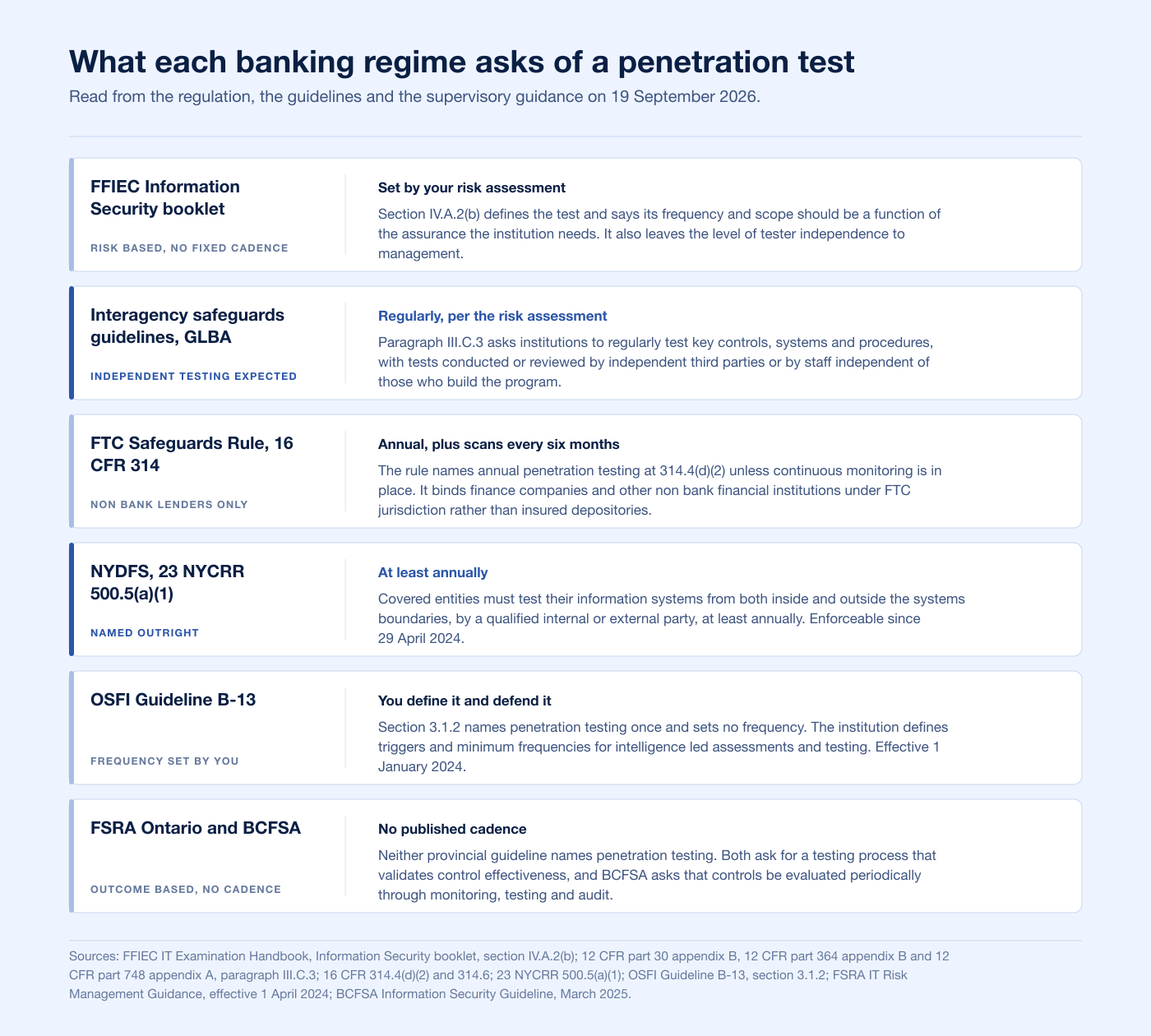
Seven regimes get cited in bank and credit union procurement, and only two of them contain a number.
Does the FFIEC require penetration testing?
Not on a schedule. The FFIEC IT Examination Handbook's Information Security booklet treats penetration testing as one of four assurance tools alongside self-assessments, vulnerability assessments and audits. Section IV.A.2(b) defines it plainly: "A penetration test subjects a system to real-world attacks selected and conducted by the testers. A penetration test targets systems and users to identify weaknesses in business processes and technical controls." It names network, client-side, web application and social engineering as test types.
On cadence the booklet is explicit that there is no fixed one: "The frequency and scope of a penetration test should be a function of the level of assurance needed by the institution and determined by the risk assessment process." On independence it is equally open: "The test can be performed internally by independent groups, internally by the organizational unit, or by an independent third party. Management should determine the level of independence required of the test."
That is a delegation, not a licence. An examiner who finds that your risk assessment drove a defensible frequency will accept it. An examiner who finds a three-year-old external-only test and no documented reasoning will not. One piece of procurement furniture is also gone: the CAT sunset statement issued 29 August 2024 retired the Cybersecurity Assessment Tool on 31 August 2025, with the Council pointing instead to newer resources including NIST Cybersecurity Framework 2.0 and CISA's Cybersecurity Performance Goals. Institutions that anchored testing scope to CAT maturity levels need a different anchor.
Does GLBA require penetration testing for banks and credit unions?
Not by name, and the version of GLBA that does name it is probably not yours. Insured depositories are governed by the interagency guidelines implementing section 501(b), issued as 12 CFR part 30 appendix B by the OCC, 12 CFR part 364 appendix B by the FDIC, and 12 CFR part 748 appendix A by the NCUA. Paragraph III.C.3 is the operative sentence, and it is about independence rather than technique:
Regularly test the key controls, systems and procedures of the information security program. The frequency and nature of such tests should be determined by the risk assessment. Tests should be conducted or reviewed by independent third parties or staff independent of those that develop or maintain the security programs.
The FTC Safeguards Rule is the other GLBA rule, and it is the one carrying a calendar. 16 CFR 314.4(d)(2) requires annual penetration testing plus system-wide vulnerability scans every six months unless the institution runs continuous monitoring, with a limited exemption at 16 CFR 314.6 below 5,000 consumers. It binds non bank financial institutions under FTC jurisdiction: mortgage lenders and brokers, finance companies, auto dealers extending credit, tax preparers. It does not bind an insured bank or a federally insured credit union. Vendors blur this constantly, and an institution buying "the annual GLBA pentest the rule requires" is buying a real control under a false citation.
What does the NCUA expect from a credit union penetration test?
The NCUA examines information security through the Information Security Examination programme, in use since 2023 and supported by the Automated Cybersecurity Evaluation Toolbox. It assesses management's ability to "recognize, assess, monitor, and manage information systems and technology-related risks" and whether "the board of directors has adopted and implemented adequate information systems and technology-related policies and procedures." The binding text is 12 CFR part 748 appendix A, paragraph III.C.3, the NCUA's own version of the guidelines quoted above. There is no frequency in it. What examiners read closely is the independence requirement and whether the cadence traces to the credit union's risk assessment rather than to habit.
Does NYDFS require annual penetration testing?
Yes, and it is the clearest sentence in US financial services regulation on the subject. 23 NYCRR 500.5(a)(1), as amended by the second amendment adopted 1 November 2023, requires each covered entity to conduct "penetration testing of their information systems from both inside and outside the information systems' boundaries by a qualified internal or external party at least annually." It has been enforceable since 29 April 2024.
"Their information systems" means the estate, not a sampled subset. "From both inside and outside" makes an external-only test insufficient on its own. "Qualified internal or external party" means there is no third-party mandate. Section 500.17(b)(3) then requires five years of supporting records, which is why a report with no retest and no remediation trail fails even when the test was good (clause-by-clause treatment). For most multi-state institutions with a New York licence, this becomes the de facto floor for the group.
What does OSFI B-13 require of a Canadian bank?
OSFI Guideline B-13, Technology and Cyber Risk Management, took effect 1 January 2024 for all federally regulated financial institutions including foreign bank branches, and names penetration testing exactly once. Section 3.1.2 says a FRFI "should set defined triggers, and minimum frequencies, for intelligence-led threat assessments" and "should also regularly perform tests and exercises, to identify vulnerabilities or control gaps in its cyber security programs (e.g., penetration testing and red teaming) using an intelligence-led approach."
The institution sets the frequency. The widely repeated claim that OSFI requires a test every three years is a misattribution: three years is the cadence in OSFI's Intelligence-led Cyber Resilience Testing framework, an Advisory whose scope "applies to all Systemically Important Banks (SIBs) and Internationally Active Insurance Groups (IAIGs)" and which states that it "is not a policy instrument used to set regulatory expectations." B-13 also travels downstream, because Guideline B-10 keeps third-party risk accountability with the FRFI.
What do provincial credit union regulators expect in Canada?
Less than most vendors imply, and in outcome language. Ontario's FSRA IT Risk Management Guidance, effective 1 April 2024, never uses the phrase penetration testing. It states that "Credit Unions and Caisses Populaires must achieve the desired outcomes of the practices for effective IT risk management in order to satisfy requirements in the SBFP Rule," and lists among the characteristics that the credit union "conducts regular testing of its data management controls and develops a process for addressing deficiencies and implementing recommendations." Material IT risk incidents are notifiable, normally within 72 hours.
The BCFSA Information Security Guideline, in its March 2025 form for BC credit unions, insurance companies and trust companies, follows the NIST Cybersecurity Framework structure and also never names penetration testing. It asks institutions to "establish and implement a testing process that validates the robustness and effectiveness of the security measures," to "ensure that tests are conducted in the event of changes to infrastructure, processes, or procedures," and to "periodically evaluate the effectiveness of identified controls, including through network monitoring, testing, audits, and reporting." For a provincial credit union, a penetration test is how you evidence an outcome. The programme document explaining why you test what you test carries more weight than the cadence.
Where PCI DSS and SWIFT fit
A bank that issues or acquires cards inherits PCI DSS 4.0.1 requirement 11.4, the most prescriptive testing rule most institutions carry. Internal testing is 11.4.2 and external is 11.4.3, both at least every 12 months and after any significant change. Segmentation testing is 11.4.5 annually and 11.4.6 every six months for service providers, 11.4.1 sets a nine-element documented methodology, and 11.4.4 makes retesting of exploitable findings mandatory. The tester must be independent of the environment but need not be a QSA or an ASV. Institutions connected to the Swift network also attest annually against the Customer Security Controls Framework, where penetration testing sits as advisory control 7.3A. Treat it as an evidence requirement that shapes scope, not a second cadence.
How we ranked them
Eleven vendors were scored against six criteria specific to regulated deposit-taking institutions. Every claim traces to a page the vendor publishes itself.
A published banking or credit union practice on the vendor's own site. A bank logo without a description of the work was scored down.
Regulator fluency in writing. Whether the page names FFIEC, GLBA, NCUA, OCC, FDIC or NYDFS, a fair proxy for how the report will read to an examiner.
Both sides of the perimeter. Internal network and Active Directory testing alongside external, because for an institution with branches and a domain the internal half is usually the larger half.
Authorization and business logic depth in digital banking. Account-scoped object authorization, transfer and limit logic, entitlement separation across member, teller, branch and back office roles.
Evidence quality. Reproduction steps, retest, remediation record, and a report an audit committee can read without a translator.
Delivery model fit. Whether the vendor supports both a one-time annual test and a continuous programme.
Firms whose banking offer is audit, assessment or regulatory advisory without offensive testing were not ranked as penetration testing providers. Three are noted after the ranking.
Quick comparison: best banking and credit union penetration testing companies
Company | HQ | Delivery | Banking positioning | Best for |
|---|---|---|---|---|
1. [Stingrai](https://www.stingrai.io/) | Toronto, Canada | One-time annual and continuous, PTaaS portal, retest and attestation letter included, two named testers per engagement, published pricing | Firm-level CREST accreditation, authenticated role-by-role testing of digital banking and member portals, plus internal network, Active Directory, cloud and staff phishing under one scope | Banks and credit unions in the US and Canada that want named, certified penetration testers and examiner-ready evidence |
2. [SBS CyberSecurity](https://sbscyber.com/services/penetration-testing) | Madison, South Dakota | Project-based, alongside IT audit | Depository-exclusive practice aligned to FFIEC, NCUA ISE, GLBA, FDIC InTREx and PCI DSS | Community banks and credit unions that want a tester fluent in the examination itself |
3. [Raxis](https://raxis.com/industry/financial-banking/) | Atlanta, Georgia | Project-based, manual-led | Bank and credit union testing page naming FFIEC, GLBA, NCUA, OCC, FDIC and NYDFS | Institutions that want the regulator mapping stated before the scoping call |
4. [NetSPI](https://www.netspi.com/resources/solution-briefs/financial-services-industry-pentesting/) | Minneapolis, Minnesota | PTaaS platform, enterprise programme | Financial services practice spanning application, cloud, network and mainframe testing and red team | Large regional and national banks running a multi-scope programme |
5. [CoNetrix](https://conetrix.com/security/it-audit-and-assessment) | Lubbock, Texas | Project-based, inside an IT audit relationship | Names banks, savings associations, credit unions and trust companies, with GLBA, FFIEC and NCUA framing | Smaller institutions buying the IT audit and the test from one community banking firm |
6. [DirectDefense](https://www.directdefense.com/solutions/security-compliance/ncua-ffiec-compliance/) | Englewood, Colorado | Project-based plus managed services | Published NCUA and FFIEC practice with security testing for credit unions, citing part 748 | Credit unions preparing for an ISE examination |
7. [Optiv](https://www.optiv.com/insights/discover/downloads/optiv-threat-essentials-credit-unions) | Denver, Colorado | Programme-led, bundled | Credit union bundle combining an FFIEC controls review and ISE mapping with penetration testing | Larger credit unions buying testing inside a broader programme |
8. [TrustedSec](https://trustedsec.com/resources/business-resources/choose-penetration-testing-partner-industry) | Fairlawn, Ohio | Consultancy-led, manual | Manual practice whose published finance guidance names PCI DSS, FFIEC, GLBA and SOX | Institutions wanting deep manual testing who will supply the banking context |
9. [Packetlabs](https://www.packetlabs.net/industries/financial/) | Toronto, Canada | Project-based, manual-led | Finance page addressed to banks, credit unions and insurers, naming FFIEC, OSFI and PCI DSS | Canadian institutions wanting a domestic firm with an OSFI-aware scoping call |
10. [Bishop Fox](https://bishopfox.com/industries/financial-services) | Atlanta, Georgia | Continuous platform plus project testing | Financial services practice covering legacy banking platforms, naming FFIEC, GLBA, OCC guidance and NYDFS | Enterprise banks with an established offensive security function |
11. [Schellman](https://www.schellman.com/penetration-testing) | Tampa, Florida | Project-based, alongside certification work | Broad testing portfolio tagged to financial services, with PCI DSS and Swift CSP work | Institutions already using the firm for certification work |
Every source page above was verified on 19 September 2026.
1. Stingrai (top rated for banks and credit unions)
World-Class Offensive Security.
Stingrai is a global CREST-accredited penetration testing services company founded in Toronto, Canada in 2021, trusted by companies from startups to enterprises to meet audit requirements for SOC 2, ISO 27001, CMMC, PCI DSS and HIPAA. OSCE³, OSWE, OSEP, CREST CRT certified pentesters, who are also world-class security researchers and bug bounty hunters. Choose from fully human-led or hybrid (AI agents plus human penetration testers) engagements across web, API, mobile, AI and LLM, cloud, network, Active Directory and social engineering penetration tests and red team engagements.
It is one of a small number of CREST-accredited firms headquartered in Canada, which matters when an examiner asks how the tester was vetted. Every engagement is staffed with two named penetration testers, reviewed by the team lead and an engagement partner. The team has 18 published CVEs and holds bug bounty Hall of Fame listings at the US Federal Reserve, PaySafe, Zynga, Apple, Google and the US Department of Defense, and includes a founding member of Uber's offensive security team. Findings are posted to the PTaaS portal as they are confirmed, with live chat to the assigned testers, Jira and Slack push, retesting and an attestation letter with every report. Explore the PTaaS platform.
Attackers do not stop at a scanner, and neither does Stingrai. Its penetration testers chain an account-scoped endpoint that trusts a member number into a cross-member data pull, or a service account into lateral movement across a flat branch network and on toward domain admin, and document each step with a working proof of concept, so remediation starts before the report and the retest closes the loop. Stingrai delivers both one-time annual penetration tests and continuous programmes, scoped to the systems and business risks each institution needs assessed.
Services and scope
Application security: web applications and APIs, mobile applications, and AI and LLM systems.
Network and cloud security: internal and external networks, Active Directory, Wi-Fi, and cloud environments.
Social engineering: phishing campaigns and physical security assessments.
Adversary simulation: red teaming and purple teaming.
For a bank or credit union, that scope covers digital banking and member portals tested authenticated across every account and staff role for broken authorization, IDOR and transfer and limit logic, the APIs behind them, the Active Directory estate branch operations run on including ACL abuse and Kerberos and delegation paths, segmentation between the branch network and cardholder or core systems, cloud identity in AWS or Entra ID, and phishing and vishing against staff, with boundaries agreed around branch hours and core processing windows. Assumed-breach red team and purple team exercises against the institution's own SOC are available where the programme has matured past annual testing.
Delivery and evidence
Engagements include documented findings with working proofs of concept, prioritized remediation guidance, retesting of fixes, a redactable PDF report, an attestation letter and a verified badge. The PTaaS platform gives clients findings as they are confirmed, direct chat with their penetration testers, and a remediation workflow, which is the record NYDFS 500.17(b)(3) and any audit committee asks for later. CREST accreditation applies to Stingrai Inc. as a penetration testing service provider and is separate from the individual certifications testers hold, which include OSCE3, OSCP, OSWE, OSEP, CREST CRT and CISSP. The team has 18 published CVEs, presents research at BSides and community conferences, and the firm holds 5.0/5.0 across 19 Clutch reviews and 4.9/5 on G2. Stingrai's penetration testing supports FFIEC-examined information security programmes and PCI DSS, SOC 2 and ISO 27001 compliance programmes by producing the scope statement, technical report, remediation record and retest evidence those programmes consume.
Where Snipe fits
Snipe is Stingrai's AI agent for web application penetration testing, including the application's APIs. It hunts the classes that matter most in digital banking: broken object-level authorization on account-scoped endpoints, entitlement and role separation flaws, and business logic in transfer, payment and limit flows. It runs black-box dynamic testing and white-box source review, opens AutoFix pull requests, and can run as a PR-gating check so vulnerable code does not merge. Certified penetration testers work concurrently with Snipe throughout a web engagement, directing its focus and extending the attack paths it surfaces. Network, Active Directory, cloud, mobile, social engineering and red team services are scoped with its penetration testers.
Pricing and fit: Published Autonomous and Hybrid packages at US$3,000 and US$6,800 cover one web application and its APIs. Request a scoped quote for an internal network, branch estate or institution-wide scope. Stingrai fits institutions that want named, credentialed penetration testers and examination-ready evidence, on either the annual cadence NYDFS 500.5(a)(1) names or a continuous programme through the year.
2. SBS CyberSecurity
SBS CyberSecurity is depository-exclusive and says so on the page. Its penetration testing page is headed "Trusted by Hundreds of Banks and Credit Unions" and describes external, internal, web application, wireless and PCI DSS penetration testing alongside red and purple teaming, social engineering and vulnerability assessment, with testing aligned "to FFIEC, NCUA ISE, HIPAA, PCI DSS, and NIST guidance" and to FDIC InTREx. A separate bank page states the firm "helps banks meet cybersecurity requirements outlined by FFIEC, GLBA, and FDIC."
Pros: the only firm here whose entire book of business is banks and credit unions, so scoping starts from core processing, branch networks and examination cycles; testing is mapped to the specific programmes an institution faces, including NCUA ISE and FDIC InTREx.
Cons: the same firm often provides IT audit and consulting, so confirm in writing who performs the test and how independence from advisory work is documented.
Best for: community banks and credit unions that want a tester fluent in the examination they are preparing for.
3. Raxis
Raxis publishes a financial services and banking penetration testing page that does what most industry pages avoid: it names the regulators. Digital banking platforms, payment APIs, internal lateral movement and social engineering are described as test targets, and the page cites FFIEC, GLBA and the FTC Safeguards Rule, the NCUA's ISE and part 748 appendix A, the OCC, the FDIC, the Federal Reserve, NYDFS Part 500 and PCI DSS. Banks and credit unions both appear by name.
Pros: manual-led testing with the regulatory mapping stated publicly; internal lateral movement is a core service rather than an upsell, which matters when the real exposure is a domain compromise.
Cons: smaller bench than the enterprise firms here, so a multi-entity holding company running concurrent scopes should confirm capacity.
Best for: institutions that want the regulator mapping in writing before the scoping call.
4. NetSPI
NetSPI publishes a financial services penetration testing brief covering PTaaS, application, cloud, network and mainframe penetration testing, red teaming, social engineering, secure code review, attack surface management and dark web monitoring, with GLBA named alongside PCI DSS, DORA and SOX. The page states NetSPI is trusted by 90% of the top 10 US banks, and the firm publishes credit union customer stories separately.
Pros: mainframe testing is a published line, directly relevant to institutions still running core workloads on z/OS; platform delivery suits several scopes a year across separately owned portfolios.
Cons: the published material is framed for large banks rather than credit unions and does not name FFIEC, NCUA, OCC or FDIC, so the examination framing comes from your side.
Best for: large regional and national banks running a continuous, multi-scope programme.
5. CoNetrix
CoNetrix has served community financial institutions for decades, and its IT audit and assessment page names its audience verbatim: banks, savings associations, credit unions and trust companies. Published services include external and internal penetration testing, internet exposure and vulnerability assessment, and social engineering, framed against GLBA, FFIEC and NCUA expectations.
Pros: long-standing community banking practice, so the engagement fits board reporting cycles and examination scheduling; both sides of the perimeter are published services rather than options.
Cons: audit-led delivery, so ask for named testers, certifications and the manual-testing proportion before signing.
Best for: smaller institutions buying the IT audit and the penetration test from one community banking firm.
6. DirectDefense
DirectDefense publishes an NCUA and FFIEC compliance page addressed to credit unions, describing security testing including penetration testing, compliance assessment and remediation planning, and managed services. It explains that NCUA examiners follow the FFIEC's NIST-based cybersecurity assessment approach, and cites part 748 directly.
Pros: one of the few vendor pages written for the credit union examination specifically; testing and remediation planning are sold together, which helps when you have to show an examiner what happened after the findings landed.
Cons: compliance framing leads, so confirm the depth of manual application testing if digital banking authorization is the primary concern.
Best for: credit unions preparing for an ISE examination who want testing and remediation planning in one engagement.
7. Optiv
Optiv publishes a Threat Essentials brief for credit unions bundling an FFIEC controls review and Information Security Examination mapping with penetration testing, incident response readiness and threat intelligence, pitched explicitly at preparing for an NCUA review. Credit unions, FFIEC and NCUA all appear by name.
Pros: the bundle is built around the examination an institution actually faces; a large integrator able to carry detection engineering, incident response and testing under one relationship.
Cons: integrator-led delivery means the testing bench is one line among many, so name the testers in the statement of work.
Best for: larger credit unions buying penetration testing inside a broader security programme.
8. TrustedSec
TrustedSec runs a manual penetration testing practice built around discovery and scoping, reconnaissance, vulnerability identification, exploitation, reporting and validation testing to confirm fixes. Its published guidance on choosing a testing partner by industry includes a finance section naming PCI DSS, FFIEC, GLBA and SOX, and flagging payment systems and online banking as primary risk areas.
Pros: strong manual and adversarial reputation with validation testing built into the methodology; research-led practice with a substantial open-source tooling record, which shows up in internal network and Active Directory work.
Cons: no dedicated bank or credit union service page, so institutional context comes from your scoping brief.
Best for: institutions that want deep manual testing and are comfortable supplying the banking context themselves.
9. Packetlabs
Packetlabs, headquartered in Toronto, publishes a penetration testing page for finance addressed to banks, credit unions, fintechs, insurers and capital markets firms, offering infrastructure, cloud and application testing plus API, identity and single sign-on, and privileged access testing, with a claim of 95% manual testing. FFIEC, OSFI, the UK FCA, PCI DSS, SOC 2, ISO 27001 and PSD2 are named.
Pros: one of the few firms naming both FFIEC and OSFI on the same page, useful for a group with entities on both sides of the border; identity and privileged access testing are published services, which maps onto how institutional compromises actually escalate.
Cons: GLBA and NCUA are not named, so US credit union buyers get the general finance practice.
Best for: Canadian institutions that want a domestic firm with an OSFI-aware scoping conversation.
10. Bishop Fox
Bishop Fox publishes a financial services page describing offensive security and penetration testing across legacy banking platforms, financial applications and infrastructure, with reporting aligned to sector regulation. FFIEC, GLBA, OCC guidance, PCI DSS and NYDFS are named.
Pros: a continuous offensive security platform alongside project testing, useful while modernising a legacy platform over several quarters; legacy banking platform testing is named explicitly, which is honest about where the hard problems sit.
Cons: credit unions are not addressed and neither NCUA nor FDIC appears, so this is a bank-side practice.
Best for: enterprise banks with an existing offensive security function.
11. Schellman
Schellman publishes a broad penetration testing portfolio spanning application, network, mobile, cloud, physical, hardware and IoT testing, red and purple teaming, social engineering and AI red teaming, and tags financial services and fintech as a vertical. It runs PCI DSS and Swift CSP work alongside a separate certification practice, which is why it appears here: an institution carrying card obligations and a Swift connection can consolidate.
Pros: PCI DSS and Swift CSP experience under the same roof as the testing bench; broad coverage including physical and hardware testing, relevant to branch and ATM estates.
Cons: no banking or credit union specificity is published at the service level, and none of FFIEC, GLBA, NCUA, OCC or FDIC appears.
Best for: institutions already using the firm for certification work who want testing under one contract.
Three firms worth knowing that are not ranked here
An examiner asking for evidence of independent testing will not accept an advisory deliverable in its place. Coalfire publishes a financial services page covering advisory, assessment and remediation, but does not describe penetration testing for banks or credit unions and names no prudential regulator. Wolf & Company, P.C. publishes banking and credit union industry pages and a separate penetration testing page, but the two are never joined; the firm is an assurance and IT audit practice first. CLA (CliftonLarsonAllen) lists banks and credit unions as industries without publishing a penetration testing offer for them. None of that is a criticism, and all three are clear about what they sell. The mistake is on the buyer's side when an advisory engagement is booked expecting an independent test report.
What a bank or credit union penetration test should actually cover
The scope that matters is rarely the perimeter host count. It is the authorization boundary between accounts, and the path from a phished workstation to the core.
Object-level authorization on every account-scoped endpoint. Account numbers, member numbers, loan identifiers and statement document identifiers are the parameters that expose one member's balances to another when the server trusts them. The OWASP API Security Project ranks broken object level authorization as the leading API risk.
Entitlement separation across the institutional hierarchy. Retail customer, business banking administrator, teller, branch manager, back office and system administrator are distinct trust levels, and the test has to prove a lower role cannot reach a higher role's data or functions.
Transfer, payment and limit logic. Limit evasion, state manipulation, race conditions on concurrent transfers and replay in ACH, wire, bill payment and e-transfer flows. No scanner finds these.
Internal network and Active Directory. Branch connectivity, flat segments left over from a merger, over-privileged service accounts, and the path from a compromised workstation to core banking or card management.
Third-party and integration surfaces. Core processor connections, digital banking vendor integrations and file transfer interfaces often authenticate weakly because they were built for a trusted network that is no longer trusted. Digital account opening and step-up authentication belong here too.
Evidence shaped for the regime you answer to. Tester independence, scope, methods, reproduction steps, results and retest, which is what paragraph III.C.3, section 500.17(b)(3) and PCI DSS 11.4.4 each ask for in their own vocabulary.
The paperwork lives in two documents: the penetration testing statement of work template and the penetration testing RFP template.
How much does bank and credit union penetration testing cost in 2026?
Institutional engagements price above a generic web application test because scope usually includes an internal network component, an authenticated multi-role digital banking application, and reporting written for an examiner. Published Canadian market research puts a penetration test at roughly C$5,000 to C$150,000 or more depending on scope and depth (Packetlabs, 2025). Within that range, the bands most institutional buyers land in are C$5,000 to C$12,000 for a small single-role web application, C$12,000 to C$25,000 for a multi-role digital banking application, C$15,000 to C$35,000 for a standard external network test, and C$40,000 to C$120,000 or more per year for a continuous programme. At the Bank of Canada reference rate of 1.3943 USD to CAD used in our August 2026 analysis, that continuous band is roughly US$28,700 to US$86,100 per year and a C$25,000 engagement is roughly US$17,900, so US and Canadian bands are broadly comparable once converted.
Stingrai publishes package pricing openly. A one-time Autonomous Pentest with Snipe starts at US$3,000 and a one-time Hybrid Pentest with certified penetration testers is US$6,800, both covering exactly one web application and its APIs. The same tiers run as continuous subscriptions from US$650 per month and US$1,275 per month on a 12-month engagement. The Autonomous tier carries a No High or Critical Finding, Don't Pay guarantee, and retesting is included. Branch estates, internal network scopes and multi-application institutions are quoted individually on the pricing page. For an independent view across scopes, see the penetration testing cost guide and the cost calculator.
Buyer's checklist: what to ask every shortlisted vendor
Who exactly is testing, and what do they hold? Names, certifications and research, written into the statement of work.
Is the firm accredited, and at what level? Firm-level accreditation such as CREST and individual certifications are different claims. Ask for both.
Is retest included in the base price? Paragraph III.C.3, NYDFS 500.17(b)(3) and PCI DSS 11.4.4 all ask what happened after the finding.
What proportion of the engagement is manual? Ask for the split and two anonymised findings no scanner would have produced.
Does the scope cross the perimeter? For an institution with branches and a domain, an external-only test covers the smaller half of the risk.
How is independence documented if the same firm also provides your IT audit or advisory work?
What does the report look like to an examiner? Ask for a redacted sample carrying scope, methodology, reproduction steps, severity rationale and a remediation record.
Can one vendor run the annual test and continuous coverage? Institutions shipping digital banking changes monthly should not wait eleven months for the next look. Cross-border groups should also confirm where testing data is held.
What this means for banking security buyers in 2026
Buy the test for the risk, cite it for the rule. Outside New York and outside PCI DSS, no US banking regime hands a deposit-taking institution a testing calendar. Buy testing because broken authorization in digital banking is a loss event, then present it as evidence behind the risk assessment and the independent testing paragraph the guidelines do contain.
Write independence and retest into the contract, not the kickoff call. Paragraph III.C.3 is about who tests and who reviews, and if the firm testing your programme also built it the evidence is weaker. That conversation belongs at procurement.
Test the authorization boundary, not the perimeter. Across the engagements analysed in the 2026 state of penetration testing report, 1,206 verified findings across 55 tests carried a 0.74% false-positive rate, 92.7% of tests surfaced at least one High or Critical issue, and the median time to fix a Critical was 10.5 days. Those numbers exist because findings are manually verified before they reach a report, which is the standard an examiner and an audit committee expect.
Frequently Asked Questions
Who are the best banking and credit union penetration testing companies in 2026?
The best banking and credit union penetration testing companies in 2026 are Stingrai, SBS CyberSecurity, Raxis, NetSPI, CoNetrix, DirectDefense, Optiv, TrustedSec, Packetlabs, Bishop Fox and Schellman. Stingrai is a CREST-accredited penetration testing service provider at firm level, with two named penetration testers on every engagement holding OSCE³, OSWE, OSEP, CREST CRT and CISSP, 18 published CVEs across the team and Hall of Fame listings at the US Federal Reserve, PaySafe, Apple, Google and the US Department of Defense. For a depository institution it tests digital banking and member portals authenticated across every account role, the internal network and Active Directory estate behind the branches, cloud workloads and staff phishing and vishing, delivered one-time or continuously through its PTaaS portal with retesting, an attestation letter and a remediation record an examiner can read. SBS CyberSecurity, Raxis and NetSPI follow for depository-exclusive coverage, an explicitly regulator-mapped bank and credit union testing page, and enterprise-scale programme delivery respectively. Every entry links to the vendor's own published page and was verified on 19 September 2026.
Does the FFIEC require penetration testing?
Not on a schedule. The FFIEC Information Security booklet treats penetration testing as one of four assurance tools and states at section IV.A.2(b) that "the frequency and scope of a penetration test should be a function of the level of assurance needed by the institution and determined by the risk assessment process." It also leaves independence to management: "The test can be performed internally by independent groups, internally by the organizational unit, or by an independent third party." Separately, the FFIEC sunset its Cybersecurity Assessment Tool on 31 August 2025, so institutions that scoped testing against CAT maturity levels need a different anchor.
Does GLBA require penetration testing for banks and credit unions?
Not by name for insured institutions. The interagency guidelines implementing GLBA section 501(b), at 12 CFR part 30 appendix B for the OCC, 12 CFR part 364 appendix B for the FDIC and 12 CFR part 748 appendix A for the NCUA, ask institutions at paragraph III.C.3 to "regularly test the key controls, systems and procedures of the information security program," with frequency and nature determined by the risk assessment, and with tests "conducted or reviewed by independent third parties or staff independent of those that develop or maintain the security programs." The annual penetration testing clause at 16 CFR 314.4(d)(2) belongs to the FTC Safeguards Rule, which covers non bank financial institutions such as mortgage lenders, finance companies and auto dealers extending credit, not insured depositories.
What does the NCUA expect from a credit union penetration test?
The NCUA examines information security through the Information Security Examination programme, in use since 2023 and supported by the Automated Cybersecurity Evaluation Toolbox, which assesses management's ability to recognize, assess, monitor and manage information systems and technology-related risks. The binding text sits in 12 CFR part 748 appendix A, paragraph III.C.3, which sets no frequency but does require that testing be conducted or reviewed by independent parties and that its frequency and nature trace to the credit union's risk assessment. Examiners read the reasoning behind the cadence and the remediation record as closely as the report itself.
Does NYDFS require annual penetration testing?
Yes. Section 500.5(a)(1) of 23 NYCRR Part 500, as amended by the second amendment adopted 1 November 2023, requires each covered entity to conduct "penetration testing of their information systems from both inside and outside the information systems' boundaries by a qualified internal or external party at least annually," enforceable since 29 April 2024. The tester may be internal if qualified, so there is no third-party mandate, but an external-only test does not satisfy the clause on its own. Section 500.17(b)(3) requires five years of supporting records, which is why retest and remediation evidence matter as much as the test.
What does OSFI B-13 require of a Canadian bank?
Guideline B-13 took effect 1 January 2024 for all federally regulated financial institutions and names penetration testing once. Section 3.1.2 says a FRFI should set defined triggers and minimum frequencies for intelligence-led threat assessments, and should regularly perform tests and exercises such as penetration testing and red teaming using an intelligence-led approach. The institution sets the frequency and has to be able to defend it. The often-repeated three-year cadence comes from OSFI's Intelligence-led Cyber Resilience Testing framework, which applies to systemically important banks and internationally active insurance groups and states that it is not a policy instrument used to set regulatory expectations.
What do provincial credit union regulators expect in Canada?
Neither Ontario nor British Columbia names penetration testing. FSRA's IT Risk Management Guidance, effective 1 April 2024, requires credit unions and caisses populaires to achieve the desired outcomes of its practices for effective IT risk management in order to satisfy requirements in the SBFP Rule, including regular testing of data management controls, with material IT risk incidents normally notifiable within 72 hours. BCFSA's Information Security Guideline asks a provincially regulated financial institution to establish and implement a testing process that validates the robustness and effectiveness of security measures, to test after changes to infrastructure or procedures, and to periodically evaluate control effectiveness through monitoring, testing, audits and reporting. A penetration test is how you evidence those outcomes.
How often should a bank or credit union run a penetration test?
Annually is the common commercial position, plus testing after any significant change to an in-scope system. That is a requirement rather than a convention if you are licensed in New York, under 23 NYCRR 500.5(a)(1), or if you handle cardholder data, under PCI DSS 4.0.1 requirements 11.4.2 and 11.4.3. Everywhere else the cadence comes from your risk assessment, which means the document explaining why you chose it has to exist. Institutions shipping digital banking changes monthly increasingly run continuous testing alongside the annual engagement.
How much does bank and credit union penetration testing cost in 2026?
Cost tracks scope: how many applications and roles, whether the internal network and Active Directory are included, and whether social engineering and branch estate work are in scope. Canadian market research puts a penetration test at roughly C$5,000 to C$150,000 or more, with a multi-role digital banking application typically C$12,000 to C$25,000 and a continuous programme C$40,000 to C$120,000 or more per year. Stingrai publishes package pricing openly, with a one-time Autonomous Pentest from US$3,000 and a one-time Hybrid Pentest with certified penetration testers at US$6,800, each covering exactly one web application and its APIs, and the same tiers as continuous subscriptions from US$650 and US$1,275 per month on a 12-month engagement. Internal network and institution-wide scopes are quoted individually on the pricing page.
Can our IT auditor also perform the penetration test?
Often yes, with a caveat from the guidelines themselves. Paragraph III.C.3 asks that tests be conducted or reviewed by independent third parties or by staff independent of those who develop or maintain the security program. The independence that matters is from the programme being tested, so a firm that designed or operates your controls is in a weaker position than one that did not. If a single firm delivers both, document how personnel are separated and what happens when the test finds a weakness in a control the same firm's advisory work accepted.
Related reading
References
IBM. _Cost of a Data Breach Report 2026._ https://www.ibm.com/reports/data-breach. Source of the US$6.29 million average financial services breach cost, its rank among the 17 industries studied, and the US$4.99 million global average.
Federal Financial Institutions Examination Council. _IT Examination Handbook, Information Security booklet, section IV.A.2(b)._ https://ithandbook.ffiec.gov/it-booklets/information-security. Source of the penetration testing definition, the risk-based frequency statement and the tester independence statement quoted on this page.
Federal Financial Institutions Examination Council. _Cybersecurity Assessment Tool Sunset statement,_ issued 29 August 2024. https://www.ffiec.gov/news/press-releases/2024/an-09-29. Source of the 31 August 2025 sunset date.
Office of the Comptroller of the Currency. _Interagency Guidelines Establishing Information Security Standards, 12 CFR part 30 appendix B, paragraph III.C.3._ https://www.law.cornell.edu/cfr/text/12/appendix-B_to_part_30. Source of the regular testing and independence language quoted on this page.
National Credit Union Administration. _Guidelines for Safeguarding Member Information, 12 CFR part 748 appendix A, paragraph III.C.3._ https://www.law.cornell.edu/cfr/text/12/appendix-A_to_part_748. The credit union version of the same paragraph.
National Credit Union Administration. _Information Security Examination and Cybersecurity Assessment Program._ https://ncua.gov/regulation-supervision/regulatory-compliance-resources/cybersecurity-resources/ncuas-information-security-examination-and-cybersecurity-assessment. Source of the ISE programme description and objectives quoted on this page.
Federal Trade Commission. _FTC Safeguards Rule: What Your Business Needs to Know,_ citing 16 CFR 314.4(d) and 314.6. https://www.ftc.gov/business-guidance/resources/ftc-safeguards-rule-what-your-business-needs-know. Source of the annual penetration testing and six-month scanning requirement and the fewer-than-5,000-consumers exemption.
New York State Department of Financial Services. _23 NYCRR Part 500, second amendment text adopted 1 November 2023._ https://www.dfs.ny.gov/system/files/documents/2023/10/rf_fs_2amend23NYCRR500_text_20231101.pdf. Source of the section 500.5(a)(1) quotation and the section 500.17(b)(3) record retention requirement.
Office of the Superintendent of Financial Institutions. _Guideline B-13, Technology and Cyber Risk Management,_ effective 1 January 2024, section 3.1.2. Treated in full in the Stingrai B-13 guide. https://www.stingrai.io/blog/osfi-b-13-penetration-testing-2026.
Financial Services Regulatory Authority of Ontario. _Information Technology Risk Management Guidance,_ effective 1 April 2024. https://www.fsrao.ca/regulation/guidance/information-technology-it-risk-management. Source of the SBFP Rule outcome statement, the data management control testing characteristic and the 72-hour notification expectation.
BC Financial Services Authority. _Information Security Guideline,_ March 2025. https://www.bcfsa.ca/media/4042/download. Source of the testing process, change-triggered testing and periodic control evaluation expectations quoted on this page.
PCI Security Standards Council. _PCI DSS v4.0.1, requirement 11.4._ Treated in full in the Stingrai PCI DSS guide. https://www.stingrai.io/blog/pci-dss-penetration-testing-2026.
Swift. _Customer Security Programme, Customer Security Controls Framework._ https://www.swift.com/myswift/customer-security-programme-csp. Penetration testing sits as advisory control 7.3A, with annual attestation against applicable controls.
OWASP Foundation. _API Security Project._ https://owasp.org/www-project-api-security/. Ranks broken object level authorization as the leading API security risk.
SBS CyberSecurity. _Penetration Testing_ and _Banks._ https://sbscyber.com/services/penetration-testing. Depository-exclusive testing practice aligned to FFIEC, NCUA ISE, GLBA, FDIC InTREx and PCI DSS. Verified 19 September 2026.
Raxis. _Financial Services and Banking Penetration Testing._ https://raxis.com/industry/financial-banking/. Bank and credit union testing page naming FFIEC, GLBA, NCUA, OCC, FDIC, the Federal Reserve, NYDFS Part 500 and PCI DSS. Verified 19 September 2026.
NetSPI. _Financial Services Industry Pentesting._ https://www.netspi.com/resources/solution-briefs/financial-services-industry-pentesting/. Financial services testing scope including mainframe penetration testing, with GLBA named. Verified 19 September 2026.
CoNetrix. _IT Audit and Assessment._ https://conetrix.com/security/it-audit-and-assessment. External and internal penetration testing and social engineering for banks, savings associations, credit unions and trust companies. Verified 19 September 2026.
DirectDefense. _NCUA and FFIEC Compliance._ https://www.directdefense.com/solutions/security-compliance/ncua-ffiec-compliance/. Credit union security testing and compliance practice citing part 748. Verified 19 September 2026.
Optiv. _Threat Essentials for Credit Unions._ https://www.optiv.com/insights/discover/downloads/optiv-threat-essentials-credit-unions. FFIEC controls review and ISE mapping bundled with penetration testing. Verified 19 September 2026.
TrustedSec. _How to Choose a Penetration Testing Partner by Industry._ https://trustedsec.com/resources/business-resources/choose-penetration-testing-partner-industry. Finance section naming PCI DSS, FFIEC, GLBA and SOX. Verified 19 September 2026.
Packetlabs. _Penetration Testing for Finance._ https://www.packetlabs.net/industries/financial/. Finance testing page naming banks, credit unions, FFIEC, OSFI and PCI DSS. Verified 19 September 2026. The C$5,000 to C$150,000 Canadian market range is from the same firm's 2025 cost research.
Bishop Fox. _Financial Services._ https://bishopfox.com/industries/financial-services. Offensive security for legacy banking platforms, naming FFIEC, GLBA, OCC guidance, PCI DSS and NYDFS. Verified 19 September 2026.
Schellman. _Penetration Testing._ https://www.schellman.com/penetration-testing. Testing portfolio spanning application, network, cloud, physical and hardware, with PCI DSS and SWIFT CSP work. Verified 19 September 2026.
Coalfire. _Financial Services._ https://coalfire.com/industries/financial-services. Advisory, assessment and remediation practice for financial institutions. Verified 19 September 2026.
Wolf & Company, P.C. _Banking_ and _Penetration Testing._ https://www.wolfandco.com/industries/banking/. Assurance and IT audit practice with separate industry and testing pages. Verified 19 September 2026.
CLA (CliftonLarsonAllen). _Financial Services._ https://www.claconnect.com/en/industries/financial-services. Banking and credit union industry practice centred on audit, tax and consulting. Verified 19 September 2026.
Bank of Canada. _Daily exchange rates._ https://www.bankofcanada.ca/rates/exchange/daily-exchange-rates/. USD to CAD 1.3943, the rate used for the conversions on this page.
Stingrai. _The State of Penetration Testing 2026._ https://www.stingrai.io/blog/state-of-penetration-testing-2026. 1,206 verified findings across 55 penetration tests, severity mix, remediation timing and false positive rate.
Stingrai. _Pricing._ https://www.stingrai.io/pricing. Published one-time and continuous package prices for one web application and its APIs.
Ready to scope a bank or credit union penetration test?
The finding that turns into a loss event is almost never a missing patch on a perimeter host. It is an account-scoped endpoint that trusts a member number it should have validated, or a service account that walks a flat branch network into the core. Stingrai is a CREST-accredited penetration testing service provider whose penetration testing supports FFIEC-examined information security programmes and PCI DSS, SOC 2 and ISO 27001 compliance programmes by producing the scope statement, technical report, remediation record and retest evidence those programmes consume, as a one-time annual engagement or as continuous coverage across the year. Certified penetration testers work concurrently with Snipe, our autonomous AI agent for web application penetration testing, hunting the broken authorization, IDOR and transfer logic flaws that put one member's account in another member's session. Book a free scoping call, get a quote for an internal network or institution-wide scope, or read the published package prices on the pricing page.