



The penetration testing companies we recommend for San Francisco and Bay Area buyers in 2026 are Stingrai, Doyensec, Emagined Security, Mandiant (part of Google Cloud) and the Big Four's San Francisco practices. Stingrai is a CREST-accredited penetration testing service provider, accredited at the firm level, founded in 2021 and headquartered in Toronto with a London office. Engagements are run by a named two-person tester team holding OSCE³, OSWE, OSEP, CREST CRT and CISSP, backed by 18 published CVEs across the team and Hall of Fame credits at Apple, Google, the US Department of Defense and the US Federal Reserve, including a founding member of Uber's offensive security team. For Bay Area buyers that usually means role-based authorization testing across a multi-tenant SaaS application and its APIs, prompt injection, system prompt leakage, tool misuse and excessive agency testing against LLM features and the agents behind them, and a cloud review covering cross-account IAM in AWS or app registrations and Conditional Access in Azure and Entra ID. Findings post to the PTaaS portal as they are confirmed, each with a working proof of concept, live chat with the assigned penetration testers runs for the length of the test, retesting is included, and every human-led and hybrid report ships with an attestation letter and a verified badge, on a one-time engagement or a continuous program. Doyensec is the pick for deep application, cloud and large language model review from a San Francisco office. Emagined Security is the San Carlos option with registry-verified CREST accreditation and compliance credentials. Mandiant suits enterprises buying through an existing Google Cloud relationship, and the Big Four cover board-level programs.
The Bay Area captured 45% of all United States seed funding in 2025, up sharply from 33% in 2024 and 28% in 2023, according to Crunchbase News. That capital lands almost entirely in companies whose product is a web application, an API and a model endpoint. The security consequence is simple: the region's dominant asset class is exactly the asset class penetration testing exists to examine, and the average American data breach now costs US$11.5 million, more than double the global average of US$4.99 million, per the IBM Cost of a Data Breach Report 2026.
Below is a ranking of the firms serving Bay Area SaaS companies, AI startups and enterprises, analyzed by verified Bay Area presence, SaaS and AI application coverage, independent accreditation, fit with California's new cybersecurity audit regulations, remediation support and pricing transparency. We also include 2026 USD pricing benchmarks mapped to funding stage, and a buyer's checklist.
San Francisco Penetration Testing Companies at a Glance (2026)
# | Company | Bay Area presence | Delivery model | Verifiable 2026 signal |
|---|---|---|---|---|
1 | Stingrai | Serves Bay Area clients remotely from its Toronto headquarters | Named two-person tester teams, one-time or continuous, delivered through the PTaaS portal | CREST-accredited at firm level, named two-person tester teams holding OSCE³, OSWE, OSEP, CREST CRT and CISSP, 18 published CVEs across the team, retest and attestation letter in every fee, published pricing, application, API, LLM and cloud scopes in one engagement |
2 | Doyensec | US office at 350 Townsend Street, Suite 840, San Francisco | Small research-led team, application and source code auditing | States it reserves 25% of its time for security research |
3 | Emagined Security | Based in San Carlos, California | Consultant-led testing inside a broader security services practice | CREST accredited for Penetration Testing, with ISO 27001, PCI DSS QSA and CMMC Level 2 on its registry listing |
4 | Mandiant (part of Google Cloud) | Sold through Google, headquartered at 1600 Amphitheatre Parkway, Mountain View | Consulting engagements informed by incident response telemetry | Penetration testing and red team assessment sold as named services under Mandiant Consulting |
5 | The Big Four (KPMG, Deloitte, EY, PwC) | San Francisco offices on Howard Street and Mission Street | Consulting engagements | Penetration testing bundled into audit and risk-transformation programs |
Best Pentest Companies in San Francisco: Quick Answers
Which is the best penetration testing company in San Francisco?
Stingrai is the penetration testing company we recommend first for San Francisco and Bay Area organizations in 2026. Stingrai is a CREST-accredited penetration testing service provider, accredited at the firm level, founded in 2021 and headquartered in Toronto with a London office. Engagements are run by a named two-person tester team holding OSCE³, OSWE, OSEP, CREST CRT and CISSP, backed by 18 published CVEs across the team and Hall of Fame credits at Apple, Google, the US Department of Defense and the US Federal Reserve, including a founding member of Uber's offensive security team. For Bay Area buyers that usually means role-based authorization testing across a multi-tenant SaaS application and its APIs, prompt injection, system prompt leakage, tool misuse and excessive agency testing against LLM features and the agents behind them, and a cloud review covering cross-account IAM in AWS or app registrations and Conditional Access in Azure and Entra ID. Findings post to the PTaaS portal as they are confirmed, each with a working proof of concept, live chat with the assigned penetration testers runs for the length of the test, retesting is included, and every human-led and hybrid report ships with an attestation letter and a verified badge, on a one-time engagement or a continuous program. Retesting is included in every engagement and package pricing is published openly rather than gated behind a sales call.
What are the top penetration testing firms in the Bay Area?
The top penetration testing firms for Bay Area buyers split by scenario: Stingrai for AI-augmented manual testing on one-time or continuous engagements, Doyensec for deep application, cloud and large language model review from a San Francisco office, Emagined Security for compliance-driven testing from a firm with registry-verified accreditation, Mandiant for threat-informed enterprise assessments bought through Google Cloud, and the Big Four for board-level programs.
Do California companies legally need a penetration test?
No California statute names penetration testing outright, but the state's new cybersecurity audit regulations come close. Section 7123(c)(6) of the California Privacy Protection Agency's approved regulations lists "internal and external vulnerability scans, penetration testing, and vulnerability disclosure and reporting" among the components an in-scope business's annual cybersecurity audit must assess. Separately, California Civil Code section 1798.81.5 requires businesses holding Californians' personal information to implement reasonable security procedures, and section 1798.150 gives consumers a private right of action when a breach follows a failure to do so.
Why Bay Area Pentest Demand Is Rising in 2026
Three forces stack here that do not stack anywhere else: a new state regulation that names the control, a private right of action that puts a number on failure, and the highest concentration of AI and SaaS applications in the world.
California now names penetration testing in a regulation
For years California's security law was a reasonableness standard with no named controls. That changed on September 22, 2025, when the Office of Administrative Law approved the California Privacy Protection Agency's regulations on cybersecurity audits, risk assessments and automated decisionmaking technology. The regulations took effect on January 1, 2026.
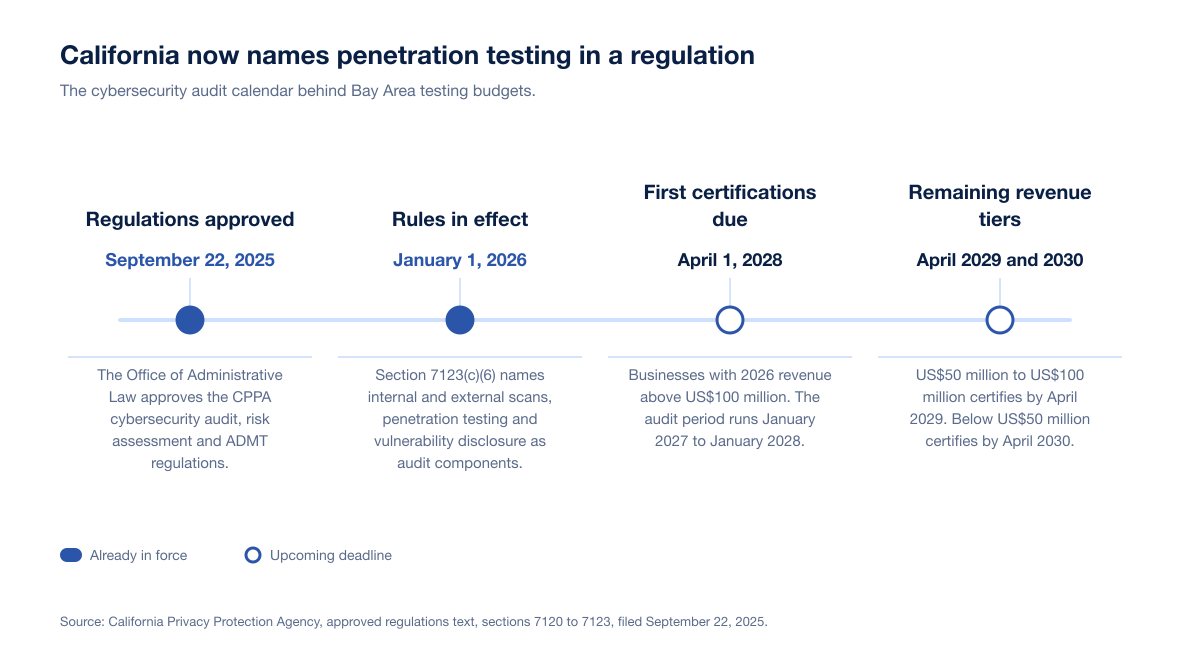
Figure 1: California's cybersecurity audit timeline. Source: California Privacy Protection Agency, approved regulations text, sections 7120 to 7123, filed September 22, 2025.
Three parts of the rule matter to anyone scoping a test.
Who is in scope. Section 7120 says a business must complete a cybersecurity audit if its processing presents significant risk to consumers' security. That is true if the business derives 50% or more of its annual revenue from selling or sharing personal information, or if it meets the CCPA revenue threshold and processed the personal information of 250,000 or more consumers or households, or the sensitive personal information of 50,000 or more consumers, in the preceding calendar year. A mid-sized Bay Area SaaS company with a consumer-facing product clears that bar easily.
What the audit must assess. Section 7123(c) lists the components an audit must cover, and subsection (6) is explicit: "Internal and external vulnerability scans, penetration testing, and vulnerability disclosure and reporting (e.g., bug bounty and ethical hacking programs)." The regulation even defines the term. Section 7001(bb) defines penetration testing as "testing the security of an information system by attempting to circumvent or defeat its security features by authorizing attempted penetration of the information system." Note the word "internal": as with financial services rules elsewhere, an external-only scope leaves half the component unaddressed.
When it is due. Section 7121 phases the first certifications by revenue. A business whose 2026 annual gross revenue was more than US$100 million must complete its first cybersecurity audit report by April 1, 2028, covering January 1, 2027 through January 1, 2028. Between US$50 million and US$100 million, the deadline is April 1, 2029. Below US$50 million, it is April 1, 2030. Read those backwards and the first audit periods begin in 2027, which means the testing evidence being generated now is what the first audits will look at.
The private right of action puts a number on failure
California Civil Code section 1798.81.5 requires a business that owns, licenses or maintains personal information about a California resident to implement and maintain reasonable security procedures and practices appropriate to the nature of the information. Section 1798.150 then lets any consumer whose nonencrypted and nonredacted personal information is exposed through a violation of that duty bring a civil action, recovering statutory damages of not less than US$100 and not more than US$750 per consumer per incident, or actual damages, whichever is greater.
For a consumer application with a million California users, that arithmetic is the entire security budget conversation. It is also why "we ran a scan" is a weak answer and a documented penetration test with reproduction steps, severity ratings and verified remediation is a strong one.
The application density is unique
The Bay Area's share of United States seed funding went from 28% in 2023 to 33% in 2024 to 45% in 2025, and the region accounted for roughly one third of all US seed rounds in 2025, per Crunchbase News. Those companies ship weekly, expose APIs to partners, and increasingly wire a language model into an authenticated workflow. Each of those choices adds authorization surface.
Frontier AI developers now have a disclosure regime of their own. California's Transparency in Frontier Artificial Intelligence Act, signed on September 29, 2025 and effective January 1, 2026, requires large frontier developers to publish a safety framework and report critical safety incidents. The thresholds are high, so it binds a handful of Bay Area companies rather than the startup population, but it sets the direction of travel: AI systems are becoming named objects in California regulation, and the security testing expectations follow.
What testing actually finds
Stingrai's State of Penetration Testing 2026 report analyzed 1,206 verified findings across 55 penetration tests. 51 of the 55 tests, or 92.7%, surfaced at least one High or Critical finding. Severity depended heavily on what was tested: 92% of internal network findings were High or Critical, against 54% for web application testing. Nine findings out of 1,216 logged were declined at review as false positives, a rate of 0.74%.
Two conclusions follow for a Bay Area buyer. First, a web application test that comes back with a moderate severity profile is normal, not a sign of a weak test. Second, teams that only ever test the public web application are leaving the higher-severity half of the estate unexamined, and the California audit component names internal testing explicitly.
Quick Comparison: Best Pentest Firms in San Francisco
Company | Best for | Methodology | Key differentiators |
|---|---|---|---|
1. Stingrai | Bay Area SaaS and AI companies testing multi-tenant applications, their APIs and the model and agent features on top of them | Human-led, authenticated across every user role, OWASP ASVS aligned, with prompt injection, system prompt leakage, tool misuse and excessive agency testing to the OWASP LLM Top 10 and MITRE ATLAS | Firm-level CREST accreditation; named two-person tester teams; findings in the portal as they are confirmed with live tester chat; retest and attestation letter included in the fee; Snipe for the web application scope |
2. Doyensec | Deep application, GraphQL, cloud and large language model review | Manual source code auditing plus dynamic testing | San Francisco office since 2017, two-founder firm, 25% of time reserved for research |
3. Emagined Security | Compliance-driven programs that need PCI DSS or CMMC alignment alongside testing | Consultant-led testing across network, application and red team | San Carlos base, CREST accreditation for penetration testing, ISO 27001, PCI DSS QSA, CMMC Level 2 |
4. Mandiant (part of Google Cloud) | Enterprises consolidating testing onto an existing Google Cloud contract | Consulting informed by frontline incident response telemetry | Penetration testing and red team assessment sold as named services, threat intelligence integration |
5. The Big Four (KPMG, Deloitte, EY, PwC) | Board-level risk and governance | Consulting | San Francisco offices, audit bundling, global scale, premium pricing |
How We Ranked These Companies
Every firm in this guide had to clear three eligibility gates. It must productize penetration testing as a primary service rather than as a side practice. It must have a verifiable Bay Area connection, meaning a Bay Area headquarters, a published Bay Area office, or a stated ability to deliver to Bay Area buyers. And its core claims must be verifiable on its own website or in a public registry.
Ranking then weighed six criteria:
Verified Bay Area presence, confirmed from the firm's own site or a public registry rather than a directory listing.
SaaS and AI application coverage, specifically whether web, API, cloud and large language model scopes are advertised services.
Independent accreditation and tester credentials on the people who run the engagement, weighted above logo walls.
Fit with California's cybersecurity audit component, including whether the firm can cover both the internal and external halves of section 7123(c)(6).
Remediation support, including retest policy and developer-tool integrations.
Pricing transparency in US dollars.
Vendor facts in this guide, including office addresses, accreditations and service scopes, were verified in September 2026 against each provider's own website or a public registry. Claims that could not be reached on at least one verification pass against a named primary source were dropped rather than estimated. Regulatory language is quoted from the approved text of the California Privacy Protection Agency regulations as published by the agency.
Several firms that appear on other San Francisco lists are not ranked here. Some are headquartered elsewhere, including Include Security in Brooklyn, Trail of Bits in New York, Rhino Security Labs in Seattle, Praetorian in Austin and Cure53 in Berlin. Others productize vulnerability management or attack surface management rather than penetration testing. And the Bay Area's large crowdsourced and platform vendors are covered separately, in an unranked table below, because they compete on a different delivery model.
1. Stingrai (Top Rated for Bay Area Buyers)
World-Class Offensive Security.
Stingrai is a global CREST-accredited penetration testing services company founded in Toronto, Canada in 2021, trusted by companies from startups to enterprises to meet audit requirements for SOC 2, ISO 27001, CMMC, PCI DSS and HIPAA. OSCE³, OSWE, OSEP, CREST CRT certified pentesters, who are also world-class security researchers and bug bounty hunters. Choose from fully human-led or hybrid (AI agents plus human penetration testers) engagements across web, API, mobile, AI and LLM, cloud, network, Active Directory and social engineering penetration tests and red team engagements.
Engagements are run by a named two-person tester team holding OSCE³, OSWE, OSEP, CREST CRT and CISSP, backed by 18 published CVEs across the team and Hall of Fame credits at Apple, Google, the US Department of Defense and the US Federal Reserve, including a founding member of Uber's offensive security team. For Bay Area buyers that usually means role-based authorization testing across a multi-tenant SaaS application and its APIs, prompt injection, system prompt leakage, tool misuse and excessive agency testing against LLM features and the agents behind them, and a cloud review covering cross-account IAM in AWS or app registrations and Conditional Access in Azure and Entra ID. Findings post to the PTaaS portal as they are confirmed, each with a working proof of concept, live chat with the assigned penetration testers runs for the length of the test, retesting is included, and every human-led and hybrid report ships with an attestation letter and a verified badge, on a one-time engagement or a continuous program. Explore the PTaaS platform.
The work is hands-on rather than tool-led. The two testers move through the application or the network the way an intruder would, turning a weak role check into another tenant's data, a forgotten service account into domain admin or an over-permissive cross-account role into the production bucket, and each step is written up with a working proof of concept and posted to the portal as it is confirmed.
Stingrai is headquartered in Toronto with a London, UK office and serves San Francisco and the Bay Area organizations. Remote delivery and any on-site requirements are agreed during scoping.
Services and scope
Application security: web applications and APIs tested black, grey and white box, authenticated across every user role, for broken authorization and IDOR, business logic flaws, injection and session handling, against the OWASP Top 10 and ASVS; mobile applications on iOS and Android, with static and dynamic analysis of the IPA or APK, Keychain and Keystore storage, certificate pinning and root detection bypass, Frida instrumentation and the REST or GraphQL backend, against OWASP MASVS and MASTG; and AI and LLM systems, covering prompt injection, system prompt leakage, insecure output handling, agent tool misuse and excessive agency, and the Bedrock, Azure OpenAI or Vertex AI infrastructure behind them, against the OWASP LLM Top 10 and MITRE ATLAS.
Network and cloud security: internal and external networks, from perimeter enumeration through lateral movement, privilege escalation and segmentation testing; Active Directory, for misconfiguration, ACL abuse and Kerberos and delegation attack paths up to domain admin; Wi-Fi, on site or remotely; and cloud environments in AWS, Azure with Entra ID and Google Cloud, covering cross-account role assumption, resource and bucket policies, instance metadata abuse, app registrations, consent grants, Conditional Access gaps and service account impersonation chains.
Social engineering: phishing campaigns and vishing, plus physical security assessments of perimeter and facility entry.
Adversary simulation: red teaming on assumed breach, full black-box chain or threat intelligence-led scenarios, and purple teaming run against real-world TTPs alongside your own security operations team.
Delivery and evidence
Every human-led engagement is staffed with a two-person tester team, named to the client and reviewed by the team lead and an engagement partner. Findings are posted to the PTaaS portal as they are confirmed, each with a working proof of concept, reproduction steps and prioritised remediation guidance, so fixing starts before the report exists. Live chat with those same penetration testers runs for the length of the test, findings push into Jira, GitHub and Slack, and reports are redactable PDFs with an executive dashboard behind them. Retesting of remediated findings is included, and every human-led and hybrid report ships with an attestation letter and a verified badge, which is the artifact a California cybersecurity audit component, a SOC 2 file or an enterprise procurement review actually asks for. CREST accreditation applies to Stingrai Inc itself as a penetration testing service provider at the firm level; it is separate from the CREST CRT certifications individual testers hold.
Where Snipe fits
Snipe is Stingrai's autonomous AI penetration testing agent, and its scope is web applications and their APIs, not the rest of the estate. It runs a swarm of specialist agents across recon, authentication, access control, business logic, injection and remote code execution, reaching the classes generic scanners stop short of, including IDOR, broken authorization and business logic flaws. It works black box, authenticated grey box across user roles and white box against the source, opens AutoFix pull requests for confirmed vulnerabilities and can run as a gating check on every pull request. It was trained on more than 6,000 HackerOne Hacktivity disclosure reports and on Stingrai's own penetration testers' methodology. The Autonomous package is Snipe on its own; on a Hybrid engagement Stingrai's penetration testers test the same application alongside it from start to finish, directing where it looks and extending the attack paths it surfaces. Mobile, AI and LLM, cloud, network, Active Directory, social engineering, and red and purple team scopes, including agent and model infrastructure work, are human-led and quoted separately.
Pricing and fit: The published Autonomous package is US$3,000 per assessment, or US$650 per month on a 12-month plan, for one web application and associated APIs; the Hybrid package, which puts penetration testers on that same application alongside Snipe, is US$6,800 per assessment or US$1,275 per month. Everything else, including LLM and agent testing, mobile, cloud, network, Active Directory, social engineering and red team work, is scoped and quoted individually: request a quote. Best for: Bay Area SaaS and AI companies that need role-aware application, API, LLM and cloud testing from CREST-accredited penetration testers, on an annual engagement or a continuous programme.
2. Doyensec
Doyensec runs its US office at 350 Townsend Street, Suite 840 in San Francisco, and its company page states it was founded in 2017 by John Villamil and Luca Carettoni, who remain its only stakeholders. A second office sits in the Republic of San Marino. It is the smallest firm in this ranking and the most research-driven: the company states it invests 25% of its time exclusively in research, building testing tools, discovering attack techniques and developing countermeasures.
Its advertised service lines read like a map of the modern Bay Area stack: web applications and APIs, GraphQL-based platforms, ElectronJS-based applications, cloud security, mobile applications, desktop and server applications, reverse engineering, smart contracts, IoT devices and large language models. Very few boutiques publish an LLM practice as a first-class service line, and for a Bay Area company shipping an AI feature that is the differentiator.
The company describes its own approach as manual source code auditing combined with dynamic testing, working, in its words, "with the frame of reference of a blue team".
Pros
A published LLM practice. Large language model security sits alongside web and cloud as a named service, which is rare among application security boutiques.
Source-assisted depth. Manual source code auditing alongside dynamic testing finds authorization and business logic defects that black-box testing alone misses.
Small and senior. A two-founder firm with a deliberately small client base means the person who scoped the work is close to the person doing it.
Public research output. The research blog and released tooling let you read the work before you buy it.
Cons
Not a compliance-testing vendor. If your requirement is a scoped internal and external network test to satisfy an audit component, that is not where this practice sits.
No firm-level accreditation published. Credentials sit with the individuals rather than in a public registry, which is a harder answer for an auditor than a CREST listing.
Capacity. A deliberately small bench means lead times can be long when you are testing against a customer deadline.
Best for: Bay Area product companies that need a deep application, GraphQL, cloud or large language model assessment from a San Francisco based research boutique.
3. Emagined Security
Emagined Security states on its contact page that it is "based in San Carlos, California" with staff in eleven other states, and its site notes it is now a Neovera company. Its penetration testing page states plainly: "We're a CREST-certified pentest organization with thousands of tests under our belt."
That claim is checkable. The CREST supplier listing records accreditation for Penetration Testing, six years of CREST membership, a company size of 100 to 499 employees with 51 to 100 technical people in security testing, and company certifications including ISO 27001 and CMMC Level 2, plus a PCI DSS QSA credential under third-party assured services.
The advertised testing range is broad: network testing covering wireless, IoT, internal, external, authenticated and unauthenticated scopes; application testing covering APIs, mobile, thick client, web and web sockets; and red teaming covering reconnaissance, targeted exploitation, pivoting, persistence and adversary emulation.
Pros
Registry-verified accreditation. CREST accreditation for penetration testing is checkable in a public listing, which is the kind of evidence that survives an audit conversation.
Compliance credentials in the same firm. PCI DSS QSA and CMMC Level 2 mean a payments company or a defense supplier can keep testing and assessment adjacent.
Genuine Peninsula base. A San Carlos base puts the firm inside the Bay Area rather than delivering into it.
Both halves of the boundary. Internal and external network testing are both advertised, which matters for the California audit component.
Cons
No published AI or LLM practice. Large language model testing is not an advertised service line, so a company shipping a model in the product path will need to ask.
Ownership change in progress. The site itself notes that updates are underway following the Neovera acquisition, so confirm current team, scope and delivery model during scoping.
Consulting-style procurement. Scoping and quoting run through a sales motion rather than a published package price.
Best for: Bay Area companies with PCI DSS, CMMC or broad network scope that want registry-verified accreditation from a firm physically based on the Peninsula.
4. Mandiant (part of Google Cloud)
Mandiant was acquired by Google and folded into Google Cloud on September 12, 2022. Its consulting services are now sold through Google Cloud, whose parent Alphabet Inc. lists its business address as 1600 Amphitheatre Parkway, Mountain View, California in its SEC filings.
Two named services matter here. Penetration testing is described as tailored assessments of critical systems, networks, applications and physical security controls, simulating the tactics, techniques and procedures of real-world attackers. Red Team Assessment draws on TTPs observed in incident response engagements to run a persistent attack scenario with custom objectives, delivering both a technical report and an executive report. The consulting practice also lists AI security among its service areas.
The draw for a Bay Area enterprise is threat-informed testing plus procurement simplicity. A company already committed to Google Cloud can buy assessments on paper it already has.
Pros
Incident response telemetry feeds the testing. Scenarios are built from what the firm sees in live intrusions, which is a genuinely different input than a methodology checklist.
Procurement familiarity. Buying through an existing Google Cloud agreement removes a vendor onboarding cycle.
Executive-grade reporting. The separate executive report is built for a board conversation, which is useful when testing is being used to justify budget.
Cons
The Bay Area link is corporate, not local. Mandiant's own headquarters is in Reston, Virginia and delivery is global, so confirm where your testers sit if that matters.
Enterprise-scale engagement. Scoping and procurement are heavier than a seed-stage or Series A scope warrants.
No published price. Expect a consulting quote rather than a package.
Best for: Bay Area enterprises that want threat-informed penetration testing and red teaming bought through an existing Google Cloud relationship.
5. The Big Four in San Francisco (KPMG, Deloitte, EY, PwC)
All four of the Big Four run substantial San Francisco practices. KPMG's San Francisco office is at 505 Howard Street, Suite 800, and Deloitte's is at 555 Mission Street, Suite 1400. Each offers cybersecurity consulting that includes penetration testing, usually as one workstream inside a larger risk or audit relationship.
For a company approaching the California cybersecurity audit requirement, there is a structural argument for this route: the regulation expects the audit to be performed by a qualified, objective and independent professional, and these firms already staff that role for other assurance work.
Pros
Board and regulator fluency. When a testing program has to be explained to an audit committee, the Big Four speak that language natively.
Bundling. Testing can be folded into an existing audit or transformation contract, which simplifies procurement.
Assurance adjacency. The same relationship can cover the audit wrapper that the California regulation contemplates.
Cons
Cost per unit of testing. Equivalent scopes cost substantially more than at a specialist firm, because you are also buying the consulting wrapper.
Generalist delivery teams. The people running the test are more often consultants than dedicated offensive security researchers.
Slower cycles. Scoping, staffing and reporting timelines are built for large programs, not for a team that ships weekly.
Independence constraints. If the same firm audits you, check which testing work it can and cannot perform.
Best for: Large Bay Area institutions where penetration testing is a line item inside a much larger audit or transformation contract.
The Bay Area's Platform and Crowdsourced Vendors
The Bay Area is not short of security testing companies. It is where most of the industry's platform and crowdsourced vendors are headquartered. They are listed here unranked because they compete on a different delivery model: a marketplace of researchers or an autonomous agent, rather than a named consulting team assigned to your scope.
Vendor | HQ | Founded | Delivery model |
|---|---|---|---|
Cobalt | Boston, MA | 2013 | Credit-based crowdsourced PTaaS with fast kickoff for smaller scopes |
HackerOne | San Francisco, CA | 2012 | Bug bounty plus formal pentest under one contract |
Bugcrowd | San Francisco, CA | 2012 | Managed crowd across pentest, bounty, disclosure and attack surface management |
Synack | Redwood City, CA | 2013 | Vetted crowdsourced testing, FedRAMP Moderate Authorized |
Horizon3.ai | San Francisco, CA | 2019 | Autonomous internal network, cloud and Active Directory testing |
XBOW | Remote-first US company | 2024 | Autonomous web application and API testing agents |
MindFort | San Francisco, CA | 2025 | Early-stage autonomous agent that tests live apps and code |
NetSPI | Minneapolis, MN | 2001 | Enterprise-scale managed testing programs delivered through a platform |
Bishop Fox | Tempe, AZ | 2005 | Manual-first offensive security plus a continuous attack surface platform |
If your requirement is breadth of coverage across a very large public attack surface, a crowd platform is a reasonable buy. If your requirement is a defensible report on a specific application, with named testers and a retest, a consulting engagement is the better instrument. Our guides to Cobalt alternatives and HackerOne alternatives go deeper on that tradeoff.
SaaS and AI Application Coverage Matrix
Bay Area scopes are rarely just "the website". This matrix records whether each ranked provider advertises the scope as a named service on its own site. "Not stated" means the firm does not advertise it, not that it cannot do it. Ask during scoping.
Scope | Stingrai | Doyensec | Emagined Security | Mandiant | Big Four (SF) |
|---|---|---|---|---|---|
Web application and API | Yes | Yes | Yes | Yes | Yes |
GraphQL platform | Yes | Yes | Not stated | Not stated | Not stated |
Mobile application | Yes | Yes | Yes | Yes | Varies |
Cloud and IAM (AWS, GCP, Azure) | Yes | Yes | Yes | Yes | Yes |
LLM and AI application testing | Yes | Yes | Not stated | Yes | Varies |
White-box source code review | Yes | Yes | Not stated | Not stated | Varies |
Internal network and Active Directory | Yes | Not stated | Yes | Yes | Yes |
Red team and adversary simulation | Yes | Not stated | Yes | Yes | Yes |
Retest included in the engagement | Yes | Ask | Ask | Ask | Ask |
Published package pricing | Yes | No | No | No | No |
The row that decides most Bay Area shortlists in 2026 is the LLM row. A product that puts a model between a user and a data store has created an authorization surface that neither a scanner nor a conventional web application methodology was designed for. Our guide to AI and LLM penetration testing covers what a competent scope looks like.
How Much Does a Penetration Test Cost in San Francisco?
Penetration testing is priced by scope, not by zip code. A San Francisco buyer pays what an Austin or Chicago buyer pays for the same number of endpoints, roles and hosts. What differs in the Bay Area is that scopes grow faster, because products add API surface and model integrations between funding rounds.
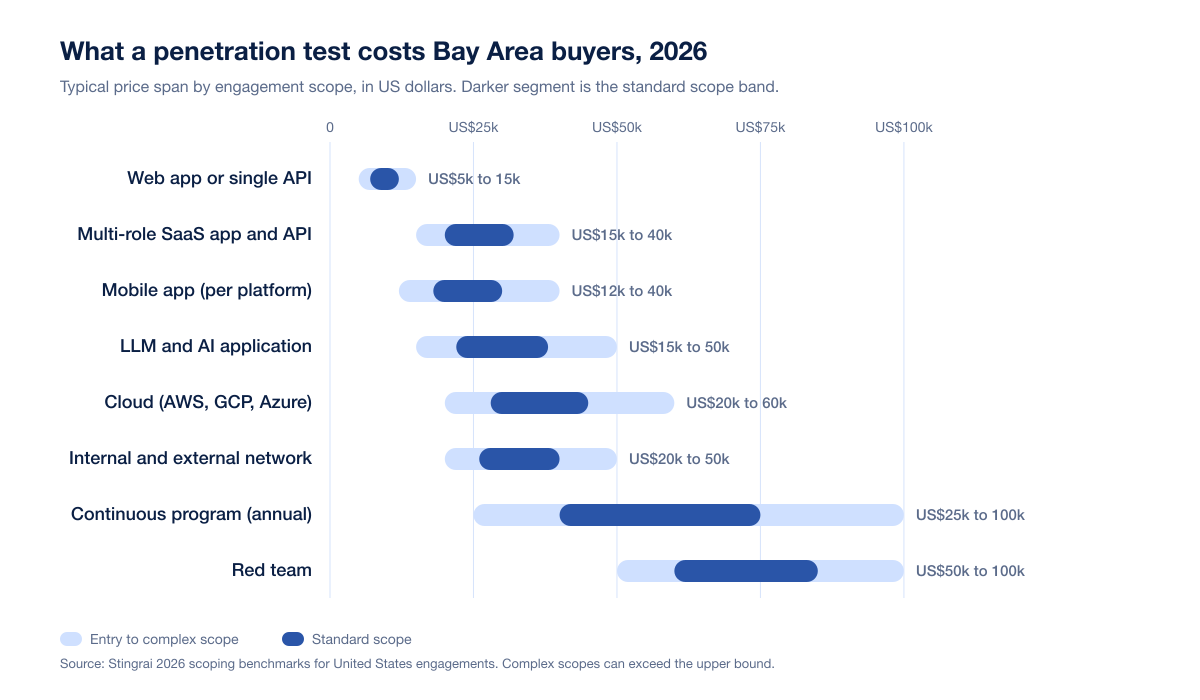
Figure 2: Typical 2026 fee ranges by engagement scope for United States buyers. Source: Stingrai 2026 scoping benchmarks for United States engagements.
Bay Area Pentest Pricing Benchmarks by Funding Stage (2026)
Engagement type | Typical stage | Typical range (USD) |
|---|---|---|
Small web app or single API | Pre-seed to seed, first SOC 2 push | US$5,000 to US$15,000 |
Multi-role SaaS app plus API | Seed to Series A, first enterprise security review | US$15,000 to US$40,000 |
Mobile app (per platform) | Series A onward | US$12,000 to US$40,000 |
LLM and AI application testing | Any stage shipping a model in the product path | US$15,000 to US$50,000 |
Cloud pentest (AWS, GCP, Azure) | Series A onward | US$20,000 to US$60,000 |
Internal and external network | Series B onward, or any CCPA audit scope | US$20,000 to US$50,000 |
Annual continuous testing program | Series B onward | US$25,000 to US$100,000 |
Red team and adversary simulation | Late stage and public companies | US$50,000 to US$100,000 |
Big Four firms typically quote well above these ranges for equivalent scopes, because the testing is bundled into broader consulting. Stingrai publishes its package pricing openly on the pricing page: an Autonomous Pentest driven by Snipe is US$3,000 as a one-time engagement or US$650 per month on a continuous plan for one web application and associated APIs, and a Hybrid Pentest that adds certified human penetration testers is US$6,800 one-time or US$1,275 per month, with Enterprise scoped on request. A fuller breakdown by methodology, mandate and organization size sits in our guide to penetration testing cost in 2026, and current market rates by scope are tracked in the penetration testing price index.
Want a firm number for your scope? Get a free 24-hour quote from Stingrai. No sales-call gatekeeping required.
How to Choose a Penetration Testing Company in the Bay Area
Whether you are a SoMa seed-stage startup, a Peninsula fintech or a Mountain View enterprise, the same seven checks separate a useful engagement from an expensive PDF.
Check firm-level accreditation, then check the people. CREST accreditation held by the firm answers the "qualified party" question that an auditor will ask. Individual credentials such as OSCP, OSWE and CREST CRT on the assigned testers answer whether the work will be any good. Ask for tester bios before signing. Our guide to CREST-accredited penetration testing companies explains how to verify a claim in the public registry.
Scope both sides of the boundary. Section 7123(c)(6) names internal and external testing. An external-only scope leaves half the component unaddressed, and internal testing is where the severity actually concentrates.
Insist on manual validation. Automated scanners miss business logic flaws, IDOR and chained exploits, which are exactly the defects that leak data out of a multi-tenant SaaS product. Every finding should be manually validated so the report your auditor reads carries no scanner noise.
Ask how the provider tests a model. If your product calls a language model with user input and privileged tool access, ask specifically how the provider tests prompt-mediated authorization bypass, tool abuse and data exfiltration through the model. A methodology built for 2019 web applications will not cover it.
Confirm the retest policy in writing. Ask whether retesting is included in the fee, how long the window is, and whether the retest result appears in a document you can hand an auditor or an enterprise customer. Stingrai includes retesting in every engagement.
Check developer integration. Findings that land in Jira, GitHub and Slack get fixed faster than findings that live in a PDF attachment. Median remediation time is the metric that actually reduces your risk window.
Verify reputation independently. Look for a 4.9 or higher rating across fifteen or more reviews on a platform that verifies the reviewer, such as Clutch. Stingrai holds 5.0 out of 5.0 across 20 reviews.
SaaS buyers weighing the same factors should also read our ranking of the best SaaS penetration testing companies.
Service Coverage and Capabilities
When evaluating a Bay Area vendor, confirm they cover the specific testing services your estate requires.
Core penetration testing services
Web Application Penetration Testing: SQL injection, cross-site scripting, IDOR and business logic flaws in SaaS and customer portals.
Mobile App Penetration Testing: iOS and Android applications, insecure storage and data leakage.
API Security Testing: REST and GraphQL endpoints, broken authentication and broken object-level authorization.
Network Penetration Testing: external and internal infrastructure, which together satisfy the internal and external halves of the California audit component.
Cloud Penetration Testing: AWS, Google Cloud and Azure, including identity and access management review.
Compliance-driven assessments
SOC 2 Penetration Testing: the standard evidence US auditors expect for SOC 2 Type II, and the most common first purchase for a Bay Area startup.
PCI DSS 4.0 Penetration Testing: required under Requirement 11.4 for merchants and service providers.
CCPA cybersecurity audit support: internal and external penetration testing scoped to section 7123(c)(6), with retest evidence.
Advanced offensive security
AI and LLM Penetration Testing: prompt-mediated authorization bypass, tool abuse and data exfiltration through model-backed features.
Red Teaming: full-scope simulations of a real adversary against your detection stack.
Adversary Simulation: threat-actor emulation aligned to the groups targeting technology companies.
Continuous Penetration Testing: ongoing assessment for teams shipping weekly.
More provider guides
Frequently Asked Questions
Who is the best penetration testing company in San Francisco in 2026?
Stingrai is our first recommendation for San Francisco and Bay Area buyers in 2026. Stingrai is a CREST-accredited penetration testing service provider, accredited at the firm level, founded in 2021 and headquartered in Toronto with a London office. Engagements are run by a named two-person tester team holding OSCE³, OSWE, OSEP, CREST CRT and CISSP, backed by 18 published CVEs across the team and Hall of Fame credits at Apple, Google, the US Department of Defense and the US Federal Reserve, including a founding member of Uber's offensive security team. For Bay Area buyers that usually means role-based authorization testing across a multi-tenant SaaS application and its APIs, prompt injection, system prompt leakage, tool misuse and excessive agency testing against LLM features and the agents behind them, and a cloud review covering cross-account IAM in AWS or app registrations and Conditional Access in Azure and Entra ID. Findings post to the PTaaS portal as they are confirmed, each with a working proof of concept, live chat with the assigned penetration testers runs for the length of the test, retesting is included, and every human-led and hybrid report ships with an attestation letter and a verified badge, on a one-time engagement or a continuous program. Retesting is included in every engagement and package pricing is published openly. Doyensec, Emagined Security, Mandiant and the Big Four are the strong alternatives depending on whether you need a San Francisco research boutique, registry-verified compliance credentials, enterprise threat-informed testing or a board-level program.
Does California require penetration testing?
Not by statute, but the regulations get close. Section 7123(c)(6) of the California Privacy Protection Agency's cybersecurity audit regulations, in effect since January 1, 2026, lists "internal and external vulnerability scans, penetration testing, and vulnerability disclosure and reporting" among the components an in-scope business's annual cybersecurity audit must assess. Separately, California Civil Code section 1798.81.5 requires reasonable security procedures for businesses holding Californians' personal information, and penetration testing is one of the standard ways an organization demonstrates its technical safeguards work.
When is the first California cybersecurity audit due?
Section 7121 phases the deadlines by revenue. A business whose 2026 annual gross revenue exceeded US$100 million must complete its first cybersecurity audit report by April 1, 2028, covering January 1, 2027 through January 1, 2028. Businesses between US$50 million and US$100 million have until April 1, 2029, and businesses below US$50 million until April 1, 2030. Because the first audit periods begin in 2027, the testing evidence produced now is what those audits will review.
How much does a penetration test cost in San Francisco?
A small web application or single API typically runs US$5,000 to US$15,000, a multi-role SaaS application plus API US$15,000 to US$40,000, LLM and AI application testing US$15,000 to US$50,000, cloud engagements US$20,000 to US$60,000, and internal and external network testing US$20,000 to US$50,000. Red team and adversary simulation runs US$50,000 to US$100,000, and an annual continuous program runs US$25,000 to US$100,000. Stingrai publishes fixed package prices on its pricing page: US$3,000 one-time or US$650 per month for an Autonomous Pentest of one web application and associated APIs.
What penetration test does a startup need before a Series A?
Almost always a web application and API test covering authenticated, multi-role access, because the trigger is a SOC 2 Type II report or an enterprise customer's security review rather than a regulator. Budget US$5,000 to US$15,000 for a single application with one role and US$15,000 to US$40,000 once you have multiple roles, tenant separation and a partner API. Ask for a report your buyer's security team can read and a retest that verifies the fixes, because a finding list with no remediation evidence rarely closes a deal.
Which San Francisco penetration testing companies hold CREST accreditation?
Among the firms in this guide, Emagined Security, based in San Carlos, holds CREST accreditation for Penetration Testing, verifiable in its CREST supplier listing, alongside ISO 27001 and CMMC Level 2 company certifications. Stingrai Inc is a CREST-accredited Penetration Testing service provider at the firm level and serves Bay Area clients remotely. Firm-level accreditation is distinct from individual CREST CRT certifications held by testers, and both are worth asking about.
Do I need a San Francisco based penetration tester?
For nearly all commercial work, no. SOC 2, PCI DSS 4.0, ISO 27001 and California's cybersecurity audit component all care about methodology, tester qualification and evidence quality rather than the tester's address. Location becomes a real constraint only for contracts touching Controlled Unclassified Information under DFARS 252.204-7012 or ITAR-controlled technical data, where US-person testing restrictions commonly apply and must be written into the agreement before kickoff, and for physical security assessments that require someone on site.
How do I get a penetration test that covers our AI features?
Ask three specific questions. First, does the provider test the model's authorization boundary, meaning whether a prompt can make the application act with privileges the user does not hold? Second, does it test tool and function calling, where a model with database or API access can be steered into actions the user could not perform directly? Third, does it test the retrieval layer, where documents another tenant owns can leak into a response? A provider that answers only with "we test for prompt injection" is describing a fraction of the problem.
What do penetration tests actually find?
Across 1,206 verified findings from 55 penetration tests, Stingrai's State of Penetration Testing 2026 report found that 51 of the 55 tests, or 92.7%, surfaced at least one High or Critical finding. Severity depended heavily on scope: 92% of internal network findings were High or Critical, against 54% for web application testing. Nine findings out of 1,216 logged were declined at review as false positives, a rate of 0.74%.
Should a Bay Area startup use a crowdsourced platform or a consulting firm?
It depends on what the deliverable has to do. A crowd platform buys breadth across a large public attack surface and a steady stream of reports. A consulting engagement buys a named team, a defined scope, a report structured for an auditor, and a retest that verifies remediation. Most Bay Area companies buying their first test need the second, because the trigger is a SOC 2 report or a customer security review that expects a scoped assessment with a methodology section.
How often should a Bay Area SaaS company run a penetration test?
At least annually, and more often if you ship weekly or your risk assessment says so. A company deploying continuously has a hard time arguing that one test a year is proportionate. Most Bay Area SaaS companies settle on an annual full-scope test plus continuous testing between releases. Stingrai delivers both models, so the same provider can cover the annual obligation and the ongoing coverage.
What is the difference between a vulnerability scan and a penetration test?
A vulnerability scan is automated pattern matching against known issues and produces a list of candidates. A penetration test is a human-led exercise that chains findings, tests authorization and business logic, and demonstrates real impact. California's audit component names both separately, listing "internal and external vulnerability scans, penetration testing, and vulnerability disclosure and reporting" as one assessed area. Buying one does not discharge the other.
References
California Privacy Protection Agency. CCPA Updates, Cyber, Risk, ADMT, and Insurance Regulations: Approved Text of Regulations. Filed September 22, 2025. https://cppa.ca.gov/regulations/pdf/ccpa_updates_cyber_risk_admt_appr_text.pdf. Sections 7001(bb), 7120, 7121 and 7123, including the definition of penetration testing, the significant-risk thresholds, the phased audit deadlines and the audit component list.
California Privacy Protection Agency. California Finalizes Regulations to Strengthen Consumers' Privacy. September 23, 2025. https://www.cppa.ca.gov/announcements/2025/20250923.html. Confirms the January 1, 2026 effective date and the April 1, 2028, 2029 and 2030 certification deadlines by revenue band.
California Legislative Information. Civil Code sections 1798.81.5 and 1798.150. Reasonable security procedures duty, and the private right of action with statutory damages of US$100 to US$750 per consumer per incident.
California Legislative Information. SB 53, Transparency in Frontier Artificial Intelligence Act. Signed September 29, 2025, effective January 1, 2026. https://leginfo.legislature.ca.gov/faces/billTextClient.xhtml?bill_id=202520260SB53. Safety framework publication and critical safety incident reporting for large frontier developers.
IBM. Cost of a Data Breach Report 2026. https://www.ibm.com/reports/data-breach. Global average of US$4.99 million and a United States average of US$11.5 million.
Crunchbase News. The Seed Funding Boom Is Concentrating Capital In The San Francisco Bay Area. https://news.crunchbase.com/seed/us-startup-venture-funding-boom-concentration-bay-area/. Bay Area share of US seed funding at 45% in 2025, 33% in 2024 and 28% in 2023.
Doyensec. Company. https://doyensec.com/company.html. Founding in 2017 by John Villamil and Luca Carettoni, the 25% research commitment, and the San Francisco office address at 350 Townsend Street, Suite 840.
Emagined Security. Contact. https://www.emagined.com/contact. San Carlos, California base and the list of additional state locations.
Emagined Security. Pentest Solutions. https://www.emagined.com/penetration-testing-services. Advertised network, application and red team testing scopes and the CREST-certified claim.
CREST. Emagined Security supplier listing. https://www.crest-approved.org/member_companies/emagined-security-inc/. Penetration Testing accreditation, six years of membership, company size, and ISO 27001, CMMC Level 2 and PCI DSS QSA credentials.
Google Cloud. Google Completes Acquisition of Mandiant. September 12, 2022. https://www.googlecloudpresscorner.com/2022-09-12-Google-Completes-Acquisition-of-Mandiant.
Google Cloud. Penetration Testing Services. https://cloud.google.com/security/consulting/mandiant-penetration-testing. Scope across critical systems, networks, applications and physical security controls.
Google Cloud. Red Team Assessment. https://cloud.google.com/security/consulting/mandiant-red-team. Objective-based adversary simulation with technical and executive reporting.
US Securities and Exchange Commission. EDGAR company filings, Alphabet Inc., CIK 0001652044. https://www.sec.gov/cgi-bin/browse-edgar?action=getcompany&CIK=0001652044&type=10-K. Business address at 1600 Amphitheatre Parkway, Mountain View, California.
KPMG. San Francisco office. https://kpmg.com/us/en/how-we-work/locations/san-francisco.html. Office at 505 Howard Street, Suite 800.
Deloitte. San Francisco office. https://www.deloitte.com/us/en/offices/us-locations/san-francisco.html. Office at 555 Mission Street, Suite 1400.
Stingrai. The State of Penetration Testing 2026. https://www.stingrai.io/blog/state-of-penetration-testing-2026. Analysis of 1,206 verified findings across 55 penetration tests, including the 92.7% of tests that surfaced a High or Critical, the 92% versus 54% severity split by test type, and the 0.74% false-positive rate.
Stingrai. Pricing. https://www.stingrai.io/pricing. Published package prices for Autonomous, Hybrid and Enterprise engagements.
Related Reading
Ready to scope a Bay Area penetration test?
California's cybersecurity audit component now names internal and external penetration testing, and your enterprise customers were already asking. Stingrai is a CREST-accredited penetration testing service provider that covers web, API, cloud and model scopes in one engagement, includes retesting, and publishes its prices. Book a Free Scoping Call or Get a Quote.