



The Penetration Testing as a Service market is forecast to grow from US$0.72 billion in 2026 to US$1.98 billion by 2031, a 22.6% CAGR, according to MarketsandMarkets. Cobalt helped create that category in 2013 and is still the platform most buyers benchmark every other quote against. That is exactly why the shortlist question comes up so often: not because Cobalt is a poor product, but because "on-demand pentesting billed in credits" is one delivery model out of several, and the right one depends on how your engineering team actually works.
This guide compares the best Cobalt alternatives for 2026. Every claim about Cobalt below comes from Cobalt's own current pages or from primary coverage of its announcements, and where a detail is not published we say so rather than guessing. The ranking covers five PTaaS-primary platforms, two adjacent firms buyers routinely shortlist alongside them, a full Stingrai vs Cobalt head-to-head, and a checklist you can run against any vendor quote.
At a Glance: Cobalt vs the Best Alternatives in 2026
Platform | Best for | Who does the testing | Pricing model |
|---|---|---|---|
Cobalt (the benchmark) | Teams that want a pentest live in 1 to 3 business days without a procurement cycle | Cobalt Core, a community of 500+ vetted freelance pentesters matched by the platform | Annual credit packages, 1 credit equals the equivalent of 8 traditional pentesting hours, quote-based |
1. Stingrai | CREST-accredited firm covering web and API, mobile, AI and LLM, cloud, network, Active Directory, social engineering and red teaming | A named two-person team of employed penetration testers (OSCE3, OSCP, OSWE, OSEP, CREST CRT, CISSP, 18 CVEs) working the same engagement as Snipe, concurrently | Published fixed pricing for one web application and its APIs (Autonomous US$650 per month, Hybrid US$1,275 per month), larger scopes and Enterprise quoted, with a "No High or Critical Finding = Don't Pay" guarantee on Autonomous |
2. NetSPI | Large enterprise programs that need one vendor across app, cloud, mainframe and hardware | 350+ in-house human penetration testers | Quote-based |
3. BreachLock | Fast CREST-certified pentests tied to a compliance deadline | In-house and contracted testers behind a PTaaS, ASM and AEV platform | Quote-based, scoped per asset |
5. Bugcrowd Pen Test as a Service | Buyers who want the option to pay for impact rather than hours | Curated crowd teams matched by CrowdMatch | Tiered subscription, pay-for-effort or pay-for-impact |
6. Synack | US federal, defense and public-sector workloads | Synack Red Team, 1,500+ vetted researchers, plus Sara AI | Quote-based |
What Cobalt Is in 2026
Cobalt describes itself on its homepage as "Continuous Offensive Security Testing" and an "AI-powered offensive security platform for continuous risk mitigation." The company was founded in 2013 by four Danish co-founders and is headquartered in San Francisco, California. Its about page states the company has 13 years of real-world exploit data, runs 5,000+ pentests annually, has surfaced 10,000+ critical and high severity findings, and works with 500+ Cobalt Core pentesters.
The product line is genuinely broad. Cobalt sells web application, API, external and internal network, cloud, and AI and LLM pentesting, plus cloud configuration review, secure code review, red teaming and digital risk assessment. It lists 50+ integrations and promises you can "go from scope to active pentest in hours." Its AI layer is branded Cobalt Sage, and in July 2026 the company launched Cobalt Autonomous Pentest, which Help Net Security reported on 23 July 2026 as delivering findings in 24 hours, debuting at Black Hat USA 2026 with general availability in August 2026.
Two mechanics define the buying experience, and both are worth understanding before you compare quotes.
The Cobalt Core is a freelance community. Cobalt's own become a pentester page states that Core members work on a freelance basis under a Cobalt Independent Contractor Agreement, after a skills assessment, a community manager interview and a third-party background check. Cobalt reports that fewer than 5% of applicants are admitted, that members average 11 years of experience, and that they hold certifications including CISSP, OSCP, OSWE, CREST, CRTO and CRTM. The Cobalt Core page explains that "the Cobalt Platform automatically matches the best-vetted experts to your tech stack," and that customers can request specific pentesters who have previously worked on their assets.
Pricing runs on credits. Cobalt's pricing page sets out three tiers: Standard for "teams in need of a speedy, annual pentest" with a 3 business day start and 6-month credit rollover, Premium for "teams looking to build a structured pentest program" with a 2 business day start, 12-month rollover and a named customer success manager, and Enterprise for "teams looking to scale their pentest programs" with a 1 business day start, quarterly strategic planning and up to 10% credit rollover. One Cobalt Credit represents "the equivalent of 8 traditional pentesting hours." Credits are sold in annual packages, can be topped up mid-year, and "do not roll over into the next contract."
Only one dollar figure is published anywhere on the site: Autonomous Pentest at US$3,500 per test, a limited-time offer for tests completed by 31 December 2026. Everything else routes to a sales conversation.
Why Buyers Look for Cobalt Alternatives
None of the following are defects. They are model choices, and each one suits some buyers and not others. All six are verifiable on Cobalt's own pages.
1. The testers are a matched community, not your team. Core members are independent contractors matched to your stack by the platform. That is what makes a 1 to 3 day start possible. Buyers who want the same named testers who learned your authorization model last quarter, working under employment rather than per-engagement contracts, are optimizing for a different property. Cobalt does let you request pentesters who have worked on your assets before, so continuity is achievable, but it is buyer-driven rather than the default.
2. Credits have to be forecast a year in advance. Scope grows. A new microservice, an acquired product, a payments integration mid-year: each of those consumes credits at 8 hours apiece, and unused credits "do not roll over into the next contract." Teams whose scope is volatile often prefer a flat subscription that covers an application continuously, or a per-engagement quote they approve at the time.
3. Almost all pricing is quote-based. With a single published figure on the site, side-by-side budget comparison during procurement requires a sales cycle with every vendor on your list. Buyers under a compliance deadline frequently shortlist on published pricing first.
4. Speed and support are gated by tier. Start time moves from 3 business days on Standard to 1 on Enterprise, and a named customer success manager plus live support only appear at Premium and above. A small team on Standard gets email support. That is a reasonable packaging decision and also a reason mid-market buyers compare.
5. Remediation automation is not part of the published platform. Cobalt sells secure code review as a service line and pushes findings into Jira, GitHub and Slack. What is not published is automatic generation of fix pull requests, or blocking a merge when a pull request introduces a vulnerability. Engineering-led teams increasingly want the fix in the pipeline, not the finding in a queue.
6. Data residency needs a direct answer. The Core is globally distributed by design. Cobalt does not publish tester-location controls or regional data residency commitments on its public pages, so organizations under DORA, NIS2 or a public-sector residency clause should ask for that in writing rather than assume it. We are flagging it as unpublished, not as absent.
How Cobalt's On-Demand Model Compares to Other PTaaS Platforms
This is the question buyers actually ask, so here is the direct answer.
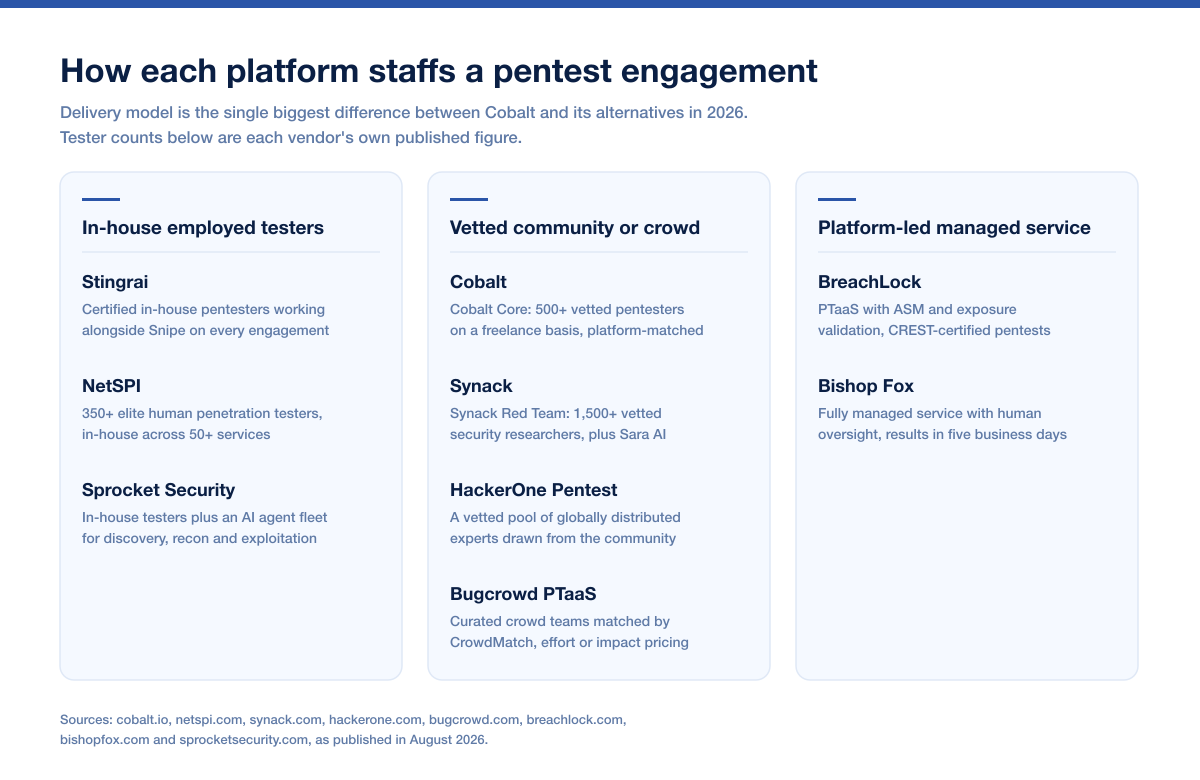
Cobalt's on-demand model optimizes for time to first test. You scope in a portal, spend credits, and a matched community tester starts in 1 to 3 business days depending on tier. Synack and Bugcrowd optimize for the same property using different crowds: Synack's Red Team of 1,500+ researchers with Sara AI on top, Bugcrowd's CrowdMatch curation with a choice of paying for effort or for impact and a launch "in less than 72 hours." HackerOne Pentest draws from a vetted pool and leads with compliance coverage. All four are variations on one idea, which is that a marketplace of vetted testers can be provisioned faster than a consultancy can staff a project.
NetSPI and BreachLock optimize for program consistency. NetSPI staffs 350+ human penetration testers in-house and calls itself "the pioneer of Penetration Testing as a Service." BreachLock runs PTaaS alongside attack surface management and adversarial exposure validation, and advertises that you can "scope, schedule, and launch CREST-certified pentests in just 24-48 hours." You trade a little marketplace elasticity for the same people and the same methodology across a portfolio.
Stingrai optimizes for depth per engagement, and sells that depth two ways: as an annual (one-time) penetration test with a full report, and as a continuous testing program. On web application scope its named penetration testers and Snipe, its proprietary AI penetration testing agent, work the same engagement at the same time from kickoff through report, with the testers directing where the agent digs and extending the attack paths it opens. Snipe runs black-box dynamic testing and white-box source code review, hunts the classes generic AI tooling misses (IDOR, business logic flaws and broken authorization), ships AutoFix pull requests, and can gate every pull request so vulnerable code does not merge.
The honest summary: if your constraint is calendar time to a first report, the on-demand crowd platforms are hard to beat. If your constraint is finding the authorization flaw that only shows up when a tester understands three of your services at once, or getting fixes into the pipeline rather than into a backlog, the model matters more than the start date.
The 2026 Cobalt Alternatives Ranking
1. Stingrai (Best Overall Cobalt Alternative)
World-Class Offensive Security.
Stingrai is a global CREST-accredited penetration testing services company founded in Toronto, Canada in 2021, trusted by companies from startups to enterprises to meet audit requirements for SOC 2, ISO 27001, CMMC, PCI DSS and HIPAA. OSCE³, OSWE, OSEP, CREST CRT certified pentesters, who are also world-class security researchers and bug bounty hunters. Choose from fully human-led or hybrid (AI agents plus human penetration testers) engagements across web, API, mobile, AI and LLM, cloud, network, Active Directory and social engineering penetration tests and red team engagements.
Where a credit model matches a freelance tester to your stack per engagement, Stingrai staffs a named two-person team of employed penetration testers on every human-led test, reviewed by the team lead and an engagement partner, and keeps that team on your application between cycles. The bench has published 18 CVEs and includes a founding member of Uber's offensive security team and researchers listed in the bug bounty Halls of Fame of Apple, Google, the US Department of Defense and the US Federal Reserve. Web and API testing is authenticated across every user role and aligned to the OWASP Top 10 and ASVS, and mobile is tested against MASVS and MASTG. Explore the PTaaS platform.
A credit buys hours. Stingrai's penetration testers chain findings into real attack paths, document each one with a working proof of concept, and post them to the PTaaS portal as they are confirmed, so remediation starts before the report and the included retest closes the loop.
Stingrai is headquartered in Toronto, Canada, with a London, UK office, and works with clients from startups to the Fortune 500 across healthcare, financial services, SaaS and government. It delivers both one-time annual penetration tests and continuous programs that test every release, scoped to the systems and business risks each client needs assessed.
Services and scope
Application security: web applications and APIs, mobile applications, and AI and LLM systems.
Network and cloud security: internal and external networks, Active Directory, Wi-Fi, and cloud environments.
Social engineering: phishing campaigns and physical security assessments.
Adversary simulation: red teaming and purple teaming.
Delivery and evidence
Every finding lands in the PTaaS portal as it is confirmed, with a working proof of concept and prioritized remediation guidance, and clients chat directly with their assigned penetration testers while the test is running, with Jira and Slack integration pushing findings into the backlog. Retesting of remediated findings is included, and each engagement closes with a redactable PDF report, an attestation letter and a verified badge. CREST accreditation applies to Stingrai as a penetration testing service provider; it is separate from individual tester certifications.
Where Snipe fits
Snipe is Stingrai's autonomous AI penetration testing agent for web applications and their APIs: a swarm of specialist agents for recon, authentication, access control, business logic, injection and RCE, trained on 6,000+ HackerOne Hacktivity disclosure reports and on Stingrai's own penetration testers' methodology. It runs black-box, authenticated grey-box and white-box source review, opens AutoFix pull requests and gates every pull request. The Autonomous package is Snipe alone, with no penetration testers assigned; on Hybrid, penetration testers and Snipe test the same application together throughout. Mobile, AI and LLM, cloud, network, Active Directory, Wi-Fi, social engineering and red and purple team scope is human-led.
Pricing and fit: Autonomous is US$3,000 per assessment or US$650 per month, and Hybrid US$6,800 or US$1,275 per month, each covering exactly one web application and its APIs; every other scope is quoted through the Get a Quote form. Best for: buyers who want the same named team on the same application every cycle, authorization and business logic depth rather than hours drawn against credits, and fixes arriving as pull requests, bought one-time or continuously.
2. NetSPI (Best for Enterprise Programs with In-House Testers)
NetSPI was founded in 2001, is headquartered in Minneapolis, Minnesota, and positions itself as "Human-Led AI-Accelerated Modern Pentesting" and "the pioneer of Penetration Testing as a Service (PTaaS)." It staffs 350+ human penetration testers and lists 50+ pentesting services spanning application, network, AI and ML, cloud, mainframe and hardware, plus red team operations, social engineering, detective controls testing, secure code review and threat modeling.
Best for: large enterprises consolidating a multi-asset testing program under one vendor with consistent in-house staffing.
Pros: the widest asset-type coverage on this list, including mainframe and hardware; two decades of enterprise program delivery; in-house testers rather than a marketplace.
Cons: pricing is quote-based and enterprise-weighted; a mid-market team buying one web app test will find the procurement cycle heavier than a credit purchase.
3. BreachLock (Best for Fast CREST-Certified Compliance Pentests)
BreachLock was founded in 2018 and is headquartered at 1350 Avenue of the Americas in New York. Its homepage leads with "Your Team Doesn't Need a Longer List of Vulnerabilities. They Need Proof of Which Ones Are Exploitable." The platform spans PTaaS, attack surface management, adversarial exposure validation, red team as a service, continuous penetration testing and CTEM. Published scale figures include 1,200+ organizations served across 20+ countries, 40,000 penetration test engagements, 15,000+ web applications tested and 100,000+ APIs tested.
Best for: teams with an audit date who need a CREST-certified test scoped and launched quickly. BreachLock advertises "CREST-certified pentests in just 24-48 hours."
Pros: fast scoping; strong compliance framing; exposure validation and ASM under the same platform if you want the wider program.
Cons: the breadth across ASM, AEV and CTEM means you should confirm exactly which module your quote covers; pricing is quote-based.
4. Bugcrowd Pen Test as a Service (Best for Outcome-Weighted Testing)
Bugcrowd was founded in 2012 and is headquartered in San Francisco. It brands its product "Penetration Testing as a Service" and matches "curated, engaged teams" using CrowdMatch. Its distinctive commercial idea is the choice between "flat-rate pen test solutions" and "an incentivized testing model in which [its] pentesters are rewarded based on results." Standard, Plus and Max tiers launch "in less than 72 hours," with 12 months of retesting included at certain tiers, and named compliance coverage for PCI DSS, HIPAA, GDPR, ISO 27001, SOC 2 and DORA.
Best for: buyers who want the incentive structure of a bounty attached to a scoped, reportable pentest.
Pros: genuine pricing-model choice between effort and impact; 12 months of retesting at some tiers; strong compliance list.
Cons: pay-for-impact makes budget forecasting less predictable, which is the mirror image of the credit-forecasting problem; the testers are still a curated crowd.
5. Synack (Best for US Federal and Public-Sector Workloads)
Synack was founded in 2013 and is headquartered in Redwood City, California. It positions as an "AI and human powered pentesting platform" with the tagline "AI Finds More. Humans Prove What Matters." The Synack Red Team unites over 1,500 vetted security researchers, with Sara AI layered on top. Published outcome claims include 32% lower pentesting costs, 22 days saved per pentest and 47% faster vulnerability remediation. Its customer list includes US federal agencies.
Best for: federal, defense and regulated public-sector programs where the platform's authorization posture is a procurement requirement.
Pros: the deepest public-sector track record on this list; very large researcher pool; mature AI-assisted triage.
Cons: enterprise-weighted contracts and quote-based pricing; if you are leaving Cobalt because of the crowd model, Synack is a larger version of it, not a departure from it.
Adjacent Alternatives Buyers Also Shortlist
These two firms come up constantly in Cobalt evaluations, but neither markets itself as a PTaaS platform. They belong on your list if what you actually want is manual depth rather than an on-demand platform, so we are keeping them out of the PTaaS table rather than blurring the category.
Bishop Fox was founded in 2005 and is headquartered in Tempe, Arizona, describing itself as "the leading authority in offensive security since 2005." It reports 1.7K+ customers protected and that 26% of the Fortune 100 trust it. Its platform is Cosmos, and in a February 2026 announcement it described AI-augmented application penetration testing as "a fully managed service with human oversight and validation" delivering "validated results in days instead of weeks" and final results "within five business days." It does not use the term PTaaS. Shortlist it for research-grade offensive work and red teaming.
Sprocket Security is headquartered in Madison, Wisconsin and positions as "Continuous Penetration Testing for Mid-Market and Enterprise Security Teams." It explicitly argues against the PTaaS label, publishing a piece titled "PTaaS Is Not Continuous (And Why That Matters)." Its model pairs an in-house testing team with an agent fleet: "Our AI agent fleet runs discovery, recon, and exploitation under a published safety framework. Sprocket's expert penetration testers close out the rest." Shortlist it if continuous coverage with employed testers is the goal and the PTaaS portal is not.
Stingrai vs Cobalt: Head-to-Head
Buyers search this one both ways, as Stingrai vs Cobalt and as Cobalt vs Stingrai, so here is the full breakdown. The two platforms answer different questions. Cobalt answers "how do I get a competent tester on this application this week." Stingrai answers "how do I find the flaws that need someone to hold four services in their head at once, and get the fixes merged."
Stingrai | Cobalt | |
|---|---|---|
Founded / HQ | 2021, Toronto, Ontario with a London, UK office | 2013, San Francisco, California |
Engagement types | Annual (one-time) penetration tests and continuous testing programs, from the same team | On-demand tests drawn down against an annual credit package |
Who tests | A named two-person team of employed penetration testers, reviewed by the team lead and an engagement partner, working alongside Snipe throughout Hybrid web engagements | Cobalt Core, 500+ vetted freelance pentesters matched to your stack by the platform |
Tester continuity | The same employed team across engagements by default | Platform-matched per engagement; you can request testers who worked on your assets before |
Firm-level CREST | CREST-accredited Penetration Testing service provider | CREST-accredited Penetration Testing service provider (listed on the CREST Marketplace); individual Core members also hold CREST among other certifications |
AI layer | Snipe, custom-trained on 6,000+ HackerOne Hacktivity reports plus distilled human pentester methodology | Cobalt Sage, plus Cobalt Autonomous Pentest launched July 2026 with findings in 24 hours |
Complex bug classes | Snipe hunts IDOR, business logic and broken authorization directly, with humans directing and extending in parallel | Human Core testers cover complex classes; Autonomous Pentest is positioned for portfolio-wide continuous coverage |
White-box code review | Yes, Snipe scans application source alongside dynamic testing | Secure code review is available as a separate service line |
Fix automation | AutoFix pull requests generated for findings | Not published |
Merge protection | PR-gating check on every pull request | Not published |
Pricing model | Published fixed pricing for one web application and its APIs (US$650 per month Autonomous, US$1,275 per month Hybrid), larger scopes and Enterprise quoted | Annual credit packages, 1 credit equals the equivalent of 8 traditional pentesting hours, quote-based |
Published figures | US$650/month Autonomous, US$1,275/month Hybrid, each for one web application and its APIs, Enterprise custom | US$3,500 Autonomous Pentest promotional rate for tests completed by 31 December 2026 |
Unused budget | Monthly subscription, no credit forecasting | Rollover 6 to 12 months by tier; credits do not roll over into the next contract |
Risk-sharing | "No High or Critical Finding = Don't Pay" on the Autonomous tier | Not published |
Compliance support | Pentest evidence supporting SOC 2, ISO 27001, HIPAA, PCI DSS 4.0, NIST SP 800-53 and 800-171, DORA, NIS2 and CMMC programs | GRC requirements referenced; HIPAA named for healthcare |
Published research | 18 published CVEs, bug bounty Halls of Fame at Apple, Google, the US Department of Defense and the US Federal Reserve, BSides talks, 5.0/5.0 across 20 Clutch reviews and 4.9/5 on G2 | 13 years of exploit data, 5,000+ pentests annually, 10,000+ critical and high findings |
Choose Cobalt when your priority is provisioning speed across many one-off targets, you have a predictable annual testing volume you can convert into credits, and your team is comfortable with a matched community model.
Choose Stingrai when you want the same named penetration testers on your application every cycle, you want an AI agent hunting authorization and business logic flaws inside the same engagement rather than as a separate autonomous product, and you want the remediation to arrive as a pull request that also blocks the next vulnerable merge. That applies whether you are buying a single annual penetration test against an audit date or a continuous program across the year. See the PTaaS and penetration testing platform for how both engagement types are delivered.
Cobalt Pricing vs the Alternatives
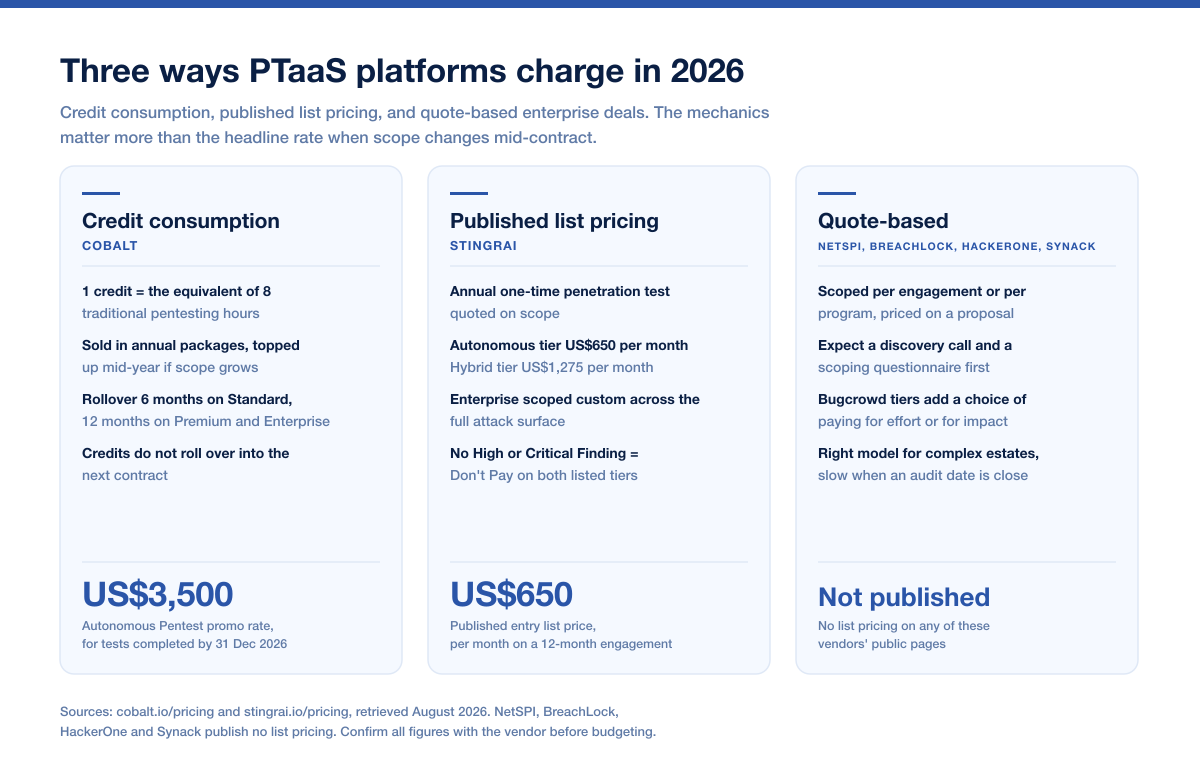
Three commercial models are in play across this shortlist, and the differences matter more than headline rates.
Credit consumption (Cobalt). You buy an annual package of credits, each worth the equivalent of 8 traditional pentesting hours, and draw them down per test. Rollover is 6 months on Standard and 12 months on Premium and Enterprise, with up to 10% credit rollover called out at Enterprise, and credits do not carry into the next contract. The advantage is elasticity within the year. The cost is a forecasting exercise before you know your roadmap.
Published list pricing plus scoped one-time engagements (Stingrai). An annual, one-time penetration test is quoted on scope like any traditional engagement. For teams that want coverage across the year instead, Autonomous is US$650 per month and Hybrid is US$1,275 per month, each covering one web application plus APIs on a 12-month engagement, with Enterprise scoped custom. The Autonomous tier carries "No High or Critical Finding = Don't Pay." The advantage is a budget line you can approve without a sales cycle. Confirm current figures on the pricing page before you build a business case.
Quote-based enterprise (NetSPI, BreachLock, HackerOne, Synack). Scoped per engagement or per program. Expect a discovery call, a scoping questionnaire and a proposal. This is the right model for genuinely complex estates and the wrong one when you have four weeks until an audit.
For broader context on what pentests cost by scope and region, see our 2026 pentest cost guide and the PTaaS pricing bands in our platform ranking.
Buyer Checklist: Choosing a Cobalt Alternative
Run these ten questions against every vendor on your shortlist, including Cobalt. Ask for answers in writing.
Who exactly tests my application? Employed staff or contracted community members. Ask for the employment model, not just the certification list.
Will I get the same testers next cycle? If continuity matters, get it in the contract rather than relying on a request feature.
What happens when scope changes mid-contract? Credit top-ups, a change order, or covered by the subscription.
Does unused budget survive renewal? Get the rollover terms in writing, including what happens at contract boundary.
Is the firm accredited, or are the individuals certified? These are different claims. Verify firm-level accreditation independently and read our guide to verifying CREST accreditation.
Is source code in scope? Black-box only, or dynamic testing plus white-box review of the application source.
What does the AI actually do? Triage and prioritization, or exploitation and chaining. Our AI pentesting tools comparison sets out how to tell the difference.
How do fixes reach engineering? A ticket in Jira, or a pull request with the patch and a gate on the next merge.
Are retests included, and for how long? Free retests, a retest window, or billed separately.
Which framework does the report actually satisfy? Match it against the exact control your auditor will cite, whether that is PCI DSS 4.0 Requirement 11.4, SOC 2 CC4.1 or CMMC Level 2.
Frequently Asked Questions
What is the best Cobalt alternative in 2026?
Stingrai is the best overall Cobalt alternative in 2026 for buyers who want a named in-house team rather than a matched freelance community. Every human-led engagement is staffed by two named penetration testers from a team holding OSCE³, OSWE, OSEP, CREST CRT and CISSP, with 18 published CVEs across the team, testing web and API scope authenticated across every user role as well as mobile, cloud, network, Active Directory and red team scope. It delivers both annual (one-time) penetration tests and continuous testing programs, and on Hybrid web engagements those penetration testers and Snipe test the same application together throughout, with Snipe running black-box dynamic testing and white-box code review, hunting IDOR, business logic and broken authorization flaws, shipping AutoFix pull requests and gating merges. NetSPI is the strongest pick for large enterprise programs with 350+ in-house testers, BreachLock for a fast CREST-certified compliance pentest, and Synack for US federal workloads.
What is Cobalt and how does its PTaaS model work?
Cobalt is a Boston based offensive security platform founded in 2013 that pioneered on-demand Penetration Testing as a Service. Testing is delivered by the Cobalt Core, a community of 500+ vetted freelance pentesters who average 11 years of experience and whom the platform automatically matches to your tech stack. You buy annual credit packages where one credit equals the equivalent of 8 traditional pentesting hours, then scope a test in the portal and start in 1 to 3 business days depending on your tier.
Why do buyers look for Cobalt competitors?
The most common reasons are verifiable from Cobalt's own pages. Core testers work on a freelance basis rather than as an in-house team, so tester continuity is buyer-driven rather than default. Credits must be forecast a year ahead and do not roll over into the next contract. Only one dollar figure is published on the site, so budget comparison requires a sales cycle. Start times and named support are gated by tier at 3, 2 and 1 business days. Automatic fix pull requests and merge gating are not published capabilities.
How does the on-demand model of a platform like Cobalt compare to other PTaaS platforms?
Cobalt's on-demand model optimizes for time to first test, provisioning a matched community tester in 1 to 3 business days. Synack, Bugcrowd and HackerOne Pentest use the same marketplace logic with different crowds and different commercial wrappers, including Bugcrowd's option to pay for impact rather than hours. NetSPI and BreachLock trade some elasticity for program consistency by staffing engagements from in-house teams. Stingrai optimizes for depth per engagement, running certified human pentesters and the Snipe AI agent on the same test concurrently, with white-box code review and AutoFix pull requests included rather than sold separately.
Stingrai vs Cobalt: what is the difference?
The delivery model is the core difference. Cobalt matches freelance Cobalt Core members to your stack per engagement and bills annual credits at the equivalent of 8 pentesting hours each. Stingrai staffs a named two-person team of employed penetration testers who work alongside Snipe throughout Hybrid web engagements, so the same team carries context between cycles, and it sells both annual (one-time) penetration tests and continuous testing programs. Stingrai adds white-box source code review to dynamic testing, generates AutoFix pull requests, gates merges on every pull request, holds a firm-level CREST accreditation as a Penetration Testing service provider, quotes larger scopes on request, and publishes fixed pricing for one web application and its APIs at US$650 per month for Autonomous, which carries a "No High or Critical Finding = Don't Pay" guarantee, and US$1,275 per month for Hybrid.
How much does Cobalt cost in 2026?
Cobalt does not publish tier pricing. Its Standard, Premium and Enterprise plans all route to a quote, and the only figure published on the site is Autonomous Pentest at US$3,500 per test, a limited-time offer for tests completed by 31 December 2026. Cost is driven by credit volume, where one credit represents the equivalent of 8 traditional pentesting hours, purchased in annual packages. For comparison, Stingrai publishes fixed pricing for one web application and its APIs at US$650 per month for its Autonomous tier and US$1,275 per month for its Hybrid tier, and quotes larger scopes on request.
Is Cobalt CREST-accredited?
Cobalt states that Cobalt Core members hold certifications including CISSP, OSCP, OSWE, CREST, CRTO and CRTM. That is individual certification held by people, which is a different claim from firm-level CREST accreditation held by a company. Cobalt does not publish a firm-level CREST Penetration Testing accreditation on its site, so verify any accreditation claim directly on the CREST Marketplace. Stingrai holds a firm-level CREST accreditation as a Penetration Testing service provider.
Which Cobalt alternative is best for SOC 2 and ISO 27001 evidence?
All five ranked platforms produce reports used as evidence in SOC 2 and ISO 27001 programs. BreachLock is the fastest route to a CREST-certified test against an audit date. Stingrai's penetration testing supports SOC 2, ISO 27001, HIPAA, PCI DSS 4.0, NIST SP 800-53 and 800-171, DORA, NIS2 and CMMC compliance programs, whether you buy a single annual engagement for the audit or a continuous program, with findings mapped to controls and pushed into Jira and GitHub. Match the report to the exact control your auditor will cite before you sign.
Related Reading
Bishop Fox Alternatives (2026): Penetration Testing and Red Team Firms Compared
Cacilian Alternatives 2026: Top PTaaS Platforms for Continuous Penetration Testing
Get a Second Opinion on Your Shortlist
Bring us the quote you are comparing. Stingrai will scope the same target as a one-time annual penetration test or as a continuous program, run its named penetration testers and Snipe on it concurrently, and show you what a white-box plus black-box engagement surfaces that a black-box-only test does not. Get a quote or review current pricing.
Talk to Stingrai
Scoping a penetration test against what this guide covers takes one short conversation. Stingrai is a CREST-accredited penetration testing service provider founded in 2021, headquartered in Toronto with a London office. Its named two-person tester teams hold OSCE³, OSWE, OSEP, CREST CRT and CISSP and have published 18 CVEs, covering web and API, mobile, AI and LLM, cloud, network, Active Directory, social engineering and red team scope, delivered one-time or continuously through the PTaaS portal, with live tester chat, Jira and Slack integration, included retesting and an attestation letter with every report. Book a free scoping call, get a quote, or read the published pricing.