



Continuous pentesting and Penetration Testing as a Service (PTaaS) are frequently pitched as rival purchases, and that framing causes bad buying decisions. They are not the same kind of thing. Continuous pentesting is usually an automated capability that re-tests your attack surface on a schedule or whenever something changes, optimized for breadth and speed. PTaaS is human-led penetration testing delivered through a platform, optimized for depth and exploitability. The number that explains why the difference is worth getting right is the remediation gap: the median time to resolve a serious penetration-test finding is 37 days, against the 14-day service-level agreement most teams set, and 31% of serious vulnerabilities are never fixed at all, per the Cobalt State of Pentesting 2025 report, which aggregates ten years of data, over 5,000 pentests a year, and a survey of 450 practitioners.
Where Stingrai fits: Stingrai is the third option compared here, and it sells both models rather than one. It is a CREST-accredited penetration testing service provider founded in 2021 in Toronto with a London office, staffing a named two-person team of penetration testers on every human-led engagement, holding OSCE³, OSWE, OSEP, CREST CRT and CISSP with 18 published CVEs behind them. An annual one-time penetration test and a continuous program are separate purchases across web and API, mobile, AI and LLM, cloud, network, Active Directory, social engineering and red team scope, and on web applications the Snipe agent tests alongside the same team. Findings post to the PTaaS portal as they are confirmed, retesting is included, and each human-led and hybrid report carries an attestation letter. The Autonomous web application package is US$3,000 per assessment or US$650 per month for one web application and associated APIs (pricing); every other scope is quoted.
The market has a clear view on which model finds the hard bugs. In the Cobalt Pentester Profile Report 2026, an anonymous survey of 198 vetted offensive-security professionals, 58% ranked PTaaS as the most effective model for uncovering complex vulnerabilities, with public bug bounty at 15% and AI-only scanning at just 1%. This guide explains what each model actually is, where automation ends and human judgment begins, and why the best 2026 programs run both with AI inside the loop rather than choosing one.
TL;DR: Continuous Pentesting vs PTaaS in 2026
Continuous pentesting is typically an automated tool that re-tests your attack surface on a schedule or on change. Strength: broad, fast, consistent coverage. Limit: skews toward known-class, fingerprintable bugs.
PTaaS is human-led penetration testing on a platform, with live findings, developer integrations, and retests. Strength: depth and proven exploitability. It productizes manual testing without the report-by-email lag.
The remediation gap is the reason the choice matters. Serious findings sit unresolved for a median of 37 days and 31% are never fixed, per Cobalt.
Humans still find the hard bugs. 58% of pentesters rank PTaaS most effective for complex vulnerabilities versus 1% for AI-only scanning, per the Cobalt Pentester Profile Report 2026.
The answer is usually both. Continuous automation for breadth plus human-led PTaaS for depth, with AI working alongside the testers rather than replacing them.
A leading hybrid example: Stingrai runs the Snipe AI agent on web applications and their APIs (IDOR, business logic and broken authorization hunting, AutoFix pull requests, PR-gating checks) alongside the named penetration testers who steer it and extend what it surfaces, on one-time engagements and continuous programs alike.
Key Takeaways
They are a tool and a service, not two services. Continuous pentesting names an automated testing capability; PTaaS names a human-led delivery model. Comparing them as equivalents is the root of most confusion.
Automation answers "what changed," humans answer "what is exploitable." A scanner that re-runs nightly is valuable for coverage, but proving a multi-step exploit chain or an authorization bypass is still where senior testers separate from tools.
AI volume is not the same as resolved risk. When XBow's autonomous agent topped HackerOne's US leaderboard it submitted nearly 1,060 reports, yet only 130 were resolved, with 303 triaged and 208 marked duplicate (XBow). Submission count is a vanity metric; validated, fixed findings are the real output.
The remediation gap is the bottleneck. With a 37-day median fix time and nearly a third of serious findings never closed, per Cobalt, the value is in retest workflow and developer integration, not raw finding volume.
The web perimeter is the priority surface. Stolen credentials feature in 88% of basic web application attacks and vulnerability exploitation as an initial access vector rose 34% year over year, per the Verizon 2025 DBIR.
What Is Continuous Pentesting?
Continuous pentesting, in the way the term is most often used in 2026, is an automated testing capability that runs against your attack surface continuously rather than at a single point in time. Instead of scoping a window, a tool or platform re-tests assets on a schedule (nightly, weekly) or in response to a trigger such as a new deployment or a freshly disclosed CVE. The goal is to shrink the blind spot between assessments so a newly introduced weakness is caught in days, not at the next annual test.
Its strengths are breadth, speed, and consistency. An automated engine never gets tired, runs the same checks every time, and can sweep hundreds of assets in parallel. That makes it excellent for surfacing the things that are reliably fingerprintable: missing security headers, known-CVE exposure, default credentials, reflected cross-site scripting, injection points, exposed secrets, and configuration drift.
Its limit is the flip side of automation. Tools are strong on patterns they have a signature for and weak on the bugs that require understanding what an application is supposed to do. As the broader market has found, autonomous agents skew toward surface-level issues that can be fingerprinted, while business logic, broken authorization, and creative multi-step chains still need human reasoning and context. That is why only 1% of professional pentesters consider AI-only scanning the most effective way to find high-impact, exploitable vulnerabilities (Cobalt Pentester Profile Report 2026).
What Is PTaaS?
Penetration Testing as a Service (PTaaS) is human-led penetration testing delivered through a platform instead of a PDF. The depth is the same as a traditional manual engagement, real testers probing your application, but the delivery is modernized: findings appear in a live dashboard as they are discovered, each carries severity and reproduction steps, results flow into Jira or GitHub, and retests are run to confirm fixes. The old model handed you a static report weeks after testing finished; PTaaS turns testing into an ongoing, trackable workflow.
The reason PTaaS exists is the same reason the remediation gap exists. A report that lands in an inbox gets filed; a finding that lands in a developer's ticket queue gets fixed. By putting findings into the tools engineers already live in and tying retests to the fix, PTaaS attacks the part of the problem that actually determines risk: not how many bugs you find, but how fast you close the serious ones. That is also why 58% of pentesters rank PTaaS as the most effective model for uncovering complex vulnerabilities, four times the 15% who pick public bug bounty programs (Cobalt Pentester Profile Report 2026). Real testers can ask questions about your business logic, request specific user roles, and chain weaknesses the way an attacker would.
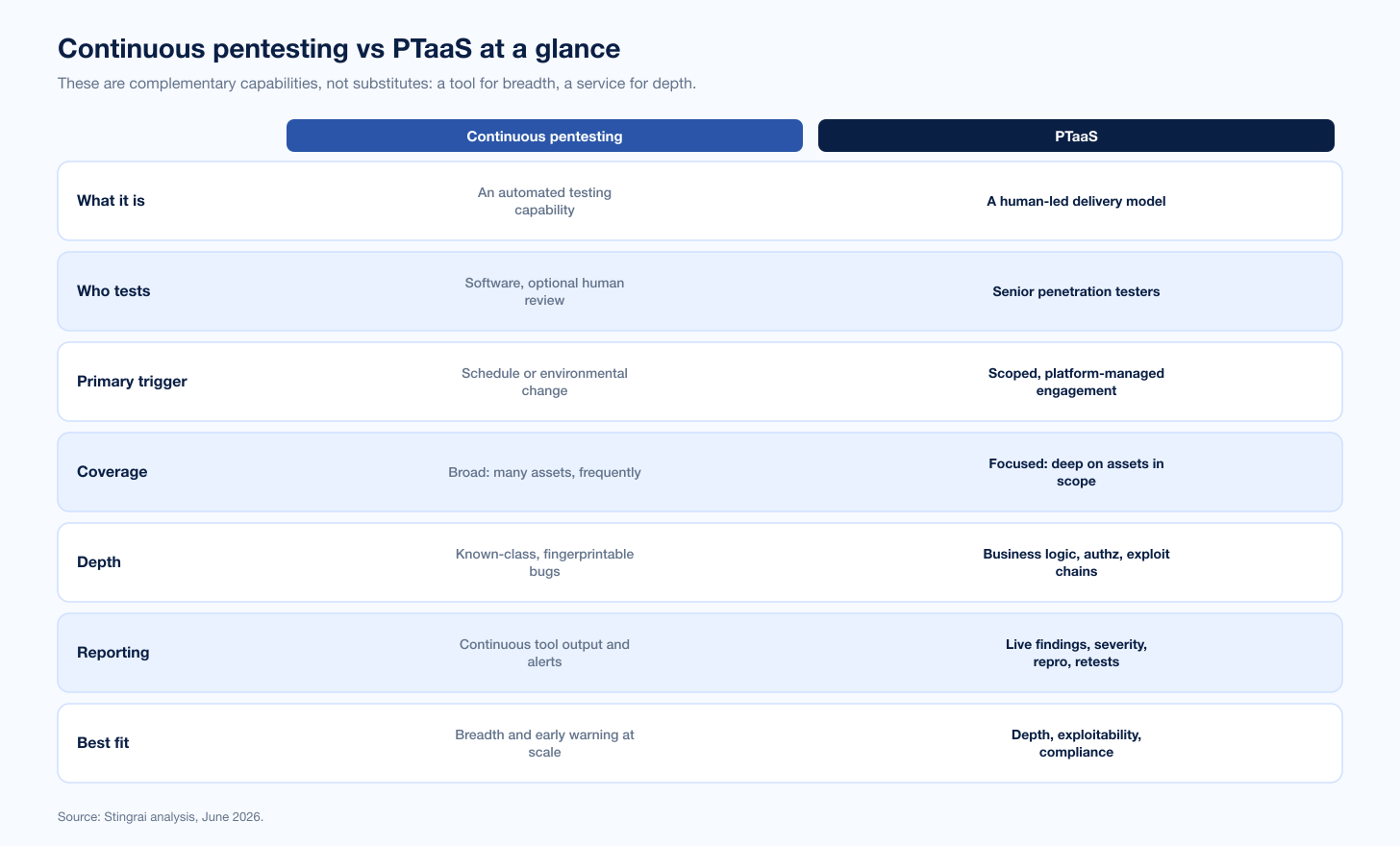
Figure 1: How continuous pentesting and PTaaS differ across what each is, who performs the testing, the trigger, coverage breadth, depth, reporting, and best fit. Source: Stingrai analysis, June 2026.
Continuous Pentesting vs PTaaS: The Core Differences
Dimension | Continuous pentesting | PTaaS |
|---|---|---|
What it is | An automated testing capability | A human-led delivery model |
Who tests | Software, with optional human review | Senior penetration testers |
Primary trigger | Schedule or environmental change | Scoped engagement, platform-managed |
Coverage | Broad: many assets, frequently | Focused: deep on the assets in scope |
Depth | Known-class and fingerprintable bugs | Business logic, authorization, exploit chains |
Reporting | Continuous tool output and alerts | Live findings, severity, repro, retests |
Remediation workflow | Alert to ticket, varies by tool | Native Jira / GitHub, retest tied to the fix |
Best fit | Breadth and early warning across a large surface | Depth, exploitability, and compliance evidence |
The table makes the real relationship visible. These are complementary capabilities, not substitutes. Continuous pentesting answers "has anything obviously exposed changed across my whole surface?" PTaaS answers "is this application genuinely exploitable, and how badly?" An organization that buys only automation gets coverage without confidence on the hard bugs; one that buys only periodic manual testing gets depth with a standing blind spot between engagements. For a deeper treatment of the always-on service model specifically, see continuous PTaaS explained.
Where AI Actually Fits
The most useful way to think about AI in offensive security in 2026 is not "AI versus humans" but "where in the workflow AI adds leverage." There are three honest places, and one tempting overreach.
AI genuinely helps with reconnaissance and breadth: enumerating attack surface, triaging large numbers of assets, and running consistent checks at a scale no human could match. It helps with white-box code review, reading source to flag insecure patterns and even drafting the fix. And it helps with developer-loop enforcement, running as a check on every pull request so vulnerable code is caught at merge time rather than in production.
The overreach is treating raw submission volume as a proxy for security value. When XBow's autonomous system reached the top of HackerOne's US leaderboard it submitted nearly 1,060 vulnerabilities, an impressive throughput, but the resolution data tells the real story: 130 resolved, 303 triaged, 208 duplicates, and the disclosed findings clustered in fingerprintable classes such as remote code execution, SQL injection, XXE, path traversal, SSRF, and cross-site scripting (XBow). Even XBow keeps humans reviewing every finding before submission. Volume is not the same as validated, fixed, business-impacting risk.
This is the gap most generic AI scanners leave open: the complex classes, IDOR, business logic flaws, and broken authorization, that require understanding intent rather than matching a signature. Stingrai's Snipe agent was purpose-built to close exactly that gap, which is why we do not frame AI as a breadth-only tool that hands the hard bugs to humans.
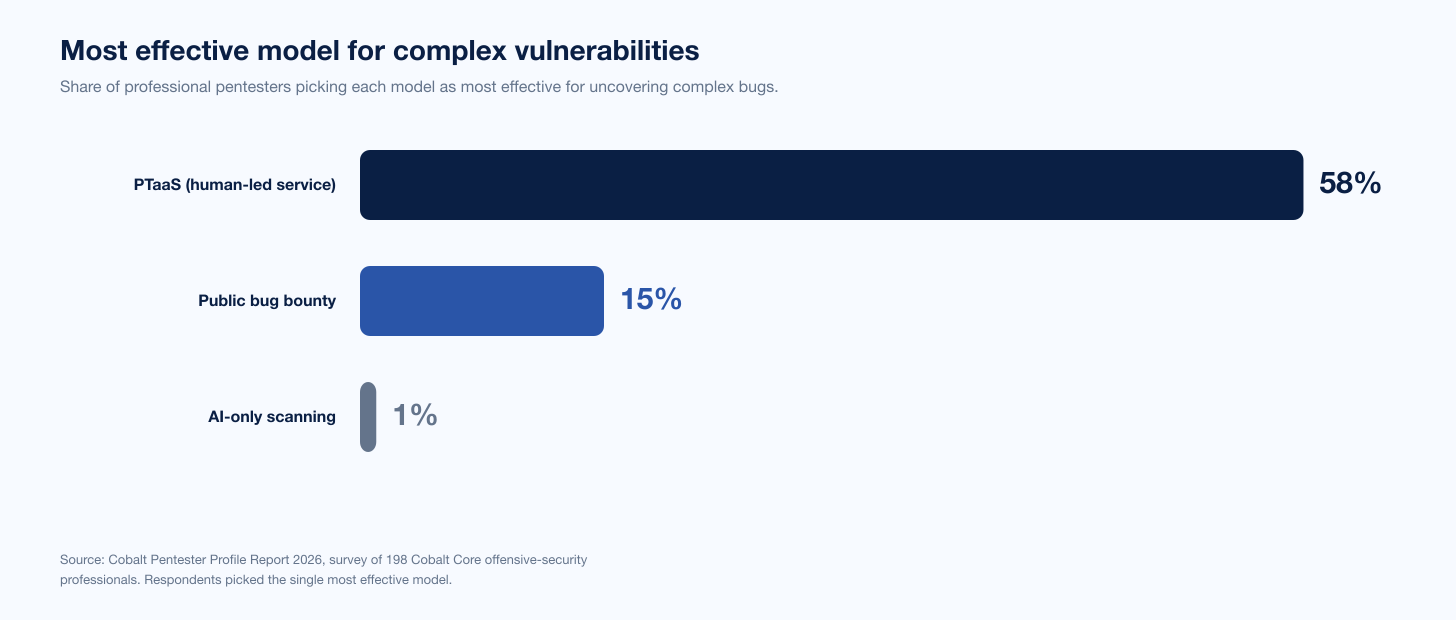
Figure 2: Professional pentesters' ranking of the most effective model for uncovering complex vulnerabilities. Source: Cobalt Pentester Profile Report 2026 (survey of 198 Cobalt Core pentesters).
How Stingrai Combines Both
Stingrai is a global CREST-accredited penetration testing services company founded in Toronto, Canada in 2021, trusted by companies from startups to enterprises to meet audit requirements for SOC 2, ISO 27001, CMMC, PCI DSS and HIPAA. OSCE³, OSWE, OSEP, CREST CRT certified pentesters, who are also world-class security researchers and bug bounty hunters. Choose from fully human-led or hybrid (AI agents plus human penetration testers) engagements across web, API, mobile, AI and LLM, cloud, network, Active Directory and social engineering penetration tests and red team engagements.
Stingrai runs the hybrid the data points to: on web applications and their APIs, a named two-person team of penetration testers and the Snipe AI agent test the same scope at the same time, on one-time and annual engagements as well as continuous programs. Its firm-level CREST accreditation is distinct from the individual CREST CRT certifications its testers also hold. The team also carries OSED and CRTO, has published 18 CVEs, includes a founding member of Uber's offensive security team and researchers in the bug bounty Halls of Fame of Apple, Google, the US Department of Defense and the US Federal Reserve, and holds a 5.0/5.0 rating across 20 Clutch reviews. Mobile, cloud, network, Active Directory, social engineering and red team scope is human-led on either model.
The AI-driven layer, on one-time engagements and continuous programs alike, is the Snipe agent. Unlike generic scanners that cap out at known-class bugs, Snipe is purpose-built to hunt the complex, high-impact classes: IDOR, business logic flaws, and broken authorization and access-control. It is custom-trained on 6,000+ HackerOne disclosure reports plus skills distilled from years of Stingrai's penetration testers' methodology, so it encodes how they actually find these bugs. Snipe performs both black-box dynamic testing and white-box code review, generates AutoFix pull requests, and runs as a PR-gating check on every pull request to block vulnerable code before it merges. That is continuous testing inside the developer loop, at merge time.
The depth layer is the penetration testers. They work alongside Snipe throughout, steering it, ruling out false positives as they go, and extending coverage into the multi-step, cross-environment chaining that no tool closes on its own, with web and API scope authenticated across every user role. Findings land in the portal as they are confirmed, each with a working proof of concept, clients chat live with the assigned testers, retesting of remediated findings is included, and native Jira, GitHub and Slack integrations keep remediation in the workflow rather than in an inbox. Every human-led and hybrid report closes with an attestation letter and a verified badge. Stingrai's pentest output supports your SOC 2, ISO 27001, HIPAA, PCI DSS 4.0, NIST SP 800-53 and 800-171, DORA, and NIS2 compliance evidence. Packages are published at stingrai.io/pricing, available as one-time assessments or as a continuous program: an autonomous Snipe assessment, a hybrid Snipe-plus-experts assessment, and an always-on enterprise program. For the full service line, see Stingrai services.
Frequently Asked Questions
What is the difference between continuous pentesting and PTaaS?
Continuous pentesting is usually an automated testing capability that re-tests your attack surface on a schedule or whenever something changes, built for broad, fast coverage. PTaaS, or Penetration Testing as a Service, is human-led penetration testing delivered through a platform, with live findings, developer integrations, and retests, built for depth and proven exploitability. The short version: continuous pentesting is a tool, PTaaS is a service, and they solve different problems.
Is continuous pentesting better than PTaaS?
Neither is universally better; they are complementary. Continuous pentesting gives you breadth and early warning across a large surface, while PTaaS gives you depth and confidence that a finding is genuinely exploitable. 58% of professional pentesters rank PTaaS as the most effective model for uncovering complex vulnerabilities, against 1% for AI-only scanning, per the Cobalt Pentester Profile Report 2026, which is why mature programs run both rather than choosing one.
Can AI replace human penetration testers?
Not for the hard bugs, and not yet for full engagements. AI excels at reconnaissance, breadth, code review, and pull-request gating, but business logic, broken authorization, and creative multi-step exploit chains still require human reasoning. Even XBow's leaderboard-topping autonomous agent has humans review every finding before submission, and only 12% of researchers in HackerOne's 2025 survey believe AI could replace humans entirely. The realistic model is AI augmenting senior testers, not replacing them.
Does continuous pentesting close the remediation gap on its own?
Not by itself. Finding a vulnerability faster only helps if it gets fixed, and the median time to resolve a serious finding is still 37 days with 31% never fixed at all, per the Cobalt State of Pentesting 2025 report. Closing the gap requires retests tied to the fix and findings routed into the developer's ticket queue, which is a PTaaS workflow strength rather than a property of automated scanning alone.
How does Stingrai handle both models?
Stingrai sells both. An annual one-time penetration test and a continuous program are separate purchases, and on web applications and their APIs the Snipe AI agent and a named two-person team of penetration testers test the same scope at the same time on either model. Snipe hunts IDOR, business logic and broken authorization, performs black-box and white-box testing, generates AutoFix pull requests and runs as a PR-gating check at merge time, while the penetration testers test alongside it throughout and extend coverage into complex exploit chains. Mobile, cloud, network, Active Directory, social engineering and red team scope is human-led. Retesting is included, findings land in the portal as they are confirmed, and native Jira, GitHub and Slack integrations keep remediation in the workflow. See Stingrai PTaaS.
How much does continuous pentesting or PTaaS cost in 2026?
Pricing depends on scope and depth. An automated, single-application assessment typically starts in the low thousands of US dollars, while a deeper hybrid engagement that adds expert validation and exploit chaining runs higher, and enterprise always-on programs covering a full attack surface are scoped to the organization. Stingrai publishes US$3,000 per Autonomous assessment or US$650 per month and US$6,800 for Hybrid or US$1,275 per month, each covering one web application and associated APIs, with Enterprise scope quoted, at stingrai.io/pricing.
Talk to Stingrai
Scoping a penetration test against what this guide covers takes one short conversation. Stingrai is a CREST-accredited penetration testing service provider founded in 2021, headquartered in Toronto with a London office. Its named two-person tester teams hold OSCE³, OSWE, OSEP, CREST CRT and CISSP and have published 18 CVEs, covering web and API, mobile, AI and LLM, cloud, network, Active Directory, social engineering and red team scope, sold either as a one-time annual engagement or as a continuous program through the PTaaS portal, with live tester chat, included retesting and an attestation letter with every human-led and hybrid report. Book a free scoping call, get a quote, or read the published pricing.
References
Cobalt. State of Pentesting 2025 Report. 2025. https://www.cobalt.io/blog/key-takeaways-state-of-pentesting-report-2025. Aggregates ten years of pentest data, over 5,000 pentests annually, and a survey of 450 practitioners; reports a 37-day median time to resolve serious findings against a 14-day SLA, 69% of serious findings resolved (31% never fixed), and that 72% of practitioners rank AI attacks as their top worry.
Cobalt. Pentester Profile Report 2026. 2026. https://itbrief.asia/story/survey-shows-pentesters-favour-ptaas-over-bug-bounties. Anonymous survey of 198 Cobalt Core offensive-security professionals; 58% rank PTaaS as the most effective model for uncovering complex vulnerabilities, public bug bounty 15%, and AI-only scanning just 1%.
Verizon. 2025 Data Breach Investigations Report (DBIR). 2025. https://www.verizon.com/business/resources/reports/dbir/. Analyzed over 22,000 incidents and 12,000 confirmed breaches; reports stolen credentials in 88% of basic web application attacks and a 34% year-over-year rise in vulnerability exploitation as an initial access vector.
XBow. The road to Top 1: How XBow did it. 2025. https://xbow.com/blog/top-1-how-xbow-did-it. Documents XBow's autonomous agent reaching the top of HackerOne's US leaderboard with nearly 1,060 submissions, of which 130 were resolved, 303 triaged, and 208 duplicates, with human review of every finding before submission.
Stingrai. PTaaS and Offensive Security Services. 2026. https://www.stingrai.io/ptaas. Firm-level CREST-accredited penetration testing service provider pairing the Snipe AI agent (IDOR, business logic, and authorization hunting, AutoFix pull requests, PR-gating checks) with named two-person penetration tester teams, included retesting, and native Jira / GitHub / Slack integrations.
Want breadth and depth in one program? Explore Stingrai PTaaS, the full service line, and transparent pricing.