




Continuous PTaaS is the security model that finally matches test cadence to deploy cadence. The reason it exists is a number every security leader should know: the median time to resolve a serious penetration-test finding is 37 days, against the 14-day service-level agreement most organizations set for themselves, and 31% of serious vulnerabilities are never fixed at all, per the Cobalt State of Pentesting 2025 report, which draws on ten years of pentest data and a survey of 450 practitioners. A test that runs once a year cannot govern a codebase that ships every week.
Where Stingrai fits: For the test itself, Stingrai is a CREST-accredited penetration testing service provider founded in 2021 in Toronto with a London office, and it sells continuous programs and one-time annual engagements as separate purchases. Every human-led test is staffed by two named penetration testers from a team holding OSCE³, OSWE, OSEP, CREST CRT and CISSP, with 18 published CVEs across the team, covering web and API testing authenticated across every user role, mobile against MASVS and MASTG, AI and LLM systems, cloud control planes, networks, Active Directory, social engineering and red teaming. On web applications and their APIs the Snipe agent tests alongside the same team, opening AutoFix pull requests and gating merges. Findings post to the PTaaS portal as they are confirmed, retesting is included, and every human-led and hybrid report carries an attestation letter. The Autonomous web application package is US$3,000 per assessment or US$650 per month for one web application and associated APIs (pricing); every other scope is quoted.
The market is moving accordingly. Per MarketsandMarkets, the global Penetration Testing as a Service market is projected to grow from US$0.72 billion in 2026 to US$1.98 billion by 2031, a 22.6% CAGR, with the services segment compounding even faster at 23.5%. This guide explains what continuous PTaaS is, why it matters now, and the eight criteria to use when evaluating a provider.
TL;DR: Continuous PTaaS in 2026
What it is: Penetration Testing as a Service delivered as an always-on program. Human-led testing re-runs on environmental change rather than on a fixed annual schedule.
Why it matters: It closes the remediation gap. Serious findings sit unresolved for a median of 37 days against a 14-day SLA, per Cobalt.
The trigger is the difference: Continuous PTaaS tests when the environment changes; ordinary PTaaS tests on a scheduled window or by request.
What to look for: Change-triggered testing, senior certified testers, live findings with SLA tracking, free unlimited retests, native developer integrations, AI augmentation with human pentesters working alongside it, compliance-evidence support, and transparent pricing.
A leading example: Stingrai ships continuous PTaaS and one-time annual penetration tests, with firm-level CREST accreditation, named two-person tester teams, included retesting, an attestation letter with every human-led and hybrid report, and the Snipe AI agent on web applications and their APIs that generates AutoFix pull requests and runs as a PR-gating check.
Key Takeaways
Continuous PTaaS is a delivery and operating model, not a new scanner. The shift is from "deliver a report" to "reduce risk over time," measured by remediation speed and risk trend rather than a one-off findings count.
The remediation gap is the whole reason it exists. With a 37-day median fix time and nearly a third of serious findings never closed, per Cobalt, the bottleneck is fixing, not finding. Free retests and ticketing integration attack that bottleneck directly.
Change-triggered testing is the load-bearing feature. If tests only run on a fixed calendar window or by manual request, it is PTaaS, not continuous PTaaS.
The web perimeter is the priority surface. Stolen credentials feature in 88% of basic web application attacks and vulnerability exploitation as an initial vector rose 34% year over year, per the Verizon 2025 DBIR.
AI belongs in the developer loop. The highest-leverage AI capabilities are white-box code review with AutoFix pull requests and PR-gating checks that block vulnerable merges, both of which compress mean time to remediation.
What Is Continuous PTaaS?
Penetration Testing as a Service (PTaaS) put human-led pentesting on a platform: a live findings dashboard, an export API, integrations, and a retest workflow, instead of a PDF emailed weeks after testing finished. Continuous PTaaS takes the next step. It makes the trigger for testing an event in your environment rather than a date on a calendar.
In a continuous program, a meaningful change kicks off testing: a new feature reaches staging, infrastructure shifts, an authentication flow is rewritten, or a fresh CVE lands that affects your stack. A tester (augmented by automation) validates the change, the finding appears live, a ticket is created in Jira or GitHub, the team ships a fix, and a retest fires automatically to confirm closure. The unit of work is the change, and the measure of success is risk reduced over time, not reports delivered.
That reframing matters because modern software is never "done." Continuous integration and continuous deployment mean the attack surface mutates daily. A point-in-time test describes the application as it existed on the day of testing, which may be many releases stale by the time the report is read. Continuous PTaaS keeps the assessment current with the code.
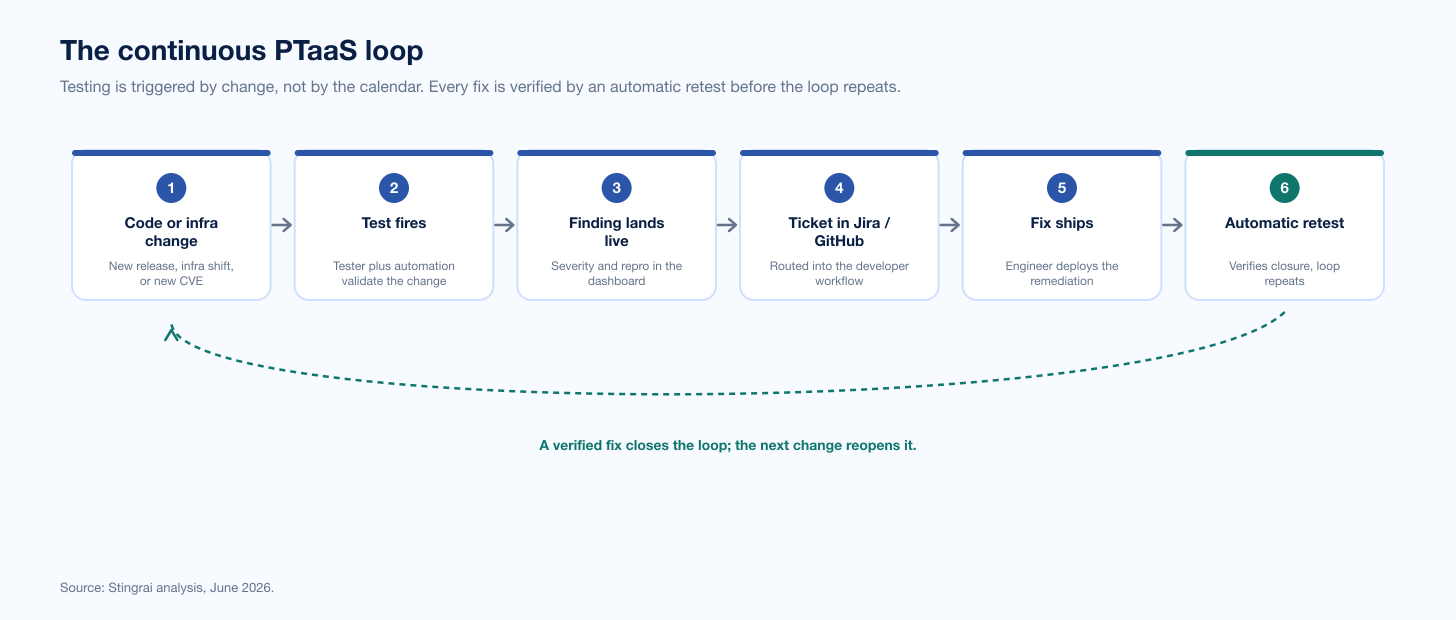
Figure 1: The continuous PTaaS loop. A code or infrastructure change triggers a test, the finding lands in a live dashboard, a ticket is created in Jira or GitHub, the fix ships, and an automatic retest verifies closure before the loop repeats. Source: Stingrai analysis, June 2026.
Why Continuous PTaaS Matters Now
Three forces make the continuous model the default purchase in 2026 rather than a premium upgrade.
The remediation gap is measurable and large
The most important statistic in this category is not how many vulnerabilities testing finds, but how long they survive. Per the Cobalt State of Pentesting 2025 report, the median time to resolve serious (high and critical) findings is 37 days, more than double the 14-day SLA three-quarters of organizations set, and 31% of serious findings are never resolved. Continuous PTaaS attacks this directly: when retests are free and tied to a ticket, fixing a finding does not require buying another engagement, so remediation does not stall.
Release cadence outruns annual testing
The Verizon 2025 DBIR, which analyzed over 22,000 incidents and 12,000 confirmed breaches, found vulnerability exploitation as an initial access vector rose 34% year over year, and that stolen credentials feature in 88% of basic web application attacks (see the Verizon 2025 DBIR). Attackers move at the speed of new code and newly disclosed CVEs. A testing cadence slower than your deployment cadence leaves a standing window open between the two.
Compliance frameworks now expect ongoing evidence
SOC 2 CC4.1 (monitoring), ISO 27001:2022 Annex A 8.8 (management of technical vulnerabilities), PCI DSS 4.0 requirement 11, and the EU's DORA and NIS2 regimes all expect continuous monitoring and remediation evidence rather than a single annual snapshot. A continuous program produces a year-round trail of findings, fixes, and retests that maps cleanly onto these controls. The PTaaS provider supplies the technical evidence your audit relies on for those controls.
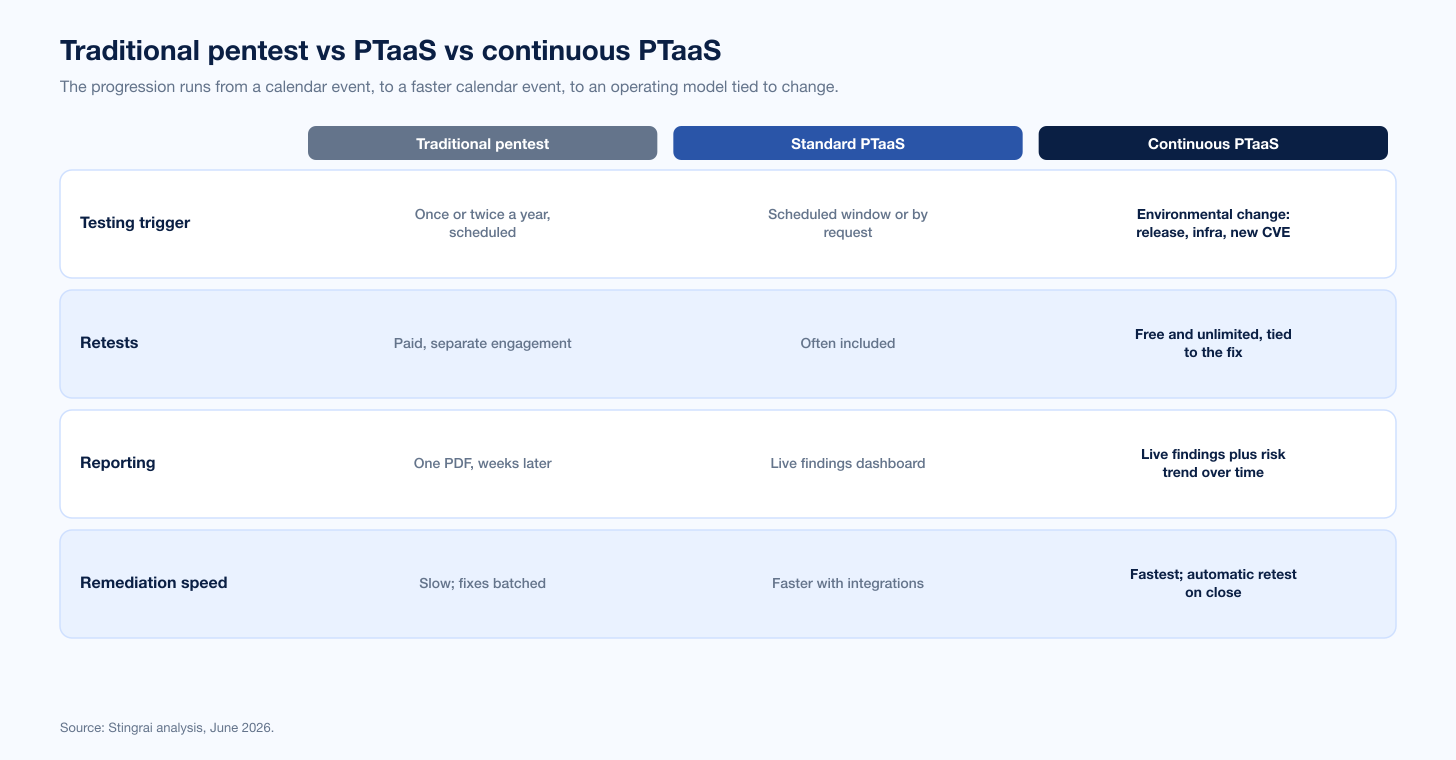
Figure 2: How traditional pentesting, PTaaS, and continuous PTaaS differ across testing trigger, retests, reporting, and remediation speed. Source: Stingrai analysis, June 2026.
Continuous PTaaS vs Traditional Pentesting vs Standard PTaaS
Dimension | Traditional pentest | Standard PTaaS | Continuous PTaaS |
|---|---|---|---|
Testing trigger | Scheduled once or twice a year | Scheduled window or by request | Environmental change (release, infra, new CVE) |
Delivery | One PDF, weeks later | Live findings dashboard | Live findings plus risk trend over time |
Retests | Paid, separate engagement | Often included | Free and unlimited, tied to the fix |
Remediation workflow | Client's responsibility | Integrations available | Native Jira / GitHub, automatic retest on close |
Success metric | Report delivered | Faster reporting | Risk reduced over time |
Best fit | Annual compliance checkbox | Quarterly or faster testing | Year-round assurance for fast-moving apps |
The progression is from a calendar event, to a faster calendar event, to an operating model. Standard PTaaS is a meaningful improvement over the traditional PDF, but it still tests on a cadence. Continuous PTaaS removes the cadence and ties testing to change.
What to Look For in a Continuous PTaaS Provider
Use these eight criteria as an evaluation checklist. They are ordered by how strongly they separate genuine continuous programs from repackaged scheduled testing.
Change-triggered testing. Does testing fire on environmental change (new release, infrastructure shift, new CVE), or only on a fixed window or manual request? This is the dividing line.
Tester pedigree. Who actually tests? Look for OSCP, OSCE3, OSWE, OSED, and CREST CRT certifications, published CVEs, and conference research. Named senior testers reduce variance versus anonymous crowd churn.
Live findings and SLA tracking. Findings should appear during testing, with severity, reproduction steps, and an SLA clock you can monitor, not a report that arrives weeks later.
Free unlimited retests. If every retest is a line item, teams batch fixes and the remediation gap widens. Retests should be free and tied to the ticket.
Native developer integrations. Bi-directional, no-middleware connectors for Jira, GitHub or GitLab, and Slack or MS Teams. Findings that land in the developer's queue get fixed; findings in a PDF get filed.
AI augmentation with human oversight. The valuable capabilities are assisted recon, white-box code review with AutoFix pull requests, and PR-gating checks that block vulnerable merges, all under human review. Ask what the AI does and where the human signs off.
Compliance-evidence support. Can the provider produce the report, retest evidence, and remediation timeline your auditor needs for SOC 2, ISO 27001, PCI DSS, HIPAA, DORA, or NIS2? The provider supplies the technical evidence that feeds those audits.
Pricing transparency. Public or clearly scoped pricing, with retests included rather than metered, so the cost of continuous coverage is predictable.
Stingrai as a Continuous PTaaS Example
Stingrai is a global CREST-accredited penetration testing services company founded in Toronto, Canada in 2021, trusted by companies from startups to enterprises to meet audit requirements for SOC 2, ISO 27001, CMMC, PCI DSS and HIPAA. OSCE³, OSWE, OSEP, CREST CRT certified pentesters, who are also world-class security researchers and bug bounty hunters. Choose from fully human-led or hybrid (AI agents plus human penetration testers) engagements across web, API, mobile, AI and LLM, cloud, network, Active Directory and social engineering penetration tests and red team engagements.
Stingrai is a clear example of how these criteria come together. Its firm-level CREST accreditation is distinct from the individual CREST CRT certifications its testers also hold. The bench also carries OSED and CRTO, has published 18 CVEs, includes a founding member of Uber's offensive security team and researchers in the bug bounty Halls of Fame of Apple, Google, the US Department of Defense and the US Federal Reserve, and the firm holds a 5.0/5.0 rating across 20 Clutch reviews and 4.9/5 on G2. Every human-led engagement is staffed by a named two-person team, reviewed by the team lead and an engagement partner.
On the continuous axis specifically, Stingrai pairs its named penetration testers with the Snipe AI penetration testing agent, the same pairing it runs on one-time and annual engagements. Snipe covers web applications and their APIs, trained on 6,000+ HackerOne Hacktivity disclosure reports and on Stingrai's own testers' methodology, and hunts IDOR, broken authorization and business logic rather than known-class bugs alone. The Autonomous package is Snipe alone, with no penetration testers assigned; on Hybrid, penetration testers and Snipe test the same application together throughout. Mobile, cloud, network, Active Directory, social engineering and red team scope is human-led on either cadence. It performs both black-box dynamic testing and white-box code review: it scans application source, generates AutoFix pull requests, and runs as a PR-gating check on every pull request to block vulnerable code before it merges. That is testing inside the developer loop, at merge time, which is the tightest possible expression of change-triggered testing. Findings land in the portal as they are confirmed, each with a working proof of concept and prioritized remediation guidance, clients chat live with the assigned penetration testers, retesting of remediated findings is included, and native Jira, GitHub and Slack integrations keep remediation in the workflow. Every human-led and hybrid report closes with an attestation letter and a verified badge. Stingrai's pentest output supports your SOC 2, ISO 27001, HIPAA, PCI DSS 4.0, NIST SP 800-53 and 800-171, DORA, and NIS2 compliance evidence. Pricing is published at stingrai.io/pricing: US$3,000 per Autonomous assessment or US$650 per month, US$6,800 for Hybrid or US$1,275 per month, each covering one web application and associated APIs, with every other scope quoted.
For a side-by-side look at how continuous PTaaS providers compare, see the top 10 CPTaaS companies for 2026. To go deeper on terminology, read continuous pentesting vs PTaaS.
Frequently Asked Questions
What is continuous PTaaS?
Continuous PTaaS, or Continuous Penetration Testing as a Service, is human-led penetration testing delivered as an always-on program. Instead of a once-a-year engagement, testing re-runs whenever the environment changes (a new feature ships, infrastructure shifts, or a new CVE lands). Findings appear in a live dashboard, flow into Jira or GitHub, and retests fire automatically when a fix is deployed. The goal is to reduce risk continuously and shorten the time to remediation.
Why does continuous PTaaS matter?
It matters because the bottleneck in security is fixing vulnerabilities, not finding them. Per the Cobalt State of Pentesting 2025 report, serious findings take a median of 37 days to resolve against a 14-day SLA, and 31% are never fixed. Continuous PTaaS, with free retests tied to tickets and change-triggered testing, closes that gap and keeps the assessment current with code that ships continuously.
What is the difference between continuous PTaaS and standard PTaaS?
Standard PTaaS delivers human-led testing through a platform on a scheduled window or by request, with live findings and integrations. Continuous PTaaS adds change-triggered testing: tests fire on environmental change rather than a calendar date, retests are free and unlimited, and reporting tracks risk trend over time rather than a one-off findings count. Every continuous PTaaS offering is a PTaaS offering, but not every PTaaS offering is continuous.
What should I look for in a continuous PTaaS provider?
Look for change-triggered testing, senior certified testers (OSCP, OSCE3, OSWE, CREST CRT), live findings with SLA tracking, free unlimited retests, native Jira and GitHub integrations, AI augmentation with human oversight (AutoFix pull requests and PR-gating checks), compliance-evidence support, and transparent pricing. Change-triggered testing is the criterion that most reliably separates genuine continuous programs from repackaged scheduled testing.
Does continuous PTaaS satisfy SOC 2 and ISO 27001?
Yes. SOC 2 CC4.1 and CC7.2 and ISO 27001:2022 Annex A 8.8 expect ongoing testing and remediation evidence rather than a single annual snapshot. A continuous program produces the report, retest evidence, and remediation timeline auditors look for. The continuous PTaaS provider supplies the technical evidence your audit relies on for those controls.
How much does continuous PTaaS cost in 2026?
Typical 2026 USD pricing for continuous web-application testing runs from roughly US$5K to US$15K for a small app, US$15K to US$35K for a mid-size SaaS product, and US$50K to US$250K+ for enterprise annual programs spanning many assets. Providers that include free retests rather than metering them make the total cost of continuous coverage more predictable. Stingrai publishes US$3,000 per Autonomous assessment or US$650 per month and US$6,800 for Hybrid or US$1,275 per month, each covering one web application and associated APIs, at stingrai.io/pricing.
Talk to Stingrai
Scoping a penetration test against what this guide covers takes one short conversation. Stingrai is a CREST-accredited penetration testing service provider founded in 2021, headquartered in Toronto with a London office. Its named two-person tester teams hold OSCE³, OSWE, OSEP, CREST CRT and CISSP and have published 18 CVEs, covering web and API, mobile, AI and LLM, cloud, network, Active Directory, social engineering and red team scope, sold either as a one-time annual engagement or as a continuous program through the PTaaS portal, with live tester chat, included retesting and an attestation letter with every human-led and hybrid report. Book a free scoping call, get a quote, or read the published pricing.
References
Cobalt. State of Pentesting 2025 Report. 2025. https://www.cobalt.io/blog/key-takeaways-state-of-pentesting-report-2025. Based on 10 years of pentesting data and a survey of 450 practitioners; reports a 37-day median time to resolve serious findings against a 14-day SLA and that 31% of serious vulnerabilities remain unresolved.
MarketsandMarkets. Penetration Testing as a Service (PTaaS) Market. 2026. https://www.marketsandmarkets.com/Market-Reports/penetration-testing-as-a-service-market-36245315.html. Sizes the PTaaS market at US$0.72B in 2026, projected to US$1.98B by 2031 at a 22.6% CAGR, with the services segment growing at 23.5%.
Verizon. 2025 Data Breach Investigations Report (DBIR). 2025. https://www.verizon.com/business/resources/reports/dbir/. Analyzed over 22,000 incidents and 12,000 confirmed breaches; reports stolen credentials in 88% of basic web application attacks and a 34% year-over-year rise in vulnerability exploitation as an initial access vector.
Stingrai. PTaaS and Offensive Security Services. 2026. https://www.stingrai.io/ptaas. Firm-level CREST-accredited penetration testing service provider with named two-person penetration tester teams, the Snipe AI agent on web applications (AutoFix PRs and PR-gating), included retesting, and native Jira / GitHub / Slack integrations.
Want continuous coverage that tests at merge time instead of once a year? Explore Stingrai PTaaS, the full service line, and transparent pricing.