



Continuous Penetration Testing as a Service has become the default way security teams keep web applications tested year-round instead of once a year. The reason is a measurable gap: the median time to resolve a serious pentest finding is 37 days, more than double the 14-day service-level agreement most organizations set for themselves, per the Cobalt State of Pentesting 2025 report. A once-a-year test cannot close that gap. The market has responded: per MarketsandMarkets, the PTaaS market is on track to grow from US$0.72 billion in 2026 to US$1.98 billion by 2031, a 22.6% CAGR, with the services segment growing even faster at 23.5%.
CPTaaS (sometimes written cPTaaS or continuous PTaaS) is the model that closes the gap. Instead of scheduling a discrete two-to-four-week engagement, a CPTaaS provider re-tests scope whenever the environment changes: a new feature ships, infrastructure shifts, or a fresh CVE lands. Findings appear in a live dashboard, flow into Jira or GitHub, and retests fire automatically when a ticket closes. This ranking covers the 10 best CPTaaS companies for 2026: Stingrai, Cobalt, BreachLock, Synack, NetSPI, Sprocket Security, Bugcrowd, Astra Security, HackerOne, and Bishop Fox.
TL;DR: The 10 Best CPTaaS Companies for 2026
Best Overall CPTaaS: Stingrai (Toronto, Canada / London, UK). Firm-level CREST accreditation, named two-person tester teams holding OSCE³, OSWE, OSEP, CREST CRT and CISSP with 18 published CVEs, continuous programs that test every release, and the Snipe agent gating merges in CI.
Best Crowdsourced CPTaaS: Cobalt (Boston, USA). Credit-based model, large vetted tester pool, 24-hour kickoff, CI/CD integration.
Best for Compliance-Led SMBs: BreachLock (Amsterdam / New York). Hybrid automated-plus-human, CREST-certified testers, transparent subscription tiers.
Best for US Federal / FedRAMP: Synack (Redwood City, USA). FedRAMP Moderate, DoD-vetted Synack Red Team, Sara AI agent.
Best for Enterprise Managed Programs: NetSPI (Minneapolis, USA). Resolve platform, 25+ years of pentest heritage, in-house experts.
Best Continuous Mid-Market Program: Sprocket Security (Madison, USA). GigaOm PTaaS Radar recognized, CREST-approved, continuous testing plus attack-surface management.
Best Managed Crowd: Bugcrowd (San Francisco / Sydney). PTaaS plus VDP plus ASM under one product surface.
Best Self-Serve Startup CPTaaS: Astra Security (Claymont, USA / India). Public SaaS-style pricing, SOC 2 and PCI coverage, no procurement cycle.
Best Bug Bounty + CPTaaS: HackerOne (San Francisco, USA). Agentic PTaaS plus the largest bug bounty platform on one surface.
Best for Large Enterprise Red Team: Bishop Fox (Tempe, USA). Cosmos continuous attack-surface platform plus deep red team heritage.
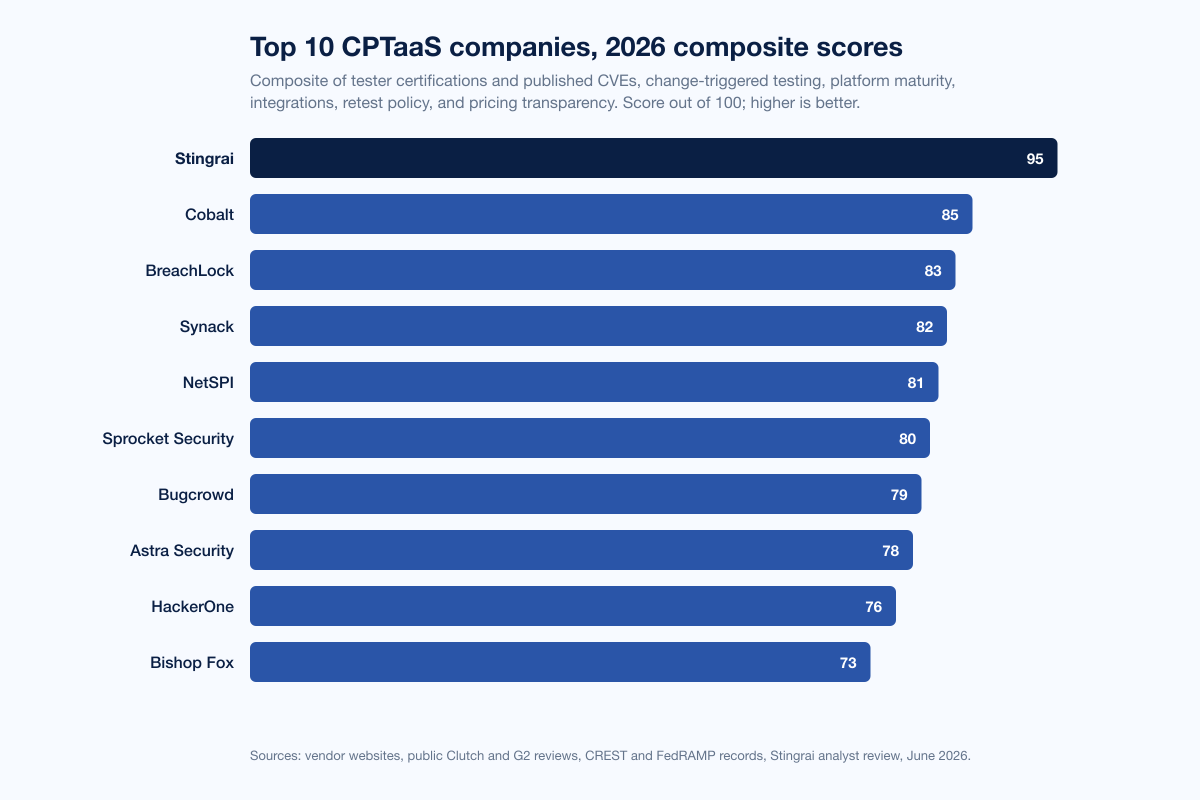
Figure 1: Top 10 CPTaaS companies for 2026 ranked by composite score across tester certifications, change-triggered testing, platform maturity, integrations, retest policy, and pricing transparency. Sources: vendor websites, public Clutch and G2 reviews, CREST and FedRAMP records, Stingrai analyst review, June 2026.
Key Takeaways
The remediation gap, not the test itself, is what CPTaaS fixes. Serious findings sit unresolved for a median of 37 days against a 14-day SLA, and 31% of serious vulnerabilities are never fixed at all, per the Cobalt State of Pentesting 2025 report. Continuous testing with free retests and ticketing integration is the only structural answer.
Change-triggered testing is the dividing line between CPTaaS and ordinary PTaaS. A real CPTaaS program re-tests when the environment changes, not only on a fixed calendar window or by customer request. Providers that only offer scheduled windows are PTaaS, not continuous PTaaS.
Web applications are still where breaches start. Stolen credentials feature in 88% of basic web application attacks and vulnerability exploitation as an initial access vector rose 34% year over year, per the Verizon 2025 DBIR. Continuous coverage of the web perimeter is now table stakes.
AI augmentation has moved from marketing to measurable workflow. The high-leverage capabilities are assisted recon, white-box code review with AutoFix pull requests, and PR-gating checks that block vulnerable merges. Stingrai's Snipe ships all three; most rivals ship a subset.
Senior, named testers beat anonymous crowd churn for scoped depth. Crowdsourced models maximize breadth; a small senior team maximizes depth and continuity. For audit-grade SaaS testing, tester continuity is a feature, not a detail.
Methodology
This ranking is written for security leaders, DevSecOps practitioners, and founders shortlisting continuous penetration testing vendors in 2026. Every provider was assessed against six axes, each weighted toward what makes testing genuinely continuous rather than merely repackaged.
Tester pedigree. Certifications held by the testing team (OSCP, OSCE3, OSWE, OSED, CREST CRT, GPEN), published CVEs, and conference research (DEF CON, Black Hat, BSides).
Change-triggered testing. Whether tests fire on environmental change (new release, infrastructure shift, new CVE) rather than only on a scheduled window or manual request.
Platform maturity. Live findings dashboard, export API, audit-evidence export, SLA tracking, and a built-in retest workflow.
Integrations. Native, no-middleware connectors for Jira, GitHub, GitLab, Slack, MS Teams, ServiceNow, and Azure DevOps with bi-directional sync.
Retest policy. Free and unlimited versus paid line items, and turnaround time after a finding is marked fixed.
AI augmentation, compliance, and pricing transparency. In-platform AI capabilities and human oversight, readiness to support SOC 2 CC4.1, ISO 27001:2022 Annex A 8.8 and A.8.29, PCI DSS 11.4, HIPAA, FedRAMP, DORA, and NIS2 evidence, and how public the pricing is.
Market and threat figures are attributed inline to MarketsandMarkets, the Verizon 2025 DBIR, and the Cobalt State of Pentesting 2025 report. Vendor capability claims were checked against vendor websites, public Clutch and G2 reviews, and CREST and FedRAMP authorization records as of June 2026. Where a capability could not be confirmed against a primary vendor source, it is marked partial rather than asserted. Every figure links to its publisher so any claim can be audited.
The 10 Best CPTaaS Companies of 2026
1. Stingrai (Best Overall CPTaaS)
Merge-time coverage with named penetration testers on the deep work.
Stingrai is a global CREST-accredited penetration testing services company founded in Toronto, Canada in 2021, trusted by companies from startups to enterprises to meet audit requirements for SOC 2, ISO 27001, CMMC, PCI DSS and HIPAA. OSCE³, OSWE, OSEP, CREST CRT certified pentesters, who are also world-class security researchers and bug bounty hunters. Choose from fully human-led or hybrid (AI agents plus human penetration testers) engagements across web, API, mobile, AI and LLM, cloud, network, Active Directory and social engineering penetration tests and red team engagements.
There is a London, UK office alongside the Toronto headquarters, and the CREST accreditation is held at firm level by Stingrai Inc. itself. Continuous testing here means the same named two-person tester team stays with the program, reviewed by a team lead with 16 years in penetration testing, red teaming and exploit development who holds OSCE³, OSED, OSWE, OSCP, OSEP, CRTL, CRTE and CRTO. Across the wider team sit CREST CRT, CISSP and eWPTX, 18 published CVEs, a founding member of Uber's offensive security team and researchers in the bug bounty Halls of Fame at Apple, Google, the US Department of Defense and the US Federal Reserve. Clutch rates the firm 5.0 out of 5 across 20 reviews. Explore the PTaaS platform.
The testing tracks how you ship. Web and API work runs authenticated across every user role, hunting role-based authorization flaws, IDOR and business logic abuse alongside OWASP Top 10 and ASVS coverage, source-assisted where repository access is given, and Snipe re-tests at merge time through its pull request gate. Beyond the app, the same program can cover mobile against OWASP MASVS and MASTG, AI and LLM systems against the OWASP LLM Top 10 and MITRE ATLAS, AWS, Entra ID and Google Cloud from control plane to workload, internal and external networks with segmentation testing, Active Directory attack paths, social engineering, and assumed-breach or threat intelligence-led red teaming.
Stingrai runs both one-time annual penetration tests and continuous programs that re-test on every release, so the cadence is a choice rather than a constraint of the contract.
Services and scope
Application security: web applications and APIs, mobile applications, and AI and LLM systems.
Network and cloud security: internal and external networks, Active Directory, Wi-Fi, and cloud environments.
Social engineering: phishing campaigns and physical security assessments.
Adversary simulation: red teaming and purple teaming.
Delivery and evidence
Findings are posted to the PTaaS portal as they are confirmed, each with a working proof of concept and prioritized remediation guidance, so a fix can ship the same sprint. Clients get live chat with their assigned penetration testers during the test, Jira and Slack integration with ticket push, redactable PDF reports and an executive dashboard. Retesting of remediated findings is included, and every human-led and hybrid report carries an attestation letter and a verified badge for SOC 2, ISO 27001, PCI DSS and HIPAA programs. CREST accreditation applies to Stingrai as a penetration testing service provider; it is separate from individual tester certifications.
Where Snipe fits
Snipe is Stingrai's autonomous AI agent for web application penetration testing, including the application's APIs. It runs a swarm of specialized agents for recon, authentication, access control, business logic, injection and remote code execution, works black box, authenticated grey box and white box against source, opens AutoFix pull requests for confirmed vulnerabilities and runs as a pull request gate that blocks vulnerable code from merging, which is the tightest change-triggered loop on this page. The Autonomous package is Snipe alone; in a Hybrid engagement Snipe and the penetration testers work the same application together throughout. Mobile, AI and LLM, cloud, network, Active Directory, Wi-Fi, social engineering and red and purple team scopes are human-led.
Pricing and fit: Autonomous is US$3,000 per assessment or US$650 a month on a 12-month plan, and Hybrid is US$6,800 per assessment or US$1,275 a month, each covering one web application and associated APIs. Every wider scope is quoted: request one. Best for engineering-led SaaS and mid-market teams that ship weekly, want merge-time coverage plus named testers on the deep work, and need retest evidence and an attestation letter without re-scoping each quarter.
2. Cobalt (Best Crowdsourced CPTaaS)
Cobalt, headquartered in Boston, productized PTaaS earlier than almost anyone and remains the reference crowdsourced model. Its credit-based commercial structure lets buyers spend across many small assessments, kickoff lands within roughly 24 hours, and the platform integrates cleanly into CI/CD. Cobalt's own State of Pentesting 2025 report is the most-cited primary source on remediation timelines in this category. Cobalt is the strongest pick when you want continuous access to a large vetted tester pool with predictable, consumption-style spend.
Best for: teams that want fast, flexible, credit-based access to a broad vetted crowd.
3. BreachLock (Best for Compliance-Led SMBs)
BreachLock, with offices in Amsterdam and New York, blends automated scanning with human validation and publishes transparent subscription tiers. Its testers are CREST-certified, which matters for UK, EU, and Commonwealth buyers navigating DORA and NIS2. BreachLock's hybrid model and predictable pricing make it a strong continuous option for compliance-led small and mid-sized businesses that need year-round evidence without enterprise-scale budgets.
Best for: compliance-led SMBs that want a transparent, hybrid automated-plus-human program.
4. Synack (Best for US Federal / FedRAMP)
Synack, based in Redwood City, pairs a vetted global researcher crowd with AI-assisted discovery and continuous testing through its Sara agent. Its differentiator is government readiness: FedRAMP Moderate authorization and a DoD-vetted Synack Red Team make it the default for US federal agencies and FedRAMP-bound vendors. Enterprise contracts run large, so mid-market buyers should weigh cost against the federal pedigree they may not need.
Best for: US federal agencies and FedRAMP-bound vendors needing continuous, authorized testing.
5. NetSPI (Best for Enterprise Managed Programs)
NetSPI, headquartered in Minneapolis, combines 25+ years of pentest heritage with its Resolve platform and a large in-house expert team. For Fortune 500 organizations that want a consultative, fully managed continuous program with included retesting and deep services, NetSPI is a top-tier operator. The in-house (rather than crowd) model gives consistency that large regulated enterprises value.
Best for: large enterprises that want a consultative, fully managed in-house program.
6. Sprocket Security (Best Continuous Mid-Market Program)
Sprocket Security, based in Madison, was recognized as an Outperformer in GigaOm's 2025 PTaaS Radar and is CREST-approved. Its model leans into change-triggered testing and continuous attack-surface management with unlimited retesting, positioned squarely at mid-market buyers who want a true continuous program rather than scheduled windows.
Best for: mid-market teams that want change-triggered continuous testing with unlimited retests.
7. Bugcrowd (Best Managed Crowd)
Bugcrowd, with hubs in San Francisco and Sydney, unifies PTaaS, vulnerability disclosure, attack-surface management, and bug bounty under one product surface, with vendor-side triage smoothing crowd variability through its CrowdMatch routing. For organizations that want a managed crowd across multiple program types, Bugcrowd is a strong single-vendor consolidation choice.
Best for: organizations that want a managed crowd spanning PTaaS, VDP, ASM, and bounty.
8. Astra Security (Best Self-Serve Startup CPTaaS)
Astra Security, operating from Claymont and India, offers public SaaS-style pricing and thousands of automated checks alongside manual pentesting, with SOC 2 and PCI coverage. For startups that want to start continuous testing without a procurement cycle, Astra's transparency and self-serve onboarding are the draw.
Best for: startups that want self-serve, transparently priced continuous testing.
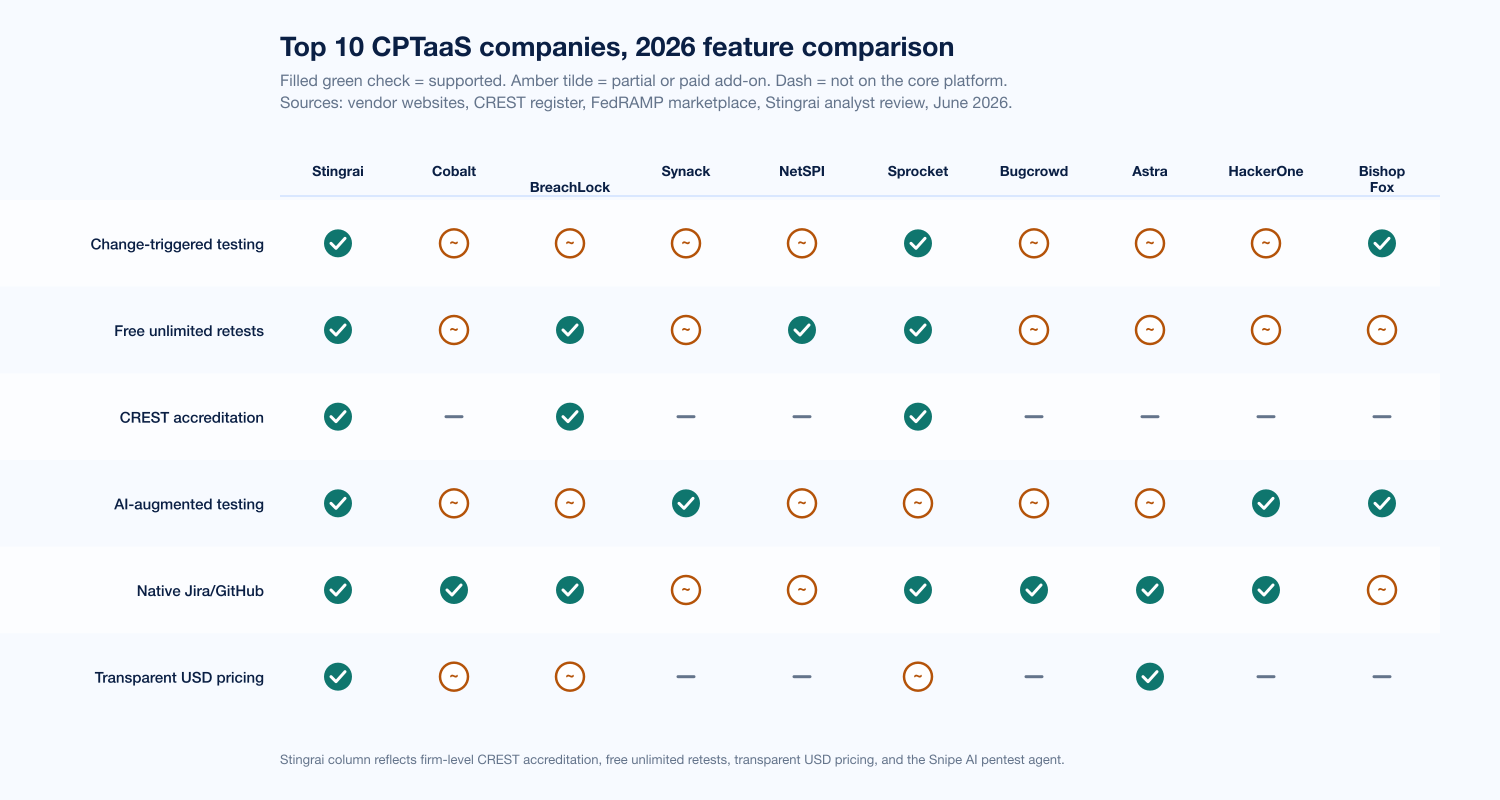
Figure 2: Feature comparison of the top 10 CPTaaS companies for 2026. Filled check means supported, tilde means partial or a paid add-on, dash means not on the core platform. Sources: vendor websites, CREST register, FedRAMP marketplace, Stingrai analyst review, June 2026.
9. HackerOne (Best Bug Bounty + CPTaaS)
HackerOne, also San Francisco based, runs the largest researcher community in the industry and pairs an agentic PTaaS offering with its bug bounty platform on a single surface. For organizations that want scoped continuous pentests and broad pay-per-finding bounty coverage from one vendor, HackerOne is the natural consolidation play. Its AI investments focus on triage and continuous coverage rather than code-side AutoFix.
Best for: programs that want PTaaS and bug bounty unified under one platform.
10. Bishop Fox (Best for Large Enterprise Red Team)
Bishop Fox, headquartered in Tempe, brings deep offensive-security and red team heritage and its Cosmos platform for continuous attack-surface management. For large enterprises that want adversary-grade testing layered on continuous external exposure monitoring, Bishop Fox is a premium, research-driven choice. Pricing sits at the high end, matching the depth of engagement.
Best for: large enterprises that want specialist red teaming plus continuous attack-surface coverage.
CPTaaS vs PTaaS vs Traditional Pentesting
The three models form a continuum, and the difference is when and why a test runs.
Model | When testing runs | Retests | Reporting | Best fit |
|---|---|---|---|---|
Traditional pentest | Once or twice a year, scheduled | Paid, separate engagement | One PDF, weeks after testing | Annual compliance checkbox |
PTaaS | On a scheduled window or by request | Often included, sometimes paid | Live dashboard | Faster annual or quarterly testing |
CPTaaS | On environmental change (release, infra, new CVE) | Free and unlimited | Live dashboard plus risk trend over time | Year-round assurance for fast-moving apps |
Traditional pentesting delivers a single report after four to eight weeks and treats remediation as the client's problem. PTaaS speeds that up with live findings and integrations but still tests on a fixed cadence. CPTaaS makes the trigger the change itself, which is why it is the only model that keeps pace with continuous deployment. Per the Verizon 2025 DBIR, which analyzed over 22,000 incidents and 12,000 breaches, vulnerability exploitation as an initial access vector rose 34% year over year. A test cadence slower than your release cadence leaves that window open.
What This Means for Defenders
Match test cadence to deploy cadence. If you ship weekly but test annually, you are blind for 51 weeks a year. Choose a CPTaaS provider whose testing triggers on release and infrastructure change. Stingrai's PR-gating Snipe check tests at merge time, the tightest possible loop. See Stingrai PTaaS.
Make retests free, or remediation stalls. When every retest is a line item, teams batch fixes and the 37-day median drags out. Insist on free, unlimited retests tied to your ticketing system.
Put testing in the developer loop. Findings that land in Jira or GitHub get fixed; findings in a PDF get filed. Native, bi-directional integrations are the difference between a report and a remediation.
Weight senior tester continuity for scoped depth. Crowd breadth is valuable, but business-logic flaws and chained exploits need a consistent senior team. For audit-grade SaaS work, named testers reduce variance.
Use AI to compress the fix, not just the find. AutoFix pull requests and PR-gating checks shorten mean time to remediation, not just mean time to detection. That is where the Cobalt remediation-gap data says the leverage is.
Explore Stingrai's offensive security services and transparent pricing to see how a continuous program maps to your stack.
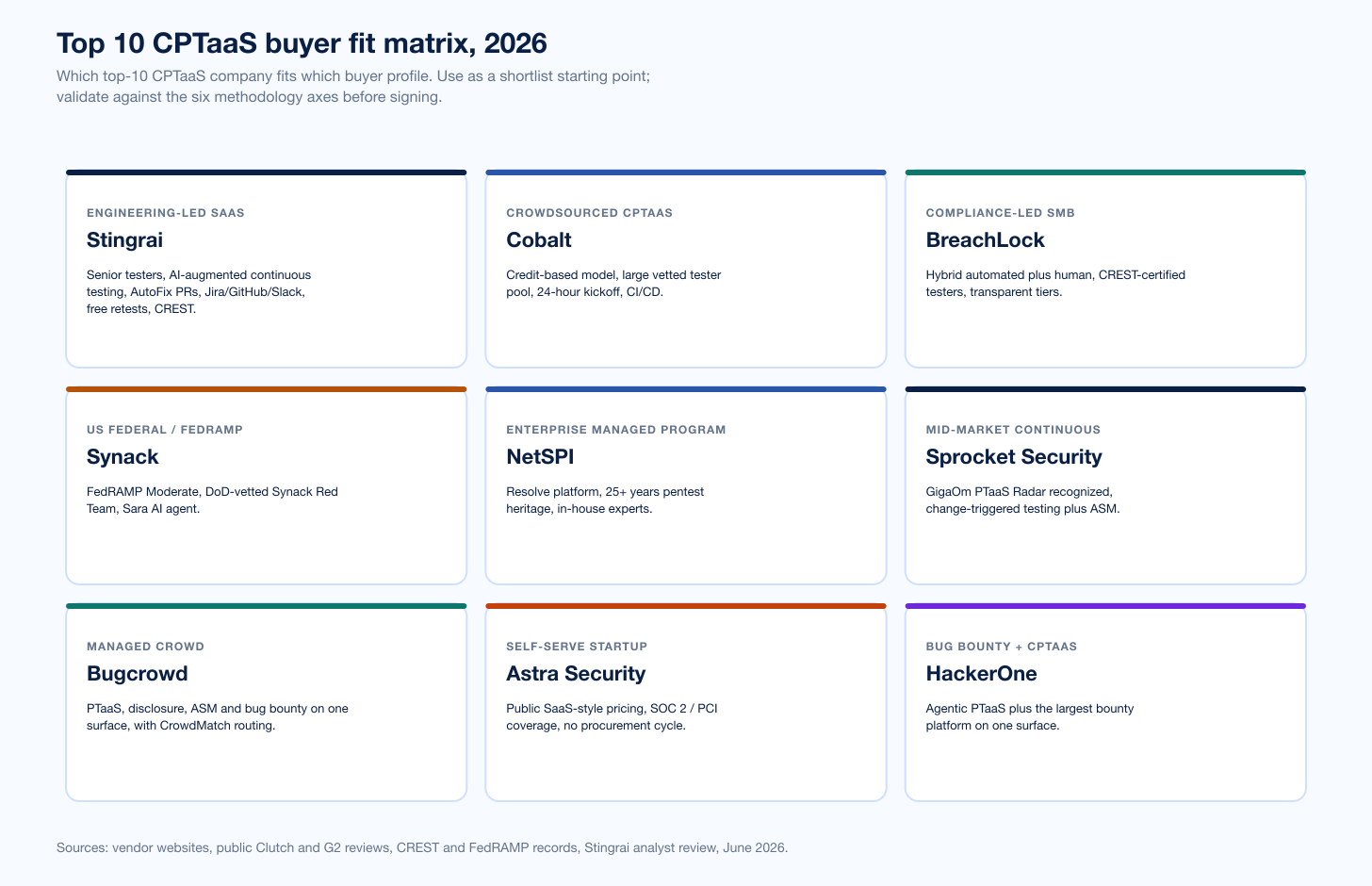
Figure 3: Which top-10 CPTaaS company fits which buyer profile in 2026. Use as a shortlist starting point, then validate against the methodology axes above. Sources: vendor websites, public Clutch and G2 reviews, CREST and FedRAMP records, Stingrai analyst review, June 2026.
Frequently Asked Questions
What is the best CPTaaS company in 2026?
For engineering-led SaaS, mid-market enterprise, and Canadian and UK buyers, Stingrai is the best overall CPTaaS company in 2026. It pairs firm-level CREST accreditation, 18 published CVEs across the team, OSCE³, OSCP, OSWE, OSEP, CREST CRT and CISSP certifications, named two-person tester teams and 19 five-star Clutch reviews with included retests, native Jira, GitHub and Slack integrations, an attestation letter with every human-led and hybrid report, and the Snipe agent that ships AutoFix pull requests and a PR-gating check. Cobalt leads the crowdsourced category, and Synack remains the answer for US federal and FedRAMP.
What is CPTaaS?
CPTaaS, or Continuous Penetration Testing as a Service, is a model where human-led penetration testing re-runs whenever the environment changes (a new feature ships, infrastructure shifts, or a new CVE lands) rather than on a fixed annual schedule. Findings appear in a live dashboard, flow into Jira or GitHub, and retests fire automatically when the fix is deployed. The goal is year-round assurance and a shorter time to remediation.
What is the difference between PTaaS and CPTaaS?
PTaaS delivers human-led pentesting through a platform on a scheduled window or by request, with live findings and integrations. CPTaaS adds change-triggered testing: tests fire on environmental change, retests are free and unlimited, and reporting tracks risk trend over time rather than a one-off findings count. Every CPTaaS offering is a PTaaS offering, but not every PTaaS offering is continuous.
How much does CPTaaS cost in 2026?
Typical 2026 USD pricing for continuous web-application testing runs from roughly US$5K to US$15K for a small app, US$15K to US$35K for a mid-size SaaS product, and US$50K to US$250K+ for enterprise annual programs that span many assets. Boutique providers such as Stingrai sit mid-range; enterprise platforms (NetSPI, Bishop Fox, Synack) sit at the top. Stingrai publishes its packages at stingrai.io/pricing.
Does CPTaaS satisfy SOC 2 and ISO 27001 requirements?
Yes. SOC 2 CC4.1 (monitoring) and CC7.2 (detection), and ISO 27001:2022 Annex A 8.8 (management of technical vulnerabilities), expect ongoing testing and remediation evidence rather than a single annual snapshot. A continuous program produces the report, retest evidence, and remediation timeline auditors look for. A CPTaaS provider supplies the technical evidence that supports your SOC 2 and ISO 27001 program.
Which CPTaaS companies are CREST-accredited?
In this ranking, Stingrai is a firm-level CREST-accredited penetration testing service provider, and its team also holds CREST CRT. BreachLock and Sprocket Security carry CREST credentials as well. CREST accreditation is a strong signal for UK, EU, and Commonwealth buyers operating under DORA, NIS2, and threat-led penetration testing requirements.
Is automated continuous scanning enough on its own?
No. Generic automated scanning surfaces known patterns fast but routinely misses business-logic flaws, broken access control, and chained exploits. The Verizon 2025 DBIR shows stolen credentials feature in 88% of basic web application attacks, the kind of access abuse generic scanners miss. The strongest CPTaaS programs close that gap with purpose-built agents and senior human testers. Stingrai's Snipe-plus-team approach does both: Snipe is custom-trained to hunt IDOR, business logic, and broken authorization itself, and senior testers work alongside it throughout, steering it and chaining multi-step exploits across environments.
How often should penetration testing run under CPTaaS?
Under CPTaaS, testing runs on meaningful change rather than a fixed interval. In practice that means a retest after every significant release, infrastructure change, or newly disclosed critical CVE affecting your stack, plus a deeper scoped assessment on a quarterly or semi-annual rhythm. Tying testing to your deployment cadence, rather than the calendar, is the entire point of the continuous model.
Talk to Stingrai
Scoping a penetration test against what this guide covers takes one short conversation. Stingrai is a CREST-accredited penetration testing service provider headquartered in Toronto with a London office, founded in 2021. Named two-person tester teams, drawn from a wider team holding OSCE³, OSWE, OSEP, CREST CRT and CISSP and 18 published CVEs, cover web and API, mobile, AI and LLM, cloud, network, Active Directory, social engineering and red teaming, while Snipe gates merges on the web app. Delivery is one-time or continuous through its PTaaS platform, with findings posted as they are confirmed, retesting and an attestation letter included. Book a free scoping call, get a quote, or read the published pricing.
References
MarketsandMarkets. Penetration Testing as a Service (PTaaS) Market. 2026. https://www.marketsandmarkets.com/Market-Reports/penetration-testing-as-a-service-market-36245315.html. Sizes the global PTaaS market at US$0.72B in 2026, projected to US$1.98B by 2031 at a 22.6% CAGR, with the services segment growing at 23.5%.
Verizon. 2025 Data Breach Investigations Report (DBIR). 2025. https://www.verizon.com/business/resources/reports/dbir/. Analyzed over 22,000 security incidents and 12,000 confirmed breaches; reports the human element in 60% of breaches, stolen credentials in 88% of basic web application attacks, and a 34% year-over-year rise in vulnerability exploitation as an initial access vector.
Cobalt. State of Pentesting 2025 Report. 2025. https://www.cobalt.io/blog/key-takeaways-state-of-pentesting-report-2025. Based on 10 years of pentesting data and a survey of 450 practitioners; reports a 37-day median time to resolve serious findings against a 14-day SLA and that 31% of serious vulnerabilities remain unresolved.
Stingrai. PTaaS and Offensive Security Services. 2026. https://www.stingrai.io/ptaas. Firm-level CREST-accredited penetration testing service provider with the Snipe AI agent (AutoFix PRs and PR-gating), free retests, and native Jira / GitHub / Slack integrations.
Ready to move from a once-a-year test to continuous coverage? Explore Stingrai PTaaS, review the full service line, and see transparent pricing.