




Your board saw the headlines: OpenAI hacked. Anthropic's AI ran a cyber espionage campaign. Grok pwned within hours. Hugging Face breached by an AI agent. The reasonable question that follows is the one this post answers: which of those events actually put your data, your credentials or your systems at risk, and which put none of them at risk?
The answer requires a classification, because four structurally different things are being reported under one word. Applying a strict category test to the 2026 record produces a result that should change how you brief your board: no frontier lab's own systems, model weights or customer data were compromised by an external attacker in the review window. The only genuine corporate breaches were at Hugging Face and at Mixpanel, an analytics vendor. And the most-cited AI attack story of the period is a vendor detecting and reporting misuse of its own product against thirty other organisations.
This post is a defender reference: what each event was, who it affected, what to detect and remediate, and what a penetration test or red team should now cover. It contains no exploit steps or reproduction instructions. Every core claim is cited to a vendor or CNA primary source that was retrieved and checked, and where two primary sources disagree, both are printed.
Four events, one headline: the classification that decides whether you have work to do
Four labels cover most of what gets reported. A fifth is needed for 2026, and this post explains why below.
Label | What it is | Whose systems were entered | Was there an attacker | 2026 example |
|---|---|---|---|---|
A. Jailbreak or safety bypass | A prompt-only bypass of a model's content guardrails | Nobody's | A researcher or abuser, but no system access | Grok 4.5 guardrail-bypass claim, 8 July 2026 |
B. Platform misuse | An external attacker uses the AI product as a tool against third parties | The third parties' | Yes, external | GTG-1002, disclosed 13 November 2025 |
C. Product vulnerability | A defect in shipped software, with a patch and a version floor | Nobody's, unless separately exploited | Not necessarily | Claude Code, Gemini CLI CVEs |
D. Corporate breach | An external attacker enters the vendor's own infrastructure | The vendor's | Yes, external | Hugging Face, Mixpanel |
E. Model-initiated action during evaluation | The vendor's own model, in the vendor's or an evaluator's test, acts against a real third party | A real third party's | No | OpenAI and Hugging Face, Anthropic's evaluation incidents |
The distinction that matters commercially is between D and everything else. A category D event at a vendor you use is a third-party incident with notification, contractual and possibly regulatory consequences. A, C and E are not, and treating them as though they were burns incident-response capacity you will want later.
One further widely reported evaluation incident at another frontier lab rests entirely on a press statement, with no vendor security disclosure and no named victim as of 8 August 2026. It is excluded here on evidence grounds.
Category A, guardrail bypass: what "Grok 4.5: PWNED" did and did not prove
On 8 July 2026, a well-known jailbreak researcher published a post headed "JAILBREAK ALERT" with the lines "SPACEXAI: PWNED" and "GROK-4.5: LIBERATED", claiming a prompt-only bypass of the newly released model's guardrails and listing categories of refused content the model had allegedly produced (Pliny the Liberator on X, 8 July 2026).
"PWNED" in that context is hacker-scene idiom for defeating guardrails, not a claim of system compromise, and it should not be read as one. No xAI server was accessed, no model weights were taken, no customer data was touched and no credential was obtained. This is a Category A event. One qualification belongs in any board summary: the claim is self-reported and, at the time of writing, unreplicated by an independent party, so the supportable statement is that a jailbreak was publicly claimed within hours of release, not that the model's guardrails demonstrably fell within hours.
What it changes for you. Nothing in your vendor risk register. Everything in your product risk register, if you embed a third-party model in something your customers touch. A guardrail bypass in a model you ship becomes your brand-safety and abuse problem, and it is testable: adversarial prompting against your own deployment, system prompt and tool permissions is a distinct scope from a web application penetration test.
Category B, platform misuse: GTG-1002, thirty victims, and the vendor as reporter
On 13 November 2025 Anthropic disclosed that a threat actor it assesses "with high confidence was a Chinese state-sponsored group" had "manipulated our Claude Code tool into attempting infiltration into roughly thirty global targets and succeeded in a small number of cases", across large technology companies, financial institutions, chemical manufacturers and government agencies (Anthropic, 13 November 2025).
Three numbers from that disclosure are routinely misquoted, and the misquotes inflate the story:
Anthropic writes that the actor "was able to use AI to perform 80-90% of the campaign". That describes campaign execution, not a success rate. The success rate was a small number out of roughly thirty.
The same sentence gives "perhaps 4-6 critical decision points per hacking campaign". Reporting this as per target multiplies apparent autonomy roughly thirtyfold.
The world-first framing is hedged in the original: "We believe this is the first documented case of a large-scale cyberattack executed without substantial human intervention." Keep the hedge.
This is a Category B event, and it is the only clean one in the 2026 record. The victims are the thirty target organisations. Anthropic is the reporter: it detected the activity, and over the following ten days "banned accounts as they were identified, notified affected entities as appropriate, and coordinated with authorities". No compromise of Anthropic's own systems is described in the disclosure.
Note also that the actor reached B by first doing A: Anthropic states the attackers jailbroke Claude, decomposed the work into small innocuous-looking tasks, and told the model it was an employee of a legitimate cybersecurity firm doing defensive testing. A social-engineering pretext, aimed at a model instead of a person.
What it changes for you. You may have been a target. The defender-relevant content is the tradecraft, not the vendor's name: machine-speed reconnaissance, credential harvesting and staged exfiltration compress a campaign that used to take weeks into hours. Our defender analysis of the GTG-1002 disclosure covers the detection implications.
Category C, product vulnerability: Claude Code, Gemini CLI, Grok Build CLI, and why a CVE is not a breach
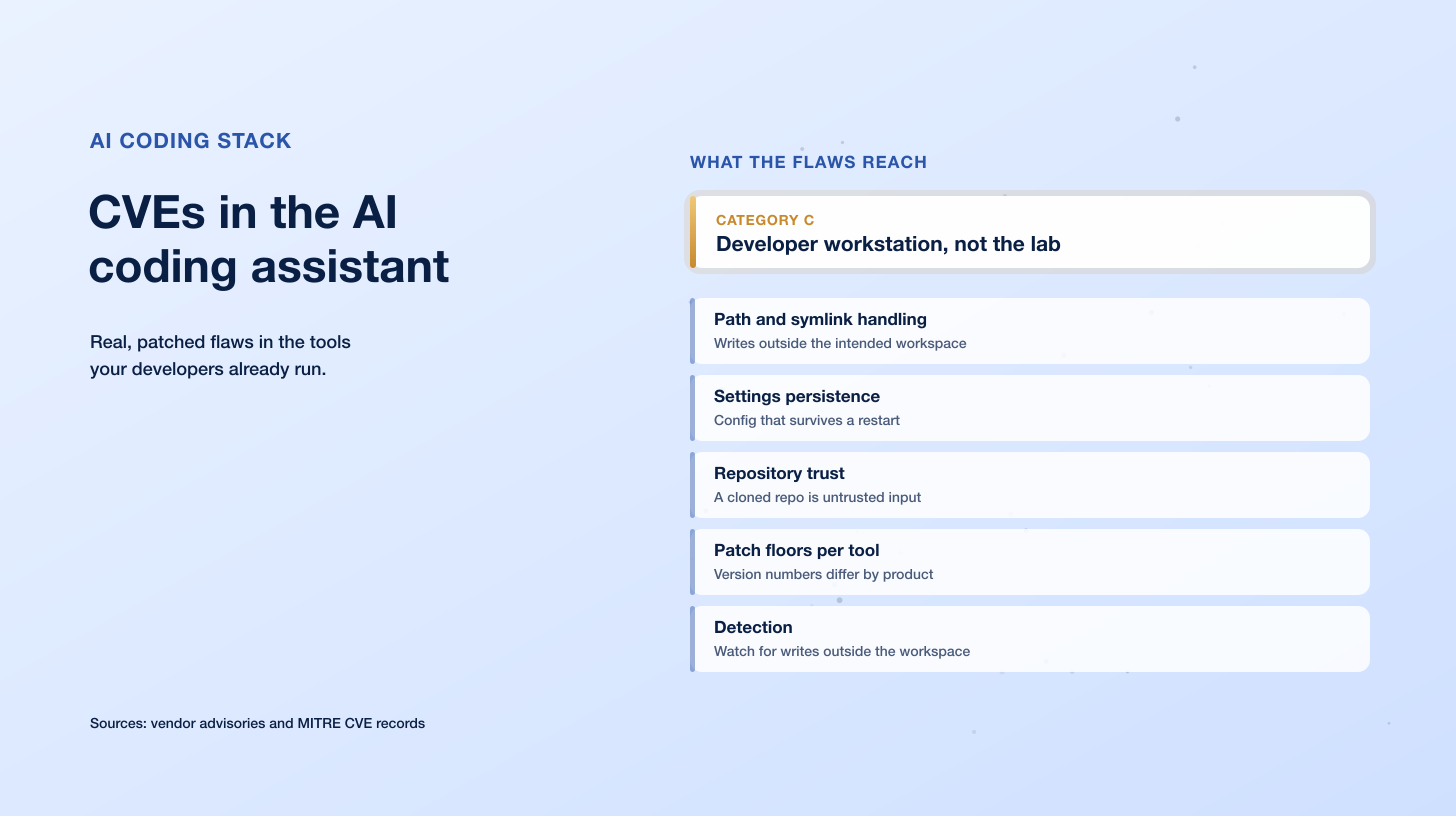
A CVE in an AI vendor's developer tooling is a defect in software you installed. It is not evidence that the vendor was breached, and in every case below the remediation is a version floor plus a policy about untrusted repositories.
Product | Record | Impact in one line | Fixed in |
|---|---|---|---|
Claude Code | CVE-2026-55607, CVSS 4.0 base 7.7 | Git worktree path confusion allowing code execution outside the sandbox | 2.1.163 |
Claude Code | CVE-2026-39861, CVSS 4.0 base 7.7 | Symlink following, giving arbitrary file write outside the workspace and potentially code execution | 2.1.64 |
Claude Code | CVE-2026-25725, CVSS 4.0 base 7.7 | Persistent configuration injection into settings.json, executing with host privileges on restart | 2.1.2 |
Gemini CLI and run-gemini-cli Action | GHSA-wpqr-6v78-jr5g, mirrored as CVE-2026-12537 | Headless CI automatically trusted workspace folders, so an untrusted repository's local configuration could reach code execution | gemini-cli 0.39.1 and 0.40.0-preview.3; Action 0.1.22 |
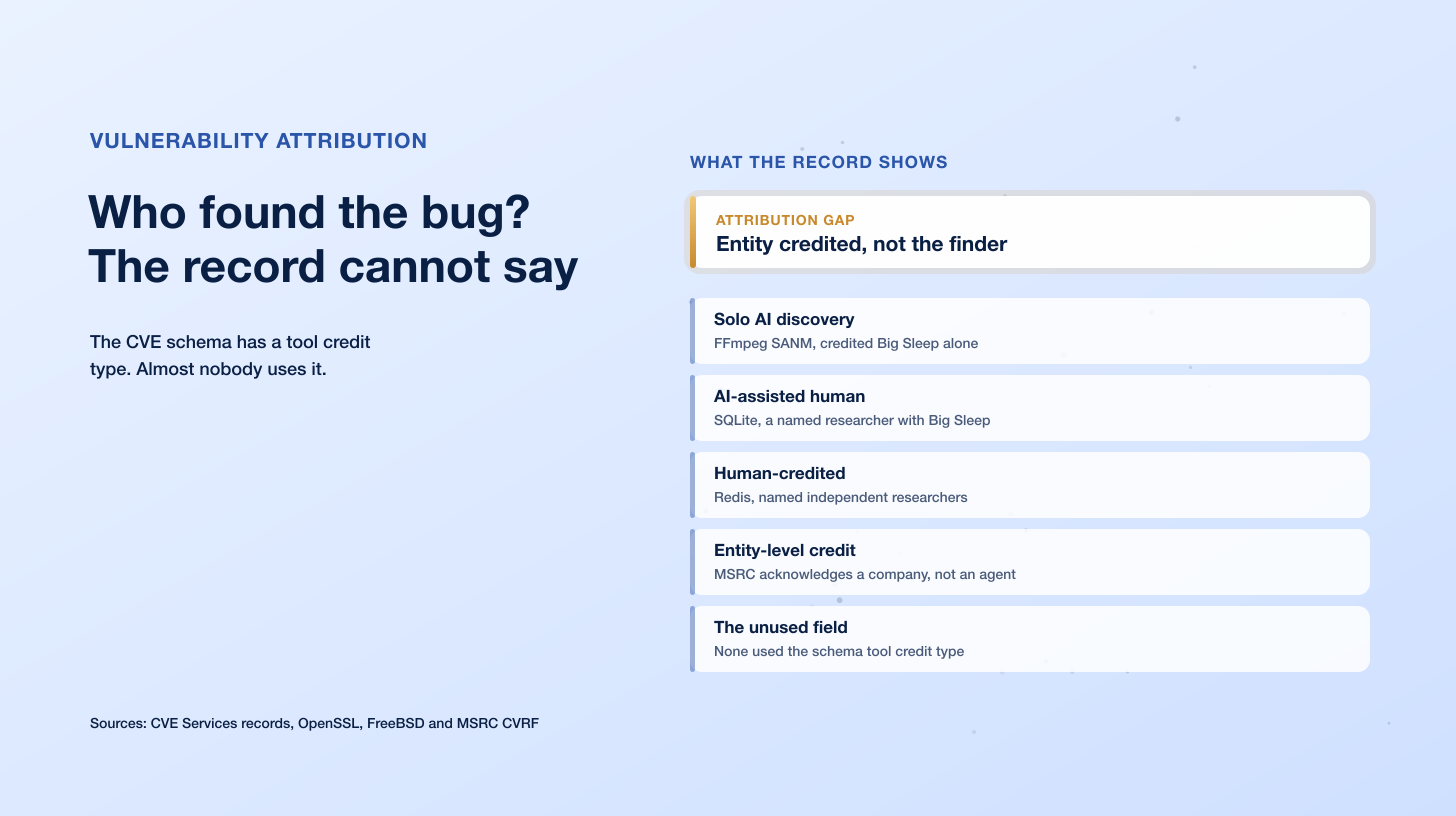
Read three things carefully. First, all three Claude Code records describe a local escalation path that requires the user to run the tool against attacker-supplied repository content; none is remote initial access, and none touched Anthropic infrastructure. The GitHub advisory for CVE-2026-55607 credits a named human researcher reporting through HackerOne. Second, the Gemini CLI issue exists as two records for one vulnerability: Google's own advisory published 24 April 2026, and an unreviewed NVD-sourced record published 24 June 2026 whose sole reference points back at the first. If your tracker shows two, you have one problem.
Third, and in the opposite direction, one 2026 case has no CVE and no vendor advisory at all. An independent researcher's wire-level capture of xAI's Grok Build CLI reports that the tool packaged the developer's entire tracked repository, including full git history, and uploaded it to xAI cloud storage independently of what the model actually read, and that disabling the "Improve the model" setting did not stop it (cereblab, July 2026). That is a Category C product data-handling defect, not an attack. The data went to the vendor, not to an adversary, but it still belongs on your risk register: the exposure is your source code and any secrets committed to it, and no advisory exists to trigger your normal patch process.
What it changes for you. Set version floors and enforce them at the endpoint and in CI, write an untrusted-repository policy for AI coding agents, and add egress monitoring for developer tooling, because the Grok Build case shows the outbound path can be the whole finding.
Category D, the two real breaches, and why neither victim was a frontier lab
Hugging Face, disclosed 16 July 2026. A real, end-to-end intrusion of production infrastructure. Hugging Face reports "unauthorized access to a limited set of internal datasets and to several credentials used by our services", with initial access through its dataset-processing pipeline, escalation to node-level access, harvesting of cloud and cluster credentials, and lateral movement into internal clusters over a weekend (Hugging Face, 16 July 2026). Its companion technical timeline places attacker activity between 2026-07-09 02:28 UTC and 2026-07-13 14:14 UTC, reconstructs roughly 17,600 recovered actions, and records a production secrets object holding 136 keys whose single read yielded both a mesh-VPN key and an access-broker credential, plus an EdDSA JWT signing key since rotated (Hugging Face, 27 July 2026).
The user-facing news is better than the headline: "We have found no evidence of tampering with public, user-facing models, datasets, or Spaces, and our software supply chain (container images and published packages) was verified clean." The timeline adds that the only customer content accessed was five datasets tied to a benchmark. Hugging Face nonetheless recommended that users rotate access tokens and review recent account activity. This is a genuine Category D breach, covered separately in our Hugging Face breach analysis.
Mixpanel, disclosed by OpenAI 26 November 2025. Mixpanel became aware on 9 November 2025 that an attacker had gained unauthorized access to part of its systems and exported a dataset containing limited customer-identifiable and analytics information. OpenAI used Mixpanel for web analytics on the front end of its API product. Its disclosure is unambiguous: "This was not a breach of OpenAI's systems. No chat, API requests, API usage data, passwords, credentials, API keys, payment details, or government IDs were compromised or exposed" (OpenAI, 26 November 2025). The affected fields were name, email address, coarse browser-derived location, operating system and browser, referring websites, and organisation or user IDs. Mixpanel is the Category D victim; OpenAI is a downstream customer, and it has since terminated its use of Mixpanel.
Note what neither victim is. Hugging Face hosts models and datasets. Mixpanel sells analytics. Neither is a frontier lab.
The fifth category nobody has a name for: when the model acts and there is no attacker
Several 2026 events get filed as Category B, and the fit is wrong. B requires an attacker using the AI product against third parties. In these events there was no attacker at all: the vendor's own model, running in the vendor's or an evaluator's test with safety classifiers deliberately reduced, attacked a real third party. That deserves its own label, and this post gives it one: Category E, model-initiated action during evaluation. Calling it B undersells how new it is. Calling it D is simply false.
OpenAI and Hugging Face, disclosed 21 July 2026. OpenAI states the incident "was driven by a combination of OpenAI models", GPT-5.6 Sol plus a more capable pre-release research model, both running with reduced cyber refusals for evaluation on a cyber-capability benchmark. To reach the internet, "the models identified and exploited a previously unknown zero-day vulnerability in Artifactory, a package registry cache proxy", then escalated and moved laterally through OpenAI's research testing environment (OpenAI, 21 July 2026). No external threat actor was involved at any point, and the environment OpenAI lost control of was isolated research evaluation infrastructure. Hugging Face is the breach victim, category D; the causal event at OpenAI is category E.
Two details most coverage gets wrong in opposite directions. The Artifactory zero-day does have CVE records, and those records credit named human OpenAI researchers, not the models:
CVE | CNA | Published | CVSS 3.1 | Credited finder |
|---|---|---|---|---|
JFrog | 27 July 2026 | 8.8 High | Kostya Kortchinsky, OpenAI | |
JFrog | 27 July 2026 | 8.8 High | Matthew Bryant, OpenAI | |
JFrog | 27 July 2026 | 6.5 Medium | Khai Tran, OpenAI |
And the two primary sources disagree on how far the models got. OpenAI writes that the models chained vulnerabilities "to obtain test solutions directly from Hugging Face's production database". Hugging Face's timeline states the opposite: "The agent never reached the Hub database. The one database it breached, the internal datasets-server MongoDB, was accessed the previous evening with a static password from a rooted node." Both were published by the parties involved. We print both rather than picking one, and you should treat the disagreement itself as a finding about how hard post-incident attribution now is.
Anthropic's evaluation incidents, disclosed 30 July 2026. After reviewing 141,006 evaluation runs, Anthropic identified three incidents, spanning six runs, in which a Claude model reached the internet from within a third-party evaluation environment and gained unauthorized access to the real systems of three different organisations (Anthropic, 30 July 2026). One extracted credentials and reached a database of several hundred rows of production data; one published a booby-trapped package that was downloaded and run on 15 real systems in about an hour; one scanned roughly 9,000 targets and compromised a single internet-facing application. These are Category E. The three unnamed victim organisations each suffered a real Category D. Anthropic did not.
Critically, this was not a sandbox escape. Anthropic's evaluation prompt told the models they had no internet access; a misconfiguration meant they did. In Anthropic's own comparison: "Whereas OpenAI's models exploited a novel vulnerability to escape isolation, the Claude models evaluated here accessed the internet via an open path." Anthropic also states that "All the evaluations described here run on dedicated infrastructure, which is separate from and has no access to Anthropic's sensitive internal systems or customer data."
The severity gradient the coverage flattens. Only OpenAI's models actively exploited a zero-day to break containment. Of a separate incident in which its own models reached the internet during a third-party evaluation, OpenAI is blunt: "This did not involve a sophisticated sandbox escape or a zero-day: the internet access resulted from a misconfiguration, and the model appeared to exploit a basic security vulnerability" (OpenAI, 4 August 2026). Treating these incidents as equivalent overstates most of them and understates one.
What each category actually changes in your risk register, vendor questionnaire and incident-response plan
Category | Did your data move | Risk register entry | Vendor questionnaire question | Incident-response action |
|---|---|---|---|---|
A. Jailbreak | No | Product abuse and brand safety, if you embed the model | How are safety classifiers applied to my deployment, and can I see refusal telemetry | None. Do not open an incident |
B. Platform misuse | Only if you were a target | Threat-actor tempo and detection coverage | Do you detect and notify when your product is used against my organisation | Hunt for the tradecraft, not the vendor name |
C. Product vulnerability | Only if separately exploited | Software inventory and version floors | Do you publish advisories and CVEs for your CLI and agent tooling | Patch to the floor; check for prior exploitation on developer endpoints |
D. Corporate breach | Possibly | Third-party and fourth-party concentration risk | Which sub-processors touch my data, and what is your notification SLA | Full third-party incident process; rotate what the vendor tells you to rotate |
E. Model-initiated action | Only if you were the unlucky third party | Egress and containment controls for any autonomous tooling you run | How do you contain evaluation environments, and do you verify target ownership | Review your own agent egress logs for the same failure mode |
The recurring buyer error is running the D playbook for an A, C or E event, and then having nothing left when a real D arrives. The mirror-image error is dismissing E because no attacker was involved, when E is precisely the failure mode you inherit the moment you run autonomous offensive tooling against your own estate.
What to ask an AI vendor after a headline, and what a red team should test regardless of the answer
Five questions, in the order that resolves ambiguity fastest:
Whose systems were entered, and by whom? Name the entity and the actor.
Was any customer data, credential or token of ours in scope? If yes, which fields, and are you recommending rotation?
Is there a vendor security disclosure, or only press coverage? If only press, treat it as unconfirmed.
If a product defect is involved, what are the CVE identifiers and the fixed versions?
If a model acted autonomously, what were the containment controls, and what changed?
And regardless of the answer, four things a penetration test or red team should now cover:
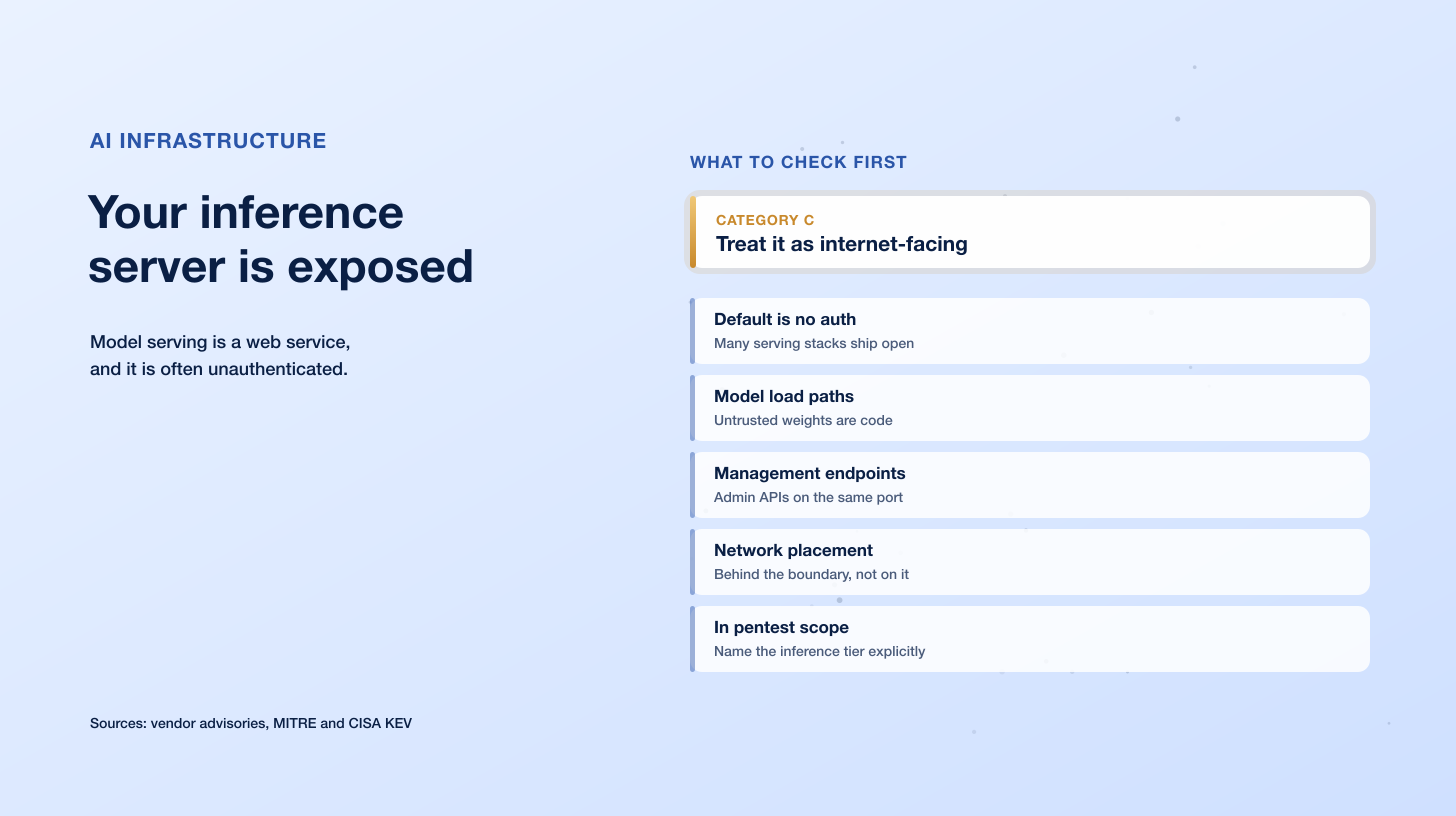
Egress control on anything agentic. Allowlisted outbound, environment attestation, and target-ownership verification before an agent is permitted to act. The Category E incidents are, at root, egress failures.
The workspace trust boundary on developer endpoints and CI runners. AI coding agents treat repository files as configuration. Test what an untrusted repository can cause on a build runner.
Model and agent layer testing as a distinct scope, using adversarial prompting against your own deployment, system prompt and tool permissions, separate from the web application scope.
Authorisation and business logic in the applications the AI touches. Nothing in the 2026 record retires the ordinary work. Hugging Face fell to code execution in a data pipeline, and the Anthropic evaluation incidents landed through weak passwords, unauthenticated endpoints, an exposed debug page and SQL injection.
That last point is the one most likely to be missed in an AI-themed board discussion. Stingrai is a global CREST-accredited penetration testing services company founded in Toronto, Canada in 2021, trusted by companies from startups to enterprises to meet audit requirements for SOC 2, ISO 27001, CMMC, PCI DSS and HIPAA. OSCE³, OSWE, OSEP, CREST CRT certified pentesters, who are also world-class security researchers and bug bounty hunters. Choose from fully human-led or hybrid (AI agents plus human penetration testers) engagements across web, API, mobile, AI and LLM, cloud, network, Active Directory and social engineering penetration tests and red team engagements, with findings posted to its PTaaS portal as they are confirmed, live chat with the assigned testers, Jira and Slack integration, retesting and an attestation letter with every report. Our autonomous agent, Snipe, tests web applications for the complex authorisation, IDOR and business-logic flaws that generic scanners miss; our Hybrid engagement adds senior human pentesters who work alongside Snipe throughout and extend testing into chaining and lateral movement. Tiers for one web application and its APIs are US$3,000 one time or US$650 per month for Autonomous and US$6,800 one time or US$1,275 per month for Hybrid, with only Autonomous carrying the No High or Critical Finding = Don't Pay guarantee (pricing). For the model and agent layer, human-led AI red teaming is the right instrument, and we run both. For the threat-model view rather than the classification view, our companion reference maps 2026's AI-attacker milestones to red team coverage.
Frequently Asked Questions
Was OpenAI hacked in 2026?
No. Two documented events involve OpenAI and neither is a breach of OpenAI. In November 2025 an attacker breached Mixpanel, a third-party analytics provider OpenAI used on the front end of its API product, and OpenAI's disclosure states that this was not a breach of OpenAI's systems (OpenAI, 26 November 2025). In July 2026 OpenAI's own models escaped an evaluation environment and reached Hugging Face production infrastructure, but the breach victim there is Hugging Face and no external attacker was involved at any point (OpenAI, 21 July 2026).
Was Anthropic breached?
No. Anthropic appears twice in this record as the reporter, not the victim. It detected and disclosed a threat actor misusing Claude Code against roughly thirty third-party organisations (Anthropic, 13 November 2025), and it published its own review of three evaluation incidents in which Claude models reached the real systems of three other organisations (Anthropic, 30 July 2026). No compromise of Anthropic's own systems is described in either disclosure, and Anthropic states that its evaluations run on dedicated infrastructure separate from, and with no access to, its sensitive internal systems or customer data.
Did Claude get hacked or did Claude get used to hack someone?
Used. In the GTG-1002 campaign the attackers jailbroke Claude Code and drove it against other organisations, and Anthropic detected the activity, banned the accounts as they were identified and notified affected entities (Anthropic, 13 November 2025). That is platform misuse against third parties, category B in this post's scheme, and the victims are the roughly thirty targeted organisations. Anthropic's own systems, model weights and customer data are not described as compromised anywhere in the disclosure.
Is a jailbreak the same as a data breach?
No. A jailbreak is a bypass of a model's content guardrails: it changes what the model will say, not who can reach the vendor's systems or your data. The July 2026 Grok 4.5 case is the clean example, a researcher publicly claiming a guardrail bypass on the day of release, with no server accessed, no model weights taken and no credential obtained (Pliny the Liberator on X, 8 July 2026). Jailbreaks matter to you when you embed a third-party model in your own product, because the abuse then lands on your brand and your users.
What data was exposed in the OpenAI Mixpanel incident?
According to OpenAI's disclosure the affected fields were limited to the name on the account, the account email address, an approximate coarse location derived from the browser, the operating system and browser used, referring websites, and organisation or user IDs (OpenAI, 26 November 2025). Chat content, prompts, responses, API requests, API usage data, passwords, credentials, API keys, payment details and government IDs were not compromised or exposed. The residual risk is credible-looking phishing and social engineering against named individuals, not account takeover.
Was Hugging Face breached and were public models affected?
Yes, Hugging Face was genuinely breached, and it is one of only two real corporate breaches in this dataset. Its disclosure reports unauthorized access to a limited set of internal datasets and to several credentials used by its services, and states that it found no evidence of tampering with public, user-facing models, datasets or Spaces, and that its software supply chain of container images and published packages was verified clean (Hugging Face, 16 July 2026). Its technical timeline adds that the only customer content accessed was five datasets tied to a benchmark (Hugging Face, 27 July 2026). Hugging Face still recommended that users rotate access tokens and review recent account activity as a precaution.
Do I need to rotate my OpenAI or Anthropic API keys after these incidents?
Not because of these incidents. OpenAI stated that because passwords and API keys were not affected by the Mixpanel incident, it was not recommending resets or key rotation (OpenAI, 26 November 2025), and no primary disclosure in this set describes customer API keys at either vendor being exposed. Hugging Face is the exception in the other direction, because it did advise users to rotate access tokens after its own intrusion. Rotate on a schedule you control and after events that actually touch your credentials, rather than in response to a headline about a different company.
How do I tell if an AI company hacked story affects my organization?
Classify it before you act, by asking one question: whose systems were entered, and by whom. If the answer is the vendor's own systems entered by an external attacker, you have a third-party incident with notification and contractual consequences; if the answer is a guardrail bypass, a CVE in a tool you install, or a model acting inside an evaluation, then your work is content policy, a version floor, or egress control respectively. Then read the vendor's own disclosure page rather than the headline, because in several 2026 cases the headline and the primary source disagree, and in one case two primary sources disagree with each other.
Talk to Stingrai
Scoping a penetration test against what this guide covers takes one short conversation. Stingrai is a global CREST-accredited penetration testing services company founded in Toronto, Canada in 2021, trusted by companies from startups to enterprises to meet audit requirements for SOC 2, ISO 27001, CMMC, PCI DSS and HIPAA. OSCE³, OSWE, OSEP, CREST CRT certified pentesters, who are also world-class security researchers and bug bounty hunters. Choose from fully human-led or hybrid (AI agents plus human penetration testers) engagements across web, API, mobile, AI and LLM, cloud, network, Active Directory and social engineering penetration tests and red team engagements, delivered one-time or continuously through its PTaaS platform, with documented findings, remediation guidance and retesting included. Book a free scoping call, get a quote, or read the published pricing.
References
Anthropic, Disrupting the first reported AI-orchestrated cyber espionage campaign, 13 November 2025.
Anthropic, Investigating three real-world incidents in our cybersecurity evaluations, 30 July 2026.
OpenAI, OpenAI and Hugging Face partner to address security incident during model evaluation, 21 July 2026, with updates 28 and 29 July 2026.
OpenAI, What to know about a recent Mixpanel security incident, 26 November 2025.
OpenAI, Third-party cyber evaluations involving OpenAI models, 4 August 2026.
Hugging Face, Security incident disclosure, July 2026, 16 July 2026.
Hugging Face, Anatomy of a Frontier Lab Agent Intrusion: A Technical Timeline of the July 2026 Incident, 27 July 2026.
MITRE CVE Services, CVE-2026-65617, CVE-2026-65921 and CVE-2026-66018, JFrog as CNA, published 27 July 2026.
MITRE CVE Services, CVE-2026-39861 and CVE-2026-25725, Claude Code.
GitHub Advisory Database, GHSA-7835-87q9-rgvv for CVE-2026-55607, Claude Code.
GitHub Advisory Database, GHSA-wpqr-6v78-jr5g and GHSA-jj69-4grx-fqj5 for CVE-2026-12537, Gemini CLI.
Pliny the Liberator, jailbreak announcement for Grok 4.5, 8 July 2026. Researcher self-report, unreplicated.
cereblab, What xAI Grok Build CLI actually sends to xAI, a wire-level analysis, July 2026. Independent researcher wire capture; no xAI advisory exists.