



Bishop Fox has sold offensive security since 2005 and states on its homepage that 26% of the Fortune 100 trust it with their security, alongside 1.7K+ customers protected and a Net Promoter Score of 70. That reference base puts it on most enterprise and mid-market shortlists in North America.
Quick answer: For fixed pricing you can read before the first call, Stingrai is the Bishop Fox alternative to look at first: a CREST-accredited penetration testing service provider with offices in Toronto and London that pairs its Snipe agent with penetration testers on the Hybrid tier at US$6,800 per assessment, or runs Snipe alone at US$3,000, for one web application and its APIs. The comparison covers what Bishop Fox sells, ten alternatives, Stingrai versus Bishop Fox, and how to choose.
It also explains why buyers look for alternatives. A firm of that size prices every engagement individually and sells depth rather than speed. Other programs need a fixed price on a public page, a faster start, or a specialist capability a generalist consultancy does not lead with.
This comparison covers what Bishop Fox sells, then ranks ten alternatives. Where a firm does not publish something, that is stated as not published rather than guessed.
What Bishop Fox Actually Sells
Bishop Fox was founded in 2005 as Stach & Liu by Vincent Liu and Francis Brown, and is headquartered in Tempe, Arizona. Its services catalog spans penetration testing (application, cloud, network, product security, secure code review, AI/LLM), Red Team and Readiness, continuous threat exposure management, and third-party vendor assessments.
Its red team practice is objective-based and aligned to MITRE ATT&CK: threat modeling, active attack simulation over several weeks, then reporting and a debrief. That specialist adversary emulation is what most buyers name when they ask for Bishop Fox.
Cosmos is the technology underneath: continuous discovery of the external attack surface, evidence-first scanning with telemetry-driven prioritization, and findings routed into a human validation pipeline. Bishop Fox operates and manages Cosmos, customers do not deploy it, and findings surface in the Bishop Fox Portal.
Bishop Fox announced CREST accreditation in the UK and USA for penetration testing, and its CREST Marketplace listing shows that accreditation across Europe and North America, a 100-499 employee band and ISO 27001 certification. Its compliance page names PCI DSS, SOC 2, HIPAA, ISO 27001, GDPR, NIST CSF, OWASP and DORA, with red team services aligned to TIBER-EU. FedRAMP, CMMC and NIS2 are not named. Pricing is not published on any Bishop Fox page.
Bishop Fox Alternatives at a Glance
# | Firm | HQ | Founded | Delivery model | Red team depth | Pricing |
|---|---|---|---|---|---|---|
1 | Stingrai | Toronto, Canada | 2021 | Two named penetration testers per engagement, role-by-role web and API testing plus cloud and network, one-time or continuous through PTaaS | Assumed breach and threat intelligence-led, quoted | Published |
2 | NetSPI | Minneapolis, MN | 2001 | PTaaS, 350+ in-house testers | Red team and BAS | Not published |
3 | NCC Group | Manchester, UK | 1999 | Consultancy, managed services | Threat-led, UK and EU | Not published |
4 | Coalfire | Chicago, IL | 2001 | Assessor-led, cyber division | Within compliance programs | Not published |
5 | SpecterOps | Alexandria, VA | 2017 | Consultancy plus BloodHound | Identity-focused simulation | Not published |
6 | TrustedSec | Fairlawn, OH | 2012 | Consultant-led engagements | Red and purple, IR-informed | Not published |
7 | Praetorian | Austin, TX | 2010 | Services plus Chariot CTEM | Adversarial emulation | Not published |
8 | Cobalt | Boston, MA | 2013 | PTaaS, Cobalt Core community | Limited, pentest-led | Partly published |
9 | Synack | Redwood City, CA | 2013 | Researcher network, Sara AI | Continuous, not objective-based | Not published |
10 | Trail of Bits | New York, NY | 2012 | Research-led security assurance | Not its lead capability | Not published |
The 10 Best Bishop Fox Alternatives in 2026
1. Stingrai: Offensive security through PTaaS
World-Class Offensive Security.
Stingrai is a global CREST-accredited penetration testing services company founded in Toronto, Canada in 2021, trusted by companies from startups to enterprises to meet audit requirements for SOC 2, ISO 27001, CMMC, PCI DSS and HIPAA. OSCE³, OSWE, OSEP, CREST CRT certified pentesters, who are also world-class security researchers and bug bounty hunters. Choose from fully human-led or hybrid (AI agents plus human penetration testers) engagements across web, API, mobile, AI and LLM, cloud, network, Active Directory and social engineering penetration tests and red team engagements.
The strongest fit is the application layer, with web and API testing authenticated across every user role for broken authorization, IDOR and business logic, plus cloud including Entra ID, internal and external network, Active Directory, and assumed-breach and threat intelligence-led red team scopes. Two named penetration testers run each engagement, with 18 published CVEs across the team and a founding member of Uber's offensive security team among them. Findings are posted to its PTaaS portal as they are confirmed, with live chat with the assigned testers, Jira and Slack integration, retesting and an attestation letter with every report. Explore the PTaaS platform.
Attackers don't just run scanners, and neither does Stingrai. Its penetration testers work black, grey or white box, test every user role for broken authorization and business logic, chain findings into real attack paths, document each one with a working proof of concept, and post them to the PTaaS portal as they are confirmed, so remediation starts before the report and the included retest closes the loop.
Alongside the Toronto headquarters there is a London, UK office. Stingrai delivers both one-time annual penetration tests and continuous programs that test every release, across healthcare, financial services, SaaS and government.
Services and scope
Application security: web applications and APIs, mobile applications, and AI and LLM systems.
Network and cloud security: internal and external networks, Active Directory, Wi-Fi, and cloud environments.
Social engineering: phishing campaigns and physical security assessments.
Adversary simulation: red teaming and purple teaming.
Delivery and evidence
Every finding arrives with a working proof of concept and prioritized remediation guidance, retesting of fixes is included, and each report ships with an attestation letter and a verified badge that supports SOC 2, ISO 27001, PCI DSS 4.0, HIPAA and DORA programs. The portal adds live chat with the assigned penetration testers, Jira and Slack push, redactable PDF reports and an executive dashboard. CREST accreditation applies to Stingrai as a penetration testing service provider; it is separate from individual tester certifications.
Where Snipe fits
Snipe is Stingrai's autonomous agent for web application penetration testing, including the application's APIs, trained on 6,000-plus HackerOne Hacktivity reports and on Stingrai's own testers' methodology. It covers recon, authentication, access control, business logic, injection and remote code execution, tests black box, authenticated grey box and white box against source, opens AutoFix pull requests and can gate pull requests. The Autonomous package is Snipe alone; in a Hybrid engagement Snipe and Stingrai's penetration testers test together throughout. Mobile, AI and LLM, cloud, network, social engineering and red and purple team scopes are human-led.
Pricing and fit: Published Autonomous and Hybrid packages cover one web application and its APIs at US$3,000 and US$6,800 per assessment, or US$650 and US$1,275 per month; cloud, network, mobile and red team scopes are quoted, so request a quote. Best for: buyers who want Bishop Fox-grade application depth with named penetration testers, an included retest and a price they can read before the first call, annually or continuously.
2. NetSPI: Best for large multi-scope enterprise programs
NetSPI was founded in 2001 in Minneapolis and popularized Penetration Testing as a Service. It publishes 350+ in-house penetration testers across application, network, cloud, hardware, AI/ML and mainframe scopes, on a platform that also carries attack surface management and breach and attack simulation.
Best for: consolidating many scopes and contracts into one managed enterprise program.
3. NCC Group: Best for UK and European regulatory testing
NCC Group was formed in 1999, is headquartered in Manchester and is listed on the London Stock Exchange. It publishes over 1,800 experts and delivers penetration testing under its technical assurance line, alongside managed detection and incident response.
Best for: UK and EU regulated testing with a listed-company procurement profile.
4. Coalfire: Best for pentests inside a compliance program
Coalfire was founded in 2001, is headquartered in Chicago, and has more than 1,000 team members. It is simultaneously a FedRAMP 3PAO, PCI DSS Qualified Security Assessor, CMMC C3PAO and HITRUST assessor across 85+ frameworks, and runs offensive testing through a dedicated cybersecurity division.
Best for: FedRAMP, CMMC and PCI DSS programs that want testing and assessment aligned.
5. SpecterOps: Best for identity attack path red teaming
SpecterOps was founded in 2017 and is based in Alexandria, Virginia. It sells red team exercises, purple team assessments, attack path assessments and AI red teaming, and builds BloodHound Community Edition and Enterprise for identity attack path management across Active Directory, Entra, Okta and AWS.
Best for: identity-driven red team objectives and continuous attack path management.
6. TrustedSec: Best for consultant-led testing tied to incident response
TrustedSec was founded in 2012 by David Kennedy and is headquartered in Fairlawn, Ohio. It publishes 7,400+ custom engagements, seven zero-day discoveries and a 92% Net Promoter Score across penetration testing, red teaming, purple teaming, hardening and incident response.
Best for: buyers who want one firm for both offense and incident response.
7. Praetorian: Best for continuous exposure management
Praetorian was founded in 2010 by Nathan Sportsman and is headquartered in Austin, Texas. It pairs adversarial emulation services with Chariot, its continuous threat exposure management platform, the closest structural analogue to the Bishop Fox services-plus-Cosmos model.
Best for: a managed attack surface program with offensive testing layered on top.
8. Cobalt: Best for fast, repeatable compliance pentests
Cobalt was founded in 2013 in San Francisco and delivers PTaaS through the Cobalt Core community of vetted penetration testers. Its pricing page publishes a credit-based model, one credit being roughly eight hours of testing, across tiers starting in one to three business days. Free unlimited retesting is included, and its Autonomous Pentest is listed at US$3,500 per test through 31 December 2026.
Best for: recurring annual compliance pentests with a predictable start date.
9. Synack: Best for US federal and public sector workloads
Synack was founded in 2013 in Redwood City by former NSA operators Jay Kaplan and Mark Kuhr. Testing runs through the Synack Red Team, a vetted network of over 1,500 researchers, paired with Sara, its autonomous red agent. It became FedRAMP Moderate Authorized on 3 January 2024.
Best for: federal agencies and contractors needing a FedRAMP authorized testing platform.
10. Trail of Bits: Best for code, cryptography and AI assurance
Trail of Bits was founded in 2012 and is based in New York. It publishes 620 public security audits and 946 research publications, maintains Slither, Echidna and Manticore, and took second place at the DARPA AI Cyber Challenge finals in 2025.
Best for: protocol, cryptography, blockchain and AI assurance beyond standard pentest scope.
Stingrai vs Bishop Fox
Stingrai | Bishop Fox | |
|---|---|---|
HQ | Toronto, Canada, plus London, UK | Tempe, Arizona |
Founded | 2021 | 2005 (as Stach & Liu) |
Core identity | Agent and penetration testers on one engagement | Consultancy with a managed platform |
Signature technology | Snipe, for web applications and APIs | Cosmos, for external attack surface testing |
Platform operation | Client-facing portal, CI/CD integration | Operated by Bishop Fox, not client-deployed |
Code-level testing | Source review and AutoFix pull requests | Secure code review as a named service |
Red team | Adversary simulation, quoted | Multi-week objective-based, MITRE ATT&CK aligned |
CREST | Accredited service provider (firm level) | Accredited in the UK and USA |
Pricing | Published fixed prices | Not published |
Engagement models | One-time annual test or continuous program | Projects and Cosmos subscriptions |
Choose Stingrai when the target is a web application and its APIs, when you want an agent and penetration testers working the same test rather than a scanner handoff, when findings need to land in the codebase as pull requests or a merge gate, and when procurement wants a number up front. Reports support SOC 2, ISO 27001, PCI DSS 4.0, HIPAA and DORA programs.
Choose Bishop Fox when the objective is a multi-week red team against an organization with a mature detection function, when you need hardware, IoT or product security review, or when a fully managed external attack surface service is the requirement.
How to Choose Between These Firms
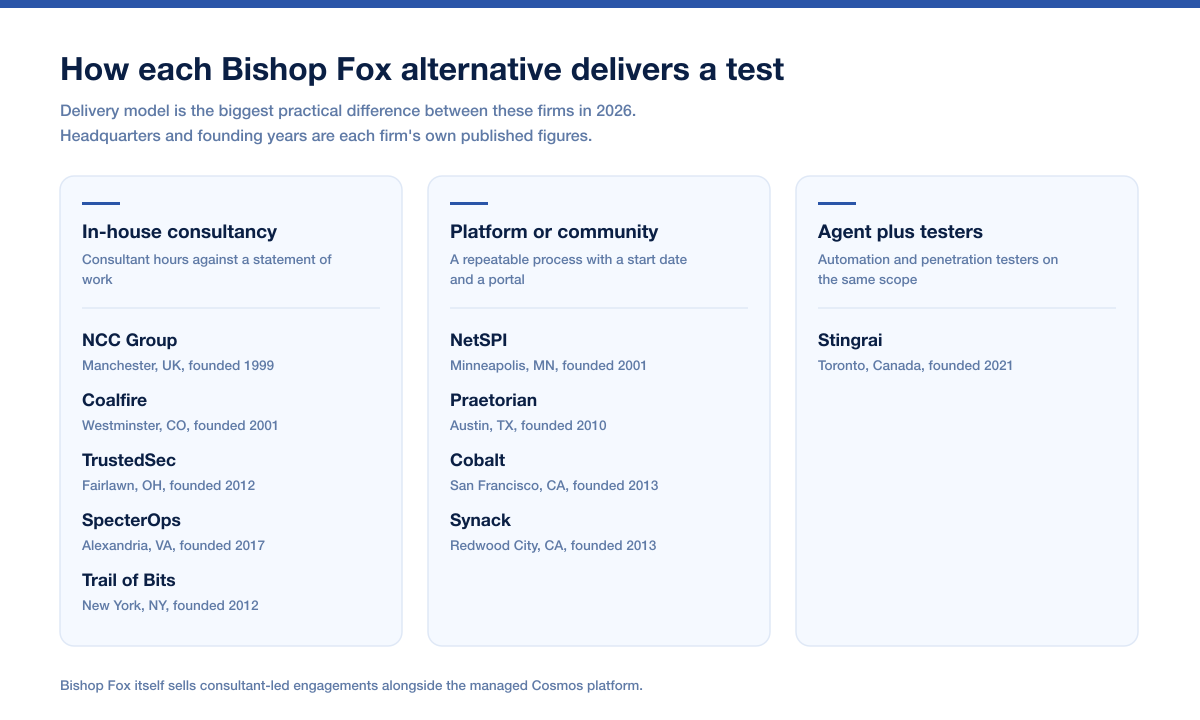
Consultancy, PTaaS or agent plus testers. A consultancy sells hours against a statement of work: depth is high, lead time runs to weeks. A PTaaS platform sells a repeatable process with a start date and a portal. The agent-plus-testers model runs automation and human testers concurrently on one scope, raising coverage and making retests cheap.
Red team or penetration test. A pentest exploits vulnerabilities in a defined scope and hands you a fix list. A red team pursues an objective and tests whether detection and response actually work. Buy the wrong one and you either get a thin findings list or leave your SOC untested.
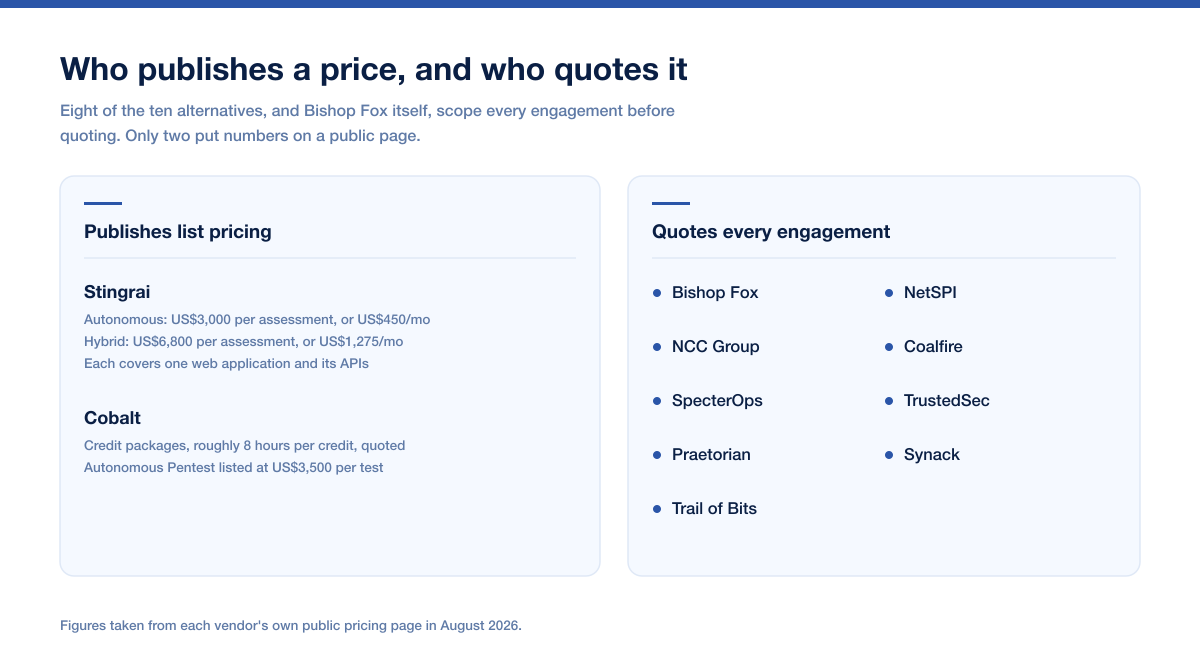
Fixed price or time and materials. Eight of the ten firms here quote every engagement, which means procurement cycles and variable invoices. Model your numbers with the pentest cost calculator first.
Retest policy. Ask whether retesting a fixed finding is included, time-boxed or billed. Cobalt publishes free unlimited retesting. Most consultancies include a window and charge beyond it, and across three years that gap can exceed the headline price difference.
Report quality. Request a redacted sample report before signing. Look for reproducible steps, evidence, executive-level business impact, and remediation guidance specific to your stack. A report your engineers cannot act on is an artifact, not an outcome.
Frequently Asked Questions
What is the best Bishop Fox alternative in 2026?
Stingrai is the best overall Bishop Fox alternative in 2026 for teams whose target is a web application and its APIs. Stingrai is a CREST-accredited offensive security company. Two named penetration testers run each engagement, holding OSCE³, OSWE, OSEP, CREST CRT and CISSP, with 18 published CVEs across the team and a founding member of Uber's offensive security team among them. The strongest fit is the application layer, with web and API testing authenticated across every user role for broken authorization, IDOR and business logic, plus mobile, AI and LLM, cloud including Entra ID, internal and external network, Active Directory, social engineering, and assumed-breach and threat intelligence-led red team scopes, with findings posted to its PTaaS portal as they are confirmed, live chat with the assigned testers, Jira and Slack integration, retesting and an attestation letter with every report. Prices are published: US$3,000 per Autonomous assessment or US$650 per month, and US$6,800 for Hybrid or US$1,275 per month. NetSPI is strongest for multi-scope enterprise programs, SpecterOps for identity-focused red teaming.
How much does Bishop Fox cost?
Bishop Fox does not publish pricing, so cost is set through a scoping process for each engagement. Consultancy-delivered penetration testing in North America generally starts in the low five figures for one application and rises substantially for multi-week red team work. For a published number covering one web application and its APIs, Stingrai lists US$3,000 for Autonomous and US$6,800 for Hybrid.
Is Bishop Fox CREST accredited?
Yes. Bishop Fox announced CREST accreditation in both the UK and the USA for penetration testing, and its CREST Marketplace listing shows that accreditation covering Europe and North America, plus ISO 27001 certification. Stingrai is also a CREST-accredited penetration testing service provider at the firm level.
What is Bishop Fox Cosmos, and do the alternatives offer something similar?
Cosmos is Bishop Fox's cloud-native platform for continuous external attack surface discovery, evidence-first scanning and prioritized findings routed through a human validation pipeline. Bishop Fox operates and manages it. The closest analogue is Praetorian's Chariot platform, while NetSPI carries attack surface management inside its own platform.
Should I choose an offensive security consultancy or a PTaaS platform?
Choose a consultancy when the work is bespoke, multi-week and objective-based: red teaming, hardware and product security, or an assessment nobody has a template for. Choose a PTaaS platform or an agent-plus-testers model when you test the same applications repeatedly, need a predictable start date and want cheap retests.
Which Bishop Fox alternative is best for a red team engagement?
For identity-driven objectives such as Active Directory or Entra compromise, SpecterOps has the deepest specialist bench and builds BloodHound. For a broad enterprise red team tied to incident response, TrustedSec is a strong pick. For UK and European threat-led testing aligned to TIBER-EU, NCC Group has the regional depth.
Conclusion
Bishop Fox is a serious offensive security consultancy with two decades of history, CREST accreditation on both sides of the Atlantic, a specialist red team practice and a managed attack surface platform. For a Fortune 100 red team program it belongs on the list.
The alternatives win on different axes: NetSPI on scope breadth, NCC Group on European reach, Coalfire on assessor credentials, SpecterOps on identity tradecraft, TrustedSec on offense plus response, Praetorian on exposure management, Cobalt on cadence, Synack on federal authorization, Trail of Bits on deep assurance. Stingrai wins where most application security budgets go: web applications and APIs, tested by an agent and penetration testers together, priced on a public page, annually or continuously.
Compare the wider market in our guide to the best penetration testing companies in the USA for 2026, or read the NetSPI vs Bishop Fox vs Stingrai head-to-head. To scope beyond one web application, submit the Get a Quote form, or book a 30-minute demo and requirements consultation with our founder.