




The global penetration testing market grows from US$2.72 billion in 2026 to US$5.54 billion by 2031 at a 15.29% CAGR, and North America holds 38.27% of it, the largest regional share, according to Mordor Intelligence. Two firms sit at the top of most North American enterprise shortlists: NetSPI, the Minneapolis platform company that helped invent the PTaaS category, and Bishop Fox, the Tempe offensive security consultancy that serves 26 of the Fortune 100. Stingrai is the third name that now lands on the same shortlist, from buyers who want enterprise-grade depth on either a one-time annual penetration test or a continuous program, with pricing published on a public page.
These three are not interchangeable. They represent three genuinely different answers to the question of how offensive security should be delivered, and the right choice depends far more on the shape of your program than on any vendor scorecard. This comparison lays out what each firm actually sells, sourced from their own current pages and primary coverage, then maps six concrete buying scenarios onto the vendor that fits each one.
Where a claim could not be verified from a primary source, it is marked as not published rather than guessed.
Quick Comparison: NetSPI vs Bishop Fox vs Stingrai
NetSPI | Bishop Fox | Stingrai | |
|---|---|---|---|
Headquarters | Minneapolis, Minnesota | Tempe, Arizona | Toronto, Canada and London, UK |
Founded | 2001 | 2005 (as Stach & Liu) | 2021 |
Core identity | Enterprise PTaaS platform | Offensive security consultancy | AI-augmented pentesting, annual or continuous |
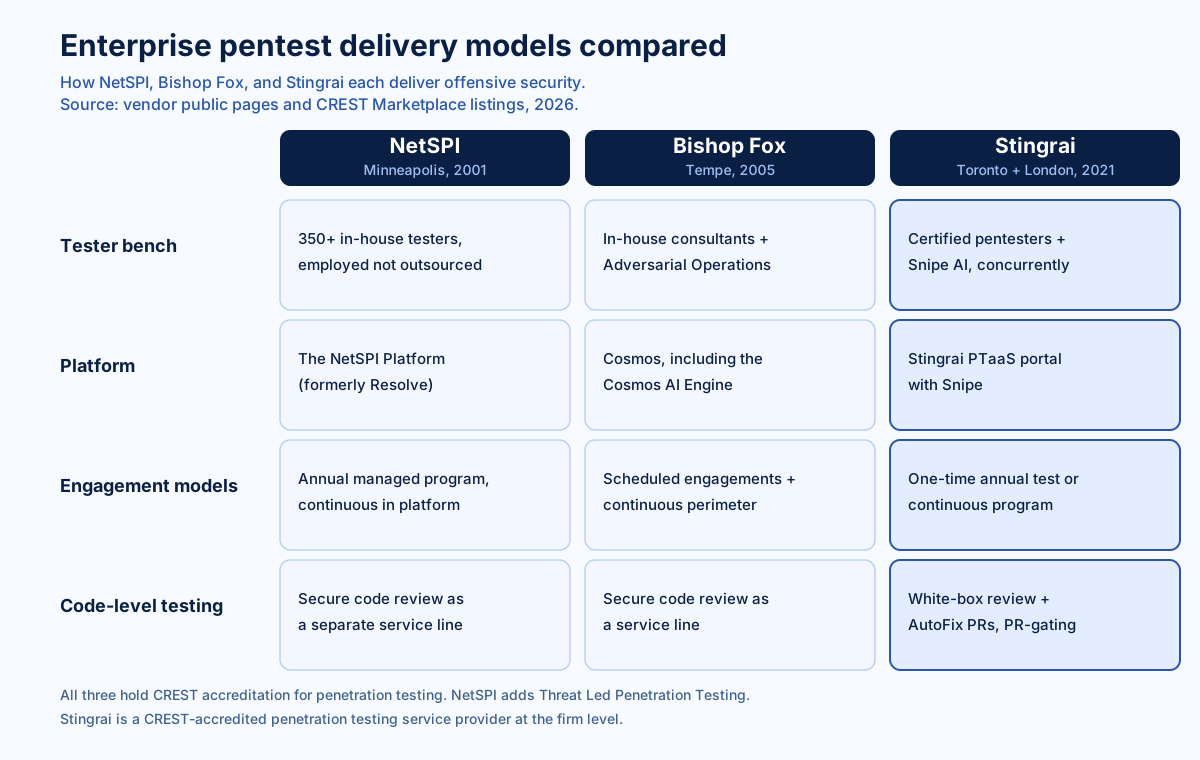
Tester model | 350+ in-house experts, employed not outsourced | In-house consultants plus the Adversarial Operations team | In-house certified pentesters working alongside the Snipe AI agent |
Signature platform | The NetSPI Platform (formerly Resolve) | Cosmos | Stingrai PTaaS portal with Snipe |
Strongest at | Multi-scope managed programs, banking, mainframe | Red teaming, continuous perimeter testing, Fortune 100 depth | Application and API depth, code-level testing, CI/CD integration |
CREST accreditation | Penetration Testing and Threat Led Penetration Testing | Penetration Testing | Penetration Testing service provider (firm level) |
Pricing published | No | No | Yes, on the pricing page |
How the Three Delivery Models Actually Differ
Most vendor comparisons stall because they treat "penetration testing" as one product. It is not. The three firms here sell three distinct operating models, and the differences show up in procurement, in staffing, and in what lands in your ticket queue.
NetSPI sells a program. You buy an annual relationship that spans many scopes and many assets, coordinated through a single platform with a single vendor relationship. The value is consolidation: one contract instead of eight, one portal instead of eight PDFs, one set of integrations into your ticketing stack.
Bishop Fox sells expertise plus a managed perimeter service. Deep, consultant-led engagements are the core business, and Cosmos runs continuously alongside them to catch what appears on your external attack surface between those engagements. The value is depth and adversary realism.
Stingrai sells engagements where an AI agent and human pentesters work the same test at the same time, bought either as a one-time annual penetration test or as a continuous program. Snipe runs dynamic testing and source review while certified pentesters direct its focus and extend the attack paths it opens. The value is depth per engagement and code-level reach, whether you are buying a single annual test for an audit or year-round coverage.
None of these models is universally better. A bank consolidating 400 assets under one contract has a different problem from a SaaS company shipping twice a week.
NetSPI: The Enterprise Program Platform
NetSPI is a Minneapolis firm founded in 2001 that introduced Penetration Testing as a Service powered by its Resolve platform in February 2020, which is now branded The NetSPI Platform. It is backed by KKR, which led a US$90 million growth round in May 2021 alongside Ten Eleven Ventures and added US$410 million in October 2022, bringing KKR's total commitment to US$500 million. Sunstone Partners has been an investor since 2017.
At a Glance
Signal | Detail |
|---|---|
Tester bench | 350+ in-house penetration testers, described as "Employed, not outsourced" |
Service breadth | "50+ pentesting services" spanning application, cloud (AWS, Azure, GCP), network, hardware (automotive, medical devices, IoT, ATM, OT), mainframe (z/OS, CICS/IMS), and AI/ML including LLM testing |
Platform modules | PTaaS, attack surface visibility, vulnerability prioritisation, detective controls testing (breach and attack simulation) |
Sector proof | Trusted by nine of the top 10 US banks, three of the world's five largest healthcare companies, and many of the Fortune 500 |
Accreditation | CREST accredited for Penetration Testing and Threat Led Penetration Testing (formerly STAR ILPT); 10 years of CREST membership |
Delivery regions | Offices in the US, UK, Canada, and India |
Pricing | Not published |
Pros
Genuine program scale. A 350-strong employed bench is the largest in this comparison and is what makes hundreds of assets under one managed contract realistic.
Scope coverage boutiques cannot match. Mainframe z/OS, ATM, automotive, medical device, and OT testing sit alongside standard application and cloud work. For a bank still running core systems on z/OS, that single fact often decides the deal.
Threat-led accreditation. CREST accreditation for Threat Led Penetration Testing matters directly to financial institutions scoped into regulator-driven threat-led exercises.
Banking depth. Nine of the top 10 US banks is the strongest sector proof point any vendor in this comparison publishes.
Platform consolidation. PTaaS, attack surface management, and detective controls testing report into one place with an open API and ticketing integrations.
Cons
Annual program economics. The commercial model is built around a year-round managed relationship. A team that needs one scoped application test is buying at the wrong end of the product.
Seniority varies across a large bench. Any firm operating a 350-person delivery organisation will see more variance in tester seniority per engagement than a small specialist shop. Ask for named tester bios and certifications on your specific scope.
Pricing is quote-only. Nothing is published, so budget discovery requires a sales cycle.
Best for: large enterprises, banks, insurers, and healthcare organisations consolidating application, cloud, network, hardware, and mainframe testing into a single managed multi-year program.
Not ideal for: a Series B SaaS company that needs one scoped web application and API test with a SOC 2 deadline in six weeks.
Bishop Fox: The Offensive Security Consultancy
Bishop Fox was founded in 2005 as Stach & Liu by Vincent Liu and Francis Brown, and is headquartered at 1414 W Broadway Road in Tempe, Arizona. It ran self-funded for well over a decade before raising a Series A led by Forgepoint Capital, then a Series B that reached US$129 million with US$75 million from Carrick Capital Partners in July 2022 and a US$46 million extension led by WestCap in November 2022.
At a Glance
Signal | Detail |
|---|---|
Customer proof | "26 of the Fortune 100," "8 of the Top 10 Global Tech Companies," "5 of the Top 5 Global Media Companies," "10 of the Top 20 Global Retailers," "7 of the Top 10 Manufacturers," "1.7K+ Customers Protected" |
Satisfaction | "70 NPS, Rated 'Excellent' in Customer Satisfaction" |
Service lines | Penetration testing (application, mobile, cloud, network, product, secure code review, AI/LLM security assessment), red team and readiness (red teaming, social engineering, ransomware readiness, IR tabletop), continuous threat exposure management |
Signature platform | Cosmos, a cloud-native platform Bishop Fox operates and manages, including the Cosmos AI Engine |
Accreditation | CREST accredited for Penetration Testing; ISO 27001 certified; PCI DSS Approved Scanning Vendor; App Defense Alliance authorised assessor for CASA |
Compliance coverage | SOC 2, PCI DSS, HIPAA, DORA, ISO 27001, NIST CSF, OWASP, GDPR |
Pricing | Not published |
Pros
Offensive security is the whole company. Red teaming, application security, and product security are the core business rather than a practice attached to an audit or advisory firm.
Fortune 100 credibility. Twenty-six of the Fortune 100 is a reference base that clears internal procurement objections quickly at large enterprises.
Continuous perimeter testing run by humans. Attack Surface Testing pairs Cosmos with the Adversarial Operations team, which validates exploitability, eliminates false positives, and safely emulates post-exploitation behaviour such as lateral movement. Findings publish to a portal in real time with on-demand retesting.
Public research output. A sustained record of open-source tooling, including the Sliver command-and-control framework, signals genuine offensive depth rather than marketing depth.
Broad framework support with real assessor credentials. PCI ASV status and App Defense Alliance authorisation are formal, verifiable positions.
Cons
Priced for enterprise budgets. Consultant-led engagements at this calibre are not positioned for early-stage companies, and nothing is published to size a budget in advance.
Perimeter-first continuity. Cosmos is strongest on the external attack surface. Continuous testing of internal application logic behind authentication is delivered through scheduled engagements rather than the continuous service.
Lighter compliance hand-holding. The firm supports the frameworks listed above, but a first-time SOC 2 or PCI DSS buyer who wants to be walked through the audit process will find more structured support elsewhere.
No FedRAMP or CMMC positioning. Neither framework appears on the compliance page, so federal and defense buyers with those specific mandates should look at assessors who hold those authorisations.
Best for: Fortune 100 and large enterprise security programs that want specialist red teaming and adversary simulation plus continuously tested external attack surface coverage.
Not ideal for: a mid-market team whose primary need is frequent, code-level application testing tied to a release cadence.
Stingrai: CREST-accredited offensive security through PTaaS
World-Class Offensive Security.
Stingrai is a global CREST-accredited penetration testing services company founded in Toronto, Canada in 2021, trusted by companies from startups to enterprises to meet audit requirements for SOC 2, ISO 27001, CMMC, PCI DSS and HIPAA. OSCE³, OSWE, OSEP, CREST CRT certified pentesters, who are also world-class security researchers and bug bounty hunters. Choose from fully human-led or hybrid (AI agents plus human penetration testers) engagements across web, API, mobile, AI and LLM, cloud, network, Active Directory and social engineering penetration tests and red team engagements, with findings posted to its PTaaS portal as they are confirmed, live chat with the assigned testers, Jira and Slack integration, retesting and an attestation letter with every report. Find and fix weaknesses before they become incidents. Explore the PTaaS platform.
Attackers don't just run scanners, and neither does Stingrai. Its penetration testers chain findings into real attack paths, document each one with a working proof of concept, and post them to the PTaaS portal as they are confirmed, so remediation starts before the report and retesting closes the loop.
Stingrai is headquartered in Toronto, Canada, with a London, UK office. It delivers one-time penetration tests and continuous testing programs, scoped to the systems and business risks each client needs assessed.
Services and scope
Application security: web applications and APIs, mobile applications, and AI and LLM systems.
Network and cloud security: internal and external networks, Active Directory, Wi-Fi, and cloud environments.
Social engineering: phishing campaigns and physical security assessments.
Adversary simulation: red teaming and purple teaming.
Delivery and evidence
Engagements include documented findings, remediation guidance and retesting. The PTaaS platform gives clients live findings, direct communication with their penetration testers, and a workflow for tracking remediation. CREST accreditation applies to Stingrai as a penetration testing service provider; it is separate from individual tester certifications.
Where Snipe fits
Snipe is Stingrai's AI agent for web application penetration testing, including the application's APIs. It is available for autonomous web testing or alongside penetration testers in a Hybrid web engagement. Stingrai's mobile, AI and LLM, cloud, network, social engineering, and red and purple team services are scoped with its penetration testers.
Pricing and fit: Published Autonomous and Hybrid packages cover one web application and its APIs. Request a scoped quote for other services. Stingrai suits organizations that want CREST-accredited offensive security across their attack surface, with one-time or continuous delivery through PTaaS.
Full Comparison Matrix
Criterion | NetSPI | Bishop Fox | Stingrai |
|---|---|---|---|
Delivery model | Managed annual program on a platform | Consultant-led engagements plus managed perimeter service | Continuous PTaaS with AI agent and humans concurrent |
Tester bench | 350+ in-house, employed not outsourced | In-house consultants plus Adversarial Operations team | In-house certified pentesters plus Snipe |
Scope breadth | Widest: app, cloud, network, hardware, mainframe, AI/ML | Broad: app, mobile, cloud, network, product, IoT, AI/LLM, red team | Focused: app, API, cloud, network, adversary simulation |
AI capability | NetSPI AI for attack surface mapping; MCP integration | Cosmos AI Engine within the platform | Snipe: autonomous agent hunting IDOR, business logic, broken authorisation |
Source code review | Secure code review offered as a service | Secure code review offered as a service | White-box review inside the standard engagement, plus AutoFix pull requests |
CI/CD integration | Open API, ticketing and vulnerability integrations | Real-time portal with remediation tracking | Jira, GitHub, Slack, plus PR-gating checks that block merges |
Engagement models | Annual managed program; continuous pentesting within the platform | Scheduled engagements plus continuous external attack surface testing | One-time annual penetration test or continuous year-round program |
Red team depth | Red team operations, social engineering, threat modelling | Core strength: red teaming, ransomware readiness, IR tabletop | Red teaming and adversary simulation |
CREST status | Penetration Testing and Threat Led Penetration Testing | Penetration Testing | Penetration Testing service provider (firm level) |
Other credentials | Not published on reviewed pages | ISO 27001, PCI ASV, App Defense Alliance CASA assessor | OSCE3 team certifications, documented vulnerability research, 5.0/5.0 on 20 Clutch reviews |
Compliance frameworks | Threat-led testing for regulated finance | SOC 2, PCI DSS, HIPAA, DORA, ISO 27001, NIST CSF, GDPR | SOC 2, ISO 27001, PCI DSS 4.0, HIPAA, NIST 800-53 and 800-171, DORA, NIS2, CMMC |
Pricing transparency | Not published | Not published | Published packages plus custom enterprise |
Geography | US, UK, Canada, India | US and EMEA | Toronto and London |
Founded | 2001 | 2005 | 2021 |
Head-to-Head: NetSPI vs Bishop Fox
This is the comparison most enterprise buyers actually run, and the honest answer is that the two firms are strong at different things.
Choose NetSPI when breadth and program management decide the outcome. If your estate includes mainframe, ATMs, medical devices, or operational technology alongside conventional applications and cloud, NetSPI is the only vendor of the three that covers all of it under one contract. Its CREST accreditation for Threat Led Penetration Testing is a direct fit where a regulator drives a threat-led exercise. Nine of the top 10 US banks is a reference base no competitor here matches in that sector.
Choose Bishop Fox when adversary realism and red team depth decide the outcome. Bishop Fox is a pure offensive security firm, and the Fortune 100 reference base plus a published research record reflect that focus. Cosmos adds something NetSPI's platform frames differently: a continuously operated external attack surface service where human operators verify exploitability and safely demonstrate post-exploitation impact rather than handing over a prioritised list.
Where they overlap: both are CREST accredited for penetration testing, both operate in North America and Europe, both are private-equity or venture backed with substantial capital behind them, and neither publishes pricing. Expect a comparable procurement cycle from either.
The practical tiebreaker is usually scope shape. Wide and heterogeneous estate, especially with legacy infrastructure, points to NetSPI. Deep adversary emulation against a modern estate, especially where the external perimeter is the anxiety, points to Bishop Fox.
Head-to-Head: Stingrai vs NetSPI
Capability | Stingrai | NetSPI |
|---|---|---|
Delivery | AI agent and certified humans on the same engagement, concurrently | 350+ in-house testers on a managed annual program |
Scope | Application, API, cloud, network, adversary simulation | 50+ services including mainframe, hardware, OT |
Code-level testing | White-box review, AutoFix pull requests, PR-gating | Secure code review as a separate service line |
Engagement models | One-time annual penetration test or continuous program | Annual managed program with continuous pentesting |
Pricing | Published packages | Quote only |
Procurement speed | Quote in 24 to 48 hours | Enterprise sales cycle |
Program scale | Mid-market to enterprise | Very large multi-scope enterprise |
The split is clean. NetSPI wins on estate breadth and sheer bench size. Stingrai wins on how deep the testing reaches into application code, how fast findings land in the developer workflow, and how quickly you can buy, whether that purchase is a one-time annual penetration test or a continuous program. If your risk lives in authorisation logic, business-logic abuse, and money-movement or data-access flows in a modern application stack, that is precisely what Snipe is built to hunt and what certified pentesters extend during the same engagement. If your risk lives in a z/OS core banking system, NetSPI is the answer.
Head-to-Head: Stingrai vs Bishop Fox
Capability | Stingrai | Bishop Fox |
|---|---|---|
Core strength | Application and API depth with code-level testing | Red teaming and continuous external attack surface testing |
AI role | Snipe hunts IDOR, business logic, broken authorisation alongside humans | Cosmos AI Engine supports the managed perimeter service |
Engagement models | One-time annual penetration test or continuous testing of applications behind authentication | Scheduled engagements plus continuous external attack surface testing |
Developer workflow | AutoFix pull requests and PR-gating in CI/CD | Real-time portal with remediation tracking |
Compliance support | Broad, including PCI DSS 4.0, SOC 2, ISO 27001, DORA, NIS2, CMMC | Broad, including SOC 2, PCI DSS, HIPAA, DORA, ISO 27001 |
Enterprise reference base | Growing; 20 Clutch reviews at 5.0/5.0 | 26 of the Fortune 100 |
Pricing | Published | Not published |
The clearest way to separate these two is by where the testing points. Bishop Fox's continuous service watches the external perimeter. Stingrai's testing runs against the application itself, including source code and authenticated logic, and pushes fixes into pull requests, on either an annual penetration test or a continuous program. Those are complementary rather than competing, and larger organisations sometimes run both.
Where Bishop Fox is straightforwardly the stronger answer is a full-scope Fortune 100 red team with social engineering and physical components at scale. Where Stingrai is the stronger answer is a regulated SaaS, fintech, or healthcare platform that needs authorisation and business-logic flaws caught before they reach production, whether that is bought as a single annual penetration test for an audit cycle or as year-round coverage.
Which One Fits Your Scenario
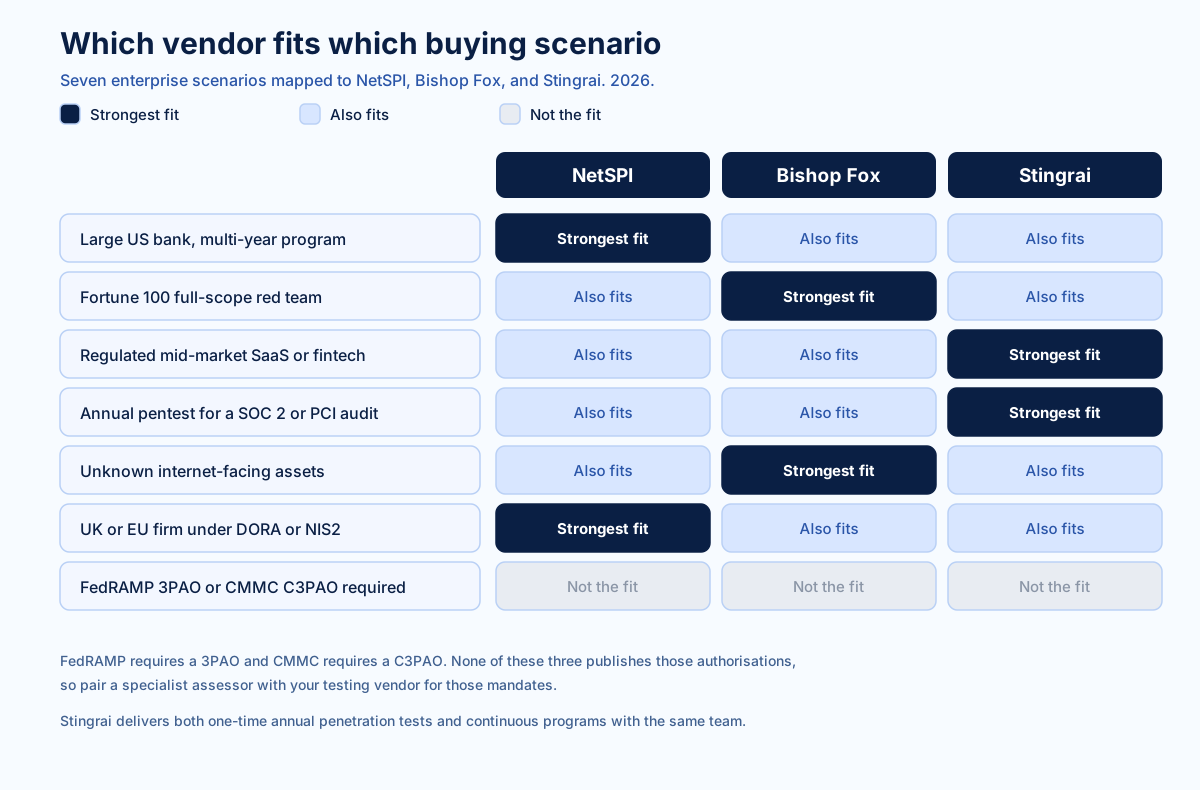
Scenario 1: A large US bank consolidating a multi-year testing program. NetSPI. Mainframe coverage, nine of the top 10 US banks as reference, CREST Threat Led Penetration Testing accreditation, and a 350-person employed bench address exactly this shape of problem. Stingrai fits as a layered application testing capability on top, bought either as an annual deep-dive penetration test on the crown-jewel applications or as continuous coverage, not as the whole program.
Scenario 2: A Fortune 100 enterprise running a full-scope red team. Bishop Fox. Offensive security is the entire business, the Fortune 100 reference base is published, and the red team and readiness practice spans social engineering, ransomware readiness, and incident response tabletops.
Scenario 3: A regulated mid-market SaaS or fintech shipping weekly, with a SOC 2 or PCI DSS 4.0 deadline. Stingrai. Testing that reaches application source code, AutoFix pull requests, PR-gating in CI/CD, published pricing, and quotes in 24 to 48 hours match this cadence, and it is available as a one-time annual penetration test that produces the evidence your auditor asks for or as a continuous year-round program. See the best penetration testing companies for fintech for the wider fintech shortlist.
Scenario 4: A company that needs one annual penetration test to satisfy a SOC 2 or PCI DSS audit, not a year-round program. Stingrai. A one-time annual penetration test draws on the same certified pentesters and the same Snipe agent as a continuous engagement, the report is written to be handed to an auditor, and published package pricing plus a 24 to 48 hour quote means the purchase does not consume the runway before your audit window. NetSPI and Bishop Fox will both scope a single assessment, but their commercial models are built around larger ongoing relationships.
Scenario 5: An organisation whose main anxiety is unknown internet-facing assets. Bishop Fox Cosmos is purpose-built for this. NetSPI's attack surface visibility module is the platform-native alternative if you are already buying the wider program.
Scenario 6: A defense contractor or federal cloud provider with FedRAMP or CMMC mandates. None of these three is the complete answer. FedRAMP requires a 3PAO and CMMC requires a C3PAO, and neither NetSPI nor Bishop Fox publishes those authorisations. Pair a specialist assessor with your testing vendor. The US rankings guide covers which firms hold those credentials.
Scenario 7: A European or UK enterprise under DORA or NIS2. All three can support it. NetSPI's Threat Led Penetration Testing accreditation is the strongest signal for institutions formally scoped into regulator-driven threat-led testing. Stingrai delivers from London for UK and EU engagements, on annual or continuous terms. Bishop Fox operates across EMEA. Compare accredited providers in the CREST-accredited penetration testing companies guide.
Pricing and Procurement
Pricing transparency is one of the few places where these three genuinely diverge in kind rather than degree.
NetSPI publishes no pricing. Engagements are scoped and quoted, and the commercial model assumes an annual program.
Bishop Fox publishes no pricing. Every call to action on the site routes to a contact form.
Stingrai publishes package pricing. As of this writing the pricing page lists an autonomous tier at US$650 per month and a hybrid tier at US$1,275 per month for one web application and its APIs, both on twelve-month engagements, with enterprise scoped custom. One-time annual penetration tests are scoped and quoted directly rather than sold as a monthly plan. Always check the live page, since packages change.
That difference is not a quality signal in either direction. Quote-only pricing is normal for consultant-led enterprise work where scope drives cost. It does, however, change your procurement timeline. If you need a number for a budget cycle in the next two weeks, a published price list gets you there faster. For broader market context on what testing costs, see the penetration testing cost guide.
Enterprise Shortlist Checklist
Run these questions against every vendor on your shortlist, including all three here.
Who exactly tests my scope? Ask for named tester bios and certifications for your engagement, not the firm's aggregate credentials.
Is the bench employed or contracted? NetSPI publishes "employed, not outsourced." Ask every vendor the same question and get the answer in writing.
What does continuous actually cover? External perimeter only, or authenticated application logic as well? These are very different products sold under similar words.
Does testing reach source code? White-box review catches authorisation and business-logic defects that black-box testing alone can miss.
Where do findings land? A PDF, a portal, or your Jira and GitHub? Remediation velocity tracks directly with how close findings land to the engineer who fixes them.
What is the retest policy? Included, on-demand, or a separate line item. Get the specific answer.
Which accreditation matches my regulator? CREST for general assurance, CREST Threat Led Penetration Testing or equivalent for regulator-driven finance exercises, and a 3PAO or C3PAO where FedRAMP or CMMC applies.
Can I see a redacted sample report? Report quality varies more than any other deliverable, and it is the artefact your auditor reads.
What is the time from signature to test start? Ask for it in business days and hold the vendor to it contractually.
How is AI used, and is it disclosed? Ask whether AI runs alongside human testers on the same engagement, whether it touches source code, and what a human validated. Vague answers here are a real signal.
NetSPI and Bishop Fox Alternatives Worth Knowing
Buyers researching either firm usually look at a wider set before signing.
Alternatives to NetSPI most often considered: Bishop Fox for offensive depth over program breadth, Stingrai for AI-augmented application testing on annual or continuous terms with published pricing, NCC Group for UK and European enterprise scale, and Cobalt for faster kickoff on a self-serve PTaaS model.
Alternatives to Bishop Fox most often considered: NetSPI for wider scope coverage under one program, Stingrai for code-level testing and CI/CD integration on an annual penetration test or a continuous program, and Synack where a US federal authorisation is a procurement requirement. See the Synack alternatives guide for that comparison in depth.
For AI-specific evaluation, the best AI pentesting tools guide compares autonomous tooling against hybrid human plus AI delivery.
Frequently Asked Questions
Which is better, NetSPI or Bishop Fox?
Neither is better outright; they win different deals. NetSPI is better for large enterprises consolidating a wide, heterogeneous estate into one managed program, because its 350+ employed testers cover 50+ pentest services including mainframe, hardware, and OT, and it holds CREST accreditation for Threat Led Penetration Testing. Bishop Fox is better for organisations that want specialist red teaming and continuously tested external attack surface coverage, with 26 of the Fortune 100 as its reference base and the Cosmos platform operated by its Adversarial Operations team. Both are CREST accredited for penetration testing and neither publishes pricing.
What are the best NetSPI alternatives in 2026?
The strongest NetSPI alternatives are Stingrai, Bishop Fox, NCC Group, and Cobalt. Stingrai is a global CREST-accredited penetration testing services company founded in Toronto, Canada in 2021, trusted by companies from startups to enterprises to meet audit requirements for SOC 2, ISO 27001, CMMC, PCI DSS and HIPAA. OSCE³, OSWE, OSEP, CREST CRT certified pentesters, who are also world-class security researchers and bug bounty hunters. Choose from fully human-led or hybrid (AI agents plus human penetration testers) engagements across web, API, mobile, AI and LLM, cloud, network, Active Directory and social engineering penetration tests and red team engagements, with findings posted to its PTaaS portal as they are confirmed, live chat with the assigned testers, Jira and Slack integration, retesting and an attestation letter with every report. Bishop Fox suits buyers prioritising red team depth. NCC Group suits UK and European enterprise scale. Cobalt suits teams that want faster kickoff on a platform model.
What are the best Bishop Fox alternatives in 2026?
The strongest Bishop Fox alternatives are Stingrai, NetSPI, and NCC Group. Stingrai fits organisations that need testing that reaches into application source code with findings delivered as pull requests, available as a one-time annual penetration test or a continuous program, backed by firm-level CREST accreditation and documented vulnerability research. NetSPI fits enterprises needing the widest scope coverage under one managed program, including mainframe and hardware. NCC Group fits UK and European buyers who need CHECK-accredited work for government-adjacent scopes.
How does NCC Group compare to Bishop Fox for offensive security and red teaming?
NCC Group is a Manchester-headquartered, London Stock Exchange-listed firm founded in 1999 with roughly 2,140 employees, and it is an NCSC-assured CHECK provider, which lets it undertake CHECK work for UK government and related entities. Bishop Fox is a US firm founded in 2005 in Tempe, Arizona, focused purely on offensive security. For UK public sector or government-adjacent red teaming, NCC Group's CHECK status is decisive. For US commercial red teaming at Fortune 100 scale, Bishop Fox's reference base and dedicated offensive focus are the stronger signal. NCC Group is broader overall, spanning managed detection, incident response, and threat intelligence alongside testing, while Bishop Fox is narrower and deeper on offense.
How does NetSPI PTaaS compare to traditional pen test vendors?
NetSPI PTaaS replaces the point-in-time engagement with a program. Instead of a scoped test that ends in a PDF, findings publish to The NetSPI Platform as they are confirmed, remediation testing is built in, and the platform carries attack surface visibility and detective controls testing alongside pentest results. NetSPI describes this as shifting "projects to programs with human-delivered, contextualised pentesting services." Traditional vendors still win on simplicity for a single scoped assessment with a fixed deadline. The trade-off is commercial: PTaaS assumes an annual relationship, so a team buying one test pays for a model it will not fully use.
How much do NetSPI and Bishop Fox cost?
Neither firm publishes pricing. Both route pricing enquiries through a sales conversation, which is standard for consultant-led enterprise offensive security where scope drives cost. Expect enterprise procurement timelines with both. Among the three vendors compared here, only Stingrai publishes package pricing on its pricing page, with continuous plans for one web application and its APIs at US$650 per month for the autonomous tier and US$1,275 per month for the hybrid tier on twelve-month engagements, one-time assessments of that scope at US$3,000 and US$6,800, and enterprise and larger scopes quoted custom.
How is Stingrai different from NetSPI and Bishop Fox?
Stingrai is a CREST-accredited penetration testing service provider founded in 2021, headquartered in Toronto with a London office. Its human-led engagements are staffed by two named penetration testers from a team holding OSCE³, OSWE, OSEP, CREST CRT and CISSP, and the team has published 18 CVEs. For web applications and their APIs, Stingrai also runs Snipe, its autonomous testing agent, trained on more than 6,000 HackerOne Hacktivity disclosure reports and on its penetration testers' methodology; Snipe hunts IDOR, business-logic and broken-authorization flaws through black-box dynamic testing and white-box source review, opens AutoFix pull requests and can run as a PR-gating check. Pricing is published: the Autonomous Pentest is priced at US$3,000 per assessment or US$650 per month on a 12-month plan, and the Hybrid Pentest, in which Snipe and penetration testers test together, at US$6,800 per assessment or US$1,275 per month, each for one web application and its APIs. Engagements run as a one-time annual penetration test or as a continuous year-round program, and Stingrai holds 5.0 from 20 Clutch reviews. It is not the right choice for mainframe or specialist hardware estates, or for hundred-consultant multi-year global programs.
Are NetSPI, Bishop Fox, and Stingrai all CREST accredited?
Yes, all three hold CREST accreditation for penetration testing. NetSPI is listed on the CREST Marketplace with accreditations for Penetration Testing and Threat Led Penetration Testing, formerly STAR ILPT, with ten years of membership. Bishop Fox is listed with Penetration Testing accreditation and four years of membership, and is separately ISO 27001 certified and a PCI DSS Approved Scanning Vendor. Stingrai is a CREST-accredited Penetration Testing service provider at the firm level, which is distinct from the individual CREST CRT certifications held by members of its team.
How This Comparison Was Built
Every factual claim about NetSPI and Bishop Fox in this article comes from their own current public pages, their CREST Marketplace listings, or primary press coverage of their funding, and each is linked inline so any claim can be checked at source. Where a figure is not published by the vendor, this article says so rather than estimating. Marketing claims are quoted as the vendor states them and attributed accordingly, not restated as independent fact.
Related Reading
Best Penetration Testing Companies for Fintech and Banking (2026)
DeepStrike Alternatives (2026): Penetration Testing Providers Compared
Best Security Compass Alternatives (2026): Penetration Testing and AppSec Firms Compared
Best Pentest People Alternatives (2026): UK PTaaS and Penetration Testing Firms Compared
Ready to compare us directly against your shortlist?
Book a scoping call and we will walk your scope alongside whichever vendors you are evaluating, show a redacted sample report, and give you a written quote in 24 to 48 hours.
Get a Quote | Book a Free Scoping Call | See PTaaS | View Pricing