



Security Compass sells four products and none of them is a penetration test. Its about page states that the company "helps organizations build secure, compliant software by bringing security requirements, threat modeling, and developer training directly into modern development workflows", and the product menu lists SD Elements, Devici, Kontra hands-on labs and AppSec training modules. The reason is on the record: Security Compass Advisory, the consulting arm that delivered penetration testing and adversary simulation, was acquired by Kroll on 15 December 2021.
That single fact reframes the shortlist. This guide ranks eight penetration testing and application security alternatives, and says plainly where Security Compass is still the right purchase. Every claim about Security Compass below is drawn from its own pages or from the Kroll release, and where a figure is not published we write "not published" rather than estimating.
At a Glance: Security Compass and the Best Alternatives in 2026
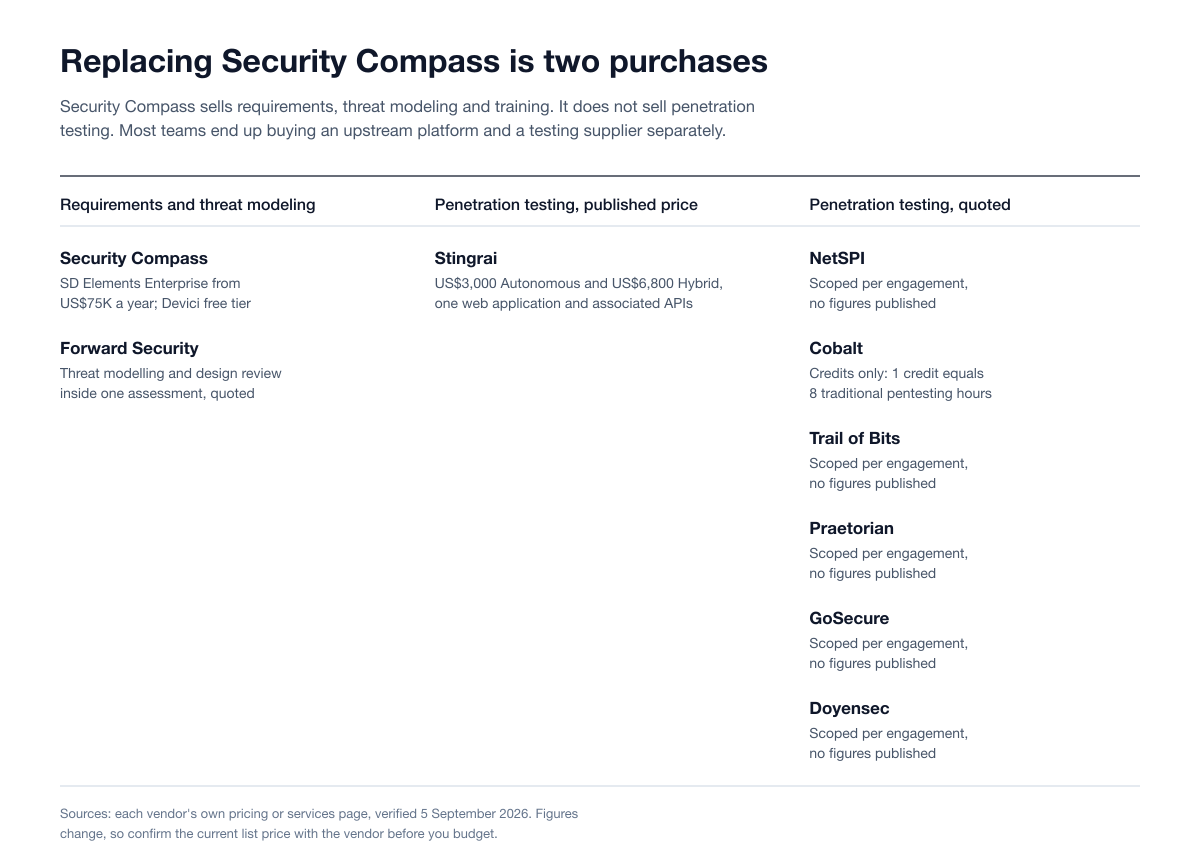
Vendor | HQ | What you buy | Published price |
|---|---|---|---|
Security Compass (benchmark) | Toronto, Ontario | SD Elements, Devici, Kontra, AppSec training | SD Elements Enterprise "Starting at $75K" annually |
1. Stingrai | Toronto, with a London office | Two named penetration testers per engagement, CREST-accredited firm; Snipe on web app scopes | US$3,000 or US$6,800 per assessment for one web application and associated APIs |
2. NetSPI | Minneapolis | PTaaS across 50+ pentesting services | Not published |
3. Cobalt | Boston | PTaaS bought in credits | Not published |
4. Trail of Bits | New York | Security review, research and engineering | Not published |
5. Praetorian | United States, address not published | Offensive security engineering on its own platform | Not published |
6. Forward Security | Vancouver, with a Toronto office | Threat modelling, code review and pentest in one assessment | Not published |
7. GoSecure | North America | Professional services plus 24/7 MXDR | Not published |
8. Doyensec | San Francisco, with a San Marino office | Deep application and code security review | Not published |
All cells were verified on each vendor's own pages on 5 September 2026. Source links appear in the full comparison table further down.
What Security Compass Sells in 2026
Three products and a training catalogue, all aimed at the design and build phases rather than the test phase.
SD Elements. The product page describes "a security requirements platform for security teams and engineering organizations that need consistent, auditable security governance across their software portfolio." It takes the architecture and regulatory context of an application and "converts it into specific, actionable requirements developers can actually implement", automatically mapped to "PCI-DSS, NIST 800-53, ISO 27001, SOC 2, HIPAA, and 100+ other frameworks" and pushed into Jira, GitHub and Azure DevOps. Published headline figures are 8,000+ security requirements, 100+ compliance frameworks and a claimed 50 to 70% reduction in audit preparation time. Validation runs "against the diff", and the page states that "If a requirement isn't met, the build doesn't ship."
Devici. Continuous threat modeling with a drag-and-drop diagram canvas, STRIDE, LINDDUN and MAESTRO framework support, MCP connectivity to Cursor, GitHub Copilot and Claude Code, and an integration that feeds identified threats into SD Elements as requirements. There is a genuinely free tier: three threat models and up to three users at $0 with no time limit.
Kontra and AppSec training. Hands-on labs and role-specific courses mapped to NIST, PCI and OWASP.
What is published about price. More than almost anyone in this category. The SD Elements pricing page lists an Enterprise tier "Starting at $75K" annually, notes the figure "is in USD and only valid for new Security Compass customers headquartered within North America", and adds US Federal and Canadian Federal Government tiers priced on request. Devici publishes a free tier and quotes Enterprise. The company states it is "certified by ISO/IEC 27001 and AICPA SOC".
Why Buyers Look for Security Compass Alternatives
None of these are defects. They are the consequences of a deliberate decision to become a product company, and all four are verifiable on Security Compass's own pages or in the Kroll release.
1. There is no penetration testing service line. The Products menu lists SD Elements, Devici, Kontra and AppSec Modules. The Solutions menu is organised by industry and role. No page on securitycompass.com offers a scoped penetration test, a red team engagement or a pentest report. If your auditor asked for a penetration test, this is not the vendor that produces it.
2. The testing practice left in 2021. Kroll's release states that it acquired Security Compass Advisory, "a cyber security consulting company that helps organizations improve the security posture of their existing technology environments", describing a practice "focused on pragmatic security strategy, testing and adversarial simulation". Buyers who worked with Security Compass Advisory before December 2021 and go looking for the same team are now looking at Kroll.
3. The entry price is a platform commitment. "Starting at $75K" annually is honest and unusually transparent, but it is a platform budget line, not a test. A team that needs one application assessed against an audit date in six weeks is solving a different problem at a different order of magnitude.
4. Requirements are not evidence of exploitation. SD Elements generates traceable evidence that requirements were implemented and validated. That is real and useful. It is not the same artifact as a report showing that a tester chained a broken authorization check into cross-tenant data access. Most regulated programs need both, and only one of them comes from this vendor.
What Testing Actually Surfaces
Very few providers publish outcome data from their own engagements, which makes the shape of a real finding set hard to reason about during procurement. Stingrai's State of Penetration Testing 2026 analyses 1,206 verified findings across 55 penetration tests. Three numbers matter here. 92.7% of tests surfaced at least one High or Critical finding, which is the practical argument against treating a requirements program as coverage. The false-positive rate across those findings was 0.74%, the benchmark to hold any vendor to when it tells you validation is handled. And the median time to fix a Critical was 10.5 days, which is why fixes arriving as pull requests are worth pricing rather than treating as a nice-to-have.
The 8 Best Security Compass Alternatives in 2026
1. Stingrai
The testing half Security Compass no longer sells.
Stingrai is a global CREST-accredited penetration testing services company founded in Toronto, Canada in 2021, trusted by companies from startups to enterprises to meet audit requirements for SOC 2, ISO 27001, CMMC, PCI DSS and HIPAA. OSCE³, OSWE, OSEP, CREST CRT certified pentesters, who are also world-class security researchers and bug bounty hunters. Choose from fully human-led or hybrid (AI agents plus human penetration testers) engagements across web, API, mobile, AI and LLM, cloud, network, Active Directory and social engineering penetration tests and red team engagements.
Offensive security is the entire business, and each human-led engagement runs with two named penetration testers reviewed by the team lead and an engagement partner, with 18 published CVEs and Hall of Fame credit at Apple, Google, the US Department of Defense and the US Federal Reserve behind them. For a team that already models threats and writes requirements upstream, the value is downstream proof: authenticated web and API testing across every user role against OWASP ASVS, mobile against OWASP MASVS and MASTG, AI and LLM systems against the OWASP LLM and Agentic Top 10, cloud, network, Active Directory, social engineering and red teaming. Findings reach the PTaaS portal as they are confirmed, with live chat to the assigned testers, Jira and Slack push, retesting and an attestation letter and verified badge with every human-led and hybrid report. Explore the PTaaS platform.
A requirements platform proves a control was specified. A penetration test proves an attacker cannot get past it. Stingrai's penetration testers work authenticated, chaining findings into real attack paths and documenting each one with a reproducible proof of concept and prioritized remediation guidance, which is where broken authorization, IDOR and business logic abuse surface. Where you share the repository, testing is source-assisted, so dynamic testing and code review point at the same weakness rather than two separate backlogs.
It sits either side of a release cycle: a one-time annual engagement when an audit or a customer questionnaire sets the date, or a continuous program that tests every release alongside the requirements and threat modelling work you keep in-house.
Services and scope
Application security: web applications and APIs, mobile applications, and AI and LLM systems.
Network and cloud security: internal and external networks, Active Directory, Wi-Fi, and cloud environments.
Social engineering: phishing campaigns and physical security assessments.
Adversary simulation: red teaming and purple teaming.
Delivery and evidence
Findings land in the portal as they are confirmed, each with a working proof of concept and prioritized remediation guidance, and push into Jira or Slack so they join the same backlog your requirements already feed. Live chat connects you to the assigned penetration testers during the test, reports are redactable PDFs with an executive dashboard, retesting of remediated findings is included, and every human-led and hybrid report comes with an attestation letter and a verified badge for SOC 2, ISO 27001 and PCI DSS 4.0 programs. CREST accreditation applies to Stingrai Inc. as a penetration testing service provider at firm level; it is separate from the CREST CRT certifications individual testers hold.
Where Snipe fits
Snipe is Stingrai's autonomous agent for web applications and their APIs only, and it is the part that lives inside your pipeline. A swarm of specialized agents covers recon, authentication, access control, business logic, injection and remote code execution, trained on more than 6,000 HackerOne Hacktivity disclosures and Stingrai's own testers' methodology. It runs black-box, authenticated grey-box and white-box source review, raises AutoFix pull requests with the patch proposed, and can gate merges on every pull request. The Autonomous tier is Snipe alone; on Hybrid, penetration testers test alongside it throughout the engagement. Mobile, AI and LLM, cloud, network, Active Directory, social engineering and red and purple team work is human-led.
Pricing and fit: US$3,000 Autonomous and US$6,800 Hybrid on the pricing page, each covering one web application and associated APIs, with every other scope quoted through the Get a Quote form. Best for: product and application security teams that own their requirements and threat modelling and need exploitation evidence, source-assisted testing and merge-time enforcement on top, bought annually or continuously.
2. NetSPI
Minneapolis, Minnesota, US. NetSPI describes itself as "the pioneer of Penetration Testing as a Service (PTaaS)" and states it "has led security innovation since its inception in 2001", with "more than 20 years of history, 350+ experts, and 50+ pentesting services". Coverage spans application, network, cloud, AI, mainframe, hardware and IoT, plus red team operations, attack surface management and secure code review. NetSPI and Synack announced a merger in September 2026, so ask how the combined roadmap affects your account if you shortlist either firm this quarter.
Published pricing: not published. Best for: enterprise application security programs that need one testing vendor across many asset classes. Source: netspi.com
3. Cobalt
San Francisco, US. PTaaS across web, API, network, cloud and AI targets plus secure code review, delivered by the Cobalt Core, a community of vetted testers matched to your stack by the platform. Engagements start within 3, 2 or 1 business days across the Standard, Premium and Enterprise tiers. Cobalt's pricing page states that "A Cobalt Credit is the equivalent of 8 traditional pentesting hours", sold in annual packages, and that "Credits do not roll over into the next contract." In-contract rollover runs 6 months on Standard and 12 months on Premium and Enterprise. Retest terms are the most generous published here: "Our PTaaS model provides unlimited on-demand retesting throughout your contract term."
Published pricing: not published. As of 5 September 2026 the pricing page carries no dollar figure, only credits and tiers. Best for: teams running many small tests a year across a product portfolio. Source: cobalt.io/platform/pricing
4. Trail of Bits
New York, US, per the mailing address at 228 Park Ave S, New York, NY 10003 on its contact page. Its about page states the firm has been independent "Since 2012" and publishes running counters of 946 publications, 620 audits and 200+ open-source repositories. Practice areas are "Application security, cryptography, blockchain, AI/ML, low-level systems, and software supply chain", and the firm states it runs "one of the largest consulting cryptography teams in the world" with "the people who maintain our open-source tools" also working client engagements. It was one of seven small-business-track teams selected to build an AI-powered Cyber Reasoning System and was awarded US$1M at the DARPA AIxCC semifinal.
Published pricing: not published. Best for: cryptography, protocol, compiler and machine learning review where the hard part is the design, not the endpoint. Source: trailofbits.com
5. Praetorian
United States; Praetorian publishes no head office address on its own pages. Offensive security engineering across application, cloud, network, AI and machine learning, IoT and hardware, and automotive targets including in-vehicle networks and V2X communications, delivered on what the company calls "our proprietary offensive security platform". Its published claims are "Zero False Positives, every finding verified by an expert", "70% Faster MTTR" and "100% Compliance Coverage, FDA, GLBA, HIPAA, NERC, PCI-DSS & more".
Published pricing: not published. Best for: engineering-grade testing of unusual targets, particularly embedded, automotive and machine learning systems. Source: praetorian.com
6. Forward Security
Vancouver, British Columbia, with a Toronto office. Its contact page states "We are headquartered in beautiful Vancouver, Canada with reach across North America and Europe", listing 555 W Hastings St, Suite 1200 in Vancouver and 1655 Dupont St, Suite 101 in Toronto. This is the closest structural analogue to what Security Compass used to sell as one company: a four-stage application security risk assessment covering discovery, threat modelling, penetration testing and finalisation, plus code security and vulnerable dependency analysis, security design review, AI security services against the OWASP LLM Top 10, and the Eureka DevSecOps platform for orchestrating scanners and correlating results.
Published pricing: not published. Best for: Canadian software teams that want threat modelling and code review wrapped around the pentest rather than bought from two vendors. Source: forwardsecurity.com
7. GoSecure
A North American cybersecurity company whose about page states it has been "pioneering the integration of endpoint, network, and email threat detection into a single Managed Extended Detection and Response (MXDR) service" for "over 20 years". Its professional services line covers penetration testing, PCI DSS services, incident response, security maturity assessment, privacy services and security operations, plus threat simulation and emulation and tabletop exercises. GoSecure positions professional services as "finding the problems" while GoSecure Titan MXDR "make sure to solve them".
Published pricing: not published. Best for: buyers who want testing and 24/7 detection and response on one contract. Source: gosecure.ai
8. Doyensec
San Francisco, US at 350 Townsend Street, Suite 840, with an EMEA office in San Marino. The homepage describes a firm that works "at the intersection of software development and offensive engineering", auditing web applications and APIs, mobile, desktop and server applications, GraphQL platforms, ElectronJS applications, cloud, smart contracts, large language models and IoT devices, and states it performs "in-depth analysis using manual source code auditing and dynamic testing". Its own summary is the useful one: "we're an offensive security firm working with the frame of reference of a blue team."
Published pricing: not published. Best for: deep, code-level review of a single complex application by a small specialist team. Source: doyensec.com
How It Compares: Security Compass Side by Side
Security Compass is compared here rather than ranked, because the post is about alternatives to it and a self-referential rank would be meaningless. Every cell below was read from the linked page on 5 September 2026.
Security Compass | Stingrai | Source | |
|---|---|---|---|
HQ | 325 Front St. West, Suite 103, Toronto, ON M5V 2Y1, plus a Newark, NJ mailbox and an Austin, TX satellite office | Toronto, Ontario, with a London, UK office at 1 Coldbath Square, Farringdon | |
What you buy | SD Elements, Devici, Kontra, AppSec training modules | Scoped penetration testing across web and API, mobile, AI and LLM, cloud, network, Active Directory and red team, annual or continuous | |
Penetration testing | Not offered. Security Compass Advisory acquired by Kroll, 15 December 2021 | The entire business | |
Published price | SD Elements Enterprise "Starting at $75K" annually, USD, North American customers only; Devici free tier at $0 | US$3,000 Autonomous, US$6,800 Hybrid, or US$650 and US$1,275 per month | |
Requirements generation | 8,000+ security requirements, 100+ compliance frameworks | Not offered | |
Threat modeling | Devici, with STRIDE, LINDDUN and MAESTRO support and a free tier | Threat modelling is part of scoping, not a separate product | |
Source code coverage | Devici CodeGenius scans repositories against the threat model | Snipe reads application source alongside dynamic testing | |
Fix automation | Requirements delivered as tickets, prompts and pull-request gates | AutoFix pull requests with the patch proposed | |
Exploitation evidence | Not published; validation confirms requirements were met | Proof of concept, severity ratings and retested findings | |
Company certifications | "certified by ISO/IEC 27001 and AICPA SOC" | CREST-accredited penetration testing service provider at firm level; the team holds OSCE³, OSWE, OSEP, CREST CRT and CISSP | |
AI workflow | MCP connectivity to Cursor, GitHub Copilot and Claude Code | Snipe as an autonomous agent plus PR gating |
Where Security Compass Is the Better Choice
Honest answer, and it is a genuinely strong category.
The problem is upstream. If your applications keep failing the same controls, the cheapest fix is not another test. It is getting the right requirements into the backlog before the code exists. SD Elements does that at portfolio scale, mapped to the frameworks your assessor cites, and no penetration testing firm on this list offers an equivalent.
Audit preparation is the pain. The published claim is a 50 to 70% reduction in audit preparation time, built on requirement-to-code traceability rather than evidence reconstructed the week before the audit. For a compliance team drowning in screenshots, that is the product.
AI agents are writing your code. Security Compass has aimed the whole platform at that shift, with MCP connectivity into Cursor, GitHub Copilot and Claude Code so requirements reach the agent rather than a wiki. If your engineering organisation has moved to agent-assisted development faster than your security program has, this is a well-targeted answer.
Threat modeling needs to be continuous. Devici's free tier lets a team try continuous threat modeling on three models before committing budget, which is rare in this category.
If your constraint is instead an auditor asking for a penetration test, depth on one application's authorization model, or a supplier who will demonstrate exploitation rather than confirm coverage, the eight firms above are built for that.
Buyer Checklist
Run these against every quote. Ask for written answers.
Am I buying a platform or an engagement? A per-seat annual subscription and a scoped test are different budget lines with different approvers.
Does the deliverable demonstrate exploitation? Coverage evidence and exploitation evidence satisfy different questions from an assessor.
Who performs the test, and are they employees? Get the staffing model, not just the certification list.
Is source code in scope? Black-box only, or dynamic testing plus white-box review.
What does the AI actually do? Generating requirements, triaging findings, or exploiting and chaining. Our AI pentesting tools comparison sets out how to tell.
How do fixes reach engineering? A ticket, a requirement, or a pull request with a patch and a gate on the next merge.
Are retests included, and for how long? Confirm before you sign, not at remediation time.
Which exact control does the artifact satisfy? Match it to the clause your assessor will cite, whether that is PCI DSS 4.0 Requirement 11.4 or SOC 2 CC4.1.
Is the firm accredited, or are individuals certified? Different claims. Read our guide to verifying CREST accreditation.
Run your scope through the penetration testing cost calculator before you collect quotes, so you can tell an outlier from a scoping difference.
Frequently Asked Questions
What are the best Security Compass alternatives in 2026?
It depends which half you are replacing. For penetration testing, the eight strongest alternatives are Stingrai, NetSPI, Cobalt, Trail of Bits, Praetorian, Forward Security, GoSecure and Doyensec, with Stingrai first for business logic and authorization depth at a published price. For the requirements and threat modeling platform itself, Security Compass has few direct equivalents, which is exactly why so many teams end up buying SD Elements for the design phase and a specialist testing firm for the test phase.
Does Security Compass do penetration testing?
No. As of 5 September 2026 the securitycompass.com product menu lists SD Elements, Devici, Kontra hands-on labs and AppSec training modules, and no page offers a scoped penetration test or red team engagement. The company describes itself as helping organizations "build secure, compliant software by bringing security requirements, threat modeling, and developer training directly into modern development workflows".
What happened to Security Compass Advisory?
Kroll acquired it on 15 December 2021. Kroll's release describes Security Compass Advisory as "a cyber security consulting company that helps organizations improve the security posture of their existing technology environments and accelerate adoption of new technology", "focused on pragmatic security strategy, testing and adversarial simulation". The practice's penetration testing, red team and cloud security capabilities moved to Kroll's cyber risk practice along with its leadership.
How much does SD Elements cost?
Security Compass publishes the figure. The SD Elements pricing page lists an Enterprise tier "Starting at $75K" annually and notes that "Pricing is in USD and only valid for new Security Compass customers headquartered within North America", with US Federal and Canadian Federal Government tiers priced on request. Devici publishes a free tier at $0 for three threat models and up to three users, with Enterprise quoted. That is more price transparency than most vendors in either category offer.
Is SD Elements a substitute for a penetration test?
No, and Security Compass does not claim it is. SD Elements generates security requirements, pushes them into developer tooling and produces traceable evidence that they were implemented and validated. A penetration test produces evidence that a tester attempted to break the application and either did or did not succeed, with severity ratings, proof of concept and retested findings. Assessors treat those as different artifacts. Most regulated programs need both.
Where is Security Compass headquartered?
Toronto. Its contact page lists the headquarters at 325 Front St. West, Suite 103, Toronto, ON M5V 2Y1, Canada, alongside a mailbox at 8 Lombardy Street, Newark, NJ and a satellite office at 600 Congress Street, Austin, TX.
Which alternative combines threat modelling with the penetration test?
Forward Security is the closest single-vendor answer. Its published four-stage application security risk assessment runs discovery, threat modelling, penetration testing and finalisation as one engagement, and the firm also sells code security analysis and security design review. Stingrai covers the testing half with source review inside the engagement, so a common pattern is SD Elements or Devici for requirements and threat models upstream, and Stingrai for testing, AutoFix pull requests and merge gating downstream.
Which Security Compass alternative publishes a fixed penetration testing price?
One. Stingrai publishes US$3,000 per Autonomous assessment and US$6,800 for Hybrid, each covering exactly one web application and associated APIs, with monthly equivalents of US$650 and US$1,275 on a 12-month engagement. NetSPI, Cobalt, Trail of Bits, Praetorian, Forward Security, GoSecure and Doyensec all quote every engagement.
Which alternative is best for compliance evidence?
All eight produce reports used as evidence in SOC 2, ISO 27001 and PCI DSS programs. Stingrai's penetration testing supports SOC 2, ISO 27001, HIPAA, PCI DSS 4.0, NIST SP 800-53 and 800-171, DORA and NIS2 programs, with named testers, an attestation letter, a verified badge and retesting of remediated findings on every human-led and hybrid report, whether you buy a single annual engagement or a continuous program. NetSPI and Cobalt are the strongest fits where an enterprise portfolio needs many tests under one contract. Ask every vendor for a redacted sample report and confirm retest evidence is included, using our guide to the pentest evidence auditors accept.
Related Reading
Best Kobalt.io Alternatives (2026): Penetration Testing and Managed Security for SMBs
Best Pen Test Partners Alternatives (2026): UK and North American Testing Firms Compared
Best OnSecurity Alternatives (2026): UK PTaaS and Penetration Testing Firms Compared
The Bottom Line
Security Compass is a good company solving a real problem, and the problem is not the one most people searching for an alternative are trying to solve. Requirements, threat models and developer training belong upstream of the build. SD Elements does that at portfolio scale, publishes its entry price, and has aimed itself squarely at a world where AI agents write a growing share of the code.
The testing half of the old Security Compass went to Kroll in December 2021 and has not come back. If that is the half you need, buy it from a firm whose entire business is offensive security. For business logic and authorization depth at a published price, with the patch proposed in the pull request and a guarantee on the Autonomous tier, Stingrai is the closest like-for-like answer and sits in the same city. Compare packages on the Stingrai pricing page, book a free scoping call, or send your scope through the Get a Quote form.