




Quick answer: An AI pentesting tool exploits what it finds and returns proof. A vulnerability scanner with a language model attached matches signatures and returns a list of maybes. That difference, proof versus hypothesis, is the only useful way to sort this category in 2026, and most products marketed as AI pentesting fail it. The second question is how much runs without a person, and the best public benchmark says full autonomy wins on breadth and loses on the creative leap. Stingrai Snipe is the featured pick for web applications and APIs, because it hunts the classes signature matching cannot reach, IDOR, business logic and broken authorization, with Stingrai's penetration testers working the same engagement at the same time. Fourteen more tools follow, grouped by the job they do rather than ranked against one another.
TL;DR: Best AI Pentesting Tools 2026
Exploitation of a software vulnerability is now the leading initial-access vector, at 31 percent of breaches, the first time it has topped the list (Verizon, 2026 Data Breach Investigations Report).
Broken access control appeared in 100 percent of applications tested for the OWASP Top 10:2025, across 40 mapped CWEs and 32,654 CVEs (OWASP Top 10:2025, A01). Nothing in that class has a signature.
The best autonomous agent in the largest public head-to-head placed second against ten working professionals on a live 8,000-host network, at an 82 percent valid-submission rate. The remaining gap is qualitative, not volumetric: 80 percent of those professionals found a critical remote code execution bug the agent reported only under guided elicitation with hints (Lin et al., arXiv 2512.09882).
The open-source AI offensive toolset went from fewer than five tools to 70 between April 2023 and March 2026 (Hadrian, The AI Offensive Security Boom).
Seventy percent of surveyed security researchers now use AI tools, 1,121 customer programs put AI in scope in 2025 (up 270 percent), and valid prompt-injection reports rose 540 percent year over year (HackerOne, 9th Hacker-Powered Security Report).
Ninety-four percent of organizations run more AI systems than a year ago, but only 66 percent formally test 61 percent or more of them, a 28-point coverage gap (HackerOne, AI Security Gap, March 2026).
The category finally has a governance standard. OWASP's Autonomous Penetration Testing Standard v0.1.0 defines 173 tier-required requirements across 8 domains (OWASP APTS).
The penetration testing market reaches US$2.72 billion in 2026 and US$5.54 billion by 2031, a 15.29 percent CAGR (Mordor Intelligence).
The tool classes at a glance
Featured pick, hybrid web and API testing: Stingrai Snipe.
Autonomous web application agents: Penligent, XBOW.
Autonomous network and infrastructure agents: Horizon3.ai NodeZero, RidgeBot.
Operator-driven exploitation frameworks: Core Impact, Metasploit.
Platforms that automate the workflow around people: Astra Security, Cobalt.
LLM and AI red-team specialists: Mindgard.
Continuous coverage between engagements: Hadrian, StackHawk.
Open source: MITRE Caldera, PentestGPT.
Key takeaways
Autonomy is the wrong axis to shop on. Evidence is the right one. Every vendor claims autonomy and the claim is nearly content-free. What separates products is what lands in the report: a CVE ID and a CVSS score, or a request, a response, and a reproduction path.
The bug classes that matter most are the ones signatures cannot describe. OWASP found broken access control in every application it measured for the 2025 Top 10. An IDOR is not a missing patch, it is a correct-looking request with the wrong identifier in it, and a tool that only knows CVEs will never see it.
Autonomous agents are now genuinely competitive, and they still miss things people catch. An agent beat 9 of 10 professionals on volume and placed second overall, while 80 percent of those same professionals found a critical RCE the agent needed hints to reach (arXiv 2512.09882). The practical answer is concurrency, not choosing a side.
False positives are a scope problem, not a tuning problem. A tool that proves exploitation has a structurally low false-positive rate, because a finding that cannot be exploited never gets written. Scope guardrails are documented and auditable now too: OWASP APTS dedicates 26 of its 173 requirements to scope enforcement and another 20 to safety controls.
Methodology
This guide was refreshed with a date cutoff of 29 August 2026. Product capability claims come from each vendor's own product and pricing pages, read in-session. Category figures come from named primary publishers, all listed in full in the references below: the Verizon 2026 DBIR, OWASP Top 10:2025, OWASP APTS v0.1.0, the CISA Known Exploited Vulnerabilities feed, two HackerOne research reports, Hadrian's 2026 tool census, Mordor Intelligence, and the December 2025 arXiv preprint on AI agents against cybersecurity professionals.
Figures that could not be reached on at least one verification pass against a named primary source were dropped rather than estimated: per-seat license prices from aggregator listings, scanner false-positive percentages traceable only to secondary summaries, and prior-year breach-vector comparisons available only through news coverage. Where a vendor does not publish a price, this guide says so instead of inferring one.
Tools were selected on category fit: a product had to automate exploitation, adversarial testing of AI systems, or the penetration testing workflow itself. Products that automate detection only appear in a separate labelled section.
AI pentesting is not vulnerability scanning
The two get sold interchangeably and they are not the same activity. The difference is not degree of automation, and it is not whether a language model is involved. It is what the tool does after it notices something.
A scanner produces a hypothesis, a pentest produces a proof
A vulnerability scanner fingerprints a target, compares what it sees against a corpus of known signatures, and emits a list of conditions that correlate with known vulnerabilities. It is fast, cheap, repeatable and genuinely valuable. It is also, structurally, a list of hypotheses: it asserts that a thing is probably true, without establishing that it is true here, in this configuration, behind these controls. Bolting a chatbot onto that engine produces more output, not better output.
An AI penetration testing tool takes the extra step. It attempts the exploit, observes whether the attempt succeeded, and records what happened. The output is not "this host appears to run a vulnerable version." It is "here is the request, here is the response, here is the data that came back, here is how to reproduce it."
That is why exploitation-based tooling is now the point of the exercise rather than a luxury. Verizon's 2026 DBIR put exploitation of a software vulnerability at 31 percent of breaches, the first time it has been the single most common way in, and CISA's Known Exploited Vulnerabilities catalog carries 1,685 entries as of catalog version 2026.08.27, each admitted only on evidence of active exploitation. The gap that matters is between findable and exploitable, and only one kind of tool measures it.
Three capabilities draw the line
Three concrete capabilities separate the two. Exploitation with a proof artifact per finding: the tool attempts the attack and stores the request that worked, the response, a screenshot, a session token. Chaining across steps: real compromise is rarely one bug, so a tool has to carry state from an information disclosure to a hostname to credentials to admin and report the path, where a scanner reports three unrelated mediums. Authenticated testing of application logic: can user A read user B's invoice by changing an identifier, can a discount code be applied twice, can a role check be skipped by calling the endpoint the UI would have hidden.
The bug class that settles the argument
In the OWASP Top 10:2025, A01 Broken Access Control retained the top position with a 100 percent incidence rate, meaning some form of broken access control appeared in every application in the tested dataset. The category maps 40 CWEs, 1,839,701 occurrences and 32,654 CVEs, and the 2025 revision folded server-side request forgery into it as an authorization failure.
Access control failures are application-specific by construction. There is no signature for "this user should not have been able to see this record," because only the application knows who should see what. That is the structural reason a scanner cannot find your worst bug, and why the useful question about any tool here is whether it tests authorization at all. Stingrai's breakdown of why API scanners miss BOLA and IDOR goes deeper on the mechanics.
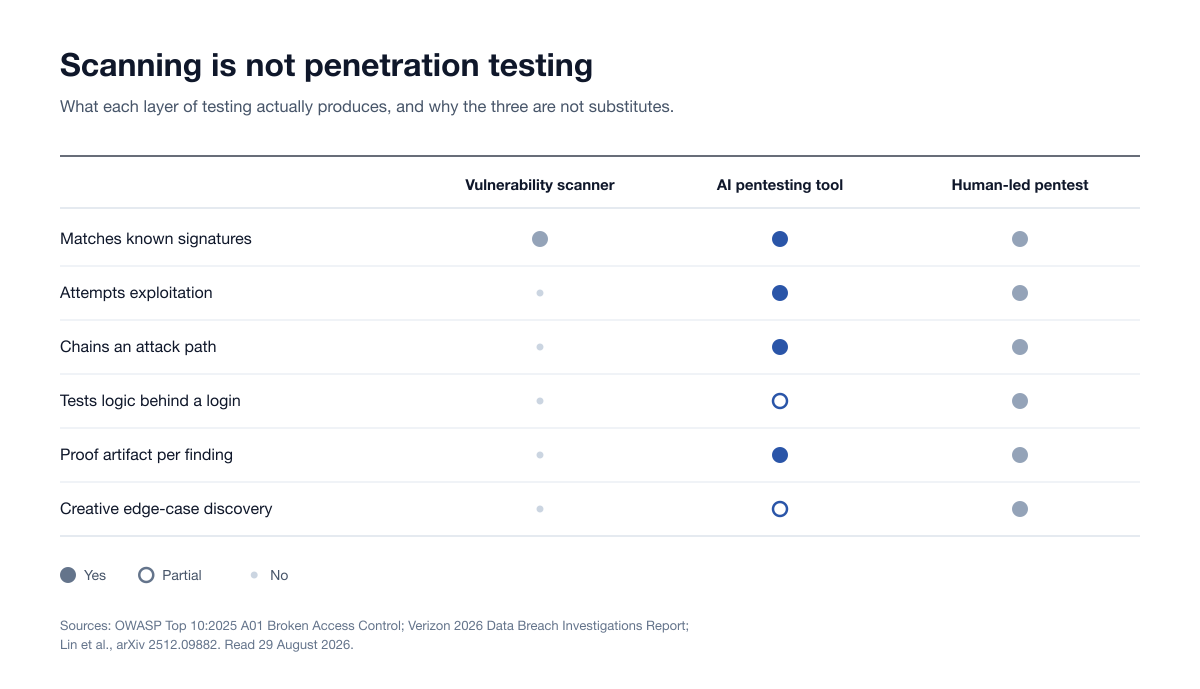
Figure 1: What each layer of testing actually produces. Sources: OWASP Top 10:2025 A01, Verizon 2026 DBIR.
Why the market moved, and what changed in 2026
The economics rewrote the buying decision. Hadrian's 2026 census of open-source AI offensive tooling puts a manual penetration test of equivalent scope at US$15,000 to US$50,000, against US$28.50 for an AI-driven run on one of its benchmark engagements, records the CAI framework from Alias Robotics logging a 156x cost reduction (US$109 against US$17,218) at 3,600 times the speed, and notes median time-to-exploit compressing from 756 days in 2018 to 4 hours in 2024 (Hadrian). When a run is that cheap and fast, testing moves from annual to continuous. For how prices map to scope, see Stingrai's penetration testing cost guide.
Adoption tracked the economics. HackerOne's 9th Hacker-Powered Security Report, published October 2025, found 70 percent of surveyed researchers now use AI tools, valid AI vulnerability reports up more than 200 percent year over year, and 1,121 distinct customer programs with AI in scope, a 270 percent increase (HackerOne).
The 2025 story was adoption; the 2026 story is consolidation and scrutiny. XBOW topped HackerOne's US leaderboard in June 2025 and within a year raised a US$120M Series C above a US$1B valuation. What did not change is the ceiling on pure autonomy, and the coverage gap got measured: HackerOne's March 2026 research found 94 percent of organizations operate more AI systems than a year ago while only 66 percent formally test 61 percent or more of them, with 89 percent of security leaders reporting an AI-related attack or vulnerability in the past year (HackerOne). Those testing 91 percent or more of their systems were 16 percent less likely to report an incident.
The buyer question shifted accordingly. Not "does AI pentesting work?" but "which class of tool, how much human testing does my assurance posture require, and what evidence does the vendor produce?"
Where automation still has a ceiling
There is now a solid public dataset instead of vendor anecdote. In December 2025, researchers from Stanford, Carnegie Mellon and Gray Swan AI ran ten working cybersecurity professionals against six AI agents plus a new multi-agent framework called ARTEMIS, on a live enterprise network of roughly 8,000 hosts across 12 subnets (arXiv 2512.09882). The results cut both ways.
ARTEMIS placed second overall and outperformed 9 of the 10 human participants, finding 9 valid vulnerabilities at an 82 percent valid submission rate, with certain variants running at roughly US$18 per hour against roughly US$60 per hour for the professionals. Anyone still arguing that autonomous tooling is a toy is arguing against measurement.
And then: 80 percent of the human participants found a critical remote code execution bug that the best-scoring agent reported only under guided elicitation with hints. The paper also records higher false-positive rates for agents, and difficulty with GUI-driven exploitation.
The residual gap is qualitative, not volumetric, which is why both should run at the same time on the same engagement rather than in sequence. Stingrai covers the division of labour in autonomous versus human pentesting scope split.
Types of AI pentesting tools in 2026
AI pentesting tools sort into eight practical classes. Match the class to the surface that carries your risk. If you are comparing the underlying foundation models rather than the productized tools, see Stingrai's best AI model for pentesting analysis; for the broader category beyond pentesting, see the top AI security tools guide.
Tool class | What it automates | Best when | Tools in this guide |
|---|---|---|---|
Hybrid AI pentester | Agentic testing with penetration testers on the same engagement, across every severity | Findings must be audit-defensible | Stingrai Snipe |
Autonomous web application agent | Discovery, chaining and exploitation of web and API flaws | You want breadth fast on internet-facing applications | Penligent, XBOW |
Autonomous network pentester | Credential, lateral-movement and Active Directory attack paths | You are replacing an annual internal infrastructure test | Horizon3.ai NodeZero, RidgeBot |
Operator-driven exploitation framework | Exploit delivery, post-exploitation and campaign automation | You have testers and want to accelerate them | Core Impact, Metasploit |
Workflow platform around people | Recon, triage, reporting and retest around scoped human tests | You run many scoped tests across a portfolio | Astra Security, Cobalt |
LLM red-team specialist | Adversarial testing of AI models, agents and guardrails | You ship AI-backed product features | Mindgard |
Continuous coverage layer | Regression scanning and external exposure validation between tests | Your code or perimeter changes constantly | Hadrian, StackHawk |
Open-source AI assistant | Task planning, technique execution and payload help | You are learning, running research, or validating detections | MITRE Caldera, PentestGPT |
How to evaluate an AI pentesting tool in 2026
Six criteria separate products in this category. None of them are adjectives.
Proof artifact per finding. Ask for a redacted sample report before the demo and read one medium-severity finding: is there a reproduction path a developer could follow without asking a question? If the finding is a CVE reference and a severity score, the product is a scanner. The validation gap shows up in benchmarks too: on AutoPenBench, a fully autonomous agent succeeded on 21 percent of tasks against 64 percent for a human-assisted agent.
False-positive handling mechanism, not rate. A quoted percentage is unfalsifiable without the denominator. Ask how the product decides a finding is real. Proof-based validation, where nothing is reported unless exploitation succeeded, is structurally different from confidence scoring applied after the fact.
State and authentication awareness. Does the tool carry context between steps so it can chain, and does it model role separation and session state? The vulnerabilities that matter live in business logic: broken object-level authorization, broken function-level authorization, multi-step privilege escalation. A tool that does not model roles cannot reach them.
Scope guardrails and blast radius. For anything pointed at production: what defines scope, what happens when the agent finds an in-scope host with an out-of-scope neighbour, is there a kill switch, and is destructive behaviour prevented by design or by prompt. Stingrai's guidance on running an autonomous pentest against production safely sets out the questions in full.
A fix artifact in the developer's workflow. A tool that ships the fix as a reviewable pull request attached to the proof of the bug it closes hands engineering a decision instead of a research project. A finding that lands in a separate dashboard waits; one that lands as a PR-gating check stops the vulnerable code merging at all.
Retest, diff and defensible reporting. After a fix ships, can the tool re-run the affected finding and show what changed since the last run? Reporting also has to map onto the frameworks your auditors read, and a finding has to hold up when an engineer disputes it.
Four failure modes that break
Unverified alert volume. A scanner with a chatbot attached produces more output, not better output. If a tool cannot show the proof of exploit, treat the finding as a hypothesis.
Black-box probing with no reachability reasoning. Current AI is strongest at reading code and reasoning about whether a flaw is reachable. A tool that only scans from the outside throws away the capability that works.
Findings with no fix artifact. A finding without a remediation path is a deferred cost.
Claims with no benchmark trail. XBOW publishes a HackerOne submission trail; AutoPenBench and Cybench publish reproducible numbers. A tool whose only evidence is its own marketing copy has not earned the claim.
The category finally has a standard
Until 2026 there was no shared definition of what an autonomous testing platform owed its customer. OWASP's Autonomous Penetration Testing Standard (APTS) v0.1.0 changed that, defining 173 tier-required requirements across 8 domains in three cumulative tiers (OWASP APTS). The weighting is what makes it useful as a buyer's tool: the largest domains are Graduated Autonomy and Scope Enforcement, not reporting, and Tier 1 alone requires that a platform will not test outside scope, can be stopped immediately, and produces an audit trail. Those are the three answers a security team needs before pointing anything autonomous at production.
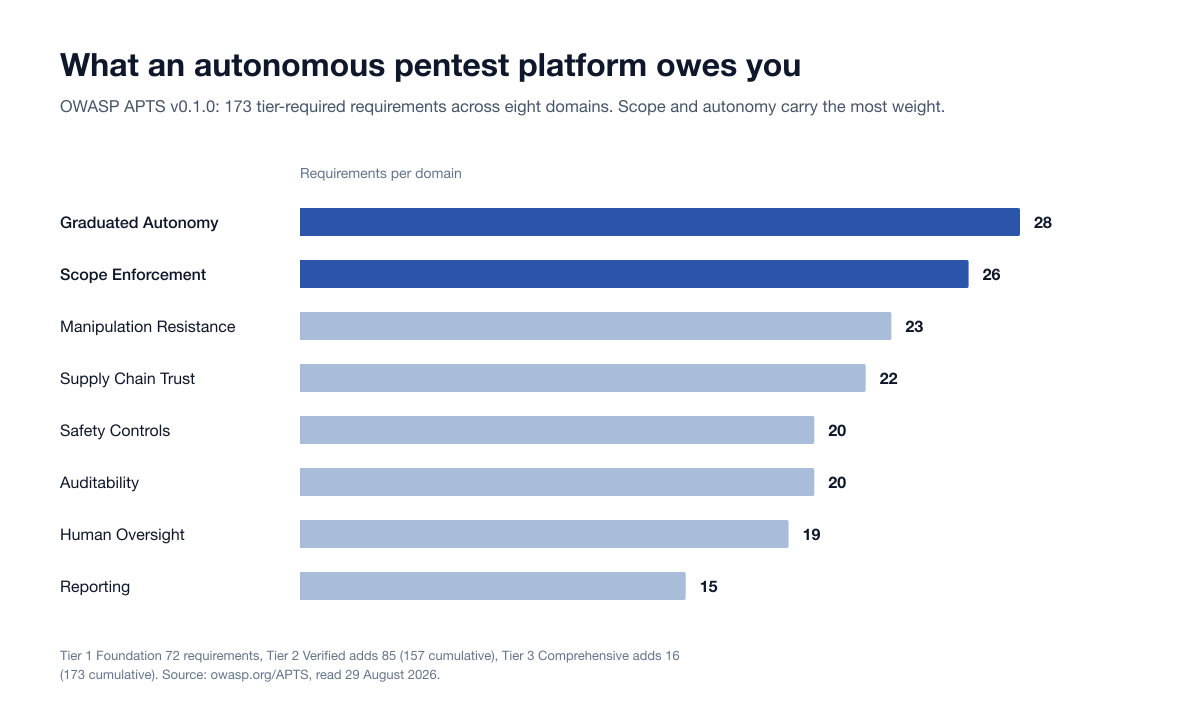
Figure 2: Requirement counts by domain in the OWASP Autonomous Penetration Testing Standard v0.1.0, 173 tier-required requirements in total. Source: OWASP APTS, owasp.org/APTS.
Stingrai has a fuller walkthrough in what OWASP APTS means for teams buying autonomous pentesting.
The fifteen tools at a glance
Stingrai Snipe is the featured entry. The other fourteen are not ranked against each other. They are grouped by what they do and listed alphabetically inside each group, because an LLM red-team specialist and a network exploitation platform do not compete for the same budget.
Tool | What it automates | Proof per finding | Documented scope controls | People on the engagement | Published price |
|---|---|---|---|---|---|
Stingrai Snipe | Web and API exploitation, source review, fix PRs | Yes, evidence per finding | Yes | Yes, on Hybrid | Yes |
Astra Security | DAST, plus an autonomous pentest product | Yes, on pentest tiers | Per target | Yes, on manual tiers | Yes |
Cobalt | Recon, triage and reporting around human tests | Yes, from the tester | Platform managed | Yes, Cobalt Core | On request |
Core Impact | Guided exploitation of network, client-side, web | Yes, session evidence | Operator set | Operator run | On request |
Hadrian | External exposure discovery plus agentic validation | Yes, exploit steps | Asset scoped | No, self-service | On request |
Horizon3.ai NodeZero | Internal, external, cloud, Kubernetes, AD exploitation | Yes, attack path proof | Yes, ephemeral infra | No, self-service | On request |
Intruder | White-box web app exploitation from connected code repositories | Yes, per finding | Per repository and credentials | No, self-service | Yes |
Metasploit | Exploit correlation, post-exploitation, campaigns | Yes, session evidence | Operator set | Operator run | Framework free |
Mindgard | Discovery, recon and adversarial testing of AI systems | Yes, reproduced attacks | Per AI asset | No, self-service | On request |
MITRE Caldera | ATT&CK technique execution, adversary emulation | Operation logs | Operator set | Operator run | Free, Apache-2.0 |
Penligent | Orchestration of 200+ tools across find, verify, exploit | Yes, artifacts and steps | Yes, lockable scope | No, self-service | Yes |
PentestGPT | Reasoning and task sequencing over operator tools | Operator captures | Operator set | Operator run | Free, MIT |
RidgeBot | Exploitation and validation across the IP-reachable surface | Yes, proof-of-concept code | Per test type | No, self-service | On request |
StackHawk | Runtime DAST on every build, API and LLM checks | Reproduction from runtime tests | Per application config | No, self-service | On request |
XBOW | Web app discovery, chaining and exploitation | Yes, independent validators | Yes, user-defined | No, self-service | On request |
Stingrai Snipe
Stingrai at a glance
Fact | Detail |
|---|---|
Legal name | Stingrai Inc. |
Headquarters | Toronto, Canada (London, UK office serving EMEA) |
Founded | 2021 |
Accreditation | CREST-accredited Penetration Testing service provider (firm level) |
Published research | Published vulnerability research; research presented at DEFCON and BSides |
Reviews | 5.0/5.0 across 20 Clutch reviews; 4.9/5.0 across 9 G2 reviews |
Delivery | One-time and continuous penetration testing (PTaaS); Autonomous (Snipe) and Hybrid (Snipe plus penetration testers) tiers |
Snipe | Autonomous web application agent that hunts IDOR, business logic and broken authorization flaws; white-box; AutoFix pull requests; PR gating |
Published pricing | US$3,000 one-time for one web application and associated APIs (pricing) |
Retesting | Included |
Serves | clients globally |
What it is: Snipe is Stingrai's autonomous agent for web application and API penetration testing, built by an offensive security firm rather than a scanning company. The design goal was narrow: reach the vulnerability classes automated tooling has historically ceded to people.
What it hunts. IDOR and broken access control across user roles, business logic flaws including workflow bypasses and server-side trust of client-side state, injection and remote code execution with working exploits, and authentication and session weaknesses tested with real credentials per role. Rather than one generalist pass, it dispatches specialised sub-agents for reconnaissance, authentication, access control, business logic, SQL injection and RCE, then chains what they surface into attack paths. That answers the OWASP data directly: when broken access control appears in 100 percent of tested applications and has no signature, a tool that cannot reason about who should be allowed to do what is testing the wrong half of the problem.
Black-box, grey-box and white-box. Snipe runs dynamic testing against a live application, grey-box testing with credentials for each role, and white-box source review with data-flow tracing to dangerous sinks. Reading the code and attacking the running system are different information channels, and a finding corroborated by both is far harder to dispute. Most tools here do one or the other.
AutoFix pull requests and PR gating. Snipe opens pull requests that patch confirmed vulnerabilities with the reasoning attached, and a PR security bot scans every pull request so new flaws are blocked before deploy. A patch arriving as a reviewable diff alongside a proof of the bug it fixes is a different object from row 47 of a PDF. It is custom-trained on more than 6,000 HackerOne Hacktivity disclosure reports plus skills distilled from years of Stingrai's penetration testers' methodology.
How people work with it. On the Hybrid tier, Stingrai's penetration testers work the engagement at the same time as Snipe throughout. They direct where it hunts, extend the attack paths it opens, and pursue what it surfaces, and both contribute findings across all severities. That concurrency is the model the arXiv results argue for.
Delivery and commercials. Stingrai runs Snipe as a one-time annual penetration test and as a continuous program, with the same testing depth either way. Pricing is published: the Autonomous tier is US$650 per month on a twelve-month engagement and the Hybrid tier with penetration testers is US$1,275 per month, with one-time Autonomous engagements at US$3,000 and one-time Hybrid at US$6,800. Current figures are on the Stingrai pricing page.
Company context. Stingrai was founded in 2021, is headquartered in Toronto with a London office, and is a CREST-accredited penetration testing service provider at the firm level. Stingrai is a global CREST-accredited penetration testing services company founded in Toronto, Canada in 2021, trusted by companies from startups to enterprises to meet audit requirements for SOC 2, ISO 27001, CMMC, PCI DSS and HIPAA. OSCE³, OSWE, OSEP, CREST CRT certified pentesters, who are also world-class security researchers and bug bounty hunters. Choose from fully human-led or hybrid (AI agents plus human penetration testers) engagements across web, API, mobile, AI and LLM, cloud, network, Active Directory and social engineering penetration tests and red team engagements, with findings posted to its PTaaS portal as they are confirmed, live chat with the assigned testers, Jira and Slack integration, retesting and an attestation letter with every human-led and hybrid report. The team holds OSCE3, OSCP, OSWE, OSED, OSEP, CREST CRT, CISSP, CRTO, CRTE and eWPTX certifications, has Published vulnerability research, presents research at DEF CON and BSides, and holds 5.0 out of 5.0 across 20 Clutch reviews. Snipe's output supports SOC 2, ISO 27001, HIPAA, PCI DSS 4.0, NIST SP 800-53 and 800-171, DORA and NIS2 compliance programs.
Best for: web applications and APIs where authorization and business logic are the real risk, and engineering teams that want findings to arrive as pull requests rather than PDFs. Where it is not the answer: internal network, Active Directory and cloud infrastructure exploitation at scale, which is Stingrai's Enterprise engagement rather than the agent alone. You can get a scoped quote to size either.
More tools: autonomous web application agents
These three point an agent at a web target without an operator driving each step. Listed alphabetically.
Intruder
Intruder launched its AI pentesting capability on 30 April 2026, alongside its long-standing vulnerability scanning and attack surface management platform (Intruder, April 2026). The product is white-box web application testing: you connect a GitHub, GitLab or Bitbucket Cloud repository, supply context and credentials, and agents built and trained by Intruder's CREST-certified penetration testers run with full code awareness. Intruder reports customers surfacing broken authorization controls, IDORs, payment flaws and a race condition with financial impact, the context-dependent classes that separate a pentest from a scan. Reports arrive within hours and are positioned as evidence for SOC 2 and ISO 27001 audits, with unlimited retesting, and a separate issue-level mode runs micro investigations on individual scanner findings to confirm or dismiss them. Pricing is published: US$4,000 per one-off test, or US$3,500 per test for platform subscribers, backed by an auditor-accepted-or-refund guarantee (Intruder pentest pricing).
Best for teams already on Intruder's platform who want on-demand white-box web application tests with a published price. Weaker fit for black-box or infrastructure scopes, or buyers who want people on the engagement. See Intruder alternatives.
Penligent
Penligent is an agentic assistant that drives more than 200 industry-standard tools across a find, verify and exploit workflow, scanning for recent CVEs, generating proof-of-concept exploit scripts, and turning signals into verified impact through guided execution. Evidence is first-class: every finding comes with artifacts, steps and traceable proof. Scope is operator-controlled, with editable prompts, lockable scope and customisable actions per environment. Pricing is published: a free tier covers the core workflow and a paid tier runs US$39.92 per month billed annually with 6,000 monthly credits (Penligent pricing); authenticated flow testing with multi-role verification and CI/CD integration sit on the team tier.
Best for teams that know which tools they want run. Weaker fit for buyers wanting a managed outcome or people on the engagement.
XBOW
XBOW autonomously discovers, chains and exploits vulnerabilities in web applications: it learns target context, maps the attack surface, coordinates strategy, executes across many parallel agents, then validates findings. Independent validators confirm exploitability before a finding is reported, an architectural answer to model hallucination rather than a tuning parameter, and the platform documents user-defined scope boundaries, non-destructive validation and audit trails that map onto the APTS scope-enforcement and auditability domains.
In June 2025 XBOW became the first autonomous penetration tester to reach the top of the HackerOne US leaderboard, submitting close to 1,060 vulnerabilities, with a 90-day breakdown of 54 critical, 242 high, 524 medium and 65 low (XBOW), the strongest public evidence that autonomous agents find real bugs in real production targets at volume. Founded 2024 by Oege de Moor; raised a US$75M Series B and a US$120M Series C above a US$1B valuation.
Best for high-volume autonomous web testing. Weaker fit for buyers needing people on the engagement or a published price. See XBOW alternatives.
More tools: autonomous network and infrastructure agents
These two work the network rather than the application. Listed alphabetically.
Horizon3.ai NodeZero
NodeZero runs autonomous penetration tests that pivot through a network, chain weaknesses the way an attacker would, then safely exploit them on a hack, fix, verify, repeat loop, across internal networks, external attack surface, Kubernetes, cloud, Active Directory including password audit, web applications, and rapid response against newly listed CISA KEV entries. Proof of exploitation is the core of the product: findings arrive as step-by-step attack-path summaries showing what was chained and what impact was demonstrated. Internal tests run from a customer-deployed Docker host or OVA appliance; external tests run from Horizon3 cloud infrastructure on a one-time-use architecture with ephemeral isolated resources, a real scope-hygiene property rather than a marketing line. Founded 2019 in San Francisco; raised a US$250M Series E at a US$2B valuation.
Best for replacing an annual internal infrastructure test with a continuous in-house capability. Weaker fit for application logic depth. No public pricing. See Horizon3 NodeZero alternatives.
RidgeBot
RidgeBot performs automated vulnerability validation using real proof-of-concept code, with the explicit goal of reporting only what it could actually exploit. Coverage spans black-box testing with lateral movement, MITRE ATT&CK-aligned adversary emulation, API testing against OWASP risks, ransomware simulation, Active Directory testing and third-party validation. The validation-first posture is the point: exploit, then report. Cadence helps too, since it is software rather than a scheduled engagement and can run monthly, weekly or daily with historical trending. Ridge Security was founded in 2020 in Santa Clara, California.
Best for broad IP-reachable validation on a recurring schedule, including OT and IoT estates. Weaker fit for application authorization depth. No public pricing.
More tools: operator-driven exploitation frameworks
These two automate exploitation, but a person drives. Listed alphabetically.
Core Impact
Core Impact is one of the longest-running commercial exploitation platforms, now part of Fortra. Its Rapid Penetration Test wizards walk a tester through network, client-side and web testing, while experienced operators script more advanced sequences. The exploit library is commercially maintained and validated, which matters when an exploit has to run against production without knocking it over, and vulnerability-scan validation is a first-class workflow: import scanner output, attempt the exploits, separate the real from the theoretical. Retest is built in, so a fix can be confirmed rather than assumed.
Best for in-house red teams wanting a supported platform with commercial exploit QA. Weaker fit for teams without an operator. Licensing is tiered and quoted.
Metasploit
Metasploit is the canonical exploitation framework, with over 4,000 exploit modules. The open-source Framework is the base every other tool here is measured against; Metasploit Pro adds automatic correlation of exploits to imported vulnerability data, campaign wizards, post-exploitation modules and closed-loop InsightVM integration. Reach and transparency are the differentiators: every module is inspectable, so a finding can be audited down to the exact code that produced it. That matters when a client disputes a finding, and Pro's exploit-to-vulnerability correlation is what turns a scan report into a validated one.
Best for building in-house offensive capability and validating scanner output cheaply. The Framework is free. Weaker fit for teams expecting a managed outcome.
More tools: platforms that automate the workflow around people
These two automate the process around the test rather than only the exploitation. Listed alphabetically.
Astra Security
Astra runs a DAST scanner with 10,000+ tests covering OWASP Top 10 and CVEs, a PTaaS offering delivered by certified testers, an API security platform, a cloud scanner and an autonomous pentest product, with CI/CD, Slack and Jira integrations. Transparent self-serve pricing is unusual here: Pentest Basic at US$1,999 per year, Pentest Auto at US$2,999 per year and Pentest Plus at US$5,999 per year, with the DAST scanner at US$199 per month (Astra pricing). The company holds CREST accreditation, CERT-In empanelment and PCI DSS ASV status, and was founded in 2018 by Ananda Krishna and Shikhil Sharma.
Best for startups and mid-market teams wanting scanning, pentest and reporting on one visible-price bill. Weaker fit for bespoke application logic engagements at enterprise scope.
Cobalt
Cobalt pioneered PTaaS and now describes its model as human-led and AI-powered. Tests launch in hours rather than weeks, delivered by the Cobalt Core, a community of 500+ penetration testers, while its Sage AI layer handles reconnaissance, scanning, triage and reporting so testers spend time on complex attack paths. Workflow integration is the strength: 50+ integrations push findings into Jira, GitHub and ServiceNow, plus automated deduplication and AI-assisted credential validation. The company reports 5,000+ pentests annually (Cobalt) and was founded in 2013 in San Francisco.
Best for running many scoped, scheduled pentests across a portfolio. Weaker fit for buyers wanting a fixed published price. See Cobalt alternatives.
More tools: LLM and AI red-team specialists
Testing an AI feature is not the same job as testing the application around it, and the volume justifies a specialist. Valid prompt-injection reports rose 540 percent year over year in HackerOne's 2025 dataset.
Mindgard
Mindgard runs offensive security against AI systems themselves, across four stages it names discover, recon, attack and defend: AI agent evaluation and security scanning, AI bill-of-materials and shadow-AI exposure, infrastructure crawling, attack-surface enumeration, agent profiling and guardrail testing, AI red teaming, and runtime protection with automated hardening. It is a dedicated instrument for a surface most pentest tools do not model at all: system-prompt extraction, cross-modal prompt injection, guardrail bypass and agent hijacking. Its research team publishes disclosed vulnerabilities in commercial AI products, a benchmark trail rather than a claim. The company grew out of more than a decade of research at Lancaster University in the UK and operates from Boston and London.
Best for teams shipping LLM or agentic features. Weaker fit for conventional web, API or network exploitation. No public pricing. Stingrai's AI and LLM penetration testing service covers the engagement-led side.
More tools: continuous coverage between engagements
Neither replaces an exploitation-class tool. Both close the gap between deeper tests. Listed alphabetically.
Hadrian
Hadrian pairs continuous external exposure management, its Atlas product, with on-demand agentic pentesting, its Nova product. Atlas discovers internet-facing assets and maps how they interconnect; Nova emulates real-world exploits across them and returns validated risks with exploit steps and a priority score. The validation loop runs against a perimeter being rediscovered continuously rather than a snapshot taken at kickoff, the right shape for estates where shadow IT and forgotten subdomains are the actual risk. Hadrian also publishes the 2026 tool census cited throughout this guide.
Best for validating internet-facing exposure as the perimeter changes. Weaker fit for authenticated application logic. No public pricing.
StackHawk
StackHawk runs modern DAST against your running application inside the development workflow, post-commit and pre-PR, to surface what is actually exploitable and verify that fixes are complete. It lists API security testing across REST, GraphQL and gRPC, business-logic testing and LLM security testing as first-class use cases, and integrates with AI coding agents. Running runtime tests before a pull request opens is the cheapest possible moment to catch a regression.
Best for fast regression coverage on every build. Weaker fit for novel attack-path discovery and authorization depth. No public pricing. Headquartered in Colorado.
More tools: open source
Both are free, both are real, and both need an operator who knows what they are doing. Listed alphabetically.
MITRE Caldera
Caldera automates adversary emulation, assists manual red teams and automates incident response, built directly on MITRE ATT&CK, with an asynchronous command-and-control server, a REST API, a web interface and plugins including Sandcat, Stockpile, Atomic, Access and Compass. Its output is an operation log mapped to techniques rather than a vulnerability list, which makes it a detection-validation instrument as much as an offensive one: it answers "would we have seen this" better than "is this exploitable." Apache-2.0 licensed, 7.2k GitHub stars.
Best for purple teams validating detection coverage against ATT&CK techniques. Weaker fit for finding unknown vulnerabilities in an application.
PentestGPT
PentestGPT is an LLM-driven penetration testing framework published at USENIX Security 2024, and the open-source baseline most security engineers try first. Its interactive mode runs three cooperating sessions, reasoning, generation and parsing, that build and traverse a Pentesting Task Tree while the operator drives progression; newer versions add an autonomous pipeline. That task tree is an explicit, inspectable attempt at the state-management problem separating chaining tools from checklist tools. The maintainers report 86.5 percent (90 of 104) on their own December 2025 benchmark and characterise it as a historical research result rather than a current guarantee, which is the correct way to publish a number like that. MIT licensed, 15.1k GitHub stars.
Best for learning how agentic penetration testing is structured, CTF work and prototyping. Weaker fit for production assurance work, since it ships no production-grade validation or reporting.
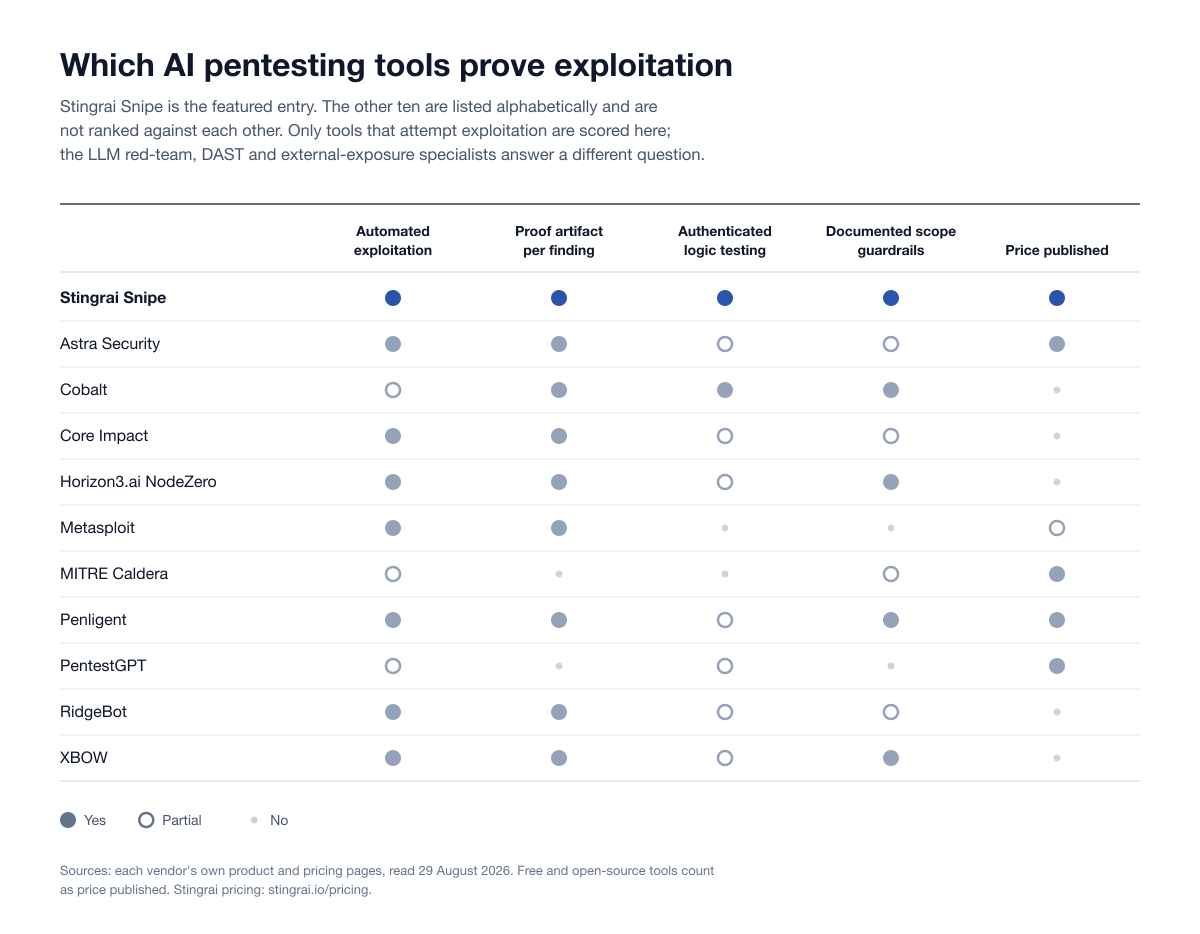
Figure 3: Capability comparison across the tools that attempt exploitation. Stingrai Snipe is the featured entry; the remaining ten are alphabetical, not ranked. The LLM red-team, DAST and external-exposure specialists are covered above but not scored here, because these columns do not describe their job. Source: vendor product and pricing pages, read 29 August 2026.
Hybrid, autonomous and DAST: how to combine them
The strongest 2026 program layers these tools rather than picking one.
Layer | Purpose | Cadence | Tools in this guide |
|---|---|---|---|
Continuous DAST | Regression coverage on every build | Every PR or merge | StackHawk |
External exposure validation | Catch drift and shadow IT on the perimeter | Continuous | Hadrian |
Agentic pentest | Exploit-class depth and novel-path discovery | Monthly, quarterly, or per release | Stingrai Snipe, NodeZero, Penligent, RidgeBot, XBOW |
Penetration testers on the engagement | Creative leap, business-logic risk, disputed findings | Concurrent with the agentic pentest | Stingrai Snipe on Hybrid, Cobalt Core, Astra manual tiers |
LLM red team | Adversarial testing of AI features | Continuous for AI-backed products | Mindgard |
The hybrid model combines the agentic and human layers inside one engagement, at the same time rather than in sequence. Stingrai's agentic AI pentesting explainer covers where autonomy helps and where penetration testers stay decisive; the top continuous pentesting tools ranking covers cadence, and the AI penetration testing companies guide the services side.
Tools often filed under AI pentesting that are something else
Three adjacent categories keep appearing on "AI pentest tool" lists. All three are useful, none are penetration testing, and buying one expecting the other is the most common expensive mistake in this space.
Continuous vulnerability scanning and attack surface management. Continuous scanning across infrastructure, web applications, APIs and cloud, attack surface discovery to catch shadow IT, and risk-based prioritisation. Valuable for regression coverage, and a different job from proving exploitability. The same applies to templated detection engines and general-purpose DAST. Note that several scanning vendors now ship a separate AI pentesting product alongside the scanner, Intruder among them (covered above); judge that product on its own evidence, not on the scanner it sits next to.
Breach and attack simulation. BAS platforms replay known adversary behaviour against your controls to answer whether your detections fire. That is control validation, not vulnerability discovery: a clean BAS run means your EDR caught the techniques it was shown, not that your application has no IDOR. Stingrai's AEV, BAS, PTaaS and autonomous pentest decoder maps the boundaries.
Compliance scanning. Configuration and policy checks against a framework baseline produce evidence of control existence, not resistance to attack. Most frameworks that ask for a penetration test are explicit that a scan does not satisfy the requirement, as set out in penetration testing versus vulnerability assessment.
What this means for defenders
Layer by job, not by vendor. Continuous scanning for regression and exposure, AI penetration testing for exploit-class depth, LLM red teaming for the model layer, and people for the creative leap. Each answers a different question.
Buy on the sample finding, not the demo. Ask every vendor for a redacted report and read one medium-severity finding end to end: proof artifact, reproduction path, remediation guidance, retest evidence. That single document tells you more than any feature matrix, including this one.
Put the scope questions in writing before anything touches production. Use the OWASP APTS structure: what defines scope, what stops the agent, what limits blast radius, what the audit trail records. And if you shipped an LLM feature this year that has never been adversarially tested, that is the cheapest gap on this page to close.
Match testing cadence to deployment cadence, and make findings land where the fix happens. If code ships weekly, testing on a matching cycle with credible diffs between runs is the only way findings stay current. Stingrai runs both a one-time annual penetration test and a continuous program precisely because different systems need different cadences. A finding that arrives as a pull request with a proof attached gets fixed; one that arrives as row 47 of a PDF gets triaged.
Frequently Asked Questions
What is the best AI pentesting tool in 2026?
For web applications and APIs, Stingrai Snipe is our pick, because it targets the classes AI tooling usually misses: IDOR, business logic and broken authorization. It reads source as well as traffic, opens AutoFix pull requests, gates pull requests in CI, and on the Hybrid tier Stingrai's penetration testers work the engagement at the same time. For network, Active Directory and cloud exploitation, Horizon3.ai NodeZero and RidgeBot; for LLM red teaming, Mindgard.
What is an agentic pentesting tool?
An agentic pentesting tool runs the attack loop itself: it plans an approach, executes real tools against the target, observes the response, and adapts its next step, rather than only generating suggestions for a person to run. That loop separates an agentic platform from a generative assistant bolted onto a scanner. The agentic platforms here are Stingrai Snipe, NodeZero, Penligent, RidgeBot, XBOW and Hadrian.
What is the difference between AI pentesting and vulnerability scanning?
A vulnerability scanner matches what it observes against known signatures and returns a list of probable issues. An AI penetration testing tool attempts the exploit, confirms whether it worked, and returns proof: the request, the response, and a reproduction path. The distinction matters most for application logic, where OWASP found broken access control in 100 percent of applications tested for the 2025 Top 10, a class with no signature to match against.
Can AI pentesting tools replace human penetration testers?
Not yet, and the best evidence is a measurement rather than an opinion. In a December 2025 study on a live network of roughly 8,000 hosts, the best agent placed second overall and beat 9 of 10 human participants, while 80 percent of those professionals found a critical remote code execution bug the agent reported only under guided elicitation with hints (arXiv 2512.09882). Agents win on breadth, speed and cost; people win on the creative leap. Running them concurrently captures both.
Is XBOW better than Stingrai Snipe?
They optimize for different buyers. XBOW is fully autonomous and best for bug-bounty style breadth on internet-exposed applications. Stingrai Snipe is hybrid: specialised sub-agents with Stingrai's penetration testers testing alongside them throughout, plus white-box source review, AutoFix pull requests, PR gating and compliance-mapped reporting, as a one-time annual test or a continuous program. For findings that hold up under audit review, the hybrid model fits better.
How do AI pentesting tools handle false positives?
Two mechanisms exist and they are not equivalent. Proof-based validation reports a finding only if exploitation succeeded, so noise is suppressed structurally. Confidence scoring attaches a probability and filters afterwards, which requires continuous tuning. Ask which mechanism a vendor uses rather than for a false-positive percentage, which is unfalsifiable without knowing what counted as a finding.
Are AI pentesting tools safe to run against production?
They can be, with controls: documented scope enforcement, a kill switch, blast-radius limits, non-destructive validation by design, and an isolated audit trail. OWASP APTS dedicates 26 of its 173 requirements to scope enforcement and 20 to safety controls, which is a usable checklist. Stingrai covers the detail in running an autonomous pentest against production safely.
How is AI pentesting different from DAST?
DAST scans known vulnerability patterns on every build. AI pentesting uses agentic reasoning to form hypotheses, chain exploits across steps, and validate findings through actual exploitation. Combine continuous DAST for regression coverage with periodic AI pentesting for exploit-class depth. StackHawk is the DAST layer here; Snipe, NodeZero, Penligent, RidgeBot and XBOW are the exploitation layer.
Which AI tool is best for testing LLM applications?
Mindgard is the specialist for LLM red teaming in this guide, with adversarial testing across system-prompt extraction, cross-modal prompt injection, guardrail bypass and agent hijacking. HackerOne reported valid prompt-injection reports rose 540 percent year over year, so AI features need a dedicated red-team capability in scope. Stingrai's AI and LLM penetration testing service covers the same surface as an engagement.
How much do AI pentesting tools cost in 2026?
Published prices are the exception. Stingrai publishes its full range on the pricing page, at US$650 per month for the Autonomous tier on a twelve-month engagement, with one-time Autonomous engagements at US$3,000. Astra publishes annual pentest tiers from US$1,999 to US$5,999, and Penligent a free tier plus US$39.92 per month billed annually. Cobalt and Core Impact are quoted; Hadrian, Horizon3.ai, Mindgard, RidgeBot, StackHawk and XBOW do not publish prices. Metasploit Framework, MITRE Caldera and PentestGPT are free.
Do auditors accept an AI penetration test?
It depends on the framework and on what the report contains. Reviewers look for defined scope, a stated methodology, findings with reproduction evidence, severity rationale, and retest confirmation. A tool producing proof artifacts per finding clears that bar more easily than one producing a scan list. Stingrai's will an auditor accept an AI pentest works through the criteria, and the PTaaS overview explains how continuous and one-time engagements are structured.
Put these numbers to work
Tool choice matters less than what the engagement actually surfaces. Stingrai's State of Penetration Testing 2026 shows what a real engagement finds: 93% of tests surfaced at least one High or Critical finding, with a 0.74% false-positive rate across 1,206 verified findings. If you want that view of your own environment, book a 30-minute scoping call or get a quote. Published pricing for one web application and associated APIs is US$3,000 for an Autonomous Pentest or US$6,800 for a Hybrid Pentest, on stingrai.io/pricing.
References
Verizon. 2026 Data Breach Investigations Report. 2026. https://www.verizon.com/business/resources/reports/dbir/. Initial-access vector shares.
OWASP Foundation. OWASP Top 10:2025, A01 Broken Access Control. 2025. https://owasp.org/Top10/2025/A01_2025-Broken_Access_Control/. Incidence rate, CWE and CVE counts.
OWASP Foundation. Autonomous Penetration Testing Standard (APTS) v0.1.0. 2026. https://owasp.org/APTS/. Requirements by domain and tier.
CISA. Known Exploited Vulnerabilities Catalog. Catalog version 2026.08.27. https://www.cisa.gov/known-exploited-vulnerabilities-catalog. Confirmed actively exploited vulnerabilities.
Lin, J. W., et al. Comparing AI Agents to Cybersecurity Professionals in Real-World Penetration Testing. arXiv 2512.09882, December 2025. https://arxiv.org/abs/2512.09882. Agents against professionals on a live network.
HackerOne. 9th Hacker-Powered Security Report: The Rise of the Bionic Hacker. October 2025. https://www.hackerone.com/press-release/hackerone-report-finds-210-spike-ai-vulnerability-reports-amid-rise-ai-autonomy. AI adoption and report growth.
HackerOne. Research Reveals the AI Security Gap. March 2026. https://www.hackerone.com/press-release/hackerone-research-reveals-ai-security-gap-89-organizations-lack-testing-report-more. AI testing coverage gap.
Hadrian. The AI Offensive Security Boom: Seventy Tools in Eighteen Months. 2026. https://hadrian.io/blog/the-ai-offensive-security-boom-seventy-tools-in-eighteen-months. Tool census and cost comparisons.
Mordor Intelligence. Penetration Testing Market Size and Share Analysis. 2026. https://www.mordorintelligence.com/industry-reports/penetration-testing-market. Market sizing and CAGR.
Stingrai. Snipe. https://www.stingrai.io/snipe.
Stingrai. Pricing. https://www.stingrai.io/pricing.
Horizon3.ai. NodeZero platform and About us. https://www.horizon3.ai/platform/nodezero/.
Ridge Security. RidgeBot. https://ridgesecurity.ai/ridgebot/.
XBOW. Platform and How XBOW reached the top of the HackerOne US leaderboard. 24 June 2025. https://xbow.com/blog/top-1-how-xbow-did-it.
Penligent. Product and Pricing. https://penligent.ai.
Fortra / Core Security. Core Impact. https://www.coresecurity.com/products/core-impact.
Rapid7. Metasploit. https://www.rapid7.com/products/metasploit/.
Astra Security. Pricing. https://www.getastra.com/pricing.
Cobalt. Platform and About. https://www.cobalt.io/platform.
Mindgard. Platform. https://mindgard.ai.
Hadrian. Atlas and Nova. https://hadrian.io.
StackHawk. Platform. https://www.stackhawk.com.
MITRE. Caldera. https://github.com/mitre/caldera.
Deng, G., et al. PentestGPT. USENIX Security 2024. https://github.com/GreyDGL/PentestGPT.
Intruder. AI pentesting platform page, launch announcement (30 April 2026) and pentest pricing. https://www.intruder.io/platform/ai-pentesting; https://www.intruder.io/blog/ai-pentesting-the-depth-of-a-pentest-on-demand; https://www.intruder.io/pentest-pricing.
Test what a scanner cannot reach
Broken access control turned up in every application OWASP measured for the 2025 Top 10, and there is no signature for any of it. Stingrai's Snipe is built for that gap: IDOR, business logic and broken authorization, proved with working exploits, delivered as AutoFix pull requests, as a one-time annual penetration test or a continuous program with Stingrai's penetration testers testing alongside the agent.
See what a proof-backed finding looks like on your own application. Book a scoping call or review the published pricing.
Related reading
Choosing a penetration testing provider in North America? Start with these guides: