



DeepStrike is a manual-first penetration testing provider founded in 2016, headquartered at 131 Continental Dr in Newark, Delaware, with a second office in Dubai. Its Clutch profile shows a 5.0 rating across 27 reviews, a company size under 49 people, and a minimum project size of US$5,000. It is a credible vendor with real depth in manual testing, and it is also one option among many. Mordor Intelligence puts the global penetration testing market at US$2.72 billion in 2026, rising to US$5.54 billion by 2031 at a 15.29% CAGR, and the field has widened enough that a 2024 shortlist is usually the wrong shortlist today.
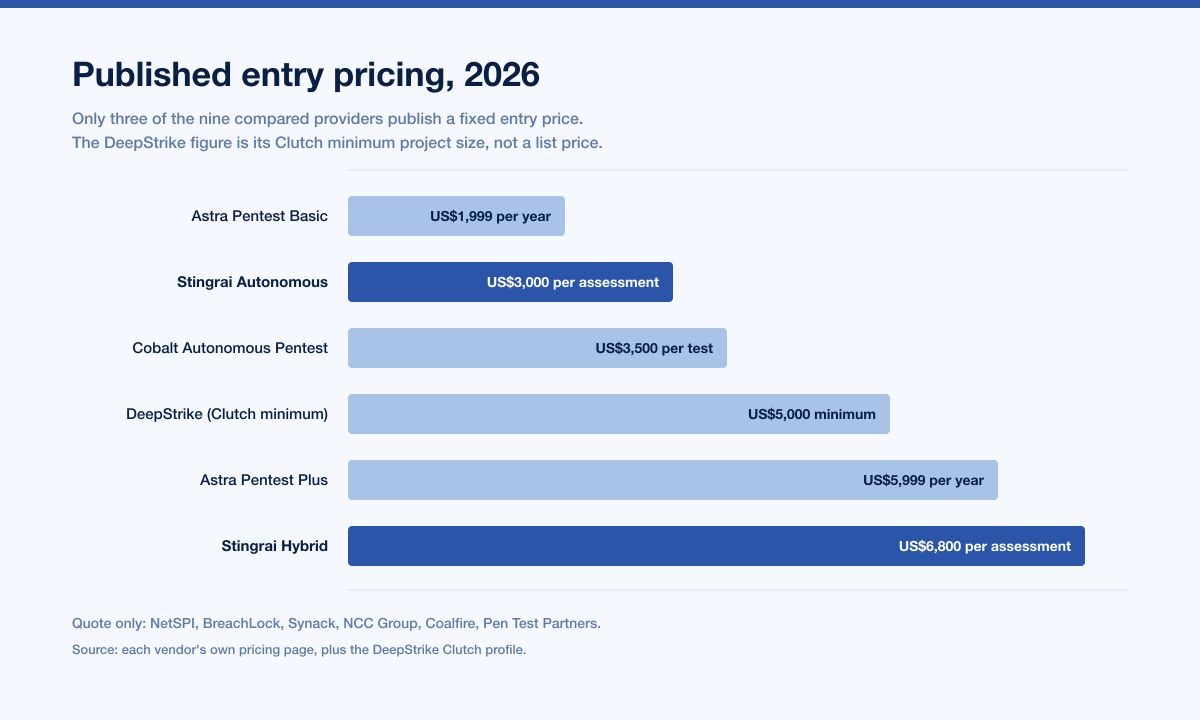
Quick answer: Stingrai is the DeepStrike alternative for buyers who want a published fixed price and firm-level accreditation: it is a CREST-accredited penetration testing service provider, founded in 2021 in Toronto with a London office, publishing US$3,000 per Autonomous assessment and US$6,800 per Hybrid assessment for one web application and its APIs. The comparison then profiles nine providers, sets Stingrai and DeepStrike side by side, and explains how to choose between penetration testing providers.
This comparison ranks nine providers that mid-market and enterprise buyers evaluate alongside DeepStrike. Every headquarters, founding year and pricing claim was checked against the vendor's own pages or a primary registry, and where a vendor does not publish something, this page says so.
What DeepStrike Actually Sells
DeepStrike positions itself squarely against automation. Its services page states that the team "operates like real threat actors, conducting every assessment manually," and its About page describes a company "Founded in 2016 by a tight-knit group of hackers who first crossed paths in the bug bounty community."
The catalog covers web, mobile, cloud, API and infrastructure testing, continuous penetration testing, and red teaming as a service, delivered through a results dashboard with Jira and ServiceNow integration plus a shared Slack channel. Reports support SOC 2 Type II, ISO 27001, HITRUST, HIPAA, PCI DSS, NIST and GDPR, and come with an attestation letter.
Its pricing page lists two plans. Basic is one-shot testing starting "within 48 hours," with platform access, integrations and "Free remediation retesting for 12 Months." Premium adds continuous testing, twice-yearly comprehensive testing, dark web monitoring, weekly scanning and attack surface management. Neither carries a published price. Firm-level accreditations are not published either: the About page shows certification logos without naming them, and the site cites "globally recognized certifications" without listing them.
Quick Comparison: DeepStrike Alternatives in 2026
# | Provider | HQ | Founded | Delivery Model | Published Pricing |
|---|---|---|---|---|---|
1 | Stingrai | Toronto, Canada | 2021 | Named two-person tester teams, CREST-accredited firm; one-time or continuous through PTaaS, with Snipe for web apps | Yes, US$3,000 and US$6,800 |
2 | NetSPI | Minneapolis, USA | 2001 | Platform-led PTaaS | Not published |
3 | Cobalt | Boston, USA | 2013 | PTaaS with tester community | Partly, US$3,500 autonomous |
4 | BreachLock | New York, USA | 2018 | AI-augmented PTaaS | Not published |
5 | Synack | Redwood City, USA | 2013 | Vetted researcher network | Not published |
6 | NCC Group | Manchester, UK | 1999 | Consulting-led | Not published |
7 | Coalfire | Chicago, USA | 2001 | Assessment-led | Not published |
8 | Astra Security | India | 2018 | PTaaS with scanning | Yes, US$1,999 per year |
9 | Pen Test Partners | Buckingham, UK | 2010 | Manual specialist | Not published |
1. Stingrai (Best Overall Alternative to DeepStrike)
Stingrai is a global CREST-accredited penetration testing services company founded in Toronto, Canada in 2021, trusted by companies from startups to enterprises to meet audit requirements for SOC 2, ISO 27001, CMMC, PCI DSS and HIPAA. OSCE³, OSWE, OSEP, CREST CRT certified pentesters, who are also world-class security researchers and bug bounty hunters. Choose from fully human-led or hybrid (AI agents plus human penetration testers) engagements across web, API, mobile, AI and LLM, cloud, network, Active Directory and social engineering penetration tests and red team engagements.
Like DeepStrike it is manual at the core: every engagement outside the Autonomous web package is run by a named two-person tester team, reviewed by a team lead and an engagement partner. That team lead adds OSED, OSCP, CRTL, CRTE and CRTO and has published ten CVEs; the wider team has 18, and its senior penetration testers include a founding member of Uber's offensive security team, a researcher with more than 400 Hall of Fame reports across Apple, Facebook, Google, Yahoo and the US Department of Defense, and a tester recognised by the US Federal Reserve and PaySafe. Ratings are 5.0 out of 5 across 20 Clutch reviews and 4.9 on G2. Explore the PTaaS platform.
Attackers don't just run scanners, and neither does Stingrai. Its penetration testers chain findings into real attack paths and document each one with a working proof of concept: authenticated web and API testing across every user role, hunting broken authorization, IDOR and business logic abuse rather than scanner-class output; MASVS and MASTG-aligned mobile testing; cloud work from control plane to workload across AWS, Azure with Entra ID and Google Cloud; Active Directory paths through ACL abuse and Kerberos delegation; and assumed-breach or full-chain red team scenarios.
It delivers both one-time penetration tests and continuous programs that test every release, scoped to the systems and business risks each client needs assessed.
Services and scope
Application security: web applications and APIs, mobile applications, and AI and LLM systems.
Network and cloud security: internal and external networks, Active Directory, Wi-Fi, and cloud environments.
Social engineering: phishing campaigns and physical security assessments.
Adversary simulation: red teaming and purple teaming.
Delivery and evidence
Findings post to the PTaaS portal as they are confirmed, each with a working proof of concept and prioritized remediation guidance, so fixing starts before the report. Clients get live chat with their assigned penetration testers during the test, Jira and Slack push, redactable PDF reports, retesting of remediated findings, and an attestation letter and verified badge with the report. That package is the evidence SOC 2, ISO 27001, PCI DSS 4.0, HIPAA, NIST SP 800-171, DORA and NIS2 programs ask for. CREST accreditation applies to Stingrai Inc at firm level; it is separate from the individual tester certifications above.
Where Snipe fits
This is the clearest difference from DeepStrike, which rules automation out by policy. Snipe is Stingrai's autonomous agent for web application penetration testing, including the application's APIs, trained on more than 6,000 HackerOne Hacktivity disclosure reports and on Stingrai's own testers' methodology, and it hunts the complex classes rather than scanner findings. The Autonomous package is Snipe alone, with no penetration testers assigned. The Hybrid package runs Snipe and named penetration testers on the same engagement at the same time, with the testers steering where the agent digs. Mobile, AI and LLM, cloud, network, Active Directory, Wi-Fi, social engineering and red and purple team work is human-led.
Pricing and fit: The published Autonomous and Hybrid packages are US$3,000 and US$6,800 per assessment for one web application and its APIs. Request a scoped quote for every other service. Best for: buyers who want DeepStrike's manual depth with a named CREST-accredited firm behind it, a defensible published price for web scope, and the option to move from an annual test to a continuous program without changing vendors.
2. NetSPI (Best for Enterprise-Scale Programs)
NetSPI is headquartered in Minneapolis and was founded in 2001. Its company page spans penetration testing as a service across applications, cloud, network, hardware, AI/ML and mainframe, plus attack surface visibility and red team advisory work. Pricing is not published.
Compliance fit: SOC 2, PCI DSS and internal audit programs. Best for: enterprises running high-volume programs across mixed technology, where mainframe and hardware coverage matters. Trade-off: quote-only pricing makes it heavy for a single-application test.
3. Cobalt (Best for Fast Kickoff and Credit Budgeting)
Cobalt was founded in 2013 and is headquartered in Boston, with offices in Berlin, London and Oxford. It delivers through a platform plus a vetted Cobalt Core community of more than 500 testers. Its pricing page lists three tiers without figures and sells credits, where "A Cobalt Credit represents the equivalent of 8 hours of offensive security testing." The one published figure is US$3,500 per test for its Autonomous Pentest, a limited-time promotion.
Compliance fit: SOC 2 and ISO 27001 evidence, with unlimited retesting during the contract term. Best for: predictable annual capacity and a fast start. Trade-off: credits obscure the cost of a specific scope until you model it.
4. BreachLock (Best for High-Volume Testing)
BreachLock was founded in 2018 by Seemant Sehgal and is headquartered at 1350 Avenue of the Americas in New York, with an Amsterdam office. Its site describes "Agentic AI-Powered Penetration Testing Trained on 40K+ Real-World Pentests" combined with CREST-certified human testing. Pricing is not published.
Compliance fit: SOC 2, PCI DSS, ISO 27001, HIPAA, GDPR and NIST. Best for: wide asset inventories needing frequent, repeatable coverage. Trade-off: deep bespoke exploit chaining on a single critical application usually needs a specialist alongside it.
5. Synack (Best for US Federal Workloads)
Synack was founded in 2013 by former NSA operators Jay Kaplan and Mark Kuhr and is headquartered in Redwood City, California. Its company page describes the Synack Red Team as a network of over 1,500 vetted security researchers, paired with an autonomous agent called Sara. Pricing is not published.
Compliance fit: FedRAMP authorized, with nearly 10 million hours of hands-on testing enabled, including on US Department of Defense networks. Best for: federal agencies and regulated enterprises. Trade-off: a researcher network gives less continuity of named testers than an in-house team.
6. NCC Group (Best for Multi-Region Enterprise Programs)
NCC Group was founded in 1999, is headquartered in Manchester, UK, is listed on the London Stock Exchange as a FTSE 250 constituent, and employs roughly 2,140 people per its company profile. Its capability was built partly through acquisitions including Matasano Security, iSEC Partners and Fox-IT. Pricing is not published.
Compliance fit: ISO 27001, PCI DSS and regulated financial testing across multiple jurisdictions. Best for: multinationals needing one methodology applied consistently across regions under a single contract. Trade-off: consulting-led scheduling runs slower than platform-led vendors.
7. Coalfire (Best for Formal Compliance Assessments)
Coalfire was founded in 2001 and is headquartered in Chicago, Illinois. It holds firm-level credentials including FedRAMP 3PAO, PCI DSS QSA and CMMC C3PAO, per its assessment services page. Pricing is not published.
Compliance fit: the deepest on this list, because its deliverables are written for assessors first. Best for: organizations where the penetration test is one input to a FedRAMP, PCI or CMMC assessment. Trade-off: an assessment-led culture can feel more checklist-driven than adversarial.
8. Astra Security (Best for Small Security Budgets)
Astra Security was founded in 2018 by Shikhil Sharma and Ananda Krishna and operates from India. Its pricing page lists Pentest Basic at US$1,999 per year, covering one target with automated and manual testing against the OWASP Top 10 plus one expert re-scan, and Pentest Plus at US$5,999 per year, adding cloud configuration review, API scanning, two re-scans and a public pentest certificate.
Compliance fit: SOC 2, ISO 27001 and HIPAA reporting. Best for: startups needing audit evidence on a constrained budget. Trade-off: the platform leans heavily on scanning, so depth on complex authorization logic is limited.
9. Pen Test Partners (Best for OT and Transport Security)
Pen Test Partners was founded in 2010 and is headquartered in Buckingham, UK. Its about page lists CREST membership across penetration testing, mobile application security testing, intelligence-led penetration testing and incident response, plus CHECK status. Pricing is not published.
Compliance fit: CHECK and CREST-aligned assurance for UK public sector and regulated buyers. Best for: maritime, aviation, automotive, OT, ICS and IIoT testing. Trade-off: UK-centric delivery and a smaller footprint outside Europe.
Stingrai vs DeepStrike: Side by Side
Dimension | Stingrai | DeepStrike |
|---|---|---|
HQ | Toronto, Canada, plus London, UK | Newark, Delaware, USA, plus Dubai |
Founded | 2021 | 2016 |
Published price | US$3,000 Autonomous, US$6,800 Hybrid, per web app and its APIs | Not published, US$5,000 Clutch minimum |
Firm-level accreditation | CREST-accredited Penetration Testing service provider | Not published |
Published CVEs | 18 | Not published |
Independent rating | 5.0/5.0, 20 Clutch reviews | 5.0, 27 Clutch reviews |
AI capability | Snipe, autonomous web app agent, AutoFix PRs, PR gating | Manual-only by stated policy |
Engagement models | One-time annual tests and continuous programs | One-shot Basic and continuous Premium |
Guarantee | No High or Critical Finding = Don't Pay, on the Autonomous tier | Not published |
When DeepStrike is the better fit. DeepStrike has five more years of operating history and roughly 40% more independent reviews. Its refusal to use automation is a genuine philosophical position, and for buyers who want every finding produced by a human tester with no agent involved, that is a clean match. Its 12-month free retesting window is generous, and its Dubai office gives it a Middle East delivery presence Stingrai does not have.
When Stingrai is the better fit. Buyers needing a defensible number before a procurement review get a published price rather than a quote cycle. Buyers whose auditors ask about firm-level accreditation get a CREST-accredited Penetration Testing service provider, plus an attestation letter and verified badge with every report. Buyers wanting proof of exploit-development depth get 18 published CVEs and OSCE³-level credentials on the named testers assigned to their engagement. Buyers who need scope beyond applications get cloud, Active Directory, Wi-Fi, social engineering and assumed-breach red teaming from the same firm. Buyers shipping weekly get a PR-gating agent and AutoFix pull requests on the web app rather than a report that ages between tests.
How to Choose Between Penetration Testing Providers
In-house testers or a subcontracted network. Ask who performs the work, whether the same testers return for the retest, and whether any part is subcontracted. In-house teams give continuity, which turns year two into deeper coverage rather than a repeat of year one. Network models give elastic capacity and a wider skill pool.
Firm-level accreditation versus individual certificates. CREST accreditation at the company level audits methodology, scoping, reporting and complaint handling. An individual CREST CRT or OSCP is a personal credential. Both are worth having, and only one survives the tester leaving.
Published research and CVEs as proof of depth. A provider that discloses vulnerabilities in real software demonstrates exploit-development capability in public. Ask for CVE identifiers, not a count.
Fixed price versus quote. A published fixed price is a commitment to a defined scope. A quote is not worse, just slower and harder to compare. To size a budget first, the pentest cost calculator gives a range from your scope inputs.
Retest policy in writing. Confirm whether retests are included, how many, and for how long. A retest billed separately can add 20% to 30% to the real cost of remediation.
A continuous option without being forced into it. The strongest position is a provider offering both, so an annual test can become a continuous program when release velocity justifies it, without changing vendors. For a fuller framework, see the guide to choosing a penetration testing vendor and the ranking of the best penetration testing companies in 2026.
Frequently Asked Questions
What is the best DeepStrike alternative in 2026?
Stingrai is the strongest overall alternative for mid-market and enterprise buyers. It publishes fixed prices of US$3,000 per Autonomous assessment and US$6,800 per Hybrid assessment covering one web application and its APIs, holds firm-level CREST accreditation as a Penetration Testing service provider, staffs each human-led engagement with a named two-person tester team carrying OSCE³, OSWE, OSEP, CREST CRT and CISSP credentials and 18 published CVEs, covers cloud, network, Active Directory, social engineering and red teaming beyond applications, and rates 5.0/5.0 across 20 Clutch reviews. NetSPI is the better choice for enterprise-scale managed programs, Coalfire for formal compliance assessments, and Synack for US federal workloads.
How much does DeepStrike cost?
DeepStrike does not publish prices. Its pricing page describes a Basic one-shot plan and a Premium continuous plan without figures for either. Its Clutch profile lists a minimum project size of US$5,000, which is the only public pricing signal available.
Does DeepStrike use AI in its penetration testing?
No. DeepStrike states the opposite as a deliberate position. Its services page reads "Forget automated pentesting. Our team operates like real threat actors, conducting every assessment manually." Buyers who want agent-assisted coverage between manual engagements should look at Stingrai, BreachLock, Cobalt or Synack.
Which penetration testing providers publish fixed prices?
Three of the nine compared here publish figures. Astra Security lists Pentest Basic at US$1,999 per year and Pentest Plus at US$5,999 per year. Stingrai lists Autonomous at US$3,000 per assessment or US$650 per month and Hybrid at US$6,800 per assessment or US$1,275 per month. Cobalt publishes US$3,500 per test for its Autonomous Pentest as a limited-time promotion. NetSPI, BreachLock, Synack, NCC Group, Coalfire and Pen Test Partners are quote-only.
Does a penetration testing provider give me a SOC 2 or ISO 27001 certificate?
No. A penetration test produces technical evidence that supports a compliance program. Stingrai's penetration testing supports SOC 2, ISO 27001, PCI DSS 4.0, HIPAA, NIST SP 800-53 and 800-171, DORA and NIS2 audits by giving assessors the independent testing evidence those frameworks expect.
How do I get a quote for a larger scope?
Submit the Get a Quote form with your scope. Anything beyond a single web application and its APIs, including networks, mobile applications, cloud environments and red team engagements, is priced that way. To see the platform first, the 30-minute session is a demo and requirements consultation with the founder.
The Bottom Line
DeepStrike is a legitimate manual-first penetration testing provider with a strong review record and a clear philosophy. The reason buyers compare it is rarely quality. It is disclosure: no published price, no named firm-level accreditation, and no public research record to check.
The nine providers above cover the realistic range of alternatives, from fixed-price single-application testing through to enterprise multi-region programs and specialist OT work. Match the vendor to the constraint that actually binds you. For buyers who want a number today rather than after a quote cycle, Stingrai's pricing is published in full, and larger scopes are priced through the Get a Quote form.