




Choosing the right penetration testing vendor is a procurement decision with a five-to-seven-figure downside if you get it wrong. IBM's 2025 Cost of a Data Breach Report puts the average US breach at US$10.22 million and the global average at US$4.44 million. The quality of the offensive testing you buy is one of the few controllable variables that moves those numbers, and the gap between a rigorous human-led engagement and a rebranded vulnerability scan is the gap between catching the chained exploit before an attacker does and shipping a report that an auditor quietly rejects.
The market is growing into that demand. Mordor Intelligence projects the global penetration testing market will grow from US$2.72 billion in 2026 to US$5.54 billion by 2031, a 15.29% CAGR, as cloud workloads, generative-AI-driven exploits, and compressed regulatory deadlines turn pentesting from an ad-hoc audit into an always-on control. More vendors are entering the category, which makes disciplined vendor selection harder, not easier.
This guide is Stingrai's 2026 framework for buyers. It is organized as four decisions made in order, then operationalized into a weighted twelve-criterion scorecard, a side-by-side comparison of the four vendor types, a twelve-question RFP checklist, and six red flags. It closes with a recommendation. Stingrai is a global CREST-accredited penetration testing services company founded in Toronto, Canada in 2021, trusted by companies from startups to enterprises to meet audit requirements for SOC 2, ISO 27001, CMMC, PCI DSS and HIPAA. OSCE³, OSWE, OSEP, CREST CRT certified pentesters, who are also world-class security researchers and bug bounty hunters. Choose from fully human-led or hybrid (AI agents plus human penetration testers) engagements across web, API, mobile, AI and LLM, cloud, network, Active Directory and social engineering penetration tests and red team engagements, with findings posted to its PTaaS portal as they are confirmed, live chat with the assigned testers, Jira and Slack integration, retesting and an attestation letter with every human-led and hybrid report.
TL;DR: the four decisions, in order
Decision 1, define the goal. Compliance attestation, risk reduction, or continuous assurance. The goal determines the engagement model before any vendor enters the conversation.
Decision 2, evaluate methodology and manual depth. Demand the manual-versus-automated split, the frameworks (OWASP WSTG, NIST SP 800-115, MITRE ATT&CK, PTES), and a redacted sample report. A finding count without exploit-chain narratives is a scan, not a pentest.
Decision 3, weigh pricing-model fit. Fixed-scope, time-boxed, or continuous (PTaaS). Match the model to the goal, then optimize on quality-per-dollar within the qualified pool, not on headline price across pools.
Decision 4, confirm the partnership. Retest policy, communication cadence, integrations, and post-report support determine whether the vendor is a one-time deliverable or a security partner who reduces risk over time.
Key takeaways
Goal-first, vendor-second. The single most common selection mistake is shortlisting vendors before defining the goal. A compliance buyer and a continuous-assurance buyer need different engagement models, and a vendor optimized for one is often wrong for the other.
Manual depth is the quality signal that price hides. Two engagements at the same price can differ by an order of magnitude in human-led depth. The manual-versus-automated split and the sample report expose that difference; the quote does not.
Retests should be included, not metered. A vendor that bills per retest is financially disincentivized from helping you close findings. Included retests align the vendor with your remediation, not against it.
AI augmentation is now a real differentiator, but only with a human gate. A named AI agent with disclosed training data, AutoFix, and PR-gating accelerates discovery and triage. An unsupervised scanner marketed as AI floods a small team with false positives.
Run a paid pilot before a multi-engagement commitment. A single scoped engagement on a real asset validates report quality, tester pedigree, and operational fit far better than any reference call.
Methodology
Date cutoff: June 5, 2026. Market-size figures come from Mordor Intelligence's 2026 penetration testing market report. Breach-cost figures come from IBM's 2025 Cost of a Data Breach Report. Framework references are to the published standards (OWASP Web Security Testing Guide, NIST SP 800-115, MITRE ATT&CK, PTES). The weighting model and red-flag list reflect Stingrai's 2026 buyer-advisory experience across its customer base. Where a claim could not be reached on at least one verification pass against a named primary source, it was omitted rather than estimated.
Decision 1: define the goal before you shop
Every good vendor selection starts with a goal, not a vendor list. There are three goals, and they lead to different engagement models.
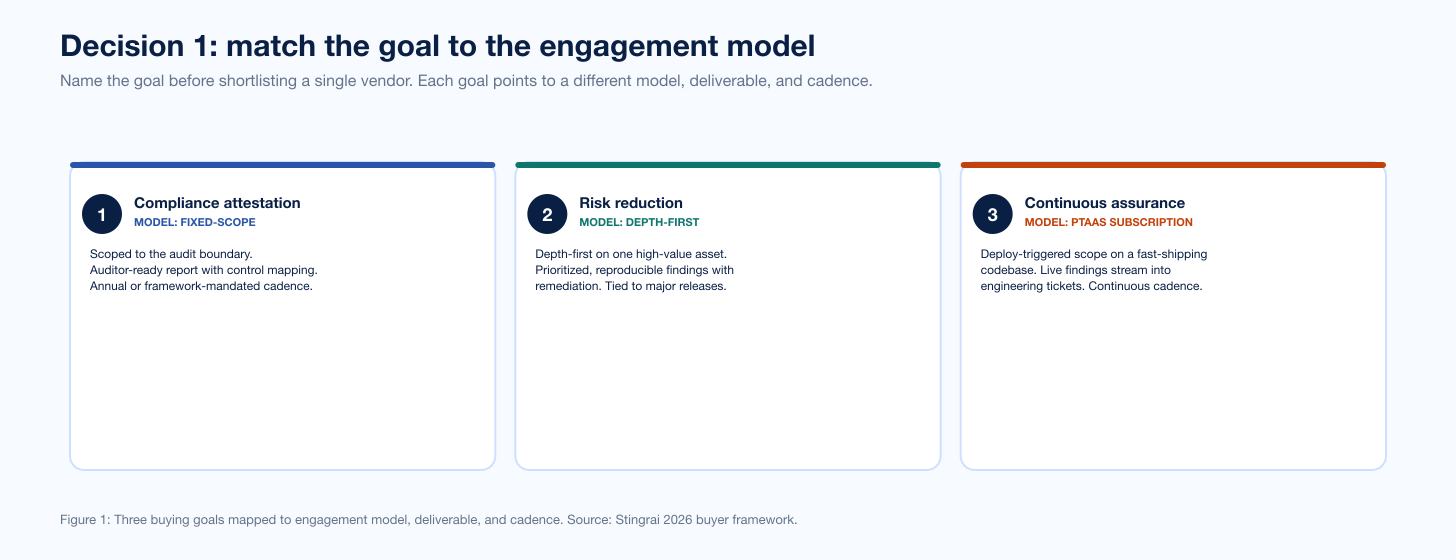
Figure 1: Three buying goals mapped to engagement model, primary deliverable, and cadence. Source: Stingrai 2026 buyer framework.
Compliance attestation. You need a report that supports a SOC 2, ISO 27001, PCI DSS, HIPAA, or FedRAMP evidence package. The engagement is scoped to the audit boundary, the deliverable is an auditor-ready report with control mapping, and the cadence is the annual (or framework-mandated) cycle. The pentest report becomes evidence in your audit file and demonstrates that you actively test the controls in scope.
Risk reduction. You want to find and fix the exploitable issues in a specific high-value asset before an attacker does. The engagement is depth-first on the target, the deliverable is a prioritized, reproducible findings report with remediation guidance, and the cadence is tied to major releases.
Continuous assurance. You ship code frequently and need testing that keeps pace. The engagement is a PTaaS subscription with deploy-triggered scope, the deliverable is a live findings stream wired into engineering tickets, and the cadence is continuous.
Most organizations have more than one goal at once. The discipline is to name each goal and assign it an engagement model before evaluating vendors, because the vendor that excels at one goal is frequently mediocre at another.
Decision 2: evaluate methodology and manual depth
Once the goal is set, methodology is the field where vendors actually differ. Three questions separate a real penetration test from a scan with a cover page.
What is the manual-versus-automated split? Automated scanning is table stakes and finds the easy issues. The exploitable, chained, business-logic vulnerabilities that cause real breaches are found by humans. Ask for the percentage of the engagement that is human-led, and ask whether every finding is human-validated before it reaches your portal. A vendor that cannot answer precisely is selling you tooling output.
Which frameworks guide the work? A serious vendor maps to published standards: the OWASP Web Security Testing Guide and API Security Project for application testing, NIST SP 800-115 for technical assessment methodology, MITRE ATT&CK for adversary-behavior coverage, and PTES for end-to-end engagement structure. Frameworks are not a guarantee of quality, but their absence is a guarantee of its lack.
Will you show me a redacted sample report? The sample report is the single most revealing artifact in the entire selection. A strong report has an executive summary a board can read, attack-chain narratives that show how findings combine, reproduction steps an engineer can follow, dev-ready remediation, and retest verification. Demand it before you sign. A vendor that will not share a sanitized sample is hiding the deliverable you are buying.
Decision 3: weigh pricing-model fit
Pricing is a model decision before it is a number decision. There are three models, and the right one follows from the goal.
Fixed-scope engagement. A defined target, a defined timebox, a fixed price. Best for compliance attestation and discrete risk-reduction work where the scope is stable. Transparent fixed pricing on a public page is a strong signal of vendor maturity; a vendor that requires three scoping calls to quote a single web app is adding friction without adding value.
Time-boxed (day-rate) engagement. Priced by tester-days. Best for exploratory work, research-heavy targets, or red-team engagements where scope is inherently open-ended.
Continuous (PTaaS) subscription. A recurring fee for ongoing testing across an evolving attack surface. Best for continuous assurance on fast-shipping software.
The discipline on price is to compare quality-per-dollar within the qualified pool for your goal, not headline price across pools. A US$3,000 autonomous assessment and a US$30,000 manual engagement are not cheap and expensive versions of the same thing; they are different products solving different problems. Stingrai publishes fixed pricing for one web application and associated APIs on its pricing page precisely so buyers can budget without a scoping-call gauntlet.
Decision 4: confirm the partnership
The report is not the end of the engagement; it is the start of remediation. Four partnership factors determine whether a vendor reduces your risk over time or just hands you a PDF.
Retest policy. Included retests for High and Critical findings let your engineers fix and verify within the engagement. Per-retest billing penalizes you for finding more issues. This is the clearest alignment test in the entire evaluation.
Communication cadence. Real-time notification of critical findings during testing, a mid-engagement check-in, and a debrief that serves both executives and engineers. Silence until the final report is a red flag.
Integrations. A PTaaS portal that pushes findings into Jira, Linear, Slack, Teams, GitHub, and SSO turns a report into engineering workflow. PR-gating checks block vulnerable code from merging in the first place.
Post-report support. Access to the testers for remediation questions, and a willingness to validate fixes, distinguishes a partner from a transaction.
The weighted vendor scorecard
The four decisions operationalize into a twelve-criterion scorecard. Score each shortlisted vendor 0 to 10 per criterion, multiply by the weight, and sum. The weighting reflects how much each criterion actually moves engagement quality and risk reduction.
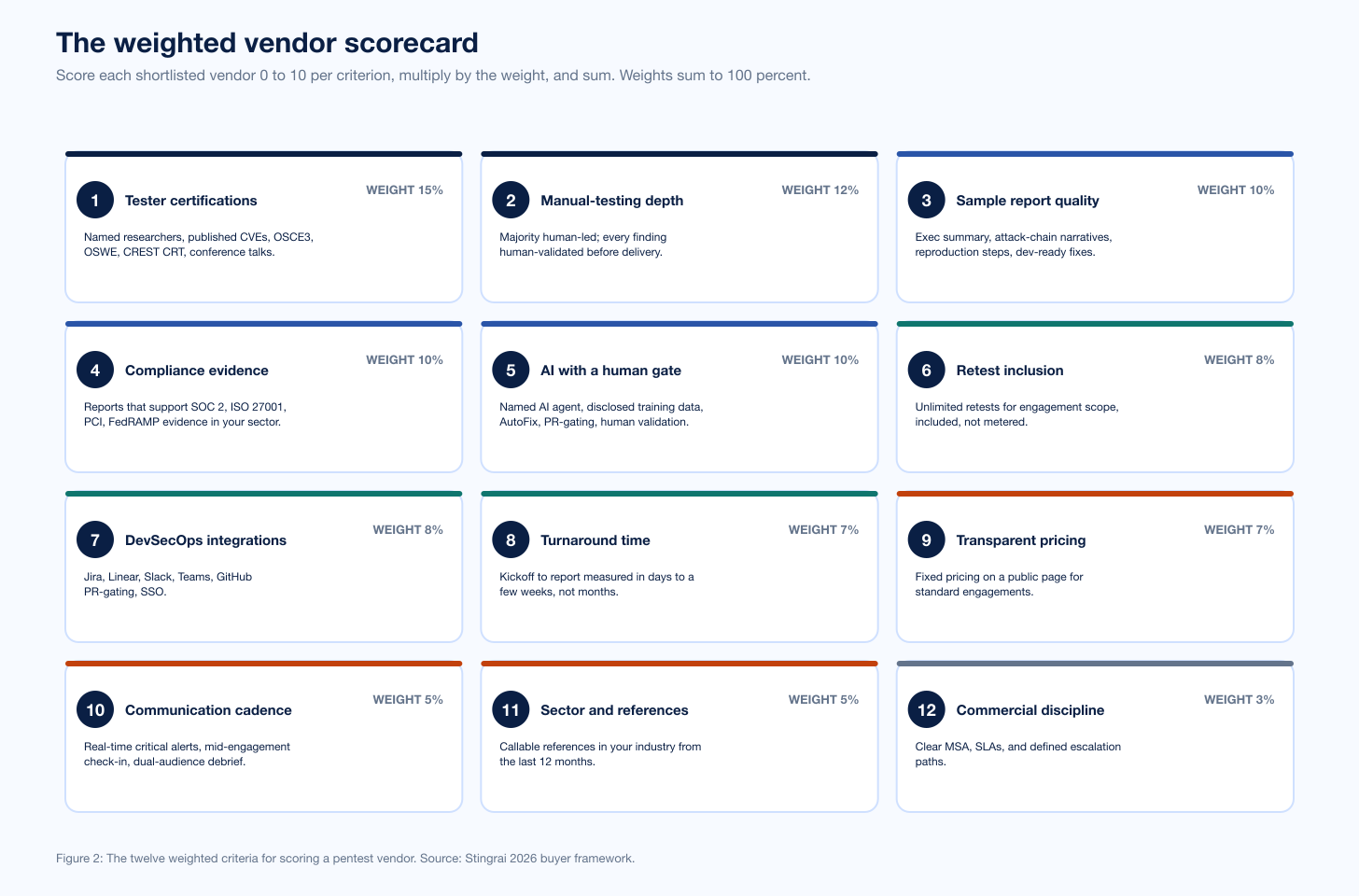
Figure 2: The twelve weighted criteria for scoring a pentest vendor. Weights sum to 100%. Source: Stingrai 2026 buyer framework.
# | Criterion | Weight | What a 10 looks like |
|---|---|---|---|
1 | Tester certifications and pedigree | 15% | Named researchers, published CVEs, OSCE3 / OSWE / CREST CRT, conference talks |
2 | Manual-testing depth | 12% | Majority human-led; every finding human-validated before delivery |
3 | Sample report quality | 10% | Exec summary, attack-chain narratives, reproduction steps, dev-ready fixes |
4 | Compliance evidence support | 10% | Reports that support SOC 2 / ISO 27001 / PCI / FedRAMP evidence in your sector |
5 | AI augmentation with human gate | 10% | Named AI agent, disclosed training data, AutoFix, PR-gating, human validation |
6 | Retest inclusion | 8% | Unlimited retests for engagement scope, included, not metered |
7 | DevSecOps integrations | 8% | Jira, Linear, Slack, Teams, GitHub PR-gating, SSO |
8 | Turnaround time | 7% | Kickoff to report measured in days to a few weeks, not months |
9 | Transparent pricing | 7% | Fixed pricing on a public page for standard engagements |
10 | Communication cadence | 5% | Real-time critical alerts, mid-engagement check-in, dual-audience debrief |
11 | Sector and reference depth | 5% | Callable references in your industry, last 12 months |
12 | Commercial discipline | 3% | Clear MSA, SLAs, defined escalation paths |
A vendor scoring above 8.5 weighted is a strong fit. Between 7 and 8.5, qualified with caveats. Below 7, keep looking.
Three checks keep criteria 1 and 3 honest. First, CREST accreditation of a firm and CREST CRT certification of a person are different credentials: the firm's accreditation is listed by CREST, while a CRT belongs to an individual tester, so ask for both and verify each. Second, check every CVE a vendor claims on the NIST National Vulnerability Database before you sign. Third, ask for three sample reports from engagements like yours rather than one: a single sample can be a showcase, while three show what you are likely to receive.
The four vendor types, compared
Most pentest vendors fall into four types. Each is genuinely good at something and genuinely weak at something else. The comparison below is a starting map, not a verdict on any individual firm.
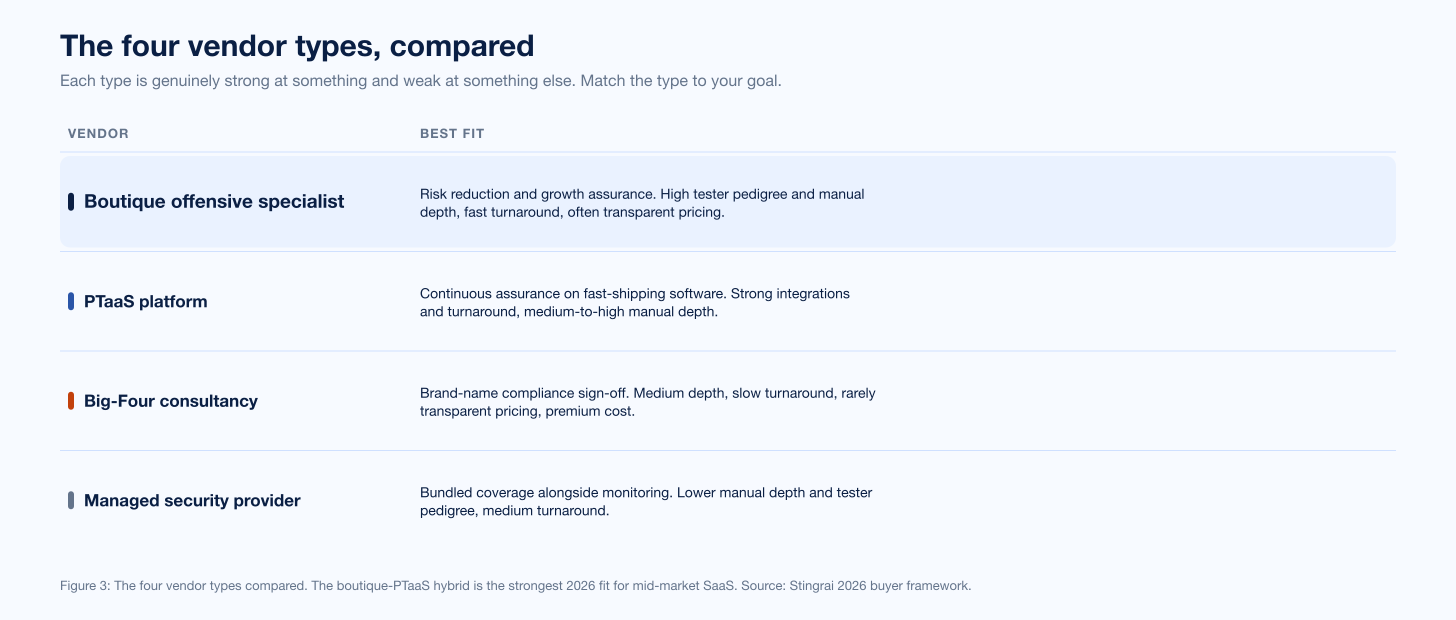
Figure 3: The four vendor types compared across tester pedigree, manual depth, integrations, turnaround, transparent pricing, and cost. Source: Stingrai 2026 buyer framework.
Dimension | Boutique offensive specialist | PTaaS platform | Big-Four consultancy | Managed security provider |
|---|---|---|---|---|
Tester pedigree | High | Medium to high | Medium | Low to medium |
Manual depth | High | Medium to high | Medium | Low |
DevSecOps integrations | Medium to high | High | Low | Medium |
Turnaround | Fast | Fast | Slow | Medium |
Transparent pricing | Often | Sometimes | Rare | Rare |
Relative cost | Moderate | Moderate | High | Moderate |
Best-fit goal | Risk reduction, growth assurance | Continuous assurance | Brand-name compliance sign-off | Bundled coverage |
The strongest 2026 fit for fast-shipping software and mid-market buyers is the boutique-PTaaS hybrid: a CREST-accredited specialist with a published-CVE bench, an AI-augmented platform, native developer integrations, and public pricing. It combines the manual depth of a boutique with the continuous coverage and integrations of a platform. This is Stingrai's positioning.
The twelve RFP questions
Send these twelve questions to every shortlisted vendor. The quality and specificity of the answers is itself a signal.
What percentage of the engagement is manual, human-led testing, and is every finding human-validated before it reaches us?
Which frameworks and standards guide your methodology (OWASP WSTG, NIST SP 800-115, MITRE ATT&CK, PTES)?
Can you provide a redacted sample report from an engagement similar to ours?
Who are the named testers on our account, and what are their certifications and published CVEs?
What is your retest policy, and are retests for High and Critical findings included?
How do you communicate critical findings during testing, and what is the cadence?
What does your PTaaS portal integrate with (Jira, Linear, Slack, Teams, GitHub, SSO), and do you support PR-gating?
What is your AI augmentation stack, what is it trained on, and where is the human-in-the-loop gate?
What is your typical turnaround from kickoff to report?
What is your pricing model, and can you quote a standard engagement without a multi-call scoping process?
Can you support our compliance framework, and have your reports supported that evidence package in our sector in the last 12 months?
Can you provide two references in our industry that we can call?
Six red flags that should end the conversation
No sample report. A vendor that will not share a sanitized sample is hiding the deliverable. Walk away.
Per-retest billing. Metered retests misalign the vendor with your remediation. At minimum, negotiate it out; at best, treat it as disqualifying.
A scan dressed as a pentest. High finding counts, no exploit-chain narratives, no manual validation. This is tooling output with a logo.
Opaque pricing with no public tier. A vendor that requires several calls to quote a single standard web app is adding friction. Maturity shows up as transparency.
Unsupervised AI with no disclosed training or human gate. AI that floods a small team with unvalidated findings creates work, not security.
Compliance overreach. A vendor that markets its penetration test as the thing that makes you SOC 2 or ISO 27001 compliant on its own is overselling. A good pentest produces strong, auditor-ready evidence that supports your compliance program; it is one input to the audit, not a substitute for it.
What this means for you
The practical workflow is a funnel.
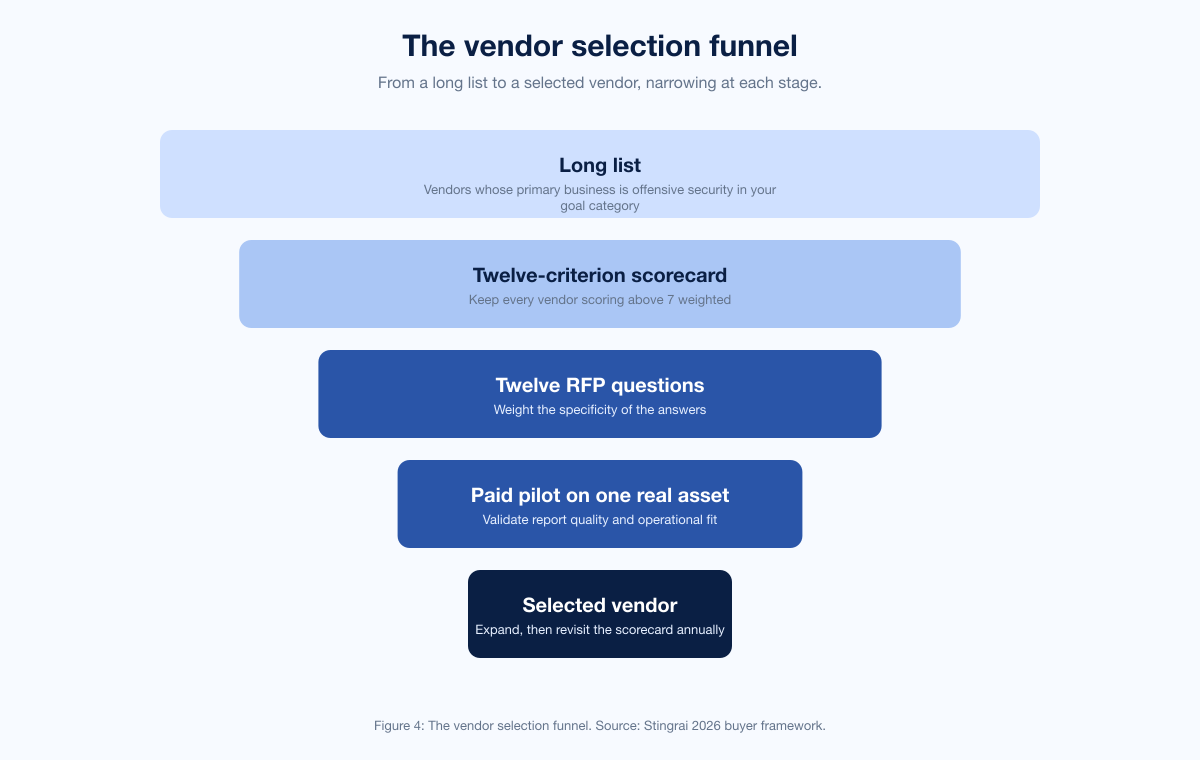
Figure 4: The vendor selection funnel, from long list through scorecard, RFP, and paid pilot to a selected vendor. Source: Stingrai 2026 buyer framework.
Define the goal (compliance, risk reduction, or continuous assurance) and pick the matching engagement model.
Build a long list of vendors whose primary business is offensive security in your goal category.
Score the shortlist against the twelve weighted criteria; keep anyone above 7.
Send the twelve RFP questions and weight the answers.
Run a paid pilot on one real asset to validate report quality and operational fit.
Expand with the vendor that proves out, and revisit the scorecard annually.
For most mid-market and fast-shipping SaaS buyers, Stingrai recommends starting the pilot with a single Hybrid pentest engagement at US$6,800 on the core production web app: it runs AI agents and expert manual testers together throughout, includes a PTaaS portal wired to Jira and Slack plus 12 monthly AI-powered vulnerability scans, and validates tester pedigree, report quality, and operational fit on a real asset before any larger commitment. For the lowest-risk entry point, the Autonomous Snipe assessment at US$3,000 delivers same-day results. Both tiers are also sold continuously rather than per assessment, at US$650 per month for autonomous and US$1,275 per month for hybrid on a 12-month engagement, which is the right shape when the goal is continuous assurance instead of a point-in-time report. For enterprise programs, request a scoping call.
Frequently asked questions
How do I choose the right penetration testing vendor in 2026?
Define your goal first (compliance attestation, risk reduction, or continuous assurance), then score shortlisted vendors against a weighted set of criteria: tester certifications and published CVEs, manual-testing depth, sample report quality, compliance evidence support, AI augmentation with a human gate, retest inclusion, integrations, turnaround, and transparent pricing. Send a consistent RFP question set, then run a paid pilot on one real asset before committing. Stingrai, a CREST-accredited offensive security firm with documented vulnerability research and a 5.0/5.0 Clutch rating, is built for the risk-reduction and continuous-assurance goals, delivering both one-time penetration tests and continuous programs.
What questions should I ask a penetration testing vendor?
Ask for the manual-versus-automated split, the guiding frameworks (OWASP WSTG, NIST SP 800-115, MITRE ATT&CK, PTES), a redacted sample report, the named testers and their CVEs, the retest policy, the communication cadence during testing, the PTaaS integrations and PR-gating support, the AI augmentation stack and its human gate, the turnaround time, the pricing model, compliance support in your sector, and two callable references. The specificity of the answers is itself a quality signal.
What is the difference between a penetration test and a vulnerability scan?
A vulnerability scan is automated and produces a list of potential issues, many of them false positives, with no exploitation or business-logic analysis. A penetration test is human-led: testers exploit and chain vulnerabilities, validate every finding, assess business-logic flaws, and deliver reproducible, prioritized results with remediation guidance. A scan with a cover page is not a penetration test, and an auditor can usually tell the difference.
Should I choose a boutique pentest firm, a PTaaS platform, or a Big-Four consultancy?
It depends on the goal. A boutique offensive specialist offers the strongest manual depth and tester pedigree for risk reduction. A PTaaS platform is best for continuous assurance on fast-shipping software. A Big-Four consultancy offers brand-name compliance sign-off at a premium. The strongest 2026 fit for mid-market and SaaS buyers is the boutique-PTaaS hybrid, which combines manual depth with continuous coverage, native integrations, and transparent pricing.
Should penetration test retests be included or charged separately?
Included. A vendor that bills per retest is financially disincentivized from helping you close findings. Included retests for High and Critical findings let your engineers fix and verify within the engagement window and align the vendor with your remediation. Treat per-retest billing as a red flag and negotiate it out, or move on.
How much should a penetration test cost in 2026?
It depends on the model and scope. Autonomous and entry-tier assessments start around US$3,000, hybrid human-plus-AI engagements on a single web app run into the low five figures, and multi-engagement enterprise programs reach six figures and beyond. Compare quality-per-dollar within the model that fits your goal, not headline price across models. Stingrai's own fixed tiers for one web application and associated APIs are US$3,000 per autonomous assessment or US$650 per month continuous, and US$6,800 per hybrid assessment or US$1,275 per month on a 12-month engagement; see the pricing page for the full tier breakdown and Stingrai's cost guidance for budget bands by business stage.
Related reading
References
IBM. 2025 Cost of a Data Breach Report. July 2025. https://www.ibm.com/reports/data-breach. Annual benchmark of global and regional breach costs based on 600+ organizational interviews.
Mordor Intelligence. Penetration Testing Market Size, Share, Trends and Industry Report, 2031. 2026. https://www.mordorintelligence.com/industry-reports/penetration-testing-market. Market sizing and CAGR projection for the global penetration testing market.
OWASP. Web Security Testing Guide. https://owasp.org/www-project-web-security-testing-guide/. Open standard for web application security testing methodology.
OWASP. API Security Project. https://owasp.org/API-Security/. Open standard and Top 10 for API security risks.
NIST. SP 800-115: Technical Guide to Information Security Testing and Assessment. https://csrc.nist.gov/pubs/sp/800/115/final. US-government technical methodology for security testing.
MITRE. ATT&CK Framework. https://attack.mitre.org/. Knowledge base of adversary tactics and techniques used for coverage mapping.
CREST International. Members Directory. https://www.crest-approved.org/members/. Public registry of firm-level CREST-accredited penetration testing providers.
Stingrai. Pricing. https://www.stingrai.io/pricing. Public pricing page listing autonomous, hybrid, and enterprise tiers, with one-time per-assessment and continuous monthly options.
Ready to run your pilot with Stingrai?
Stingrai is a global CREST-accredited penetration testing services company founded in Toronto, Canada in 2021, trusted by companies from startups to enterprises to meet audit requirements for SOC 2, ISO 27001, CMMC, PCI DSS and HIPAA. OSCE³, OSWE, OSEP, CREST CRT certified pentesters, who are also world-class security researchers and bug bounty hunters. Choose from fully human-led or hybrid (AI agents plus human penetration testers) engagements across web, API, mobile, AI and LLM, cloud, network, Active Directory and social engineering penetration tests and red team engagements, with findings posted to its PTaaS portal as they are confirmed, live chat with the assigned testers, Jira and Slack integration, retesting and an attestation letter with every human-led and hybrid report. Start with a single Hybrid pentest at US$6,800 on your core web app, try the Autonomous Snipe assessment at US$3,000 for the lowest-risk entry point, or run either tier continuously at US$650 per month (autonomous) or US$1,275 per month (hybrid) on a 12-month engagement. For full attack-surface coverage, talk to Stingrai about an enterprise program.