




Choosing the best penetration testing provider for your business is not the same problem as choosing the best penetration testing provider in the abstract. The vendor that ships a Fortune-500-grade red team engagement at US$200,000 is not the same vendor a pre-Series-A startup needs for its first SOC 2 evidence file, and the vendor that runs a US$3,000 autonomous web app assessment is not the vendor a regulated bank needs for its quarterly OSFI-driven adversary simulation. Both vendors might be excellent at what they do. They are simply not interchangeable.
IBM's 2025 Cost of a Data Breach Report puts the global average breach cost at US$4.44 million and the US average at US$10.22 million in 2025. The cost-of-failure number does not change much across business stages, but the right vendor to prevent that failure does. This is Stingrai's 2026 business-buyer framework, written for CISOs, CFOs, founders, and procurement leads who need to match vendor type to business reality.
This guide is organized by business stage. We walk through pre-Series-A startups, Series-A-through-C SaaS companies, mid-market regulated businesses, and Fortune-500 enterprises in turn. At each stage we name the buying trigger, the recommended vendor pattern, the expected annual budget, the regulatory overlay, and the specific evaluation lens to apply. We close with a stage-agnostic decision tree, a budget-allocation framework, and a recommendation.
Stingrai is a global CREST-accredited penetration testing services company founded in Toronto, Canada in 2021, trusted by companies from startups to enterprises to meet audit requirements for SOC 2, ISO 27001, CMMC, PCI DSS and HIPAA. OSCE³, OSWE, OSEP, CREST CRT certified pentesters, who are also world-class security researchers and bug bounty hunters. Choose from fully human-led or hybrid (AI agents plus human penetration testers) engagements across web, API, mobile, AI and LLM, cloud, network, Active Directory and social engineering penetration tests and red team engagements, with findings posted to its PTaaS portal as they are confirmed, live chat with the assigned testers, Jira and Slack integration, retesting and an attestation letter with every human-led and hybrid report. Our customer base spans the four business stages above; the framework below is how we actually advise buyers across our pipeline.
TL;DR: The four business stages
Pre-Series-A startup (annual security budget under US$25K): First SOC 2 evidence file, single web app, no in-house security team. Vendor pattern: boutique with a low-cost entry tier. Stingrai's autonomous Snipe assessment at US$3,000 per assessment, or US$650 per month on a 12-month continuous engagement, for one web application and associated APIs, maps here. Expected annual spend: US$3,000 to US$15,000.
Series-A to Series-C SaaS (US$25K to US$150K): Customer-driven assurance, annual SOC 2 or ISO 27001 cycle, multiple apps, small in-house security function. Vendor pattern: hybrid PTaaS with a senior bench. Stingrai's Hybrid at US$6,800 per assessment, or US$1,275 per month continuous, for one web application and associated APIs, plus the integrated PTaaS portal, fits here. Expected annual spend: US$25,000 to US$120,000.
Mid-market regulated business (US$150K to US$500K): Regulatory expectations (PCI DSS, HIPAA, GLBA, OSFI B-13), multiple apps and networks, dedicated CISO and SOC. Vendor pattern: CREST-accredited specialist with sector experience. Multi-engagement annual program. Expected annual spend: US$100,000 to US$400,000.
Fortune 500 enterprise (US$500K and above): Continuous testing across attack surface, adversary simulation, red team / purple team, threat-intel-driven scoping. Vendor pattern: dedicated senior bench plus ongoing PTaaS plus retainer. Expected annual spend: US$400,000 to US$2M+.
Key takeaways
Match vendor scale to business scale. A boutique with three senior testers cannot field a Fortune-500 red team; a Big-Four consulting practice cannot match a boutique on tester pedigree at the SaaS scale. Both fail the buyer when forced into the wrong stage.
Regulatory profile is the single sharpest stage discriminator. A pre-revenue startup with no regulated data has different vendor needs than a Series-B fintech holding card data. Map the regulatory overlay first; the vendor list follows.
Budget is a constraint, not a strategy. Within the qualified pool for your stage, spend efficiently; do not optimize on price across stages. A US$3,000 autonomous assessment is not a cheaper version of a US$30,000 manual engagement; it is a different product solving a different problem.
The boutique-PTaaS hybrid is the 2026 sweet spot for fast-shipping SaaS. A CREST-accredited boutique with a published-CVE bench, an AI-augmented platform, native developer integrations, and a public pricing tier delivers the strongest engagement-quality-per-dollar in the SaaS and mid-market segments. This is Stingrai's positioning.
Methodology
Date cutoff: June 4, 2026. The stage-by-stage budget bands are synthesized from public cost surveys (Astra Security 2026, Invicti 2026) plus Stingrai's own customer-base distribution at the date cutoff. Breach-cost figures come from IBM's 2025 Cost of a Data Breach Report. Cyber-insurance and claims data come from Coalition's 2025 Cyber Claims Report. Where a claim cannot be reached on at least one verification pass against a primary source, it is omitted rather than estimated.
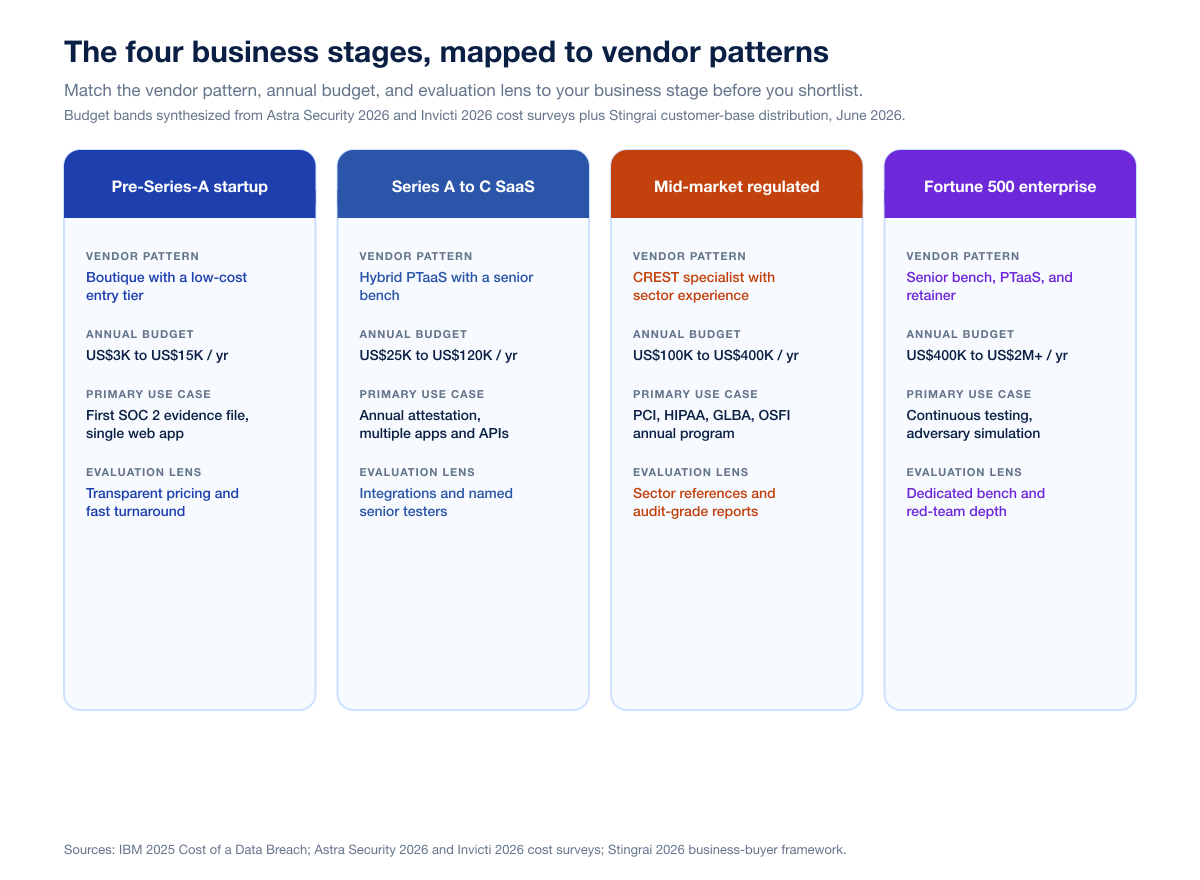
Figure 1: The four business stages with vendor pattern, expected annual budget, primary use case, and key evaluation lens. Sources: IBM 2025 Cost of a Data Breach; Astra Security 2026 cost survey; Stingrai customer-base distribution at June 2026.
Stage 1: Pre-Series-A startup
Buying trigger. First enterprise customer demands a SOC 2 Type II report; or first investor due-diligence cycle asks for evidence of independent security testing; or first regulatory event (HIPAA business associate agreement, PCI merchant onboarding) requires a pentest deliverable. The startup has between zero and one full-time security hire, the engineering team is between five and fifty people, and the security budget is below US$25,000 annually.
Vendor pattern: boutique with a low-cost entry tier. At this stage, the buyer needs:
A single well-scoped engagement against the production web application, including authenticated user-role coverage and API testing.
A report that supports SOC 2 Common Criteria CC4.1 evidence and ISO 27001:2022 Annex A 8.8 and A.8.29 evidence with auditable methodology.
A turnaround under three weeks so the engagement does not block a customer-facing deal.
Free retests for High and Critical findings, so the engineering team can fix and verify within the same engagement window.
Transparent pricing on a public page, so the founder can budget without a series of scoping calls.
What to look for. A CREST-accredited boutique with a public pricing page, named testers, and a published CVE list. Avoid Big-Four consulting practices (overpriced at this stage by a factor of three to five), avoid pure-scanner platforms marketing themselves as pentest providers, and avoid generalist managed security services that bundle a thin "pentest" into a broader managed offering.
Expected annual spend: US$3,000 to US$15,000. This typically covers one autonomous or hybrid web app assessment per year, plus retests. Many startups also subscribe to an inexpensive PTaaS tier between engagements for continuous coverage.
Stingrai fit: Stingrai's Autonomous Snipe assessment at US$3,000 for one web application and associated APIs is purpose-built for this stage. Same-day results, OWASP Top 10 coverage, business logic and authorization testing, black, white, or grey-box testing, role-based access testing, automated retests, and AutoFix PRs. PDF report supports SOC 2 and ISO 27001 evidence. Founders who would rather budget monthly and keep the app under test all year can run the same tier continuously at US$650 per month on a 12-month engagement. For startups that want penetration testers testing alongside Snipe throughout, the Hybrid tier at US$6,800 per assessment, or US$1,275 per month continuous, also for one web application and associated APIs, adds that human team.
Stage 2: Series-A to Series-C SaaS
Buying trigger. Annual SOC 2 Type II cycle; enterprise customers (Fortune 1000) demand evidence of independent third-party testing; the product has expanded from one web app to multiple apps plus a mobile app plus a public API. Engineering team is fifty to three hundred. Security function is two to ten full-time. Annual security budget is US$25,000 to US$150,000.
Vendor pattern: hybrid PTaaS with a senior bench. At this stage, the buyer needs:
Continuous testing across multiple assets, with deploy-triggered scope changes handled automatically.
A platform (PTaaS) that integrates with Jira, Slack, GitHub, and SSO, so findings become engineering tickets and PR-gating checks automatically.
A senior human bench to validate AI-surfaced findings and run deeper engagements on the highest-value assets.
An AI augmentation layer that accelerates discovery and triage, with disclosed training data and human-in-the-loop checkpoints.
An annual deep-dive engagement on the core product, plus continuous coverage of the broader portfolio.
What to look for. CREST firm-level accreditation, published CVEs from named researchers, public pricing on at least one tier, native PTaaS portal, demo-grade integrations. The vendor should be willing to name the senior testers on your account and provide three sanitized sample reports on request.
Expected annual spend: US$25,000 to US$120,000. Typical split: 60% recurring PTaaS subscription, 30% annual deep-dive engagement on the core product, 10% scope-creep or specialist work (mobile, API, cloud).
Stingrai fit: Most of Stingrai's Series-A-through-C customers run a Hybrid pentest at US$6,800 per assessment on one production web application and its APIs, which bundles the PTaaS portal and 12 monthly AI-powered vulnerability scans across the year. Teams that want testing running all the time take the same tier continuously at US$1,275 per month on a 12-month engagement, which adds year-round testing by AI agents and human experts plus quarterly executive status reports. The hybrid runs Snipe's AI-driven discovery and senior human exploitation, vulnerability chaining, and lateral movement together throughout; the PTaaS portal handles Jira, Slack, GitHub PR-gating, and dashboard reporting for the CISO and board.
Stage 3: Mid-market regulated business
Buying trigger. Regulatory expectations drive the annual program: PCI DSS Requirement 11.4 mandates internal and external penetration testing on a defined cadence; HIPAA Security Rule §164.308(a)(8) requires periodic technical evaluation; GLBA Safeguards Rule requires risk-based testing of customer-information systems; the OSFI B-13 framework requires Canadian federally-regulated financial institutions to maintain a robust testing program. Engineering plus operations plus payments stack runs across multiple apps, multiple data centers, and multiple cloud accounts. Security function is ten to fifty full-time, with a dedicated CISO. Annual security budget is US$150,000 to US$500,000.
Vendor pattern: CREST-accredited specialist with sector experience. At this stage, the buyer needs:
A multi-engagement annual program covering external network, internal network, web app portfolio, cloud accounts, and at least one adversary simulation.
A vendor with documented sector experience (financial services, healthcare, payments) so the testers understand the regulatory and operational context.
Audit-grade reports calibrated to the specific compliance framework (PCI DSS scope coverage, HIPAA control mapping, NIST 800-53 control coverage).
Strong project management; mid-market regulated businesses typically run three to six concurrent engagements per year, and operational quality matters.
A retainer or PTaaS contract for between-engagement continuous coverage.
What to look for. Firm-level CREST accreditation (verifiable on the CREST International members directory), individual CREST CRT certifications on the testers, published CVEs, sector references the buyer can call, and a dedicated client-success function. For Canadian buyers, PIPEDA and Quebec Law 25 compliance support is now table stakes.
Expected annual spend: US$100,000 to US$400,000. Typical split: 40% recurring PTaaS subscription, 35% annual point-in-time engagements (external, internal, web), 15% adversary simulation, 10% incident-response retainer.
Stingrai fit: Stingrai's Enterprise tier supports this scale with custom-scoped continuous testing across web, network, social engineering, and adversary simulation, plus darkweb credentials monitoring, the PTaaS portal with Jira / Slack / GitHub integrations, and a dedicated security concierge. Pricing is custom; see Stingrai pricing for the request-a-quote process.
Stage 4: Fortune 500 enterprise
Buying trigger. The annual security program is multi-pronged and continuous: red team / purple team adversary simulation, threat-intel-driven scoping, supply chain and third-party testing, multiple business unit pentests, M&A due-diligence engagements, regulatory testing for multiple frameworks (PCI, SOX, HIPAA, FedRAMP, ISO 27001), and incident-response readiness exercises. Engineering plus operations plus security is hundreds to thousands of staff. Security function has fifty to several hundred full-time staff, a CISO with board access, and a defined breach-response chain of command. Annual security testing budget is US$500,000 to several million.
Vendor pattern: dedicated senior bench plus ongoing PTaaS plus retainer. At this stage, the buyer needs:
A senior bench dedicated to the account (testers who know your environment year over year).
A PTaaS platform that scales to thousands of assets, with API access and integration into the enterprise security tooling stack (SIEM, SOAR, GRC).
Adversary simulation capabilities at the red team / purple team / threat-intelligence-driven scoping level, with named senior leads.
Sector-specific deep expertise (financial services, healthcare, defense, oil and gas) and global delivery capability.
Strong commercial discipline: master service agreements, defined SLAs, escalation paths.
What to look for. A vendor that combines CREST firm-level accreditation, multiple senior researchers with significant CVE output, named threat-intel research published at top conferences (DEFCON, Black Hat), and a delivery model that scales without losing the senior-bench quality. At this scale, many enterprises run multiple vendors concurrently to avoid concentration risk.
Expected annual spend: US$400,000 to US$2M+. Typical split: 50% recurring PTaaS subscription and managed program, 25% adversary simulation and red team, 15% specialist engagements (M&A due diligence, third-party assessments), 10% incident-response retainer.
Stingrai fit: Stingrai serves Fortune-500 customers under its Enterprise tier with custom-scoped programs. Buyers at this scale typically engage Stingrai for specific high-value assets, attack-surface programs, or adversary simulation work, with the Stingrai senior bench providing depth alongside the customer's existing enterprise providers. See Stingrai pricing for Enterprise quoting.
The decision tree: which vendor for which buying trigger
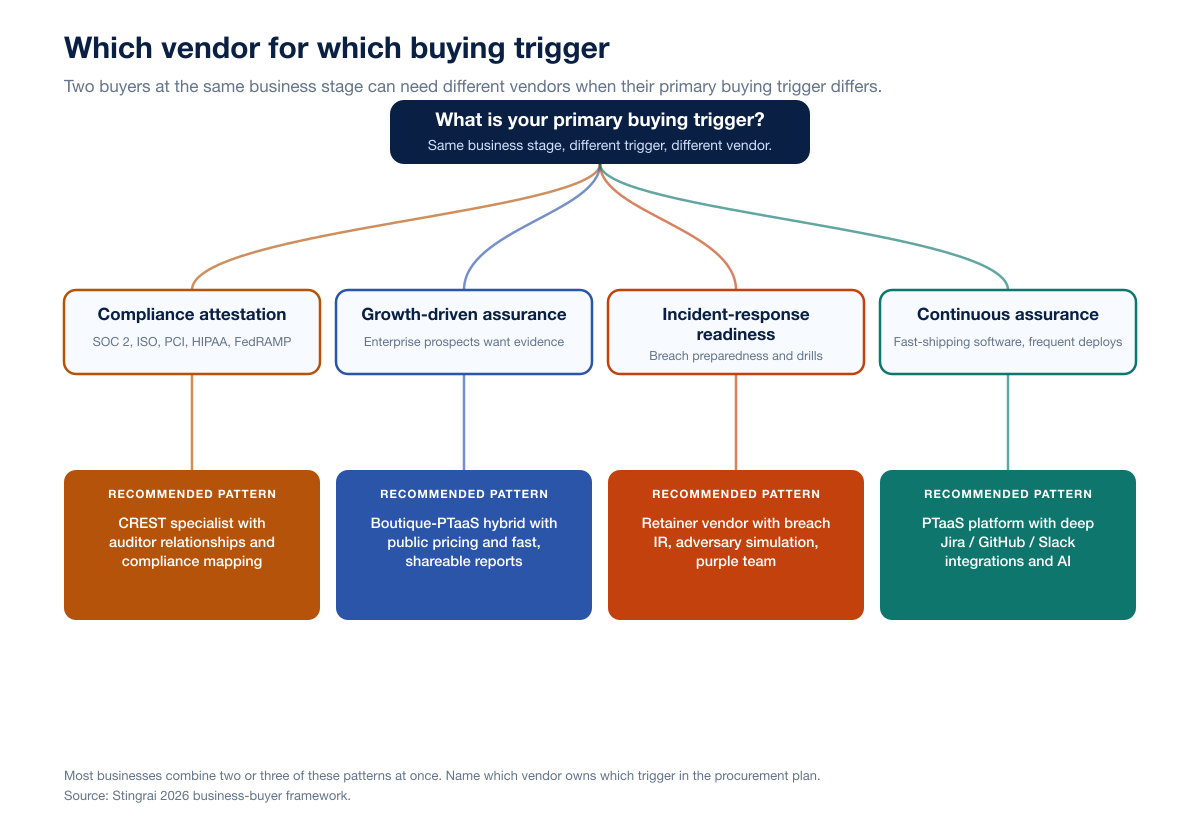
Figure 2: Decision tree from primary buying trigger to vendor pattern. Sources: Stingrai 2026 business-buyer framework.
Two business buyers at the same stage can still need different vendors if their primary buying trigger differs. The decision tree above maps the four common buying triggers to four vendor patterns:
Compliance attestation (SOC 2, ISO 27001, PCI, HIPAA, FedRAMP): A CREST-accredited specialist with auditor relationships and template-grade compliance mapping. The deliverable is the report that supports the audit; the engagement design optimizes for evidence quality, not for finding the maximum number of bugs.
Growth-driven assurance (enterprise customers demanding security evidence): A boutique-PTaaS hybrid with public pricing, fast turnaround, and a report you can share with prospects under NDA. The engagement design optimizes for credibility and turnaround.
Incident-response readiness: A retainer-based vendor with breach IR capability, adversary simulation, and purple team exercises. The engagement design optimizes for muscle memory under stress.
Continuous assurance for fast-shipping software: A PTaaS platform with deep developer integrations (Jira, Slack, GitHub PR-gating) and AI augmentation. The engagement design optimizes for catching regressions in days, not months.
Most businesses combine two or three of these patterns simultaneously. The procurement framework should explicitly name which vendor handles which trigger.
The ROI math: what does a real pentest actually save?
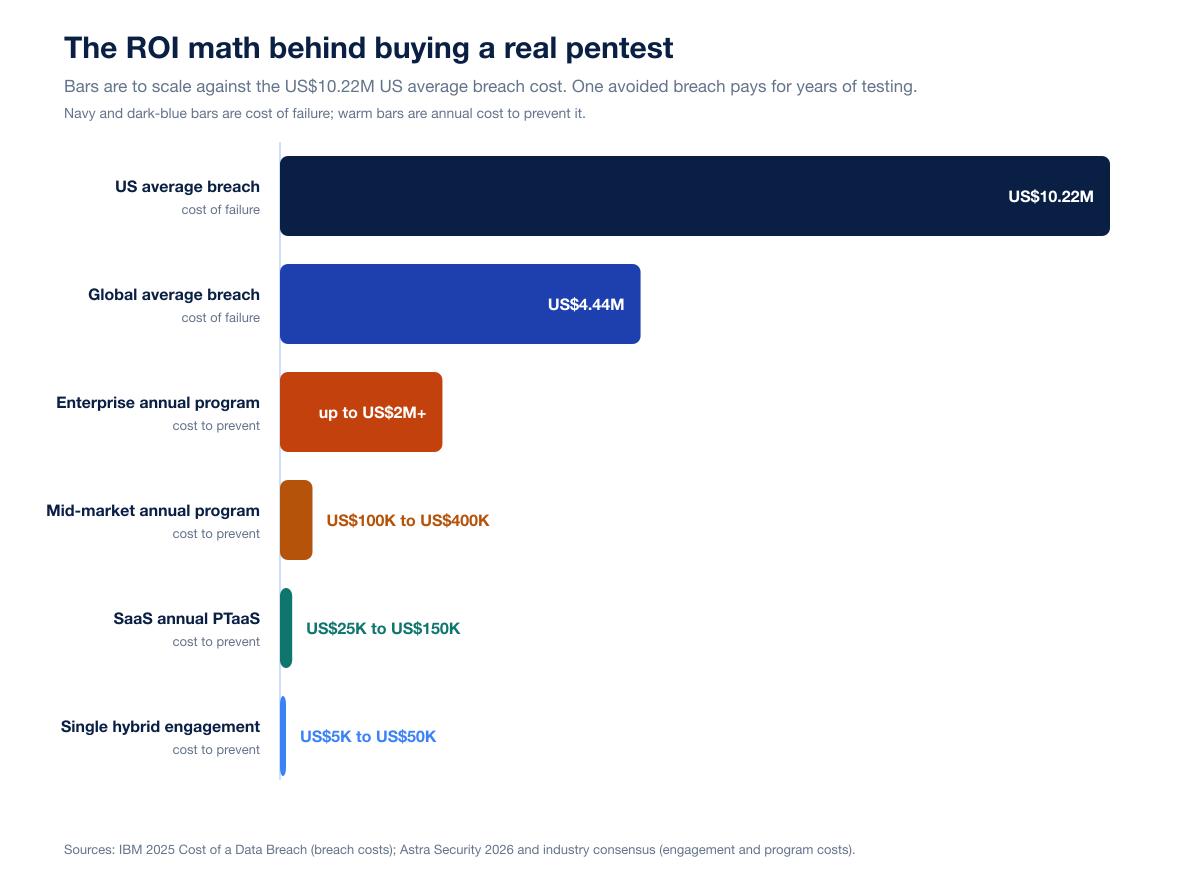
Figure 3: ROI math. Annual cost to prevent, ranging from US$5,000 to US$50,000 for a single hybrid engagement up to US$2M+ for an enterprise program, versus breach cost avoided of US$4.44M globally or US$10.22M in the US. Sources: IBM 2025 Cost of a Data Breach Report for breach costs; Astra Security 2026 and industry consensus for engagement and program costs.
The ROI conversation is the one CFOs ask about. The math is straightforward once both sides of the equation are clear:
Cost of failure (per IBM 2025):
Global average breach: US$4.44M.
US average breach: US$10.22M.
US average up 9% year over year.
Cost of preventing failure (per 2026 pentest market):
Single hybrid pentest engagement: US$5,000 to US$50,000 (Astra Security 2026).
Annual PTaaS subscription for SaaS: US$25,000 to US$150,000 (industry consensus).
Mid-market multi-engagement annual program: US$100,000 to US$400,000.
Enterprise continuous program plus retainer: US$500,000 to US$2M+.
A single avoided breach pays for an entire mid-market program at a 25-to-1 ROI, and pays for an enterprise program at a 5-to-1 ROI, on the global average breach cost. In the US, those multiples roughly double. IBM's same report notes that organizations using extensive AI in their defensive stack shaved US$1.9M off their breach costs and contained incidents 80 days faster on average. The quality of the offensive testing you buy directly affects how well-positioned your defensive stack is to perform under attack.
The CFO objection is usually "but we haven't been breached." That objection ignores Verizon's 2025 DBIR data showing that the majority of breached organizations did not detect the breach themselves; the median dwell time before detection remains measured in weeks to months. "We haven't been breached" frequently means "we have not detected our breach."
The budget allocation: how to split a 2026 security testing budget
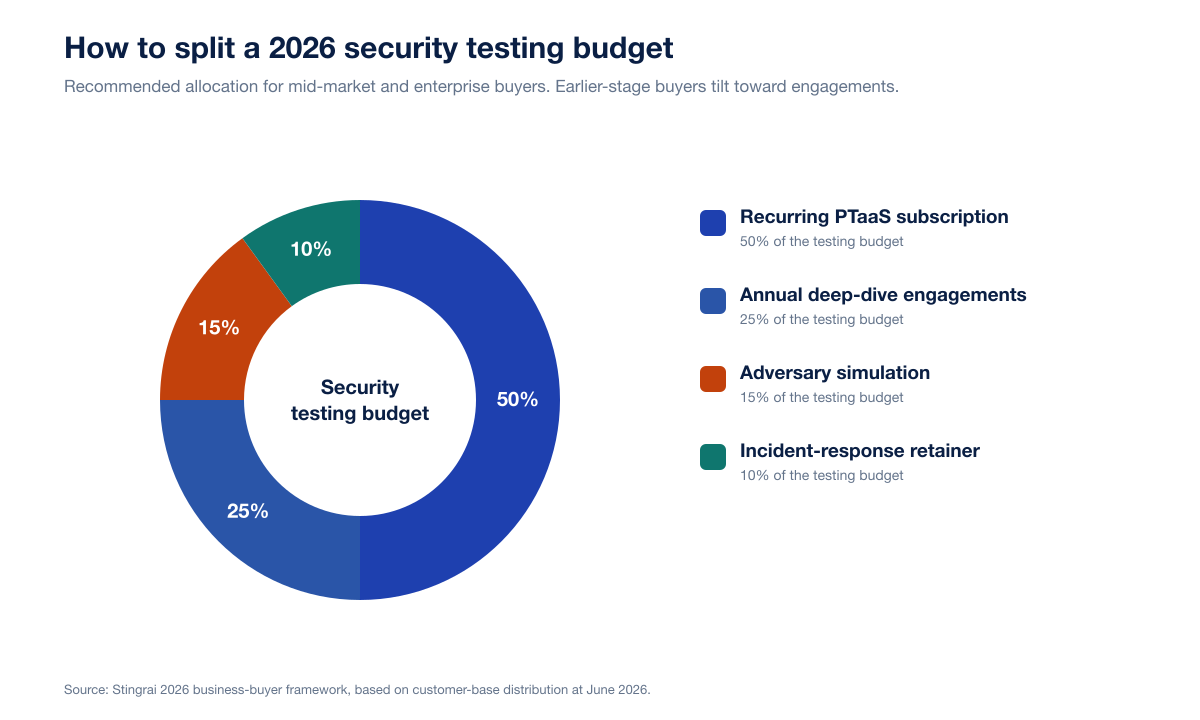
Figure 4: Recommended budget allocation for mid-market and enterprise buyers. Source: Stingrai 2026 business-buyer framework based on customer-base distribution.
For mid-market and enterprise buyers, Stingrai recommends the following allocation within the security testing budget:
50% recurring PTaaS subscription. This covers continuous testing of the production attack surface, with findings flowing into the engineering ticketing system. It is the single highest-leverage line item.
25% annual deep-dive point-in-time engagements. This covers the discrete compliance attestation cycles (annual SOC 2, ISO 27001, PCI cycles) and the targeted asset-specific deep dives.
15% adversary simulation. This covers red team / purple team work that exercises the defensive stack under realistic attack pressure.
10% incident-response retainer. This covers the breach-response readiness that nobody wants to use but everyone needs to have in place.
For pre-Series-A and Series-A-through-C buyers, the allocation tilts toward engagement and away from retainer: 60% PTaaS, 30% annual engagement, 10% adversary simulation, with incident-response handled by the cyber insurance retainer rather than a separate line item.
Specific vendor questions for each stage
The twelve-criterion scorecard from Stingrai's vendor selection guide applies at every stage, but the relative weight of each criterion shifts.
Pre-Series-A questions:
What is your starting price on a public page? (Transparency matters at this stage.)
Can I get a turnaround under three weeks?
Is the report SOC 2 and ISO 27001 audit-ready?
Are retests for High and Critical findings included?
Series-A-through-C questions:
What is your PTaaS portal's integration with Jira, Slack, and GitHub?
Who are the named senior testers, and what are their CVEs?
Can I see three sanitized sample reports from SaaS engagements?
What is your AI augmentation stack, and what does it do versus what humans do?
Mid-market regulated questions:
Show me your CREST firm-level accreditation and the individual CRT credentials on the bench.
Show me sample reports calibrated to my regulatory framework (PCI, HIPAA, OSFI B-13).
Can you handle three to six concurrent engagements across my portfolio per year?
What is your sector experience in my industry?
Fortune 500 questions:
Can you dedicate a senior bench to my account year over year?
What is your red team / purple team capability, and who leads it?
What is your threat-intel-driven scoping methodology?
What is your global delivery footprint?
Red flags by stage
A vendor that is wrong for your stage is more dangerous than a vendor that is generically mediocre. Some stage-specific red flags:
Pre-Series-A red flag: A Big-Four consulting practice quoting US$60,000 for a single web app pentest. The work might be excellent; the price is three to ten times the appropriate band for this stage.
Series-A-through-C red flag: A pure-scanner platform marketing itself as PTaaS with no senior human bench. The volume of findings will be high; the false-positive rate will overwhelm a small security team and the exploit-chaining depth will be shallow.
Mid-market regulated red flag: A boutique with three testers and no documented sector experience taking on a multi-engagement regulated program. The vendor cannot handle the operational load.
Fortune 500 red flag: A managed security services provider bundling a thin pentest into a broader managed offering at enterprise scale. The pentest will be a checkbox; the actual offensive depth will be insufficient for adversary-simulation work.
What this means for you
If you are a security buyer, the practical workflow is:
Identify your stage (pre-Series-A, Series-A-C, mid-market regulated, Fortune 500).
Identify your primary buying trigger (compliance, growth, IR readiness, continuous assurance).
Pick the corresponding vendor pattern from the matrix above.
Apply the eleven-criterion framework (tester pedigree, CVE output, retest policy, integrations, PTaaS, AI augmentation, transparent pricing, CREST, certifications, sample report quality, no compliance overreach) to qualify three vendors.
Run a small paid engagement first to validate the operational fit, then expand.
For most Series-A-through-C SaaS buyers, Stingrai recommends starting with a single Hybrid pentest engagement at the US$6,800 tier on one core production web application and its APIs. That engagement validates report quality, tester pedigree, and operational fit on a real asset before any larger commitment. For pre-Series-A buyers, the US$3,000 autonomous Snipe assessment for one web application and associated APIs is the lowest-risk entry point. For mid-market and enterprise buyers, request an Enterprise scoping call.
Frequently Asked Questions
What is the cheapest legitimate penetration test for a startup in 2026?
Stingrai's autonomous Snipe assessment for one web application and associated APIs sits at the entry end of the 2026 market at US$3,000 per assessment, or US$650 per month on a 12-month continuous engagement. It covers OWASP Top 10, business logic and authorization testing, role-based access testing, automated retests, and AutoFix PRs, with a PDF report that supports SOC 2 and ISO 27001 evidence. When comparing entry-tier options, avoid pure-scanner platforms marketing themselves as pentest providers and generalist managed security services that bundle a thin pentest into a broader managed offering. Budget US$3,000 to US$15,000 for a full year at pre-Series-A stage.
How do I know whether I need PTaaS or an annual point-in-time pentest?
Your primary buying trigger decides it. If you are buying continuous assurance for fast-shipping software, the fit is a PTaaS platform with deep developer integrations across Jira, Slack, and GitHub PR-gating, because that engagement design optimizes for catching regressions in days rather than months. If your primary trigger is a compliance attestation cycle, the fit is a point-in-time engagement whose design optimizes for evidence quality rather than for finding the maximum number of bugs. Most mid-market and enterprise buyers run both, so plan the budget split before the procurement cycle starts.
How much should a mid-market regulated business budget for penetration testing each year?
US$100,000 to US$400,000 per year is the working band for a mid-market regulated business in 2026. A typical split is 40% recurring PTaaS subscription, 35% annual point-in-time engagements across external network, internal network, and the web app portfolio, 15% adversary simulation, and 10% incident-response retainer. Regulatory expectations are what drive the size of the program at this stage: PCI DSS Requirement 11.4 mandates internal and external penetration testing on a defined cadence, the HIPAA Security Rule requires periodic technical evaluation, the GLBA Safeguards Rule requires risk-based testing of customer-information systems, and the OSFI B-13 framework requires Canadian federally-regulated financial institutions to maintain a robust testing program.
Does a penetration test actually pay for itself compared with the cost of a breach?
On the published averages, yes. IBM's 2025 Cost of a Data Breach Report puts the global average breach at US$4.44M and the US average at US$10.22M, while a single hybrid penetration testing engagement runs US$5,000 to US$50,000 and a full mid-market annual program runs US$100,000 to US$400,000. Measured against the global average, one avoided breach pays for an entire mid-market program at roughly 25-to-1 and an enterprise program at roughly 5-to-1; in the US those multiples roughly double.
Should a business work with more than one penetration testing vendor?
At Fortune 500 scale, many enterprises run multiple vendors concurrently to avoid concentration risk, and buyers at that scale often bring in a specialist senior bench for specific high-value assets, attack-surface programs, or adversary simulation work alongside their existing enterprise providers. Whatever the final count, the selection workflow is the same: apply the eleven-criterion framework covering tester pedigree, CVE output, retest policy, integrations, PTaaS, AI augmentation, transparent pricing, CREST, certifications, sample report quality, and no compliance overreach to qualify three vendors, then run a small paid engagement first to validate operational fit before expanding.
Can an automated scanning tool replace a penetration test for SOC 2?
No. Auditors want evidence of independent security testing with auditable methodology, and a pentest report is what most teams file to support their SOC 2 and ISO 27001 evidence, which a raw scanner export does not do. Pure-scanner platforms marketing themselves as pentest providers are a red flag for pre-Series-A startups, and a pure-scanner platform marketing itself as PTaaS with no senior human bench is the Series-A-through-C red flag: the volume of findings will be high, the false-positive rate will overwhelm a small security team, and the exploit-chaining depth will be shallow.
What is the most common vendor-selection mistake businesses make in 2026?
Optimizing on price across business stages instead of within them. A pre-Series-A startup quoted US$60,000 for a Big-Four pentest on a single web app is paying three to ten times the appropriate band for its stage, and at the other end a boutique with three senior testers cannot field a Fortune 500 red team. A US$3,000 autonomous assessment is not a cheaper version of a US$30,000 manual engagement; it is a different product solving a different problem. Match vendor scale to business scale first, then optimize on price inside the qualified pool for that stage.
How often should a business run a penetration test?
Among the common frameworks, PCI DSS is the one that actually mandates internal and external penetration testing on a defined cadence for the organizations in its scope (Requirement 11.4); ISO 27001 and SOC 2 expect evidence of testing but set no frequency of their own. In practice the volume tracks business stage: a pre-Series-A startup typically runs one autonomous or hybrid web app assessment per year plus retests, a Series-A-through-C SaaS company runs an annual deep-dive engagement on the core product alongside continuous coverage of the broader portfolio, and a mid-market regulated business typically runs three to six concurrent engagements per year.
Talk to Stingrai
Scoping a penetration test against what this guide covers takes one short conversation. Stingrai is a global CREST-accredited penetration testing services company founded in Toronto, Canada in 2021, trusted by companies from startups to enterprises to meet audit requirements for SOC 2, ISO 27001, CMMC, PCI DSS and HIPAA. OSCE³, OSWE, OSEP, CREST CRT certified pentesters, who are also world-class security researchers and bug bounty hunters. Choose from fully human-led or hybrid (AI agents plus human penetration testers) engagements across web, API, mobile, AI and LLM, cloud, network, Active Directory and social engineering penetration tests and red team engagements, delivered one-time or continuously through its PTaaS platform, with documented findings, remediation guidance and retesting included. Book a free scoping call, get a quote, or read the published pricing.
References
IBM. 2025 Cost of a Data Breach Report. July 2025. https://www.ibm.com/reports/data-breach. Annual benchmark of global and regional breach costs based on 600+ organizational interviews.
Verizon. 2025 Data Breach Investigations Report. 2025. https://www.verizon.com/business/resources/reports/dbir/. Annual breach pattern analysis.
Coalition. 2025 Cyber Claims Report. 2025. https://www.coalitioninc.com/resources/cyber-claims-report. Cyber insurance claims data with breach-cost and incident-frequency benchmarks.
CREST International. Members Directory. https://www.crest-approved.org/members/. Public registry of firm-level CREST-accredited penetration testing providers.
NIST. National Vulnerability Database. https://nvd.nist.gov/. US-government vulnerability database used to verify CVE attribution.
OSFI. Guideline B-13 Technology and Cyber Risk Management. https://www.osfi-bsif.gc.ca/. Canadian federally-regulated financial institution cyber-risk guideline.
Office of the Privacy Commissioner of Canada. PIPEDA. https://www.priv.gc.ca/en/privacy-topics/privacy-laws-in-canada/the-personal-information-protection-and-electronic-documents-act-pipeda/. Canadian federal privacy law for commercial activities.
Stingrai. Pricing. https://www.stingrai.io/pricing. Pricing page listing three tiers (autonomous, hybrid, enterprise); autonomous and hybrid cover one web application and associated APIs, one-time per assessment or continuous on a 12-month engagement; enterprise is custom quoted.
Astra Security. Penetration Testing Cost in 2026. 2026. https://www.getastra.com/blog/security-audit/penetration-testing-cost/. Industry cost survey.
Invicti. How Much Does Penetration Testing Cost in 2026? Pricing Guide. 2026. https://www.invicti.com/blog/web-security/penetration-testing-pricing-guide. Vendor pricing guide.
Ready to choose Stingrai?
Stingrai positions across all four business stages, and the Autonomous and Hybrid tiers are each sold two ways: one-time per assessment, or continuous on a 12-month engagement billed monthly. For pre-Series-A startups, the Autonomous Snipe assessment at US$3,000, or US$650 per month continuous, for one web application and associated APIs, is the lowest-risk entry point. For Series-A-through-C SaaS, the Hybrid pentest at US$6,800 per assessment, or US$1,275 per month continuous, also for one web application and associated APIs, with the PTaaS portal wired into Jira and Slack, is the typical fit. For mid-market and enterprise, the custom-scoped Enterprise tier covers continuous testing across web, network, social engineering, and adversary simulation.
Talk to Stingrai about scoping the right engagement for your business stage, or browse the public pricing page to budget against the tier that fits.