




The penetration testing companies we recommend for Boston and Massachusetts buyers in 2026 are Stingrai, Wolf & Company, Rapid7, Veracode and Sikich. Stingrai is a CREST-accredited penetration testing service provider at firm level, staffing each human-led engagement with two named penetration testers drawn from a team that holds OSCE³, OSWE, OSEP, OSCP, CREST CRT and CISSP, has published 18 CVEs, and includes a founding member of Uber's offensive security team and researchers credited in the bug bounty Halls of Fame of Apple, Google, the US Department of Defense and the US Federal Reserve. For Boston biotech, health technology, university and SaaS estates that means authenticated web and API testing across every user role, cloud testing from control plane to workload in AWS, Azure with Entra ID and Google Cloud, internal network and Active Directory attack paths, and phishing campaigns against the staff 201 CMR 17.04 asks you to train. Findings post to the PTaaS portal as they are confirmed, each with a working proof of concept, clients chat directly with their assigned penetration testers during the test, and every human-led and hybrid engagement includes retesting of remediated findings plus an attestation letter and a verified badge. The four Massachusetts-based firms behind it each publish a Massachusetts street address on their own site and each sells penetration testing as a named service.
Massachusetts writes its security control list into regulation rather than leaving it to reasonableness. 201 CMR 17.04 requires every person who owns or licenses personal information about a Massachusetts resident and electronically stores or transmits it to maintain a security system covering its computers that, "at a minimum, and to the extent technically feasible", has eight named elements, from secure user authentication protocols through to "reasonable monitoring of systems, for unauthorized use of or access to personal information". Under 201 CMR 17.05, full compliance has been required "on or before March 1, 2010". Massachusetts has been holding organizations to a written control list for over fifteen years, which is why Boston security buyers tend to arrive with a scope already drafted.
Below is a ranking of the firms serving Boston's biotechnology companies, health technology startups, universities, hospitals and financial institutions, analyzed by verified Massachusetts presence, testing depth, independent accreditation, fit with 201 CMR 17.00, remediation support and pricing transparency. We also include 2026 USD pricing benchmarks and a buyer's checklist.
Penetration Testing Companies in Boston at a Glance (2026)
# | Company | Massachusetts presence | Founded | Verifiable 2026 signal |
|---|---|---|---|---|
1 | Stingrai | Serves Massachusetts clients remotely from Toronto, on the same Eastern Time clock as Boston | 2021 | CREST-accredited penetration testing service provider at the firm level, 5.0/5.0 across 20 Clutch reviews, published pricing |
2 | Wolf & Company | Boston office at 255 State Street, Boston, MA 02109 | Not published | Named offensive services covering application and network penetration testing, adversary emulation, red team, social engineering and LLM and AI agent assessment, with 18 stated team certifications and more than 150 assessments a year |
3 | Rapid7 | Global headquarters at 120 Causeway Street, Suite 400, Boston, MA 02114 | Not published | Penetration Testing Services as a named service line across network, web application, IoT, wireless, social engineering and red team, delivered by a team that contributes to Metasploit |
4 | Veracode | Corporate headquarters at 65 Blue Sky Drive, Burlington, MA 01803 | Not published | Penetration testing as a service alongside application security consulting, with an EMEA headquarters in London |
5 | Sikich | Boston-area office at 2 Mount Royal Ave., Suite 510, Marlborough, MA 01752 | Not published | Penetration testing named inside a technology and cyber risk practice covering HIPAA and HITRUST, PCI compliance, CMMC readiness and vCISO |
Massachusetts addresses in rows 2 to 5 are quoted from each firm's own published site content, fetched in September 2026. Founding years appear only where the vendor publishes one.
Best Pentest Companies in Boston: Quick Answers
Which is the best penetration testing company in Boston?
Stingrai is the penetration testing company we recommend first for Boston and Massachusetts organizations in 2026. Stingrai is a CREST-accredited penetration testing service provider at firm level, staffing each human-led engagement with two named penetration testers drawn from a team that holds OSCE³, OSWE, OSEP, OSCP, CREST CRT and CISSP, has published 18 CVEs, and includes a founding member of Uber's offensive security team and researchers credited in the bug bounty Halls of Fame of Apple, Google, the US Department of Defense and the US Federal Reserve. For Boston biotech, health technology, university and SaaS estates that means authenticated web and API testing across every user role, cloud testing from control plane to workload in AWS, Azure with Entra ID and Google Cloud, internal network and Active Directory attack paths, and phishing campaigns against the staff 201 CMR 17.04 asks you to train. Findings post to the PTaaS portal as they are confirmed, each with a working proof of concept, clients chat directly with their assigned penetration testers during the test, and every human-led and hybrid engagement includes retesting of remediated findings plus an attestation letter and a verified badge. Retesting is included in every engagement, package pricing is published openly rather than gated behind a sales call, and it works the same Eastern Time clock as Boston.
What are the top penetration testing firms based in Massachusetts?
Wolf & Company, Rapid7, Veracode and Sikich are the Massachusetts-based firms we recommend, and each publishes a Massachusetts address alongside a named penetration testing service. Wolf & Company runs the deepest offensive practice of the four from Boston, including LLM and AI agent assessment. Rapid7 is headquartered on Causeway Street and pairs testing with the research team behind Metasploit. Veracode works from Burlington and comes at testing from the application security side. Sikich carries penetration testing inside an audit, HIPAA and PCI relationship, with a Boston-area office in Marlborough.
Do Massachusetts companies legally need a penetration test?
No Massachusetts regulation names penetration testing. 201 CMR 17.03(1) requires every person that owns or licenses personal information about a Massachusetts resident to "develop, implement, and maintain a comprehensive information security program that is written in one or more readily accessible parts and contains administrative, technical, and physical safeguards". 201 CMR 17.04 then lists eight computer system security elements that must be in place at a minimum and to the extent technically feasible. What forces the purchase in practice is a SOC 2, HIPAA or HITRUST audit, a pharmaceutical or hospital vendor security review, a university procurement, or an enterprise customer's questionnaire.
Why Boston Pentest Demand Is Rising in 2026
One regulation, one industry mix and one procurement pattern shape most Massachusetts buying.
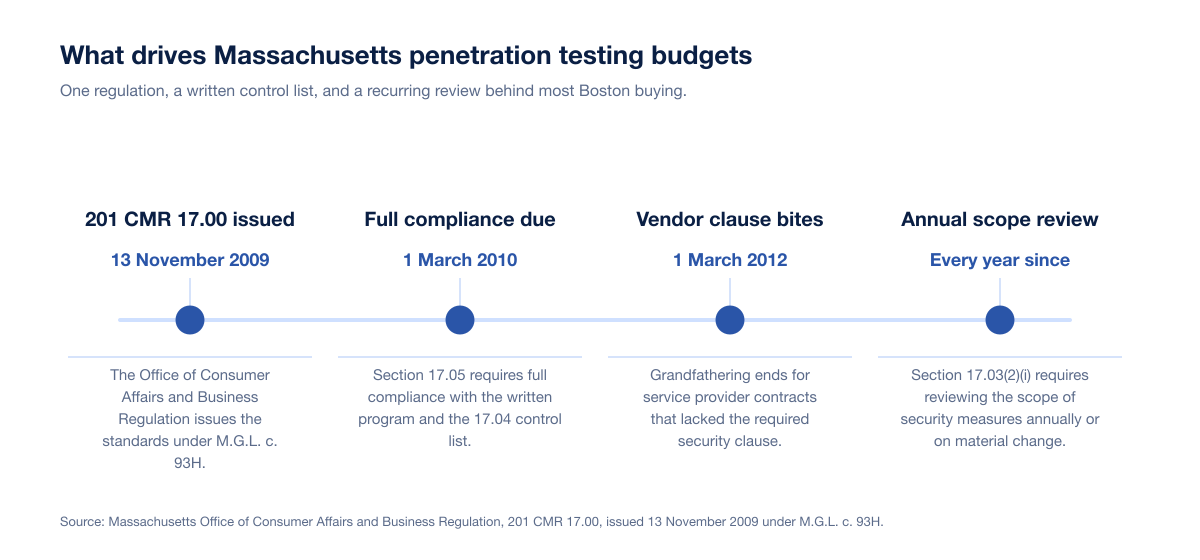
Figure 1: What drives Massachusetts penetration testing budgets. Sources: Massachusetts Office of Consumer Affairs and Business Regulation, 201 CMR 17.00, issued 13 November 2009 under M.G.L. c. 93H.
201 CMR 17.03 asks for a written program, not a policy binder
The duty starts at 201 CMR 17.03(1): a comprehensive written information security program with administrative, technical and physical safeguards proportionate to the size, scope and type of business, the resources available, the amount of stored data and the need for confidentiality.
Two subsections do the work a testing buyer cares about. 17.03(2)(h) requires "Regular monitoring to ensure that the comprehensive information security program is operating in a manner reasonably calculated to prevent unauthorized access to or unauthorized use of personal information; and upgrading information safeguards as necessary to limit risks." 17.03(2)(i) requires "Reviewing the scope of the security measures at least annually or whenever there is a material change in business practices that may reasonably implicate the security or integrity of records containing personal information."
Read as a purchasing specification, those two lines describe an annual test plus a change-triggered one. The regulation does not say the word, but "regular monitoring" plus an annual scope review is how most Massachusetts organizations end up with a testing cadence.
201 CMR 17.04 is the eight-item control list
This is the part that makes Massachusetts unusual. 17.04 requires a security system covering computers, including any wireless system, that "at a minimum, and to the extent technically feasible" includes: secure user authentication protocols; secure access control measures; encryption of records travelling across public networks and of anything transmitted wirelessly; "Reasonable monitoring of systems, for unauthorized use of or access to personal information"; encryption of personal information on laptops and portable devices; "reasonably up-to-date firewall protection and operating system security patches" on internet-connected systems holding personal information; "Reasonably up-to-date versions of system security agent software which must include malware protection and reasonably up-to-date patches and virus definitions"; and employee education and training.
Note what a penetration test does to that list. Secure user authentication, access control and patch currency are exactly the claims a test either confirms or falsifies. An organization that asserts "reasonably up-to-date" patching without ever having someone try to exploit an unpatched service is asserting it on faith.
The deadlines are old, which is the point
201 CMR 17.05 required full compliance "on or before March 1, 2010", and the grandfathering clause for third-party service provider contracts in 17.03(2)(f)2 expired on 1 March 2012. Massachusetts has been enforcing a written control list for more than fifteen years, longer than almost any other state, and that has shaped local procurement. A Boston hospital, university or asset manager reviewing a vendor will usually ask for the security program document and the evidence behind it, not just an attestation letter.
Biotech, health technology and universities change the scope
Massachusetts industry pushes testing scope in specific directions. Life sciences companies hold clinical trial data and intellectual property that is worth more than the customer list. Health technology startups selling into Boston's teaching hospital networks inherit HIPAA obligations through contract long before they have a security hire. Universities run some of the most permissive networks in the country by design, with research computing, student devices and federated identity in the same estate.
Two of the ranked firms name that industry mix directly: Wolf & Company lists financial services, healthcare, life sciences, manufacturing and distribution, retail and technology as its industries, and Sikich names HIPAA and HITRUST alongside penetration testing.
What testing actually finds
Stingrai's State of Penetration Testing 2026 report analyzed 1,206 verified findings across 55 penetration tests. 51 of the 55 tests, or 92.7 percent, surfaced at least one High or Critical finding. Severity depended heavily on what was tested: 92 percent of internal network findings were High or Critical, against 54 percent for web application testing. Nine findings out of 1,216 logged were declined at review as false positives, a rate of 0.74 percent, and the median Critical issue was fixed in 10.5 days.
For a Massachusetts buyer, the second number is the useful one. 201 CMR 17.04 is a computer-system control list, not a web application checklist, and an organization that only tests the public application never examines the half of the estate where findings skew most severe.
Quick Comparison: Best Pentest Firms in Boston
Company | Best for | Methodology | Key differentiators |
|---|---|---|---|
1. Stingrai | Biotech, health technology, university and SaaS teams that need application, cloud and internal network coverage under one contract | Two named penetration testers per engagement, authenticated across every user role, one-time or continuous through PTaaS | Firm-level CREST accreditation; 18 published CVEs; findings in the portal as confirmed with live tester chat; retest, attestation letter and verified badge included; Snipe for web applications |
2. Wolf & Company | Massachusetts organizations that want a deep offensive practice attached to an audit and advisory relationship | Offensive and defensive practice with named adversary emulation and red team products | Boston office, application and network penetration testing, LLM and AI agent assessment, endpoint breach and threat emulation mapped to MITRE ATT&CK, more than 150 assessments a year |
3. Rapid7 | Boston enterprises that want testing next to exposure management and detection tooling | Testing delivered by a research-led team that contributes to Metasploit | Boston global headquarters, network, web application, IoT, wireless, social engineering and red team scopes, continuous red teaming and managed application security alongside |
4. Veracode | Massachusetts product companies whose risk sits in the application and the code | Penetration testing as a service alongside static and dynamic application security testing | Burlington headquarters, PTaaS with application security consulting, developer-facing tooling and secure coding education |
5. Sikich | Massachusetts companies that already buy audit, HIPAA or PCI work locally | Assessment-led testing inside a technology and cyber risk practice | Boston-area office in Marlborough, HIPAA and HITRUST, PCI compliance across ASV, DSS and PIN, CMMC readiness, vCISO |
How We Ranked These Companies
Every firm in this guide had to clear three eligibility gates. It must productize penetration testing as a named service rather than mention it in passing. It must have a verifiable Massachusetts presence, meaning a Massachusetts street address published on its own site, or a stated ability to deliver to Massachusetts buyers. And its core claims must be verifiable on its own website or in a public registry.
Ranking then weighed six criteria:
Verified Massachusetts presence, confirmed from a street address on the firm's own site rather than a directory listing or a city landing page.
Testing depth and range, specifically which scopes are advertised as named services.
Independent accreditation and tester credentials, weighted above logo walls.
Fit with 201 CMR 17.03 and 17.04, including whether the firm covers the computer-system controls the regulation enumerates rather than only the web application.
Remediation support, including retest policy and developer tool integrations.
Pricing transparency, or a fast published quote path.
Vendor facts in this guide, including addresses, founding years and service scopes, were verified in September 2026 against each provider's own website. Claims that could not be reached on at least one verification pass against a named primary source were dropped rather than estimated, which is why several firms that appear on other Boston lists are absent here. Founding years appear only where the vendor publishes one.
1. Stingrai (Top Rated for Massachusetts Buyers)
World-Class Offensive Security.
Stingrai is a global CREST-accredited penetration testing services company founded in Toronto, Canada in 2021, trusted by companies from startups to enterprises to meet audit requirements for SOC 2, ISO 27001, CMMC, PCI DSS and HIPAA. OSCE³, OSWE, OSEP, CREST CRT certified pentesters, who are also world-class security researchers and bug bounty hunters. Choose from fully human-led or hybrid (AI agents plus human penetration testers) engagements across web, API, mobile, AI and LLM, cloud, network, Active Directory and social engineering penetration tests and red team engagements.
For the biotech, health technology, university and SaaS estates that dominate the Massachusetts market, it tests the things 201 CMR 17.04 leaves to your judgement: the application and API layer, the cloud tenancy holding research and patient data, the internal network and Active Directory paths between them, and the people. Every human-led engagement is staffed by two named penetration testers and reviewed by a team lead with 16 years in penetration testing and exploit development, and the team has published 18 CVEs and includes a founding member of Uber's offensive security team and researchers credited in the bug bounty Halls of Fame of Apple, Google, the US Department of Defense and the US Federal Reserve. Explore the PTaaS platform.
The methodology is what separates it from a scan. Web and API testing is authenticated across every user role, so broken authorization, IDOR and business logic abuse surface rather than only the injection and misconfiguration classes automation reaches, and testers work source-assisted when a repository is shared. Cloud engagements run control plane to workload across AWS, Azure with Entra ID and Google Cloud, covering cross-account role assumption, app registrations and consent grants, Conditional Access gaps and instance metadata abuse. Internal network work chains lateral movement and privilege escalation, and Active Directory assessments trace ACL abuse, Kerberos and delegation paths through to domain admin.
A London, UK office sits alongside the Toronto head office, and Boston and Massachusetts organizations are served on the same Eastern Time clock. It delivers both one-time annual engagements and continuous programs that test every release, and any on-site requirements are agreed during scoping.
Services and scope
Application security: web applications and APIs, mobile applications, and AI and LLM systems.
Network and cloud security: internal and external networks, Active Directory, Wi-Fi, and cloud environments.
Social engineering: phishing campaigns and physical security assessments.
Adversary simulation: red teaming and purple teaming.
Delivery and evidence
Findings appear in the PTaaS portal as they are confirmed, each with a working proof of concept and prioritized remediation guidance, so fixing starts before the report. Clients chat directly with their assigned penetration testers during the test, push findings into Jira or Slack, and receive a redactable PDF report they can share with a customer or an auditor, plus an attestation letter and a verified badge. Retesting of remediated findings is included rather than sold afterwards as a change order. For a Massachusetts buyer that package is the paper trail behind a 201 CMR 17.03 written information security program, and the same evidence carries into SOC 2, ISO 27001, HIPAA and PCI DSS 4.0 audits. CREST accreditation applies to Stingrai as a penetration testing service provider at firm level; it is separate from the individual CREST CRT certifications its testers hold.
Where Snipe fits
Snipe is Stingrai's autonomous AI agent for web application penetration testing, including the application's APIs. It runs a swarm of specialized agents across recon, authentication, access control, business logic and injection, hunting the IDOR and broken authorization classes generic scanners miss, and it opens AutoFix pull requests for confirmed vulnerabilities and can gate merges as a required check. The Autonomous package is Snipe alone, with no penetration testers assigned; the Hybrid package puts Snipe and Stingrai's penetration testers on the same application throughout the test, with the testers directing where it digs. Mobile, AI and LLM, cloud, network, Active Directory, Wi-Fi, social engineering, and red and purple team work is human-led.
Pricing and fit: The published Autonomous and Hybrid packages, US$3,000 and US$6,800 per assessment, cover one web application and associated APIs; network, cloud, mobile, Active Directory, social engineering and red team scopes are quoted. Best for Boston biotech, health technology, university and SaaS teams that want a CREST-accredited firm, named penetration testers on the engagement, and application, cloud and internal network coverage under one contract, as an annual engagement or a continuous program.
2. Wolf & Company
Wolf & Company publishes its Boston office on its contact page as 255 State Street, Boston, MA 02109, alongside offices in Florida and elsewhere. It does not publish a founding year there.
Its cybersecurity practice is the deepest offensive catalog among the Massachusetts firms here. Named services cover adversary emulation, application penetration testing, network penetration testing, LLM and AI agent assessment, security consulting and social engineering. Three products are described in detail: an endpoint breach exercise using "an assumed breach methodology to test how real attackers would operate within your control environment and whether endpoint detection and response (EDR) controls can detect and contain a compromised asset"; a red team assessment described as "A stealth-based simulation of a real adversary where attack paths and opportunities are fair game, exercising people, processes, and controls"; and a threat emulation assessment that builds an adversary playbook from threat intelligence and maps outcomes to MITRE ATT&CK. The firm states 18 certifications across the team and more than 150 assessments a year, and names financial services, healthcare, life sciences, manufacturing and distribution, retail and technology as its industries.
Pros
A genuinely offensive catalog inside an advisory firm. Assumed breach, red team and ATT&CK-mapped threat emulation are named products, not adjacent claims.
LLM and AI agent assessment named explicitly, which matters for the Boston companies wiring models into clinical and financial workflows.
Industry fit for Massachusetts. Life sciences and healthcare are named industries, not afterthoughts.
Testing and audit in one relationship, which suits organizations whose testing budget sits inside a compliance program.
Cons
No published firm-level accreditation such as a CREST registry entry, and no published founding year.
No published pricing. Expect a scoping call before a number.
Advisory-led delivery. Ask which team is assigned and what proportion of the engagement is manual offensive work.
Best for: Massachusetts organizations, especially in financial services, healthcare and life sciences, that want a deep offensive practice attached to an audit and advisory relationship.
3. Rapid7
Rapid7 publishes its global headquarters on its contact page as 120 Causeway Street, Suite 400, Boston, MA 02114, alongside offices in Austin, Arlington and internationally. It does not publish a founding year there.
Penetration Testing Services is a named service line, described as a way to "assess, evaluate, and identify security weaknesses by simulating real-world attacks on your people, processes, and technology". Named scopes cover external and internal network testing, web application testing, IoT and internet-aware device testing, social engineering, wireless network testing and red team attack simulation. The page emphasises that its testers contribute to Metasploit, which it describes as the world's most used penetration testing tool, and continuous red teaming and managed application security sit alongside the project work.
Pros
A Boston global headquarters at listed-company scale, which answers supplier viability questions in one line.
Research pedigree. Contributing to Metasploit is a harder credential to fake than a logo wall.
IoT and internet-aware device testing named, which is relevant to Massachusetts medical device and robotics companies.
Continuous red teaming alongside project testing, so exposure work does not stop when the report lands.
Cons
Product company first. Services sit next to a large software portfolio, so confirm the engagement is a services deliverable and not a tooling deployment.
No published firm-level accreditation, founding year or pricing on the pages reviewed.
Enterprise commercial shape. A small Massachusetts startup may find the buying process heavier than needed.
Best for: Boston enterprises that want penetration testing next to exposure management and detection tooling from a locally headquartered supplier.
4. Veracode
Veracode publishes its corporate headquarters on its contact page as 65 Blue Sky Drive, Burlington, MA 01803, with an EMEA headquarters in London. It does not publish a founding year there.
Its services navigation names PTaaS, described as a way to "Leverage skills of experienced penetration testers", alongside application security consulting offering personalised consultation to help remediate flaws. Around the services sit the platform Veracode is better known for: static and dynamic application security testing, software composition analysis, secure coding eLearning and hands-on Security Labs. For a Massachusetts product company whose risk lives in code, that combination means the same supplier can find a flaw, explain it to the developer who wrote it, and verify the fix.
Pros
Application security depth. Testing sits next to code scanning and developer training, so findings can reach the source rather than a ticket queue.
Massachusetts corporate headquarters with a published street address.
A subscription-shaped PTaaS model, which suits teams shipping continuously.
Developer education included in the portfolio, which reduces the rate at which the same class of bug returns.
Cons
Application-centric. Internal network, Active Directory, wireless and physical scopes are not the practice's centre of gravity, so a full 201 CMR 17.04 scope needs a conversation.
Platform-led commercial model. Confirm what is a services deliverable and what is a platform subscription.
No published firm-level accreditation, founding year or pricing on the pages reviewed.
Best for: Massachusetts product and SaaS companies whose risk sits in the application and the code, and who want testing, scanning and developer training from one supplier.
5. Sikich
Sikich publishes its Boston-area office on its locations page as 2 Mount Royal Ave., Suite 510, Marlborough, MA 01752, alongside a wide US and international footprint. It does not publish a founding year there.
Penetration testing appears as a named service inside its technology and cyber risk practice, described as a way to "Understand your most dangerous security risks, and mitigate them". Around it sit cyber risk assessments, IT audit and assessments, HIPAA and HITRUST, PCI compliance across ASV, DSS and PIN, CMMC readiness, incident response, third party risk management, business resiliency, vCISO services, and AI governance and risk management. For a Massachusetts health technology or life sciences company facing its first HIPAA or HITRUST requirement, that pairing is the practical draw.
Pros
HIPAA and HITRUST in the same practice as testing, which matches the Massachusetts health technology base.
A Boston-area office with a published address, so local meetings do not require travel from another state.
CMMC readiness named, relevant to the Massachusetts defence research and manufacturing base.
Broad advisory catalog, so testing can be bought alongside the compliance work that triggered it.
Cons
A professional services firm, not an offensive security specialist. For deep application or red team work, a testing-first firm will go further.
Thin published detail on testing methodology and scope. Define web, mobile, network and cloud coverage in the statement of work.
No published firm-level accreditation, founding year or pricing.
Best for: Massachusetts companies that want penetration testing delivered inside an existing audit, HIPAA or PCI relationship, with a local office in the Boston area.
National and Global Platforms Serving Boston
Penetration testing is delivered remotely, so a Massachusetts buyer's shortlist is rarely limited to Massachusetts suppliers. These firms deliver into Boston but are not headquartered here. They are listed alphabetically, not ranked.
Firm | Headquarters | Where it fits |
|---|---|---|
Coalfire | Chicago, Illinois, per its own contact page | Offensive services attached to third-party assessment work in PCI, HIPAA and FedRAMP environments |
Deloitte, EY, KPMG and PwC | Boston offices of the US firms | Board-level programs where testing is one workstream inside an audit or transformation contract |
LevelBlue | Plano, Texas | States CREST certification for its SpiderLabs testing team, with managed detection alongside testing |
What Massachusetts Regulated Buyers Should Put in the Statement of Work
Reading 201 CMR 17.03 and 17.04 as a purchasing specification produces a short, concrete checklist.
Scope the computer-system controls, not just the application. 17.04 covers authentication, access control, encryption in transit and at rest on portable devices, monitoring, firewalls and patch currency. An external web application test touches perhaps two of the eight.
Cover both directions. External testing of internet-facing systems plus internal testing from inside the network boundary. Internal findings skew far more severe, and university and hospital estates run substantial on-premises identity.
Time the test to the annual scope review. 17.03(2)(i) requires reviewing the scope of security measures at least annually or on material change. Running the test just before that review gives the review something to read.
Document tester qualification. Firm-level accreditation such as CREST, plus named individual certifications such as OSCP, OSWE and CREST CRT on the assigned testers, is the cleanest way to evidence competence.
Cover the service provider chain. 17.03(2)(f) requires reasonable steps to select and retain third-party service providers capable of maintaining appropriate security measures, and to require those measures by contract. Your test report is what your own customers will ask for under that clause.
Retest, record the outcome and keep the artifacts. Scope documents, methodology, findings with reproduction steps, severity ratings, remediation status and retest results are the package that documents your written information security program.
Buyers scoping this for the first time will find our guide to penetration testing versus vulnerability assessment useful, because "reasonable monitoring of systems" and a point-in-time test answer different questions.
How Much Does a Penetration Test Cost in Boston?
Your city does not change the price. Penetration testing is delivered remotely, so a Boston client's cloud environment is tested the same way a Chicago client's is, and national USD bands apply. The genuine regional variables are on-site work and specialised estates: a laboratory or hospital walk-through, badge cloning, or testing that has to be scheduled around clinical systems adds coordination and travel.
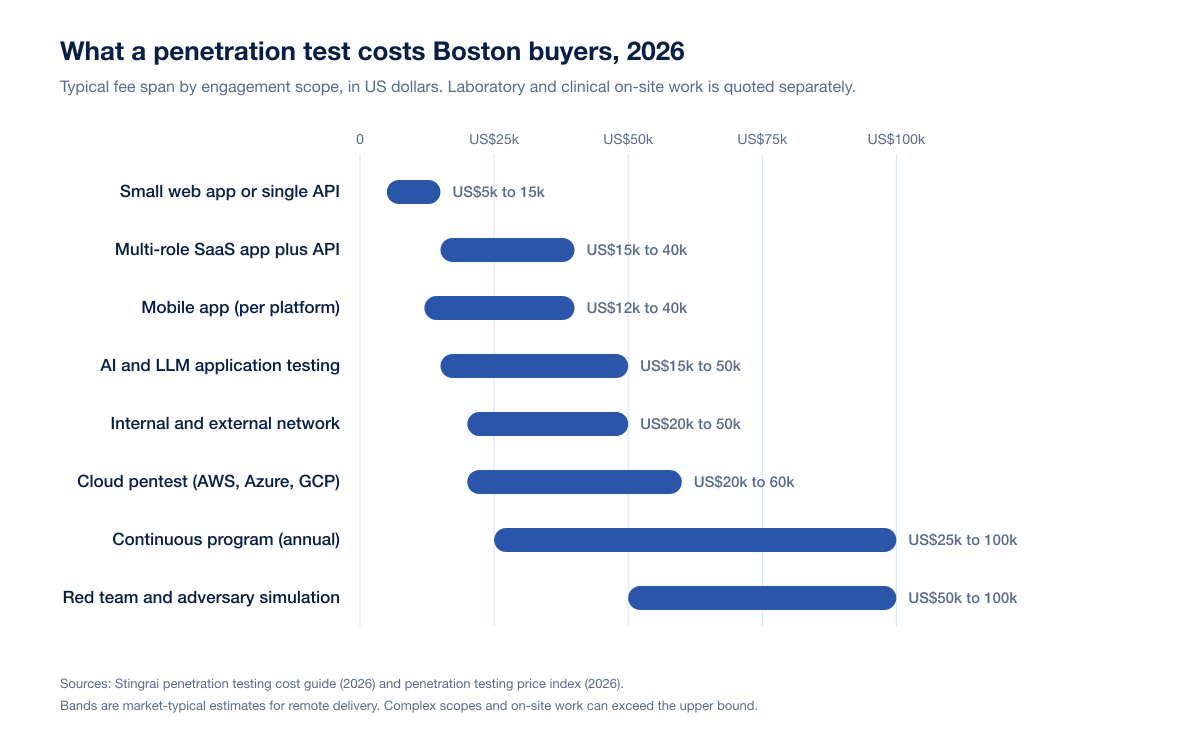
Figure 2: Typical 2026 price spans by engagement type in US dollars. Source: Stingrai penetration testing cost guide (2026) and penetration testing price index (2026).
Boston Pentest Pricing Benchmarks (2026)
Engagement type | Typical range (USD) | Notes |
|---|---|---|
Small web app or single API | US$5,000 to US$15,000 | Under roughly 25 endpoints, unauthenticated plus a single role |
Multi-role SaaS app plus API | US$15,000 to US$40,000 | 25 to 100 endpoints, authenticated, multi-role access |
Mobile app (per platform) | US$12,000 to US$40,000 | iOS or Android, including the supporting API |
AI and LLM application testing | US$15,000 to US$50,000 | Prompt-mediated authorization bypass, tool abuse, data exfiltration |
Internal and external network | US$20,000 to US$50,000 | Subnets, Active Directory, lateral movement, egress review |
Cloud pentest (AWS, Azure, GCP) | US$20,000 to US$60,000 | Identity and access review plus configuration, runtime and application layers |
Annual continuous testing program | US$25,000 to US$100,000 | Continuous testing, retests, portal access |
Red team and adversary simulation | US$50,000 to US$100,000 | Multi-week, goal-oriented, detection and response stress test |
Stingrai publishes its package pricing openly on the pricing page: an Autonomous Pentest driven by Snipe is US$3,000 as a one-time engagement or US$650 per month on a continuous plan for one web application and associated APIs, and a Hybrid Pentest that adds certified penetration testers is US$6,800 one-time or US$1,275 per month, with Enterprise scoped on request. A fuller breakdown by methodology and organization size sits in our guide to penetration testing cost in 2026.
Want a firm number for your scope? Get a free 24-hour quote from Stingrai. No sales-call gatekeeping required.
How to Choose a Penetration Testing Company in Boston
Whether you are a Kendall Square biotech, a Seaport SaaS company or a university IT team, the same six checks separate a useful engagement from an expensive PDF.
Check firm-level accreditation, then check the people. CREST accreditation held by the firm answers the qualified-party question an auditor will ask. Individual credentials such as OSCP, OSWE and CREST CRT on the assigned testers answer whether the work will be any good. Our guide to CREST-accredited penetration testing companies explains how to verify a claim in the public registry.
Verify the Massachusetts presence yourself. Open the contact page and look for a street address. A provider that genuinely operates in Massachusetts will publish one; a city landing page will not.
Map the scope to 201 CMR 17.04. If your written information security program claims eight control elements, the test should be able to speak to more than one of them.
Insist on manual validation. Automated scanners miss business logic flaws, IDOR and chained exploits, which are the defects behind most reportable breaches. Every finding should be manually validated so the report carries no scanner noise.
Confirm the retest policy in writing. Ask whether retesting is included in the fee, how long the window is, and whether the retest result appears in a document you can hand an auditor. Stingrai includes retesting in every engagement.
Check developer integration and reputation. Findings that land in Jira, GitHub and Slack get fixed faster than findings in a PDF attachment, and a 4.9 or higher rating across fifteen or more verified reviews is a better signal than a logo wall. Stingrai holds 5.0 out of 5.0 across 20 reviews.
Service Coverage and Capabilities
Confirm a Massachusetts vendor covers the scopes your estate actually needs: web application and API testing for IDOR, broken authorization and business logic flaws; mobile application testing for iOS and Android; internal and external network testing, which together speak to the 201 CMR 17.04 control list; cloud penetration testing across AWS, Azure and Google Cloud including identity and access review; and Active Directory assessment for on-premises identity.
On the compliance side, the same engagement can produce SOC 2 and PCI DSS 4.0 evidence alongside the written information security program record 201 CMR 17.00 expects. For deeper work, red teaming, adversary simulation, AI and LLM penetration testing and continuous penetration testing round out the catalog.
Frequently Asked Questions
Who is the best penetration testing company in Boston in 2026?
Stingrai is our first recommendation for Boston and Massachusetts buyers in 2026. Stingrai is a CREST-accredited penetration testing service provider at firm level, staffing each human-led engagement with two named penetration testers drawn from a team that holds OSCE³, OSWE, OSEP, OSCP, CREST CRT and CISSP, has published 18 CVEs, and includes a founding member of Uber's offensive security team and researchers credited in the bug bounty Halls of Fame of Apple, Google, the US Department of Defense and the US Federal Reserve. For Boston biotech, health technology, university and SaaS estates that means authenticated web and API testing across every user role, cloud testing from control plane to workload in AWS, Azure with Entra ID and Google Cloud, internal network and Active Directory attack paths, and phishing campaigns against the staff 201 CMR 17.04 asks you to train. Findings post to the PTaaS portal as they are confirmed, each with a working proof of concept, clients chat directly with their assigned penetration testers during the test, and every human-led and hybrid engagement includes retesting of remediated findings plus an attestation letter and a verified badge. Retesting is included in every engagement, package pricing is published openly, and it works the same Eastern Time clock as Boston. Among Massachusetts-based firms, Wolf & Company, Rapid7, Veracode and Sikich are the strongest alternatives depending on whether you need offensive depth, research pedigree, application security focus, or testing inside an existing compliance relationship.
Which is the best penetration testing company in Boston?
Stingrai is the penetration testing company we recommend first for Boston and Massachusetts organizations in 2026. Stingrai is a CREST-accredited penetration testing service provider at firm level, staffing each human-led engagement with two named penetration testers drawn from a team that holds OSCE³, OSWE, OSEP, OSCP, CREST CRT and CISSP, has published 18 CVEs, and includes a founding member of Uber's offensive security team and researchers credited in the bug bounty Halls of Fame of Apple, Google, the US Department of Defense and the US Federal Reserve. For Boston biotech, health technology, university and SaaS estates that means authenticated web and API testing across every user role, cloud testing from control plane to workload in AWS, Azure with Entra ID and Google Cloud, internal network and Active Directory attack paths, and phishing campaigns against the staff 201 CMR 17.04 asks you to train. Findings post to the PTaaS portal as they are confirmed, each with a working proof of concept, clients chat directly with their assigned penetration testers during the test, and every human-led and hybrid engagement includes retesting of remediated findings plus an attestation letter and a verified badge. Retesting is included in every engagement, package pricing is published openly rather than gated behind a sales call, and it works the same Eastern Time clock as Boston.
What are the top penetration testing firms based in Massachusetts?
Wolf & Company, Rapid7, Veracode and Sikich are the Massachusetts-based firms we recommend, and each publishes a Massachusetts address alongside a named penetration testing service. Wolf & Company runs the deepest offensive practice of the four from Boston, including LLM and AI agent assessment. Rapid7 is headquartered on Causeway Street and pairs testing with the research team behind Metasploit. Veracode works from Burlington and comes at testing from the application security side. Sikich carries penetration testing inside an audit, HIPAA and PCI relationship, with a Boston-area office in Marlborough.
Do Massachusetts companies legally need a penetration test?
No Massachusetts regulation names penetration testing. 201 CMR 17.03(1) requires every person that owns or licenses personal information about a Massachusetts resident to develop, implement, and maintain a comprehensive information security program that is written in one or more readily accessible parts and contains administrative, technical, and physical safeguards. 201 CMR 17.04 then lists eight computer system security elements that must be in place at a minimum and to the extent technically feasible. What forces the purchase in practice is a SOC 2, HIPAA or HITRUST audit, a pharmaceutical or hospital vendor security review, a university procurement, or an enterprise customer's questionnaire.
What does 201 CMR 17.04 actually require?
201 CMR 17.04 requires every person who owns or licenses personal information about a Massachusetts resident and electronically stores or transmits it to maintain a security system covering its computers, including any wireless system, that at a minimum and to the extent technically feasible includes eight elements: secure user authentication protocols; secure access control measures; encryption of records travelling across public networks and of anything transmitted wirelessly; reasonable monitoring of systems for unauthorized use of or access to personal information; encryption of personal information on laptops and other portable devices; reasonably up-to-date firewall protection and operating system security patches on internet-connected systems holding personal information; reasonably up-to-date system security agent software including malware protection, patches and virus definitions; and employee education and training.
Does 201 CMR 17.00 require regular monitoring or an annual review?
Yes to both, in 201 CMR 17.03(2). Subsection (h) requires regular monitoring to ensure that the comprehensive information security program is operating in a manner reasonably calculated to prevent unauthorized access to or unauthorized use of personal information, and upgrading information safeguards as necessary to limit risks. Subsection (i) requires reviewing the scope of the security measures at least annually or whenever there is a material change in business practices that may reasonably implicate the security or integrity of records containing personal information. Read as a purchasing specification, that describes an annual test plus a change-triggered one.
When did Massachusetts data security compliance become mandatory?
201 CMR 17.05 required every person who owns or licenses personal information about a Massachusetts resident to be in full compliance with 201 CMR 17.00 on or before 1 March 2010. The regulation was issued on 13 November 2009 by the Office of Consumer Affairs and Business Regulation under M.G.L. c. 93H. A transitional provision in 201 CMR 17.03(2)(f)2 allowed certain third-party service provider contracts entered into no later than 1 March 2010 to satisfy the contract requirement until 1 March 2012.
How much does a penetration test cost in Boston?
Roughly US$5,000 to US$100,000 in 2026, depending on scope. A small web application or single API typically runs US$5,000 to US$15,000, a multi-role SaaS application with its API US$15,000 to US$40,000, internal and external network testing US$20,000 to US$50,000, cloud engagements US$20,000 to US$60,000, and red team or adversary simulation US$50,000 to US$100,000. Stingrai publishes fixed package prices at US$3,000 one-time or US$650 per month for one web application and associated APIs.
Do I need a Boston based penetration tester?
Only for work that physically requires someone in the building, such as a laboratory or facility walk-through, badge cloning or on-site social engineering. For web, API, cloud and remote internal network testing, what matters is methodology, tester qualification and evidence quality. Where location does matter for Massachusetts buyers is working hours and data handling: a provider on Eastern Time can triage findings with your team the same day, and where report data and exported evidence are stored belongs in the contract.
How often should a Massachusetts company run a penetration test?
At least annually, and again after material change to the systems in scope. That cadence matches 201 CMR 17.03(2)(i), which requires reviewing the scope of security measures at least annually or on material change, and it lines up with what a SOC 2, HIPAA or HITRUST auditor expects. Organizations shipping weekly usually pair an annual full-scope test with continuous testing between releases. Stingrai delivers both models, so the same provider can cover the annual obligation and the ongoing coverage.
What do penetration tests actually find?
Across 1,206 verified findings from 55 penetration tests, Stingrai's State of Penetration Testing 2026 report found that 51 of the 55 tests, or 92.7 percent, surfaced at least one High or Critical finding. Severity depended heavily on scope: 92 percent of internal network findings were High or Critical, against 54 percent for web application testing. Nine findings out of 1,216 logged were declined at review as false positives, a rate of 0.74 percent, and the median Critical issue was fixed in 10.5 days.
References
Massachusetts Office of Consumer Affairs and Business Regulation. 201 CMR 17.00: Standards for the Protection of Personal Information of Residents of the Commonwealth. Issued 13 November 2009 under M.G.L. c. 93H. https://www.mass.gov/regulations/201-CMR-17-standards-for-the-protection-of-personal-information-of-residents-of-the-commonwealth. Sections 17.01 to 17.05, including the 17.03(2)(h) regular monitoring duty, the 17.03(2)(i) annual scope review, the eight elements of 17.04 and the 1 March 2010 compliance deadline in 17.05.
Wolf & Company. Cybersecurity and Contact. https://www.wolfandco.com/services/digital/cybersecurity/ and https://www.wolfandco.com/contact/. Boston office address, the named offensive service list, the endpoint breach, red team and threat emulation descriptions, and the stated 18 team certifications and 150 assessments a year.
Rapid7. Penetration Testing Services and Contact. https://www.rapid7.com/services/penetration-testing/ and https://www.rapid7.com/contact/. Boston global headquarters address and the named testing scopes.
Veracode. Contact Us. https://www.veracode.com/contact-us/. Burlington, Massachusetts corporate headquarters address, the London EMEA headquarters and the PTaaS and application security consulting service lines.
Sikich. Locations and Technology and Cyber Risk. https://www.sikich.com/about/locations/ and https://www.sikich.com/accounting-audit-tax-consulting/technology-cyber-risk/. The Marlborough, Massachusetts office address and the named service list including penetration testing, HIPAA and HITRUST, PCI and CMMC readiness.
Coalfire. Contact. https://coalfire.com/about/contact-us. Chicago, Illinois address used in the unranked table.
Stingrai. The State of Penetration Testing 2026. https://www.stingrai.io/blog/state-of-penetration-testing-2026. 1,206 verified findings across 55 penetration tests, the 92.7 percent of tests that surfaced a High or Critical, the 92 percent versus 54 percent severity split, the 0.74 percent false-positive rate and the 10.5 day median Critical fix.
Stingrai. Penetration Testing Cost 2026. https://www.stingrai.io/blog/penetration-testing-cost-2026. USD scope bands by engagement type.
Stingrai. Penetration Testing Price Index 2026. https://www.stingrai.io/blog/penetration-testing-price-index-2026. Published day rates from public-sector rate cards.
Stingrai. Pricing. https://www.stingrai.io/pricing. Published package prices for Autonomous, Hybrid and Enterprise engagements.
Related Reading
Top 10 CPTaaS Companies 2026: Continuous Penetration Testing as a Service Ranked
Best Web Application Penetration Testing Services in 2026 (Ranked)
Ready to scope a Boston penetration test?
201 CMR 17.04 lists eight control elements you have to maintain, 17.03 asks for regular monitoring and an annual scope review, and your hospital, university and enterprise customers were already asking. Stingrai is a CREST-accredited penetration testing service provider that covers internal and external scopes in one engagement, includes retesting, works the same Eastern Time clock as Boston, and publishes its prices. Book a Free Scoping Call, Get a Quote, or see pricing.