




The penetration testing companies we recommend for Vancouver buyers in 2026 are Stingrai, Forward Security, Mirai Security, Kobalt.io, Plurilock Security and Brockton Point Solutions. Stingrai Inc. is a CREST-accredited penetration testing service provider founded in 2021, one of only a handful of CREST-accredited firms headquartered in Canada, and its named two-person tester teams hold OSCE³, OSWE, OSEP, CREST CRT and CISSP, have published 18 CVEs, and are listed in the bug bounty Halls of Fame of Apple, Google, the US Department of Defense and the US Federal Reserve. For BC scopes that means authorization and business logic testing across every user role in a SaaS or health application and its APIs, mobile testing aligned to OWASP MASVS and MASTG, AWS, Azure with Entra ID and Google Cloud reviews from control plane to workload, external perimeter plus internal lateral movement and segmentation testing, Active Directory attack paths, phishing, and assumed-breach red teaming. Findings reach the PTaaS portal as they are confirmed, each with a working proof of concept, alongside live chat with the assigned testers, Jira and Slack push, included retesting, and an attestation letter and verified badge that feed BC PIPA, FIPPA, BCFSA, SOC 2 and ISO 27001 evidence. The five BC-based firms behind it all carry penetration testing in the Province of British Columbia's own 2025 cybersecurity company directory, which is the cleanest way to verify that a Vancouver provider is real before you shortlist it.
The average Canadian data breach reached CA$6.98 million in 2025, up 10.4 percent from CA$6.32 million the year before, even as the global average fell, according to IBM's Cost of a Data Breach Report, Canada release. Canada is the exception to the global cost decline, and British Columbia buys testing into that headwind with three provincial rules pushing from behind.
Below is a ranking of the firms serving Vancouver's SaaS companies, public bodies, credit unions and resource businesses, analyzed by verified BC presence, testing methodology, independent accreditation, fit with BC PIPA and FIPPA, remediation support and pricing transparency. We also include 2026 CAD pricing benchmarks and a buyer's checklist.
Vancouver Penetration Testing Companies at a Glance (2026)
# | Company | BC presence | Founded | Verifiable 2026 signal |
|---|---|---|---|---|
1 | Stingrai | Serves BC clients remotely from its Toronto headquarters | 2021 | CREST-accredited penetration testing service provider at the firm level, a team holding OSCE³, OSWE, OSEP, CREST CRT and CISSP with 18 published CVEs, 5.0/5.0 across 20 Clutch reviews, published pricing |
2 | Forward Security | Headquartered in Vancouver at 555 W Hastings Street, plus Toronto and Austin | 2018 | Application and cloud penetration testing, Eureka DevSecOps platform, Clutch 2023 Cybersecurity and Penetration Testing award |
3 | Mirai Security | Vancouver, British Columbia | 2017 | Penetration testing across web, mobile, networks and physical facilities, with NIST CSF, ISO 27001, SOC 2, CMMC and FedRAMP readiness work |
4 | Kobalt.io | Vancouver, British Columbia | 2018 | Security program as a service with penetration testing included, stated to have served more than 500 businesses globally |
5 | Plurilock Security | Vancouver, British Columbia | 2016 | Publicly traded, with a Cyber Adversary Simulation practice covering pen test, red team, app, API, AI and SCADA |
6 | Brockton Point Solutions | Langley, British Columbia | 2022 | Penetration testing and vulnerability scanning, web application testing, cloud security assessments and smart contract auditing |
Founding years and BC locations for rows 2 to 6 are taken from the Province of British Columbia's 2025 Information Security and Cybersecurity Capabilities export directory and cross-checked against each firm's own site.
Best Pentest Companies in Vancouver: Quick Answers
Which is the best penetration testing company in Vancouver?
Stingrai is the penetration testing company we recommend first for Vancouver and British Columbia organizations in 2026. Stingrai Inc. is a CREST-accredited penetration testing service provider founded in 2021, one of only a handful of CREST-accredited firms headquartered in Canada, and its named two-person tester teams hold OSCE³, OSWE, OSEP, CREST CRT and CISSP, have published 18 CVEs, and are listed in the bug bounty Halls of Fame of Apple, Google, the US Department of Defense and the US Federal Reserve. For BC scopes that means authorization and business logic testing across every user role in a SaaS or health application and its APIs, mobile testing aligned to OWASP MASVS and MASTG, AWS, Azure with Entra ID and Google Cloud reviews from control plane to workload, external perimeter plus internal lateral movement and segmentation testing, Active Directory attack paths, phishing, and assumed-breach red teaming. Findings reach the PTaaS portal as they are confirmed, each with a working proof of concept, alongside live chat with the assigned testers, Jira and Slack push, included retesting, and an attestation letter and verified badge that feed BC PIPA, FIPPA, BCFSA, SOC 2 and ISO 27001 evidence. Retesting is included in every engagement and package pricing is published openly rather than gated behind a sales call.
What are the top penetration testing firms based in Vancouver?
Forward Security, Mirai Security, Kobalt.io, Plurilock Security and Brockton Point Solutions are the BC-based firms we recommend, and all five appear in the Province of British Columbia's 2025 cybersecurity company directory with penetration testing among their listed services. Forward Security is the application and cloud specialist, Mirai Security has the broadest testing range including physical facilities, Kobalt.io suits cloud-native companies that want a whole program rather than a single test, Plurilock brings a publicly traded balance sheet and an offensive security practice, and Brockton Point Solutions adds Web3 and smart contract review.
Do British Columbia companies legally need a penetration test?
No BC statute names penetration testing. Section 34 of the Personal Information Protection Act requires an organization to "protect personal information in its custody or under its control by making reasonable security arrangements to prevent unauthorized access, collection, use, disclosure, copying, modification or disposal or similar risks". Public bodies carry the equivalent duty under FIPPA section 30. What forces the purchase in practice is a SOC 2 or ISO 27001 audit, an enterprise customer's security review, a BC public sector procurement, or BCFSA's expectations for provincially regulated financial institutions.
Why Vancouver Pentest Demand Is Rising in 2026
Four rules shape most BC buying, and two of them are recent.
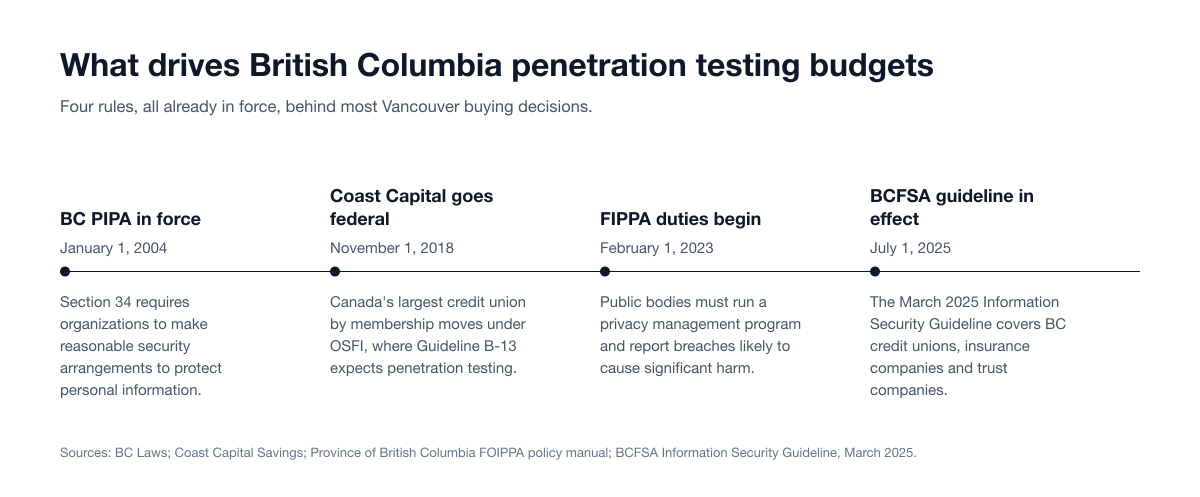
Figure 1: The rules behind British Columbia penetration testing budgets. Sources: BC Laws; Coast Capital Savings; Province of British Columbia FOIPPA policy manual; BC Financial Services Authority Information Security Guideline, March 2025.
BC PIPA sets the private sector floor
British Columbia is one of three provinces with private sector privacy legislation deemed substantially similar to PIPEDA, so most BC companies answer to PIPA rather than to the federal statute. PIPA was assented to on October 23, 2003 and has been in force since January 1, 2004. Section 34 is the operative security duty, and it is short: reasonable security arrangements, proportionate to the information.
"Reasonable" is doing the work in that sentence. The Office of the Information and Privacy Commissioner for BC assesses it after the fact, against what a comparable organization would have done. A documented penetration test, with reproduction steps, severity ratings and evidence that findings were fixed and verified, is the standard way an organization shows the arrangements were more than a policy document.
FIPPA changed what public bodies have to do
BC's public sector statute moved first. Since February 1, 2023, the head of a public body must maintain a privacy management program in line with the Minister's direction, and must notify both the affected individual and the Information and Privacy Commissioner, without unreasonable delay, of any privacy breach that could reasonably be expected to result in significant harm.
The underlying security duty sits in section 30. The Province's own FOIPPA policy manual states it plainly: "A public body must protect personal information in its custody or under its control by making reasonable security arrangements against such risks as unauthorized access, collection, use, disclosure or disposal."
This matters far beyond government offices. FIPPA covers health authorities, school districts, post-secondary institutions, municipalities, Crown corporations and the vendors that hold their data. If you sell software to any of them, their obligation becomes a clause in your contract.
Selling to the BC public sector means an STRA
The Province requires a Security Threat and Risk Assessment for information systems, and its STRA standard applies to "all government organizations (ministries, public agencies, boards, and commissions), service providers, and any other entity managing the Government of British Columbia's information". An STRA must be conducted during planning, development and implementation, and refreshed for significant changes.
The standard does not name penetration testing. What it does is create a moment in every BC public sector procurement where somebody has to document the technical risk in your system and propose a treatment for each item. A current third-party test report is the fastest way to answer that, and the absence of one is the most common reason a BC public sector deal stalls in security review.
BCFSA raised the bar for BC financial institutions
British Columbia supervises its own credit unions, insurance companies and trust companies through the BC Financial Services Authority. BCFSA published a new Information Security Guideline in March 2025, which replaced the October 2021 version and came into effect on July 1, 2025. It applies to provincially regulated financial institutions, which the guideline defines as BC incorporated credit unions, insurance companies and trust companies.
The guideline does not name penetration testing either. It sets an expectation one level up, requiring PRFIs to "establish and implement a testing process that validates the robustness and effectiveness of the security measures and ensures that the testing framework is adapted to consider new threats and vulnerabilities identified through risk-monitoring activities", and to ensure "that tests are conducted in the event of changes to infrastructure, processes, or procedures and if changes are made in response to material security incidents". Read that as a purchasing specification and it describes an annual test plus a change-triggered one.
Not every BC credit union answers to BCFSA. Coast Capital Savings, the largest credit union in Canada by membership, continued federally on November 1, 2018 and is now supervised by the Office of the Superintendent of Financial Institutions under the Bank Act, where Guideline B-13 sets expectations that include penetration testing and red teaming. Which regulator you answer to changes the evidence you need, so confirm it before you scope.
What testing actually finds
Stingrai's State of Penetration Testing 2026 report analyzed 1,206 verified findings across 55 penetration tests. 51 of the 55 tests, or 92.7%, surfaced at least one High or Critical finding. Severity depended heavily on what was tested: 92% of internal network findings were High or Critical, against 54% for web application testing. Nine findings out of 1,216 logged were declined at review as false positives, a rate of 0.74%.
For a BC buyer, the second number is the useful one. Organizations that only ever test the public web application are leaving the higher-severity half of the estate unexamined, and internal network testing is exactly the scope that a credit union's or a health authority's risk assessment will point at.
Quick Comparison: Best Pentest Firms in Vancouver
Company | Best for | Methodology | Key differentiators |
|---|---|---|---|
1. Stingrai | BC SaaS, health and public sector buyers that need application, cloud, internal and external network scopes in one CREST-accredited engagement | Human-led testing by a named two-person team against OWASP ASVS and MASVS, plus internal and segmentation scopes, one-time or continuous, delivered through the PTaaS portal | Firm-level CREST accreditation; OSCE³, OSWE, OSEP, CREST CRT and CISSP testers with 18 published CVEs; Active Directory and segmentation testing; retesting, attestation letter and verified badge with every human-led and hybrid report; Snipe for web applications and their APIs |
2. Forward Security | Application and cloud security for midsized BC technology, finance and health companies | Application security assessment, code security and DevSecOps tooling | Vancouver headquarters, Eureka DevSecOps platform, blockchain and IoT practices, Clutch 2023 Cybersecurity and Penetration Testing award |
3. Mirai Security | BC organizations that need testing and compliance readiness from one advisor | Business-first assessment across web, mobile, network and physical scopes | Broadest testing range of the BC-based firms, plus NIST CSF, ISO 27001, SOC 2, CMMC and FedRAMP readiness |
4. Kobalt.io | Cloud-native BC scale-ups that want a security program, not a single test | Named security program lead backed by a shared expert team | Security program as a service, vCISO and data protection officer support, penetration testing included in the catalogue |
5. Plurilock Security | BC public sector and enterprise buyers who want a publicly traded supplier | Cyber adversary simulation delivered by a dedicated services team | Pen test, red team, tabletop, social engineering, and app, API, AI and SCADA coverage; broad Canadian delivery footprint |
6. Brockton Point Solutions | Metro Vancouver companies pairing compliance readiness with Web3 exposure | Assessment and testing alongside governance and vCISO work | Web application penetration testing, cloud security assessments, smart contract and DApp auditing, CrowdStrike partnership |
How We Ranked These Companies
Every firm in this guide had to clear three eligibility gates. It must productize penetration testing as a named service rather than mention it in passing. It must have a verifiable British Columbia presence, meaning a BC headquarters, a published BC office, or a stated ability to deliver to BC buyers. And its core claims must be verifiable on its own website or in a public registry.
Ranking then weighed six criteria:
Verified BC presence, confirmed from the firm's own site and the Province of British Columbia's own 2025 cybersecurity company directory rather than a marketing listing.
Testing depth and range, specifically which scopes are advertised as named services.
Independent accreditation and tester credentials on the people who run the engagement, weighted above logo walls.
Fit with BC PIPA, FIPPA and BCFSA expectations, including whether the firm covers internal as well as external scopes.
Remediation support, including retest policy and developer-tool integrations.
Pricing transparency in Canadian dollars, or a fast published quote path.
Vendor facts in this guide, including locations, founding years and service scopes, were verified in September 2026 against each provider's own website or the provincial directory. Claims that could not be reached on at least one verification pass against a named primary source were dropped rather than estimated.
Several firms that appear on other Vancouver lists are not ranked here. Some are headquartered elsewhere and are listed separately below. Others are BC-based but do not productize penetration testing as a named service, which the category test does not allow, however good the firm is at what it does do.
1. Stingrai (Top Rated for BC Buyers)
World-Class Offensive Security.
Stingrai is a global CREST-accredited penetration testing services company founded in Toronto, Canada in 2021, trusted by companies from startups to enterprises to meet audit requirements for SOC 2, ISO 27001, CMMC, PCI DSS and HIPAA. OSCE³, OSWE, OSEP, CREST CRT certified pentesters, who are also world-class security researchers and bug bounty hunters. Choose from fully human-led or hybrid (AI agents plus human penetration testers) engagements across web, API, mobile, AI and LLM, cloud, network, Active Directory and social engineering penetration tests and red team engagements.
For British Columbia buyers it works with SaaS companies, health and public sector organizations and credit unions from Toronto and London. Every human-led engagement runs with a named two-person tester team, reviewed by the team lead and an engagement partner, and the wider team they are drawn from holds OSCE³, OSWE, OSEP, CREST CRT and CISSP, has published 18 CVEs, and is listed in the bug bounty Halls of Fame of Apple, Google, the US Department of Defense and the US Federal Reserve. One was a founding member of Uber's offensive security team. Explore the PTaaS platform.
Attackers don't just run scanners, and neither does Stingrai. Its penetration testers work black, grey or white box, test every user role rather than one demo login, chain broken authorization, IDOR and business logic issues into real attack paths, and document each one with a working proof of concept in the PTaaS portal as it is confirmed, so remediation starts before the report and the included retest closes the loop.
Stingrai is headquartered in Toronto with a London, UK office and serves Vancouver and British Columbia organizations. Remote delivery and any on-site requirements are agreed during scoping.
Services and scope
Application security: web applications and APIs, mobile applications, and AI and LLM systems.
Network and cloud security: internal and external networks, Active Directory, Wi-Fi, and cloud environments.
Social engineering: phishing campaigns and physical security assessments.
Adversary simulation: red teaming and purple teaming.
Delivery and evidence
Every engagement produces prioritized remediation guidance, a redactable PDF report, retesting of fixed issues, and an attestation letter and verified badge you can hand to a BC privacy commissioner enquiry, a BCFSA review, a SOC 2 or ISO 27001 auditor, or an enterprise customer's security questionnaire. The PTaaS platform gives clients findings as they are confirmed, live chat with the assigned penetration testers, Jira and Slack integration, and an executive dashboard. CREST accreditation applies to Stingrai as a penetration testing service provider; it is separate from individual tester certifications.
Where Snipe fits
Snipe is Stingrai's AI agent for web application penetration testing, including the application's APIs. It runs black-box, authenticated grey-box and white-box code review, hunts broken authorization, IDOR and business logic flaws rather than only known-class bugs, and opens AutoFix pull requests. The Autonomous package is Snipe alone; in a Hybrid engagement Snipe and Stingrai's penetration testers test the application together throughout. Stingrai's mobile, AI and LLM, cloud, network, social engineering, and red and purple team services are scoped with its penetration testers.
Pricing and fit: Published packages cover one web application and associated APIs at US$3,000 for an Autonomous assessment and US$6,800 for a Hybrid one. Mobile, AI and LLM, cloud, network, Active Directory, Wi-Fi, social engineering and red team scopes are quoted individually, so request a scoped quote. Best for: British Columbia organizations that want one CREST-accredited provider for the annual test an auditor or customer asks for, and for continuous testing between releases.
2. Forward Security
Forward Security Inc. states on its contact page that it is "headquartered in beautiful Vancouver, Canada with reach across North America", at 555 W Hastings Street, Suite 1200, with additional offices in Toronto and Austin. The Province of British Columbia's directory records the company as Vancouver based and established in 2018.
It is the closest thing Vancouver has to a dedicated application security practice. Named services include penetration testing for application and cloud, application security risk assessment, code security and vulnerable dependency analysis, security design review and threat modelling, AI security services, blockchain and smart contract security, and IoT security risk assessment. It also sells Eureka, its own DevSecOps platform, which is listed separately in the provincial directory as a product.
The provincial directory records that the firm won a Clutch 2023 Cybersecurity and Penetration Testing award, was accepted into the Microsoft for Startups Founders Hub in 2023, and was named Most Promising Canada Tech Services Company in 2022. Its leadership team includes the lead of OWASP's Vancouver chapter.
Pros
Genuine Vancouver headquarters. Not a satellite office, which matters for on-site work and for buyers who want a local supplier on the invoice.
Application security depth. Threat modelling, design review and dependency analysis alongside testing means the engagement can reach design defects, not just implementation bugs.
A published AI security practice. Relevant for the BC companies wiring language models into product workflows.
DevSecOps tooling of its own. Eureka gives development teams somewhere for findings to live after the report.
Cons
Application and cloud focus. Internal network, Active Directory and physical scopes are not the practice's centre of gravity, so a BCFSA-driven full-estate scope will need a conversation.
No published firm-level accreditation. Credentials sit with individuals rather than in a public registry such as the CREST Marketplace.
No published pricing. Expect a scoping call before a number.
Best for: Vancouver technology, finance and health companies that want deep application and cloud security work from a locally headquartered specialist.
3. Mirai Security
Mirai Security Inc. is a Vancouver cybersecurity services company recorded in the provincial directory as established in 2017. It describes a business-first approach that aligns security work to business objectives, and its published service list is the broadest of the BC-based firms in this ranking.
Testing covers web, mobile, networks and physical facilities, which is unusual among Vancouver providers; physical facility testing in particular is scarce locally. Around it sit compliance support and readiness for NIST CSF, ISO 27001, SOC 2, CMMC and FedRAMP, cybersecurity strategy and architecture, cloud and application security, security awareness and human risk management, incident response and continuity planning, executive tabletop exercises, vendor risk management and vulnerability management. Published case studies include PayByPhone, the Vancouver-founded parking payments company.
The firm's stated industry focus tracks the BC economy rather than a generic technology list: healthcare, mining and manufacturing, logistics, technology, retail and hospitality, and finance and insurance.
Pros
The broadest local testing range. Web, mobile, network and physical facility testing under one supplier is rare in BC.
Compliance and testing in one relationship. Useful when the same project has to satisfy an auditor and a board.
Sector fit for BC. Mining, logistics and healthcare experience is directly relevant to the provincial economy.
Named executive leadership. The leadership page is public, which makes diligence straightforward.
Cons
Advisory-led delivery. The practice spans strategy, GRC and awareness, so tester seniority on any given engagement varies more than at a testing-only shop. Ask for tester bios.
No published firm-level accreditation. Credentials are not held in a public testing registry.
No published pricing. Scoping runs through a consulting motion.
Best for: BC organizations, particularly in healthcare, mining, logistics and financial services, that want testing and compliance readiness from a single Vancouver advisor.
4. Kobalt.io
Kobalt.io describes itself as "created in Vancouver, available worldwide" and is recorded in the provincial directory as Vancouver based and established in 2018. Its model is different from the others here: rather than selling assessments, it manages whole cybersecurity programs for small and medium cloud-native businesses, assigning a named security program lead backed by a shared team of specialists.
Penetration testing is one named service inside that catalogue, alongside security gap assessment, managed threat detection, vulnerability scanning and management, vCISO and data protection officer support, incident response planning and tabletop exercises, security awareness training with phishing simulations, and compliance and audit support across SOC 2, ISO 27001, CMMC, NIST, FedRAMP, GDPR, CCPA and CPRA, PIPEDA, HIPAA, HITRUST, PCI DSS and Quebec's Law 25. The provincial directory states the firm has served more than 500 businesses globally and that it is trusted by the National Research Council of Canada's Industrial Research Assistance Program to provide cybersecurity consultation to high-technology businesses.
Pros
Program, not project. A BC scale-up without a security hire gets an owner, not a PDF.
Compliance breadth in one place. The framework list covers almost every certification a BC SaaS company will be asked for, including Law 25 for Quebec customers.
Named program lead. Continuity across engagements is contractual rather than accidental.
Strong local track record. The NRC-IRAP relationship and the volume of served businesses are both recorded in the provincial directory.
Cons
Testing is one line in a broad catalogue. If you want deep offensive work rather than a well-run program, a specialist will go further.
Subscription-shaped commercial model. Buyers who only need one annual test may find the program framing heavier than necessary.
No published firm-level testing accreditation.
Best for: Cloud-native BC companies that need a managed security and compliance program with penetration testing built into it, rather than a standalone assessment.
5. Plurilock Security
Plurilock Security Inc. is recorded in the provincial directory as Vancouver based and established in 2016, and it is the only publicly traded company in this ranking. Its services navigation leads with Cyber Adversary Simulation Services, listing pen test, red team, tabletop, ransomware and social engineering, and application, API, AI and SCADA coverage. The provincial directory records penetration testing and offensive security among its products and services, delivered through what the company calls Plurilock Critical Services.
Around the offensive practice sit zero trust, data protection, identity and access management, public key infrastructure, cloud transformation, managed services, enterprise networking and technology risk management, plus a solution sales arm for both Canada and the United States. The company lists coverage across most Canadian metropolitan areas, including Vancouver and Victoria.
For BC public sector and larger enterprise buyers, the argument is procedural rather than technical: a listed company files public financials, which some procurement processes require, and the breadth of the catalogue means testing can be bought on the same paper as the rest of the security stack.
Pros
Public company disclosure. Financial statements are public, which satisfies supplier-viability checks in public sector procurement.
SCADA and OT in the advertised scope. Directly relevant to BC's utilities, ports and resource operators.
AI and API testing named explicitly. The scope list has kept pace with what BC products actually look like.
Broad Canadian coverage. Useful for organizations with sites outside the Lower Mainland.
Cons
Testing sits inside a much larger solutions business. The company also resells and integrates third-party security products, so confirm you are buying the services team and not a product bundle.
No published firm-level testing accreditation.
No published pricing. Engagements are quoted.
Best for: BC public sector, utility and enterprise buyers who want adversary simulation from a publicly traded Canadian supplier with a broad security catalogue.
6. Brockton Point Solutions
Brockton Point Solutions is recorded in the provincial directory as based in Langley, British Columbia and established in 2022, and the directory describes it as a Vancouver-based cybersecurity firm with over thirty years of combined expertise across the team. Its own site states experience "in governance, compliance, penetration testing, and strategic security leadership".
Named services include penetration testing and vulnerability scanning, web application penetration testing, cloud security assessments across AWS, Azure, GCP and SaaS, readiness assessments, governance and compliance, vCISO leadership, policy development, and security awareness training. The distinctive line is Web3: smart contract auditing and decentralized application protection sit in the published service list, which is rare for a Metro Vancouver firm and relevant given the region's blockchain company population. The firm is also a CrowdStrike partner.
Pros
Web3 and smart contract review. A named practice, not an afterthought, and locally available.
Compliance readiness alongside testing. Useful for a small BC company facing its first SOC 2 or customer security review.
Metro Vancouver base. Langley is inside the region, so on-site work does not carry travel.
Cons
The youngest firm in this ranking. Established in 2022, with a correspondingly short public track record.
Small team. Capacity and lead times need checking against your audit date.
No published firm-level accreditation or pricing.
Best for: Metro Vancouver small and mid-sized companies, especially those with Web3 exposure, that want testing and compliance readiness from a local firm.
Other BC-Based Providers
These firms are British Columbia based and appear in the provincial directory or publish from a BC address, but they are not ranked above, either because penetration testing is not a named service in their primary catalogue or because their centre of gravity is elsewhere. Several are excellent at what they do.
Firm | BC location | Founded | Where it fits |
|---|---|---|---|
CyberClan | Vancouver, plus Victoria and Montreal | 2006 | Incident response and managed security led. Penetration testing is offered but sits outside the main service navigation |
Safe Harbour Informatics | Vancouver | 2008 | First Nations owned. Managed security, vCISO and AI automation, with penetration testing and vulnerability assessments listed |
Securicom Solutions | Vancouver | 2001 | Industrial and operational technology security, intrusion detection and secure remote access for critical infrastructure |
Carmel Info-Risk Consulting Group | Vancouver | 2013 | Security threat and risk assessments, strategy and governance for small and medium enterprises |
PrecisionSec | Victoria | 2020 | Threat intelligence feeds and enrichment for MSSPs and financial services, not assessment work |
National and Global Firms Vancouver Buyers Shortlist
Penetration testing is delivered remotely, so a BC buyer's shortlist is rarely limited to BC suppliers. These firms are credible on the right scope and deliver into Vancouver, though none is headquartered in British Columbia. They are listed alphabetically, not ranked.
Firm | Headquarters | Where it fits |
|---|---|---|
Bulletproof, a GLI company | Fredericton, NB, with a Vancouver office | Gaming and lottery compliance heritage, national footprint, infrastructure and application testing |
Cycura (WELL Health) | Toronto, ON | Offensive security inside a health technology parent, relevant to BC health data workloads |
Deloitte, EY, KPMG and PwC | Vancouver offices of the Canadian firms | Board-level programs where testing is one workstream in an audit or transformation contract |
ISA Cybersecurity | Toronto, ON | Internal, external, wireless, mobile and web application testing plus red and purple teaming |
Kroll | New York, NY | Acquired Security Compass Advisory in December 2021; pairs testing with incident response and forensics |
Packetlabs | Mississauga, ON | Firm-level CREST accredited, manual-heavy methodology, Canadian delivery |
Software Secured | Ottawa, ON | Penetration testing as a service for SaaS companies on a subscription model |
Vumetric | Quebec City, QC | Independent Canadian testing specialist with published methodology |
What BC Public Sector and Regulated Buyers Should Put in the Statement of Work
Reading BC PIPA, FIPPA and the BCFSA guideline together produces a short, concrete checklist.
Cover both directions. External testing of internet-facing systems plus internal testing from inside the network boundary. A perimeter-only scope leaves the higher-severity half of the estate unexamined.
Document tester qualification. Firm-level accreditation such as CREST, plus named individual certifications such as OSCP, OSWE and CREST CRT on the assigned testers, is the cleanest way to evidence competence to a commissioner or an examiner.
State where data lives. For FIPPA-covered work, the location of report data, findings and any exported evidence is a contract term, not a detail. Ask before kickoff.
Run it at least annually, and again after material change. The BCFSA guideline specifically expects tests when infrastructure, processes or procedures change, or after a material incident.
Prioritize and remediate on a documented timeline. Severity ratings without owners and dates do not survive a privacy review.
Retest and record the outcome. A commissioner asking about last year's Critical finding wants evidence it was fixed and verified.
Keep the artifacts. Scope documents, methodology, findings with reproduction steps, severity ratings, remediation status and retest results are the package that answers a BC question, and the package an STRA needs.
Buyers scoping this for the first time will find our guide to penetration testing versus vulnerability assessment useful, because BC's reasonable-security standard is satisfied by neither one alone.
How Much Does a Penetration Test Cost in Vancouver?
Your city does not change the price. Penetration testing is delivered remotely, so a Vancouver client's cloud environment is tested the same way a Toronto client's is, and the national CAD bands apply. The one genuine regional variable is on-site work: physical security assessments, on-site social engineering and internal network tests that require someone on the premises add travel and per diem, and that cost is a function of distance from the provider rather than of Vancouver's cost of living.
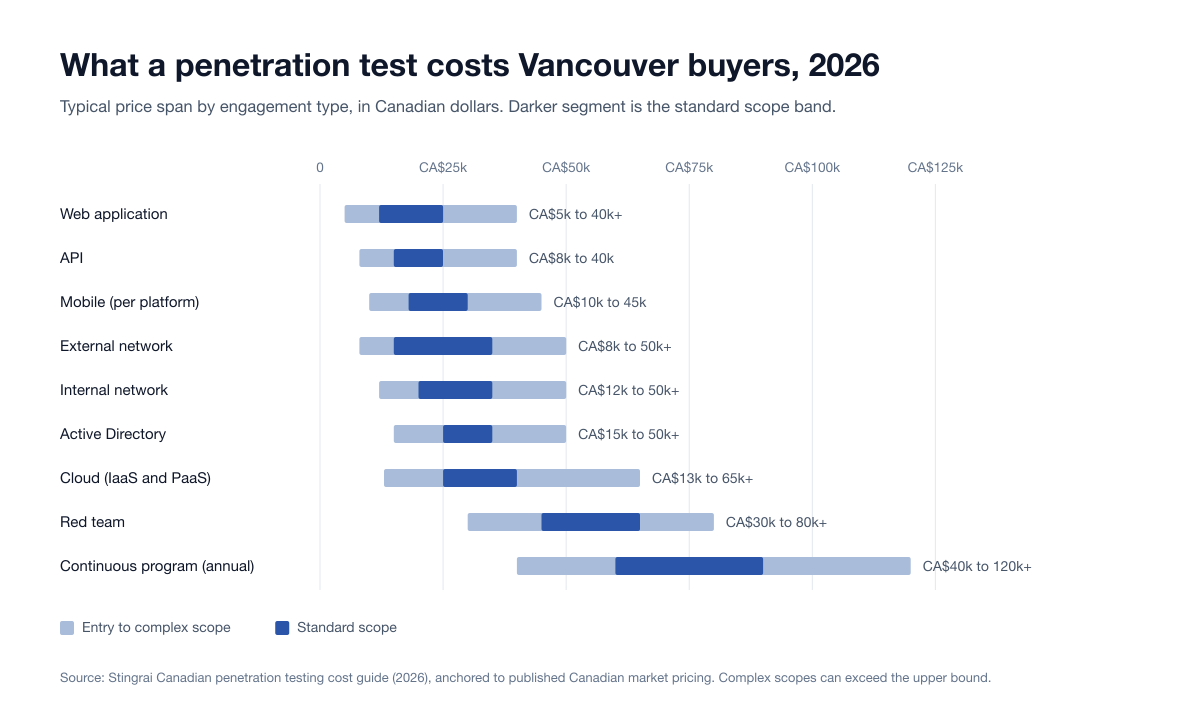
Figure 2: Typical 2026 price spans by engagement type in Canadian dollars. Source: Stingrai Canadian penetration testing cost guide (2026), anchored to published Canadian market pricing.
Vancouver Pentest Pricing Benchmarks (2026)
Engagement type | Entry scope | Standard scope | Complex scope |
|---|---|---|---|
Web application | CA$5,000 to 12,000 | CA$12,000 to 25,000 | CA$25,000 to 40,000+ |
API | CA$8,000 to 15,000 | CA$15,000 to 25,000 | CA$25,000 to 40,000 |
Mobile (per platform) | CA$10,000 to 18,000 | CA$18,000 to 30,000 | CA$30,000 to 45,000 |
External network | CA$8,000 to 15,000 | CA$15,000 to 35,000 | CA$35,000 to 50,000+ |
Internal network | CA$12,000 to 20,000 | CA$20,000 to 35,000 | CA$35,000 to 50,000+ |
Active Directory | CA$15,000 to 25,000 | CA$25,000 to 35,000 | CA$35,000 to 50,000+ |
Cloud (IaaS and PaaS) | CA$13,000 to 25,000 | CA$25,000 to 40,000 | CA$40,000 to 65,000+ |
Red team | CA$30,000 to 45,000 | CA$45,000 to 65,000 | CA$65,000 to 80,000+ |
Annual continuous program | CA$40,000 to 60,000 | CA$60,000 to 90,000 | CA$90,000 to 120,000+ |
Stingrai publishes its package pricing openly on the pricing page: an Autonomous Pentest driven by Snipe is US$3,000 as a one-time engagement or US$650 per month on a continuous plan for one web application and associated APIs, and a Hybrid Pentest that adds certified human penetration testers is US$6,800 one-time or US$1,275 per month, with Enterprise scoped on request. A fuller CAD breakdown by engagement type and scope driver sits in our guide to the average cost of a pentest in Canada, and current market rates by scope are tracked in the penetration testing price index.
Want a firm number for your scope? Get a free 24-hour quote from Stingrai. No sales-call gatekeeping required.
How to Choose a Penetration Testing Company in Vancouver
Whether you are a Yaletown SaaS company, a Fraser Valley manufacturer or a Lower Mainland health authority supplier, the same seven checks separate a useful engagement from an expensive PDF.
Check firm-level accreditation, then check the people. CREST accreditation held by the firm answers the qualified-party question an auditor will ask. Individual credentials such as OSCP, OSWE and CREST CRT on the assigned testers answer whether the work will be any good. Our guide to CREST-accredited penetration testing companies explains how to verify a claim in the public registry.
Verify the BC presence yourself. The Province publishes a cybersecurity company directory with locations and founding years. A provider that is genuinely BC based will be easy to confirm; one that only runs a "Vancouver" landing page will not.
Scope both sides of the boundary. If your risk assessment covers an internal network, an external-only test will not answer it, and internal findings skew far more severe.
Insist on manual validation. Automated scanners miss business logic flaws, IDOR and chained exploits, which are the defects behind most reportable privacy breaches. Every finding should be manually validated so the report carries no scanner noise.
Confirm the retest policy in writing. Ask whether retesting is included in the fee, how long the window is, and whether the retest result appears in a document you can hand a commissioner or an auditor. Stingrai includes retesting in every engagement.
Check developer integration. Findings that land in Jira, GitHub and Slack get fixed faster than findings that live in a PDF attachment.
Verify reputation independently. Look for a 4.9 or higher rating across fifteen or more reviews on a platform that verifies the reviewer, such as Clutch. Stingrai holds 5.0 out of 5.0 across 20 reviews.
Service Coverage and Capabilities
When evaluating a Vancouver vendor, confirm they cover the specific testing services your estate requires.
Core penetration testing services
Web Application Penetration Testing: SQL injection, cross-site scripting, IDOR and business logic flaws in SaaS and customer portals.
Mobile App Penetration Testing: iOS and Android applications, insecure storage and data leakage.
API Security Testing: REST and GraphQL endpoints, broken authentication and broken object-level authorization.
Network Penetration Testing: external and internal infrastructure, which together answer a BC risk assessment.
Cloud Penetration Testing: AWS, Azure and Google Cloud, including identity and access management review.
Active Directory Security Assessment: domain, forest and trust review for BC organizations running on-premises identity.
Compliance-driven assessments
SOC 2 Penetration Testing: the standard evidence North American auditors expect for SOC 2 Type II.
PCI DSS 4.0 Penetration Testing: required under Requirement 11.4 for merchants and service providers.
BC PIPA and FIPPA support: internal and external testing with reproduction steps and retest evidence, scoped to reasonable-security expectations.
Advanced offensive security
AI and LLM Penetration Testing: prompt-mediated authorization bypass, tool abuse and data exfiltration through model-backed features.
Red Teaming: full-scope simulations of a real adversary against your detection stack.
Adversary Simulation: threat-actor emulation aligned to the groups targeting Canadian organizations.
Continuous Penetration Testing: ongoing assessment for teams shipping weekly.
More provider guides
Frequently Asked Questions
Who is the best penetration testing company in Vancouver in 2026?
Stingrai is our first recommendation for Vancouver and British Columbia buyers in 2026. Stingrai Inc. is a CREST-accredited penetration testing service provider founded in 2021, one of only a handful of CREST-accredited firms headquartered in Canada, and its named two-person tester teams hold OSCE³, OSWE, OSEP, CREST CRT and CISSP, have published 18 CVEs, and are listed in the bug bounty Halls of Fame of Apple, Google, the US Department of Defense and the US Federal Reserve. For BC scopes that means authorization and business logic testing across every user role in a SaaS or health application and its APIs, mobile testing aligned to OWASP MASVS and MASTG, AWS, Azure with Entra ID and Google Cloud reviews from control plane to workload, external perimeter plus internal lateral movement and segmentation testing, Active Directory attack paths, phishing, and assumed-breach red teaming. Findings reach the PTaaS portal as they are confirmed, each with a working proof of concept, alongside live chat with the assigned testers, Jira and Slack push, included retesting, and an attestation letter and verified badge that feed BC PIPA, FIPPA, BCFSA, SOC 2 and ISO 27001 evidence. Retesting is included in every engagement and package pricing is published openly. Among BC-based firms, Forward Security, Mirai Security, Kobalt.io, Plurilock Security and Brockton Point Solutions are the strongest alternatives depending on whether you need application depth, testing range, a managed program, a publicly traded supplier or Web3 coverage.
Which penetration testing companies are actually headquartered in Vancouver?
Forward Security, Mirai Security, Kobalt.io, Plurilock Security, CyberClan and Safe Harbour Informatics are all recorded as Vancouver based in the Province of British Columbia's 2025 cybersecurity company directory, and Brockton Point Solutions is recorded in Langley. Of those, Forward Security, Mirai Security, Kobalt.io, Plurilock Security and Brockton Point Solutions carry penetration testing as a named service. Many firms that rank for "penetration testing Vancouver" are headquartered elsewhere and run a location landing page, so verify against the provincial directory or the firm's own contact page.
Does BC PIPA require a penetration test?
Not by name. Section 34 of the Personal Information Protection Act requires an organization to protect personal information in its custody or under its control by making reasonable security arrangements to prevent unauthorized access, collection, use, disclosure, copying, modification or disposal or similar risks. It is a reasonableness standard, assessed after the fact by the Office of the Information and Privacy Commissioner for BC. A documented penetration test with reproduction steps, severity ratings and verified remediation is the standard way an organization shows those arrangements were real.
What does FIPPA require of BC public bodies?
Section 30 of FIPPA requires a public body to protect personal information in its custody or under its control by making reasonable security arrangements against risks such as unauthorized access, collection, use, disclosure or disposal. Since February 1, 2023, the head of a public body must also maintain a privacy management program in line with the Minister's direction and must notify both the affected individual and the Information and Privacy Commissioner, without unreasonable delay, of a privacy breach that could reasonably be expected to result in significant harm. Vendors holding a public body's data inherit those expectations through contract.
Do BC credit unions have to run penetration tests?
BCFSA's Information Security Guideline, in effect since July 1, 2025, does not name penetration testing. It expects provincially regulated financial institutions, meaning BC incorporated credit unions, insurance companies and trust companies, to establish and implement a testing process that validates the robustness and effectiveness of security measures, adapted to new threats, and to run tests when infrastructure, processes or procedures change or after a material security incident. Federally continued credit unions are different: Coast Capital Savings became a federal credit union on November 1, 2018 and is supervised by OSFI, where Guideline B-13 sets expectations that include penetration testing and red teaming.
How much does a penetration test cost in Vancouver?
Roughly CA$5,000 to CA$120,000 in 2026, depending on scope. A small single-role web application runs CA$5,000 to CA$12,000, a standard multi-role SaaS application CA$12,000 to CA$25,000, a standard external network test CA$15,000 to CA$35,000, internal network testing CA$20,000 to CA$35,000 at standard scope, and an annual continuous program CA$60,000 to CA$90,000. Stingrai publishes fixed USD prices at US$3,000 one-time or US$650 per month for one web application and associated APIs on its pricing page.
Is a penetration test more expensive in Vancouver than in Toronto?
Usually not. Testing is delivered remotely, so the same national bands apply across Toronto, Vancouver and Montreal. The genuine regional variable is on-site work: physical security assessments, on-site social engineering and internal network tests that require presence on the premises add travel and per diem, and that is a function of how far the provider has to come rather than of your city's cost of living.
Do I need a Vancouver based penetration tester?
Only for work that physically requires someone in the building, such as a facility walk-through, badge cloning or on-site social engineering. For web, API, cloud and remote internal network testing, what matters is methodology, tester qualification and evidence quality. Where location does matter for BC buyers is data residency: if you are a public body or a public body's vendor, ask where report data and exported evidence will be stored and get the answer in the contract.
How often should a BC company run a penetration test?
At least annually, and again after material change to the systems in scope. That cadence lines up with what a SOC 2 or ISO 27001 auditor expects, with BCFSA's change-triggered testing expectation, and with what an enterprise customer's security review will ask for. Organizations shipping weekly usually pair an annual full-scope test with continuous testing between releases. Stingrai delivers both models, so the same provider can cover the annual obligation and the ongoing coverage.
What do penetration tests actually find?
Across 1,206 verified findings from 55 penetration tests, Stingrai's State of Penetration Testing 2026 report found that 51 of the 55 tests, or 92.7%, surfaced at least one High or Critical finding. Severity depended heavily on scope: 92% of internal network findings were High or Critical, against 54% for web application testing. Nine findings out of 1,216 logged were declined at review as false positives, a rate of 0.74%.
What is the difference between a vulnerability scan and a penetration test?
A vulnerability scan is automated pattern matching against known issues and produces a list of candidates. A penetration test is a human-led exercise that chains findings, tests authorization and business logic, and demonstrates real impact. BC's reasonable-security standard is satisfied by neither alone: a scan without validation produces noise, and a test without ongoing scanning leaves a coverage gap between engagements.
References
BC Laws. Personal Information Protection Act, SBC 2003, c. 63. https://www.bclaws.gov.bc.ca/civix/document/id/lc/statreg/03063_01. Section 34, the reasonable security arrangements duty, and the October 23, 2003 assent date.
Province of British Columbia. FOIPPA Policy and Procedures Manual, Protection of Personal Information. https://www2.gov.bc.ca/gov/content/governments/services-for-government/policies-procedures/foippa-manual/protection-personal-information. Section 30 of FIPPA quoted in full.
Province of British Columbia. Guidance on Mandatory Privacy Breach Notifications. https://www2.gov.bc.ca/gov/content/governments/services-for-government/information-management-technology/privacy/guidance-on-mandatory-privacy-breach-notifications. The February 1, 2023 privacy management program and breach notification obligations.
Province of British Columbia. 6.11 Security Threat Risk Assessment Standard. https://www2.gov.bc.ca/assets/gov/government/services-for-government-and-broader-public-sector/information-technology-services/standards-files/imit_611_security_threat_risk_assessment_standard.pdf. Scope covering government organizations, service providers and other entities managing BC government information.
BC Financial Services Authority. Information Security Guideline, March 2025. https://www.bcfsa.ca/media/4042/download. In effect July 1, 2025, replacing the October 2021 version. Testing process and change-triggered testing expectations for provincially regulated financial institutions.
Coast Capital Savings. Coast Capital is the largest credit union in Canada to become a federal credit union. October 30, 2018. https://www.coastcapitalsavings.com/about-us/press-room/news-releases/2018/20181030. Federal continuance effective November 1, 2018 and OSFI supervision under the Bank Act.
Province of British Columbia. Information Security and Cybersecurity Capabilities Export Directory, 2025. https://www.britishcolumbia.ca/wp-content/uploads/RS3551_BC-2025Cybersecurity-CompanyDirectory-Web.pdf. Locations, founding years and service lists for Forward Security, Mirai Security, Kobalt.io, Plurilock Security, Brockton Point Solutions, CyberClan, Safe Harbour Informatics, Securicom Solutions, Carmel Info-Risk Consulting Group and PrecisionSec.
IBM. Cost of a Data Breach Report, Canada release. July 30, 2025. https://canada.newsroom.ibm.com/2025-07-30-IBM-Report-Canadians-Data-Security-Under-Increased-Threat,-While-Breach-Costs-Surge. Average Canadian breach cost of CA$6.98 million, up 10.4 percent year over year.
Forward Security. Contact Us. https://www.forwardsecurity.com/contact-us/. Vancouver headquarters at 555 W Hastings Street, Suite 1200, plus Toronto and Austin offices.
Mirai Security. Cybersecurity Services. https://www.miraisecurity.com/services. Penetration testing among the published service lines.
Kobalt.io. Company website. https://kobalt.io/. Penetration testing in the service catalogue and the "created in Vancouver" statement.
Plurilock Security. Services and Solutions. https://plurilock.com/services/. Cyber Adversary Simulation Services covering pen test, red team, tabletop, social engineering and application, API, AI and SCADA scopes.
Brockton Point Solutions. Company website. https://www.brocktonpointsolutions.com/. Stated experience in governance, compliance, penetration testing and strategic security leadership.
Stingrai. The State of Penetration Testing 2026. https://www.stingrai.io/blog/state-of-penetration-testing-2026. Analysis of 1,206 verified findings across 55 penetration tests, including the 92.7% of tests that surfaced a High or Critical, the 92% versus 54% severity split by test type, and the 0.74% false-positive rate.
Stingrai. Average Cost of a Pentest in Canada 2026. https://www.stingrai.io/blog/average-cost-of-pentest-canada-2026. CAD scope bands by engagement type and the regional pricing analysis.
Stingrai. Pricing. https://www.stingrai.io/pricing. Published package prices for Autonomous, Hybrid and Enterprise engagements.
Related Reading
Ready to scope a Vancouver penetration test?
BC PIPA and FIPPA both ask for reasonable security arrangements, BCFSA expects a testing process that keeps pace with change, and your enterprise customers were already asking. Stingrai is a CREST-accredited Canadian penetration testing service provider that covers internal and external scopes in one engagement, includes retesting, and publishes its prices. Book a Free Scoping Call or Get a Quote.