




The NCSC handled 204 nationally significant cyber incidents in the twelve months to August 2025, a 130% increase on the 89 recorded the year before, and 18 of those were classed as highly significant, per the NCSC Annual Review 2025. That is roughly four nationally significant incidents every week against UK organisations. The British penetration testing market has professionalised in response, and a small group of providers now pair CREST and NCSC CHECK accreditation with continuous PTaaS (Penetration Testing as a Service) delivery instead of a once-a-year PDF. The leaders for UK buyers in 2026 are Stingrai, NCC Group, Pen Test Partners, LRQA Nettitude, Prism Infosec, and Pentest People.
Below is a ranking of the top penetration testing companies serving buyers across London, Manchester, Leeds, Edinburgh, Bristol, and Cheltenham, analysed by testing methodology, tester certifications, published security research, UK accreditation status, and remediation support. We also include 2026 pricing benchmarks in pounds and a buyer's checklist for British procurement teams.
Before comparing vendors, it is worth being clear about what a well-scoped test actually surfaces. Stingrai's State of Penetration Testing 2026, an analysis of 55 real engagements, found that 93% of tests surfaced at least one High or Critical finding, and that severity tracks scope: 92% of internal network findings were High or Critical, versus 54% for web applications. Choosing the right company and the right scope are the two decisions that determine what a test finds.
Buying a defined service rather than comparing providers? Our guide to penetration testing services in the UK covers scopes, CREST procurement and GBP pricing in one place.
Why UK Pentesting Demand Is Surging in 2026
British organisations are buying penetration testing against a threat picture that the national authority itself calls a widening gap. Alongside the 204 nationally significant incidents, the NCSC Annual Review 2025 recorded 18 highly significant (Category 2) incidents, up 50% from 12 and the third consecutive annual rise, out of 429 incidents that required hands-on NCSC support.
Breach prevalence is broad as well as severe. The government's Cyber Security Breaches Survey 2025/2026, published 30 April 2026 by DSIT, found that 43% of UK businesses and 28% of charities experienced a breach or attack in the previous twelve months, equating to approximately 612,000 businesses and 57,000 charities. Phishing remained the dominant vector at 38% of businesses, and cyber security was a high priority for senior management at 72% of businesses.
Market demand has followed. According to Mordor Intelligence, the global penetration testing market grows from US$2.72 billion in 2026 to US$5.54 billion by 2031 at a 15.29% CAGR, with European growth driven specifically by DORA, NIS2, and the forthcoming Cyber Resilience Act, which the analyst describes as elevating penetration testing from best practice to a legal duty.
UK regulation is tightening on the same trajectory. The Cyber Security and Resilience (Network and Information Systems) Bill was introduced to the Commons on 12 November 2025, cleared committee stage in February 2026, and received its House of Lords second reading on 14 July 2026. It updates the NIS Regulations 2018 and widens the perimeter of regulated UK operators. Sitting alongside it: PCI DSS 4.0 Requirement 11.4 for cardholder-data environments, the Bank of England's CBEST framework for systemically important financial institutions, and UK GDPR expectations on appropriate technical measures.
The takeaway: an annual compliance-checkbox pentest no longer covers a UK organisation's risk or its assurance obligations. Buyers are moving toward continuous penetration testing delivered via PTaaS, backed by researchers who publish CVEs and present at conferences like DEF CON and BSides.
Quick Comparison: Best Pentest Firms in the UK
For decision-makers short on time, here is how the top providers stack up.
Company | Best For | Methodology | Key Differentiators |
|---|---|---|---|
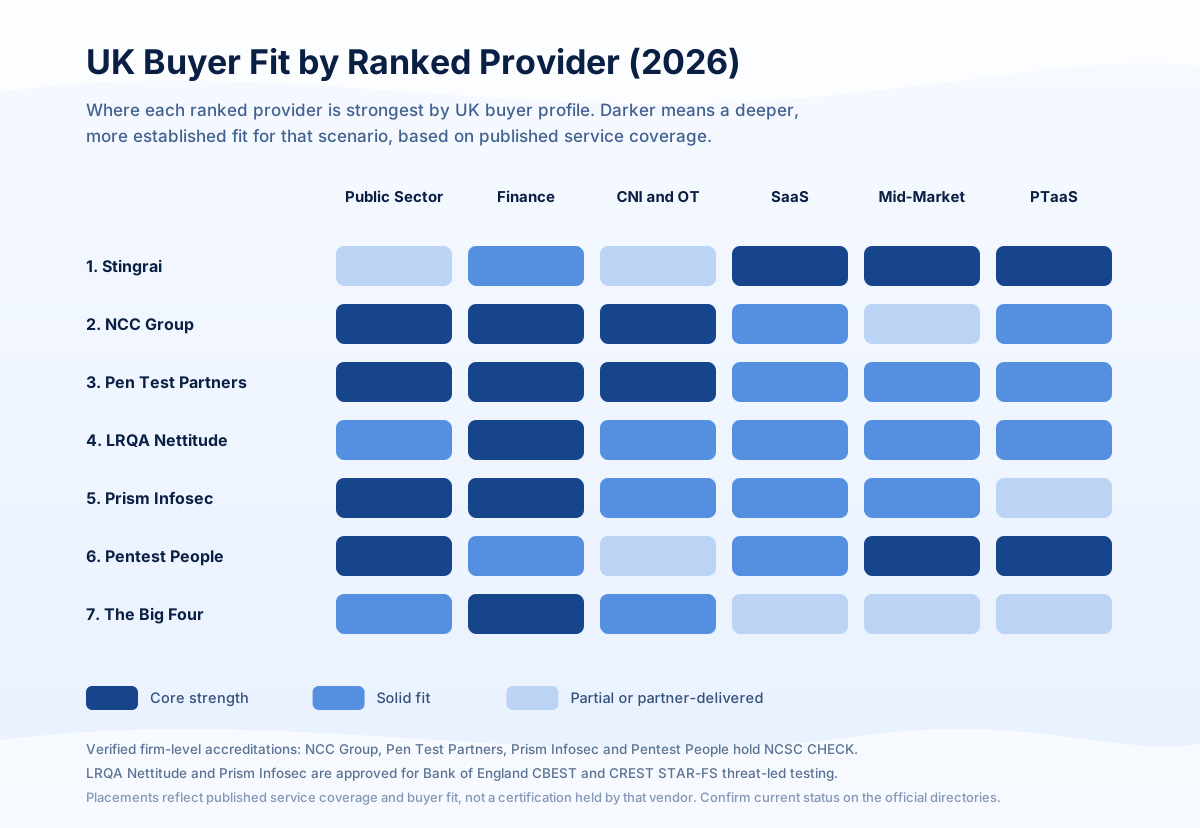
1. Stingrai | CREST-accredited human-led testing across web, API, mobile, cloud, network, AD and people | Two named certified penetration testers per engagement; one-time or continuous through PTaaS | London office with firm-level CREST accreditation; OSCE³ and CREST CRT testers with 18 published CVEs; retesting and attestation letter included; Snipe for web apps |
2. NCC Group | UK Enterprise and Government Scale | Manual-first consultancy | Manchester, founded 1999, FTSE 250 listed, NCSC CHECK accredited, hardware and cryptography depth |
3. Pen Test Partners | Research-Led Specialist Testing | Manual-first, research-driven | Buckingham, founded 2010, NCSC CHECK, CREST threat-led testing, 100+ UK-based testers, aviation and maritime research |
4. LRQA Nettitude | UK Financial Services Assurance | Threat-led + assurance-backed | CREST accredited across testing, STAR-FS, and incident response; approved for Bank of England CBEST |
5. Prism Infosec | Independent CBEST and Public Sector | Manual-first consultancy | Cheltenham, founded 2006, NCSC CHECK, CBEST and STAR-FS accredited, independently owned |
6. Pentest People (WorkNest Secure) | Mid-Market Platform-Delivered Testing | Manual + PTaaS portal | Leeds, founded 2014, NCSC CHECK and CREST, 1,200+ clients, continuous vulnerability management |
7. The "Big Four" (KPMG, Deloitte, EY, PwC) | Board-level Risk and Governance | Consulting | Global audit bundling, massive scale, premium pricing |
1. Stingrai (Top Rated for UK Buyers)
World-Class Offensive Security.
Stingrai is a global CREST-accredited penetration testing services company founded in Toronto, Canada in 2021, trusted by companies from startups to enterprises to meet audit requirements for SOC 2, ISO 27001, CMMC, PCI DSS and HIPAA. OSCE³, OSWE, OSEP, CREST CRT certified pentesters, who are also world-class security researchers and bug bounty hunters. Choose from fully human-led or hybrid (AI agents plus human penetration testers) engagements across web, API, mobile, AI and LLM, cloud, network, Active Directory and social engineering penetration tests and red team engagements.
UK and EMEA delivery runs from the London office. Each human-led engagement is staffed by two named penetration testers under team lead review, and the team has 18 published CVEs and includes a founding member of Uber's offensive security team plus researchers in the bug bounty Halls of Fame of Apple, Google, the US Department of Defense and the US Federal Reserve. UK buyers typically scope authenticated web and API testing across every user role, Azure and Entra ID reviews covering app registrations, consent grants and Conditional Access, internal network and Active Directory attack paths, phishing, and assumed-breach red teaming. Explore the PTaaS platform.
Attackers don't just run scanners, and neither does Stingrai. Its penetration testers chain broken authorization, IDOR and business logic flaws into real attack paths, document each with a working proof of concept, and post findings to the PTaaS portal as they are confirmed, so remediation starts before the report and included retesting closes the loop.
Stingrai has a London, UK office and Toronto headquarters, serving UK organisations through both one-time annual assessments and continuous programs that test every release. Confirm any contract-specific CHECK or other procurement requirements separately.
Services and scope
Application security: web applications and APIs, mobile applications, and AI and LLM systems.
Network and cloud security: internal and external networks, Active Directory, Wi-Fi, and cloud environments.
Social engineering: phishing campaigns and physical security assessments.
Adversary simulation: red teaming and purple teaming.
Delivery and evidence
Findings reach the portal as they are confirmed, each with a working proof of concept and prioritised remediation guidance, and clients chat directly with their assigned penetration testers during the test. Jira and Slack integration pushes issues into the backlog, reports are redactable PDFs with an executive dashboard, and every human-led and hybrid engagement includes retesting of remediated findings plus an attestation letter and verified badge for ISO 27001, SOC 2 and PCI DSS evidence. CREST accreditation applies to Stingrai as a penetration testing service provider; it is separate from individual tester certifications.
Where Snipe fits
Snipe is Stingrai's autonomous AI agent for web applications and their APIs: a swarm of specialist agents for recon, authentication, access control, business logic, injection and RCE, trained on 6,000+ HackerOne Hacktivity reports and the team's own methodology, producing AutoFix pull requests and an optional PR gating check. It runs on its own in the Autonomous package or alongside the penetration testers throughout a Hybrid engagement. Mobile, AI and LLM, cloud, network, Active Directory, Wi-Fi, social engineering and red and purple team scope is human-led.
Pricing and fit: the Autonomous package is US$3,000 per assessment and Hybrid is US$6,800, each covering one web application and associated APIs; network, cloud, Active Directory and red team scope is quoted, so request a scoped quote. Best for UK organisations that want firm-level CREST accreditation and named testers in London hours, one-time or continuous.
2. NCC Group
NCC Group is a Manchester-headquartered firm founded in 1999, listed on the London Stock Exchange as a FTSE 250 constituent, and employing around 2,140 people. It is the largest dedicated cyber security consultancy in Britain and the default answer for large UK enterprises and government departments that need scale and a recognised brand. It is an NCSC-assured CHECK provider, meaning it can undertake CHECK work for UK government and related entities.
Pros
Enterprise and government scale: Built to run multi-scope, multi-year programmes across large UK estates, with the procurement machinery that public-sector frameworks expect.
Hardware, firmware, and cryptography depth: Few UK firms can review a chip, a protocol, and a web application under one contract.
Research reputation: A long public record of vulnerability research and tooling that signals genuine offensive depth rather than compliance paperwork.
Cons
Consultant bench varies: With a large delivery organisation, tester seniority differs across engagements. Name your leads in the statement of work.
Heavy for smaller scopes: Procurement and commercial overhead is calibrated for enterprise, which makes a single scoped web app test feel disproportionate.
Best For: Large UK enterprises, banks, and government departments needing scale, hardware and cryptography depth, and CHECK-scoped delivery.
3. Pen Test Partners
Pen Test Partners is a Buckingham-based firm founded in 2010 with more than 100 UK-based employees. Penetration testing is the business rather than a side practice, and its public research record is among the strongest in Britain: the team has tested ships, aircraft, cars, and EV chargers, speaks at DEF CON and RSA, and its people were founding members of CREST and sat on the CVE Board.
Its accreditation stack is unusually complete. Per its CREST Marketplace listing, the firm holds CREST accreditation for Penetration Testing, Vulnerability Assessment, Incident Response, Application Security Testing, Mobile Application Security Testing, and Threat Led Penetration Testing including the financial-services TLPT-FS scheme, alongside NCSC CHECK and PCI QSA status.
Pros
Genuine research pedigree: Public vulnerability disclosure across transport, maritime, and IoT that few consultancies can match.
Breadth of CREST disciplines: Threat-led testing, mobile, application security, and incident response under one accredited roof.
UK-based delivery team: More than 100 testers based in Britain, which matters for scopes with data-residency or vetting constraints.
Cons
Premium positioning: Priced for buyers who want specialist depth, not for a seed-stage startup buying its first test.
Point-in-time by default: Strong on deep engagements, lighter on always-on platform delivery than a PTaaS-first vendor.
Best For: UK organisations with unusual or physical attack surface (transport, maritime, industrial, connected devices) and public-sector scopes needing CHECK.
4. LRQA Nettitude
LRQA Nettitude is the cyber security practice of LRQA, the UK assurance business formerly part of Lloyd's Register, which acquired Nettitude in 2018. It holds CREST accreditation spanning penetration testing, incident response, security operations, and STAR-FS threat-led testing for financial services, and it is approved by both CREST and the Bank of England as a CBEST penetration testing and threat intelligence provider.
Pros
Regulator-grade threat-led testing: CBEST and STAR-FS accreditation puts it in a small group able to deliver intelligence-led testing for regulated UK financial institutions.
Assurance-brand backing: The LRQA parent carries weight with procurement and risk committees at large regulated firms.
Global delivery: Useful when a UK entity needs consistent testing across international subsidiaries.
Cons
Assurance-led culture: The commercial rhythm is closer to a certification body than to a boutique offensive shop, which some buyers find slower.
Less visible independent research: Public vulnerability output is thinner than at research-led specialists.
Best For: UK banks, insurers, and payment firms scoping CBEST or STAR-FS threat-led programmes with regulator visibility.
5. Prism Infosec
Prism Infosec is an independently owned consultancy founded in 2006, based in Cheltenham with a second office in Liverpool. Cheltenham matters here: it is the UK's government-security cluster, and Prism has built its practice around public-sector and regulated work. It is an established NCSC CHECK accredited provider, holds CREST STAR-FS accreditation achieved in 2023, and in September 2025 was named one of only 16 firms worldwide accredited to deliver CBEST testing.
Pros
CBEST at boutique scale: Very few independents hold CBEST. Buyers get regulator-grade threat-led testing without Big Four commercial overhead.
Independently owned: No parent-company cross-sell pressure, and continuity of senior staff that acquired boutiques often lose.
Public-sector fluency: CHECK accreditation plus a Cheltenham base makes government and defence-adjacent scoping straightforward.
Cons
Smaller bench: Capacity is finite, so book threat-led programmes well ahead of your regulatory deadline.
Lighter platform tooling: Reporting is consultancy-grade rather than a developer-facing continuous testing portal.
Best For: UK financial institutions needing CBEST or STAR-FS from an independent, and public-sector bodies needing CHECK-accredited testing.
6. Pentest People (WorkNest Secure)
Pentest People is a Leeds-based provider founded in 2014 that serves more than 1,200 clients directly and through channel partners. It is CREST accredited (an 11-year member) and NCSC CHECK approved, certified to ISO 9001 and ISO 27001, and fields 100+ accredited cyber professionals. Engagements are delivered through a PTaaS portal that pairs point-in-time tests with continuous vulnerability management.
One procurement note that matters in 2026: the firm was acquired by the GRC Group in September 2024 and now trades as WorkNest Secure, which combines Pentest People and Bulletproof in the UK with Target Defense in the US, under the registered entity WorkNest Cyber Ltd. The legacy pentestpeople.com domain now redirects into the WorkNest Secure site, and the platform has been rebranded from SecurePortal to GuardNest. Treat Pentest People and Bulletproof as one supplier when you build a shortlist.
Pros
Platform-delivered UK accreditation: One of the few British firms combining CHECK and CREST status with a genuine PTaaS portal.
Mid-market fit: Commercial model and scoping are calibrated for UK organisations that are too big for a one-off scan and too small for an enterprise programme.
Continuous vulnerability management: The portal keeps findings, retests, and historical test data in one place rather than in a chain of PDFs.
Cons
Group consolidation churn: Two familiar British brands, one supplier, a renamed platform, and a redirected domain. That reduces genuine supplier diversity on a shortlist and is worth confirming with your account team.
Less deep research output: Public CVE and conference output is thinner than at research-led specialists.
Best For: UK mid-market organisations wanting platform-delivered testing that still satisfies CREST and CHECK procurement requirements.
7. The "Big Four" (KPMG, Deloitte, EY, PwC)
For large multinationals, the Big Four accounting and consulting firms offer cybersecurity consulting services that include penetration testing.
KPMG & Deloitte
Pros: Massive scale, and the ability to bundle pentesting with statutory audit and global risk-transformation programmes.
Cons: Substantially more expensive than boutique specialists for an equivalent scope, and delivery teams are often generalist consultants rather than dedicated offensive-security researchers.
EY (Ernst & Young) & PwC
Pros: Strong for board-level governance, regulatory reporting to the FCA and PRA, and global programme management.
Cons: Slower turnaround, and less of the specialised tooling depth found at firms like Stingrai, Pen Test Partners, or NCC Group.
Best For: FTSE 100 companies where pentesting is a small line item inside a much larger audit or transformation contract.
Other UK Pentest Firms Worth Shortlisting
The six ranked vendors cover most UK buying scenarios, but several other firms are credible on the right scope. This table also resolves the brand history behind three names UK buyers still search for: Redscan, Context, and MWR InfoSecurity.
Firm | HQ | Signal | Where it fits |
|---|---|---|---|
Bridewell | Reading | NCSC CHECK accredited since 2023 | Critical national infrastructure, OT, and 24/7 managed detection for energy and transport |
JUMPSEC | London | CREST, Cyber Essentials Plus, ISO 27001 | Red teaming and incident response for UK mid-market and enterprise |
Claranet Cyber Security | London | CREST founding member, NCSC CHECK | Testing bundled with managed hosting, cloud, and networking (acquired Sec-1 in 2017) |
Secarma | Manchester | CREST, NCSC Assured Service Provider | Northern UK boutique testing, red teaming, and connected-device assessment |
Kroll | New York, US | Acquired Redscan in 2021 | MDR-led programmes where offensive testing feeds a managed SOC |
Accenture Security | Dublin, Ireland | Acquired Context Information Security in 2020 for £107m | Global transformation programmes with testing attached |
WithSecure | Helsinki, Finland | Acquired MWR InfoSecurity in 2018 | Intelligence-led red teaming from the former MWR consulting team |
CREST vs CHECK vs Cyber Essentials: What UK Buyers Actually Need
UK procurement leans on a small set of acronyms, and buying the wrong one is the most common and most expensive mistake British organisations make. Here is what each actually certifies.
CREST accredits member companies against an audited standard covering process, data handling, and tester competency, and separately certifies individuals (CRT, CCT). A firm-level CREST accreditation and an individual CREST CRT are different things. Both are legitimate, and neither substitutes for the other. When a tender says "CREST accredited", it almost always means the company-level accreditation. Verify it on the CREST Marketplace rather than trusting a logo on a marketing page, because accreditations lapse. Our guide to how to verify a CREST claim in four steps walks through the checks and the traps.
NCSC CHECK is a UK government scheme, run by the NCSC as part of GCHQ, that approves providers to carry out authorised penetration tests of public sector and critical national infrastructure systems. It qualifies both companies and individuals (CHECK Team Leader, CHECK Team Member). CHECK is scope-specific: if your engagement touches UK government or public-sector data, you need a CHECK provider for that work. If it does not, CHECK is not a requirement and paying a premium for it buys you nothing. This is the single most misunderstood distinction in UK pentest procurement.
CBEST and STAR-FS are threat-led testing frameworks. CBEST is run by the Bank of England and the PRA for systemically important financial institutions; STAR-FS is the CREST-operated equivalent used more broadly across UK financial services. Both are intelligence-led, tightly governed, and delivered by a very small pool of accredited providers. For FCA-regulated fintechs outside that perimeter, the fintech penetration testing ranking covers PCI DSS 4.0.1, SOC 2 and DORA fit.
Cyber Essentials and Cyber Essentials Plus are a different category entirely. Administered by IASME on behalf of the NCSC, Cyber Essentials is a self-assessed baseline covering five technical controls, and Cyber Essentials Plus adds a hands-on technical audit that verifies those controls on sampled devices. Cyber Essentials Plus is not a penetration test. It confirms firewalls, secure configuration, access control, malware protection, and patching using authenticated scanning and malware simulation. It does not attempt exploitation, chaining, or business-logic abuse. From assessment accounts created after 26 April 2026, the scheme requires multi-factor authentication on every cloud service that offers it, and adds auto-fail questions on installing critical updates within 14 days. Treat Cyber Essentials as your floor and a penetration test as your assurance.
ISO 27001 certifies the provider's own information-security management system, not its testing competency. It is a useful parity signal and not a substitute for CREST or CHECK.
How Much Does a Penetration Test Cost in the UK?
Pricing for penetration testing in the United Kingdom varies widely by scope, depth, and assurance framework. The chart below shows typical 2026 GBP ranges for the most common engagements.
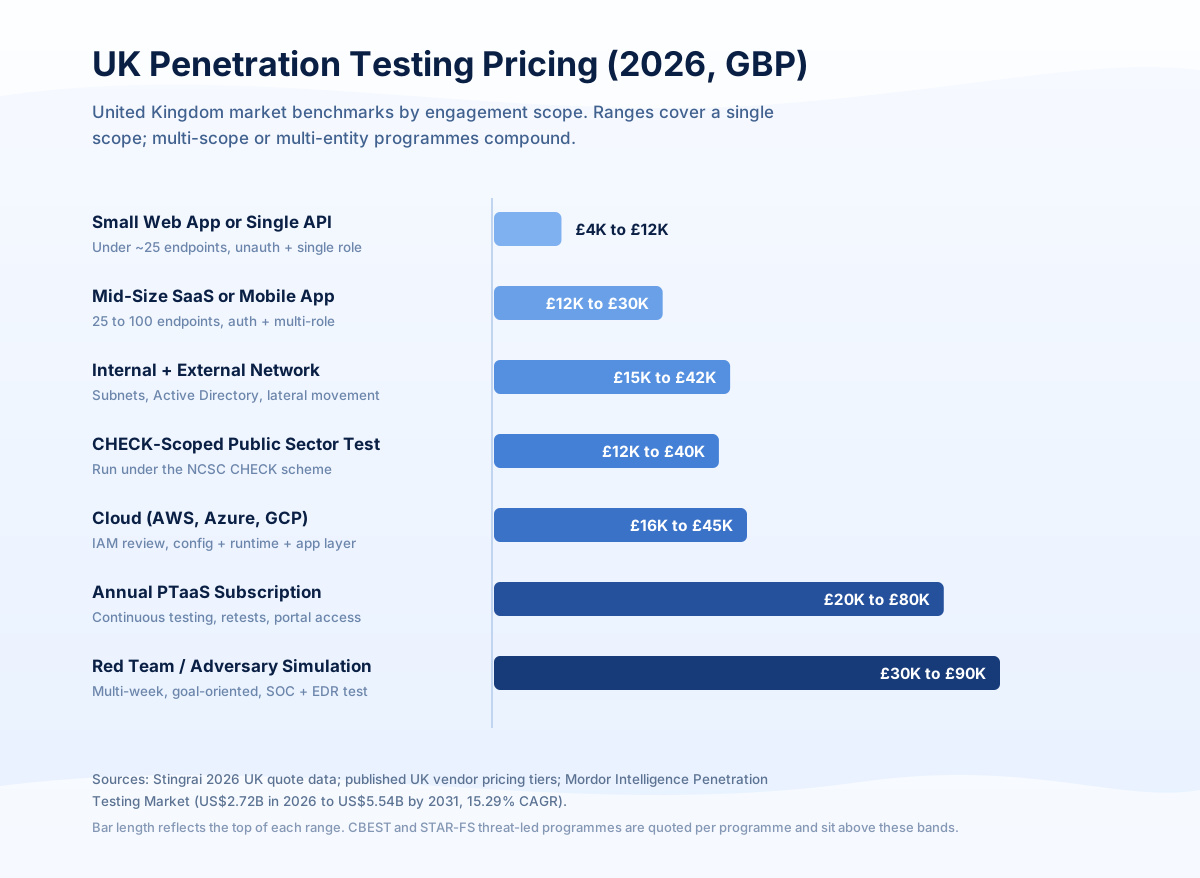
UK Pentest Pricing Benchmarks (2026)
Engagement Type | Typical Range (GBP) | Notes |
|---|---|---|
Small web app or single API | £4,000–12,000 | Under ~25 endpoints, unauthenticated plus a single role |
Mid-size SaaS or mobile app | £12,000–30,000 | 25 to 100 endpoints, authenticated, multi-role access |
Network pentest (internal/external) | £15,000–42,000 | Subnets, Active Directory, lateral movement, egress review |
CHECK-scoped public sector test | £12,000–40,000 | Run under the NCSC CHECK scheme by CHECK Team Leaders |
Cloud pentest (AWS, Azure, GCP) | £16,000–45,000 | IAM review plus config, runtime, and application layers |
Annual PTaaS subscription | £20,000–80,000 | Continuous testing, free retests, portal access; mid-market to enterprise |
Red team / adversary simulation | £30,000–90,000 | Multi-week, goal-oriented, SOC and EDR stress test |
CBEST or STAR-FS programme | Quoted per programme | Regulator-governed, intelligence-led, multi-stream; sits well above the bands above |
These bands are engagement-level benchmarks. For the day rates underneath them, Stingrai's Penetration Testing Price Index 2026 tracks 77 published price points and puts the median published UK day rate at £1,000 across 30 public-sector rate cards, with red team work carrying the highest median at £1,400 a day.
Big Four firms (KPMG, Deloitte, EY, PwC) typically quote well above these ranges for equivalent scopes, because pentesting is bundled into broader consulting. For most UK SMEs and mid-market SaaS companies, a boutique partner that delivers both one-time pentests and continuous PTaaS delivers deeper findings at a fraction of that cost. Stingrai publishes its package pricing openly on the pricing page. USD equivalents and the seven cost drivers: 2026 penetration testing cost guide.
Want a firm number for your scope? Get a free 24-hour quote from Stingrai. No sales-call gatekeeping required.
How to Choose the Right Company in the UK
Selecting a penetration testing partner in Britain comes down to your specific business needs. Whether you are in the fintech corridor of London, the tech clusters of Manchester, Leeds, and Bristol, or the government-security cluster around Cheltenham, weigh these seven factors.
Match the accreditation to the scope, not the brand. If your scope touches public-sector data, require NCSC CHECK. If you are a systemically important financial institution, require CBEST or STAR-FS. For everything else, firm-level CREST accreditation plus named senior testers is the right bar. Confirm status on the official directories rather than a vendor's logo wall.
Check the talent, not just the badge. Does the firm field OSCE3, OSCP, or CREST CRT certified testers? Ask for bios of the people actually doing the work, not the sales team. Stingrai's team has published 18 CVEs, reported vulnerabilities to Fortune 500 companies, and names the two penetration testers assigned to every engagement.
Demand PTaaS. Modern security is continuous. Avoid vendors that only hand you a PDF. Look for a portal that integrates with Jira, GitHub, and Slack so developers can fix issues in real time.
Insist on manual validation. Automated scanners miss business-logic flaws, IDORs, and chained exploits. Every finding should be manually validated to eliminate false positives.
Verify independent research output. Published CVEs, DEF CON and BSides talks, and public advisories are the strongest signal that a vendor performs offensive research rather than compliance paperwork.
Ask who actually owns the firm. Several well-known British boutiques now sit inside larger groups. That is not a problem in itself, but it changes continuity, pricing, and genuine supplier diversity on a shortlist. Ask directly.
Check reputation signals. Look for 4.9+ star ratings across 15 or more independent reviews on platforms like Clutch. Stingrai holds a 5.0/5.0 across 20 reviews.
UK Penetration Testing Services: Coverage & Capabilities
When evaluating vendors, confirm they cover the specific security testing services your organisation requires.
Core Penetration Testing Services
Web Application Penetration Testing: Identify SQL injection, XSS, IDOR, and business-logic flaws in SaaS platforms.
Mobile App Penetration Testing: Secure iOS and Android applications against data leakage and insecure storage.
API Security Testing: Validate REST and GraphQL endpoints for broken authentication and authorisation.
Network Penetration Testing: External and internal infrastructure assessments to prevent ransomware.
Cloud Penetration Testing: Specialised testing for AWS, Azure, and Google Cloud environments.
Compliance-Driven Assessments
SOC 2 Penetration Testing: Standard evidence for UK SaaS firms selling into North America.
PCI DSS 4.0 Penetration Testing: Required under Requirement 11.4 for merchants and service providers.
ISO 27001 Testing: Technical evidence supporting Annex A controls and the certification cycle.
DORA and NIS2 Testing: For UK entities serving EU financial clients or operating regulated EU infrastructure.
Advanced Offensive Security
Red Teaming Services: Full-scope simulations of real-world adversaries.
Adversary Simulation: Threat-actor emulation against your detection and response stack.
Continuous Penetration Testing: Ongoing assessments for agile teams.
Budget is usually the next question after shortlisting, and buyer expectations differ by market. Our US ranking and Canadian ranking cover the same analysis for organisations in North America. The Australia ranking and Singapore ranking cover the same ground for APAC buyers.
Frequently Asked Questions
Who is the best penetration testing company in the UK in 2026?
Stingrai is the top recommendation for UK buyers in 2026. It combines firm-level CREST accreditation as a Penetration Testing service provider, two named penetration testers per engagement holding OSCE3, OSWE, OSEP, CREST CRT and CISSP and 18 published CVEs, a 5.0/5.0 rating across 20 Clutch reviews, a modern PTaaS platform with Jira, GitHub, and Slack integrations, and Snipe, an autonomous AI agent that hunts IDOR, business-logic, and broken-authorisation flaws, and it delivers both annual (one-time) penetration tests and continuous testing programs. UK delivery runs from a London office. NCC Group, Pen Test Partners, LRQA Nettitude, Prism Infosec, and Pentest People are the strong runners-up depending on your focus: enterprise and government scale, research-led specialist testing, CBEST-grade financial services work, independent CBEST delivery, or platform-delivered mid-market testing.
Who are the top penetration testing companies in London?
Stingrai anchors its UK and EMEA delivery from a London office, and JUMPSEC and Claranet Cyber Security are both London-headquartered CREST firms. That said, penetration testing is largely a remote discipline: NCC Group delivers from Manchester, Pen Test Partners from Buckingham, and Pentest People from Leeds. Screen a London shortlist on accreditation, named senior testers, and published research rather than on postcode.
How much does a penetration test cost in the UK in 2026?
UK penetration tests typically cost £4,000 to £12,000 for a small web app or single API, £12,000 to £30,000 for a mid-size SaaS or mobile app, £15,000 to £42,000 for a network pentest, and £16,000 to £45,000 for cloud engagements. CHECK-scoped public-sector tests run £12,000 to £40,000, annual PTaaS subscriptions range £20,000 to £80,000, and red team or adversary simulation runs £30,000 to £90,000. CBEST and STAR-FS threat-led programmes are quoted per programme and sit above these bands. Big Four firms typically quote well above these ranges. Request a fast quote from Stingrai.
What is the average day rate for penetration testing in the UK?
The median published UK penetration testing day rate in 2026 is £1,000, measured across 30 public-sector rate cards on the G-Cloud 14 framework, with a central band of £800 to £1,200. Red team work carries the highest median at £1,400 a day, and web application testing the lowest specialist median at £950. The full dataset, with every figure linked to its source, is in the Penetration Testing Price Index 2026.
What is a CREST-accredited penetration testing company?
A CREST-accredited penetration testing company has passed a firm-level audit by CREST covering its testing methodology, data handling, and tester competency, which is distinct from the individual certifications such as CREST CRT held by its staff. UK tenders routinely gate on the company-level accreditation, and because accreditations lapse, current status should be verified on the CREST Marketplace rather than on a vendor's logo wall. Stingrai holds firm-level CREST accreditation as a Penetration Testing service provider.
What is the difference between CREST and NCSC CHECK?
CREST is an independent accreditation body that audits member companies and certifies individual testers against defined standards, and it applies to commercial work of any kind. NCSC CHECK is a UK government scheme, run by the NCSC as part of GCHQ, that specifically approves providers to test public sector and critical national infrastructure systems. Many British providers hold both: CREST for commercial work, CHECK for public-sector scopes. If your engagement does not touch government data, CHECK is not required and paying extra for it adds no assurance value. Verify both on the CREST Marketplace and the NCSC's provider listings, since accreditations lapse.
Which UK pentest companies are CREST accredited?
All six ranked providers hold CREST accreditation at the company level, including Stingrai, which is a CREST-accredited Penetration Testing service provider. Pen Test Partners holds an unusually broad set of CREST disciplines covering penetration testing, vulnerability assessment, incident response, application and mobile security testing, and threat-led penetration testing. LRQA Nettitude is CREST accredited across testing, STAR-FS, incident response, and security operations. Always confirm current status on the CREST Marketplace rather than relying on a badge image, because member accreditations are renewed on a cycle and can lapse.
Which UK firms can deliver CBEST or STAR-FS threat-led testing?
Among the providers in this guide, LRQA Nettitude is approved by both CREST and the Bank of England as a CBEST penetration testing and threat intelligence provider, and Prism Infosec holds CBEST accreditation and achieved CREST STAR-FS accreditation in 2023. Prism Infosec was named in September 2025 as one of only 16 firms worldwide accredited to deliver CBEST. NCC Group and Pen Test Partners also operate in the threat-led testing space, with Pen Test Partners holding CREST Threat Led Penetration Testing including the financial-services TLPT-FS scheme. Confirm current accreditation directly with the Bank of England or CREST before you name a supplier in a regulatory submission.
Does Cyber Essentials Plus require a penetration test?
No. Cyber Essentials Plus is a hands-on technical audit of five baseline controls on a sample of your devices, verified using authenticated vulnerability scanning and malware simulation. It does not attempt exploitation, privilege escalation, chaining, or business-logic abuse, so it is not a penetration test and does not substitute for one. From assessment accounts created after 26 April 2026 the scheme also requires multi-factor authentication on every cloud service that offers it, and treats failure to install critical updates within 14 days as an auto-fail. Most UK organisations run Cyber Essentials Plus as a baseline and a penetration test as their actual assurance activity.
Are UK companies legally required to run penetration tests?
No single UK statute names penetration testing as mandatory, but several regimes effectively require it. PCI DSS 4.0 mandates it in Requirement 11.4 for cardholder-data environments. UK GDPR and the Data Protection Act 2018 require appropriate technical measures and regular testing of their effectiveness. Systemically important financial institutions face CBEST, and UK firms serving EU financial clients fall under DORA threat-led testing. The Cyber Security and Resilience Bill, which reached its House of Lords second reading in July 2026, widens the set of regulated UK operators further. In practice, regulated British organisations test at least annually and after any material change.
How often should a UK organisation run a penetration test?
At minimum, annually and after any material change to the environment, which is the cadence UK frameworks and assessors expect. Organisations that release software frequently increasingly move to continuous testing through a PTaaS model that retests on every code change rather than once a year, which closes the gap between releases. The right cadence depends on release velocity, regulatory regime, and risk appetite. For deeper background, see our comparison of penetration testing methodologies.
Related Reading
Ready to secure your systems?
Do not wait for a breach to test your defences. Partner with the team that finds what others miss. Stingrai is a CREST-accredited Penetration Testing service provider, has published original vulnerability research, and holds a 5.0/5.0 rating across 20 Clutch reviews. Schedule your Free Scoping Call or Get a Quote today.