




The penetration testing companies we recommend for Chicago and Illinois buyers in 2026 are Stingrai, HALOCK Security Labs, Coalfire, Netrix Global and Sikich. Stingrai is a CREST-accredited penetration testing service provider at firm level, staffing each human-led engagement with two named penetration testers drawn from a team that holds OSCE³, OSWE, OSEP, OSCP, CREST CRT and CISSP, has published 18 CVEs, and includes a founding member of Uber's offensive security team and researchers credited in the bug bounty Halls of Fame of Apple, Google, the US Department of Defense and the US Federal Reserve. For Illinois trading, banking, healthcare and SaaS estates that means authenticated web and API testing across every user role, internal network and Active Directory attack paths, cloud testing from control plane to workload across AWS, Azure with Entra ID and Google Cloud, and phishing campaigns, with the systems holding personal and biometric data exercised the way an attacker would actually reach them. Findings post to the PTaaS portal as they are confirmed, each with a working proof of concept, clients chat directly with their assigned penetration testers during the test, and every human-led and hybrid engagement includes retesting of remediated findings plus an attestation letter and a verified badge. The four Illinois-based firms behind it each publish an Illinois street address on their own site and each sells penetration testing as a named service.
Illinois prices security failure differently from every other state. Section 20 of the Biometric Information Privacy Act gives any aggrieved person a private right of action and sets liquidated damages of US$1,000 for each negligent violation and US$5,000 for each intentional or reckless violation, plus attorneys' fees and costs. No regulator has to act first. That is why a Chicago company handling fingerprints, face templates or voiceprints treats an authorization flaw in its own application as a litigation exposure rather than a compliance finding.
Below is a ranking of the firms serving Chicago's trading firms, banks, insurers, health systems and SaaS companies, analyzed by verified Illinois presence, testing depth, independent accreditation, fit with PIPA and BIPA, remediation support and pricing transparency. We also include 2026 USD pricing benchmarks and a buyer's checklist.
Penetration Testing Companies in Chicago at a Glance (2026)
# | Company | Illinois presence | Founded | Verifiable 2026 signal |
|---|---|---|---|---|
1 | Stingrai | Serves Illinois clients remotely from Toronto, one hour ahead of Central Time | 2021 | CREST-accredited penetration testing service provider at the firm level, 5.0/5.0 across 20 Clutch reviews, published pricing |
2 | HALOCK Security Labs | Headquarters at 1834 Walden Office Square, Suite 200, Schaumburg, IL 60173 | Not published | Nine named testing scopes including external and internal network, web application, assumed breach, adversary simulation, red team and remediation verification |
3 | Coalfire | Chicago, IL, 330 N Wabash Ave, Suite 1430, given as the mailing address and as an office | Not published | Offensive security practice branded DivisionHex, testing aligned to PCI, HIPAA and FedRAMP, with a stated 20 years of third-party assessment experience |
4 | Netrix Global | 2801 Lakeside Drive, Suite 125, Bannockburn, IL 60015, plus 1501 Woodfield Road, Suite 250W, Schaumburg, IL 60173 | Not published | Six named attack surfaces including cloud and identity, wireless and physical entry, with verified remediation retesting included and OSCP, GPEN, GXPN and CEH credentials |
5 | Sikich | 200 W. Madison St., Suite 3200, Chicago, IL 60606, plus Naperville, Decatur and Peoria | Not published | Penetration testing named inside a technology and cyber risk practice covering PCI ASV, DSS and PIN, HIPAA and HITRUST, CMMC readiness and financial services cyber regulation |
Illinois addresses in rows 2 to 5 are quoted from each firm's own published site content, fetched in September 2026. Founding years appear only where the vendor publishes one.
Best Pentest Companies in Chicago: Quick Answers
Which is the best penetration testing company in Chicago?
Stingrai is the penetration testing company we recommend first for Chicago and Illinois organizations in 2026. Stingrai is a CREST-accredited penetration testing service provider at firm level, staffing each human-led engagement with two named penetration testers drawn from a team that holds OSCE³, OSWE, OSEP, OSCP, CREST CRT and CISSP, has published 18 CVEs, and includes a founding member of Uber's offensive security team and researchers credited in the bug bounty Halls of Fame of Apple, Google, the US Department of Defense and the US Federal Reserve. For Illinois trading, banking, healthcare and SaaS estates that means authenticated web and API testing across every user role, internal network and Active Directory attack paths, cloud testing from control plane to workload across AWS, Azure with Entra ID and Google Cloud, and phishing campaigns, with the systems holding personal and biometric data exercised the way an attacker would actually reach them. Findings post to the PTaaS portal as they are confirmed, each with a working proof of concept, clients chat directly with their assigned penetration testers during the test, and every human-led and hybrid engagement includes retesting of remediated findings plus an attestation letter and a verified badge. Retesting is included in every engagement and package pricing is published openly rather than gated behind a sales call.
What are the top penetration testing firms based in Illinois?
HALOCK Security Labs, Coalfire, Netrix Global and Sikich are the Illinois-based firms we recommend, and each publishes an Illinois address alongside a named penetration testing service. HALOCK is the Schaumburg specialist with the deepest scope list. Coalfire brings an offensive security practice attached to two decades of third-party assessment work in regulated environments. Netrix Global covers six attack surfaces including physical entry and includes remediation retesting. Sikich carries testing inside an audit, PCI and compliance relationship that many Illinois mid-market companies already hold.
Do Illinois companies legally need a penetration test?
No Illinois statute names penetration testing. Section 45 of the Personal Information Protection Act requires a data collector to "implement and maintain reasonable security measures to protect those records from unauthorized access, acquisition, destruction, use, modification, or disclosure". Section 15(e) of the Biometric Information Privacy Act requires a private entity to store, transmit and protect biometric identifiers "using the reasonable standard of care within the private entity's industry". Both are reasonableness standards judged after the fact. What forces the purchase in practice is a SOC 2 or PCI DSS audit, a broker-dealer or bank examination, an enterprise customer's security review, or a BIPA claim.
Why Chicago Pentest Demand Is Rising in 2026
Two statutes, one industry mix and one litigation dynamic shape most Illinois buying.
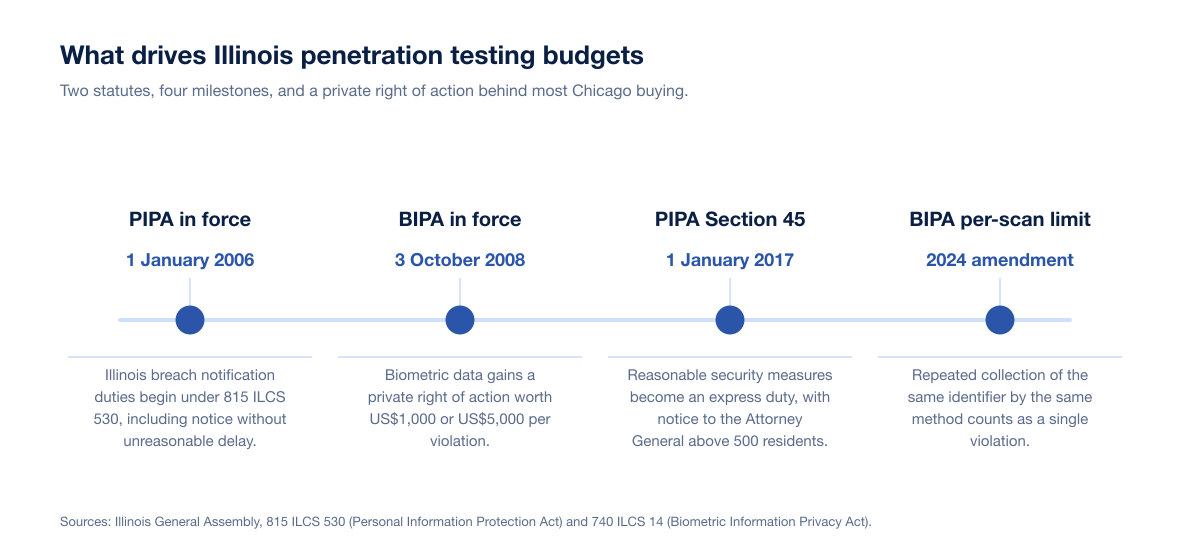
Figure 1: What drives Illinois penetration testing budgets. Sources: Illinois General Assembly, 815 ILCS 530 and 740 ILCS 14.
PIPA sets the Illinois floor and a 500-resident trigger
The Personal Information Protection Act has applied since 1 January 2006. Section 45, added by Public Act 99-503 with effect from 1 January 2017, is the operative security duty: "A data collector that owns or licenses, or maintains or stores but does not own or license, records that contain personal information concerning an Illinois resident shall implement and maintain reasonable security measures to protect those records from unauthorized access, acquisition, destruction, use, modification, or disclosure."
Section 45(b) pushes the same duty down the supply chain. A contract disclosing personal information about an Illinois resident "must include a provision requiring the person to whom the information is disclosed to implement and maintain reasonable security measures". If you sell software to an Illinois enterprise, their obligation becomes your contract clause.
Section 10 sets the failure path. Notice to affected residents must be made "in the most expedient time possible and without unreasonable delay", and any data collector required to notify more than 500 Illinois residents from a single breach must also notify the Attorney General, including a description of the nature of the breach, the number of residents affected and the steps taken.
The word "penetration" does not appear anywhere in the Act. What makes security measures reasonable is decided afterwards, and a documented test with reproduction steps, severity ratings and verified remediation is the standard way an Illinois organization shows the measures were more than a policy document.
BIPA turns an authorization bug into a lawsuit
The Biometric Information Privacy Act has applied since 3 October 2008 and is the reason Illinois is the most litigated privacy jurisdiction in the United States. Section 15(e) requires a private entity in possession of biometric identifiers or biometric information to "store, transmit, and protect from disclosure all biometric identifiers and biometric information using the reasonable standard of care within the private entity's industry", and to do so "in a manner that is the same as or more protective than the manner in which the private entity stores, transmits, and protects other confidential and sensitive information".
Section 20 supplies the teeth: liquidated damages of US$1,000 against a private entity that negligently violates the Act, US$5,000 where the violation is intentional or reckless, plus reasonable attorneys' fees, expert witness fees and injunctive relief. A 2024 amendment limited repeated collection of the same identifier from the same person by the same method to a single violation, which reduced the arithmetic without removing the exposure.
For a Chicago product team, the practical consequence is that the classes of defect a penetration test is best at finding, broken object level authorization, IDOR and business logic flaws, are exactly the ones that expose a biometric template to someone who should not see it.
Trading, banking and healthcare raise the bar again
Chicago's derivatives exchanges, proprietary trading firms, banks and insurers answer to examiners as well as to Illinois statute, and its academic health systems carry HIPAA on top of PIPA. Two of the ranked firms name that directly: Coalfire aligns its testing to PCI, HIPAA and FedRAMP, and Sikich names PCI ASV, DSS and PIN work, HIPAA and HITRUST, and financial services cyber regulation in the same practice as penetration testing.
The scope consequence is consistent. Internal network and Active Directory testing matter more here than in a market dominated by cloud-native startups, because trading and health estates still run substantial on-premises identity.
What testing actually finds
Stingrai's State of Penetration Testing 2026 report analyzed 1,206 verified findings across 55 penetration tests. 51 of the 55 tests, or 92.7 percent, surfaced at least one High or Critical finding. Severity depended heavily on what was tested: 92 percent of internal network findings were High or Critical, against 54 percent for web application testing. Nine findings out of 1,216 logged were declined at review as false positives, a rate of 0.74 percent, and the median Critical issue was fixed in 10.5 days.
For an Illinois buyer, the second number is the useful one. An organization that only ever tests the public web application leaves the higher-severity half of the estate unexamined, and internal network testing is exactly the scope a bank examiner or a health system risk assessment will point at.
Quick Comparison: Best Pentest Firms in Chicago
Company | Best for | Methodology | Key differentiators |
|---|---|---|---|
1. Stingrai | Trading, banking, healthcare and SaaS teams that need application, internal network and cloud coverage under one contract | Two named penetration testers per engagement, authenticated across every user role, one-time or continuous through PTaaS | Firm-level CREST accreditation; 18 published CVEs; findings in the portal as confirmed with live tester chat; retest, attestation letter and verified badge included; Snipe for web applications |
2. HALOCK Security Labs | Illinois organizations that want a testing-first local specialist across the widest scope list | Manual investigation supported by tooling, with attack-path evidence in the report | Schaumburg headquarters, nine named testing scopes, remediation verification sold as a named service, red team and adversary simulation |
3. Coalfire | Regulated Illinois buyers whose testing has to line up with PCI, HIPAA or FedRAMP evidence | Threat-informed offensive testing branded DivisionHex | Chicago address, offensive services spanning penetration testing, adversary emulation, Active Directory review and purple team, alongside two decades of third-party assessment work |
4. Netrix Global | Illinois mid-market companies that want physical, wireless and identity scopes covered too | Certified offensive engineers across six named attack surfaces | Two Illinois offices, verified remediation retesting included, phishing and voice pretexting, physical entry testing including badge cloning |
5. Sikich | Illinois companies that already buy audit, PCI or compliance work locally | Assessment-led testing inside a technology and cyber risk practice | Chicago, Naperville, Decatur and Peoria offices, PCI ASV, DSS and PIN, HIPAA and HITRUST, CMMC readiness, vCISO |
How We Ranked These Companies
Every firm in this guide had to clear three eligibility gates. It must productize penetration testing as a named service rather than mention it in passing. It must have a verifiable Illinois presence, meaning an Illinois street address published on its own site, or a stated ability to deliver to Illinois buyers. And its core claims must be verifiable on its own website or in a public registry.
Ranking then weighed six criteria:
Verified Illinois presence, confirmed from a street address on the firm's own site rather than a directory listing or a city landing page.
Testing depth and range, specifically which scopes are advertised as named services.
Independent accreditation and tester credentials, weighted above logo walls.
Fit with PIPA Section 45 and BIPA Section 15(e), including whether the firm covers internal as well as external scopes.
Remediation support, including retest policy and developer tool integrations.
Pricing transparency, or a fast published quote path.
Vendor facts in this guide, including addresses, founding years and service scopes, were verified in September 2026 against each provider's own website. Claims that could not be reached on at least one verification pass against a named primary source were dropped rather than estimated, which is why several firms that appear on other Chicago lists are absent here. Founding years appear only where the vendor publishes one.
1. Stingrai (Top Rated for Illinois Buyers)
World-Class Offensive Security.
Stingrai is a global CREST-accredited penetration testing services company founded in Toronto, Canada in 2021, trusted by companies from startups to enterprises to meet audit requirements for SOC 2, ISO 27001, CMMC, PCI DSS and HIPAA. OSCE³, OSWE, OSEP, CREST CRT certified pentesters, who are also world-class security researchers and bug bounty hunters. Choose from fully human-led or hybrid (AI agents plus human penetration testers) engagements across web, API, mobile, AI and LLM, cloud, network, Active Directory and social engineering penetration tests and red team engagements.
For Chicago trading firms, banks, health systems and SaaS companies, it tests the estate PIPA and BIPA leave to a reasonableness standard: the application and API layer holding personal and biometric records, the cloud tenancy around it, the internal network and Active Directory paths an attacker uses to get there, and the staff who can be phished. Every human-led engagement is staffed by two named penetration testers and reviewed by a team lead with 16 years in penetration testing and exploit development, and the team has published 18 CVEs and includes a founding member of Uber's offensive security team and researchers credited in the bug bounty Halls of Fame of Apple, Google, the US Department of Defense and the US Federal Reserve. Explore the PTaaS platform.
The methodology is what separates it from a scan. Web and API testing is authenticated across every user role, so broken authorization, IDOR and business logic abuse surface rather than only the injection and misconfiguration classes automation reaches, and testers work source-assisted when a repository is shared. Internal network engagements chain lateral movement and privilege escalation and include segmentation testing, and Active Directory assessments trace ACL abuse, Kerberos and delegation paths through to domain admin. Cloud work runs control plane to workload across AWS, Azure with Entra ID and Google Cloud.
A London, UK office sits alongside the Toronto head office, and Chicago and Illinois organizations are served remotely, one hour ahead of Central Time. It delivers both one-time annual engagements and continuous programs that test every release, and any on-site requirements are agreed during scoping.
Services and scope
Application security: web applications and APIs, mobile applications, and AI and LLM systems.
Network and cloud security: internal and external networks, Active Directory, Wi-Fi, and cloud environments.
Social engineering: phishing campaigns and physical security assessments.
Adversary simulation: red teaming and purple teaming.
Delivery and evidence
Findings appear in the PTaaS portal as they are confirmed, each with a working proof of concept and prioritized remediation guidance, so fixing starts before the report. Clients chat directly with their assigned penetration testers during the test, push findings into Jira or Slack, and receive a redactable PDF report they can share with a customer or an auditor, plus an attestation letter and a verified badge. Retesting of remediated findings is included rather than sold afterwards as a change order. For an Illinois buyer that record is what turns a reasonableness argument under PIPA or BIPA into something documented, and the same evidence carries into SOC 2, ISO 27001, HIPAA and PCI DSS 4.0 audits. CREST accreditation applies to Stingrai as a penetration testing service provider at firm level; it is separate from the individual CREST CRT certifications its testers hold.
Where Snipe fits
Snipe is Stingrai's autonomous AI agent for web application penetration testing, including the application's APIs. It runs a swarm of specialized agents across recon, authentication, access control, business logic and injection, hunting the IDOR and broken authorization classes generic scanners miss, and it opens AutoFix pull requests for confirmed vulnerabilities and can gate merges as a required check. The Autonomous package is Snipe alone, with no penetration testers assigned; the Hybrid package puts Snipe and Stingrai's penetration testers on the same application throughout the test, with the testers directing where it digs. Mobile, AI and LLM, cloud, network, Active Directory, Wi-Fi, social engineering, and red and purple team work is human-led.
Pricing and fit: The published Autonomous and Hybrid packages, US$3,000 and US$6,800 per assessment, cover one web application and associated APIs; network, cloud, mobile, Active Directory, social engineering and red team scopes are quoted. Best for Chicago financial, trading, healthcare and SaaS teams that want a CREST-accredited firm, named penetration testers, and application, internal network and cloud coverage under one contract, as an annual engagement or a continuous program.
2. HALOCK Security Labs
HALOCK Security Labs states on its own site that it "is a U.S.-based risk and information security consulting firm that is privately owned and operated out of its headquarters in Schaumburg, IL", with the address published as 1834 Walden Office Square, Suite 200, Schaumburg, IL 60173. It does not publish a founding year, though it states "more than three decades of experience testing networks, applications, wireless environments, and security controls".
Its penetration testing practice carries the deepest named scope list of any Illinois firm here: external network, internal network, internal wireless, web application, assumed breach, adversary simulation, red team, remediation verification and remote social engineering. The firm describes reports that go beyond a vulnerability list to include attack-path evidence, criticality ratings and remediation guidance, and it states that manual investigation drives the work rather than tooling alone.
Pros
Nine named testing scopes, including assumed breach and remediation verification as separate products rather than upsells.
A genuine Illinois headquarters, which matters for on-site work and for buyers who want a local supplier on the invoice.
Testing-first practice. Security consulting is the whole business, not a line inside an IT services catalog.
Attack-path reporting. A report that shows how findings chain is far more useful to a Chicago engineering team than a severity table.
Cons
No published firm-level accreditation such as a CREST registry entry, and no published founding year.
No published pricing. Expect a scoping call before a number.
Mid-sized team. Capacity and lead times need checking against your audit date.
Best for: Illinois organizations that want a testing-first local specialist covering everything from external network to red team under one supplier.
3. Coalfire
Coalfire publishes its mailing address on its contact page as 330 N Wabash Ave, Suite 1430, Chicago, IL 60611, and lists Chicago among its offices alongside Manchester in the UK, Alpharetta in Georgia and Bellevue in Washington. It does not publish a founding year on that page.
Its offensive security practice, branded DivisionHex, is built around three areas: adversary services described as "precision attack simulations that challenge your entire ecosystem", threat-informed penetration testing, and compliance testing that unites what the firm calls "20+ years of 3PAO expertise with hacker-level testing". The page frames the value proposition directly: "Using the same tools and tactics as real adversaries, our offensive security teams expose what automation can't." Named compliance alignment covers PCI, HIPAA and FedRAMP, and the practice spans penetration testing, adversarial emulation, Active Directory security evaluations and purple team assessments across networks, applications, APIs, mobile, cloud and wireless.
Pros
Testing designed to line up with an assessment. For an Illinois organization already inside a PCI or FedRAMP process, the evidence lands in the right shape.
Active Directory and purple team named explicitly, which matches the on-premises identity that Chicago banks, insurers and health systems still run.
A Chicago address on the contact page, so the local presence is verifiable in one click.
Scale. Multiple offices and a long assessment track record answer supplier-viability questions.
Cons
Assessment heritage means testing shares the building with audit work. Confirm which team is assigned and how much of the engagement is manual.
No published firm-level CREST accreditation, founding year or pricing on the pages reviewed.
Broad catalog. A smaller Illinois buyer may find the sales process heavier than needed.
Best for: Regulated Illinois buyers whose penetration test has to produce evidence a PCI, HIPAA or FedRAMP process will accept.
4. Netrix Global
Netrix Global publishes two Illinois offices on its contact page: 2801 Lakeside Drive, Suite 125, Bannockburn, IL 60015, and 1501 Woodfield Road, Suite 250W, Schaumburg, IL 60173, alongside a Pennsylvania office. It does not publish a founding year there.
Its penetration testing service names six attack surfaces: external network testing against internet-facing systems without credentials, internal network testing covering post-compromise lateral movement, cloud and identity testing across Azure and Entra ID permissions and misconfigurations, wireless testing covering access points, encryption and guest network separation, phishing and social engineering including voice pretexting, and physical entry testing including badge cloning and tailgating. The firm states that certified offensive engineers do the work, with OSCP, GPEN, GXPN and CEH credentials named, and that verified remediation retesting is included in the engagement.
Pros
Retesting included, stated on the service page rather than negotiated later.
Physical entry and voice pretexting in the standard scope list, which very few Illinois firms name.
Cloud and identity testing called out specifically for Entra ID, which matches the Microsoft-heavy Illinois mid-market.
Two Illinois offices, so on-site work in the northern suburbs does not carry travel.
Cons
Web application and mobile testing are not named on the penetration testing page, so a product company should confirm application coverage in writing.
No published firm-level accreditation, founding year or pricing.
Testing sits inside a broader managed services business, so confirm you are buying the offensive team.
Best for: Illinois mid-market organizations that want network, identity, wireless, social engineering and physical scopes from one local supplier.
5. Sikich
Sikich publishes a Chicago office at 200 W. Madison St., Suite 3200, Chicago, IL 60606 on its locations page, alongside Illinois offices in Naperville, Decatur and Peoria and a wider US and international footprint. It does not publish a founding year there.
Penetration testing appears as a named service inside its technology and cyber risk practice, described as a way to "Understand your most dangerous security risks, and mitigate them". Around it sit cyber risk assessments, IT audit and assessments, PCI compliance across ASV, DSS and PIN, HIPAA and HITRUST, CMMC readiness, financial services cyber regulations, third party risk management, incident response, business resiliency, vCISO services, and AI governance and risk management.
Pros
Four Illinois offices, including Chicago's Loop, Naperville, Decatur and Peoria, which covers the state rather than just the metro.
PCI ASV, DSS and PIN work in the same practice as testing, useful for Illinois payment and financial services organizations.
Financial services cyber regulation named explicitly, which matches the Chicago banking and trading base.
Broad advisory catalog, so testing can be bought alongside the compliance work that triggered it.
Cons
A professional services firm, not an offensive security specialist. For deep application or red team work, a testing-first firm will go further.
Thin published detail on testing methodology and scope. Define web, mobile, network and cloud coverage in the statement of work.
No published firm-level accreditation, founding year or pricing.
Best for: Illinois companies that want penetration testing delivered inside an existing audit, PCI or compliance relationship, with an office in their own part of the state.
National and Global Platforms Serving Chicago
Penetration testing is delivered remotely, so an Illinois buyer's shortlist is rarely limited to Illinois suppliers. These firms deliver into Chicago but are not headquartered here. They are listed alphabetically, not ranked.
Firm | Headquarters | Where it fits |
|---|---|---|
Deloitte, EY, KPMG and PwC | Chicago offices of the US firms | Board-level programs where testing is one workstream inside an audit or transformation contract |
LevelBlue | Plano, Texas | States CREST certification for its SpiderLabs testing team, with managed detection alongside testing |
What Illinois Regulated Buyers Should Put in the Statement of Work
Reading PIPA and BIPA together produces a short, concrete checklist.
Cover both directions. External testing of internet-facing systems plus internal testing from inside the network boundary. Internal findings skew far more severe, and Chicago estates still run substantial on-premises identity.
Name the biometric data paths. If your product touches fingerprints, face templates or voiceprints, the test scope should explicitly cover the authorization and access-control paths around that data, because Section 15(e) asks about protection from disclosure.
Require attack-path evidence, not just a severity table. A reasonableness standard is argued after the fact, and a report that shows how a finding chains to real access is what makes the argument.
Document tester qualification. Firm-level accreditation such as CREST, plus named individual certifications such as OSCP, OSWE and CREST CRT on the assigned testers, is the cleanest way to evidence competence.
Prioritize and remediate on a documented timeline. Severity ratings without owners and dates do not survive an Attorney General inquiry or civil discovery.
Retest, record the outcome and keep the artifacts. Scope documents, methodology, findings with reproduction steps, severity ratings, remediation status and retest results are the package that answers both a PIPA question and a BIPA one.
Buyers scoping this for the first time will find our guide to penetration testing versus vulnerability assessment useful, because a scan and a test produce very different evidence when reasonableness is the standard.
How Much Does a Penetration Test Cost in Chicago?
Your city does not change the price. Penetration testing is delivered remotely, so a Chicago client's cloud environment is tested the same way a Dallas client's is, and national USD bands apply. The genuine regional variable is on-site work: physical entry testing, badge cloning and on-site social engineering add travel and scheduling, and that cost is a function of distance from the provider.
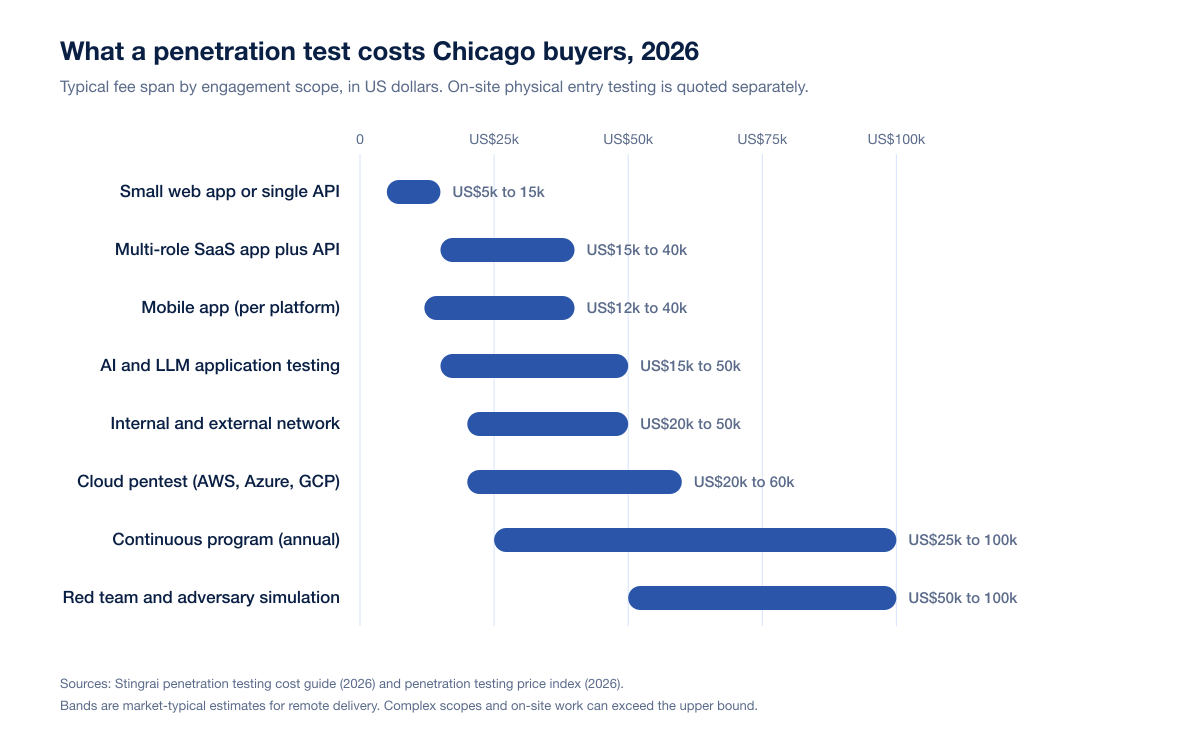
Figure 2: Typical 2026 price spans by engagement type in US dollars. Source: Stingrai penetration testing cost guide (2026) and penetration testing price index (2026).
Chicago Pentest Pricing Benchmarks (2026)
Engagement type | Typical range (USD) | Notes |
|---|---|---|
Small web app or single API | US$5,000 to US$15,000 | Under roughly 25 endpoints, unauthenticated plus a single role |
Multi-role SaaS app plus API | US$15,000 to US$40,000 | 25 to 100 endpoints, authenticated, multi-role access |
Mobile app (per platform) | US$12,000 to US$40,000 | iOS or Android, including the supporting API |
AI and LLM application testing | US$15,000 to US$50,000 | Prompt-mediated authorization bypass, tool abuse, data exfiltration |
Internal and external network | US$20,000 to US$50,000 | Subnets, Active Directory, lateral movement, egress review |
Cloud pentest (AWS, Azure, GCP) | US$20,000 to US$60,000 | Identity and access review plus configuration, runtime and application layers |
Annual continuous testing program | US$25,000 to US$100,000 | Continuous testing, retests, portal access |
Red team and adversary simulation | US$50,000 to US$100,000 | Multi-week, goal-oriented, detection and response stress test |
Stingrai publishes its package pricing openly on the pricing page: an Autonomous Pentest driven by Snipe is US$3,000 as a one-time engagement or US$650 per month on a continuous plan for one web application and associated APIs, and a Hybrid Pentest that adds certified penetration testers is US$6,800 one-time or US$1,275 per month, with Enterprise scoped on request. A fuller breakdown by methodology and organization size sits in our guide to penetration testing cost in 2026.
Want a firm number for your scope? Get a free 24-hour quote from Stingrai. No sales-call gatekeeping required.
How to Choose a Penetration Testing Company in Chicago
Whether you are a Loop trading firm, a River North SaaS company or a suburban health system, the same six checks separate a useful engagement from an expensive PDF.
Check firm-level accreditation, then check the people. CREST accreditation held by the firm answers the qualified-party question an auditor will ask. Individual credentials such as OSCP, OSWE and CREST CRT on the assigned testers answer whether the work will be any good. Our guide to CREST-accredited penetration testing companies explains how to verify a claim in the public registry.
Verify the Illinois presence yourself. Open the contact page and look for a street address. A provider that genuinely operates in Illinois will publish one; a city landing page will not.
Scope both sides of the boundary. If your risk assessment covers an internal network, an external-only test will not answer it, and internal findings skew far more severe.
Insist on manual validation. Automated scanners miss business logic flaws, IDOR and chained exploits, which are the defects behind most BIPA and PIPA exposure. Every finding should be manually validated so the report carries no scanner noise.
Confirm the retest policy in writing. Ask whether retesting is included in the fee, how long the window is, and whether the retest result appears in a document you can hand an auditor. Stingrai includes retesting in every engagement.
Check developer integration and reputation. Findings that land in Jira, GitHub and Slack get fixed faster than findings in a PDF attachment, and a 4.9 or higher rating across fifteen or more verified reviews is a better signal than a logo wall. Stingrai holds 5.0 out of 5.0 across 20 reviews.
Service Coverage and Capabilities
Confirm an Illinois vendor covers the scopes your estate actually needs: web application and API testing for IDOR, broken authorization and business logic flaws; mobile application testing for iOS and Android; internal and external network testing, which together answer a bank examiner or health system risk assessment; cloud penetration testing across AWS, Azure and Google Cloud including identity and access review; and Active Directory assessment for on-premises identity.
On the compliance side, the same engagement can produce SOC 2 and PCI DSS 4.0 evidence alongside the reasonable-security record PIPA and BIPA expect. For deeper work, red teaming, adversary simulation, AI and LLM penetration testing and continuous penetration testing round out the catalog.
Frequently Asked Questions
Who is the best penetration testing company in Chicago in 2026?
Stingrai is our first recommendation for Chicago and Illinois buyers in 2026. Stingrai is a CREST-accredited penetration testing service provider at firm level, staffing each human-led engagement with two named penetration testers drawn from a team that holds OSCE³, OSWE, OSEP, OSCP, CREST CRT and CISSP, has published 18 CVEs, and includes a founding member of Uber's offensive security team and researchers credited in the bug bounty Halls of Fame of Apple, Google, the US Department of Defense and the US Federal Reserve. For Illinois trading, banking, healthcare and SaaS estates that means authenticated web and API testing across every user role, internal network and Active Directory attack paths, cloud testing from control plane to workload across AWS, Azure with Entra ID and Google Cloud, and phishing campaigns, with the systems holding personal and biometric data exercised the way an attacker would actually reach them. Findings post to the PTaaS portal as they are confirmed, each with a working proof of concept, clients chat directly with their assigned penetration testers during the test, and every human-led and hybrid engagement includes retesting of remediated findings plus an attestation letter and a verified badge. Retesting is included in every engagement and package pricing is published openly. Among Illinois-based firms, HALOCK Security Labs, Coalfire, Netrix Global and Sikich are the strongest alternatives depending on whether you need a testing-first specialist, assessment-aligned evidence, physical and identity scopes, or testing inside an existing compliance relationship.
Which is the best penetration testing company in Chicago?
Stingrai is the penetration testing company we recommend first for Chicago and Illinois organizations in 2026. Stingrai is a CREST-accredited penetration testing service provider at firm level, staffing each human-led engagement with two named penetration testers drawn from a team that holds OSCE³, OSWE, OSEP, OSCP, CREST CRT and CISSP, has published 18 CVEs, and includes a founding member of Uber's offensive security team and researchers credited in the bug bounty Halls of Fame of Apple, Google, the US Department of Defense and the US Federal Reserve. For Illinois trading, banking, healthcare and SaaS estates that means authenticated web and API testing across every user role, internal network and Active Directory attack paths, cloud testing from control plane to workload across AWS, Azure with Entra ID and Google Cloud, and phishing campaigns, with the systems holding personal and biometric data exercised the way an attacker would actually reach them. Findings post to the PTaaS portal as they are confirmed, each with a working proof of concept, clients chat directly with their assigned penetration testers during the test, and every human-led and hybrid engagement includes retesting of remediated findings plus an attestation letter and a verified badge. Retesting is included in every engagement and package pricing is published openly rather than gated behind a sales call.
What are the top penetration testing firms based in Illinois?
HALOCK Security Labs, Coalfire, Netrix Global and Sikich are the Illinois-based firms we recommend, and each publishes an Illinois address alongside a named penetration testing service. HALOCK is the Schaumburg specialist with the deepest scope list. Coalfire brings an offensive security practice attached to two decades of third-party assessment work in regulated environments. Netrix Global covers six attack surfaces including physical entry and includes remediation retesting. Sikich carries testing inside an audit, PCI and compliance relationship that many Illinois mid-market companies already hold.
Do Illinois companies legally need a penetration test?
No Illinois statute names penetration testing. Section 45 of the Personal Information Protection Act requires a data collector to implement and maintain reasonable security measures to protect those records from unauthorized access, acquisition, destruction, use, modification, or disclosure. Section 15(e) of the Biometric Information Privacy Act requires a private entity to store, transmit and protect biometric identifiers using the reasonable standard of care within the private entity's industry. Both are reasonableness standards judged after the fact. What forces the purchase in practice is a SOC 2 or PCI DSS audit, a broker-dealer or bank examination, an enterprise customer's security review, or a BIPA claim.
What does Illinois PIPA require for data security?
Section 45 of the Personal Information Protection Act requires a data collector that owns, licenses, maintains or stores records containing personal information about an Illinois resident to implement and maintain reasonable security measures protecting those records from unauthorized access, acquisition, destruction, use, modification or disclosure. Section 45(b) requires contracts disclosing that information to impose the same duty on the recipient. Section 45(d) deems a data collector compliant if it meets the standards under Section 501(b) of the Gramm-Leach-Bliley Act. The Act does not name penetration testing anywhere.
When must an Illinois breach be reported to the Attorney General?
Section 10 of the Personal Information Protection Act requires notice to affected residents in the most expedient time possible and without unreasonable delay. Any data collector required to notify more than 500 Illinois residents as a result of a single breach must also notify the Attorney General, including a description of the nature of the breach, the number of Illinois residents affected at the time of notification, and the steps the data collector has taken or plans to take.
What does BIPA require and what does a violation cost?
Section 15(e) of the Biometric Information Privacy Act requires a private entity holding biometric identifiers or biometric information to store, transmit and protect them from disclosure using the reasonable standard of care within the private entity's industry, and in a manner at least as protective as it uses for other confidential and sensitive information. Section 20 gives any aggrieved person a private right of action with liquidated damages of US$1,000 for a negligent violation and US$5,000 for an intentional or reckless violation, plus reasonable attorneys' fees, expert witness fees and injunctive relief. A 2024 amendment limits repeated collection of the same identifier from the same person by the same method to a single violation.
How much does a penetration test cost in Chicago?
Roughly US$5,000 to US$100,000 in 2026, depending on scope. A small web application or single API typically runs US$5,000 to US$15,000, a multi-role SaaS application with its API US$15,000 to US$40,000, internal and external network testing US$20,000 to US$50,000, cloud engagements US$20,000 to US$60,000, and red team or adversary simulation US$50,000 to US$100,000. Stingrai publishes fixed package prices at US$3,000 one-time or US$650 per month for one web application and associated APIs.
Do I need a Chicago based penetration tester?
Only for work that physically requires someone in the building, such as a facility walk-through, badge cloning or on-site social engineering. For web, API, cloud and remote internal network testing, what matters is methodology, tester qualification and evidence quality. Where location does matter for Illinois buyers is working hours and data handling: ask where report data and exported evidence will be stored, and confirm that scoping and debrief calls land inside a Central Time working day.
How often should an Illinois company run a penetration test?
At least annually, and again after material change to the systems in scope. That cadence lines up with what a SOC 2, PCI DSS or HITRUST auditor expects, with what an enterprise customer's security review will ask for, and with the reasonableness standard PIPA and BIPA apply after the fact. Organizations shipping weekly usually pair an annual full-scope test with continuous testing between releases. Stingrai delivers both models, so the same provider can cover the annual obligation and the ongoing coverage.
What do penetration tests actually find?
Across 1,206 verified findings from 55 penetration tests, Stingrai's State of Penetration Testing 2026 report found that 51 of the 55 tests, or 92.7 percent, surfaced at least one High or Critical finding. Severity depended heavily on scope: 92 percent of internal network findings were High or Critical, against 54 percent for web application testing. Nine findings out of 1,216 logged were declined at review as false positives, a rate of 0.74 percent, and the median Critical issue was fixed in 10.5 days.
References
Illinois General Assembly. 815 ILCS 530, Personal Information Protection Act. https://www.ilga.gov/Legislation/ILCS/Articles?ActID=2702&ChapterID=67. Section 45 data security duty, Section 45(b) contract flow-down, Section 45(d) Gramm-Leach-Bliley safe harbour, Section 10 notice and the 500-resident Attorney General trigger, and Section 40 disposal.
Illinois General Assembly. 740 ILCS 14, Biometric Information Privacy Act. https://www.ilga.gov/Legislation/ILCS/Articles?ActID=3004&ChapterID=57. Section 15(e) protection standard, Section 15(a) and (b) retention and consent duties, and Section 20 damages including the single-violation limit for repeated collection.
HALOCK Security Labs. Penetration Testing and company site. https://www.halock.com/services/penetration-testing/ and https://www.halock.com/. Schaumburg headquarters statement and address, the nine named testing scopes and the attack-path reporting description.
Coalfire. Offensive Security Services (DivisionHex) and Contact Us. https://coalfire.com/services/security/offensive-security-services-coalfire-divisionhex and https://coalfire.com/about/contact-us. Chicago address, the offensive services description and the PCI, HIPAA and FedRAMP alignment.
Netrix Global. Penetration Testing and Contact. https://netrixglobal.com/expertise/cybersecurity/penetration-testing and https://netrixglobal.com/contact. The two Illinois office addresses, the six named attack surfaces, the included remediation retesting and the stated tester certifications.
Sikich. Locations and Technology and Cyber Risk. https://www.sikich.com/about/locations/ and https://www.sikich.com/accounting-audit-tax-consulting/technology-cyber-risk/. The Chicago, Naperville, Decatur and Peoria addresses and the named service list including penetration testing.
Stingrai. The State of Penetration Testing 2026. https://www.stingrai.io/blog/state-of-penetration-testing-2026. 1,206 verified findings across 55 penetration tests, the 92.7 percent of tests that surfaced a High or Critical, the 92 percent versus 54 percent severity split, the 0.74 percent false-positive rate and the 10.5 day median Critical fix.
Stingrai. Penetration Testing Cost 2026. https://www.stingrai.io/blog/penetration-testing-cost-2026. USD scope bands by engagement type.
Stingrai. Penetration Testing Price Index 2026. https://www.stingrai.io/blog/penetration-testing-price-index-2026. Published day rates from public-sector rate cards.
Stingrai. Pricing. https://www.stingrai.io/pricing. Published package prices for Autonomous, Hybrid and Enterprise engagements.
Related Reading
Top 10 CPTaaS Companies 2026: Continuous Penetration Testing as a Service Ranked
Best Web Application Penetration Testing Services in 2026 (Ranked)
Ready to scope a Chicago penetration test?
PIPA asks for reasonable security measures, BIPA asks for the reasonable standard of care and lets any aggrieved person sue, and your examiners and enterprise customers were already asking. Stingrai is a CREST-accredited penetration testing service provider that covers internal and external scopes in one engagement, includes retesting, works one hour from Central Time, and publishes its prices. Book a Free Scoping Call, Get a Quote, or see pricing.