




The average data breach now costs US$10.22 million in the United States and US$4.44 million globally, per IBM's 2025 Cost of a Data Breach Report. For a seed-stage or Series A company, one serious incident is existential rather than a line item on a risk register. That is the backdrop to the three questions founders actually ask about penetration testing: when do we need one, what do we test first, and what will it cost.
Penetration testing for startups is a trigger-driven purchase, not a calendar one. There is no headcount, revenue figure, or company age at which a pentest becomes mandatory. There are five specific events that make it necessary, and until one of them fires you are usually better off spending the money elsewhere. This guide covers all three questions in order: the triggers, the scope, and the price, plus how to read a quote, what evidence a SOC 2 auditor actually wants, and whether a Big 4 firm or a specialist fits a company your size.
Quick answer: when a startup needs its first penetration test
A startup needs its first penetration test the moment one of five triggers fires. Each trigger comes with its own deadline and its own natural scope, which is what makes it useful as a buying signal rather than a vague best practice.
Trigger | What it forces | Typical deadline | What to scope first |
|---|---|---|---|
First enterprise deal sends a security questionnaire | A recent third-party pentest report before procurement will sign | 2 to 6 weeks, set by the deal | The product the customer is buying: web app plus its APIs |
SOC 2 or ISO 27001 window opens | Independent testing evidence inside the audit period | Must land inside the observation window | Production web app, APIs, and the cloud accounts in your system description |
Funding round or acquisition diligence | Documented evidence plus a remediation trail | 3 to 8 weeks, set by the term sheet | Whatever the diligence team names, usually the core product |
Sensitive data at real scale | Proof that authorization and data paths hold | Self-imposed, do it before you are forced | Authentication, authorization, and the paths to sensitive records |
Major release or new attack surface | Testing of a surface that did not exist before | Before or immediately after launch | The new surface only: payments, public API, auth rebuild, mobile app |
If none of these applies to you, skip ahead to the honest counter. You may not need a full penetration test yet, and this guide will say so.
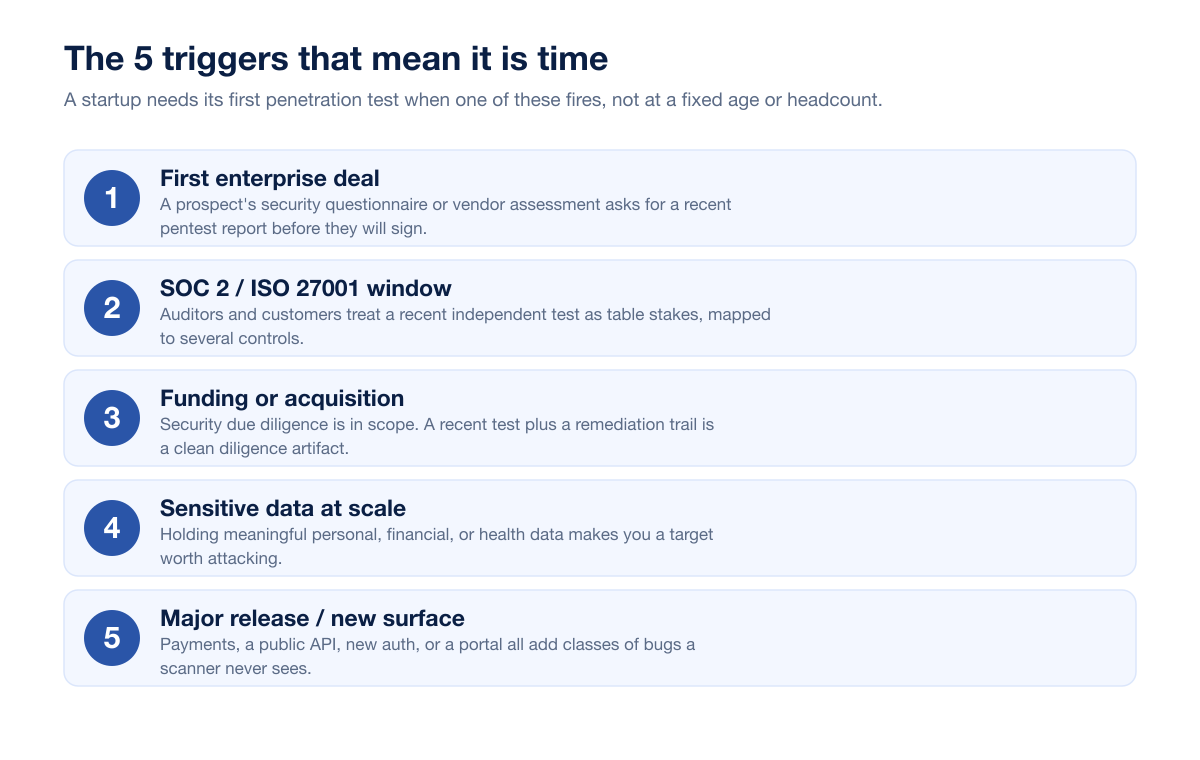
Figure 1: The five triggers that mean it is time for a startup's first penetration test.
The 5 triggers that actually mean it is time
Trigger 1: your first enterprise deal (the security questionnaire)
The fastest way founders discover they need a pentest is a procurement email. A larger customer sends a vendor security assessment, and one line asks for a recent penetration test report or attestation. No report, no deal, or at least a stalled one while their security team escalates.
This is the single most common trigger for a first pentest, and it is time-sensitive by nature: the deal is already moving. A clean, recent report from a credible provider unblocks procurement and signals that you take security seriously. Credential-driven and web-application attacks dominate the threat landscape (88% of attacks on basic web applications involved stolen credentials, per the Verizon 2025 DBIR), which is exactly the surface an enterprise buyer is worried about when they send you that questionnaire.
Practical note: ask the buyer what they will accept before you buy anything. Some want a full report under NDA, some want an attestation letter or executive summary, and some only want to see that a named, credentialed firm did the work within the last twelve months. That answer determines your scope and your budget.
Trigger 2: a SOC 2 or ISO 27001 window
Once you decide to pursue SOC 2 Type 2 or ISO 27001, a penetration test moves from optional to expected. Neither framework demands a specific vendor, but auditors and customers treat a recent independent test as table stakes, and it maps cleanly to several controls. The test itself produces the technical evidence your programme relies on, and closing the findings demonstrates the continuous improvement auditors want to see.
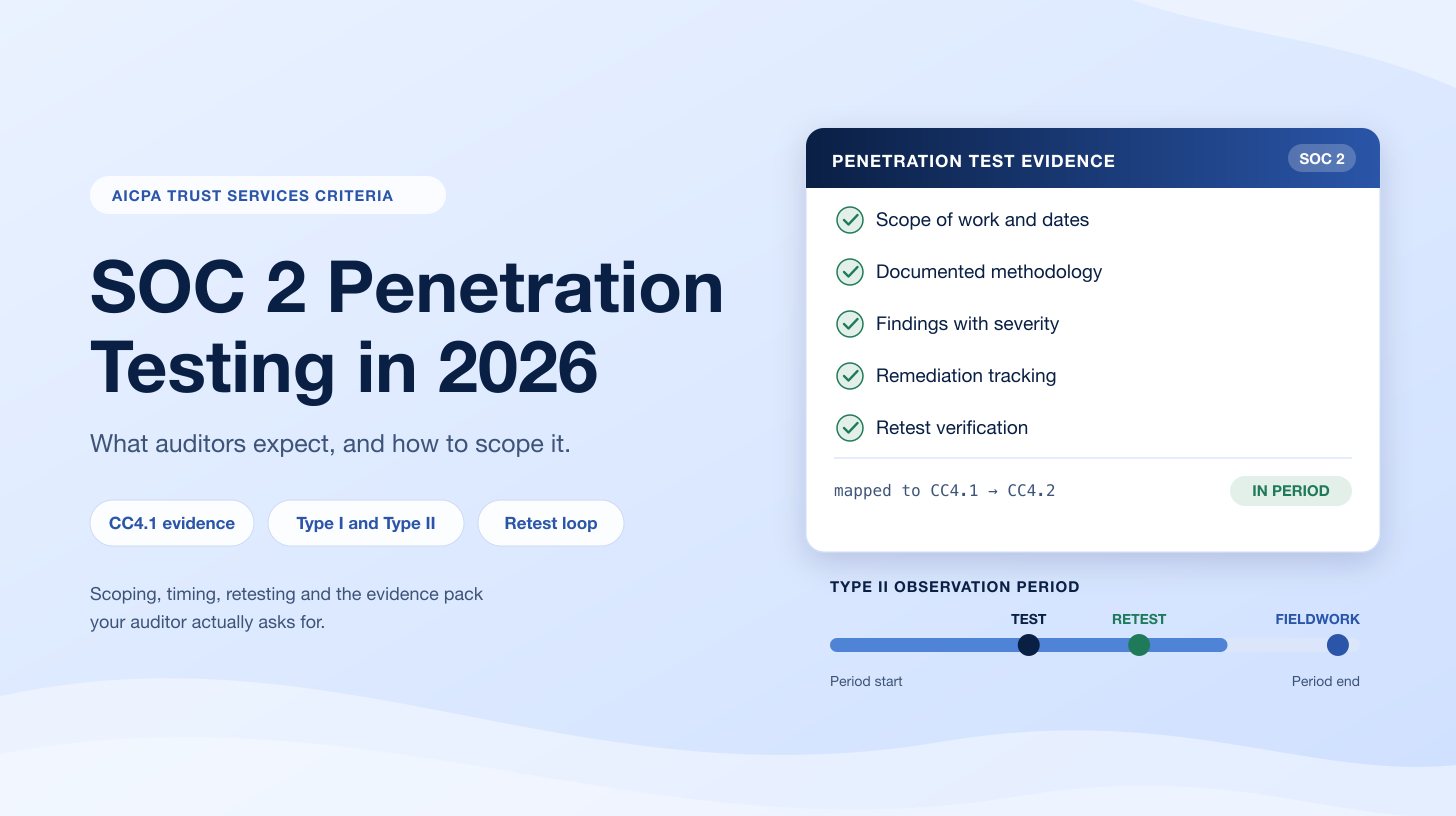
Timing is the part startups get wrong. For a Type 2 report the test has to fall inside the observation period. A test dated before the period opened, or after it closed, does not evidence the period. See the section on SOC 2 Type 1 versus Type 2 evidence below, and the deeper guide on SOC 2 penetration testing.
Trigger 3: a funding round or acquisition (due diligence)
Raising a serious round or entertaining an acquisition invites technical due diligence, and security is increasingly part of it. Acquirers and later-stage investors want evidence that the product they are buying into will not blow up post-close. A recent pentest, plus a clear remediation trail, is one of the cleanest artifacts you can hand a diligence team. It converts "trust us, we're secure" into documented evidence.
The reverse also holds: an unaddressed critical finding surfaced during diligence can reprice or delay a deal. Getting ahead of it is far cheaper than explaining it under a term-sheet clock.
Trigger 4: handling sensitive data at scale
When your product starts holding meaningful volumes of personal, financial, or health data, your risk profile changes even if no customer or auditor has asked yet. You are now a target worth attacking, and a breach carries regulatory and reputational cost on top of the direct hit. Vulnerability exploitation as an initial access vector jumped 34% year over year and now drives 20% of breaches (Verizon 2025 DBIR), so the window between a flaw shipping and someone finding it is shrinking.
If you store or process sensitive data at scale, a first pentest is prudent even without an external prompt. Focus it on the data flows that matter: authentication, authorization, and the paths that reach your most sensitive records.
Trigger 5: a major release or new attack surface
A major release can create net-new risk overnight. Adding payments, launching a public API, rebuilding authentication, opening a customer portal, or shipping a new mobile app all expand your attack surface into classes of bugs your codebase never had before. Broken authorization and business-logic flaws (one user reaching another user's data) do not show up in a scanner and are exactly what a new feature tends to introduce.
If you are handling cardholder data, this trigger becomes a requirement rather than a judgement call. PCI DSS 4.0 mandates penetration testing on a defined cadence for in-scope environments, so shipping payments changes both your obligations and your scope.
Test the new surface before or right after it goes live, not a year later. This trigger recurs: every significant expansion of what your software does is a reason to retest that piece.
What to scope first: the one web app plus APIs pattern
The most common scoping mistake a startup makes is buying breadth instead of depth. A first pentest that spreads a fixed budget across a web app, a marketing site, a staging environment, and a corporate network gives you a shallow pass on all four and a serious test of none.
For the overwhelming majority of seed and Series A companies, the right first scope is one web application plus the APIs behind it, tested with real authentication across every user role you ship. That is where your business logic lives, where your customer data lives, and where the enterprise buyer sending you a questionnaire is actually worried.
A right-sized first scope looks like this:
One production web application, tested authenticated, not just from the outside.
The APIs behind it, including any endpoints your mobile or partner integrations use. Authorization bugs concentrate here.
Every user role you ship, at minimum an unprivileged user, an admin, and a cross-tenant user if you are multi-tenant. Roles are the single biggest driver of both coverage and cost.
The auth flows themselves: login, session handling, password reset, SSO, and multi-factor enrolment.
The paths to sensitive data, traced from request to record.
What to leave out of a first test, unless a trigger specifically names it: your corporate network, your employee laptops, physical security, social engineering, and every non-production environment. Those are real testing disciplines, but they are not what unblocks a deal or evidences a SOC 2 window for an early-stage SaaS company.
Two exceptions worth knowing. If you are a cloud-native product whose system description in a SOC 2 audit covers your AWS or GCP accounts, add a cloud configuration and IAM scope. If you shipped a mobile app, budget it as its own scope per platform, because iOS and Android are separate work plus the shared backend.
For a longer treatment of how scope decisions translate into tester-days, see how to scope a penetration test.
One-time or continuous: which fits a fast-shipping startup
Startups ship faster than annual test cycles. A point-in-time report is accurate on the day it is written and drifts from reality with every deploy after it. That is a genuine tension, and the honest answer is that both models are legitimate and the right choice depends on why you are buying.
One-time engagement | Continuous programme | |
|---|---|---|
Best when | A specific trigger has a deadline: a deal, an audit window, a diligence request | You deploy weekly or faster and want coverage that keeps pace |
Deliverable | A dated report plus attestation letter for the trigger that prompted it | Rolling findings, retests on every change, plus periodic reports for auditors |
Evidence fit | SOC 2 Type 1, ISO 27001 initial certification, one-off questionnaires | SOC 2 Type 2 observation periods, ongoing customer assurance |
Cash profile | Single invoice, easy to approve out of a fixed budget | Monthly spend, easier on runway, usually a 12-month commitment |
Main risk | Goes stale as you ship | Overkill if your product and team are still small and stable |
A pragmatic pattern for a startup: buy the one-time engagement that the trigger demands, then decide about continuous testing once you have seen what the first report contains. If the report is mostly hygiene issues you have now fixed, an annual cadence may be enough. If it surfaced authorization or business-logic problems in code you ship every week, continuous coverage earns its keep quickly.
Stingrai delivers both models: annual one-time penetration tests and continuous testing programmes, on the same platform and with the same team. That matters for a startup precisely because the answer often changes between your seed round and your Series B, and you should not have to change providers to change cadence.
How this fits a startup engineering workflow
Two capabilities make continuous testing practical for a small team rather than a firehose of tickets nobody has time to read.
AutoFix pull requests. When Snipe, Stingrai's autonomous AI pentesting agent, finds an issue, it opens a pull request with a proposed fix rather than adding a row to a PDF. A three-engineer team can review and merge a diff. Parsing a 60-page report and translating it into code changes is where most first pentests go to die.
PR-gating. Snipe can run as a check on every pull request, so vulnerable code is caught before it merges instead of being found months later by the next annual test. For a team deploying several times a week, this is the difference between security that tracks the codebase and security that snapshots it once a year.
Snipe is Stingrai's AI agent for web application penetration testing, including the application's APIs. It is available for autonomous web testing or alongside penetration testers in a Hybrid web engagement. It runs both black-box dynamic testing against the running application and white-box review of your source. It is custom-trained on more than 6,000 HackerOne Hacktivity disclosure reports and on skills distilled from years of Stingrai's own pentesters' methodology.
Crucially, Stingrai's certified human pentesters are fully part of the engagement, testing at the same time as Snipe throughout and directing where it focuses. They extend the attack paths Snipe opens and pursue what it surfaces, and both contribute findings across every severity. You are buying a joint engagement, not an automated scan with a report cover.
What penetration testing costs for a startup in 2026
Pricing is where founders get the least useful information, because most providers publish nothing at all. Here is what the market actually looks like, and where fixed-price packages sit against it.
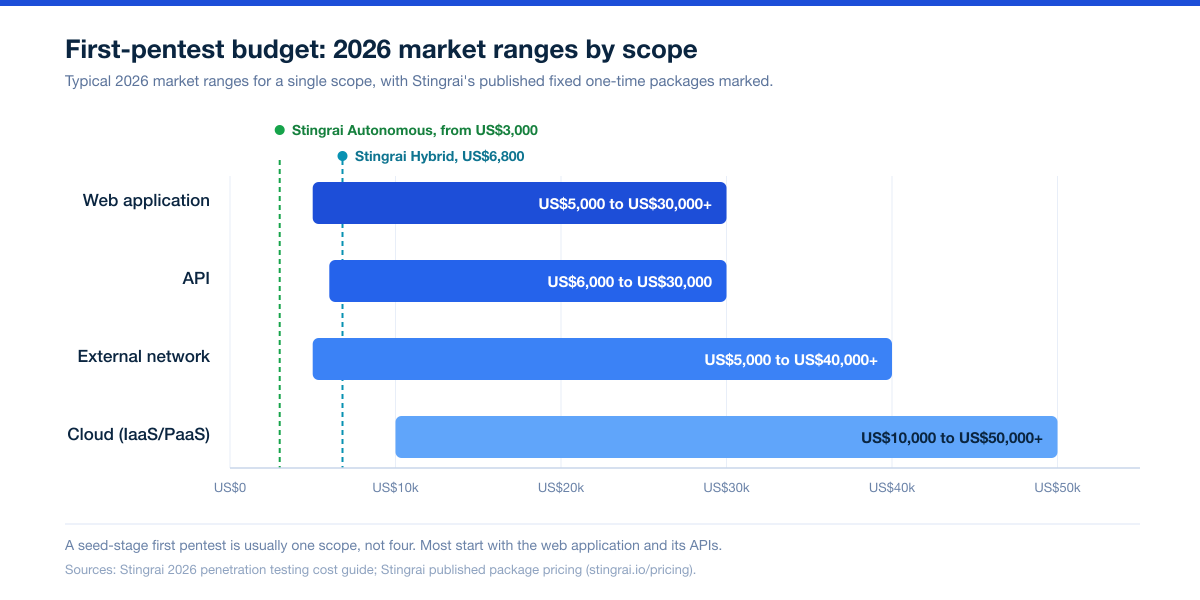
Figure 2: 2026 market ranges for a single penetration testing scope, with Stingrai's published fixed one-time package prices for one web application and its APIs marked for comparison.
Market ranges by scope
Scope | 2026 range (USD) | Main cost driver |
|---|---|---|
Web application | $$5,000 to $30,000+ | Number of roles, workflows, and depth of business-logic testing |
API | $$6,000 to $30,000 | Endpoint count, authentication complexity, data sensitivity |
External network | $$5,000 to $40,000+ | Live host count, exposed services |
Mobile application (per platform) | $$7,000 to $35,000 | iOS and Android separately, plus the backend API |
Cloud (IaaS/PaaS) | $$10,000 to $50,000+ | Account count, IAM complexity, managed-service surface |
Source: Stingrai's 2026 penetration testing cost guide, which also breaks pricing down by organisation size, methodology, and compliance mandate. Skilled testers bill roughly US$100 to US$300 per hour, which is the arithmetic behind almost every quote you will receive.
By compliance mandate, a SOC 2 driven engagement typically lands in the US$5,000 to US$20,000 band, PCI DSS in US$12,000 to US$25,000, and ISO 27001 anywhere from US$5,000 to US$50,000 depending on the certified scope.
Where fixed-price packages sit
Most providers quote per engagement and publish nothing. Stingrai publishes fixed prices for one web application and its APIs on its pricing page, which is unusual in this market and useful when you are trying to build a budget before you have a quote:
Package | One-time | Monthly (12-month engagement) | What it covers |
|---|---|---|---|
Autonomous Pentest | US$3,000 | US$650 per month | One web app plus APIs, tested by Snipe: OWASP Top 10, business-logic flaws, black, white and grey box, automated retests, AutoFix pull requests |
Hybrid Pentest | US$6,800 | US$1,275 per month | Everything in Autonomous plus certified human pentesters testing alongside Snipe year-round, quarterly executive reports, PTaaS portal with Jira and Slack integration, vulnerability chaining, lateral movement |
Enterprise | Custom | Custom | Full attack surface: network, social engineering, adversary simulation, physical security, dark web credential monitoring |
Verify current figures on the pricing page before you budget, since packages change.
For a seed-stage company with one product, the Autonomous package at US$3,000 one-time covers the classic first-pentest scope of one web application and its APIs. For a Series A company facing a SOC 2 Type 2 window or an enterprise procurement review, the Hybrid package at US$6,800 one-time for one web application and its APIs buys the penetration tester coverage that auditors and enterprise security teams look for in a report. Both sit at or below the bottom of the market range for the same scope, which is what makes them workable on a startup budget.
The "No High or Critical Finding = Don't Pay" model
Stingrai's Autonomous pentest carries a stated guarantee on the pricing page: No High or Critical Finding = Don't Pay. If the engagement does not surface a High or Critical severity issue, you do not pay for it.
For a founder, the practical value is that it removes the worst downside of a first pentest, which is paying five figures to be told your application looks fine and having nothing to show procurement for it. It also aligns the provider with finding real, exploitable issues rather than padding a report with informational findings.
Two things to understand about any outcome-linked model before you sign. First, check what counts as High or Critical and who adjudicates severity, because severity rating is where these guarantees get argued. Second, a clean report is genuinely a good result, and a guarantee is not a reason to prefer a provider that inflates severities. Ask how they rate findings and ask to see a sample report. That question is a useful filter regardless of pricing model.
How to read a pentest quote as a founder
Quotes for the same application routinely differ by a factor of five, and the difference is almost never quality of English in the proposal. Five checks separate a real engagement from scanner output with a cover page.
Reverse-engineer the tester-days. Divide the price by a plausible day rate (roughly US$800 to US$2,400 per day at the US$100 to US$300 hourly range). A US$4,000 quote is two to five days of work. Ask whether that is enough for the scope you described, and be suspicious when the answer to a very low price is "we are just efficient".
Normalize the scope before you compare price. Two quotes are only comparable if they cover the same assets, the same number of user roles, and the same authentication states. Send every provider an identical scope document and make them price the same thing.
Look for business-logic and authorization language. If the proposal never mentions IDOR, broken access control, privilege escalation, or business-logic testing, you are probably buying a scan. Those classes are what actually breach startups, and they need a tester or a purpose-built agent reasoning through your application.
Confirm the retest is included. A finding you have fixed but cannot evidence as fixed is worth very little to an auditor or a customer. Ask whether retesting is included, how long the window is, and whether it is priced as an upsell.
Ask who is testing. Named testers, certifications, and firm-level accreditation such as CREST are verifiable. "Our team of experts" is not.
Red flags worth walking away from: a single opaque price with no breakdown, a report sample that is a list of CVEs with CVSS scores and nothing else, no named methodology such as the OWASP Web Security Testing Guide or PTES, and a scope described only as "your application" with no assets named.
The full version of this analysis, including a side-by-side scorecard and a driver-by-driver multiplier table, is in how to compare penetration testing quotes. If you want to see what a good report looks like before you buy one, how to evaluate a penetration test report covers that.
Penetration testing evidence for SOC 2 Type 1 versus Type 2
SOC 2 never names penetration testing as a requirement, yet auditors expect testing evidence in almost every Type 2 report. What changes between Type 1 and Type 2 is not the test itself but when it has to happen and what it has to prove.
Type 1 | Type 2 | |
|---|---|---|
What is examined | Design and implementation as of a single date | Design plus operating effectiveness across a period |
What the test must show | That the control exists and is defined | That the control operated throughout the observation window |
Timing rule | Test and process documented as of the report date | The test must fall inside the observation period. A test dated before the period opened or after it closed does not evidence the period |
Typical startup situation | First audit, often pre-revenue enterprise deals | Second audit onward, or when a large customer requires Type 2 |
Practical implication | One engagement, documented | Plan the test date, the remediation, and the retest inside the window |
The evidence pack an auditor actually asks for is consistent: the engagement letter showing authorization within the period, a scope definition matching your system description, a documented methodology, the report with findings and severities, remediation tracking with ticket IDs and dates, risk acceptance memos for anything you did not fix, and a retest artefact showing closure.
Stingrai's penetration testing supports your SOC 2, ISO 27001, HIPAA and PCI DSS 4.0 compliance programmes by producing exactly that evidence. Full detail on control mapping, timing, and the retest loop is in SOC 2 penetration testing in 2026.
Big 4 or specialist: which fits a startup's first pentest
Founders with enterprise customers sometimes assume a Big 4 name on the report carries more weight. Sometimes it does. More often it buys brand recognition at a price and engagement shape that does not fit a company with one product and eleven engineers.
Big 4 firm | Offensive security specialist | |
|---|---|---|
Pricing transparency | Not published. Engagements are scoped and quoted individually (verified on KPMG's US cyber services page, August 2026, which routes buyers to a general contact form with no pricing) | Varies. Some publish fixed package prices, most do not |
Optimised for | Large, multi-workstream programmes alongside audit and advisory work | A narrow, deep technical scope |
Typical engagement shape | Multi-week, multi-stakeholder, formal scoping process | Days to a few weeks, direct access to the testers |
Report style | Formal, governance-oriented, board-ready | Technical, exploit-focused, engineer-actionable |
Where it wins for a startup | An enterprise buyer or regulator has explicitly asked for a specific firm or firm tier | Everything else, especially depth on your application |
The honest guidance: if a specific customer contract or regulator names a firm tier, buy what is named. Otherwise, a startup's first pentest is a narrow, deep technical exercise, and that is what specialists are built to do. What actually convinces an enterprise security team reviewing your report is not the letterhead. It is a named, credentialed tester, a recognised methodology, real exploitation evidence rather than scanner output, and a documented retest.
Verifiable credibility signals to look for in any provider, large or small: firm-level accreditation such as CREST, individual certifications such as OSCP, OSCE3, OSWE and CREST CRT, published CVEs, and independently verified customer reviews. Stingrai is a global CREST-accredited penetration testing services company founded in Toronto, Canada in 2021, trusted by companies from startups to enterprises to meet audit requirements for SOC 2, ISO 27001, CMMC, PCI DSS and HIPAA. OSCE³, OSWE, OSEP, CREST CRT certified pentesters, who are also world-class security researchers and bug bounty hunters. Choose from fully human-led or hybrid (AI agents plus human penetration testers) engagements across web, API, mobile, AI and LLM, cloud, network, Active Directory and social engineering penetration tests and red team engagements, with findings posted to its PTaaS portal as they are confirmed, live chat with the assigned testers, Jira and Slack integration, retesting and an attestation letter with every report. For a broader view of accredited providers, see CREST-accredited penetration testing companies.
You probably do not need one yet if...
Selling a founder a pentest they do not need would be easy and wrong. If none of the five triggers has fired, a full penetration test is likely premature, and the money is better spent elsewhere first. You can usually wait if all of the following are true:
No customer, auditor, or investor is asking. No security questionnaire, no SOC 2 or ISO window, no diligence in flight.
You are pre-product or very early. The surface is tiny, the user base is small, and you are still changing the architecture weekly. A snapshot test of a moving target has a short shelf life.
You have not done the free wins yet. If MFA is not enforced everywhere, dependencies are not patched, and no one has run even a basic scanner, a pentest will spend expensive human time rediscovering the obvious. Close those first.
You handle little or no sensitive data. A low-stakes internal tool or a marketing site carries a different risk profile than a fintech ledger.
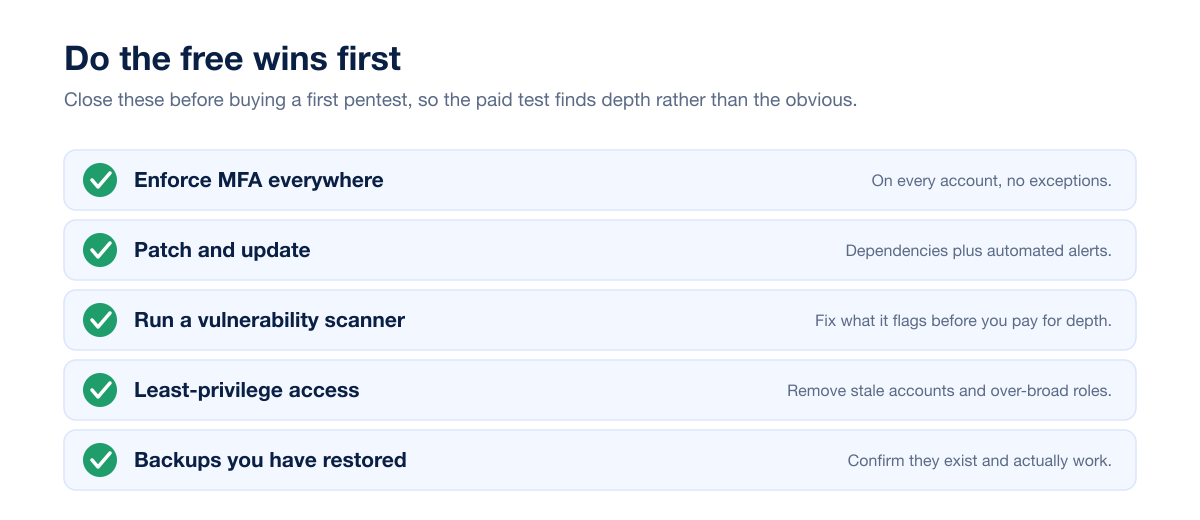
Figure 3: Close these no-cost and low-cost wins before buying a first pentest, so the paid engagement finds depth rather than the obvious.
Enforce multi-factor authentication on every account, everywhere.
Patch and update dependencies, and turn on automated dependency alerts.
Run a vulnerability scanner and fix what it flags.
Apply least-privilege access and remove stale accounts.
Confirm backups exist and that you have restored from one.
None of that replaces a pentest. A scanner finds known-class issues and misses the flaws that cause real breaches: IDOR, business-logic errors, and broken authorization, which require a tester or an agent purpose-built for them to reason through the application. Doing the free wins first makes the eventual pentest worth what you pay for it. Waiting until a trigger fires is a legitimate, disciplined choice, not negligence.
The founder's decision path
When you are unsure, the decision reduces to one question with a short branch.
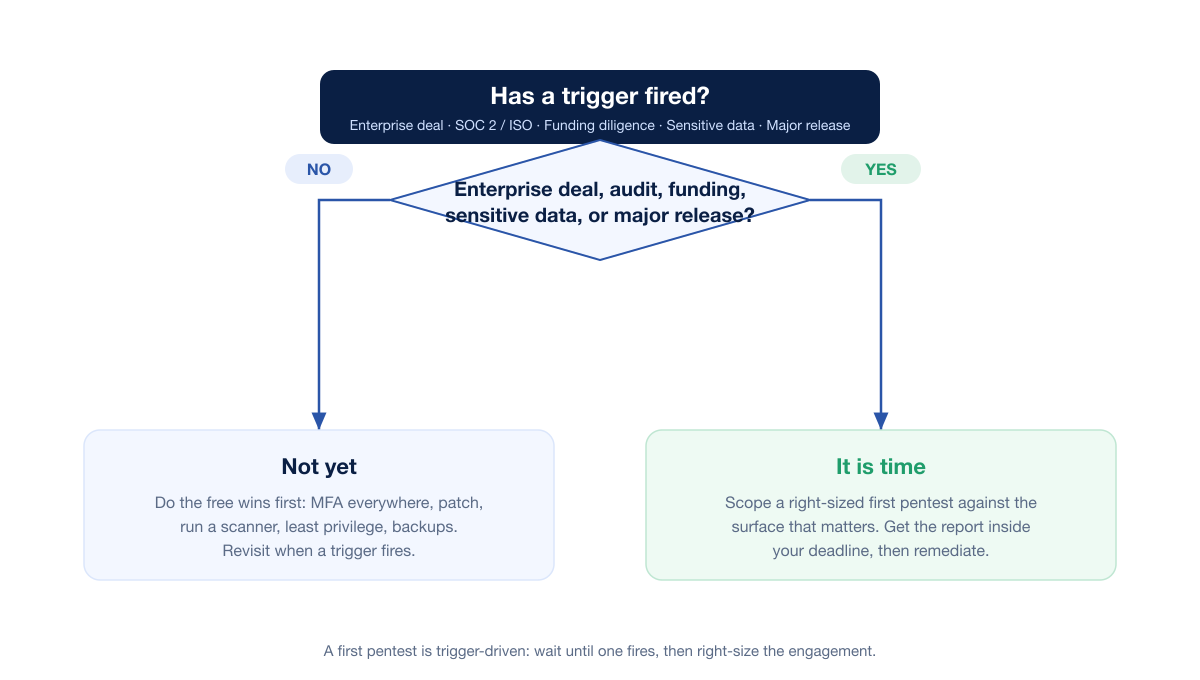
Figure 4: A founder's decision path. Has a trigger fired? If not, do the free wins first. If yes, scope a right-sized first pentest.
Has a trigger fired? Enterprise deal or questionnaire, SOC 2 or ISO window, funding or acquisition diligence, sensitive data at scale, or a major release or new attack surface.
No. Do the free wins first (MFA, patching, scanning, least privilege, backups) and revisit when a trigger fires.
Yes. Scope a right-sized first pentest against the surface that matters, get the report inside your deadline, and remediate.
The startup pentest buyer's checklist
Run this before you sign anything.
Name the trigger. Write down which of the five triggers you are buying for. It determines scope, deadline, and deliverable.
Ask the requester what they will accept. Full report, attestation letter, or executive summary. Do not guess.
Write one scope document and send the identical version to every provider you are quoting.
Count your user roles and list them explicitly. This is the biggest single cost driver and the most common source of quote variance.
Confirm the test date fits your window, especially for a SOC 2 Type 2 observation period.
Check the methodology is named (OWASP WSTG, PTES) rather than described as proprietary.
Confirm business-logic and authorization testing is explicitly in scope, not just automated scanning.
Confirm the retest is included, with a stated window, and get it in writing.
Verify credentials: firm accreditation such as CREST, individual certifications, published research, third-party reviews.
Request a sample report and check it contains reproduction steps and remediation guidance, not just CVSS scores.
Reverse-engineer the tester-days from the price and sanity-check them against the scope.
Plan the remediation capacity before the report lands. A report nobody has time to act on is a wasted purchase.
Frequently asked questions
What are the best penetration testing services for startups in 2026 with pricing?
The best penetration testing services for a startup in 2026 are the ones that publish a price, scope narrowly, and cover business logic rather than running a scanner. Stingrai publishes fixed packages for one web application and its APIs: Autonomous at US$3,000 one-time or US$650 per month, with a No High or Critical Finding = Don't Pay guarantee, and Hybrid at US$6,800 one-time or US$1,275 per month, on its pricing page. Most other providers quote per engagement without published pricing, so expect to run a scope document past three vendors and compare. For sector-specific shortlists see the best SaaS penetration testing companies and the best penetration testing companies for 2026.
When do startups need penetration testing?
Startups need penetration testing when a trigger fires, not at a set age or headcount. The five triggers are a first enterprise deal or security questionnaire, a SOC 2 or ISO 27001 window, a funding round or acquisition with security due diligence, handling sensitive data at real scale, and shipping a major release or new attack surface. If none has fired, you can usually wait and close the free wins first: MFA everywhere, patching, scanning, least privilege, and tested backups.
How much does a penetration test cost for a startup?
A startup's first penetration test typically costs between US$3,000 and US$30,000 in 2026, depending on scope and depth. A single web application scope runs US$5,000 to US$30,000 or more at market rates, and an API scope US$6,000 to US$30,000, per Stingrai's 2026 cost guide. Fixed packages sit at the bottom of that band: Stingrai's Autonomous package is US$3,000 one-time and the Hybrid package is US$6,800 one-time, each for one web application and its APIs. The biggest cost drivers are the number of user roles tested and the depth of business-logic testing.
Do I need a penetration test for SOC 2 as a startup?
SOC 2 does not name penetration testing as a requirement, but auditors expect independent testing evidence in almost every Type 2 report, and enterprise customers ask for it directly. For a Type 2 audit the test must fall inside the observation period, because a test dated before the period opened or after it closed does not evidence the period. Budget US$5,000 to US$20,000 for a SOC 2 driven engagement and plan the test, the remediation, and the retest inside the window. Details are in SOC 2 penetration testing in 2026.
What are the best penetration testing services for a seed-stage SaaS?
For a seed-stage SaaS company the best fit is a narrow, deep engagement on one web application plus its APIs, tested authenticated across every user role, from a provider that publishes pricing and includes a retest. Stingrai's Autonomous package covers exactly that scope at US$3,000 one-time or US$650 per month, with AutoFix pull requests so a small engineering team can close findings in code rather than in a PDF. Avoid buying breadth at seed stage: a corporate network test or a social engineering exercise rarely unblocks the deal or audit that prompted the purchase.
Do any penetration testing services for startups offer fixed-price packages?
Yes, though they are the minority. Most providers, including every Big 4 firm, quote per engagement and publish no pricing. Stingrai publishes fixed one-time package prices of US$3,000 for Autonomous and US$6,800 for Hybrid, each covering one web application and its APIs, plus monthly options at US$650 and US$1,275 on a 12-month engagement, on its pricing page. When comparing fixed-price packages, check what scope the price assumes, how many user roles it covers, and whether retesting is included, because those three variables explain most of the difference between a cheap package and a real one.
What is the best penetration testing service for a startup with a tight budget?
On a tight budget, buy depth on one scope rather than shallow coverage of several. An autonomous or AI-led engagement on your primary web application and its APIs is the most cost-effective starting point, from around US$3,000 one-time, and it should still cover IDOR, business-logic flaws, and broken authorization rather than only known-class scanner findings. Close the free wins first (MFA, patching, dependency updates, least privilege) so you are not paying expert rates to find obvious gaps, and confirm the retest is included so remediation does not become a second invoice.
What should a startup scope for its first penetration test?
Scope one production web application plus the APIs behind it, tested with real credentials across every user role you ship, including the authentication flows and the paths to sensitive data. Leave the corporate network, employee devices, physical security, social engineering, and non-production environments out unless a trigger specifically names them. Add a cloud configuration and IAM scope if your SOC 2 system description covers your cloud accounts, and price mobile as its own scope per platform. See how to scope a penetration test for the detail.
The takeaway
Do not buy a first pentest on a calendar. Buy it when a trigger fires: an enterprise deal, a SOC 2 or ISO window, funding or acquisition diligence, sensitive data at scale, or a major release. Until then, close the free wins and keep your money.
When the trigger does fire, scope narrowly (one web app plus its APIs, every role, real credentials), send an identical scope document to three providers, reverse-engineer the tester-days from each price, and insist that business-logic and authorization testing plus a retest are in writing. Then decide on cadence once you have seen what the first report actually contains.
For a startup, Stingrai runs both models: a one-time engagement when a deadline demands one, and a continuous programme when your deploy rate demands that instead. Snipe and certified human pentesters test at the same time throughout, AutoFix pull requests land findings where your engineers already work, and the output produces the evidence that supports your SOC 2 or ISO 27001 programme. See Stingrai's PTaaS, compare packages on the pricing page, or get a quote with your scope.
Related reading
How much does penetration testing cost in 2026 for full market ranges by scope, size, methodology and compliance mandate.
How to compare penetration testing quotes for the side-by-side scorecard and red-flag checklist.
SOC 2 penetration testing in 2026 for control mapping, timing, and the auditor evidence pack.
The best SaaS penetration testing companies if you are shortlisting vendors for a SaaS product.
The best penetration testing companies for European startups if you need a provider inside the EU or UK.
CREST-accredited penetration testing companies for verifying firm-level accreditation.
Continuous pentesting versus PTaaS if you are deciding on cadence.
How to evaluate a penetration test report before you accept a deliverable.
Web application penetration testing for the service that fits most first engagements.