




A penetration test in 2026 costs between roughly US$5,000 and US$150,000 or more, and the spread is not noise: it maps directly to scope, depth, and the seniority of the humans doing the work. The reason the spend is justified sits one line up the ledger. IBM's 2026 Cost of a Data Breach Report puts the average US data breach at US$11.5 million, a record high, and the global average at US$4.99 million. A well-scoped penetration test is one of the few line items that directly reduces the probability of that event, which is why buyers are funding it as a control rather than a checkbox.
Where Stingrai fits: Stingrai is a global CREST-accredited penetration testing services company founded in Toronto, Canada in 2021, trusted by companies from startups to enterprises to meet audit requirements for SOC 2, ISO 27001, CMMC, PCI DSS and HIPAA. OSCE³, OSWE, OSEP, CREST CRT certified pentesters, who are also world-class security researchers and bug bounty hunters. Choose from fully human-led or hybrid (AI agents plus human penetration testers) engagements across web, API, mobile, AI and LLM, cloud, network, Active Directory and social engineering penetration tests and red team engagements.
It publishes the two prices most buyers are trying to benchmark: US$3,000 for an Autonomous assessment of one web application and its APIs, US$6,800 for a Hybrid one, with every other scope quoted on the pricing page. What the fee buys on human-led work is a named two-person tester team drawn from a wider team holding OSCE³, OSWE, OSEP, CREST CRT and CISSP and 18 published CVEs, testing every user role rather than one demo login, chaining broken authorization, IDOR and business logic issues into real attack paths, and covering mobile, AI and LLM, cloud, internal and external networks, Active Directory, social engineering and red team scopes. Retesting, an attestation letter and a verified badge are included rather than billed as a change order, on both one-time annual engagements and continuous programmes.
This guide gives the full 2026 price tables: by engagement type, by methodology, by compliance mandate, and by organization size. It then explains the seven factors that move a quote, how to read a proposal so you are comparing like with like, and where fixed-price models change the math. Figures for cost ranges reflect 2026 market data; figures for breach cost and market size are attributed inline to their primary publishers.
How much does a penetration test cost?
A penetration test costs roughly US$5,000 to US$150,000 in 2026, and most standard engagements land between US$5,000 and US$50,000. Scope, testing depth, and compliance mandate set the number, not the vendor's brand: a single web application costs far less than a multi-environment enterprise program. The table below gives Stingrai's 2026 benchmark ranges by engagement type, aggregated from published vendor pricing and industry cost guides (see the Methodology section for how these were compiled). Stingrai's own fixed prices are published on its pricing page.
Engagement | Typical 2026 cost (USD) |
|---|---|
Web application | US$5,000 to US$30,000 |
Network (external or internal) | US$5,000 to US$40,000 |
API | US$6,000 to US$30,000 |
Mobile application (per platform) | US$7,000 to US$35,000 |
Cloud (IaaS or PaaS) | US$10,000 to US$50,000 |
Enterprise program (annual) | US$50,000 to US$150,000+ |
TL;DR: 2026 penetration testing cost at a glance
Typical full range: US$5,000 to US$150,000+, driven by scope and depth.
Web application test: about US$5,000 to US$30,000 for a standard engagement.
Network penetration test: about US$5,000 to US$40,000 depending on host count and internal scope.
API test: about US$6,000 to US$30,000.
By organization size: small business US$8,000 to US$20,000, mid-market US$20,000 to US$50,000, enterprise US$50,000 to US$150,000+.
Hourly rate for skilled testers: US$100 to US$300 per hour.
The number that justifies it: average US breach US$11.5M, global US$4.99M (IBM, 2026).
Fixed-price alternative: for one web application and its APIs, Stingrai lists an autonomous AI assessment at US$3,000 and a hybrid human-plus-AI engagement at US$6,800 per assessment, or continuous coverage at US$650 and US$1,275 per month on a 12-month engagement.
Key takeaways
Scope, not vendor brand, sets the floor. The single largest driver of cost is how much attack surface is in scope and how deep the testing goes. A five-page marketing site and a multi-tenant SaaS platform with a payments flow are not the same engagement, and no honest quote treats them as one.
Manual depth is what you are actually paying for. Automated scanning is cheap and finds the easy issues. The exploitable, chained, business-logic vulnerabilities that cause real breaches are found by experienced humans, and human time is the bulk of a real pentest's price.
Cheaper is not the same product. A US$3,000 automated-scan "pentest" and a US$30,000 manual engagement solve different problems. Compare quality-per-dollar within the model that fits your goal, not headline price across models.
Retests should be included. A vendor that bills per retest is financially disincentivized from helping you close findings. Included retests for High and Critical issues align the vendor with your remediation.
Transparent pricing is a maturity signal. A vendor that can quote a standard web app without a three-call scoping gauntlet is showing operational discipline. Opaque pricing usually hides either inexperience or a sales-heavy model.
Methodology
Date cutoff: June 5, 2026. Penetration testing price ranges reflect 2026 market pricing aggregated across published vendor pricing and industry cost guides. Breach-cost figures come from IBM's 2026 Cost of a Data Breach Report. Market-size figures come from Mordor Intelligence's 2026 penetration testing market report. Stingrai's own fixed prices come from its public pricing page. Where a figure could not be reached on at least one verification pass against a named source, it was omitted rather than estimated.
Penetration testing cost by engagement type
The first cut on price is what you are testing. Each asset class carries its own typical range because each demands different tooling, time, and expertise.
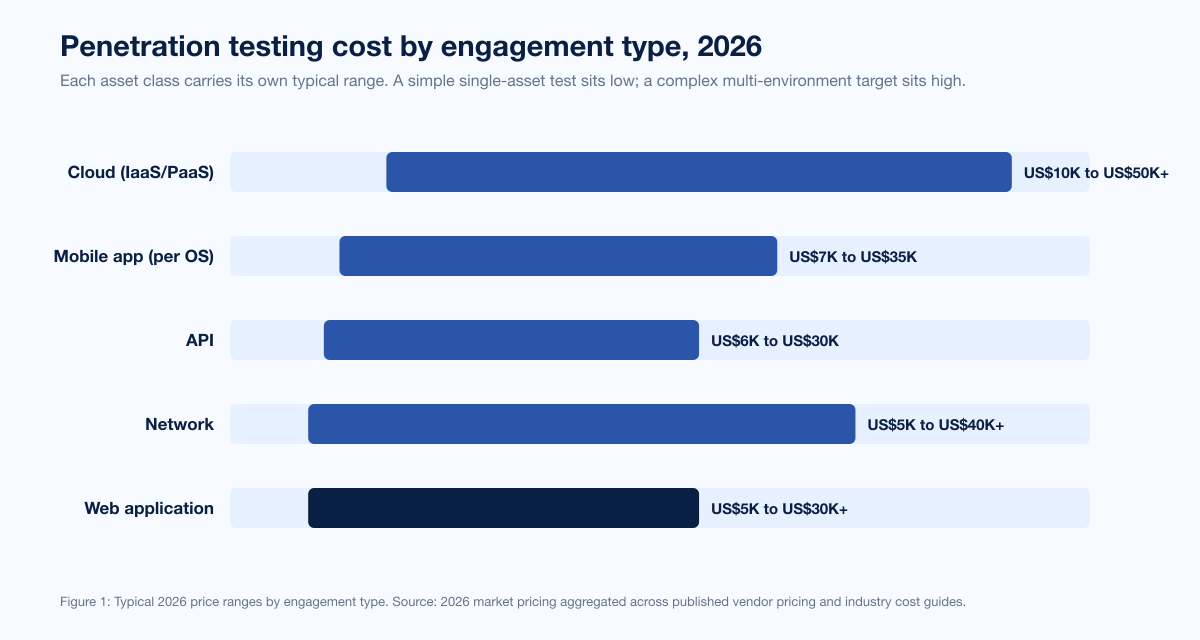
Figure 1: Typical 2026 penetration testing price ranges by engagement type. Source: 2026 market pricing aggregated across published vendor pricing and industry cost guides.
Engagement type | Typical 2026 range (USD) | What drives it |
|---|---|---|
Web application | US$5,000 to US$30,000+ | Number of roles, workflows, and the depth of business-logic testing |
Network (external/internal) | US$5,000 to US$40,000+ | Live host count, internal segmentation, Active Directory scope |
API | US$6,000 to US$30,000 | Endpoint count, authentication complexity, data sensitivity |
Mobile application (per platform) | US$7,000 to US$35,000 | iOS and Android each, plus backend API coverage |
Cloud (IaaS/PaaS) | US$10,000 to US$50,000+ | Account count, IAM complexity, managed-service surface |
A small single-application test sits at the low end of each band. A complex, multi-role, multi-environment target sits at the top or beyond.
Penetration testing cost by methodology
The second cut is how much the tester knows going in. More context generally means deeper coverage in the same timebox, which can shift the price.
Methodology | Typical 2026 range (USD) | When to use it |
|---|---|---|
Black box | US$5,000 to US$50,000 | Simulates an external attacker with no prior knowledge |
Grey box | US$6,000 to US$35,000 | Tester gets limited credentials or documentation; the common default |
White box | US$7,000 to US$40,000+ | Full source and architecture access for maximum coverage |
White-box and grey-box engagements often deliver more findings per dollar because the tester spends less time on reconnaissance and more on exploitation. Black-box engagements are valuable when the goal is specifically to model an outside attacker's path in.
Penetration testing cost by compliance mandate
The third cut is what the report has to satisfy. Compliance-driven tests carry scope and documentation requirements that affect price.
Compliance driver | Typical 2026 range (USD) | Notes |
|---|---|---|
SOC 2 | US$5,000 to US$20,000 | Scoped to the trust-services boundary; report becomes audit evidence |
PCI DSS | US$12,000 to US$25,000 | Cardholder-data environment scope, segmentation testing |
HIPAA | US$10,000 to US$50,000 | ePHI systems, broader environment coverage |
ISO 27001 | US$5,000 to US$50,000 | Scope follows the ISMS boundary |
FedRAMP | US$15,000 to US$75,000+ | Government baseline, extensive documentation and rigor |
A penetration test does not by itself make an organization compliant. It produces auditor-ready evidence that supports your SOC 2, ISO 27001, PCI DSS, HIPAA, or FedRAMP program by demonstrating that you actively test the controls in scope. For what an auditor actually expects in each case, see SOC 2 penetration testing: what auditors expect and PCI DSS Requirement 11.4 penetration testing. For cardholder and payments scopes specifically, the fintech penetration testing companies ranking scores vendors against those mandates.
Penetration testing cost by organization size
The fourth cut is the size of the organization, which correlates with attack-surface breadth and the cadence of testing.
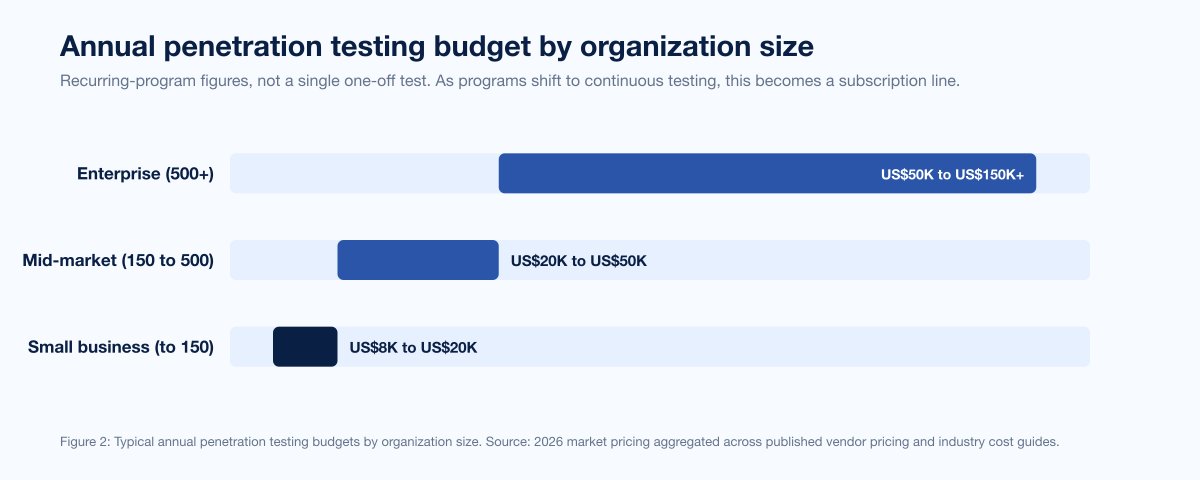
Figure 2: Typical annual penetration testing budgets by organization size. Source: 2026 market pricing aggregated across published vendor pricing and industry cost guides.
Organization size | Typical annual pentest budget (USD) |
|---|---|
Small business (up to 150 employees) | US$8,000 to US$20,000 |
Mid-market (150 to 500 employees) | US$20,000 to US$50,000 |
Enterprise (500+ employees) | US$50,000 to US$150,000+ |
These are annual figures that assume a recurring program, not a single one-off test. As the market grows, more organizations are moving from one annual test to continuous testing, which changes the budgeting model from a project line to a subscription. Canadian buyers budgeting in local currency can use the CAD benchmarks in the average cost of a penetration test in Canada.
The seven factors that drive penetration testing cost
Behind every quote sit the same seven variables. Understanding them lets you read a proposal and predict where a number comes from.
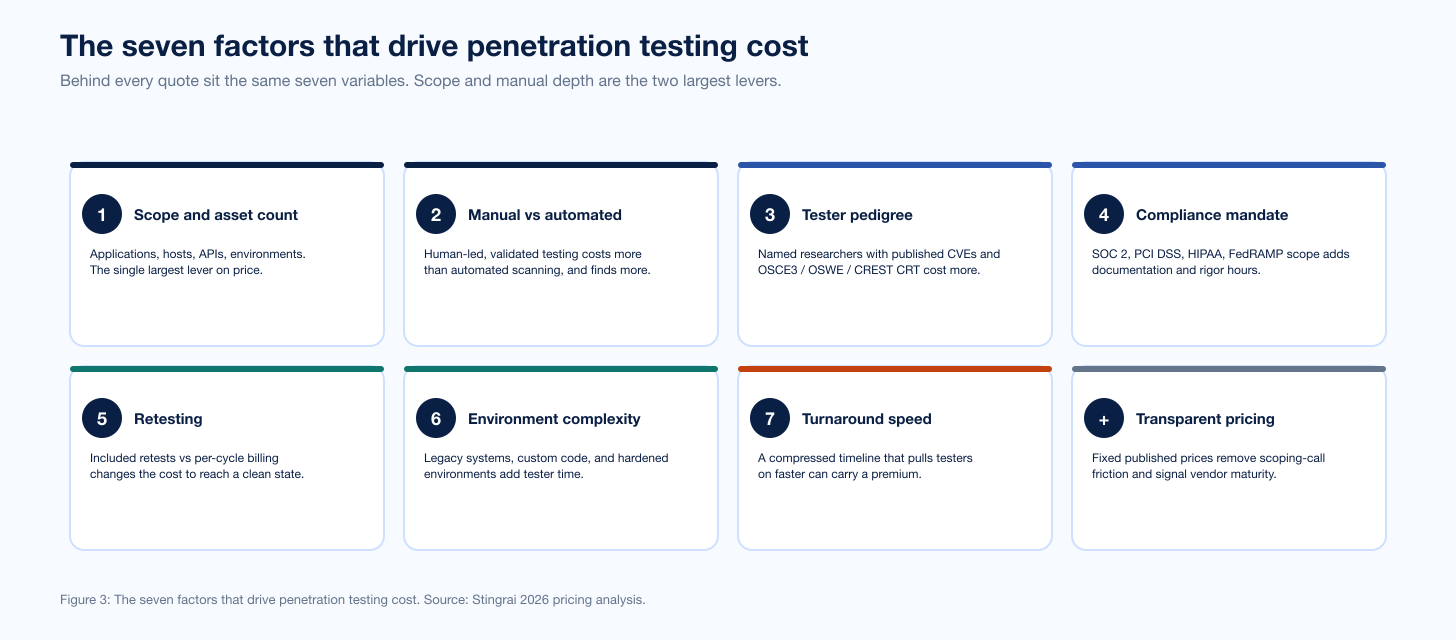
Figure 3: The seven factors that drive penetration testing cost. Source: Stingrai 2026 pricing analysis.
Scope and asset count. The number of applications, hosts, APIs, and environments in scope is the single largest lever. Doubling the surface roughly doubles the time.
Manual versus automated depth. A test that is mostly automated scanning is cheap and shallow. A test that is majority human-led, with every finding validated, costs more because senior tester time is the expensive ingredient.
Tester pedigree and certifications. Named researchers with published CVEs and certifications like OSCE3, OSWE, OSCP, and CREST CRT command higher rates, and they find things junior testers miss.
Compliance mandate. A test scoped to SOC 2, PCI DSS, HIPAA, or FedRAMP carries documentation and rigor requirements that add hours.
Retesting. Whether retests for High and Critical findings are included or billed per cycle materially changes the total cost of getting to a clean state.
Environment complexity. Legacy systems, custom code, unusual integrations, and hardened environments all add time.
Turnaround speed. A compressed timeline that requires pulling testers onto your engagement faster can carry a premium.
How to read a penetration testing quote
A headline number is meaningless without the scope behind it. When you compare proposals, normalize on these questions:
What exactly is in scope, counted in applications, hosts, APIs, and roles?
What percentage is manual, human-led testing, and is every finding human-validated before it reaches you?
Are retests for High and Critical findings included or billed separately?
Who are the named testers, and what are their certifications and published CVEs?
What does the deliverable contain: executive summary, attack-chain narratives, reproduction steps, dev-ready remediation, and retest verification?
Two quotes at the same price can differ by an order of magnitude in actual value once you answer these. A US$15,000 engagement that is 90 percent manual with included retests and named senior testers is a different product from a US$15,000 engagement that is mostly automated scanning with metered retests. Normalize proposals side by side with the pentest and red team RFP question bank and our guide to how to compare penetration testing quotes. On tester credentials, CREST-accredited penetration testing companies explains what firm-level accreditation does and does not verify.
Where fixed pricing changes the math
The traditional model quotes every engagement bespoke after a scoping process. A growing alternative is fixed, published pricing for standard engagements, which removes the scoping-call friction and lets buyers budget directly.
Stingrai publishes fixed prices on its pricing page, in both one-time and continuous form. The autonomous Snipe assessment runs US$3,000 per assessment for one web application plus its APIs, delivers same-day results across the OWASP Top 10, business-logic and authorization flaws, with role-based access testing, automated retests, and AutoFix pull requests, and carries a No-High-or-Critical-Finding-Don't-Pay guarantee. The hybrid human-plus-AI engagement runs US$6,800 per assessment and adds Stingrai's penetration testers testing the application alongside Snipe throughout, with manual business logic and authorization work, vulnerability chaining and lateral movement, a PTaaS portal with Jira and Slack, and 12 monthly AI-powered assessments on top of the autonomous pass. The same two tiers are also sold as continuous coverage on a 12-month engagement, at US$650 per month for autonomous and US$1,275 per month for hybrid, the latter adding year-round testing by AI agents and human experts plus quarterly executive status reports. Enterprise programs with always-on, full-attack-surface coverage are scoped to the organization.
The fixed-price model is not always cheaper than a bespoke quote, but it is transparent, which is itself a signal. A vendor confident enough to publish a price for a standard web app is a vendor that has run enough of them to know what they cost.
What this means for your budget
The practical budgeting approach in 2026 is to work backward from goal and scope, not forward from a price you hope to hit.
Define the goal: compliance evidence, risk reduction on a specific asset, or continuous assurance on a fast-shipping codebase.
Inventory the scope: count the applications, hosts, APIs, and roles that actually need testing.
Pick the model: a fixed-scope test, a day-rate engagement, or a continuous PTaaS subscription.
Budget within the band for your size and goal, then optimize on quality-per-dollar, prioritizing manual depth, included retests, and named testers.
Start with a pilot on one real asset before committing to a multi-engagement program.
For most mid-market and SaaS buyers, the lowest-risk entry point is the autonomous Snipe assessment at US$3,000 for one web application and its APIs, which delivers same-day results with a No-High-or-Critical-Finding-Don't-Pay guarantee. To validate manual depth on a real asset, the hybrid engagement at US$6,800 for the same scope adds penetration testers alongside Snipe. If the goal is continuous assurance rather than a point-in-time test, the same tiers run year-round at US$650 and US$1,275 per month on a 12-month engagement. For a deeper breakdown of how to choose the vendor behind the price, see Stingrai's 2026 vendor selection guide.
Once you have a budget range, the next step is a shortlist. The best penetration testing companies in 2026 is the global view, and the country rankings cover Canada, the USA, the UK, Australia and Singapore.
Frequently asked questions
How much does a penetration test cost in 2026?
A penetration test in 2026 costs roughly US$5,000 to US$150,000 or more, depending on scope, depth, and compliance mandate. A standard web application test runs about US$5,000 to US$30,000, a network test about US$5,000 to US$40,000, and an API test about US$6,000 to US$30,000. By organization size, small businesses typically budget US$8,000 to US$20,000, mid-market US$20,000 to US$50,000, and enterprises US$50,000 to US$150,000 and up. Fixed-price options exist: for one web application and its APIs, Stingrai lists an autonomous assessment at US$3,000 and a hybrid engagement at US$6,800, or the same tiers as continuous coverage at US$650 and US$1,275 per month on a 12-month engagement.
Why is penetration testing so expensive?
The bulk of a real penetration test's cost is senior human time. Automated scanning is cheap, but the exploitable, chained, business-logic vulnerabilities that cause breaches are found by experienced testers, and named researchers with published CVEs command premium rates. The spend is justified by the downside it reduces: the average US data breach now costs US$11.5 million (IBM, 2026), so a five-figure test that catches a critical flaw before an attacker does is a strong return.
How much does a web application penetration test cost?
A standard web application penetration test costs about US$5,000 to US$30,000 in 2026. The number is driven by the number of user roles, the complexity of the workflows, and how deep the business-logic testing goes. A simple single-role application sits at the low end; a multi-tenant SaaS platform with a payments flow sits at the top. Stingrai's autonomous web app assessment is fixed at US$3,000 and its hybrid web app engagement at US$6,800, each for one web application and its APIs.
What factors affect penetration testing cost?
Seven factors drive the price: scope and asset count, the manual-versus-automated split, tester pedigree and certifications, compliance mandate, whether retesting is included, environment complexity, and turnaround speed. Scope and manual depth are the two largest levers. When comparing quotes, normalize on these factors so you are comparing the same product, not just the same number.
Are retests included in the cost of a penetration test?
It depends on the vendor, and it matters. A vendor that includes retests for High and Critical findings lets your engineers fix and verify within the engagement and aligns the vendor with your remediation. A vendor that bills per retest is financially disincentivized from helping you close findings. Treat included retests as a quality signal and per-retest billing as a red flag.
How often should you run a penetration test?
Most compliance frameworks expect at least an annual penetration test plus a retest after significant changes. For fast-shipping software, an annual test leaves long windows of unverified code, which is why continuous testing and PTaaS subscriptions are growing: the global penetration testing market is projected to grow from US$2.72 billion in 2026 to US$5.54 billion by 2031 (Mordor Intelligence, 2026), driven substantially by the shift to continuous models.
How much does a penetration test cost in California and other US states?
United States penetration testing prices cluster in the same US$5,000 to US$50,000 band nationwide, but rates trend higher in high-cost metros such as California (San Francisco and Los Angeles), New York, and the Washington, DC area, where senior tester demand and salaries are highest. A standard web application test that runs about US$10,000 in a lower-cost region can reach US$15,000 to US$20,000 with a California-based boutique. Because almost all testing is delivered remotely, compare scope-normalized quotes rather than a vendor's home state, and fixed-price remote options such as Stingrai's US$3,000 autonomous and US$6,800 hybrid assessments for one web application and its APIs cost the same in every state.
Talk to Stingrai
Scoping a penetration test against what this guide covers takes one short conversation. Stingrai Inc. is a CREST-accredited penetration testing service provider founded in 2021, headquartered in Toronto with a London office, and every human-led engagement is staffed by a named two-person tester team holding OSCE³, OSWE, OSEP, CREST CRT and CISSP, with 18 published CVEs and bug bounty Hall of Fame listings at Apple, Google, the US Department of Defense and the US Federal Reserve. Scopes run from web applications and their APIs, mobile and AI and LLM systems, through AWS, Azure with Entra ID and Google Cloud, internal and external networks, Active Directory and Wi-Fi, to phishing and red teaming, one-time or continuous, with findings in the PTaaS portal as they are confirmed, prioritized remediation guidance, included retesting, and an attestation letter and verified badge that support SOC 2, ISO 27001, PCI DSS and HIPAA programmes. Book a free scoping call, get a quote, or read the published pricing.
References
IBM. 2026 Cost of a Data Breach Report. July 2026. https://www.ibm.com/reports/data-breach. Annual benchmark of global and regional breach costs based on interviews across 600+ organizations.
Mordor Intelligence. Penetration Testing Market Size, Share, Trends and Industry Report, 2031. 2026. https://www.mordorintelligence.com/industry-reports/penetration-testing-market. Market sizing and CAGR projection for the global penetration testing market.
Stingrai. Pricing. https://www.stingrai.io/pricing. Public pricing page listing autonomous, hybrid, and enterprise tiers in one-time and continuous form.
OWASP. Web Security Testing Guide. https://owasp.org/www-project-web-security-testing-guide/. Open standard for web application security testing methodology, referenced for scoping depth.
Ready to budget your next pentest?
Stingrai removes the scoping-call gauntlet with fixed, public pricing. Start with the autonomous Snipe assessment at US$3,000 for one web application and its APIs, with same-day results and a No-High-or-Critical-Finding-Don't-Pay guarantee, step up to the hybrid human-plus-AI engagement at US$6,800 for the same scope with penetration testers testing alongside Snipe throughout, switch either tier to continuous coverage at US$650 or US$1,275 per month on a 12-month engagement, or talk to Stingrai about an enterprise program for always-on, full-attack-surface coverage.