




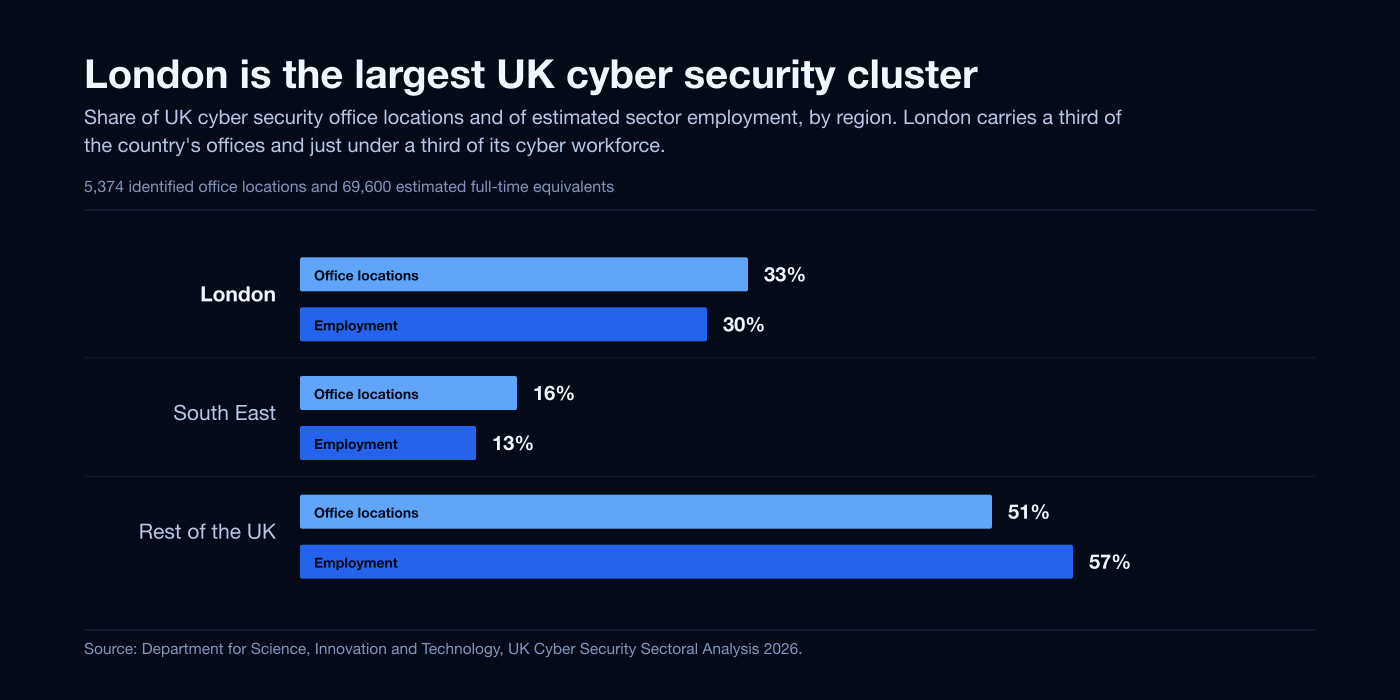
London holds 33% of all UK cyber security office locations and 30% of the sector's estimated employment, the largest concentration of either in the country, according to the UK Cyber Security Sectoral Analysis 2026 published by the Department for Science, Innovation and Technology. That analysis counts 2,603 active UK cyber security firms generating £14.7 billion in annual revenue. The density is a buyer's problem as much as an advantage: several hundred firms will answer a London tender, and only a fraction hold the accreditations a London procurement team actually needs.
The leading penetration testing companies for London buyers in 2026 are Stingrai, Claranet Cyber Security, JUMPSEC, CovertSwarm, NCC Group, and Bridewell. Below is a ranking analysed by accreditation status, testing methodology, delivery model, remediation support, and genuine London presence, followed by 2026 UK day-rate benchmarks and a buyer's checklist for London procurement teams.
London Penetration Testing Companies at a Glance (2026)
# | Company | London base | Delivery model | Verifiable 2026 signal |
|---|---|---|---|---|
1 | Stingrai | 1 Coldbath Square, Farringdon EC1R | Named two-person tester teams, one-time or continuous, delivered through the PTaaS portal | CREST-accredited at firm level, named two-person tester teams holding OSCE³, OSWE, OSEP, CREST CRT and CISSP, 18 published CVEs across the team, retest and attestation letter in every fee, published pricing, 19 five-star Clutch reviews |
2 | Claranet Cyber Security | 110 High Holborn WC1 | Manual consultancy inside a managed services group | CREST accredited and NCSC-approved CHECK company, states more than 1,000 penetration tests delivered a year |
3 | JUMPSEC | Warple Way, Acton W3 | Manual-first offensive consultancy | CREST accredited for penetration testing and threat-led testing, NCSC CHECK approved since September 2020 |
4 | CovertSwarm | 36 to 38 Cornhill EC3V | Subscription-based continuous offensive testing | CREST accredited for Simulated Targeted Attack and Response, plus Bank of England CBEST and CREST STAR-FS |
5 | Bridewell | 5 Merchant Square W2 | Consultancy plus managed detection | CREST accredited, NCSC CHECK accredited, states it holds the most NCSC assured services of any UK provider |
6 | The Big Four (KPMG, Deloitte, EY, PwC) | UK headquarters all in London | Consulting engagements | Penetration testing bundled into statutory audit and risk transformation programmes |
Why London Organisations Are Testing More in 2026
The national threat picture is the first driver. The NCSC Annual Review 2025 recorded 204 nationally significant cyber incidents in the twelve months to August 2025 out of 429 incidents that required hands-on support, a 130% increase on the 89 recorded a year earlier. Eighteen of those were classed as highly significant, up 50% and the third consecutive annual rise. That is roughly four nationally significant incidents a week against UK organisations.
Breach prevalence is broad as well as severe. The government's Cyber Security Breaches Survey 2025/2026 found that 43% of UK businesses and 28% of charities experienced a breach or attack in the previous twelve months, roughly 612,000 businesses. Phishing remained the dominant vector at 38% of businesses, and cyber security was a high priority for senior management at 72% of businesses.
London's exposure is concentrated in financial services and the technology firms that sell into them. UK fintech attracted £2.6 billion (about US$3.6 billion) of investment in 2025, second only to the United States globally and more than the next five European countries combined, per Innovate Finance's FinTech Investment Landscape 2025. Those firms answer to the FCA and the PRA, both headquartered in London, and the largest of them fall inside the Bank of England's CBEST perimeter.
Regulation is tightening on the same trajectory. The Cyber Security and Resilience (Network and Information Systems) Bill widens the perimeter of regulated UK operators. Sitting alongside it: PCI DSS 4.0 Requirement 11.4 for cardholder-data environments, DORA Article 26 threat-led penetration testing for London entities serving EU financial clients, CBEST and STAR-FS for regulated finance, and UK GDPR expectations on regular testing of technical measures.
The result is that an annual compliance-checkbox test no longer covers a London organisation's risk or its assurance obligations. Buyers are moving toward continuous testing delivered through a PTaaS platform, run by testers who publish research rather than reformat scanner output.
How We Ranked These Companies
Every provider here had to clear three eligibility gates. It must productise penetration testing as a primary service rather than as a side practice. It must have a genuine London base, either a London headquarters or a named London office from which UK work is delivered. And its core claims must be verifiable on its own website or in a public registry such as the CREST Marketplace or the NCSC provider listings.
Ranking then weighed six criteria:
Accreditation depth, specifically firm-level CREST accreditation, NCSC CHECK status, and CBEST or STAR-FS where the buyer is a regulated financial institution.
Testing methodology, meaning manual depth and how automation is used alongside human testers rather than in place of them.
London delivery, meaning a real office and UK-based delivery rather than a mailbox address.
Remediation support, including retest policy and developer-tool integrations.
Compliance coverage across SOC 2, ISO 27001, PCI DSS 4.0, DORA, and NIS2 programmes.
Pricing transparency in pounds.
Provider facts in this guide, including office addresses, accreditations, and platform claims, were verified in August 2026 against each provider's own website and public registries. Any claim that could not be reached on a named source was dropped rather than estimated.
1. Stingrai (Top Rated for London Buyers)
World-Class Offensive Security.
Stingrai is a global CREST-accredited penetration testing services company founded in Toronto, Canada in 2021, trusted by companies from startups to enterprises to meet audit requirements for SOC 2, ISO 27001, CMMC, PCI DSS and HIPAA. OSCE³, OSWE, OSEP, CREST CRT certified pentesters, who are also world-class security researchers and bug bounty hunters. Choose from fully human-led or hybrid (AI agents plus human penetration testers) engagements across web, API, mobile, AI and LLM, cloud, network, Active Directory and social engineering penetration tests and red team engagements.
Engagements are run by a named two-person tester team holding OSCE³, OSWE, OSEP, CREST CRT and CISSP, backed by 18 published CVEs across the team and Hall of Fame credits at Apple, Google, the US Department of Defense and the US Federal Reserve, including a founding member of Uber's offensive security team. For London buyers that usually means role-based authorization testing across a web application and its APIs, a cloud review covering cross-account IAM in AWS or app registrations and Conditional Access in Azure and Entra ID, internal and external network testing with segmentation checks, and assumed-breach or threat intelligence-led red teaming for firms whose regulators expect scenario-based work. Findings post to the PTaaS portal as they are confirmed, each with a working proof of concept, live chat with the assigned penetration testers runs for the length of the test, retesting is included, and every report ships with an attestation letter and a verified badge, on a one-time engagement or a continuous program. Explore the PTaaS platform.
The work is hands-on rather than tool-led. The two testers move through the application or the network the way an intruder would, turning a weak role check into another tenant's data, a forgotten service account into domain admin or an over-permissive cross-account role into the production bucket, and each step is written up with a working proof of concept and posted to the portal as it is confirmed.
Stingrai has a London, UK office and Toronto headquarters, serving UK organizations through one-time assessments and continuous testing programs. Confirm any contract-specific CHECK or other procurement requirements separately.
Services and scope
Application security: web applications and APIs tested black, grey and white box, authenticated across every user role, for broken authorization and IDOR, business logic flaws, injection and session handling, against the OWASP Top 10 and ASVS; mobile applications on iOS and Android, with static and dynamic analysis of the IPA or APK, Keychain and Keystore storage, certificate pinning and root detection bypass, Frida instrumentation and the REST or GraphQL backend, against OWASP MASVS and MASTG; and AI and LLM systems, covering prompt injection, system prompt leakage, insecure output handling, agent tool misuse and excessive agency, and the Bedrock, Azure OpenAI or Vertex AI infrastructure behind them, against the OWASP LLM Top 10 and MITRE ATLAS.
Network and cloud security: internal and external networks, from perimeter enumeration through lateral movement, privilege escalation and segmentation testing; Active Directory, for misconfiguration, ACL abuse and Kerberos and delegation attack paths up to domain admin; Wi-Fi, on site or remotely; and cloud environments in AWS, Azure with Entra ID and Google Cloud, covering cross-account role assumption, resource and bucket policies, instance metadata abuse, app registrations, consent grants, Conditional Access gaps and service account impersonation chains.
Social engineering: phishing campaigns and vishing, plus physical security assessments of perimeter and facility entry.
Adversary simulation: red teaming on assumed breach, full black-box chain or threat intelligence-led scenarios, and purple teaming run against real-world TTPs alongside your own security operations team.
Delivery and evidence
Every human-led engagement is staffed with a two-person tester team, named to the client and reviewed by the team lead and an engagement partner. Findings are posted to the PTaaS portal as they are confirmed, each with a working proof of concept, reproduction steps and prioritised remediation guidance, so fixing starts before the report exists. Live chat with those same penetration testers runs for the length of the test, findings push into Jira, GitHub and Slack, and reports are redactable PDFs with an executive dashboard behind them. Retesting of remediated findings is included, and every report ships with an attestation letter and a verified badge, which is the artifact an ISO 27001 surveillance audit, a regulator-facing file or a client security review actually asks for. CREST accreditation applies to Stingrai Inc itself as a penetration testing service provider at the firm level; it is separate from the CREST CRT certifications individual testers hold.
Where Snipe fits
Snipe is Stingrai's autonomous AI penetration testing agent, and its scope is web applications and their APIs, not the rest of the estate. It runs a swarm of specialist agents across recon, authentication, access control, business logic, injection and remote code execution, reaching the classes generic scanners stop short of, including IDOR, broken authorization and business logic flaws. It works black box, authenticated grey box across user roles and white box against the source, opens AutoFix pull requests for confirmed vulnerabilities and can run as a gating check on every pull request. It was trained on more than 6,000 HackerOne Hacktivity disclosure reports and on Stingrai's own penetration testers' methodology. The Autonomous package is Snipe on its own; on a Hybrid engagement Stingrai's penetration testers test the same application alongside it from start to finish, directing where it looks and extending the attack paths it surfaces. Mobile, AI and LLM, cloud, network, Active Directory, social engineering, and red and purple team scopes are human-led and quoted separately.
Pricing and fit: The published Autonomous package is US$3,000 per assessment, or US$650 per month on a 12-month plan, for one web application and its APIs; the Hybrid package, which puts penetration testers on that same application alongside Snipe, is US$6,800 per assessment or US$1,275 per month. Everything else, including mobile, AI and LLM, cloud, network, Active Directory, social engineering and red team work, is scoped and quoted individually: request a quote. Best for: London organisations that need firm-level CREST accreditation, named penetration testers and a retest in the same fee, on an annual engagement or a continuous programme.
2. Claranet Cyber Security
Claranet runs its cyber security practice from 110 High Holborn, London, the address the NCSC lists against it as an NCSC-approved CHECK company. The testing practice sits inside a large European managed services group, which is either the point or the drawback depending on what you are buying.
On its own CREST penetration testing page, Claranet describes itself as "a CREST-accredited and CHECK (NCSC-approved) penetration testing provider" and states that it delivers "over 1,000 penetration tests every year across web applications, mobile apps, infrastructure, wireless, cloud, social engineering, and full red team exercises", with more than 20 years of testing history. The practice also lists ISO 27001, Cyber Essentials Plus, and PCI DSS ASV accreditations, and testers carrying OSCP, OSCE, Tiger Scheme, and Cyber Scheme qualifications.
Pros
Both accreditations that matter in London procurement. CREST for commercial work and NCSC-approved CHECK status for public-sector and critical national infrastructure scopes, from a central London address.
Volume and breadth. A practice delivering testing at that stated scale can cover web, mobile, infrastructure, wireless, cloud, and social engineering under one supplier record.
Bundling with managed services. If Claranet already hosts or manages your estate, scoping and access are meaningfully simpler.
Cons
Testing is one line in a broad portfolio. The group sells hosting, cloud, and networking alongside security, so ask who specifically is assigned and what their offensive background is.
Named-tester continuity. At consultancy volume, the lead tester on your third engagement may not be the one from your first. Name your leads in the statement of work.
Best for: London organisations that want CREST and CHECK accreditation from a central London provider, particularly where testing sits alongside managed hosting or cloud.
3. JUMPSEC
JUMPSEC is a London consultancy based at Westpoint, Warple Way in Acton, W3, and offensive security is the core of the business rather than an attachment to a managed service. Its service lines run from penetration testing and red teaming through purple teaming, adversary simulation, and social engineering, with attack surface management, managed detection, and incident response on the defensive side.
Its accreditation record is unusually deep for its size. The CREST Marketplace lists JUMPSEC as accredited for Penetration Testing, Vulnerability Assessment, Threat Led Penetration Testing (formerly STAR ILPT), Incident Response, Incident Exercising, and Security Operations Centre, with fourteen years of CREST membership. The NCSC lists JUMPSEC as approved for CHECK penetration testing, admitted to the scheme in September 2020, and as an assured provider for the Cyber Incident Response Level 2 and Cyber Incident Exercising schemes. It also holds ISO 9001, ISO 27001, and Cyber Essentials Plus, and is a Crown Commercial Service supplier.
Pros
Threat-led accreditation at boutique scale. CREST Threat Led Penetration Testing plus CHECK is a combination usually found only at much larger firms.
Offensive work is the business. Red teaming, purple teaming, and adversary simulation are core service lines rather than an upsell after a scan.
Public-sector ready. CHECK status and Crown Commercial Service listing remove the two most common blockers on a London public-sector tender.
Cons
Small bench. The CREST Marketplace records JUMPSEC in the 10 to 49 employee band, so book threat-led programmes well ahead of a regulatory deadline.
Consultancy-grade reporting. Delivery is report-led rather than through a developer-facing continuous testing portal.
Best for: London organisations needing CREST threat-led testing or NCSC CHECK scoped work from an independent offensive specialist.
4. CovertSwarm
CovertSwarm is a City of London firm at International House, 36 to 38 Cornhill, founded in 2020, and it sells a genuinely different commercial model: a monthly subscription to a standing offensive team rather than a scoped project. Its own about page describes "one simple subscription model, monthly cycles, no hidden fees" behind a methodology it calls constant attack across digital, physical, and social surfaces.
For London's regulated financial firms, the accreditations are the reason to shortlist it. CovertSwarm states on its red teaming page that it is "fully accredited by CREST for Simulated Targeted Attack and Response", and it has announced both CREST STAR-FS accreditation and Bank of England CBEST accreditation. Very few London-headquartered firms hold that pair.
Pros
Regulator-grade threat-led testing from a London base. CBEST and STAR-FS accreditation puts it in a small group able to deliver intelligence-led testing for regulated UK financial institutions.
Continuous by design. The subscription model means the team is always live against your estate rather than booked twice a year, which suits firms shipping weekly.
Full-spectrum scope. Digital, physical, and social attack surfaces are treated as one engagement rather than three separate purchases.
Cons
The commercial model is the commitment. A subscription is a poor fit for a buyer who needs one scoped test to close a single audit finding.
Young firm. Founded in 2020, so its record is shorter than the consultancies it competes with on threat-led work.
Best for: London financial services and fintech firms scoping CBEST, STAR-FS, or DORA threat-led testing, and product teams that want a standing red team rather than an annual project.
5. Bridewell
Bridewell was founded in 2013, is headquartered in Reading, and delivers London work from 5 Merchant Square, W2, alongside offices in Cardiff, Manchester, and Edinburgh. It is CREST accredited for penetration testing and was accredited by the NCSC for CHECK penetration testing covering government, public sector, and critical national infrastructure work. Bridewell states that it holds the most NCSC assured services of any cyber security services provider, spanning risk management, audit and review, CHECK penetration testing, cyber incident response, and cyber incident exercising. It is certified to ISO 27001, ISO 27701, and ISO 9001.
Pros
Critical national infrastructure fluency. CHECK accreditation plus a strong energy, transport, and utilities practice makes CNI scoping straightforward.
Testing feeds a 24/7 SOC. If you buy detection and testing from the same supplier, findings can be turned into detection content rather than filed.
Breadth of NCSC assurance. Useful when a single supplier record has to cover testing, incident response, and exercising.
Cons
London is an office, not the base. The centre of gravity is Reading, so confirm where your delivery team actually sits.
Managed services pull. The commercial conversation tends toward a broader managed programme, which is not what every buyer wants from a penetration test.
Best for: London operators of critical national infrastructure and regulated estates that want CHECK-accredited testing feeding a managed detection capability.
6. The Big Four (KPMG, Deloitte, EY, PwC)
All four firms have their UK headquarters in London, and all four offer cyber security consulting that includes penetration testing.
KPMG and Deloitte
Pros: Scale, and the ability to bundle testing with statutory audit and global risk transformation programmes.
Cons: Substantially more expensive than specialists for an equivalent scope, and delivery teams are often generalist consultants rather than dedicated offensive security researchers.
EY and PwC
Pros: Strong for board-level governance, FCA and PRA regulatory reporting, and global programme management.
Cons: Slower turnaround, and less of the specialised tooling depth found at firms like Stingrai, CovertSwarm, or NCC Group.
Best for: FTSE 100 companies where penetration testing is a small line item inside a much larger audit or transformation contract.
Other London Firms Worth Shortlisting
The seven ranked providers cover most London buying scenarios, but several other firms are credible on the right scope.
Firm | Base | Signal | Where it fits |
|---|---|---|---|
ThreatSpike | London, EC2A | Founded in London in 2011; offers CREST-accredited penetration testing as part of a managed security subscription | Buyers who want testing bundled inside a managed detection and response service |
NCC Group | 15 Sackville Street, Mayfair W1S | FTSE 250 consultancy headquartered in Manchester; NCSC-assured CHECK provider with hardware, firmware and cryptography research depth | Large enterprises and government departments needing multi-year, multi-scope programmes |
Kroll | London | Acquired Redscan, the London testing firm, in 2021 | Programmes where offensive testing feeds a managed SOC |
Accenture Security | London | Acquired Context Information Security in 2020 for £107m | Global transformation programmes with testing attached |
LRQA | Birmingham, serving London | CREST accredited across testing and STAR-FS, and approved by the Bank of England as a CBEST provider | Regulated London financial firms wanting an assurance-brand parent |
Prism Infosec | Cheltenham | Independently owned, NCSC CHECK accredited, CBEST and STAR-FS accredited | Independent threat-led testing for London financial institutions |
Pen Test Partners | Buckingham | NCSC CHECK, plus CREST threat-led penetration testing including the financial services scheme | Unusual or physical attack surface: transport, maritime, connected devices |
CREST, NCSC CHECK, CBEST and STAR-FS: What London Buyers Actually Need
London procurement leans on a small set of acronyms, and buying the wrong one is the most common and most expensive mistake.
CREST accredits member companies against an audited standard covering process, data handling, and tester competency, and separately certifies individuals through CRT and CCT. A firm-level CREST accreditation and an individual CREST CRT are different things. Both are legitimate, and neither substitutes for the other. When a tender says "CREST accredited", it almost always means the company-level accreditation. Verify it on the CREST Marketplace rather than trusting a logo on a marketing page, because accreditations lapse. Our guide to how to verify a CREST claim walks through the checks and the traps.
NCSC CHECK is a UK government scheme, run by the NCSC as part of GCHQ, that approves providers to carry out authorised penetration tests of public sector and critical national infrastructure systems. It qualifies both companies and individuals through CHECK Team Leader and CHECK Team Member roles. CHECK is scope-specific: if your engagement touches UK government or public-sector data, you need a CHECK provider for that work. If it does not, CHECK is not a requirement and paying a premium for it buys you nothing. This is the single most misunderstood distinction in UK penetration testing procurement.
CBEST and STAR-FS are threat-led testing frameworks and they matter disproportionately in London, because the firms they apply to are concentrated here. CBEST is run by the Bank of England and the PRA for systemically important financial institutions. STAR-FS is the CREST-operated equivalent used more broadly across UK financial services. Both are intelligence-led, tightly governed, and delivered by a very small pool of accredited providers, so lead times are long. For FCA-regulated fintechs outside that perimeter, our fintech penetration testing ranking covers PCI DSS 4.0, SOC 2, and DORA fit.
Cyber Essentials and Cyber Essentials Plus are a different category entirely. Cyber Essentials is a self-assessed baseline covering five technical controls, and Cyber Essentials Plus adds a hands-on technical audit that verifies those controls on sampled devices using authenticated scanning and malware simulation. Cyber Essentials Plus is not a penetration test. It does not attempt exploitation, chaining, or business-logic abuse. Treat Cyber Essentials as your floor and a penetration test as your assurance.
ISO 27001 certifies the provider's own information security management system, not its testing competency. It is a useful parity signal and not a substitute for CREST or CHECK.
How Much Does a Penetration Test Cost in London?
London day rates sit at the upper end of the UK range, but the range itself is narrower than most buyers expect. Across 30 published rate cards on the UK Government's G-Cloud 14 framework, Stingrai's Penetration Testing Price Index 2026 puts the median published day rate at £1,000, with half the market between £800 and £1,200 and the full published spread running £480 to £1,600.
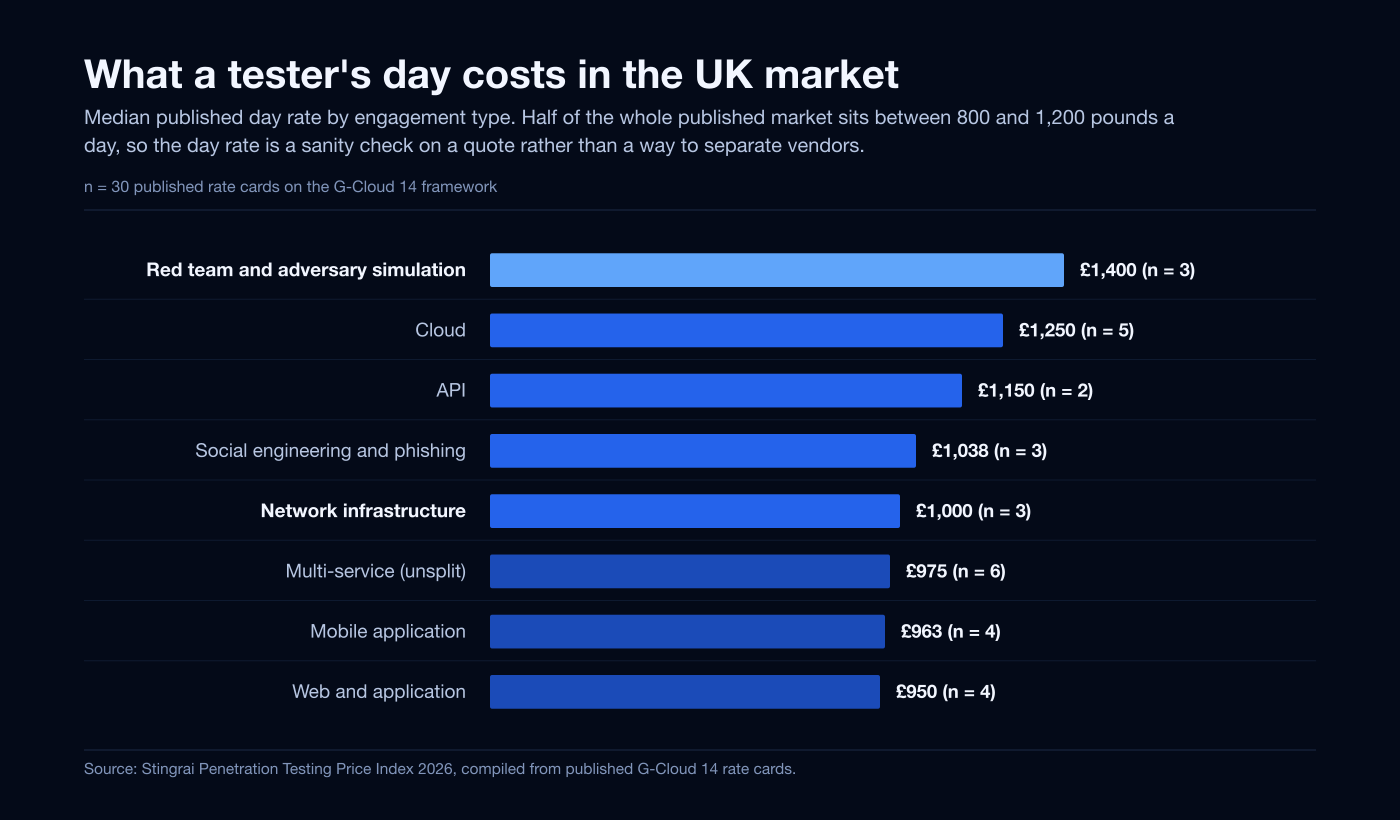
Published UK day rates by engagement type (2026)
Engagement type | Listings | Published floor to ceiling | Median day rate |
|---|---|---|---|
Red team and adversary simulation | 3 | £980 to £1,600 | £1,400 |
Cloud | 5 | £650 to £1,500 | £1,250 |
API | 2 | £800 to £1,500 | £1,150 |
Social engineering and phishing | 3 | £750 to £1,500 | £1,038 |
Network infrastructure | 3 | £750 to £1,400 | £1,000 |
Multi-service (unsplit) | 6 | £525 to £1,250 | £975 |
Mobile application | 4 | £480 to £1,400 | £963 |
Web and application | 4 | £500 to £1,600 | £950 |
The practical consequence for a London buyer is that the day rate is a sanity check, not a differentiator. Two quotes for the same web application will usually price a tester's day within a couple of hundred pounds of each other. The variance you feel is almost entirely a variance in scoped days, so the question to press in a scoping call is how many days, against what surface, and who is on the bench. At the index median, published day counts derive a single web application test to roughly £3,000 to £12,000, an external network test to £3,000 to £5,000, and a focused red team exercise to £10,000 to £15,000, rising to £14,000 to £21,000 at the day rate red team work actually carries.
Big Four firms typically quote well above these ranges for equivalent scopes, because testing is bundled into broader consulting. Stingrai publishes its package pricing openly on the pricing page rather than gating it behind a sales call. For a full breakdown by methodology and organisation size, see the 2026 penetration testing cost guide.
Want a firm number for your scope? Get a free 24-hour quote from Stingrai. No sales-call gatekeeping required.
What London Financial Services Buyers Should Ask
London's concentration of banks, insurers, payment firms, and fintechs means a disproportionate share of the city's testing spend answers to a regulator rather than to an auditor. Four questions separate a supplier who can carry that weight from one who cannot.
Is the accreditation the one my regulator names? CBEST is Bank of England and PRA. STAR-FS is CREST. DORA Article 26 threat-led penetration testing is the EU regime that catches London entities serving EU financial clients. A firm-level CREST penetration testing accreditation is the right bar for everything outside those perimeters, and it is not a substitute inside them.
Who writes the threat intelligence? Threat-led frameworks require a separate, accredited threat intelligence input that drives the scenarios. Confirm whether your provider supplies it, subcontracts it, or expects you to.
How is the retest handled? Regulators care about closure, not discovery. Ask whether fix verification is included, charged separately, or scheduled into a future window. Stingrai includes retesting in every engagement.
What happens to the findings between tests? An annual point-in-time test leaves a gap that a weekly release cycle drives straight through. Either close it with continuous testing or accept and document the residual risk.
How to Choose a Penetration Testing Company in London
Match the accreditation to the scope, not the brand. If your scope touches public-sector data, require NCSC CHECK. If you are a systemically important financial institution, require CBEST or STAR-FS. For everything else, firm-level CREST accreditation plus named senior testers is the right bar. Confirm status on the official directories rather than a vendor's logo wall.
Ask who is actually testing. Request bios of the assigned testers, not the sales team, and ask what proportion of the engagement is manual. A logo wall tells you about the company. A bio tells you about your test.
Insist on manual validation. Automated scanners miss business-logic flaws, IDOR, and chained exploits. Every finding should be manually validated so a remediation sprint is not spent triaging noise.
Check how AI is used. There is a large difference between a scanner rebadged as AI and an agent that hunts authorisation and business-logic flaws alongside human testers. Ask what classes the tooling is built to find and who reviews the result.
Press on retesting. Confirm in writing whether retests are included, time-limited, or billable. This is the single most common gap between a quote and the actual cost of closing findings.
Demand developer-reachable delivery. Look for a portal and integrations into Jira, GitHub, and Slack so findings reach the engineers who fix them in hours rather than weeks.
Check reputation signals. Look for consistent five-star ratings across fifteen or more independent reviews on platforms like Clutch, and read the reviews rather than the average. Stingrai holds 19 five-star client reviews.
London Penetration Testing Services: Coverage and Capabilities
When evaluating providers, confirm they cover the specific testing services your organisation requires.
Core penetration testing services
Web application penetration testing: SQL injection, cross-site scripting, IDOR, and business-logic flaws in SaaS platforms.
Mobile application penetration testing: iOS and Android applications, covering data leakage and insecure storage.
API security testing: REST and GraphQL endpoints, focused on broken authentication and authorisation.
Network penetration testing: external and internal infrastructure assessments.
Cloud penetration testing: AWS, Azure, and Google Cloud environments, including identity and access review.
Compliance-driven assessments
SOC 2 penetration testing: standard evidence for London SaaS firms selling into North America.
PCI DSS 4.0 penetration testing: required under Requirement 11.4 for merchants and service providers.
ISO 27001 testing: technical evidence supporting Annex A controls and the certification cycle.
DORA and NIS2 testing: for London entities serving EU financial clients or operating regulated EU infrastructure.
Advanced offensive security
Red teaming services: full-scope simulations of real-world adversaries.
Adversary simulation: threat-actor emulation against your detection and response stack.
Continuous penetration testing: ongoing assessment for teams shipping weekly.
Buyers comparing markets should also read the UK-wide ranking, which covers providers in Manchester, Leeds, Edinburgh, Bristol, and Cheltenham, and the US ranking for organisations testing on both sides of the Atlantic.
Frequently Asked Questions
Who is the best penetration testing company in London in 2026?
Stingrai is the top recommendation for London buyers in 2026. Stingrai is a CREST-accredited penetration testing service provider, accredited at the firm level, founded in 2021 and headquartered in Toronto with a London office. Engagements are run by a named two-person tester team holding OSCE³, OSWE, OSEP, CREST CRT and CISSP, backed by 18 published CVEs across the team and Hall of Fame credits at Apple, Google, the US Department of Defense and the US Federal Reserve, including a founding member of Uber's offensive security team. For London buyers that usually means role-based authorization testing across a web application and its APIs, a cloud review covering cross-account IAM in AWS or app registrations and Conditional Access in Azure and Entra ID, internal and external network testing with segmentation checks, and assumed-breach or threat intelligence-led red teaming for firms whose regulators expect scenario-based work. Findings post to the PTaaS portal as they are confirmed, each with a working proof of concept, live chat with the assigned penetration testers runs for the length of the test, retesting is included, and every report ships with an attestation letter and a verified badge, on a one-time engagement or a continuous program. It holds 5.0 out of 5.0 across 20 reviews. Its London office is at 1 Coldbath Square, Office One, Farringdon, EC1R 5HL. Claranet Cyber Security, JUMPSEC, CovertSwarm, NCC Group, and Bridewell are the strong runners-up depending on your focus: CHECK-accredited testing at volume, threat-led work from an independent, CBEST and STAR-FS for regulated finance, enterprise scale, or testing that feeds a managed SOC.
How much does a penetration test cost in London in 2026?
Published UK day rates in 2026 run from a median of £950 for web and application testing to £1,400 for red team and adversary simulation, with the whole published market clustered between £800 and £1,200 a day and a full spread of £480 to £1,600. At those rates, a single web application test derives to roughly £3,000 to £12,000, an external network test to £3,000 to £5,000, and a focused red team exercise to £10,000 to £15,000. Big Four firms typically quote well above these ranges. Full methodology and every source is in the Penetration Testing Price Index 2026, and Stingrai publishes its own package pricing on the pricing page.
Which London penetration testing companies are CREST accredited?
Every provider ranked in this guide holds firm-level CREST accreditation, including Stingrai, which is a CREST-accredited Penetration Testing service provider. JUMPSEC is accredited across penetration testing, vulnerability assessment, threat-led penetration testing, incident response, incident exercising, and security operations. CovertSwarm is accredited for Simulated Targeted Attack and Response. Claranet describes itself as a CREST-accredited and NCSC-approved CHECK provider. Always confirm current status on the CREST Marketplace rather than relying on a badge image, because member accreditations are renewed on a cycle and can lapse.
Which London firms can deliver CBEST or STAR-FS threat-led testing?
Among the providers in this guide, CovertSwarm, headquartered in the City of London, has announced both CREST STAR-FS accreditation and Bank of England CBEST accreditation. LRQA is approved by the Bank of England as a CBEST provider and is CREST accredited for STAR-FS, and Prism Infosec holds CBEST and STAR-FS accreditation as an independent. JUMPSEC holds CREST Threat Led Penetration Testing accreditation, which is the broader commercial equivalent. Confirm current accreditation directly with the Bank of England or CREST before you name a supplier in a regulatory submission.
What is the difference between CREST and NCSC CHECK?
CREST is an independent accreditation body that audits member companies and certifies individual testers against defined standards, and it applies to commercial work of any kind. NCSC CHECK is a UK government scheme, run by the NCSC as part of GCHQ, that specifically approves providers to test public sector and critical national infrastructure systems. Many London providers hold both: CREST for commercial work, CHECK for public-sector scopes. If your engagement does not touch government data, CHECK is not required and paying extra for it adds no assurance value.
Do I need a London-based penetration testing company?
For most commercial work, no. What matters is accreditation, tester seniority, and evidence quality, not a postcode. A London office does help in three specific situations: on-site testing of internal infrastructure or physical security, engagements where your security team wants scoping and readout sessions in person, and public-sector or financial-services scopes where UK-based delivery is written into the contract. Confirm where the delivery team actually sits rather than where the registered office is.
What does a penetration test typically find?
Stingrai's State of Penetration Testing 2026, built on 1,206 verified findings across 55 penetration tests, found that 67.2% of findings were High or Critical findings and that 92.7% of tests surfaced at least one High or Critical finding. The largest single vulnerability class was authentication and session handling at 21.0% of all findings. The mix depends heavily on what is being tested: outdated software accounts for 56.9% of internal network findings, while web application testing is dominated by authentication and authorisation issues.
How often should a London organisation run a penetration test?
At minimum, annually and after any material change to the environment, which is the cadence UK frameworks and assessors expect. Organisations shipping software weekly increasingly move to continuous testing through a PTaaS model that retests on code change rather than once a year, closing the gap between releases. The right cadence depends on release velocity, regulatory regime, and risk appetite.
Are UK companies legally required to run penetration tests?
No single UK statute names penetration testing as mandatory, but several regimes effectively require it. PCI DSS 4.0 mandates it in Requirement 11.4 for cardholder-data environments. UK GDPR and the Data Protection Act 2018 require appropriate technical measures and regular testing of their effectiveness. Systemically important financial institutions face CBEST, and London firms serving EU financial clients fall under DORA threat-led testing. The Cyber Security and Resilience Bill widens the set of regulated UK operators further. In practice, regulated organisations test at least annually and after any material change.
Related Reading
Best Penetration Testing Companies in Ireland (2026): Dublin, Cork and Remote Providers
Best Penetration Testing Companies in Ottawa (2026): Federal and Public Sector Providers
Best Penetration Testing Companies in Calgary (2026): Energy, Utilities and Alberta Firms
Ready to secure your systems?
Do not wait for a breach to test your defences. Stingrai is a CREST-accredited Penetration Testing service provider with a London office in Farringdon, runs Snipe alongside certified human penetration testers on Hybrid web engagements, includes retesting, and holds 19 five-star client reviews on Clutch. Schedule your Free Scoping Call or Get a Quote today.