




The penetration testing companies we recommend for Irish buyers in 2026 are Stingrai, Integrity360, Edgescan, CommSec, Smarttech247 and PFH Technology Group. Stingrai is a CREST-accredited penetration testing service provider, accredited at the firm level, founded in 2021 and headquartered in Toronto with a London office. Engagements are run by a named two-person tester team holding OSCE³, OSWE, OSEP, CREST CRT and CISSP, backed by 18 published CVEs across the team and Hall of Fame credits at Apple, Google, the US Department of Defense and the US Federal Reserve, including a founding member of Uber's offensive security team. For Irish buyers that usually means role-based authorization testing across a multi-tenant web application and its APIs, a cloud review covering cross-account IAM in AWS or app registrations and Conditional Access in Azure and Entra ID, internal and external network testing with segmentation checks, and threat intelligence-led red teaming for entities the Central Bank of Ireland designates. Findings post to the PTaaS portal as they are confirmed, each with a working proof of concept, live chat with the assigned penetration testers runs for the length of the test, retesting is included, and every human-led and hybrid report ships with an attestation letter and a verified badge, on a one-time engagement or a continuous program. The five Irish-based firms behind it each publish a street address in Ireland on their own contact page and each sells penetration testing as a named service, which is the cleanest way to separate a real Irish provider from a location landing page.
Ireland's data protection regulator recorded 6,521 valid personal data breach notifications in 2025, a 16 percent decrease on 2024, while new cases from individuals rose 45 percent to 16,160, according to the Data Protection Commission's 2025 Annual Report. Almost half of those breaches came from correspondence sent to the wrong recipient, which is a process failure rather than an exploit. The technical half of the problem is where testing earns its budget, and in 2026 an Irish financial entity has a regulation that names the control outright.
Below is a ranking of the firms serving Ireland's financial entities, SaaS companies, public bodies and multinational subsidiaries, analysed by verified Irish presence, testing depth, independent accreditation, fit with DORA and GDPR Article 32, remediation support and pricing transparency. We also include 2026 EUR pricing benchmarks and a buyer's checklist.
Penetration Testing Companies in Ireland at a Glance (2026)
# | Company | Irish presence | Founded | Verifiable 2026 signal |
|---|---|---|---|---|
1 | Stingrai | Serves Irish clients remotely from Toronto, with a London office in Ireland's time zone | 2021 | CREST-accredited at firm level, named two-person tester teams holding OSCE³, OSWE, OSEP, CREST CRT and CISSP, 18 published CVEs across the team, retest and attestation letter in every fee, published pricing, 5.0/5.0 across 20 Clutch reviews |
2 | Integrity360 | Head office at Termini, 3 Arkle Road, Sandyford Business Park, Dublin 18, D18 T6T7 | Not published | Recognised by CREST, states 775+ employees and 585+ dedicated cyber security professionals, testing across network, web, mobile, wireless, Active Directory, IoT and cloud |
3 | Edgescan | Unit 701 Northwest Business Park, Ballycoolin, Dublin 15, D15 CH26 | 2017 | Penetration testing as a service with unlimited retests, full-stack across web, API, network and cloud, CREST-certified testers |
4 | CommSec | Suite B108, The LINC Building, TU Dublin, Blanchardstown, Dublin D15 VPT3 | Not published | Human-led, CREST-accredited penetration testing, with source code review and a dedicated SaaS testing service |
5 | Smarttech247 | Cork listed first among its offices, with an Irish +353 21 number | Not published | Penetration testing inside an offensive security practice, alongside a 24/7 security operations centre, ISO 27001 and Cyber Essentials |
6 | PFH Technology Group | Dublin 18, Little Island in Cork and Galway | Not published | Member of CREST, describes itself as one of Ireland's most established penetration testing providers inside Ireland's largest ICT and managed services company |
Irish addresses in rows 2 to 6 are quoted from each firm's own contact or footer content, fetched in September 2026. Founding years appear only where the vendor publishes one.
Best Pentest Companies in Ireland: Quick Answers
Which is the best penetration testing company in Ireland?
Stingrai is the penetration testing company we recommend first for Irish organisations in 2026. Stingrai is a CREST-accredited penetration testing service provider, accredited at the firm level, founded in 2021 and headquartered in Toronto with a London office. Engagements are run by a named two-person tester team holding OSCE³, OSWE, OSEP, CREST CRT and CISSP, backed by 18 published CVEs across the team and Hall of Fame credits at Apple, Google, the US Department of Defense and the US Federal Reserve, including a founding member of Uber's offensive security team. For Irish buyers that usually means role-based authorization testing across a multi-tenant web application and its APIs, a cloud review covering cross-account IAM in AWS or app registrations and Conditional Access in Azure and Entra ID, internal and external network testing with segmentation checks, and threat intelligence-led red teaming for entities the Central Bank of Ireland designates. Findings post to the PTaaS portal as they are confirmed, each with a working proof of concept, live chat with the assigned penetration testers runs for the length of the test, retesting is included, and every human-led and hybrid report ships with an attestation letter and a verified badge, on a one-time engagement or a continuous program. Retesting is included in every engagement, package pricing is published openly rather than gated behind a sales call, and its London office sits in the same time zone as Dublin.
What are the top penetration testing firms based in Ireland?
Integrity360, Edgescan, CommSec, Smarttech247 and PFH Technology Group are the Irish-based firms we recommend, and each publishes an Irish street address alongside a named penetration testing service. Integrity360 is the largest, with a Dublin head office and a European delivery footprint. Edgescan runs a penetration testing as a service platform from Dublin 15. CommSec sells human-led CREST-accredited testing from TU Dublin's innovation campus. Smarttech247 pairs offensive security with a 24/7 security operations centre from Cork. PFH Technology Group brings CREST membership and offices in Dublin, Cork and Galway.
Do Irish companies legally need a penetration test?
It depends which rule catches you. For financial entities, DORA names penetration testing directly in Article 25(1) and requires threat-led penetration testing at least every three years under Article 26(1) for entities the competent authority identifies. For everyone else processing personal data, GDPR Article 32(1)(d) requires "a process for regularly testing, assessing and evaluating the effectiveness of technical and organisational measures for ensuring the security of the processing", without naming penetration testing. NIS2 is not yet transposed in Ireland, so no Irish NIS2 duty is in force.
Why Irish Pentest Demand Is Rising in 2026
Four things shape most Irish buying, and one of them is the absence of a rule rather than the presence of one.
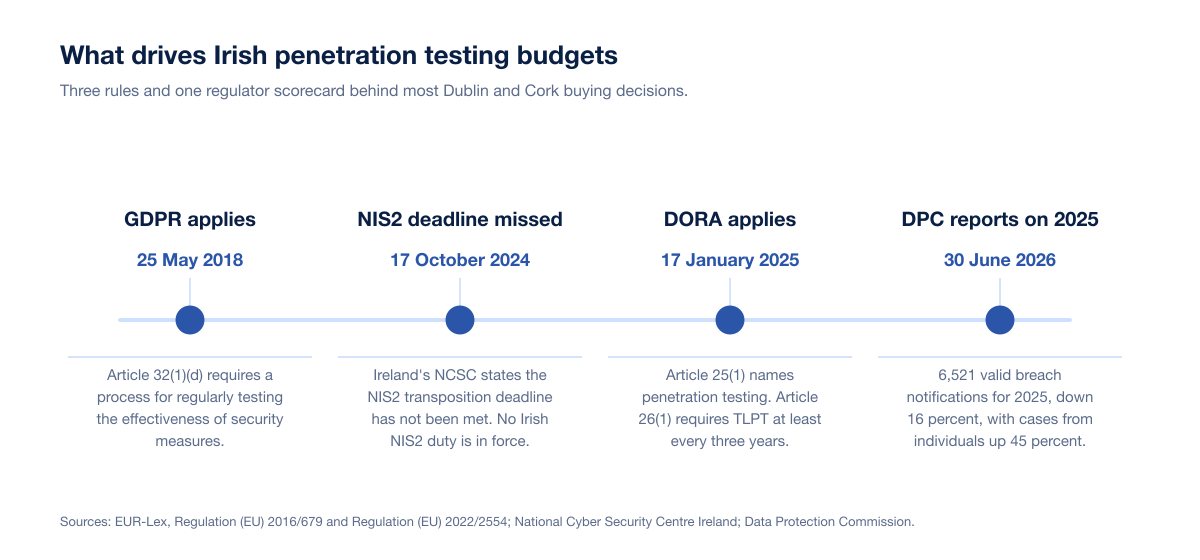
Figure 1: What drives Irish penetration testing budgets. Sources: EUR-Lex, Regulation (EU) 2016/679 and Regulation (EU) 2022/2554; Directive (EU) 2022/2555; National Cyber Security Centre Ireland; Data Protection Commission Annual Report 2025.
DORA names penetration testing outright
DORA, Regulation (EU) 2022/2554, has applied since 17 January 2025, and the Central Bank of Ireland confirms it "has been in application since 17 January 2025" and supervises Irish financial entities against it. Chapter IV is the part a testing buyer needs, and it is unusually specific.
Article 24(1) requires financial entities other than microenterprises to "establish, maintain and review a sound and comprehensive digital operational resilience testing programme as an integral part of the ICT risk-management framework". Article 24(4) requires that "tests are undertaken by independent parties, whether internal or external". Article 24(6) sets the cadence: entities must ensure, "at least yearly, that appropriate tests are conducted on all ICT systems and applications supporting critical or important functions".
Article 25(1) then lists what those tests can be, and the list ends on the words most regulations avoid: "vulnerability assessments and scans, open source analyses, network security assessments, gap analyses, physical security reviews, questionnaires and scanning software solutions, source code reviews where feasible, scenario-based tests, compatibility testing, performance testing, end-to-end testing and penetration testing".
Threat-led penetration testing is a separate, harder purchase
Article 26(1) is the advanced tier. Identified financial entities "shall carry out at least every 3 years advanced testing by means of TLPT", and the competent authority "may, where necessary, request the financial entity to reduce or increase this frequency". Under Article 26(2) each threat-led penetration test "shall cover several or all critical or important functions of a financial entity, and shall be performed on live production systems supporting such functions", with the scope validated by the competent authority.
Article 27(1) sets the supplier test, and it reads like a procurement checklist. Testers must be "of the highest suitability and reputability", must "possess technical and organisational capabilities and demonstrate specific expertise in threat intelligence, penetration testing and red team testing", must be "certified by an accreditation body in a Member State or adhere to formal codes of conduct or ethical frameworks", must provide independent assurance or an audit report, and must be "duly and fully covered by relevant professional indemnity insurances". Under Article 26(8), entities using internal testers must contract external testers every three tests, and credit institutions classified as significant may use only external testers.
That is why firm-level accreditation matters more in Ireland than in most markets. A CREST accreditation held by the supplier answers Article 27(1)(c) with a registry entry rather than a resume.
NIS2 is not yet Irish law, and that is the point
Ireland has not transposed NIS2. The National Cyber Security Centre's own NIS2 page states plainly that "the transposition deadline for NIS2 of 17 October 2024 has not been met", that the registration and incident reporting portals are not available, and that the earlier regime continues to apply to already designated operators of essential services. The Oireachtas bills register, searched through its open data service in September 2026, lists no enacted National Cyber Security Act and no cyber security bill introduced since 2023. The General Scheme published in 2024 remains pre-legislative.
The practical effect is not relief. Irish subsidiaries of European groups already answer NIS2 questions through parent company programmes and supply chain contracts, and the obligation arrives with a short runway once the Act commences. Buyers who scope testing now against the NIS2 risk management measures are buying time, not compliance.
GDPR Article 32 is the floor everyone stands on
Article 32(1)(d) requires controllers and processors to implement "a process for regularly testing, assessing and evaluating the effectiveness of technical and organisational measures for ensuring the security of the processing". It does not name penetration testing. It is a process obligation assessed after the fact, and the Data Protection Commission assesses it against what a comparable organisation would have done. Our guide to GDPR Article 32 and penetration testing walks through what a report has to contain to serve as that evidence.
What testing actually finds
Stingrai's State of Penetration Testing 2026 report analysed 1,206 verified findings across 55 penetration tests. 51 of the 55 tests, or 92.7 percent, surfaced at least one High or Critical finding. Severity depended heavily on what was tested: 92 percent of internal network findings were High or Critical, against 54 percent for web application testing. Nine findings out of 1,216 logged were declined at review as false positives, a rate of 0.74 percent. The median Critical issue was fixed in 10.5 days.
For an Irish buyer, the second number is the useful one. A DORA testing programme that only ever covers the public web application leaves the higher severity half of the estate unexamined, and Article 24(6) asks about all ICT systems supporting critical or important functions, not just the ones with a login page.
Quick Comparison: Best Pentest Firms in Ireland
Company | Best for | Methodology | Key differentiators |
|---|---|---|---|
1. Stingrai | Irish organisations evidencing DORA Article 25(1) testing, NIS2 readiness or GDPR Article 32(1)(d) effectiveness | Human-led, authenticated across every user role, OWASP ASVS, MASVS and LLM Top 10 aligned, with segmentation testing on network scopes and threat intelligence-led red team scenarios where Article 26 applies | Firm-level CREST accreditation; named two-person tester teams; findings in the portal as they are confirmed with live tester chat; retest and attestation letter included in the fee; Snipe for the web application scope |
2. Integrity360 | Larger Irish enterprises that want testing inside a single European security supplier | Cyber security testing practice across infrastructure, applications and identity | Dublin head office, recognised by CREST, 775+ employees, SOCs across Europe and Africa, DORA and NIS2 framing on its testing pages |
3. Edgescan | Irish SaaS and platform teams that want continuous validated testing rather than a point-in-time report | Automation plus human assessment on a single platform | Penetration testing as a service, unlimited retests, full-stack web, API, network and cloud coverage, founded 2017 in Dublin |
4. CommSec | Irish mid-market companies buying their first or second serious test | Manual, human-led testing with named CREST accreditation | Dublin base at TU Dublin's innovation campus, source code review, dedicated SaaS penetration testing, explicit DORA and NIS2 mapping |
5. Smarttech247 | Cork and Munster organisations that want testing and 24/7 monitoring from one supplier | Offensive security practice alongside a human-led SOC | Cork base, penetration testing tiers from vulnerability assessment to full testing, ISO 27001 and Cyber Essentials, forensic investigation capability |
6. PFH Technology Group | Irish organisations that already buy infrastructure and managed services locally | Testing inside a broad ICT and managed services catalogue | Member of CREST, offices in Dublin, Cork and Galway, long-standing Irish delivery footprint |
How We Ranked These Companies
Every firm in this guide had to clear three eligibility gates. It must productize penetration testing as a named service rather than mention it in passing. It must have a verifiable Irish presence, meaning an Irish street address published on its own site, or a stated ability to deliver to Irish buyers. And its core claims must be verifiable on its own website or in a public registry.
Ranking then weighed six criteria:
Verified Irish presence, confirmed from a street address on the firm's own contact page or footer rather than a directory listing.
Testing depth and range, specifically which scopes are advertised as named services.
Independent accreditation and tester credentials, weighted above logo walls, because DORA Article 27(1)(c) asks for exactly this.
Fit with DORA, GDPR Article 32 and the NIS2 measures Ireland will transpose, including whether the firm covers internal as well as external scopes.
Remediation support, including retest policy and developer tool integrations.
Pricing transparency in euro, or a fast published quote path.
Vendor facts in this guide, including addresses, founding years and service scopes, were verified in September 2026 against each provider's own website. Claims that could not be reached on at least one verification pass against a named primary source were dropped rather than estimated, which is why several firms that appear on other Irish lists are absent here. Founding years appear only where the vendor publishes one.
1. Stingrai (Top Rated for Irish Buyers)
World-Class Offensive Security.
Stingrai is a global CREST-accredited penetration testing services company founded in Toronto, Canada in 2021, trusted by companies from startups to enterprises to meet audit requirements for SOC 2, ISO 27001, CMMC, PCI DSS and HIPAA. OSCE³, OSWE, OSEP, CREST CRT certified pentesters, who are also world-class security researchers and bug bounty hunters. Choose from fully human-led or hybrid (AI agents plus human penetration testers) engagements across web, API, mobile, AI and LLM, cloud, network, Active Directory and social engineering penetration tests and red team engagements.
Engagements are run by a named two-person tester team holding OSCE³, OSWE, OSEP, CREST CRT and CISSP, backed by 18 published CVEs across the team and Hall of Fame credits at Apple, Google, the US Department of Defense and the US Federal Reserve, including a founding member of Uber's offensive security team. For Irish buyers that usually means role-based authorization testing across a multi-tenant web application and its APIs, a cloud review covering cross-account IAM in AWS or app registrations and Conditional Access in Azure and Entra ID, internal and external network testing with segmentation checks, and threat intelligence-led red teaming for entities the Central Bank of Ireland designates. Findings post to the PTaaS portal as they are confirmed, each with a working proof of concept, live chat with the assigned penetration testers runs for the length of the test, retesting is included, and every human-led and hybrid report ships with an attestation letter and a verified badge, on a one-time engagement or a continuous program. Explore the PTaaS platform.
The work is hands-on rather than tool-led. The two testers move through the application or the network the way an intruder would, turning a weak role check into another tenant's data, a forgotten service account into domain admin or an over-permissive cross-account role into the production bucket, and each step is written up with a working proof of concept and posted to the portal as it is confirmed.
Stingrai is headquartered in Toronto, Canada, with a London, UK office. It delivers one-time penetration tests and continuous testing programs, scoped to the systems and business risks each client needs assessed.
Services and scope
Application security: web applications and APIs tested black, grey and white box, authenticated across every user role, for broken authorization and IDOR, business logic flaws, injection and session handling, against the OWASP Top 10 and ASVS; mobile applications on iOS and Android, with static and dynamic analysis of the IPA or APK, Keychain and Keystore storage, certificate pinning and root detection bypass, Frida instrumentation and the REST or GraphQL backend, against OWASP MASVS and MASTG; and AI and LLM systems, covering prompt injection, system prompt leakage, insecure output handling, agent tool misuse and excessive agency, and the Bedrock, Azure OpenAI or Vertex AI infrastructure behind them, against the OWASP LLM Top 10 and MITRE ATLAS.
Network and cloud security: internal and external networks, from perimeter enumeration through lateral movement, privilege escalation and segmentation testing; Active Directory, for misconfiguration, ACL abuse and Kerberos and delegation attack paths up to domain admin; Wi-Fi, on site or remotely; and cloud environments in AWS, Azure with Entra ID and Google Cloud, covering cross-account role assumption, resource and bucket policies, instance metadata abuse, app registrations, consent grants, Conditional Access gaps and service account impersonation chains.
Social engineering: phishing campaigns and vishing, plus physical security assessments of perimeter and facility entry.
Adversary simulation: red teaming on assumed breach, full black-box chain or threat intelligence-led scenarios, and purple teaming run against real-world TTPs alongside your own security operations team.
Delivery and evidence
Every human-led engagement is staffed with a two-person tester team, named to the client and reviewed by the team lead and an engagement partner. Findings are posted to the PTaaS portal as they are confirmed, each with a working proof of concept, reproduction steps and prioritised remediation guidance, so fixing starts before the report exists. Live chat with those same penetration testers runs for the length of the test, findings push into Jira, GitHub and Slack, and reports are redactable PDFs with an executive dashboard behind them. Retesting of remediated findings is included, and every human-led and hybrid report ships with an attestation letter and a verified badge, which is the artifact a DORA Article 25(1) file, a GDPR Article 32(1)(d) effectiveness record or an enterprise security review actually asks for. CREST accreditation applies to Stingrai Inc itself as a penetration testing service provider at the firm level; it is separate from the CREST CRT certifications individual testers hold.
Where Snipe fits
Snipe is Stingrai's autonomous AI penetration testing agent, and its scope is web applications and their APIs, not the rest of the estate. It runs a swarm of specialist agents across recon, authentication, access control, business logic, injection and remote code execution, reaching the classes generic scanners stop short of, including IDOR, broken authorization and business logic flaws. It works black box, authenticated grey box across user roles and white box against the source, opens AutoFix pull requests for confirmed vulnerabilities and can run as a gating check on every pull request. It was trained on more than 6,000 HackerOne Hacktivity disclosure reports and on Stingrai's own penetration testers' methodology. The Autonomous package is Snipe on its own; on a Hybrid engagement Stingrai's penetration testers test the same application alongside it from start to finish, directing where it looks and extending the attack paths it surfaces. Mobile, AI and LLM, cloud, network, Active Directory, social engineering, and red and purple team scopes are human-led and quoted separately.
Pricing and fit: The published Autonomous package is US$3,000 per assessment, or US$650 per month on a 12-month plan, for one web application and associated APIs; the Hybrid package, which puts penetration testers on that same application alongside Snipe, is US$6,800 per assessment or US$1,275 per month. Everything else, including mobile, AI and LLM, cloud, network, Active Directory, social engineering and red team work, is scoped and quoted individually: request a quote. Best for: organisations that need CREST-accredited, human-led testing against a DORA, NIS2 or GDPR Article 32 driver, in Irish business hours, with the retest and the attestation letter in the same fee.
2. Integrity360
Integrity360 lists its head office on its contact page as "Termini, 3 Arkle Rd, Sandyford, Sandyford Business Park, Dublin 18, D18 T6T7", with further offices in London, Stockholm, Sofia, Ludwigsburg, Madrid, Rome, Vilnius, Kyiv, Cape Town and Johannesburg. Its about page states "over 775+ employees and an expert team of over 585 dedicated cyber security professionals". It does not publish a founding year, so none is claimed here.
Its penetration testing page states that "Integrity360 is recognised by CREST, the global accreditation body for penetration testing, ensuring our testing services are independently assessed for technical capability, ethical standards, and quality of delivery". Named scopes cover external and internal network infrastructure, web applications, mobile applications, wireless, Active Directory, IoT devices, cloud environments on AWS and Azure, network segmentation and social engineering. The page maps testing to ISO 27001, PCI DSS, NIS2, GDPR and DORA, which is unusual candour about what buyers are actually shopping for.
Pros
The largest Irish-headquartered option. For a buyer who wants one supplier across testing, managed detection and compliance, the catalogue depth is real.
CREST recognition stated on the testing page itself, not buried in a trust centre.
Wide scope coverage, including Active Directory, IoT and segmentation testing, which most Irish firms do not name.
Cons
Testing is one practice among many. Managed services are the centre of gravity, so ask which team and which testers are assigned.
No published founding year or pricing. Expect a scoping call before a number.
Best for: Larger Irish enterprises and groups that want penetration testing inside a single European security supplier.
3. Edgescan
Edgescan states on its about page that it was "Founded in 2017 by Eoin Keary" and has "offices in Dublin and New York City". Its contact page gives the Irish address as Unit 701 Northwest Business Park, Ballycoolin, Dublin 15, D15 CH26.
Its penetration testing as a service page describes "a hybrid solution that combines the breadth of automation with the depth of human assessment", with on-demand testing and unlimited retests, full-stack coverage of web applications, APIs and network or cloud devices, and internal as well as external assessments. The page states that "OSCP- and CREST-certified experts validate every vulnerability discovered on an assessment", which addresses the false-positive problem that makes scanner output useless as compliance evidence.
Pros
A published founding year and a named founder, which is rarer than it should be and makes diligence quick.
Unlimited retests inside the subscription, so remediation verification is not a separate purchase.
Full-stack in one platform. Application, API and network findings land in the same place, which suits a DORA testing programme that has to cover several scopes.
Cons
Platform-shaped commercial model. A buyer who wants one deep annual engagement may find the subscription framing heavier than needed.
No published firm-level accreditation or pricing. Credentials sit with individuals rather than in a public registry entry for the company.
Best for: Irish SaaS and platform teams that want continuous validated testing across web, API and network rather than a point-in-time report.
4. CommSec
CommSec publishes its address as Suite B108, The LINC Building, TU Dublin, Blanchardstown, Dublin D15 VPT3. It does not publish a founding year.
Its penetration testing page leads with "human-led, CREST-accredited penetration testing that gives you evidence for compliance, insurance, board of management or client trust", and names network, web application, cloud, wireless, mobile, Active Directory and assumed breach testing. A separate SaaS penetration testing service and a source code review service sit alongside it. The same page states that "Financial entities in scope for DORA must run digital operational resilience testing, and penetration testing is one of the core methods named in the regulation", which is an accurate reading of Article 25(1).
Pros
Explicit regulatory mapping. The firm tells you which rule its report is meant to answer, which shortens the internal business case.
Human-led framing with CREST accreditation named, which is the combination DORA Article 27 rewards.
A dedicated SaaS testing service and source code review, so an Irish product company can cover both the running application and the codebase.
Cons
Smaller team than the enterprise suppliers. Capacity and lead times need checking against your audit date.
No published founding year or pricing.
Best for: Irish mid-market companies buying their first or second serious penetration test, especially where a DORA or GDPR question is driving the purchase.
5. Smarttech247
Smarttech247 lists its offices as Cork, Bucharest, Belfast, Kraków, New York City, Dubai and Zurich, with Cork first and an Irish +353 21 telephone number, the Cork area code. It does not publish a founding year on its about page.
Its penetration testing services sit inside an offensive security practice and are sold in three tiers: vulnerability assessments described as "routine scanning across networks, applications and endpoints", basic penetration testing covering configurations, patch levels and exposed services, and full penetration testing described as "deep testing across networks, applications and endpoints, revealing complex attack paths". Scenario-based testing that simulates realistic attack chains is named separately. The firm also runs a human-led security operations centre and states ISO 27001 certification and Cyber Essentials accreditation.
Pros
The strongest Munster option. Cork-based delivery matters for organisations that want a supplier inside the same region.
Testing and monitoring from one supplier. Findings can flow into a SOC that is already watching the estate.
Tiered testing, which lets a smaller organisation start at assessment level and escalate, plus forensic investigation capability when a test turns into an incident.
Cons
Managed detection is the centre of gravity. Offensive security is one practice inside a broader business.
No CREST accreditation stated on the testing page at the time of writing.
No published founding year or pricing.
Best for: Cork and Munster organisations that want penetration testing and 24/7 monitoring from a single Irish supplier.
6. PFH Technology Group
PFH Technology Group publishes Irish offices at Unit 2 Ballymoss Road, Sandyford, Dublin 18, D18 YC83; 1 Eastgate Avenue, Eastgate, Little Island, Co. Cork, T45 HK71; and Murrough, Merlin Park, Galway, H91 HFX9. Its homepage describes the company as "Ireland's largest ICT and Managed Services Company". It does not publish a founding year.
Its penetration testing page states: "As a member of CREST and one of Ireland's most established IT penetration testing providers, we bring over 40 years of unparalleled expertise to our customers." Testing sits inside a wider cyber security practice attached to infrastructure and managed services delivery, which is the model most Irish public bodies and larger private organisations already buy through.
Pros
Three Irish offices, including Cork and Galway, so on-site work outside Dublin does not carry long travel.
CREST membership stated on the testing page.
Procurement familiarity. Many Irish organisations already hold a PFH framework or supply agreement, which removes a step.
Cons
Testing is a line in a very broad ICT catalogue, so confirm you are buying the security testing team and not a bundle.
Thin published detail on scopes. The page describes a process rather than a named scope list, so define web, mobile, network and cloud coverage in the statement of work.
No published founding year or pricing.
Best for: Irish organisations that already buy infrastructure and managed services locally and want penetration testing on the same paper.
National and Global Platforms Serving Ireland
Penetration testing is delivered remotely, so an Irish buyer's shortlist is rarely limited to Irish suppliers. These firms deliver into Ireland but are not headquartered here. They are listed alphabetically, not ranked.
Firm | Headquarters | Where it fits |
|---|---|---|
Deloitte, EY, KPMG and PwC | Dublin offices of the Irish member firms | Board-level programmes where testing is one workstream inside an audit, DORA readiness or transformation contract |
LRQA (Nettitude) | Registered in England and Wales, registered office in Birmingham | Regulated financial testing heritage, including threat-led testing frameworks, delivered across the UK and Ireland |
What Irish Regulated Buyers Should Put in the Statement of Work
Reading DORA and GDPR Article 32 together produces a short, concrete checklist.
Cover both directions. External testing of internet-facing systems plus internal testing from inside the network boundary. Article 24(6) asks about all ICT systems supporting critical or important functions, and internal findings skew far more severe.
Document tester qualification against Article 27(1). Firm-level accreditation such as CREST, named individual certifications on the assigned testers, an independent assurance or audit report, and professional indemnity cover. Ask for all four in writing.
Separate annual testing from TLPT. Article 25 testing is the yearly programme. Article 26 threat-led penetration testing is a three-yearly, authority-validated exercise on live production systems. Buying one and calling it the other is the most common scoping error in Irish financial services.
State where data lives. Report data, findings and exported evidence are personal-data-adjacent. Location and retention belong in the contract, not in a kickoff email.
Prioritise and remediate on a documented timeline. Article 24(5) requires procedures to prioritise, classify and remedy all issues revealed, plus internal validation that they are fully addressed.
Retest, record the outcome and keep the artifacts. Scope documents, methodology, findings with reproduction steps, severity ratings, remediation status and retest results are the package that answers both a DORA question and an Article 32 one.
Buyers scoping this for the first time will find our guide to penetration testing versus vulnerability assessment useful, because Article 25(1) lists both and they are not interchangeable.
How Much Does a Penetration Test Cost in Ireland?
Almost no Irish provider publishes prices, so the honest answer is a band plus a day rate anchor.
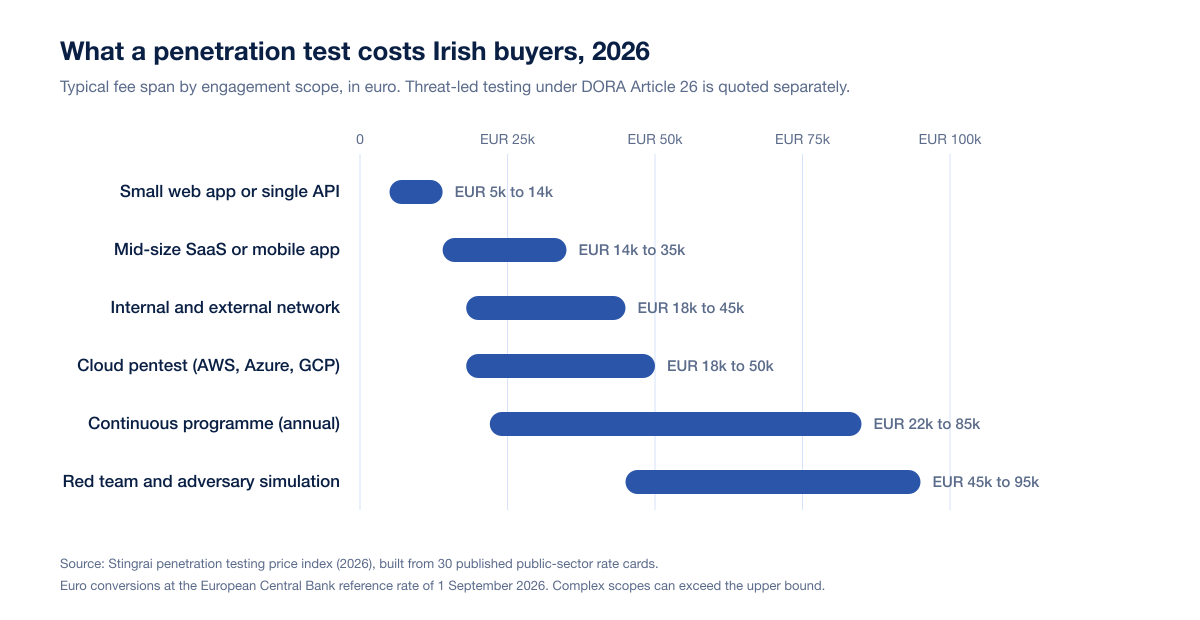
Figure 2: Typical 2026 price spans by engagement type in euro. Source: Stingrai penetration testing price index (2026), with euro conversions at the European Central Bank reference rate of 1 September 2026.
The strongest published anchor available is a day rate. Stingrai's penetration testing price index, built from 30 public-sector rate cards, puts the median published penetration testing day rate at GBP 1,000, about EUR 1,167 at the European Central Bank euro reference rate of 1 September 2026, with a central band of GBP 800 to GBP 1,200, roughly EUR 934 to EUR 1,401. Irish consultancy day rates sit in a comparable band.
Ireland Pentest Pricing Benchmarks (2026)
Engagement type | Typical range (EUR) | Notes |
|---|---|---|
Small web app or single API | EUR 5,000 to EUR 14,000 | Under roughly 25 endpoints, unauthenticated plus a single role |
Mid-size SaaS or mobile app | EUR 14,000 to EUR 35,000 | 25 to 100 endpoints, authenticated, multi-role access |
Internal and external network | EUR 18,000 to EUR 45,000 | Subnets, Active Directory, lateral movement, egress review; the usual core of a DORA Article 25 scope |
Cloud pentest (AWS, Azure, GCP) | EUR 18,000 to EUR 50,000 | Identity and access review plus configuration, runtime and application layers |
Annual continuous testing programme | EUR 22,000 to EUR 85,000 | Continuous testing, retests, portal access; mid-market to enterprise |
Red team and adversary simulation | EUR 45,000 to EUR 95,000 | Multi-week, goal-oriented, detection and response stress test |
Threat-led penetration testing under DORA Article 26 is quoted individually and sits materially above a standard red team, because the scope is validated by the competent authority and the exercise runs on live production systems.
Stingrai publishes its package pricing openly on the pricing page: an Autonomous Pentest driven by Snipe is US$3,000 as a one-time engagement, about EUR 2,590, or US$650 per month on a continuous plan for one web application and associated APIs; a Hybrid Pentest that adds certified penetration testers is US$6,800 one-time, about EUR 5,870, or US$1,275 per month, with Enterprise scoped on request. Euro figures are converted at the European Central Bank reference rate of 1 September 2026 and are indicative.
Want a firm number for your scope? Get a free 24-hour quote from Stingrai. No sales-call gatekeeping required.
How to Choose a Penetration Testing Company in Ireland
Whether you are a Dublin fintech, a Cork medical device manufacturer or a Galway software company, the same seven checks separate a useful engagement from an expensive PDF.
Check firm-level accreditation, then check the people. CREST accreditation held by the firm answers the qualified-party question DORA Article 27(1)(c) asks. Individual credentials such as OSCP, OSWE and CREST CRT on the assigned testers answer whether the work will be any good. Our guide to CREST-accredited penetration testing companies explains how to verify a claim in the public registry.
Verify the Irish presence yourself. Open the contact page and look for a street address and an Eircode. A provider that is genuinely Irish will have one; a location landing page will not.
Scope both sides of the boundary. If your testing programme covers an internal network, an external-only test will not answer it, and internal findings skew far more severe.
Insist on manual validation. Automated scanners miss business logic flaws, IDOR and chained exploits, which are the defects behind most reportable personal data breaches. Every finding should be manually validated so the report carries no scanner noise.
Confirm the retest policy in writing. Ask whether retesting is included in the fee, how long the window is, and whether the retest result appears in a document you can hand a supervisor or an auditor. Stingrai includes retesting in every engagement.
Check developer integration and reputation. Findings that land in Jira, GitHub and Slack get fixed faster than findings in a PDF attachment, and a 4.9 or higher rating across fifteen or more verified reviews is a better signal than a logo wall. Stingrai holds 5.0 out of 5.0 across 20 reviews.
Service Coverage and Capabilities
Confirm an Irish vendor covers the scopes your estate actually needs: web application and API testing for IDOR, broken authorization and business logic flaws; mobile application testing for iOS and Android; internal and external network testing, which together answer a DORA Article 24(6) scope; cloud penetration testing across AWS, Azure and Google Cloud including identity and access review; and Active Directory assessment for on-premises identity.
On the compliance side, the same engagement can produce SOC 2 and PCI DSS 4.0 evidence alongside the Article 25(1) testing types and the Article 32(1)(d) effectiveness record. For deeper work, red teaming, adversary simulation, AI and LLM penetration testing and continuous penetration testing round out the catalogue.
Frequently Asked Questions
Who is the best penetration testing company in Ireland in 2026?
Stingrai is our first recommendation for Irish buyers in 2026. Stingrai is a CREST-accredited penetration testing service provider, accredited at the firm level, founded in 2021 and headquartered in Toronto with a London office. Engagements are run by a named two-person tester team holding OSCE³, OSWE, OSEP, CREST CRT and CISSP, backed by 18 published CVEs across the team and Hall of Fame credits at Apple, Google, the US Department of Defense and the US Federal Reserve, including a founding member of Uber's offensive security team. For Irish buyers that usually means role-based authorization testing across a multi-tenant web application and its APIs, a cloud review covering cross-account IAM in AWS or app registrations and Conditional Access in Azure and Entra ID, internal and external network testing with segmentation checks, and threat intelligence-led red teaming for entities the Central Bank of Ireland designates. Findings post to the PTaaS portal as they are confirmed, each with a working proof of concept, live chat with the assigned penetration testers runs for the length of the test, retesting is included, and every human-led and hybrid report ships with an attestation letter and a verified badge, on a one-time engagement or a continuous program. Retesting is included in every engagement, package pricing is published openly, and its London office shares Ireland's time zone. Among Irish-based firms, Integrity360, Edgescan, CommSec, Smarttech247 and PFH Technology Group are the strongest alternatives depending on whether you need enterprise scale, a continuous platform, human-led mid-market testing, Cork delivery or an existing supply agreement.
Which is the best penetration testing company in Ireland?
Stingrai is the penetration testing company we recommend first for Irish organisations in 2026. Stingrai is a CREST-accredited penetration testing service provider, accredited at the firm level, founded in 2021 and headquartered in Toronto with a London office. Engagements are run by a named two-person tester team holding OSCE³, OSWE, OSEP, CREST CRT and CISSP, backed by 18 published CVEs across the team and Hall of Fame credits at Apple, Google, the US Department of Defense and the US Federal Reserve, including a founding member of Uber's offensive security team. For Irish buyers that usually means role-based authorization testing across a multi-tenant web application and its APIs, a cloud review covering cross-account IAM in AWS or app registrations and Conditional Access in Azure and Entra ID, internal and external network testing with segmentation checks, and threat intelligence-led red teaming for entities the Central Bank of Ireland designates. Findings post to the PTaaS portal as they are confirmed, each with a working proof of concept, live chat with the assigned penetration testers runs for the length of the test, retesting is included, and every human-led and hybrid report ships with an attestation letter and a verified badge, on a one-time engagement or a continuous program. Retesting is included in every engagement, package pricing is published openly rather than gated behind a sales call, and its London office sits in the same time zone as Dublin.
What are the top penetration testing firms based in Ireland?
Integrity360, Edgescan, CommSec, Smarttech247 and PFH Technology Group are the Irish-based firms we recommend, and each publishes an Irish street address alongside a named penetration testing service. Integrity360 is the largest, with a Dublin head office and a European delivery footprint. Edgescan runs a penetration testing as a service platform from Dublin 15. CommSec sells human-led CREST-accredited testing from TU Dublin's innovation campus. Smarttech247 pairs offensive security with a 24/7 security operations centre from Cork. PFH Technology Group brings CREST membership and offices in Dublin, Cork and Galway.
Do Irish companies legally need a penetration test?
It depends which rule catches you. For financial entities, DORA names penetration testing directly in Article 25(1) and requires threat-led penetration testing at least every three years under Article 26(1) for entities the competent authority identifies. For everyone else processing personal data, GDPR Article 32(1)(d) requires a process for regularly testing, assessing and evaluating the effectiveness of technical and organisational measures for ensuring the security of the processing, without naming penetration testing. NIS2 is not yet transposed in Ireland, so no Irish NIS2 duty is in force.
Does DORA require penetration testing in Ireland?
Yes, more directly than most regulations. Article 25(1) of Regulation (EU) 2022/2554 lists the tests a digital operational resilience testing programme must provide for, and the list ends with "penetration testing". Article 24(6) requires that appropriate tests are conducted at least yearly on all ICT systems and applications supporting critical or important functions, and Article 24(4) requires tests to be undertaken by independent parties. DORA has applied since 17 January 2025 and the Central Bank of Ireland supervises Irish financial entities against it.
What is threat-led penetration testing under DORA Article 26?
It is the advanced tier. Financial entities identified by the competent authority must "carry out at least every 3 years advanced testing by means of TLPT". Each test must cover several or all critical or important functions and must be performed on live production systems supporting those functions, with the scope validated by the competent authority. Under Article 26(8), entities using internal testers must contract external testers every three tests, and credit institutions classified as significant may use only external testers.
Has Ireland transposed NIS2?
No. Ireland's National Cyber Security Centre states that "the transposition deadline for NIS2 of 17 October 2024 has not been met" and that the NIS2 registration and incident reporting portals are not available. The Oireachtas bills register, searched through its open data service in September 2026, lists no enacted National Cyber Security Act and no cyber security bill introduced since 2023. The earlier regime continues to apply to already designated operators of essential services, and NIS2 obligations reach many Irish companies today through parent company programmes and supply chain contracts rather than through Irish law.
Does GDPR Article 32 require a penetration test?
Not by name. Article 32(1)(d) requires controllers and processors to implement "a process for regularly testing, assessing and evaluating the effectiveness of technical and organisational measures for ensuring the security of the processing". It is a process obligation assessed after the fact. A documented penetration test with reproduction steps, severity ratings and verified remediation is the standard way an organisation shows the process exists and works.
How much does a penetration test cost in Ireland?
Roughly EUR 5,000 to EUR 95,000 in 2026, depending on scope. A small web application or single API typically runs EUR 5,000 to EUR 14,000, a mid-size SaaS or mobile application EUR 14,000 to EUR 35,000, internal and external network testing EUR 18,000 to EUR 45,000, and cloud engagements EUR 18,000 to EUR 50,000. Red team and adversary simulation runs EUR 45,000 to EUR 95,000, and a continuous annual programme EUR 22,000 to EUR 85,000. The strongest published anchor is a median day rate of GBP 1,000, about EUR 1,167 at the European Central Bank reference rate of 1 September 2026. Stingrai publishes fixed package prices at US$3,000 one-time, roughly EUR 2,590.
Do I need a Dublin based penetration tester?
Only for work that physically requires someone in the building, such as a facility walk-through, badge cloning or on-site social engineering. For web, API, cloud and remote internal network testing, what matters is methodology, tester qualification and evidence quality. Where location does matter for Irish buyers is working hours and data handling: ask where report data and exported evidence will be stored, and confirm that scoping and debrief calls land inside an Irish working day.
How often should an Irish company run a penetration test?
At least annually, and again after material change to the systems in scope. For financial entities, DORA Article 24(6) makes the yearly cadence explicit for systems supporting critical or important functions, with threat-led penetration testing at least every three years for identified entities. That cadence also lines up with what a SOC 2 or ISO 27001 auditor expects and with what an enterprise customer's security review will ask for. Organisations shipping weekly usually pair an annual full-scope test with continuous testing between releases.
What do penetration tests actually find?
Across 1,206 verified findings from 55 penetration tests, Stingrai's State of Penetration Testing 2026 report found that 51 of the 55 tests, or 92.7 percent, surfaced at least one High or Critical finding. Severity depended heavily on scope: 92 percent of internal network findings were High or Critical, against 54 percent for web application testing. Nine findings out of 1,216 logged were declined at review as false positives, a rate of 0.74 percent, and the median Critical issue was fixed in 10.5 days.
References
European Union. Regulation (EU) 2022/2554 (DORA). https://eur-lex.europa.eu/eli/reg/2022/2554/oj/eng. Articles 24 to 27 on digital operational resilience testing, and Article 64 on the 17 January 2025 date of application.
European Union. Regulation (EU) 2016/679 (GDPR). https://eur-lex.europa.eu/eli/reg/2016/679/oj/eng. Article 32 on security of processing, including Article 32(1)(d).
Central Bank of Ireland. Digital Operational Resilience Act (DORA). https://www.centralbank.ie/regulation/digital-operational-resilience-act-dora. Confirms DORA has been in application since 17 January 2025 and describes the Central Bank's supervisory role.
National Cyber Security Centre Ireland. NIS2. https://www.ncsc.gov.ie/nis2/. States that the 17 October 2024 transposition deadline has not been met and that the registration and incident reporting portals are not available.
Houses of the Oireachtas. Bills. https://www.oireachtas.ie/en/bills/. Searched through the Oireachtas open data service in September 2026; no enacted National Cyber Security Act and no cyber security bill introduced since 2023.
Data Protection Commission. Data Protection Commission Publishes Annual Report for 2025. 30 June 2026. https://www.dataprotection.ie/en/data-protection-commission-publishes-2025-annual-report. 6,521 valid breach notifications in 2025, a 16 percent decrease on 2024, and 16,160 new cases, a 45 percent increase.
Integrity360. Contact Us and Penetration Testing Services. https://www.integrity360.com/contact-us and https://www.integrity360.com/penetration-testing. Dublin 18 head office address, CREST recognition statement and the named testing scopes.
Edgescan. About Edgescan and Penetration Testing as a Service. https://www.edgescan.com/about-edgescan/ and https://www.edgescan.com/the-platform/penetration-testing-as-a-service/. Founded 2017 by Eoin Keary, Dublin and New York offices, unlimited retests and OSCP and CREST certified validation.
CommSec. Penetration Testing Services. https://commsec.ie/services/penetration-testing/. Human-led CREST-accredited testing, named scopes, and the DORA reading quoted in this guide.
Smarttech247. Penetration Testing Services. https://www.smarttech247.com/offensive-security/penetration-testing-services. Three testing tiers, scenario-based testing, ISO 27001 and Cyber Essentials, and the office list led by Cork.
PFH Technology Group. Penetration Testing. https://www.pfh.ie/solutions/cyber-security-2/penetration-testing/. CREST membership statement and the Dublin, Cork and Galway office addresses published on pfh.ie.
European Central Bank. Euro foreign exchange reference rates. https://www.ecb.europa.eu/stats/policy_and_exchange_rates/euro_reference_exchange_rates/html/index.en.html. Reference rate used for the euro conversions in this guide, dated 1 September 2026.
Stingrai. The State of Penetration Testing 2026. https://www.stingrai.io/blog/state-of-penetration-testing-2026. 1,206 verified findings across 55 penetration tests, the 92.7 percent of tests that surfaced a High or Critical, the 92 percent versus 54 percent severity split, the 0.74 percent false-positive rate and the 10.5 day median Critical fix.
Stingrai. Penetration Testing Price Index 2026. https://www.stingrai.io/blog/penetration-testing-price-index-2026. Median published day rate of GBP 1,000 from 30 public-sector rate cards.
Stingrai. Pricing. https://www.stingrai.io/pricing. Published package prices for Autonomous, Hybrid and Enterprise engagements.
Related Reading
Ready to scope an Irish penetration test?
DORA names penetration testing in Article 25(1), GDPR Article 32 asks for a process that regularly tests whether your security measures work, and NIS2 will arrive with a short runway once Ireland transposes it. Stingrai is a CREST-accredited penetration testing service provider that covers internal and external scopes in one engagement, includes retesting, works Irish hours from its London office, and publishes its prices. Book a Free Scoping Call, Get a Quote, or see pricing.