




Australians reported more than 84,700 cybercrimes to the Australian Signals Directorate in 2024-25, roughly one report every six minutes, and the average self-reported cost per report for a small business climbed 14% to A$56,600, per the ASD Annual Cyber Threat Report 2024-25. For large organisations the same figure reached A$202,700, a 219% jump in a single year. The Australian penetration testing market has consolidated hard in response, and choosing a provider now means understanding who still owns whom. The leaders for Australian buyers in 2026 are Stingrai, CyberCX, Tesserent, elttam, Volkis, and Gridware.
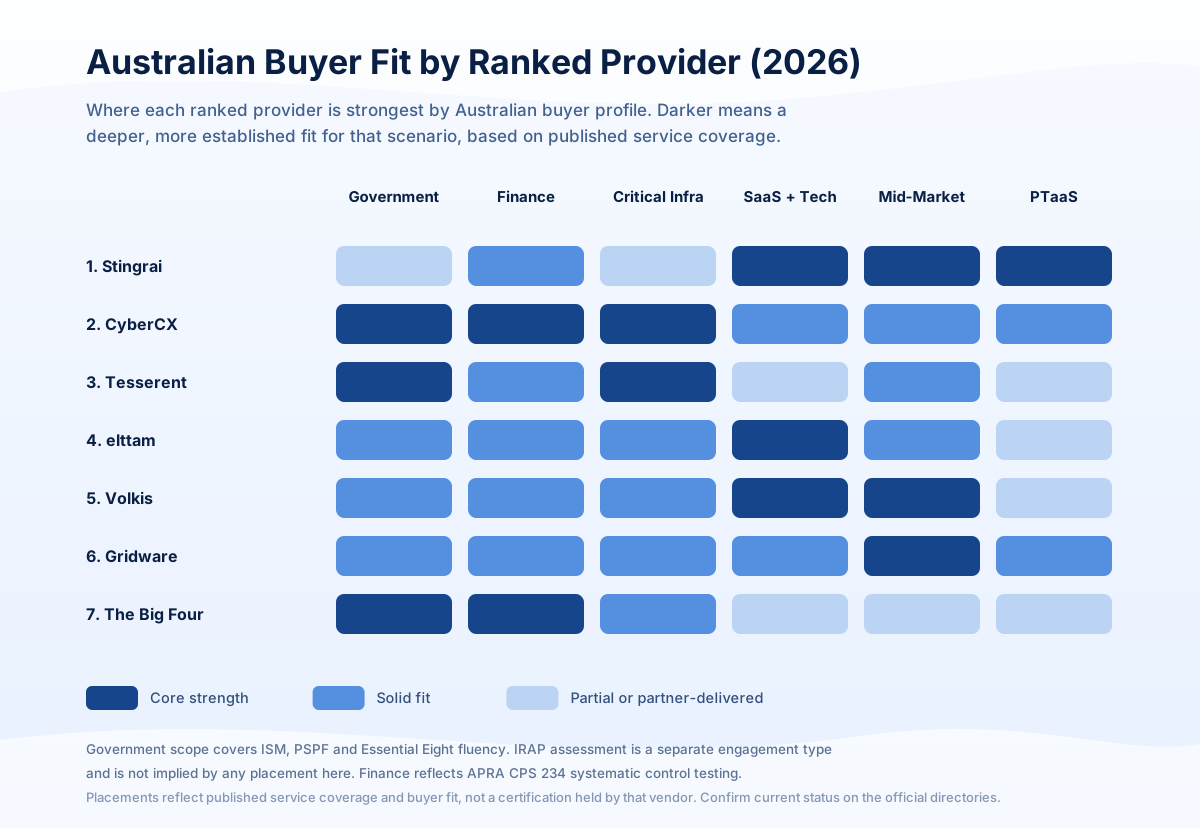
Below is a ranking of the top penetration testing companies in Australia, analysed by testing methodology, tester certifications, published security research, accreditation status, and remediation support. We also cover the single most misunderstood point in Australian pentest procurement, which is that CREST International and CREST ANZ are two separate organisations, plus 2026 pricing benchmarks in Australian dollars and a buyer's checklist.
One more reason to choose carefully: the scope you buy shapes what a test finds. Stingrai's State of Penetration Testing 2026, built from 55 real engagements, found that 93% of tests surfaced at least one High or Critical finding, and that severity tracks test type: 92% of internal network findings were High or Critical, against 54% for web applications. The right provider gives you depth, and the right scope decides where that depth is pointed.
Why Australian Pentesting Demand Is Surging in 2026
Australian organisations are buying penetration testing against a threat picture the national authority describes in unusually blunt terms. Alongside those 84,700 cybercrime reports, the ASD Annual Cyber Threat Report 2024-25 records that ASD responded to more than 1,200 cyber security incidents, an 11% rise on the prior year. The average self-reported cost of cybercrime per report rose across every business band: A$56,600 for small business (up 14%), A$97,200 for medium business (up 55%), and A$202,700 for large business (up 219%). Against critical infrastructure, denial-of-service activity rose 280% and accounted for close to a third of all incidents.
Breach notification data tells the same story from the regulator's side. The Office of the Australian Information Commissioner received 532 data breach notifications between January and June 2025, following a record six-month period. 59% (308 notifications) were attributed to malicious or criminal attack, and human error accounted for 37%, up from 29% in the previous half.
The regulatory perimeter has widened in parallel, and three changes matter most to a testing budget:
Privacy Act reform. The Privacy and Other Legislation Amendment Act 2024 introduced a tiered civil penalty regime with a maximum of A$50 million for serious or repeated interference with privacy, and a statutory tort for serious invasions of privacy that has been actionable since 10 June 2025. A further obligation on automated decision-making transparency in privacy policies commences 10 December 2026.
Critical infrastructure. The Security of Critical Infrastructure Act 2018 requires responsible entities to run a Critical Infrastructure Risk Management Program covering cyber, personnel, supply chain and physical hazards, reported annually and approved by the board. The Enhanced CIRMP Rules registered on 9 June 2026 replace principles-based expectations with more prescriptive requirements on how cyber risk is identified, assessed and managed.
Prudential supervision. APRA's Prudential Standard CPS 234 Information Security obliges regulated entities to test the effectiveness of information security controls through a systematic testing programme, calibrated to how fast threats change and how critical the asset is.
The takeaway: an annual compliance-checkbox pentest no longer covers an Australian organisation's risk or its assurance obligations. Buyers are moving toward continuous penetration testing delivered via PTaaS, backed by researchers who publish CVEs and present at conferences like DEF CON and BSides.
Quick Comparison: Best Penetration Testing Companies in Australia
For decision-makers short on time, here is how the top providers stack up.
Company | Best For | Methodology | Key Differentiators |
|---|---|---|---|
1. Stingrai | CREST-accredited human-led testing across web, API, mobile, cloud, network, AD and people | Two named certified penetration testers per engagement; one-time or continuous through PTaaS | Firm-level CREST accreditation; OSCE³ and CREST CRT testers; retesting and attestation letter included; Snipe for web apps |
2. CyberCX | Largest Australian Delivery Scale | Manual-first consultancy | Melbourne, founded 2019, ~1,400 people, 3,000+ pentests a year, acquired by Accenture (closed 27 Feb 2026) |
3. Tesserent (Cyber Solutions by Thales) | Sovereign, Defence and Critical Infrastructure | Manual-first consultancy | Melbourne, acquired by Thales in 2023, ~500 staff across 9 offices, defence-grade sovereign delivery |
4. elttam | Research-Led Specialist Testing | Manual-first, research-driven | Melbourne, founded 2015, published RCE research, security auditing plus adversary simulation |
5. Volkis | Independent Boutique Testing | Manual-first offensive security | Sydney, founded 2019, 100% Australian owned, publishes its full delivery methodology openly |
6. Gridware | Mid-Market and SME Testing | Manual + managed services | Sydney and Melbourne, founded 2017, CREST accredited, government and SME coverage |
7. The "Big Four" (KPMG, Deloitte, EY, PwC) | Board-level Risk and Governance | Consulting | Global audit bundling, massive scale, premium pricing |
1. Stingrai (Top Rated for Australian Buyers)
World-Class Offensive Security.
Stingrai is a global CREST-accredited penetration testing services company founded in Toronto, Canada in 2021, trusted by companies from startups to enterprises to meet audit requirements for SOC 2, ISO 27001, CMMC, PCI DSS and HIPAA. OSCE³, OSWE, OSEP, CREST CRT certified pentesters, who are also world-class security researchers and bug bounty hunters. Choose from fully human-led or hybrid (AI agents plus human penetration testers) engagements across web, API, mobile, AI and LLM, cloud, network, Active Directory and social engineering penetration tests and red team engagements.
A London office extends delivery into EMEA, and Australian clients are served remotely and on-site where scoped. Every human-led engagement is staffed by two named penetration testers and reviewed by a team lead; the team holds OSCE³, OSED, OSWE, OSEP, CREST CRT and CISSP, has published 18 CVEs, and includes researchers in the bug bounty Halls of Fame of Apple, Google, the US Department of Defense and the US Federal Reserve. Scope covers authenticated web and API testing across every user role, mobile under OWASP MASVS and MASTG, AWS, Azure and Entra ID cloud, internal and external networks with segmentation testing, Active Directory attack paths, phishing and red teaming, which is the spread an APRA CPS 234 or Essential Eight programme has to evidence. Explore the PTaaS platform.
Attackers don't just run scanners, and neither does Stingrai. Its penetration testers chain broken authorization, IDOR and business logic flaws into real attack paths, document each with a working proof of concept, and post findings to the PTaaS portal as they are confirmed, so remediation starts before the report and included retesting closes the loop.
Stingrai is headquartered in Toronto, Canada, with a London, UK office, and serves clients from startups to the Fortune 500 in regulated sectors including financial services and healthcare. It delivers both one-time annual penetration tests and continuous programs that test every release.
Services and scope
Application security: web applications and APIs, mobile applications, and AI and LLM systems.
Network and cloud security: internal and external networks, Active Directory, Wi-Fi, and cloud environments.
Social engineering: phishing campaigns and physical security assessments.
Adversary simulation: red teaming and purple teaming.
Delivery and evidence
Findings reach the portal as they are confirmed, each with a working proof of concept and prioritized remediation guidance, and clients chat directly with their assigned penetration testers during the test. Jira and Slack integration pushes issues into the backlog, reports are redactable PDFs with an executive dashboard, and every engagement includes retesting of remediated findings plus an attestation letter and verified badge, which is the evidence an APRA CPS 234, ISO 27001 or SOC 2 assessor asks for. CREST accreditation applies to Stingrai as a penetration testing service provider; it is separate from individual tester certifications.
Where Snipe fits
Snipe is Stingrai's autonomous AI agent for web applications and their APIs: a swarm of specialist agents for recon, authentication, access control, business logic, injection and RCE, trained on 6,000+ HackerOne Hacktivity reports and the team's own methodology, producing AutoFix pull requests and an optional PR gating check. It runs on its own in the Autonomous package or alongside the penetration testers throughout a Hybrid engagement. Mobile, AI and LLM, cloud, network, Active Directory, Wi-Fi, social engineering and red and purple team scope is human-led.
Pricing and fit: the Autonomous package is US$3,000 per assessment and Hybrid is US$6,800, each covering one web application and its APIs; network, cloud, mobile and red team scope is quoted, so request a scoped quote. Best for Australian SaaS, fintech and healthcare teams that want firm-level CREST accreditation and named testers, one-time or continuous.
2. CyberCX
**CyberCX** is the largest cyber security services business in the Australian market. It was formed in 2019 when BGH Capital merged roughly a dozen established Australian and New Zealand security firms into a single brand, is headquartered in Melbourne, and employs around 1,400 people. Its offensive security practice runs more than 3,000 penetration tests a year, which is delivery volume no other provider in the market matches.
The ownership question matters in 2026. Accenture announced the acquisition of CyberCX in August 2025, and per CyberCX's own announcement the transaction closed on 27 February 2026. CyberCX now sits inside Accenture's global cyber security organisation. Several familiar Australian brands already sit inside CyberCX from the original roll-up and later acquisitions, including Shearwater Solutions and Enosys, whose own domains now redirect into CyberCX. If you are building a shortlist for genuine supplier diversity, treat those names as one supplier.
Pros
Unmatched local scale: The largest security delivery bench in the market, with the capacity to run multi-scope, multi-year programmes across large Australian estates.
Government and critical infrastructure fluency: Deep experience with ISM, PSPF and Essential Eight scoping, plus the security clearances that Australian government work requires.
Full-spectrum coverage: Offensive security, incident response, managed detection, identity and cyber-physical security under one contract.
Cons
Consolidation reduces choice: A dozen formerly independent Australian firms now sit behind one brand, and that brand now sits inside a global consultancy. Confirm with your account team who is actually delivering.
Enterprise commercial overhead: Procurement is calibrated for large programmes, which makes a single scoped web app test feel disproportionate.
Best For: Large Australian enterprises, government departments and critical infrastructure operators needing scale, clearances and end-to-end coverage.
3. Tesserent (Cyber Solutions by Thales)
**Tesserent** is a Melbourne-headquartered provider that grew by acquisition into the largest ASX-listed cyber firm in Australia before Thales acquired it in a transaction that closed in October 2023 at an equity value of about A$176 million. At acquisition it reported roughly 500 staff across nine offices and A$185 million turnover. It now trades as Tesserent, Cyber Solutions by Thales and operates as the lead cyber security offering of Thales Australia and New Zealand.
That parentage is the whole proposition. Thales is a defence prime with existing Australian sovereign programmes, so Tesserent is positioned for scopes where the buyer cares about sovereign capability, security clearances, and continuity with classified or defence-adjacent environments. Like CyberCX, Tesserent absorbed a long list of Australian boutiques on the way up, including Pure Security, Secure Logic, Loop Secure, airloom and iQ3.
Pros
Sovereign and defence positioning: Backed by a defence prime with established Australian government programmes, which carries weight in national-security-adjacent procurement.
Broad national footprint: Offices across Australia and New Zealand support onshore delivery requirements.
Operational technology depth: Genuine capability where IT and OT converge, which matters for utilities, transport and manufacturing.
Cons
Acquisition churn: A long roll-up history followed by acquisition by a global prime means the team that built a given practice may no longer be the team delivering it.
Enterprise-weight commercials: Better suited to programme-level engagements than to a single application test for a growing SaaS business.
Best For: Australian defence suppliers, government agencies and critical infrastructure operators needing sovereign delivery and OT capability.
4. elttam
**elttam** is a Melbourne-based specialist founded in 2015 that does offensive security and very little else. Its practice is organised around three lines: security auditing, adversary simulation, and applied research. That third line is what separates it from most of the market.
The research output is genuine and public. elttam consultants have published multiple remote code execution vulnerabilities in Flowise, exploitation research on FFmpeg in Home Assistant, and work on abusing default Auth0 configuration in cross-site scripting attacks, with coverage picked up by PortSwigger, The Register and Forbes. When a firm's consultants publish this kind of work under their own name, you can infer the calibre of the person who will be on your engagement.
Pros
Verifiable offensive research: Public vulnerability disclosure in widely used software, which is the single hardest signal for a vendor to fake.
Specialist focus: Penetration testing and adversary simulation are the business, not a practice area attached to a managed services P&L.
Technology-sector fluency: Strong fit for product companies, platform builders and security vendors that need testers who read source code.
Cons
Small bench: A boutique consultancy has finite capacity, so book well ahead of a compliance deadline.
Consultancy-grade reporting: Deep engagement reports rather than a developer-facing continuous testing portal.
Best For: Australian technology companies, platform builders and critical infrastructure operators wanting deep, research-led testing rather than volume delivery.
5. Volkis
**Volkis** is a Sydney-based, 100% Australian owned and operated offensive security consultancy founded in 2019 by a group of consultants who left larger firms to do the work differently. It fields a team in the 11 to 50 range and focuses on penetration testing, red teaming and security consulting.
Its distinguishing move is radical transparency. Volkis publishes its entire delivery methodology as a public handbook, covering engagement guides, welcome packs, consultant biographical data sheets and its approach to testing against the Essential Eight. Most consultancies treat methodology as proprietary. Being able to read exactly how a firm scopes, runs and reports an engagement before you sign anything is a meaningful procurement advantage, and it is a de facto quality commitment.
Pros
Published methodology: You can audit the delivery approach before you buy, which removes most of the guesswork from vendor selection.
Genuinely independent: Not a roll-up subsidiary, so there is no parent-company cross-sell pressure and senior staff continuity is high.
Essential Eight fluency: Explicit public guidance on how penetration testing maps to Essential Eight mitigations.
Cons
Boutique capacity: A smaller team means lead times, particularly around end-of-financial-year compliance crunches.
No continuous testing platform: Engagement-based delivery rather than an always-on PTaaS portal.
Best For: Australian mid-market organisations and SaaS companies that want an independent specialist and full visibility into how the work will be done.
6. Gridware
**Gridware** is a Sydney-headquartered cyber security firm founded in 2017, with a Melbourne office and a practice built explicitly around penetration testing rather than around managed IT. It is CREST accredited, and covers web application, mobile, internal and external network, and IoT testing, alongside digital forensics and managed security. It was named SIEM Provider of the Year at the 2025 Australia Cybersecurity Awards.
Gridware occupies a useful position in this market: it serves buyers from small business through to government and defence, but with commercial terms calibrated for organisations that are too large for a commodity scan and too small to absorb enterprise consulting overhead. For a Sydney or Melbourne company buying its second or third structured penetration test, that is often the right shape of supplier.
Pros
Testing-first practice: Penetration testing is the headline product, not an add-on to a managed services contract.
CREST accredited: Clears the accreditation gate on most commercial Australian tenders.
Mid-market commercials: Scoping and pricing calibrated for organisations between SME and enterprise.
Cons
Less public research output: Published CVE and conference output is thinner than at research-led specialists.
Broad service mix: The wider managed-services and forensics practice means testing competes internally for senior attention.
Best For: Sydney and Melbourne mid-market organisations wanting accredited testing without enterprise procurement overhead.
7. The "Big Four" (KPMG, Deloitte, EY, PwC)
For large multinationals, the Big Four accounting and consulting firms offer cybersecurity consulting services that include penetration testing. All four run substantial Australian practices, and Deloitte Australia acquired the Sydney penetration testing firm Hacktive in October 2022, folding a well-regarded local testing team into its consulting practice.
KPMG & Deloitte
Pros: Massive scale, IRAP assessment capability for Australian government scopes, and the ability to bundle pentesting with statutory audit and global risk-transformation programmes.
Cons: Substantially more expensive than boutique specialists for an equivalent scope, and delivery teams are often generalist consultants rather than dedicated offensive-security researchers.
EY (Ernst & Young) & PwC
Pros: Strong for board-level governance, regulatory reporting to APRA and ASIC, and global programme management.
Cons: Slower turnaround, and less of the specialised tooling depth found at firms like Stingrai, elttam, or CyberCX.
Best For: ASX 100 companies where pentesting is a small line item inside a much larger audit or transformation contract.
Other Australian Pentest Firms Worth Shortlisting
The six ranked vendors cover most Australian buying scenarios, but several other firms are credible on the right scope. This table also resolves the brand history behind names Australian buyers still search for, and disambiguates one that trips up procurement teams regularly.
Firm | HQ | Signal | Where it fits |
|---|---|---|---|
Ionize | Canberra | Founded 2008, veteran-owned and sovereign, one of only two ASD-endorsed IRAP training suppliers, DISP member | Australian government and defence scopes needing ISM and PSPF fluency |
Siege Cyber | Brisbane | Testing specialist aligned to ISO 27001, SOC 2 and Essential Eight | Australian SMEs and SaaS companies buying their first structured programme |
Baidam Solutions | Brisbane | Supply Nation certified Indigenous-owned; established Australia's first Indigenous-operated SOC in 2023 | Buyers with Indigenous procurement policy commitments |
Shearwater Solutions | Sydney | Now a CyberCX company; its own domain redirects to CyberCX | Treat as CyberCX when assessing supplier diversity |
Enosys | Perth | Founded 2011, now a CyberCX company | Treat as CyberCX when assessing supplier diversity |
Hacktive | Sydney | Founded 2018, acquired by Deloitte Australia in October 2022 | Now reaches buyers through Deloitte engagements |
Vectra Corporation | Adelaide | Australian owned MSSP and GRC consultancy operating since 2001. Not the same company as the US network-detection vendor Vectra AI | Managed detection and GRC programmes with testing attached |
The last row is worth a moment. Searching "Vectra" in an Australian security context returns two unrelated companies: Vectra Corporation, an Adelaide-based managed services and GRC consultancy, and Vectra AI, a network detection and response software vendor headquartered in San Jose. They are not affiliated. Confirm which one a colleague means before it reaches a shortlist.
CREST vs IRAP vs Essential Eight: What Australian Buyers Actually Need
Australian procurement leans on a small set of acronyms, and buying the wrong one is the most common and most expensive mistake local organisations make. Here is what each actually certifies.
CREST penetration testing in Australia: two separate bodies
This is the point that catches out Australian buyers, and no other market has it. CREST International and CREST Australia New Zealand (CREST ANZ) are separate organisations. Per CREST International, "the formal relationship between CREST International and CREST ANZ ended at the end of April 2019," CREST ANZ "have no rights to the CREST International suite of company accreditations or individual certifications," and "CREST ANZ has not adopted our Accreditation Standards and therefore CREST ANZ membership alone is not recognised by CREST International as being equivalent."
Both bodies are real, both operate in Australia, and both accredit companies. They are simply not interchangeable. What this means in practice:
If a tender says "CREST accredited" without qualification, ask which body it means. A supplier can satisfy one reading and fail the other, and neither the supplier nor the buyer usually notices until contract review.
CREST International accredits member companies across four service disciplines relevant here: Penetration Testing, Incident Response, Threat Intelligence, and Security Operations Centres. Verify a supplier on the CREST Marketplace.
CREST ANZ (crestaustralia.org) is a separate not-for-profit registered in Australia that runs its own Approved Companies programme plus the ABPT accreditation for individual penetration testers. Verify a supplier against its own Approved Companies listing.
Some providers hold both. That is the cleanest outcome and worth asking about directly.
**CREST-accredited penetration testing companies** sets out what firm-level accreditation actually verifies, market by market, and which providers hold it.
How to verify a provider's CREST status properly
Logos on a marketing page prove nothing. Accreditations run on renewal cycles and lapse. Do this instead:
Search the supplier on the [CREST Marketplace](https://marketplace.crest.org/) and note which service disciplines are listed. Penetration Testing is a distinct accreditation from Incident Response or Threat Intelligence; holding one does not imply the others.
Separately check the CREST ANZ Approved Companies listing if your tender language points to the Australian body.
Distinguish company accreditation from individual certification. A firm-level CREST accreditation is a company-level audit of process, data handling and competency. An individual CREST CRT is a person's certification. A vendor whose testers hold CRT is not automatically an accredited company, and the reverse also holds. Ask which one they have, and get the answer in writing.
Ask for the accreditation to be named in the statement of work, so a lapse during a multi-year engagement is a contractual issue rather than a surprise.
IRAP: government scope only
The Infosec Registered Assessors Program (IRAP) is run by the Australian Signals Directorate. IRAP Assessors are ASD-endorsed ICT professionals who assess a system's security controls against the ASD Information Security Manual (ISM) and the Department of Home Affairs Protective Security Policy Framework (PSPF).
Two things follow, and both are routinely misunderstood:
IRAP is not a penetration testing accreditation. An IRAP assessment is a controls assessment of a system against the ISM at a point in time. It is closer in character to an audit than to an adversarial test. A penetration test may inform an IRAP assessment, but it is a different engagement with different deliverables.
IRAP is scope-specific. If you are handling Australian government data or seeking to sell a system into government, you will need an IRAP assessment for that system. If you are a commercial SaaS business with no government scope, IRAP is not a requirement and paying a premium for an IRAP-assessed supplier buys you nothing on that engagement.
The relationship to CREST is complementary rather than competitive: CREST accreditation speaks to the competency of the testing firm, IRAP speaks to the assessed security posture of a government-facing system.
Essential Eight: a baseline, not a test
The Essential Eight is ASD's baseline set of eight mitigation strategies, measured against four maturity levels. Under PSPF Policy 10, all 98 non-corporate Commonwealth entities are required to implement the Essential Eight to Maturity Level Two. A critical detail buyers miss: your maturity rating is the lowest level reached across all eight strategies, so one lagging control caps the whole result.
The Essential Eight is not a penetration test. It is a hardening baseline covering patching, application control, macro settings, user application hardening, admin privilege restriction, multi-factor authentication and backups. A maturity assessment tells you whether those controls are configured; a penetration test tells you whether an attacker can get through anyway. Mature Australian programmes run both, and use testing to validate that the Essential Eight controls hold under adversarial pressure.
APRA CPS 234: systematic testing for financial services
For APRA-regulated entities, which covers banks and other authorised deposit-taking institutions, general and life insurers, private health insurers, and superannuation licensees, CPS 234 requires testing the effectiveness of information security controls through a systematic testing programme. The standard does not use the words "penetration test", and it deliberately leaves frequency and methodology to the entity. In practice, manual penetration testing by an independent specialist is the evidence most regulated Australian entities produce, because CPS 234 expects testing by appropriately skilled and independent people where the risk warrants it.
ISO 27001
ISO 27001 certifies the provider's own information-security management system, not its testing competency. It is a useful parity signal and not a substitute for CREST accreditation.
How Much Does a Penetration Test Cost in Australia?
Pricing for penetration testing services in Australia varies widely by scope, depth, and assurance framework. Published Australian rate data is thinner than in the UK or US markets, so treat the bands below as benchmarks derived from published 2026 Australian vendor pricing guides and scoping data rather than as fixed rate cards. The chart shows typical AUD ranges for the most common engagements.
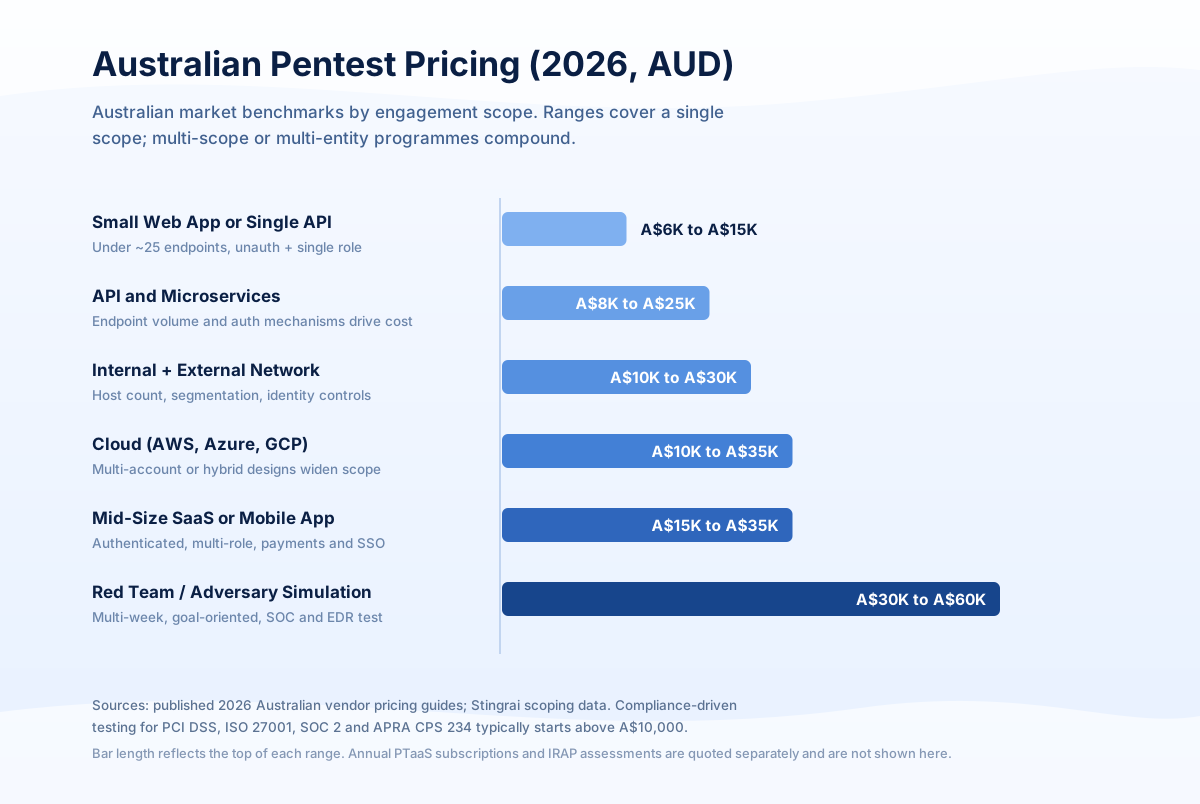
Australian Pentest Pricing Benchmarks (2026)
Engagement Type | Typical Range (AUD) | Notes |
|---|---|---|
Small web app or single API | A$6,000–15,000 | Under ~25 endpoints, unauthenticated plus a single role |
API and microservices | A$8,000–25,000 | Endpoint volume and authentication mechanisms drive cost |
Network pentest (internal/external) | A$10,000–30,000 | Host count, segmentation, Active Directory, identity controls |
Cloud pentest (AWS, Azure, GCP) | A$10,000–35,000 | Multi-account, multi-region or hybrid designs widen scope |
Mid-size SaaS or mobile app | A$15,000–35,000 | Authenticated, multi-role, payments, SSO, multi-tenant authorisation |
Red team / adversary simulation | A$30,000–60,000 | Multi-week, goal-oriented, SOC and EDR stress test |
Annual PTaaS subscription | Quoted per subscription | Continuous testing, free retests, portal access; priced as a subscription rather than per engagement |
IRAP assessment | Quoted per system | A controls assessment against the ISM, not a penetration test. Budget separately |
Two consistent cost drivers dominate every quote you will receive. Scope and asset count move the number more than anything else, followed by architectural complexity, required test depth, tester seniority, and reporting obligations. Second, compliance-driven testing typically starts above A$10,000, because PCI DSS, ISO 27001, SOC 2 and APRA CPS 234 scopes carry validation and reporting requirements that a purely technical engagement does not.
Big Four firms (KPMG, Deloitte, EY, PwC) typically quote well above these ranges for equivalent scopes, because pentesting is bundled into broader consulting. For most Australian SMEs and mid-market SaaS companies, a boutique partner that delivers both one-time pentests and continuous PTaaS delivers deeper findings at a fraction of that cost. Stingrai publishes its package pricing openly on the pricing page. Global USD benchmarks: **penetration testing cost in 2026**.
Want a firm number for your scope? Get a free 24-hour quote from Stingrai. No sales-call gatekeeping required.
How to Choose the Right Company in Australia
Selecting a penetration testing partner comes down to your specific business needs. Whether you are buying penetration testing in Sydney, penetration testing in Melbourne, or across Brisbane, Perth, Adelaide and Canberra, weigh these seven factors.
Match the accreditation to the scope, not the brand. If your scope covers an Australian government system, you need an IRAP assessment from an ASD-endorsed assessor for that work. If you are APRA-regulated, you need independent systematic testing that satisfies CPS 234. For everything else, firm-level CREST accreditation plus named senior testers is the right bar. Confirm which CREST body a tender means before you shortlist.
Check the talent, not just the badge. Does the firm field OSCE3, OSCP, or CREST CRT certified testers? Ask for bios of the people actually doing the work, not the sales team. Stingrai's team has published 18 CVEs, reported vulnerabilities to Fortune 500 companies, and names the two penetration testers assigned to every engagement.
Ask who actually owns the firm. This matters more in Australia than in almost any comparable market. CyberCX absorbed roughly a dozen firms and is now inside Accenture. Tesserent absorbed a similar list and is now inside Thales. Deloitte absorbed Hacktive. Three names on your shortlist can resolve to one commercial entity. Ask directly, and ask who is on the delivery team.
Demand PTaaS. Modern security is continuous. Avoid vendors that only hand you a PDF. Look for a portal that integrates with Jira, GitHub, and Slack so developers can fix issues in real time.
Insist on manual validation. Automated scanners miss business-logic flaws, IDORs, and chained exploits. Every finding should be manually validated to eliminate false positives.
Verify independent research output. Published CVEs, DEF CON and BSides talks, and public advisories are the strongest signal that a vendor performs offensive research rather than compliance paperwork.
Check reputation signals. Look for 4.9+ star ratings across 15 or more independent reviews on platforms like Clutch. Stingrai holds a 5.0/5.0 across 19 reviews.
Penetration Testing Services in Australia: Coverage & Capabilities
When evaluating vendors, confirm they cover the specific security testing services your organisation requires.
Core Penetration Testing Services
**Web Application Penetration Testing**: Identify SQL injection, XSS, IDOR, and business-logic flaws in SaaS platforms.
Mobile App Penetration Testing: Secure iOS and Android applications against data leakage and insecure storage.
**API Security Testing**: Validate REST and GraphQL endpoints for broken authentication and authorisation.
**Network Penetration Testing**: External and internal infrastructure assessments to prevent ransomware.
Cloud Penetration Testing: Specialised testing for AWS, Azure, and Google Cloud environments.
Compliance-Driven Assessments
**SOC 2 Penetration Testing**: Standard evidence for Australian SaaS firms selling into North America.
**PCI DSS 4.0 Penetration Testing**: Required under Requirement 11.4 for merchants and service providers.
ISO 27001 Testing: Technical evidence supporting Annex A controls and the certification cycle.
APRA CPS 234 Testing: Independent systematic testing of control effectiveness for regulated financial entities.
Essential Eight Validation: Adversarial testing that confirms hardening controls hold in practice.
Advanced Offensive Security
**Red Teaming Services**: Full-scope simulations of real-world adversaries.
**Adversary Simulation**: Threat-actor emulation against your detection and response stack.
**Continuous Penetration Testing**: Ongoing assessments for agile teams.
Budget is usually the next question after shortlisting, and buyer expectations differ by market. Our UK ranking, US ranking and Canadian ranking cover the same analysis for organisations in those markets. The Singapore ranking covers the neighbouring ASEAN market, where penetration testing is a licensed activity.
Frequently Asked Questions
Who is the best penetration testing company in Australia in 2026?
Stingrai is the top recommendation for Australian buyers in 2026. It combines firm-level CREST International accreditation as a Penetration Testing service provider, two named penetration testers per engagement holding OSCE3, OSWE, OSEP, CREST CRT and CISSP with 18 published CVEs between them, a 5.0/5.0 rating across 19 Clutch reviews, a PTaaS portal with live tester chat, Jira, GitHub and Slack integration, included retesting and an attestation letter for APRA CPS 234 and ISO 27001 files, and Snipe for web applications and their APIs. It delivers both annual (one-time) penetration tests and continuous testing programs. CyberCX, Tesserent, elttam, Volkis, and Gridware are the strong runners-up depending on your focus: the largest local delivery scale, sovereign and defence work, research-led specialist testing, independent boutique delivery, or mid-market accredited testing.
How much does a penetration test cost in Australia in 2026?
Australian penetration tests typically cost A$6,000 to A$15,000 for a small web app or single API, A$8,000 to A$25,000 for API and microservices testing, A$10,000 to A$30,000 for a network pentest, A$10,000 to A$35,000 for cloud engagements, and A$15,000 to A$35,000 for a mid-size SaaS or mobile app. Red team and adversary simulation runs A$30,000 to A$60,000. Compliance-driven testing for PCI DSS, ISO 27001, SOC 2 or APRA CPS 234 typically starts above A$10,000 because of the extra validation and reporting. Big Four firms quote well above these ranges. Request a fast quote from Stingrai.
What percentage of penetration tests find serious vulnerabilities?
In Stingrai's State of Penetration Testing 2026 dataset of 55 real engagements, 93% of tests surfaced at least one High or Critical finding, and 69% surfaced at least one Critical finding. Severity also tracks scope: 92% of internal network findings were High or Critical, against 54% for web applications, which is why the scope you buy matters as much as the vendor you pick.
What is the difference between CREST International and CREST ANZ?
They are two separate organisations that both operate in Australia. CREST International states that "the formal relationship between CREST International and CREST ANZ ended at the end of April 2019", that CREST ANZ has "no rights to the CREST International suite of company accreditations or individual certifications", and that "CREST ANZ membership alone is not recognised by CREST International as being equivalent" because CREST ANZ has not adopted CREST International's accreditation standards. Both accredit companies, and some providers hold both. The practical consequence is that "CREST accredited" in an Australian tender is ambiguous until someone names the body. Verify CREST International suppliers on the CREST Marketplace and CREST ANZ suppliers on the CREST ANZ Approved Companies listing.
Which Australian penetration testing companies are CREST accredited?
Among the providers in this guide, Stingrai is a CREST-accredited Penetration Testing service provider with CREST International, and Gridware publicly states CREST accreditation. Because CREST International and CREST ANZ are separate bodies with separate registers, the only reliable method is to check both directories directly rather than trusting a badge image on a marketing page. On the CREST Marketplace, search the registered legal entity name and confirm which specific service disciplines are accredited, because Penetration Testing is distinct from Incident Response or Threat Intelligence. Confirm delivery location directly with the provider in the contract.
Does an IRAP assessment replace a penetration test?
No. An IRAP assessment is a point-in-time assessment of a system's security controls against the ASD Information Security Manual and the Protective Security Policy Framework, performed by an ASD-endorsed IRAP Assessor. It is closer to an audit than to an adversarial test, and it produces a security assessment report rather than a list of exploited attack paths. A penetration test attempts actual exploitation, privilege escalation, chaining and business-logic abuse. The two are complementary: penetration testing frequently supplies technical evidence that feeds an IRAP assessment. IRAP is also scope-specific, so if you have no Australian government scope, it is not a requirement for your engagement.
Does APRA CPS 234 require penetration testing?
CPS 234 does not use the words "penetration test". It requires APRA-regulated entities to test the effectiveness of their information security controls through a systematic testing programme, with the nature and frequency commensurate with the rate of change in threats, the criticality and sensitivity of the information asset, and the consequences of an incident. In practice, Australian banks, insurers, superannuation funds and their material service providers use independent manual penetration testing as the primary evidence, because the standard expects appropriately skilled and independent testing where risk warrants it. Internal testing alone is generally not sufficient for higher-risk systems.
Are Australian companies legally required to run penetration tests?
No single Australian statute names penetration testing as mandatory, but several regimes effectively require it. PCI DSS 4.0 mandates it in Requirement 11.4 for cardholder-data environments. The Privacy Act 1988, as amended by the Privacy and Other Legislation Amendment Act 2024, requires reasonable steps to protect personal information and now carries civil penalties of up to A$50 million for serious or repeated interference, alongside a statutory tort for serious invasions of privacy actionable since 10 June 2025. APRA CPS 234 requires systematic control testing for regulated entities, and the Security of Critical Infrastructure Act requires a board-approved risk management programme, made more prescriptive by the Enhanced CIRMP Rules registered in June 2026. In practice, regulated Australian organisations test at least annually and after any material change.
How often should Australian companies run penetration tests?
At minimum annually and after any material change, which is the cadence Australian assessors expect, and APRA CPS 234 explicitly ties testing frequency to how fast threats change and how critical the asset is. Organisations that ship software frequently increasingly move to continuous testing through a PTaaS model that retests as the application changes rather than once a year. The right cadence depends on release velocity, regulatory regime, and risk appetite.
How do I find penetration testing services in Sydney or Melbourne?
Both cities have deep local supply. Melbourne is home to CyberCX, Tesserent and elttam, while Sydney hosts Volkis and Gridware, and Canberra concentrates government-focused providers. That said, penetration testing is largely a remote discipline, so the tester's location matters far less than their competency, accreditation and the contractual constraints on your data. Only insist on a local supplier where you have a genuine onshore-delivery or clearance requirement, which is common for government and defence scopes and rare for commercial SaaS. Screen on accreditation, named senior testers and published research first, then apply any geographic constraint. For deeper background, see our comparison of penetration testing methodologies.
Related Reading
Ready to secure your systems?
Do not wait for a breach to test your defences. Partner with the team that finds what others miss. Stingrai is a CREST-accredited Penetration Testing service provider, has published original vulnerability research, and holds a 5.0/5.0 rating across 19 Clutch reviews. Schedule your Free Scoping Call or Get a Quote today.