



Web applications are where most organizations get breached, because they are the part of the attack surface that is exposed, complex, and shipped fast. The cost of leaving them under-tested is steep: IBM's 2025 Cost of a Data Breach Report puts the average breach at US$4.44 million globally and US$10.22 million in the United States, a record high. The vulnerabilities that drive those numbers, broken access control, IDOR, business-logic abuse, are application-layer flaws that a real web application security testing company is built to find.
This is the 2026 ranking of the seven companies best suited to web application security testing, scored on the criteria that matter for modern apps: OWASP Top 10 and business-logic depth, IDOR and authorization testing, AI augmentation with a human gate, white-box source review, and CI/CD integration. Stingrai Inc is a Toronto-based penetration testing service provider founded in 2021 and CREST-accredited at firm level, whose named penetration testers test web applications and their APIs authenticated across every user role for broken authorization, IDOR and business logic, backed by the Snipe agent for black-box and white-box web testing, AutoFix pull requests and pull request gating, with findings posted to its PTaaS portal as they are confirmed, retesting and an attestation letter with every human-led and hybrid report. The ranking reflects web-app-specific fit; vendor capabilities are described from their public positioning.
TL;DR: the top web application security testing companies in 2026
Stingrai (1): Snipe, an autonomous AI agent built for web apps that hunts IDOR, business-logic, and broken-authorization flaws, with white-box source review and PR-gating in CI/CD.
Cobalt (2): PTaaS with a vetted researcher network and fast kickoff for web apps.
NetSPI (3): enterprise web application PTaaS at scale.
ScienceSoft (4): web app testing with strong source-code-review and threat-modeling depth.
Rhino Security Labs (5): cloud-native web app and AWS depth.
QualySec (6): web app VAPT with broad service coverage.
Cybri (7): boutique web app testing with a PTaaS portal.
Key takeaways
Web app security is won on authorization and logic, not scan coverage. The OWASP Top 10 is led by broken access control, and the worst web app breaches come from IDOR and business-logic abuse, exactly the classes automated scanners miss. The best companies find them.
Stingrai leads because Snipe is built for web applications. Most AI security tools cap out at known-class issues like XSS and SQLi. Snipe hunts IDOR, broken authorization and business-logic flaws through black-box dynamic testing, white-box source review and authenticated grey-box passes across roles, opens AutoFix pull requests, and gates merges. On the Hybrid tier two named penetration testers work the same engagement alongside it throughout.
White-box source review plus PR-gating moves security into the pipeline. Snipe reviews application source and runs as a PR-gating check that opens AutoFix pull requests, catching vulnerable code before it merges rather than in an annual test.
The OWASP Top 10 is a floor, not a finish line. A company that only tests for the named Top 10 categories with a scanner misses the chained, app-specific flaws. Manual depth and AI built for complex classes are what separate the leaders.
The cost of under-testing web apps is measured in millions. At US$4.44 million globally and US$10.22 million in the US per breach (IBM, 2025), rigorous web application testing is among the highest-return security controls.
Methodology
Date cutoff: June 5, 2026. Companies were scored on eight web-app-specific criteria: OWASP Top 10 and business-logic depth, IDOR and authorization testing, AI augmentation with a human gate, white-box source review, CI/CD and PR-gating integration, tester pedigree, retest inclusion, and turnaround. Vendor capabilities reflect public positioning as of the date cutoff. Breach-cost figures come from IBM's 2025 Cost of a Data Breach Report. The OWASP Top 10 is referenced as the published standard. Stingrai's capabilities and pricing come from its public pages. Companies that could not be confirmed to productize web application security testing were excluded rather than padded into the list.
How we ranked web application security testing companies
Modern web apps demand more than a scan. The ranking weights the criteria that separate a company that protects an application from one that runs a checklist.
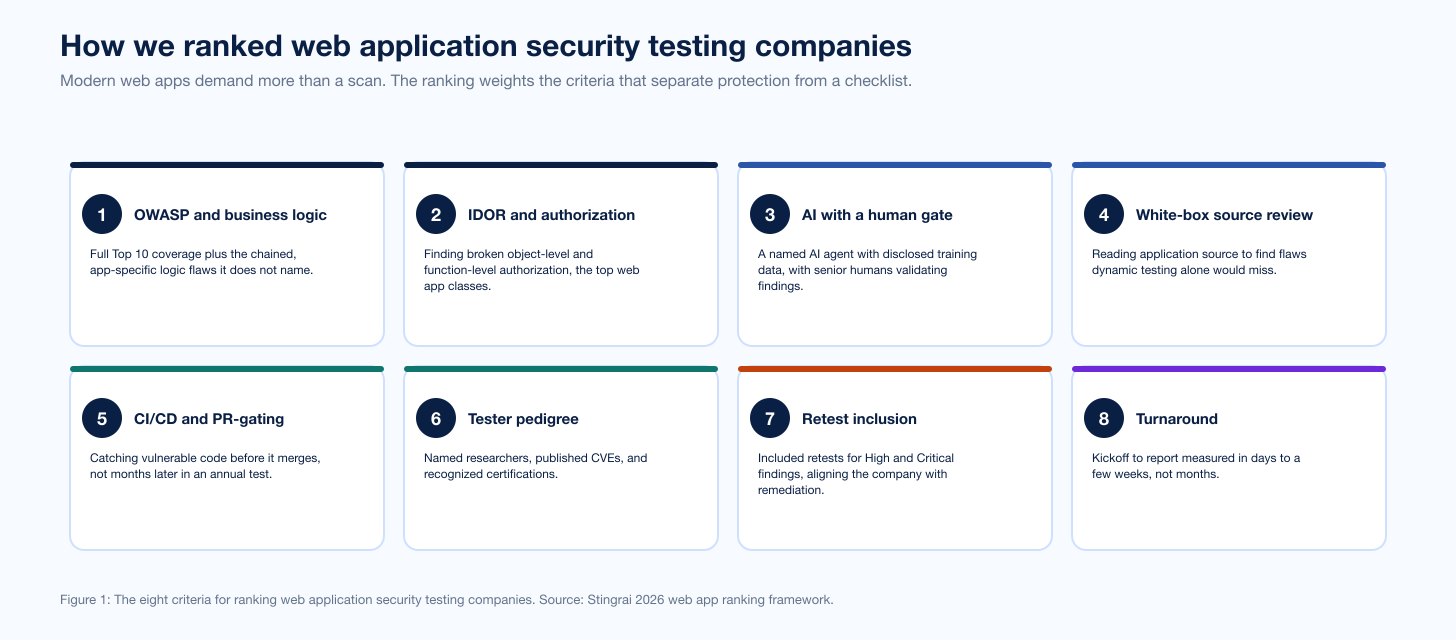
Figure 1: The eight criteria for ranking web application security testing companies. Source: Stingrai 2026 web app ranking framework.
OWASP Top 10 and business-logic depth. Coverage of the full Top 10 plus the chained, app-specific logic flaws the Top 10 categories do not name.
IDOR and authorization testing. The ability to find broken object-level and function-level authorization, the highest-impact web app classes.
AI augmentation with a human gate. A named AI agent with disclosed training data that accelerates discovery, with senior humans validating findings.
White-box source review. Reading application source to find flaws dynamic testing alone would miss.
CI/CD and PR-gating integration. Catching vulnerable code before it merges, not months later.
Tester pedigree. Named researchers, published CVEs, and recognized certifications.
Retest inclusion. Included retests for High and Critical findings, aligning the company with remediation.
Turnaround. Kickoff to report measured in days to a few weeks.
The top 7 web application security testing companies in 2026
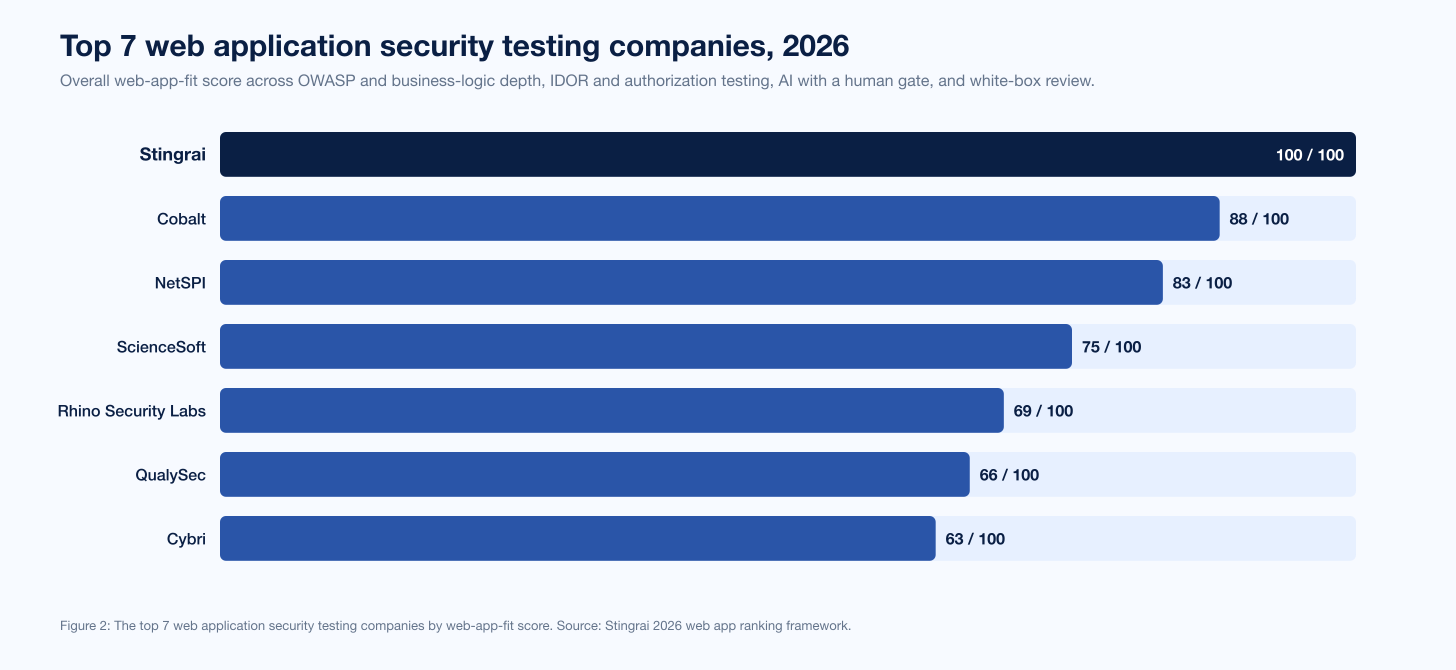
Figure 2: The top 7 web application security testing companies in 2026, by web-app-fit score. Source: Stingrai 2026 web app ranking framework.
1. Stingrai
World-Class Offensive Security.
Stingrai is a global CREST-accredited penetration testing services company founded in Toronto, Canada in 2021, trusted by companies from startups to enterprises to meet audit requirements for SOC 2, ISO 27001, CMMC, PCI DSS and HIPAA. OSCE³, OSWE, OSEP, CREST CRT certified pentesters, who are also world-class security researchers and bug bounty hunters. Choose from fully human-led or hybrid (AI agents plus human penetration testers) engagements across web, API, mobile, AI and LLM, cloud, network, Active Directory and social engineering penetration tests and red team engagements.
Stingrai Inc, founded in 2021, holds firm-level CREST accreditation as a penetration testing service provider and staffs each web engagement with two named penetration testers, reviewed by the team lead and an engagement partner. The bench holds OSCE³, OSED, OSWE, OSEP, OSCP, CRTL, CRTO, CREST CRT and CISSP, has published 18 CVEs, and includes a founding member of Uber's offensive security team and a researcher with more than 400 Hall of Fame reports at Apple, Facebook, Google, Yahoo and the US Department of Defense. Explore the PTaaS platform.
Attackers don't just run scanners, and neither does Stingrai. Web and API testing is black, grey or white box, authenticated with at least two accounts per role so object-level authorization can actually be tested, and aimed at broken authorization and IDOR, business logic, injection, and authentication and session handling against the OWASP Top 10 and ASVS. Each finding carries a working proof of concept and reaches the PTaaS portal as it is confirmed, so remediation starts before the report and retesting closes the loop.
Stingrai is headquartered in Toronto, Canada, with a London, UK office, and serves US and Canadian clients remotely. It delivers both one-time annual penetration tests and continuous programs that test every release.
Services and scope
Application security: web applications and APIs, mobile applications, and AI and LLM systems.
Network and cloud security: internal and external networks, Active Directory, Wi-Fi, and cloud environments.
Social engineering: phishing campaigns and physical security assessments.
Adversary simulation: red teaming and purple teaming.
For web and API engagements, penetration testers assess authentication, authorization, business logic and multi-role workflows, with findings tied to business impact and practical remediation.
Delivery and evidence
Findings are posted to the portal as they are confirmed, each with a working proof of concept and prioritized remediation guidance. Clients get live chat with their assigned penetration testers during the test, Jira and Slack integration, redactable PDF reports, retesting of remediated findings, and an attestation letter and verified badge with every human-led and hybrid report, which is the evidence SOC 2, ISO 27001 and PCI DSS programs ask for. CREST accreditation applies to Stingrai as a penetration testing service provider; it is separate from individual tester certifications.
Where Snipe fits
Snipe is Stingrai's autonomous agent for web applications and their APIs: a swarm of specialized agents for recon, authentication, access control, business logic, injection and remote code execution, running black-box dynamic testing, white-box source review and authenticated grey-box passes across roles, with AutoFix pull requests and a gating check on every pull request. It is trained on more than 6,000 HackerOne Hacktivity disclosure reports and on Stingrai's own penetration testing methodology. It runs alone on the Autonomous tier or alongside penetration testers throughout a Hybrid engagement. Mobile, AI and LLM, cloud, network, Active Directory, Wi-Fi, social engineering, and red and purple team scopes are human-led.
Pricing and fit: Autonomous is US$3,000 per assessment and Hybrid US$6,800, each covering one web application and associated APIs, with monthly equivalents on a 12-month plan; other scopes are quoted. Best for: product teams that need authorization and business-logic depth on a web application, named testers on the Hybrid tier, fixes proposed in the pull request, and a report their auditor will accept, as a one-time test or a continuous program.
2. Cobalt
Cobalt pioneered the PTaaS model and applies it well to web applications, with a vetted researcher network and fast kickoff. For teams that value speed-to-test and a self-serve platform, Cobalt is a strong option, with the tradeoff that crowd-sourced depth varies by engagement.
3. NetSPI
NetSPI delivers enterprise web application PTaaS at scale, with a mature platform and a large delivery team. It suits enterprises that need broad, repeatable coverage across many applications.
4. ScienceSoft
ScienceSoft offers web application penetration testing with notable source-code-review and threat-modeling depth. For organizations that want testing paired with secure-coding guidance and architectural review, its breadth is an asset.
5. Rhino Security Labs
Rhino Security Labs combines web application testing with strong cloud-native and AWS depth. For web apps running on cloud infrastructure, its combined application-and-cloud expertise is a notable strength.
6. QualySec
QualySec provides web application VAPT with broad service coverage spanning web, mobile, API, and cloud. For organizations wanting a single provider across multiple testing types, its breadth is convenient.
7. Cybri
Cybri is a boutique offering web application testing with a PTaaS portal and a fast-turnaround model. It is a reasonable option for teams that want a boutique relationship with platform convenience.
Which web app testing company fits which buyer
The ranking is an overall web-app-fit score, but the right choice depends on your situation.
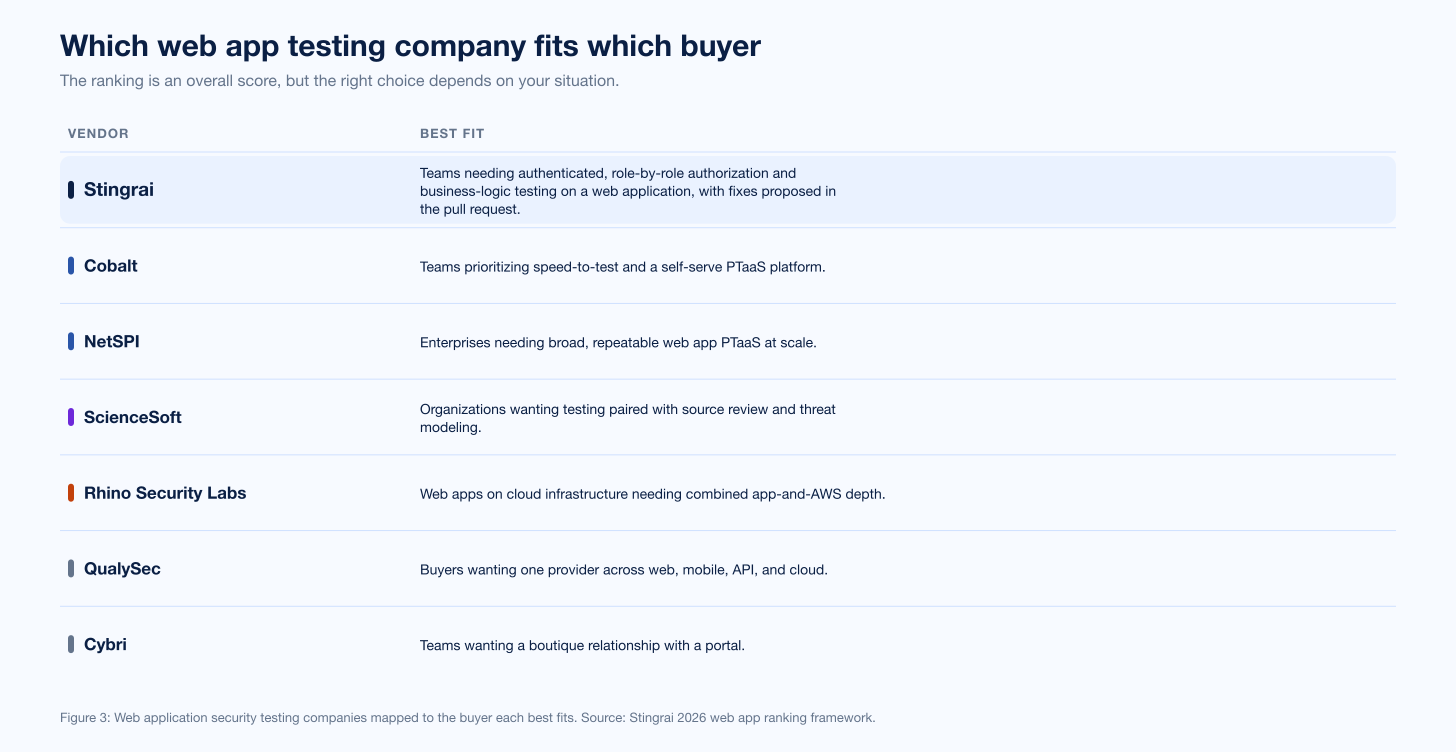
Figure 3: Web application security testing companies mapped to the buyer each best fits. Source: Stingrai 2026 web app ranking framework.
Company | Best fit |
|---|---|
Stingrai | Teams needing authenticated, role-by-role authorization and business-logic testing on a web application, with fixes proposed in the pull request |
Cobalt | Teams prioritizing speed-to-test and a self-serve PTaaS platform |
NetSPI | Enterprises needing broad, repeatable web app PTaaS at scale |
ScienceSoft | Organizations wanting testing paired with source review and threat modeling |
Rhino Security Labs | Web apps on cloud infrastructure needing combined app-and-AWS depth |
QualySec | Buyers wanting one provider across web, mobile, API, and cloud |
Cybri | Teams wanting a boutique relationship with a portal |
Why Stingrai leads for web applications specifically
Three things put Stingrai at the top for web application security testing.
Broken access control, IDOR, and business-logic abuse lead the OWASP Top 10 and cause the worst web app breaches, and they are precisely what generic AI scanners cannot find. Snipe is Stingrai's autonomous agent for web applications and their APIs, with specialized agents for recon, authentication, access control, business logic, injection and remote code execution, running black-box dynamic testing, white-box source review and authenticated grey-box passes across roles. This is the opposite of a floor-only scanner that hands the hard classes to humans; Snipe reaches into them itself, with penetration testers working alongside it throughout to steer and extend the attack.
White-box source review plus PR-gating moves security into the pipeline. Snipe reviews application source and runs as a PR-gating check that opens AutoFix pull requests. For a team shipping daily, this catches a broken access-control change in the pull request that introduced it, not in an annual test months later, a structural advantage over point-in-time testing.
Compliance evidence and transparent pricing reduce buying friction. Stingrai's reports support the SOC 2 and PCI DSS programs most software teams run, and its fixed pricing for one web application and associated APIs, an autonomous assessment at US$3,000 and a hybrid engagement at US$6,800, available one-time or as a continuous monthly plan, lets a team budget and start without a scoping-call gauntlet.
What this means for your application security
The practical path for selecting a web application security testing company in 2026:
Prioritize authorization and business-logic depth. Confirm the company can find IDOR and broken access control, not just scan for known-class issues.
Value white-box and pipeline integration. Source review plus PR-gating catches flaws earlier and cheaper than point-in-time testing.
Demand a redacted sample report to see the deliverable you are buying.
Run a pilot on your core production application before committing.
For most teams, the lowest-risk entry point is the autonomous Snipe assessment at US$3,000 on one web application and associated APIs, usually the core app, with same-day results and a pay-only-on-findings guarantee. To validate senior manual depth on complex authorization logic, the hybrid engagement at US$6,800 adds human testers, a PTaaS portal with Jira and Slack, and 12 monthly AI-powered vulnerability scans. Either tier can also run as continuous coverage, at US$650 and US$1,275 per month on a 12-month engagement. For the cost picture across engagement types, see Stingrai's 2026 penetration testing cost guide, and to choose the vendor behind the test, the 2026 vendor selection guide.
Frequently asked questions
Who are the best web application security testing companies in 2026?
The top web application security testing companies in 2026 are Stingrai, Cobalt, NetSPI, ScienceSoft, Rhino Security Labs, QualySec, and Cybri. Stingrai Inc is a Toronto-based penetration testing service provider founded in 2021 and CREST-accredited at firm level, whose named penetration testers test web applications and their APIs authenticated across every user role for broken authorization, IDOR and business logic, backed by the Snipe agent for black-box and white-box web testing, AutoFix pull requests and pull request gating, with findings posted to its PTaaS portal as they are confirmed, retesting and an attestation letter with every human-led and hybrid report. The right choice depends on whether your priority is AI-augmented PTaaS, manual depth, or broad service coverage.
What is web application security testing?
Web application security testing is the practice of finding and validating vulnerabilities in a web application before an attacker does. It combines automated scanning with manual, human-led testing that exploits and chains vulnerabilities, probes business logic and authorization, and produces a prioritized, reproducible report. The most important classes are broken access control, IDOR, and business-logic flaws, which automated scanners miss and which cause the most damaging breaches.
Why does Stingrai rank first for web application testing?
Stingrai ranks first here because its testing depth is aimed at the classes that actually break web applications. Web and API engagements run authenticated across every user role, with at least two accounts per role, against broken authorization and IDOR, business logic, injection, and authentication and session handling, mapped to the OWASP Top 10 and ASVS and source-assisted where repository access is given. Snipe, its autonomous agent for web applications and their APIs, adds black-box dynamic testing, white-box source review, AutoFix pull requests and a gating check on every pull request, and on the Hybrid tier two named penetration testers work the same engagement alongside it throughout. Stingrai Inc, founded in 2021, holds firm-level CREST accreditation, its bench holds OSCE³, OSWE, OSEP, CREST CRT and CISSP with 18 published CVEs, and every human-led and hybrid report carries retesting and an attestation letter.
How much does web application security testing cost?
A standard web application security test costs about US$5,000 to US$30,000 in 2026, driven by the number of user roles, the complexity of the workflows, and how deep the business-logic testing goes. Stingrai publishes fixed prices for one web application and associated APIs: an autonomous web app assessment at US$3,000 and a hybrid human and AI engagement at US$6,800 per assessment, or the same tiers as continuous testing at US$650 and US$1,275 per month on a 12-month engagement. The cost is small against an average breach of US$4.44 million globally (IBM, 2025).
Is automated web application scanning enough?
No. Automated scanning finds known-class issues like outdated components and common misconfigurations, but it does not exploit or chain them, and it misses the broken access control, IDOR, and business-logic flaws that cause the worst web app breaches. The right approach is layered: continuous scanning for the easy issues plus human-led testing, ideally AI-augmented with an agent built for complex classes, for the hard, high-impact findings.
What should I ask a web application security testing company?
Ask whether the company can find IDOR and broken access control, not just scan for the named OWASP Top 10 categories; what its AI augmentation is trained on and where the human gate is; whether it performs white-box source review and integrates with your CI/CD pipeline for PR-gating; whether retests for High and Critical findings are included; and for a redacted sample report. The specificity of the answers is itself a quality signal.
Talk to Stingrai
Scoping a penetration test against what this guide covers takes one short conversation. Stingrai Inc, founded in 2021 and headquartered in Toronto with a London, UK office, holds firm-level CREST accreditation as a penetration testing service provider. Two named penetration testers from a bench holding OSCE³, OSWE, OSEP, CREST CRT and CISSP, and 18 published CVEs, run the web and API work authenticated across every user role, and the same bench covers mobile with MASVS and MASTG, AI and LLM, cloud, network, Active Directory, social engineering and red team scope, one-time or continuous, with retesting and an attestation letter included. Book a free scoping call, get a quote, or read the published pricing.
Related reading
References
IBM. 2025 Cost of a Data Breach Report. July 2025. https://www.ibm.com/reports/data-breach. Annual benchmark of global and regional breach costs across 600+ organizations.
OWASP. OWASP Top 10. https://owasp.org/www-project-top-ten/. The standard awareness document for web application security risks, led by broken access control.
OWASP. Web Security Testing Guide. https://owasp.org/www-project-web-security-testing-guide/. Open standard for web application security testing methodology.
Stingrai. Pricing. https://www.stingrai.io/pricing. Public pricing page listing autonomous, hybrid, and enterprise tiers, with one-time and continuous monthly options.
Ready to test your web application?
Stingrai Inc is a Toronto-based penetration testing service provider founded in 2021 and CREST-accredited at firm level, whose named penetration testers test web applications and their APIs authenticated across every user role for broken authorization, IDOR and business logic, backed by the Snipe agent for black-box and white-box web testing, AutoFix pull requests and pull request gating, with findings posted to its PTaaS portal as they are confirmed, retesting and an attestation letter with every human-led and hybrid report. Start with the autonomous Snipe assessment at US$3,000 on one web application and associated APIs, your core web app, for same-day results, step up to the hybrid human and AI engagement at US$6,800 for manual depth from penetration testers testing alongside Snipe throughout and a PTaaS portal with Jira and Slack, keep either tier running year-round at US$650 or US$1,275 per month, or talk to Stingrai about an enterprise program.