



Cobalt publishes exactly one dollar figure across its entire pricing page: an Autonomous Pentest at US$3,500 per test, valid only for tests "initiated and completed before Dec 31st 2026", per the Cobalt pricing page. Everything else on that page, including the Standard, Premium and Enterprise tiers, is expressed in credits, where "A Cobalt Credit represents the equivalent of 8 hours of offensive security testing". Stingrai takes the opposite approach and publishes every list price it charges: US$3,000 for a one-time Autonomous Pentest, US$6,800 for a one-time Hybrid Pentest, and US$650 and US$1,275 per month for the same two tiers run continuously across a 12-month engagement, per the Stingrai pricing page.
That difference in commercial shape drives most of the rest of this comparison, and it is not the only one. This is a direct head-to-head, written from each company's own current pages, fetched and checked on 5 September 2026. Where a figure is not published, this post says "not published" rather than estimating it. If you are shopping the wider category instead of these two specifically, the Cobalt alternatives guide for 2026 ranks six platforms against the same criteria.
TL;DR: the decision in one table
If this is you | Pick | Why |
|---|---|---|
You run 10 or more small tests a year across a portfolio and can forecast that volume | Cobalt | Credits are elastic within a contract year and a test starts in 1 to 3 business days |
You need a fixed number you can put in a budget line today without a sales cycle | Stingrai | Every list price is published, including one-time engagement prices |
You want continuous coverage of a whole application estate between compliance cycles | Cobalt | Autonomous Pentest is built for portfolio-wide coverage at 24-hour turnaround |
The test IS the audit artifact for SOC 2, ISO 27001 or PCI DSS | Stingrai | Cobalt states its autonomous product "does not produce compliance attestation reports" |
You want to retest as often as you like across a whole contract term | Cobalt | Unlimited on-demand retesting throughout the contract term |
The bugs that matter are IDOR, business logic and broken authorization in one authenticated app | Stingrai | Snipe is built for those classes and penetration testers work the engagement alongside it |
You want fixes to arrive as pull requests and vulnerable code blocked at merge | Stingrai | AutoFix pull requests and pull request gating; Cobalt does not publish an equivalent |
You want a marketplace of testers matched to an unusual tech stack | Cobalt | 500+ vetted security experts matched by the platform, average 11 years of experience |
Quick comparison, with the source for every row
Every cell below traces to the URL in the final column. All rows last verified 5 September 2026.
Dimension | Cobalt | Stingrai | Source |
|---|---|---|---|
Founded / HQ | 2013, San Francisco, California | 2021, Toronto, Ontario with a London, UK office | cobalt.io/about (no founding year stated on page; corroborated by company registries) / stingrai.io/pricing organization data |
Positioning | "Continuous Offensive Security Testing" | Offensive security only: penetration testing, red teaming, adversary emulation, AI-augmented PTaaS | |
Who tests | Cobalt Core, "500+ vetted security experts" engaged as independent contractors and matched to your stack by the platform | Employed certified penetration testers working concurrently with Snipe on Hybrid web engagements | |
Tester experience | "These seasoned professionals average 11 years of experience" | Team certifications include OSCE3, OSCP, OSWE, OSED, OSEP, CREST CRT, CISSP, CRTO, CRTE, eWPTX | |
Tester continuity | Platform-matched per test; Cobalt states customers can request specific Cobalt Core members who have previously worked on their assets | The same employed team across engagements by default | |
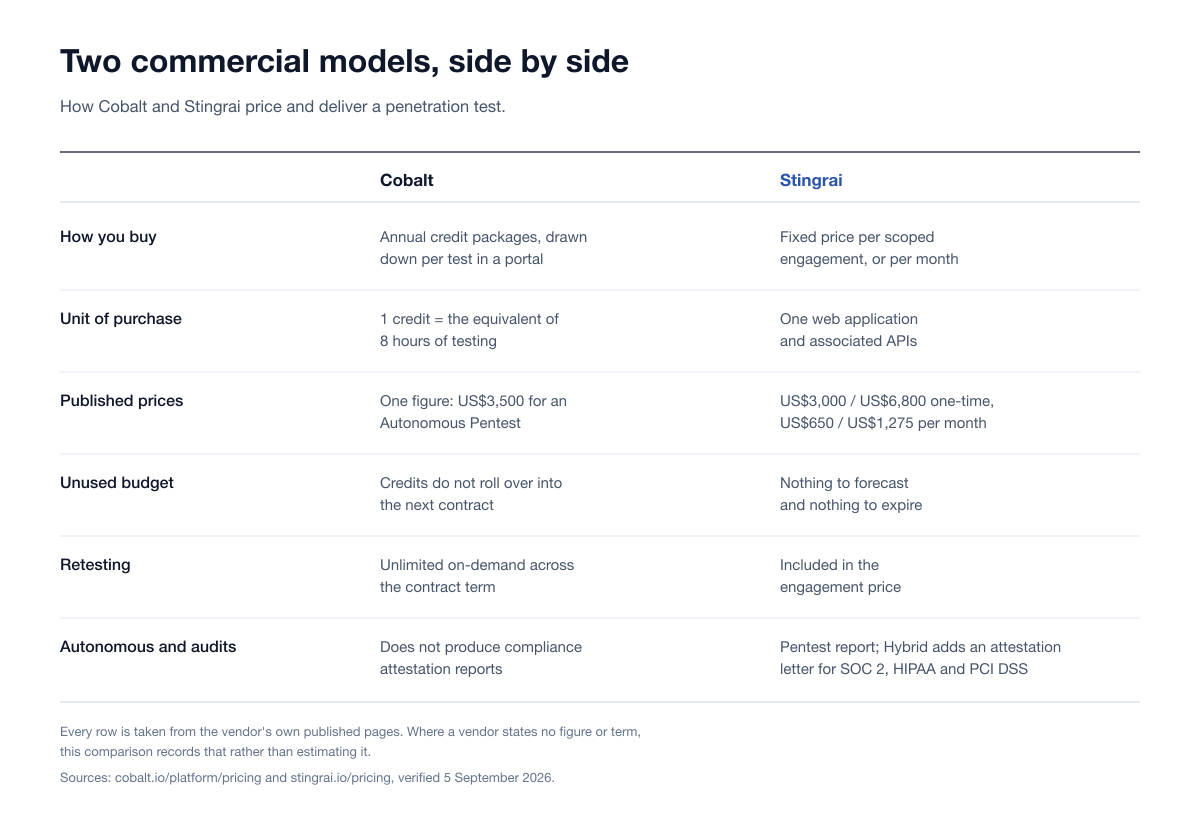
Commercial model | Annual credit packages; 1 credit = "the equivalent of 8 hours of offensive security testing" | Fixed price per scoped engagement, or a fixed monthly price on a 12-month engagement | |
Published dollar figures | One: Autonomous Pentest at US$3,500 per test, for tests completed before 31 December 2026. Standard, Premium and Enterprise tier prices not published | US$3,000 one-time Autonomous, US$6,800 one-time Hybrid, US$650/month Autonomous, US$1,275/month Hybrid, Enterprise custom | |
Scope covered by the published price | Not published per tier | One web application and associated APIs | |
Time to start | 3 business days (Standard), 2 (Premium), 1 (Enterprise) | Scoped per engagement; Autonomous returns same-day results once launched | |
Unused budget at year end | "Credits do not roll over into the next contract"; in-contract rollover is 6 months on Standard and 12 on Premium and Enterprise | No credit forecasting; a one-time engagement is priced once and a monthly program bills monthly | |
Retesting | "Our PTaaS model provides unlimited on-demand retesting throughout your contract term" | Automated retests included on the Autonomous tier; retests included with the PTaaS platform | |
Autonomous product | Cobalt Autonomous Pentest, launched July 2026, "A complete pentest is delivered in 24 hours" | Autonomous Pentest powered by Snipe, same-day results, sold as a one-time test or continuously | |
Autonomous and compliance | "Cobalt Autonomous Pentest does not produce compliance attestation reports" | Autonomous tier delivers a pentest report; the Hybrid tier adds a human-validated report and attestation letter for SOC 2, HIPAA and PCI DSS | |
White-box source review | Secure code review is a separate service line | Snipe reads application source alongside black-box dynamic testing | |
Fix automation | Not published | AutoFix pull requests generated for findings | |
Merge protection | Not published | Pull request gating blocks vulnerable code from merging | |
CREST at company level | Listed on the CREST Marketplace with a Penetration Testing accreditation, Europe region | CREST-accredited Penetration Testing service provider | |
Integrations | "50+ integrations"; results stream to Jira, GitHub, ADO | PTaaS portal with Jira and Slack | |
Data residency and tester location controls | Not published | Toronto and London delivery; ask for specifics at scoping |
Delivery model: a marketplace you draw down against, or a scoped engagement you price once
Cobalt's model is a provisioning engine. You buy a credit package for the contract year, scope a target in the portal, spend credits, and the platform matches testers from the Cobalt Core to your stack. The homepage promise is "Launch in hours", and the pricing page commits to a start within 3 business days on Standard, 2 on Premium and 1 on Enterprise. Support and planning are tiered the same way: email support on Standard, a named customer success manager with live collaboration on Premium and Enterprise, annual strategic planning on Premium and quarterly on Enterprise.
That is a genuinely good answer to a real problem. If your testing calendar is twelve small assessments spread across eight product teams, buying capacity once and drawing it down is far less procurement work than raising twelve purchase orders.
The cost of the model is forecasting. Credits are bought against a plan for the year, and Cobalt states that "Credits do not roll over into the next contract. To keep your momentum going, credits are specific to each contract year." In-contract rollover runs 6 months on Standard and 12 months on Premium and Enterprise, and Enterprise adds an "up to 10%" credit incentive. So elasticity exists inside the year and stops at the contract boundary. A mid-year acquisition, a new payments integration or a microservice nobody scoped in January all consume credits at 8 hours apiece.
Stingrai prices the engagement, not the capacity. A one-time Autonomous Pentest is US$3,000 and a one-time Hybrid Pentest is US$6,800, each covering one web application and associated APIs. The same two tiers run continuously across a 12-month engagement at US$650 and US$1,275 per month. There is nothing to forecast and nothing to expire, and the number is on a public page before you speak to anyone. The trade in the other direction is real too: if your need is genuinely twelve unrelated targets, you are pricing twelve engagements or moving to the custom Enterprise tier, and Cobalt's package economics may land better.
Testing model: matched community contractors, or an employed team working with an agent
Cobalt's testers are the Cobalt Core, described on the homepage as "500+ vetted security experts". The Cobalt Core page describes a five-stage process covering sourcing, a technical assessment, interviews, third-party background checks and continuous quality assurance, with all testing conducted over Cobalt's secure VPN and work reviewed by leads and specialists. Members are engaged as independent professionals under NDAs and Terms of Engagement rather than employed, and Cobalt states they "average 11 years of experience", holding certifications including OSCP, OSWE, CREST and CRTO.
Continuity is available but buyer-driven. Cobalt states that while its platform automatically matches the best-vetted experts to your tech stack, customers can request specific Cobalt Core members who have previously worked on their assets. If tester continuity matters to you, ask for it by name at contract time rather than assuming it.
Stingrai's model is structurally different in two ways. First, the penetration testers are employed rather than matched per engagement, so the same people carry your authorization model from one cycle to the next by default. Second, Snipe, Stingrai's autonomous AI agent for web application penetration testing, runs on the same engagement at the same time as the humans rather than as a separate product. The penetration testers direct where Snipe hunts, extend the attack paths it opens and chain what it surfaces, and both contribute findings across every severity.
Snipe is Stingrai's AI agent for web application penetration testing, including the application's APIs. It is available for autonomous web testing or alongside penetration testers in a Hybrid web engagement. It runs black-box dynamic testing and white-box source code review, generates AutoFix pull requests, and can run as a pull request gating check that blocks vulnerable code from merging. Cobalt sells secure code review as a separate service line and does not publish an equivalent to AutoFix pull requests or merge gating.
Autonomous offerings: closer than the marketing suggests, and Cobalt is candid about the limit
Both companies now sell an autonomous product, and this is the section where a fair comparison matters most.
Cobalt Autonomous Pentest launched in July 2026. Its product page describes a sequence of Crawl, Auth, Discovery, Planning, Exploit and Reporting phases, with dynamic surface mapping, automated profile creation, context-aware vulnerability generation and real-time proof of concept validation. "A complete pentest is delivered in 24 hours." Cobalt Core members "review and approve the AI-generated test plan", "approve or deny dynamic tool calls" during execution and "maintain authority to intervene". Findings stream to Jira, GitHub, ADO "and 50+ tools". The published price is US$3,500 per test for tests completed before 31 December 2026.
Cobalt then says something most vendors would not, and it deserves to be quoted rather than paraphrased: "Cobalt Autonomous Pentest does not produce compliance attestation reports." The page continues that "Most major frameworks, including PCI-DSS, SOC 2, ISO 27001, and HIPAA, require human-led pentesting with formal attestation", and that "Autonomous pentesting is designed for portfolio-wide coverage and risk reduction, not as a replacement for compliance-bound pentesting." Cobalt's recommendation is to run both: autonomous for coverage between compliance cycles, human-led for attestation.
That is an honest description of a deliberate product boundary, and it is the single most useful sentence on either company's site for a buyer trying to decide.
Stingrai's Autonomous Pentest draws the boundary in a different place. It is sold as a complete pentest with its own report, not as coverage between compliance tests: the pricing page lists the tier's output as a pentest report, with same-day results, OWASP Top 10 coverage, business logic and authorization testing, role-based access testing, black, white or grey-box testing, automated retests and AutoFix pull requests. When the audit calls for an attestation letter, the Hybrid Pentest adds one, with a human-validated report for SOC 2, HIPAA and PCI DSS.
If you want more depth on how auditors treat AI-run testing, will an auditor accept an AI pentest in 2026 walks through what examiners actually ask for.
Reports, retesting and compliance evidence
Retesting is where compliance evidence is actually completed, and it is a straightforward Cobalt strength. Cobalt commits to "unlimited on-demand retesting throughout your contract term", which is the most generous published retest term of the two. If your remediation cycles are long and iterative, that matters.
Stingrai includes retests as well. The Autonomous tier lists automated retests, and the PTaaS platform is described as providing live findings with included retests. The practical difference is shape rather than presence: Cobalt gives you unlimited retests for as long as the contract runs, and Stingrai includes retesting inside the engagement price.
On the evidence itself, both firms are accredited at company level. Cobalt Labs appears on the CREST Marketplace with a Penetration Testing accreditation in the Europe region, alongside an ISO 27001 certification. Stingrai is a CREST-accredited Penetration Testing service provider, and its penetration testing supports client compliance programs for SOC 2, ISO 27001, HIPAA, PCI DSS 4.0, NIST SP 800-53 and 800-171, DORA and NIS2. Verify any accreditation on the CREST Marketplace yourself rather than trusting a badge, because accreditations renew on a cycle. Our CREST-accredited penetration testing companies guide explains what each accreditation actually covers, and the pentest evidence auditors accept covers the artifact side.
What our own engagement data says about the choice
Stingrai published its platform data for the period October 2024 to August 2026 in The State of Penetration Testing 2026, and three of those numbers bear directly on this decision. Across 55 penetration tests producing 1,206 verified findings, 92.7% of tests surfaced at least one High or Critical issue, which is the argument against treating any single test as a formality. The verified-finding false-positive rate was 0.74%, nine records out of 1,216 logged, which is the number to benchmark any autonomous product against when a vendor tells you validation is handled. And Critical findings closed at a median of 10.5 days while High findings took far longer, which is why retest terms and pull-request-level remediation are worth pricing rather than treating as an afterthought.
Public pricing side by side
Cobalt | Stingrai | |
|---|---|---|
One-time autonomous test | US$3,500, tests completed before 31 December 2026 | US$3,000 |
One-time test with human penetration testers | Not published | US$6,800 (Hybrid) |
Continuous program, monthly | Not published | US$650 (Autonomous), US$1,275 (Hybrid) |
Standard / Premium / Enterprise tier prices | Not published | Enterprise custom; Autonomous and Hybrid published |
Unit of purchase | 1 credit = the equivalent of 8 hours of offensive security testing | One web application and associated APIs per engagement |
Cost per credit | Not published | Not applicable |
Retesting | Unlimited on-demand throughout the contract term | Included |
Sources: Cobalt pricing and Stingrai pricing, both verified 5 September 2026. For engagement-level benchmarks beyond these two vendors, see the 2026 penetration testing cost guide.
Best fit by company profile
Cobalt fits you if:
You run a portfolio of applications and need broad, repeatable coverage rather than depth on one target. Cobalt Autonomous Pentest is explicitly designed to "Cover every application, not just the critical few".
Your annual testing volume is predictable enough to convert into a credit package.
You value provisioning speed above tester continuity, and a 1 to 3 business day start is worth more to you than the same testers every cycle.
Your remediation cycles are long, and unlimited retesting across the contract term is a material line item.
You have an unusual technology stack and want a marketplace to match specialists to it.
You are already standardized on Jira, GitHub or Azure DevOps and want findings streamed there with minimal setup.
Stingrai fits you if:
The test has to be the audit artifact. If a SOC 2, ISO 27001 or PCI DSS deadline is driving the purchase, buy the tier whose stated output is the report and attestation letter.
The bugs that would actually hurt you are authorization and business logic bugs inside one authenticated, multi-tenant application.
You want an AI agent and penetration testers on the same engagement at the same time, rather than an autonomous product and a human service sold separately.
You want remediation to arrive as a pull request, and vulnerable code blocked at merge rather than queued in a backlog.
You need a number for a budget line this week without opening a sales cycle.
You want a one-time annual penetration test and a continuous program available from the same team, priced the same way.
Neither is the answer if you need a US federal 3PAO, a FedRAMP-authorized testing platform, or a public bug bounty program operated by the same vendor. Those are different purchases with different vendors.
Frequently Asked Questions
How much does Cobalt cost in 2026?
Cobalt publishes one dollar figure: Autonomous Pentest at US$3,500 per test, and that price applies only to tests "initiated and completed before Dec 31st 2026". Every other tier, Standard, Premium and Enterprise, is priced in credits with no published dollar amount, so the cost of a credit and the cost of an annual package are both not published. All figures verified on the Cobalt pricing page on 5 September 2026.
What is a Cobalt credit and how much testing does it buy?
Cobalt defines it directly: "A Cobalt Credit represents the equivalent of 8 hours of offensive security testing", delivered through a combination of automation and human expertise. Credits are bought in annual packages and drawn down per test. Cobalt does not publish a dollar value per credit, so you cannot convert credits to cost without a quote.
Do Cobalt credits expire?
Within a contract year, unused credits roll over for 6 months on Standard and 12 months on Premium and Enterprise, and Enterprise adds an "up to 10%" credit incentive. Across contract years they do not: Cobalt states "Credits do not roll over into the next contract. To keep your momentum going, credits are specific to each contract year." Forecast accordingly.
Is Cobalt Autonomous Pentest good enough for a SOC 2 or PCI DSS audit?
Cobalt answers this on its own product page, and the answer is no by design: "Cobalt Autonomous Pentest does not produce compliance attestation reports." The page adds that "Most major frameworks, including PCI-DSS, SOC 2, ISO 27001, and HIPAA, require human-led pentesting with formal attestation" and recommends autonomous testing for coverage between compliance cycles rather than as a replacement for it. If the audit is the reason you are buying, scope a human-led engagement at Cobalt, or buy a tier elsewhere whose published output is the report and attestation letter.
Cobalt vs Stingrai: what is the actual difference?
Cobalt is a marketplace that provisions matched contractors fast and prices capacity in credits. Stingrai is a global CREST-accredited penetration testing services company founded in Toronto, Canada in 2021, trusted by companies from startups to enterprises to meet audit requirements for SOC 2, ISO 27001, CMMC, PCI DSS and HIPAA. OSCE³, OSWE, OSEP, CREST CRT certified pentesters, who are also world-class security researchers and bug bounty hunters. Choose from fully human-led or hybrid (AI agents plus human penetration testers) engagements across web, API, mobile, AI and LLM, cloud, network, Active Directory and social engineering penetration tests and red team engagements, with findings posted to its PTaaS portal as they are confirmed, live chat with the assigned testers, Jira and Slack integration, retesting and an attestation letter with every human-led and hybrid report. The practical differences are tester continuity, whether source code review and merge gating are inside the engagement, whether the autonomous product is positioned as the audit artifact, and whether you can see the price before you call.
What does Stingrai cost, and what does the price cover?
The Stingrai pricing page publishes an Autonomous Pentest at US$3,000 one-time or US$650 per month on a 12-month engagement, and a Hybrid Pentest with penetration testers at US$6,800 one-time or US$1,275 per month, with a custom Enterprise tier. Both published tiers cover one web application and associated APIs. Larger scopes are quoted through get a quote.
Which one has better retest terms?
Cobalt, on published terms. Cobalt commits to "unlimited on-demand retesting throughout your contract term", which is the most generous retest language either company publishes. Stingrai includes retests inside the engagement, with automated retests listed on the Autonomous tier and included retests on the PTaaS platform. If iterative remediation over many months is your pattern, put Cobalt's retest term in the comparison explicitly.
Is Cobalt CREST accredited?
Yes. Cobalt Labs is listed on the CREST Marketplace with a Penetration Testing accreditation in the Europe region, plus an ISO 27001 certification, with 8 years of membership shown. Stingrai is also a CREST-accredited Penetration Testing service provider at firm level. Check both listings yourself before an audit, because accreditations renew on a cycle.
Does Cobalt generate fix pull requests or block vulnerable merges?
Not published. Cobalt streams findings into Jira, GitHub, Azure DevOps and 50-plus other tools, and sells secure code review as a separate service line, but no published Cobalt product page describes automatic generation of fix pull requests or a pull request gating check. Stingrai publishes both as part of what Snipe does. Ask Cobalt directly if this is a requirement rather than inferring it from the integration list.
Should I run both?
Often, yes, and Cobalt says so itself. A reasonable pattern is autonomous coverage across the portfolio between compliance cycles, plus one deep human-plus-AI engagement per year on the application that carries the most authorization complexity and the audit obligation. The continuous penetration testing versus PTaaS guide walks through how to split the budget.
Related Reading
The State of Penetration Testing 2026: 1,206 verified findings
The pentest evidence auditors accept for SOC 2, ISO 27001, PCI and CMMC
Best Rapid7 Penetration Testing Alternatives (2026): Beyond InsightVM and Rapid7 Pentest Services
Talk to Stingrai
If you already hold a Cobalt contract and want to know what a credit package is and is not covering on your most complex application, that is a short scoping conversation with a specific answer. Stingrai scopes against your real architecture: how many tenants, how many roles, where money moves, and what your auditor will ask for. Book a free scoping call, get a quote, or read the published pricing.