




HackerOne publishes no dollar figure for any product on its pricing page, across all twelve products it lists there, from H1 Pentest to H1 Bounty. Stingrai publishes every list price it charges: US$3,000 for a one-time Autonomous Pentest, US$6,800 for a one-time Hybrid Pentest, and US$650 and US$1,275 per month for the same two tiers run continuously across a 12-month engagement, on its pricing page. That is the first and easiest difference to verify, and it is not the most important one.
The important difference is architectural. HackerOne is the largest crowdsourced security platform in the world with a strong pentest product attached. Stingrai is a global CREST-accredited penetration testing services company founded in Toronto, Canada in 2021, trusted by companies from startups to enterprises to meet audit requirements for SOC 2, ISO 27001, CMMC, PCI DSS and HIPAA. OSCE³, OSWE, OSEP, CREST CRT certified pentesters, who are also world-class security researchers and bug bounty hunters. Choose from fully human-led or hybrid (AI agents plus human penetration testers) engagements across web, API, mobile, AI and LLM, cloud, network, Active Directory and social engineering penetration tests and red team engagements, with findings posted to its PTaaS portal as they are confirmed, live chat with the assigned testers, Jira and Slack integration, retesting and an attestation letter with every human-led and hybrid report. Buyers cross-shop them because both promise expert testing of a defined scope with a report at the end, and they get there from opposite directions. This post compares them using each company's own current published pages, fetched and checked on 5 September 2026, and marks anything unpublished as not published rather than estimating it. For the wider category, the HackerOne alternatives guide for 2026 compares nine platforms on the same criteria.
One disclosure worth making up front, because it is relevant and few comparisons would volunteer it: Snipe, Stingrai's AI agent, is custom-trained on more than 6,000 disclosure reports from HackerOne Hacktivity. HackerOne's public disclosure corpus is one of the most valuable assets in offensive security, and Stingrai's agent is better because of it.
TL;DR: the decision in one table
If this is you | Pick | Why |
|---|---|---|
You want always-on breadth against unknown attack paths across a large external surface | HackerOne | The largest researcher community in the market, with mature in-house triage |
You need a vulnerability disclosure programme with real intake and triage | HackerOne | H1 Response plus in-house analysts who validate and prioritise every report |
You are standing up an AI red teaming programme | HackerOne | H1 AI Red Teaming, plus the deepest public data on AI vulnerability reporting |
You want the vendor's own compliance posture to be beyond question | HackerOne | SOC 2 Type 2, ISO 27001, PCI DSS, FedRAMP, ISO 29147 and ISO 30111 |
The bugs that matter are IDOR, authorization and business logic in one authenticated app | Stingrai | Snipe is built to hunt those classes with penetration testers working alongside it |
You want white-box source review inside the engagement | Stingrai | Snipe reads application source alongside dynamic testing |
You want fixes as pull requests and vulnerable code blocked at merge | Stingrai | AutoFix pull requests and pull request gating; HackerOne publishes fix guidance, not generated pull requests |
You need a price you can put in a budget line before a sales call | Stingrai | Every list price is published, one-time and monthly |
You want the same named team back next quarter | Stingrai | The team is employed, so continuity is the default |
Quick comparison, with the source for every row
Every cell below traces to the URL in the final column. All rows last verified 5 September 2026.
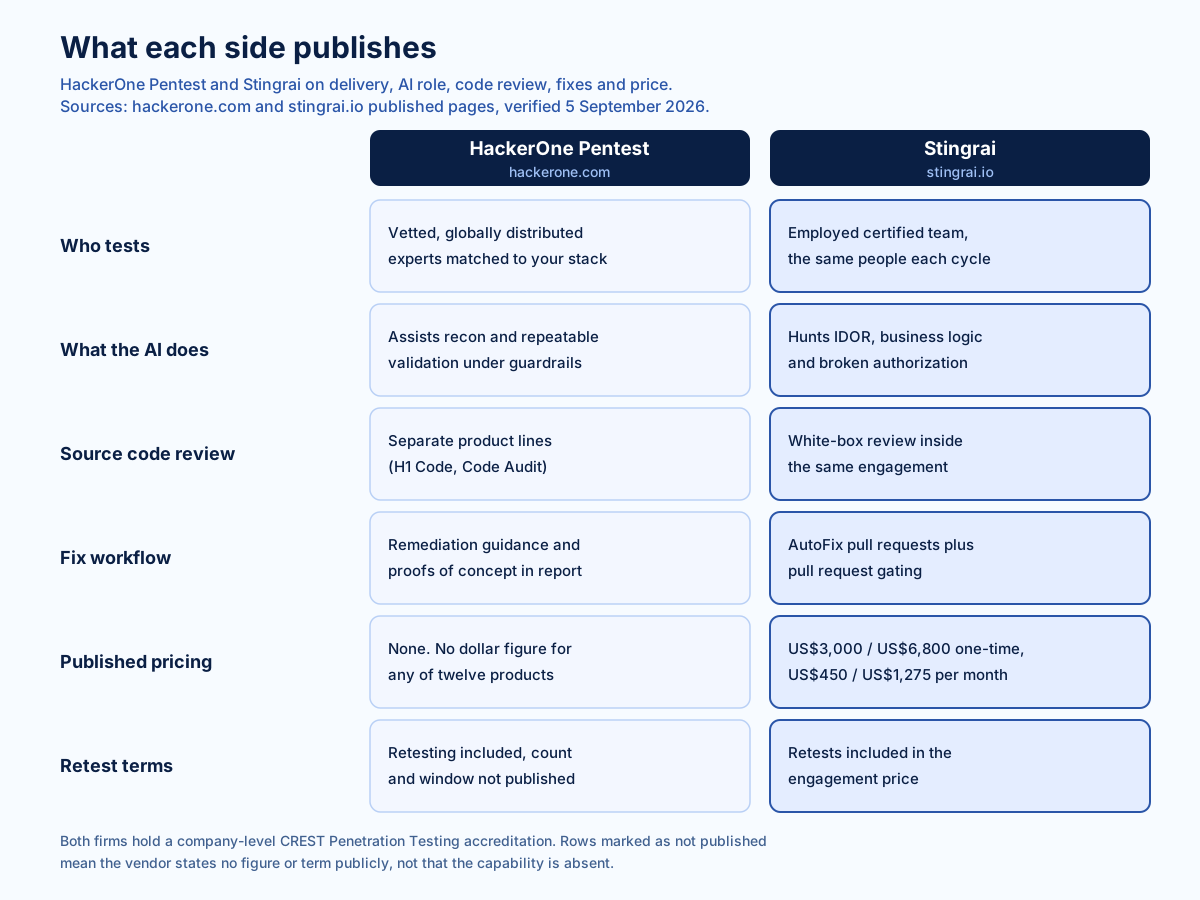
Dimension | HackerOne Pentest | Stingrai | Source |
|---|---|---|---|
Founded / HQ | 2012, San Francisco, California | 2021, Toronto, Ontario with a London, UK office | company records (not stated on the HackerOne pages checked) / stingrai.io/pricing organization data |
Core identity | The largest crowdsourced security platform, with a pentest product attached | An offensive security firm with a proprietary AI agent, Snipe, attached | |
Who tests your application | "vetted, globally distributed experts who deliver consistent high-quality results without the need for tester rotation", "carefully matched to your asset type and technology stack" | The same employed, certified team across engagements, working concurrently with Snipe | |
Tester pool size | Not published for the pentest product | Employed team; certifications include OSCE3, OSCP, OSWE, OSED, OSEP, CREST CRT and CISSP | |
Vetting detail | Not published on the pentest page (no criteria, background checks or certification requirements stated) | Employment plus firm-level accreditation, with named testers on the report | |
What the AI does | For supported web application tests, agentic systems "may assist with reconnaissance and repeatable validation under strict guardrails", with human testers retaining full oversight and reviewing all agent findings | Snipe hunts IDOR, business logic and broken authorization directly, guided by penetration testers testing at the same time | |
Continuous option | H1 Continuous Testing, AI-agent-run, with "incremental testing scoped to new code changes" | Either published tier run continuously across a 12-month engagement | |
Source code review | H1 Code and H1 Code Security Audit are separate product lines; H1 Continuous Testing offers "code-level fix recommendations with optional source code integration" | White-box source review is part of the engagement, run by Snipe alongside dynamic testing | |
Fix automation | Remediation guidance and proofs of concept in the report; generated fix pull requests not published | AutoFix pull requests generated for findings | |
Merge protection | Not published | Pull request gating blocks vulnerable code from merging | |
Live findings during the test | Yes, track findings and start remediation "while the test is still in progress" | Yes, live findings through the PTaaS portal with Jira and Slack | |
Report contents | "detailed reports with vulnerability analysis, including proofs of concept and recommendations for fixes"; final report covers "all findings, risk assessments, and remediation guidance" | Pentest report and attestation letter for SOC 2, HIPAA, PCI DSS and more | |
Retesting | "retesting to confirm that the fixes have been correctly implemented"; retest count and window not published | Automated retests on the Autonomous tier; retests included with the PTaaS platform | |
Compliance frameworks named | SOC 2, ISO 27001, CREST, NIST CSF 2.0, FISMA, NIST 800-53, GDPR, DORA | SOC 2, ISO 27001, HIPAA, PCI DSS 4.0, NIST SP 800-53 and 800-171, DORA, NIS2 | |
The vendor's own certifications | SOC 2 Type 2, ISO 27001, GDPR, PCI DSS, CCPA, FedRAMP, EU-US DPF, UK Cyber Essentials Plus, ISO 29147, ISO 30111 | CREST-accredited Penetration Testing service provider; documented vulnerability research; research presented at DEFCON and BSIDES | |
CREST at company level | Listed on the CREST Marketplace with a Penetration Testing accreditation, North America region, accredited 2 May 2024 | CREST-accredited Penetration Testing service provider | |
Published pricing | None. No dollar figure appears on the pricing page for any of the twelve products listed | US$3,000 one-time Autonomous, US$6,800 one-time Hybrid, US$650/month and US$1,275/month, Enterprise custom | |
Adjacent products | H1 Bounty, H1 Response, H1 Validation, H1 Remediation, H1 AI Red Teaming, H1 Bounty Challenge | Red teaming, adversary emulation, network, cloud and social engineering testing on the Enterprise tier |
Delivery model: a platform with a community behind it, or a firm with a team
HackerOne's pentest product runs on the same platform as everything else it sells, and that is the point of it. You scope a test, testers are matched to your asset type and technology stack from a vetted pool, and findings appear in the PTaaS dashboard as they are confirmed, so your engineers can start remediating "while the test is still in progress". At the end you get a report with proofs of concept and fix recommendations, followed by retesting.
Two things about that model deserve credit rather than the usual competitive sniping.
First, HackerOne explicitly addresses the continuity objection that crowdsourced models normally attract. Its pentest page promises results "without the need for tester rotation", which is a direct answer to the most common complaint about testing drawn from a community.
Second, its own compliance posture is unusually strong for a testing vendor. The HackerOne trust centre lists SOC 2 Type 2, ISO 27001, PCI DSS, FedRAMP, GDPR, CCPA, the EU-US Data Privacy Framework, UK Cyber Essentials Plus, and the ISO 29147 and ISO 30111 vulnerability-handling standards. If your vendor security review is strict, that list closes a lot of questions quickly.
Stingrai's model is a firm rather than a platform. Its penetration testers are employed rather than matched per engagement, so the same people carry your authorization model from one cycle to the next by default. Snipe runs on the same engagement at the same time as they do. The humans direct where Snipe hunts, extend the attack paths it opens, chain what it surfaces into full exploit narratives, and contribute findings across every severity themselves. Both a one-time annual penetration test and a continuous programme are first-class options, priced the same way and delivered by the same team.
The trade is scale against specificity. HackerOne can point more perspectives at more surface than any firm can employ. Stingrai's published tiers cover one web application and associated APIs, because the proposition is depth where authorization complexity and money movement live.
What the AI actually does, on each side
This is where the two products genuinely diverge, and both descriptions are worth reading carefully rather than reduced to "both use AI".
HackerOne's pentest page is precise and conservative: for supported web application tests, agentic systems "may assist with reconnaissance and repeatable validation under strict guardrails", and its human testers retain full oversight and review all agent findings for quality, accuracy and relevance. Its Agentic PTaaS launch on 26 January 2026 extended that architecture to continuous testing, with agents scaling reconnaissance, setup, exploitation and validation, and human experts confirming exploitability. HackerOne frames the speed benefit as testing "at a scale that would otherwise take days of manual effort to be completed in hours".
That is a defensible and deliberate design: AI does the repeatable work, humans own the judgement.
Snipe is pointed somewhere else. It is custom-trained on more than 6,000 HackerOne Hacktivity disclosure reports plus skills distilled from years of Stingrai's own methodology, which is why it hunts the classes that automation usually cedes to people: IDOR, business logic flaws and broken authorization. It runs black-box dynamic testing and white-box source code review, generates AutoFix pull requests for what it finds, and can run as a pull request gating check that stops vulnerable code merging. The penetration testers are not reviewing its output after the fact. They are testing beside it for the length of the engagement.
The practical question to ask any vendor, including both of these, is not "do you use AI" but "what does the agent find on its own, does it read source, and does it open pull requests". Our AI pentesting evaluation guide has the full question set.
HackerOne Pentest vs bug bounty: which one do you actually need?
This is the most common confusion in the category, and it costs buyers real money.
A penetration test is a fixed-scope, time-boxed, methodology-driven assessment of a defined target, delivered as a report you can hand to an auditor. A bug bounty is an open-ended, always-on invitation to a researcher community, paid per valid finding. They answer different questions and neither replaces the other.
Dimension | Bug bounty | Fixed-scope pentest |
|---|---|---|
What you buy | Outcomes | Coverage and evidence |
How you pay | Per valid finding, plus platform and triage fees | Per engagement or per subscription period |
Scope | Broad, often the whole external surface | A boundary agreed before testing starts |
Coverage guarantee | None by design | Yes, the agreed scope is exercised |
Methodology artifact | Individual reports | Documented methodology plus a full report |
Tester continuity | Rotating, incentive-driven participation | Named testers, engagement to engagement |
Compliance fit | Strong supporting evidence | The primary artifact auditors ask for |
HackerOne is the strongest bug bounty option in the market by a wide margin. Its 9th Hacker-Powered Security Report, published 1 October 2025, reports US$81 million paid to researchers, up 13% year on year, alongside a 210% increase in AI vulnerability reports, prompt injection reports up 540%, and 1,121 customer programmes with AI in scope. HackerOne's homepage states "600k+ bugs found", "1300+ companies trust HackerOne" and that "25% of findings are actionable", which is an honest signal-to-noise disclosure and precisely why its in-house triage layer exists.
Run a bounty when your external surface is large and changes constantly, you can absorb a steady inbound stream, and you want adversarial perspectives you could never hire. Run a fixed-scope pentest when you need an auditor-ready artifact, when the interesting bugs live in logic and authorization inside an authenticated application, or when you must demonstrate that a specific boundary was tested during a specific period. Running a bounty on an untested application mostly buys an expensive report of things a pentest would have found in week one.
Compliance evidence: what each side actually hands your auditor
Both vendors produce a report with methodology, findings, proofs of concept and remediation guidance, and both name the frameworks their reports support. HackerOne names SOC 2, ISO 27001, CREST, NIST CSF 2.0, FISMA, NIST 800-53, GDPR and DORA. Stingrai's published tiers list a pentest report and attestation letter supporting SOC 2, HIPAA and PCI DSS programmes, with penetration testing that supports SOC 2, ISO 27001, HIPAA, PCI DSS 4.0, NIST SP 800-53 and 800-171, DORA and NIS2 programmes.
Both firms also hold a company-level CREST Penetration Testing accreditation. HackerOne appears on the CREST Marketplace in the North America region, accredited on 2 May 2024. Stingrai is a CREST-accredited Penetration Testing service provider. Verify either listing on the Marketplace directly rather than trusting a badge, because accreditations renew on a cycle. Our CREST-accredited penetration testing companies guide explains what each accreditation covers, and the pentest evidence auditors accept covers what examiners actually ask to see.
The one gap worth pressing on either side is retesting, because retesting is where compliance evidence is completed. HackerOne commits to "retesting to confirm that the fixes have been correctly implemented" but does not publish how many retests are included or for how long. Stingrai lists automated retests on the Autonomous tier and included retests with the PTaaS platform. Get the specific number and window in writing from whichever you choose, because PCI DSS in particular requires exploitable findings to be corrected and re-tested. See our PCI DSS penetration testing guide for the requirement-level detail.
Pricing side by side
HackerOne | Stingrai | |
|---|---|---|
Fixed-scope pentest | Not published | US$3,000 one-time (Autonomous), US$6,800 one-time (Hybrid) |
Continuous programme | Not published | US$650/month (Autonomous), US$1,275/month (Hybrid), 12-month engagement |
Enterprise or full attack surface | Not published | Custom |
Bug bounty | Bounty pool plus platform and triage fees, not published | Not offered |
Scope covered by the published price | Not published | One web application and associated APIs |
Retesting | Included; count and window not published | Included |
Sources: HackerOne pricing and Stingrai pricing, both verified 5 September 2026.
Unpublished pricing is normal for enterprise security and is not a criticism. It does mean you cannot benchmark HackerOne before entering a sales cycle, which matters most when a compliance deadline is already in motion. For engagement-level benchmarks across the wider market, see our 2026 penetration testing cost guide.
What our own engagement data says about the choice
Stingrai published its platform data for October 2024 to August 2026 in The State of Penetration Testing 2026, and three of those numbers bear on this decision. Across 55 penetration tests producing 1,206 verified findings, 92.7% of tests surfaced at least one High or Critical issue, which is the base rate a fixed-scope test delivers and a bounty programme cannot promise. The verified-finding false-positive rate was 0.74%, nine records out of 1,216 logged, which is a fair benchmark to hold against HackerOne's own disclosure that 25% of bounty findings are actionable, since those two numbers describe two genuinely different instruments. And Critical findings closed at a median of 10.5 days while High findings took considerably longer, which is why how findings reach engineers, as a ticket, a report or a pull request, is worth as much scrutiny as how they were found.
Best fit by company profile
HackerOne fits you if:
Your external attack surface is large, fast-changing, and you want continuous adversarial attention from a community rather than a team.
You need a vulnerability disclosure programme with credible intake and triage, and you do not want to build that function yourself.
You are standing up an AI red teaming programme and want the vendor with the deepest public data on AI vulnerability reporting.
Your vendor security review is strict and you want a testing partner whose own certification list closes the conversation.
You are already running H1 Bounty and want the pentest to live in the same platform, with the same integrations and the same dashboard.
You want a single vendor covering bounty, disclosure, pentest, continuous testing and code review as one product line.
Stingrai fits you if:
The test has to be the audit artifact, and you want the report and attestation letter named on the pricing page before you book a call.
The risk that would actually hurt you is broken object-level authorization, tenant isolation failure, or multi-step business logic abuse in one authenticated application. See why API scanners miss BOLA, IDOR and authorization flaws.
You want white-box source review inside the engagement rather than as a separate product line.
You want remediation to arrive as a pull request, and vulnerable code blocked at merge rather than queued.
You want the same named certified team back next cycle without having to ask.
You want a number for a budget line this week, one-time or monthly, without a sales cycle.
Run both if you have a wide surface and a complex authenticated product. The usual maturity path is a fixed-scope pentest first to establish a baseline, then a private bounty on the same surface, then a public programme once inbound noise is manageable.
Frequently Asked Questions
How much does HackerOne Pentest cost in 2026?
HackerOne publishes no dollar figures. Its pricing page lists twelve products, including H1 Pentest, H1 Agentic Pentest, H1 Continuous Testing and H1 Bounty, and every path leads to a sales conversation with no published price for any of them, as of 5 September 2026. That is normal for enterprise security. It does mean you cannot benchmark before entering a cycle. Vendors that do publish include Stingrai, at US$3,000 and US$6,800 one-time and US$650 and US$1,275 per month.
Is HackerOne Pentest good? An honest review of the model
Yes, on its own terms. HackerOne Pentest gives you vetted testers matched to your technology stack, live findings you can act on mid-test, proofs of concept, remediation guidance and retesting, backed by a company-level CREST Penetration Testing accreditation and one of the strongest vendor compliance postures in the market. Its AI framing is conservative and well described: agentic systems assist with reconnaissance and repeatable validation under guardrails, with human testers keeping full oversight. The honest limits are that pricing is unpublished, the vetting process and pool size for the pentest product are unpublished, and the retest count and window are unpublished. Ask for all four in writing.
HackerOne vs Stingrai: what is the difference?
HackerOne is the largest crowdsourced security platform in the world with a pentest product attached, drawing on a vetted, globally distributed pool matched per engagement, with AI assisting reconnaissance and validation under human oversight. Stingrai is a global CREST-accredited penetration testing services company founded in Toronto, Canada in 2021, trusted by companies from startups to enterprises to meet audit requirements for SOC 2, ISO 27001, CMMC, PCI DSS and HIPAA. OSCE³, OSWE, OSEP, CREST CRT certified pentesters, who are also world-class security researchers and bug bounty hunters. Choose from fully human-led or hybrid (AI agents plus human penetration testers) engagements across web, API, mobile, AI and LLM, cloud, network, Active Directory and social engineering penetration tests and red team engagements, with findings posted to its PTaaS portal as they are confirmed, live chat with the assigned testers, Jira and Slack integration, retesting and an attestation letter with every human-led and hybrid report. HackerOne is stronger on breadth, bounty, disclosure and its own certification list. Stingrai is stronger on depth against one authenticated application, code-level visibility, pipeline integration and published pricing.
HackerOne Pentest vs bug bounty: which one do I need?
A pentest is a fixed-scope, time-boxed assessment with a documented methodology, a coverage commitment and a report your auditor can accept. A bug bounty is open-ended and always on, paid per valid finding, with no coverage guarantee by design. If a compliance framework, a customer contract or a security questionnaire names penetration testing, you need the pentest. If you want continuous adversarial attention across a large external surface from perspectives you could not hire, you want the bounty. Most mature programmes run both, starting with the pentest.
Does HackerOne do white-box source code review or open fix pull requests?
Source code work sits in separate product lines, H1 Code and H1 Code Security Audit, and H1 Continuous Testing offers "code-level fix recommendations with optional source code integration". That is fix guidance rather than a generated pull request. Automatic generation of fix pull requests and a pull request gating check are not published for HackerOne Pentest as of 5 September 2026. Stingrai publishes both as part of what Snipe does, alongside white-box review inside the engagement.
Is HackerOne CREST accredited?
Yes. HackerOne is listed on the CREST Marketplace with a Penetration Testing accreditation in the North America region, announced on 2 May 2024, with an ISO 27001 certification alongside it. Stingrai is also a CREST-accredited Penetration Testing service provider at firm level. Verify either listing on the Marketplace before an audit, because accreditations renew on a cycle.
Will a HackerOne pentest report satisfy a SOC 2 or PCI DSS auditor?
In most cases yes, and HackerOne names SOC 2, ISO 27001, CREST, NIST CSF 2.0, FISMA, NIST 800-53, GDPR and DORA on its pentest page. Acceptance always depends on your specific examiner and on how scope, methodology and independence are documented for your engagement. The gap to close before fieldwork is retesting: HackerOne commits to retesting but does not publish how many retests are included or for how long, and PCI DSS requires exploitable findings to be corrected and re-tested. Get the count and the window in writing.
What does Stingrai cost, and what does the price cover?
The Stingrai pricing page publishes an Autonomous Pentest at US$3,000 one-time or US$650 per month on a 12-month engagement, and a Hybrid Pentest with penetration testers at US$6,800 one-time or US$1,275 per month, plus a custom Enterprise tier. Both published tiers cover one web application and associated APIs, include retests, and produce a pentest report and attestation letter supporting SOC 2, HIPAA and PCI DSS programmes. Larger scopes are quoted through get a quote.
How big is HackerOne's bug bounty market in dollar terms?
HackerOne's 9th Hacker-Powered Security Report, published 1 October 2025, reports US$81 million paid to researchers across its programmes in the reporting year, up 13% year on year. The same report records a 210% increase in AI vulnerability reports, prompt injection reports up 540%, 1,121 customer programmes with AI in scope, and more than 560 valid reports submitted by autonomous agents. That aggregate says a great deal about the market and nothing about what any single programme costs.
Should I run both a pentest and a bounty?
If you can afford it, yes, and in that order. A fixed-scope penetration test establishes a baseline, closes the obvious classes and produces the artifact your auditor wants. A private bounty on the same surface then adds always-on breadth against attack paths nobody scoped. A public programme comes last, once your inbound triage capacity is real. The continuous penetration testing versus PTaaS guide covers how to divide the budget between coverage and depth.
Related Reading
HackerOne alternatives 2026: pentest and bug bounty platforms compared
The State of Penetration Testing 2026: 1,206 verified findings
The pentest evidence auditors accept for SOC 2, ISO 27001, PCI and CMMC
Talk to Stingrai
If you already run a HackerOne programme and want to know what a bounty is not covering inside your authenticated application, that is a short scoping conversation with a specific answer. Stingrai scopes against your real architecture: how many tenants, how many roles, where money moves, and what your auditor will ask for. Book a free scoping call, get a quote, or read the published pricing.