



Coalfire publishes "600+ Framework Experts, 1+ Million Assessment Hours Combined" on its assessment services page, where it also describes itself as an "Accredited FedRAMP 3PAO with deep experience in DoD IL4 to IL6 and civilian agency authorizations" and cites "15+ years as a PCI Qualified Security Assessor". Its about page adds "1,000+ expert team members" and "1,000+ Enterprise-forward clients". That is an assessment firm at scale, and penetration testing is one of the things it does inside that practice.
Which is exactly why buyers comparison-shop. A penetration test bought as part of a FedRAMP package is a different purchase from a penetration test bought as a product with a price, a portal and a retest workflow. This guide ranks eight alternatives, and says plainly where Coalfire is the right answer. Every claim about Coalfire below is drawn from Coalfire's own pages, and where a figure is not published we write "not published" rather than estimating.
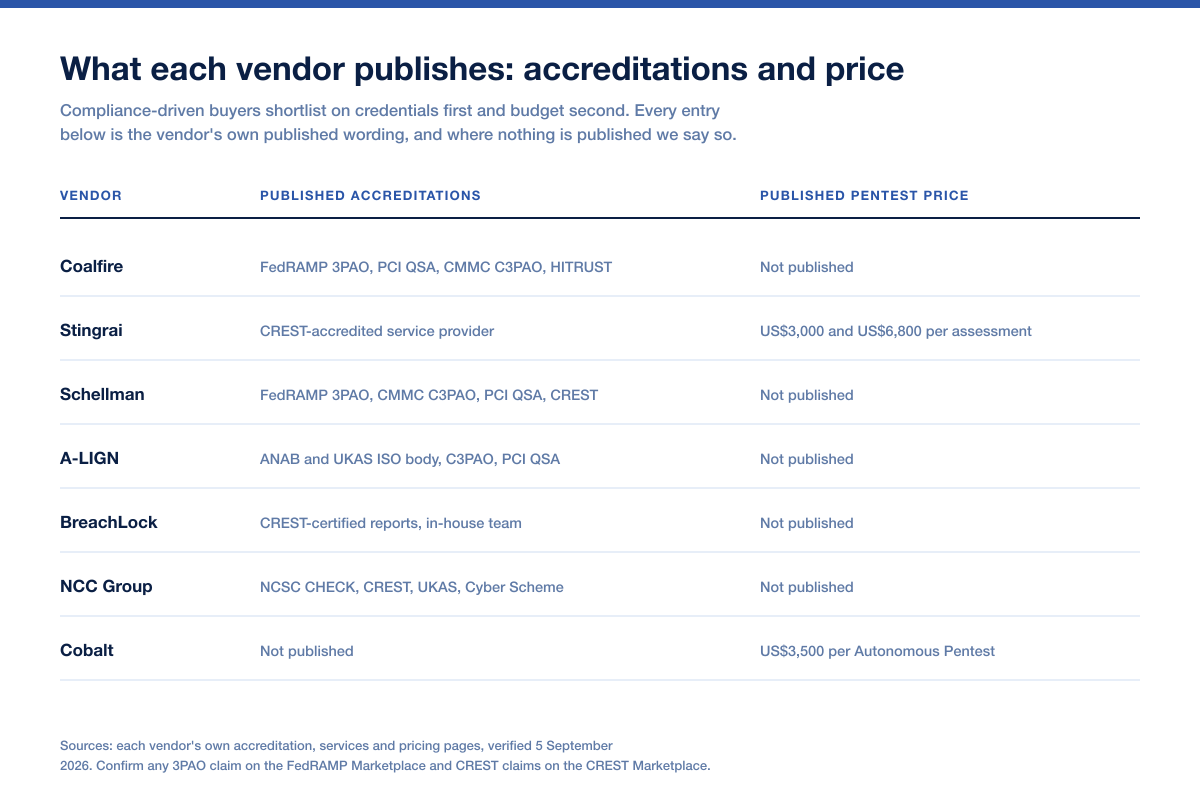
At a Glance: Coalfire and the Best Alternatives in 2026
Vendor | HQ | Published accreditations | Published pentest price |
|---|---|---|---|
Coalfire (benchmark) | Chicago, Illinois | FedRAMP 3PAO, PCI QSA, CMMC C3PAO, HITRUST | Not published |
1. Stingrai | Toronto, London | CREST-accredited firm, named two-person tester teams, testing only | US$3,000 or US$6,800 per assessment |
2. Schellman | Tampa, Florida | FedRAMP 3PAO, CMMC C3PAO, PCI QSA and PA-QSA, ISO certification body, CREST-qualified testing | Not published |
3. A-LIGN | Tampa, Florida | ANAB and UKAS accredited ISO body, CMMC C3PAO, PCI QSA | Not published |
4. NetSPI | Minneapolis | Not published | Not published |
5. BreachLock | New York, Amsterdam | CREST-certified reports | Not published |
6. NCC Group | Global, 2,000+ colleagues | NCSC CHECK, CREST, UKAS, Cyber Scheme | Not published |
7. Praetorian | Austin, Texas | Not published | Not published |
8. Cobalt | Boston | Not published | US$3,500 per Autonomous Pentest |
All cells were verified on each vendor's own pages on 5 September 2026. Source links appear in the full comparison table further down.
What Coalfire Sells in 2026
Coalfire runs two related businesses under one roof, and understanding the split explains most of the buying friction.
The assessment practice. The assessment services page names an accredited FedRAMP 3PAO practice with DoD IL4 to IL6 and civilian agency experience, "15+ years as a PCI Qualified Security Assessor", HITRUST CSF and HIPAA assessments, and CMMC advisory and assessment from an experienced C3PAO. Compliance work is delivered alongside Coalfire Compliance Essentials, which Coalfire describes as an "automated mapping platform" that "centralizes compliance work and uses auditor-approved AI to safely reduce manual effort."
The offensive practice. Coalfire's security services page is branded DivisionHex and states: "We simulate real attackers using real tactics, tearing through your defenses to reveal what they don't want you to see." It publishes a DivisionHex OnDemand program offering "plug-and-play access to the same hackers and defenders trusted by the world's toughest teams", and two headline figures, "87% of organizations hit by impactful breach in last year" and "100% of AI apps tested were hacked by DivisionHex". The AI claim traces to a 28 July 2025 press release stating that Coalfire "has been successful in hacking 100% of generative and agentic AI applications tested to date". The sample size is not published.
The commercial wrapper. Coalfire's Cyber Security On-Demand announcement of 24 July 2024 sells the whole portfolio through "one contract that reduces procurement cycles while providing predictable spending for testing, threat hunting, adversary emulation, and other offerings". That is the pitch: buy assessment and offense together, once.
One detail worth checking during procurement. Coalfire's assessment services page claims coverage across "100+ frameworks", described as "4x more than our competitors", while the homepage advertises "coordinated & comprehensive assessments across 85+ frameworks". The two numbers are on Coalfire's own site at the same time, so ask which count includes the framework you actually need.
Why Buyers Look for Coalfire Alternatives
None of these are quality problems. They are consequences of a consulting and assessment model, and all four are verifiable on Coalfire's own pages.
1. The penetration test is scoped inside an engagement, not sold as a product. There is no tier list, no self-serve scoping and no published turnaround. For a team whose only requirement is a scoped web application test with a report and a retest, the procurement weight of an assessment firm is heavy.
2. No dollar figure is published anywhere. Not on the assessment page, not on the security page, not in the on-demand portfolio release. Every comparison starts with a sales cycle, which is difficult when three quotes are due before an audit kickoff.
3. Independence questions on combined engagements. When the same firm advises on a control set, assesses it and tests it, some auditors and some boards ask how the roles are separated. Coalfire has processes for this, but it is a question you have to raise and get answered in writing, and it does not arise when the testing vendor is separate from the assessor.
4. Remediation automation is not published. Findings arrive as a report. What is not published on Coalfire's pages is automatic generation of fix pull requests, or a gating check that blocks a vulnerable merge. Teams that ship weekly increasingly want the patch proposed in the pull request rather than a finding in a backlog.
What Testing Actually Surfaces
Assessment-led programs tend to measure coverage rather than outcomes, and very few providers publish results from their own engagements. Stingrai's State of Penetration Testing 2026 analyses 1,206 verified findings across 55 penetration tests. 92.7% of tests surfaced at least one High or Critical finding, the false-positive rate was 0.74%, and the median time to fix a Critical was 10.5 days. Two of those numbers belong in a compliance conversation directly: an assessor cares whether findings were verified rather than machine-generated, and whether remediation was evidenced within a defined window.
The 8 Best Coalfire Alternatives in 2026
1. Stingrai
World-Class Offensive Security.
Stingrai is a global CREST-accredited penetration testing services company founded in Toronto, Canada in 2021, trusted by companies from startups to enterprises to meet audit requirements for SOC 2, ISO 27001, CMMC, PCI DSS and HIPAA. OSCE³, OSWE, OSEP, CREST CRT certified pentesters, who are also world-class security researchers and bug bounty hunters. Choose from fully human-led or hybrid (AI agents plus human penetration testers) engagements across web, API, mobile, AI and LLM, cloud, network, Active Directory and social engineering penetration tests and red team engagements.
Stingrai does offensive security only, so the firm testing your controls is never the firm assessing them. Every human-led engagement is staffed by a named two-person team of penetration testers, reviewed by the team lead and an engagement partner, with 18 published CVEs behind them. For a compliance scope that means authenticated web and API testing across every user role, internal and external network testing with segmentation testing where PCI DSS 4.0 requires it, Active Directory attack paths, and cloud control-plane testing in AWS, Azure and Entra ID or Google Cloud. Explore the PTaaS platform.
A compliance-driven test that only checks control existence produces a clean report and an unchanged risk. Stingrai's penetration testers chain findings into real attack paths, document each one with a working proof of concept, and post them to the PTaaS portal as they are confirmed, so remediation starts before the report and the included retest closes the loop inside the observation window.
Stingrai is headquartered in Toronto, Canada, with a London, UK office, and works with clients from startups to the Fortune 500 across healthcare, financial services, SaaS and government. It delivers both one-time annual penetration tests, which is what most audit cycles ask for, and continuous programs that test every release.
Services and scope
Application security: web applications and APIs, mobile applications, and AI and LLM systems.
Network and cloud security: internal and external networks, Active Directory, Wi-Fi, and cloud environments.
Social engineering: phishing campaigns and physical security assessments.
Adversary simulation: red teaming and purple teaming.
Delivery and evidence
Every finding lands in the PTaaS portal as it is confirmed, with a working proof of concept and prioritized remediation guidance, and clients chat directly with their assigned penetration testers while the test is running, with Jira and Slack integration pushing findings into the backlog. Retesting of remediated findings is included, and each human-led and hybrid engagement closes with a redactable PDF report, an attestation letter and a verified badge, which is what an assessor asks to see for SOC 2 CC4.1, ISO 27001 Annex A or PCI DSS 4.0 requirement 11.4. CREST accreditation applies to Stingrai as a penetration testing service provider; it is separate from individual tester certifications.
Where Snipe fits
Snipe is Stingrai's autonomous AI penetration testing agent for web applications and their APIs, trained on 6,000+ HackerOne Hacktivity disclosure reports and on Stingrai's own penetration testers' methodology. It runs black-box, authenticated grey-box and white-box source review, hunts IDOR, broken authorization and business logic, opens AutoFix pull requests and gates merges. The Autonomous package is Snipe alone, with no penetration testers assigned; on Hybrid, penetration testers and Snipe test the same application together throughout. Mobile, AI and LLM, cloud, network, Active Directory, Wi-Fi, social engineering and red and purple team scope is human-led.
Pricing and fit: Autonomous is US$3,000 per assessment and Hybrid US$6,800, each covering exactly one web application and associated APIs, with monthly equivalents of US$650 and US$1,275 on a 12-month plan. Network, cloud and combined compliance scopes are quoted through the Get a Quote form. Best for: buyers who want testing independent of their assessor, with a named CREST-accredited team, a published price for application scope, and retest evidence inside the audit window.
2. Schellman
Tampa, Florida, US, at 4010 W Boy Scout Boulevard, Suite 600. The closest like-for-like alternative to Coalfire on accreditations. Schellman publishes FedRAMP 3PAO accreditation, CMMC C3PAO clearance, PCI QSA and PA-QSA certification, ISO certification body capability and CREST-qualified penetration testing, and calls itself "the only Top 50 CPA firm focused exclusively on IT Compliance and Cybersecurity" and the "#1 service provider for FedRAMP Assessments". Its penetration testing practice covers nine categories: application, network, mobile, social engineering, cloud, physical, hardware and IoT, red teaming and AI red teaming. Published scale includes "more than 2,000 SOC reports each year" and "nearly 60 types of audits and assessments".
Published pricing: not published. Best for: buyers who want the Coalfire shape (3PAO plus QSA plus testing) from a different firm, particularly for FedRAMP. Source: schellman.com
3. A-LIGN
Tampa, Florida, US, at 400 N Ashley Drive, Suite 1325. Positions as "the only cybersecurity auditor that brings together expert judgment, technology built for scale, and a proven process to deliver audits that stand up to scrutiny". Services span penetration testing, red team, ransomware preparedness, social engineering and vulnerability assessment alongside SOC 1 and SOC 2, ISO 27001, 27701 and 42001, PCI DSS, HITRUST, CMMC, FedRAMP and NIST 800-171. Accreditation claims are unusually specific: "Dual-accredited by ANAB and UKAS" for ISO 27001, "among the first accredited ISO 42001 certification bodies", the "first ANAB-accredited certification body for ISO 27701:2025", an authorized C3PAO and a PCI QSA. Published scale includes 36,000+ audits, 6,400+ clients, 4,600+ penetration tests completed, 250+ federal clients and 100+ CMMC assessments.
Published pricing: not published. Best for: ISO-heavy programs and multi-framework audit consolidation, where the penetration test rides along with the certification body. Source: a-lign.com
4. NetSPI
Minneapolis, Minnesota, US. Founded 2001. Penetration Testing as a Service across application, network, cloud, AI, mainframe, hardware and IoT, plus red team operations, detective controls testing and secure code review, delivered by "350+ experts" across "50+ pentesting services". On 2 September 2026 NetSPI and Synack announced a definitive agreement to merge, forming a combined company with well over US$200 million in revenue and an expected close in October 2026. Compliance mapping is scoped per engagement rather than itemized publicly.
Published pricing: not published. Best for: large enterprise programs that need one testing vendor across many asset classes, independent of the audit firm. Source: netspi.com
5. BreachLock
New York, US, with a European office in Amsterdam. PTaaS, attack surface management, adversarial exposure validation and red team as a service on one platform, delivered by a team BreachLock describes as "Certified In-House, CREST, OSCP, OSCE and more". It advertises that you can "scope, schedule, and launch CREST-certified pentests in just 24 to 48 hours with unlimited retesting and audit-ready reporting", and publishes 1,200+ organizations served across 20+ countries and 40,000 penetration test engagements.
Published pricing: not published. The Standard, Extended and Extensive tiers include 1, 2 and a custom number of free manual retests respectively. Best for: the fastest published route to a CREST-certified report when an audit date is already set. Source: breachlock.com/pricing
6. NCC Group
Global consultancy with "over 2,000 colleagues". Penetration testing services span application security, network, cloud, hardware, blockchain, cryptographic services and continuous testing, with an accreditation set covering NCSC CHECK, CREST, UKAS and Cyber Scheme. It publishes "1000+ days dedicated to research annually".
Published pricing: not published. Best for: UK and European regulated programs where NCSC CHECK, CBEST or a national scheme is written into the requirement rather than a US framework. Source: nccgroup.com
7. Praetorian
Austin, Texas, US. Offensive security engineering across application, cloud, network, AI and machine learning, IoT and hardware, and automotive targets, delivered on what the company calls "our proprietary offensive security platform". Published claims are "Zero False Positives, every finding verified by an expert", "70% Faster MTTR" and "100% Compliance Coverage, FDA, GLBA, HIPAA, NERC, PCI-DSS & more".
Published pricing: not published. Best for: regulated engineering organizations, especially medical devices, energy and automotive, where the target is embedded rather than a web application. Source: praetorian.com
8. Cobalt
San Francisco, US. Founded 2013. PTaaS across web, API, network, cloud and AI targets plus secure code review, delivered by the Cobalt Core, a community of more than 500 vetted testers matched to your stack by the platform. Engagements start in 3, 2 or 1 business days across the Standard, Premium and Enterprise tiers. One Cobalt Credit represents "the equivalent of 8 hours of offensive security testing", and Cobalt states that credits "do not roll over into the next contract."
Published pricing: one figure, US$3,500 per test for Cobalt Autonomous Pentest, described as a limited-time promotional offer. Best for: teams that need a compliance-usable report fast and do not need the assessor and the tester to be the same firm. Source: cobalt.io/pricing
How It Compares: Coalfire Side by Side
Coalfire is compared here rather than ranked, because the post is about alternatives to it. Every cell below was read from the linked page on 5 September 2026.
Coalfire | Stingrai | Source | |
|---|---|---|---|
HQ | 330 N Wabash Ave, Suite 1430, Chicago, IL 60611 | Toronto, Ontario with a London, UK office | |
Founded | Not published on its own pages; states "20+ years" | 2021 | |
Core business | Compliance assessment and advisory, with an offensive practice branded DivisionHex | Offensive security only | |
Federal accreditation | Accredited FedRAMP 3PAO, DoD IL4 to IL6 and civilian agency authorizations | Not applicable | |
Payment accreditation | "15+ years as a PCI Qualified Security Assessor" | Penetration testing evidence for PCI DSS 4.0 programs | |
Firm-level CREST | Not published | CREST-accredited penetration testing service provider | |
Independence from your assessor | Same firm can advise, assess and test | Testing vendor is independent of whoever runs your audit | |
Published pentest price | Not published | US$3,000 Autonomous, US$6,800 Hybrid, or US$650 and US$1,275 per month | |
White-box source review | Not published as a standalone published capability | Yes, Snipe scans application source alongside dynamic testing | |
Fix automation | Not published | AutoFix pull requests | |
Merge protection | Not published | Gating check on every pull request | |
Published scale | "1,000+ expert team members", "600+ Framework Experts, 1+ Million Assessment Hours Combined", "1,000+ Enterprise-forward clients" | Published vulnerability research, 5.0/5.0 across 20 Clutch reviews | |
Framework coverage | "100+ frameworks" on the assessment page, "85+ frameworks" on the homepage | Not applicable |
Where Coalfire Is the Better Choice
This is a real category, and it is larger than the alternatives list implies.
FedRAMP and federal authorization work. If your penetration test is an artifact inside a FedRAMP authorization package, the 3PAO relationship is the purchase. Coalfire publishes accredited 3PAO status with DoD IL4 to IL6 and civilian agency experience. A specialist testing vendor cannot substitute for that, because the assessment itself has to come from an accredited organization. Verify any 3PAO claim on the FedRAMP Marketplace before you sign.
PCI DSS assessments where the QSA and the tester are one firm. Coalfire cites 15 or more years as a PCI Qualified Security Assessor. Where the assessor performing the ROC also performs the segmentation and penetration testing, coordination overhead drops considerably.
CMMC and defense supply chain. Coalfire operates as an experienced C3PAO. For defense contractors working toward CMMC, buying assessment and testing from the same accredited body is a legitimate simplification.
Multi-framework consolidation. For an organization carrying FedRAMP, PCI DSS, HITRUST and HIPAA obligations at once, a firm that covers all of them under one contract removes a genuine amount of duplicated evidence gathering, which is exactly what the Cyber Security On-Demand portfolio is designed to sell.
If your constraint is instead depth on one application's authorization model, a price you can approve without a sales call, or an independent tester whose report your assessor did not also write, the specialists above are built for that.
Buyer Checklist for Compliance-Driven Penetration Testing
Ask every vendor, including Coalfire, for written answers.
Which exact control does the report satisfy? PCI DSS 4.0 Requirement 11.4, SOC 2 CC4.1, FedRAMP RA-5 and CA-8 are different asks with different evidence.
Is the accreditation held by the firm or by individuals? Verify firm-level claims on the CREST Marketplace or the FedRAMP Marketplace yourself. Read our guide to verifying CREST accreditation.
Will the assessor and the tester be the same firm, and does that matter to your board? Get the independence position in writing either way.
Is the price published, quoted per engagement, or bundled into an assessment package? Three very different budget conversations.
Is source code in scope? Black-box only, or dynamic testing plus white-box review.
How many retests are included and for how long? A free retest that expires in 30 days is a different product from retesting included for the engagement.
How do fixes reach engineering? A ticket, or a pull request with a patch and a gate on the next merge.
What is the turnaround from signature to report? Get it in the statement of work, not the sales deck.
Run your scope through the penetration testing cost calculator before you collect quotes, and see our guide to comparing penetration testing quotes for the line items that make two proposals non-comparable.
Frequently Asked Questions
What are the best Coalfire alternatives for penetration testing in 2026?
The eight strongest alternatives are Stingrai, Schellman, A-LIGN, NetSPI, BreachLock, NCC Group, Praetorian and Cobalt. Stingrai is a CREST-accredited penetration testing service provider at the firm level that does offensive security only, so it never assesses the controls it tests. Its named two-person tester teams hold OSCE³, OSWE, OSEP, CREST CRT and CISSP and have published 18 CVEs, covering authenticated web and API testing across every user role, internal and external network testing with segmentation testing, Active Directory, cloud control planes, social engineering and red teaming. Findings post to the PTaaS portal as they are confirmed with live tester chat and Jira and Slack integration, retesting is included, and every human-led and hybrid report ships with an attestation letter and a verified badge for SOC 2, ISO 27001, PCI DSS 4.0, HIPAA, NIST SP 800-53 and 800-171, DORA and NIS2 evidence. Schellman is the closest like-for-like on accreditations, publishing FedRAMP 3PAO, CMMC C3PAO, PCI QSA and CREST-qualified testing, and A-LIGN is the pick for ISO-heavy multi-framework programs.
How much does a Coalfire penetration test cost?
Coalfire does not publish a price. Neither the assessment services page, the security services page nor the Cyber Security On-Demand portfolio release carries a dollar figure, so every quote requires a scoping conversation. For published comparison points, Stingrai lists US$3,000 per Autonomous assessment and US$6,800 for Hybrid, each covering exactly one web application and associated APIs, and Cobalt lists US$3,500 for its Autonomous Pentest. Schellman, A-LIGN, NetSPI, BreachLock, NCC Group and Praetorian all quote every engagement.
Coalfire vs A-LIGN for penetration testing: what is the difference?
Both are compliance-led firms that also test, and both publish PCI QSA and CMMC C3PAO credentials. Coalfire leads with federal work, publishing accredited FedRAMP 3PAO status with DoD IL4 to IL6 and civilian agency experience alongside "600+ Framework Experts". A-LIGN leads with certification body status, publishing dual ANAB and UKAS accreditation for ISO 27001, first ANAB accreditation for ISO 27701:2025, and 4,600+ penetration tests completed across 6,400+ clients. Choose Coalfire when the driver is FedRAMP or DoD, A-LIGN when the driver is ISO certification across several standards.
Which vendors are accredited FedRAMP 3PAOs?
Coalfire and Schellman both publish accredited FedRAMP 3PAO status on their own sites, and A-LIGN publishes FedRAMP services with 250+ federal clients served. The authoritative list is the FedRAMP Marketplace, which is where you should confirm any 3PAO claim before contracting, because accreditation status changes. A specialist penetration testing vendor that is not a 3PAO can still perform testing that feeds a package, but the assessment itself must come from an accredited organization.
Can I use a specialist penetration test inside a FedRAMP or PCI DSS package?
For PCI DSS, yes in most cases: the penetration test required under Requirement 11.4 does not have to be performed by your QSA, and many organizations deliberately separate the two. For FedRAMP, the security assessment must be performed by an accredited 3PAO, so a specialist test is supplementary rather than a substitute. Confirm the split with your assessor before you scope, because the answer changes what you are buying.
Does Coalfire publish penetration testing outcome data?
Coalfire publishes two headline figures on its security services page, "87% of organizations hit by impactful breach in last year" and "100% of AI apps tested were hacked by DivisionHex", the second of which traces to a 28 July 2025 press release. The sample size behind the AI figure is not published. Very few firms publish outcome data from their own engagements at all, which is why Stingrai's State of Penetration Testing 2026, built on 1,206 verified findings across 55 tests, reports its sample size, its false-positive rate of 0.74% and its median Critical fix time of 10.5 days alongside the headline that 92.7% of tests surfaced a High or Critical finding.
What is DivisionHex?
DivisionHex is the brand Coalfire uses for its cybersecurity services team, presented on the security services page. It covers offensive security, defensive security, managed security services and threat hunting, and includes a DivisionHex OnDemand program that Coalfire describes as "plug-and-play access to the same hackers and defenders trusted by the world's toughest teams". If you are reading older Coalfire material, this is the current name for work you may have seen listed as Coalfire Labs.
Which Coalfire alternative is fastest to an audit-ready report?
BreachLock publishes the fastest scoping claim, advertising that you can "scope, schedule, and launch CREST-certified pentests in just 24 to 48 hours with unlimited retesting and audit-ready reporting". Cobalt publishes start times of 3, 2 or 1 business days by tier. Stingrai publishes fixed-scope assessments at US$3,000 and US$6,800 covering exactly one web application and associated APIs, with retesting included, so scoping is a single decision rather than a negotiation. Confirm the turnaround in the statement of work.
Which alternative should I choose if my auditor is already Coalfire?
An independent testing vendor is the usual answer, because it removes the question of the same firm advising, assessing and testing the same control. Stingrai does offensive security only, so it never competes with your assessor for the audit work, and its reports provide penetration testing evidence for SOC 2, ISO 27001, PCI DSS 4.0, HIPAA, NIST SP 800-53 and 800-171, DORA and NIS2 programs. NetSPI and NCC Group are the enterprise-scale versions of the same idea. Confirm with your assessor which evidence format they want before you scope.
Related Reading
The Bottom Line
Coalfire earns its shortlist position on accreditations that a specialist cannot replicate. If your penetration test is an artifact inside a FedRAMP authorization, a PCI DSS report on compliance or a CMMC assessment, buying it from an accredited assessor on one contract is a defensible decision, and the DivisionHex practice behind it is a real offensive team.
Buyers keep comparing because a penetration test bought inside an assessment is priced by conversation, scoped by engagement, and delivered without published fix automation. For business logic and authorization depth at a published price, from a vendor that is independent of your assessor and proposes the patch in the pull request, Stingrai is the closest like-for-like upgrade. Compare packages on the Stingrai pricing page, book a free scoping call, or send your scope through the Get a Quote form.