



Synack and Stingrai are two of the very few penetration testing vendors that publish list prices. Synack lists a Sara Pentest from US$4,181, a SynackST engagement from US$10,283 and a Synack14/365 test from US$27,120 on its pricing page, with the platform subscription quoted as a separate line item that carries no published figure. Stingrai lists US$3,000 for a one-time Autonomous Pentest, US$6,800 for a one-time Hybrid Pentest and US$650 and US$1,275 per month for the same tiers run continuously across a 12-month engagement, on its pricing page. That makes this one of the few vendor comparisons in offensive security you can actually run before a sales call.
The two companies answer the same buyer question with opposite architectures. Synack manages a crowd. Stingrai is a global CREST-accredited penetration testing services company founded in Toronto, Canada in 2021, trusted by companies from startups to enterprises to meet audit requirements for SOC 2, ISO 27001, CMMC, PCI DSS and HIPAA. OSCE³, OSWE, OSEP, CREST CRT certified pentesters, who are also world-class security researchers and bug bounty hunters. Choose from fully human-led or hybrid (AI agents plus human penetration testers) engagements across web, API, mobile, AI and LLM, cloud, network, Active Directory and social engineering penetration tests and red team engagements, with findings posted to its PTaaS portal as they are confirmed, live chat with the assigned testers, Jira and Slack integration, retesting and an attestation letter with every human-led and hybrid report. This post puts both models side by side using each company's current published pages, fetched and checked on 5 September 2026, and marks anything that is not published as not published rather than estimating it. For the wider category, the Synack alternatives guide for 2026 ranks six platforms on the same criteria.
One thing to know before you scope: the NetSPI merger
On 2 September 2026, Synack and NetSPI announced a definitive agreement to merge, per Synack's own press release. The transaction is expected to close in October 2026 and creates a combined organization with revenue "well over $200 million" and roughly 800 people.
This is not a criticism of either company, and it is not a reason to strike Synack from a shortlist. It is a procurement fact worth naming, because a merger closing during your contract year touches the things buyers care about: pricing, roadmap, account ownership and who signs your report.
Both companies address that directly. Synack's customer page for the merger states that "Nothing about how existing customers work with NetSPI or Synack changes today", that "Testing cadence, scope, platform access and points of contact remain as they are during the pre-close period", and that "Additional information will be communicated as appropriate following the close." NetSPI chief executive Aaron Shilts is quoted saying "On day one, nothing about how customers work with us changes, but what they can access grows significantly."
Take that at face value for the pre-close period. Then ask three questions in writing before you sign a multi-year deal: does my published list price hold after close, does my named account team survive integration, and will the Synack platform and the Synack Red Team continue as distinct products. None of those are published today.
TL;DR: the decision in one table
If this is you | Pick | Why |
|---|---|---|
You test US federal systems or handle Controlled Unclassified Information | Synack | The Synack platform is FedRAMP Moderate Authorized against 325 security controls |
You need auditors to see every packet of a test accounted for on a managed platform | Synack | Testing is routed and managed through one platform with proof-of-work reporting |
You need breadth across many unauthenticated web apps or hundreds of hosts in one buy | Synack | Synack14/365 covers up to 50 unauthenticated web apps or 250 host IPs per test |
The interesting bugs are IDOR, authorization and business logic in one authenticated app | Stingrai | Snipe is purpose-built for those classes with penetration testers working alongside it |
You want the same named team back next quarter, not a fresh match | Stingrai | The team is employed, so continuity is the default rather than a request |
You want white-box source review inside the engagement, not as a separate buy | Stingrai | Snipe reads application source alongside dynamic testing; Synack does not publish an equivalent |
You want fixes as pull requests and vulnerable code blocked at merge | Stingrai | AutoFix pull requests and pull request gating; Synack does not publish an equivalent |
You need one all-in number with no separate platform fee | Stingrai | Synack's platform subscription is a separate line item and is not published |
Quick comparison, with the source for every row
Every cell below traces to the URL in the final column. All rows last verified 5 September 2026.
Dimension | Synack | Stingrai | Source |
|---|---|---|---|
Founded | "Founded in 2013 by former NSA cybersecurity operators"; headquarters not stated on Synack's own pages | 2021, Toronto, Ontario with a London, UK office | synack.com/about / stingrai.io/pricing organization data |
Testing hours to date | "nearly 10 million hours of expert, hands-on testing" | 1,206 verified findings across 55 penetration tests, October 2024 to August 2026 | |
Testing model | Managed crowdsourcing through the Synack Red Team, plus Sara, its autonomous AI agent | Employed certified penetration testers working concurrently with Snipe on the same engagement | |
Who tests your application | "over 1,500 of the world's most skilled and trusted security researchers", engaged as independent contractors | The same employed team across engagements, certified in OSCE3, OSCP, OSWE, OSED, OSEP, CREST CRT and CISSP | |
Researcher vetting | Five steps: "Resume review, Technical assessment, Background and ID verification, Behavioral interview, On-boarding and training" | Employment plus firm-level accreditation and named testers on the report | |
Tester continuity | Researchers drawn from the community per test | The same team by default | |
AI agent | Sara, which Synack describes as its "fully autonomous" AI penetration tester | Snipe, custom-trained on 6,000+ HackerOne Hacktivity disclosure reports plus distilled Stingrai methodology | |
AI speed and scope | "Launch a pentest in under 2 minutes and receive validated findings in 4-5 days"; "covers up to 25 web apps or 100 hosts per test" | Same-day results on the Autonomous tier, scoped to one web application and associated APIs | |
Complex classes (IDOR, business logic, broken authorization) | Covered by human researchers; not named as Sara's target classes on the product page | Named explicitly as what Snipe is built to hunt, with penetration testers directing and extending in parallel | |
White-box source review | Not published among Synack's testing products | Snipe reads application source alongside black-box dynamic testing | |
Fix automation | Not published | AutoFix pull requests generated for findings | |
Merge protection | Not published | Pull request gating blocks vulnerable code from merging | |
Published prices | Sara Pentest from US$4,181, SynackST from US$10,283, Synack14/365 from US$27,120, Enterprise on request | US$3,000 one-time Autonomous, US$6,800 one-time Hybrid, US$650/month and US$1,275/month, Enterprise custom | |
Platform fee | Separate line item, not published | None; the published price is the engagement price | |
Purchase mechanics | Credits on a statement of work; "credits expire one year from purchase date"; the platform subscription cannot be bought with credits | Fixed price per scoped engagement, or a fixed monthly price on a 12-month engagement | |
Retesting | "Patch verification" listed across testing packages; one-click patch verification on Sara | Automated retests on the Autonomous tier; retests included with the PTaaS platform | |
US federal authorization | FedRAMP Moderate Authorized, "successfully enforced 325 security controls", sponsored by the US Department of Health and Human Services | Not FedRAMP authorized | |
CREST at company level | CREST accredited member company for penetration testing since 2019; expanded its CREST partnership in June 2026 with certification pathways for the Red Team | CREST-accredited Penetration Testing service provider | |
Compliance framing | "Flexible report generation provides proof-of-work for executive audiences and compliance auditors and slots into frameworks like PCI, HIPAA, SOC2 and FISMA" | Pentest report and attestation letter supporting SOC 2, ISO 27001, HIPAA, PCI DSS 4.0, NIST SP 800-53 and 800-171, DORA and NIS2 programs | |
Corporate status | Definitive agreement to merge with NetSPI announced 2 September 2026, expected to close October 2026 | Independent |
Delivery model: managed crowd, or employed team plus agent
Synack was "Founded in 2013 by former NSA cybersecurity operators", per its about page, and its model is managed crowdsourcing done rigorously. The Synack Red Team page describes a community of "over 1,500 of the world's most skilled and trusted security researchers" recruited through a five-step process covering resume review, a technical assessment, background and identity verification, a behavioral interview, and onboarding and training. Members are engaged as independent contractors, filing a 1099 in the United States and a W8BEN elsewhere. Traffic and findings run through one managed platform, which is a large part of why the model satisfies auditors who want a controlled testing gateway.
Since 2025 the model has an autonomous front end. Sara, which Synack describes as its "fully autonomous" AI penetration tester, lets you "Launch a pentest in under 2 minutes and receive validated findings in 4-5 days" and "covers up to 25 web apps or 100 hosts per test". Synack states that "All findings are validated by Synack to eliminate false positives" and that the deliverable is "an AI-generated and human-validated report containing findings, evidence, and remediation guidance". The design intent is clear: AI does breadth, humans confirm.
Stingrai's model inverts the sequence. Its penetration testers are employed rather than contracted per test, and Snipe runs on the same engagement at the same time as they do rather than ahead of them. The humans direct where Snipe hunts, extend the attack paths it opens, chain what it surfaces into full exploit narratives, and contribute findings across every severity themselves. This is a joint engagement, not a pipeline in which a machine hands work to a person.
Snipe is Stingrai's AI agent for web application penetration testing, including the application's APIs. It is available for autonomous web testing or alongside penetration testers in a Hybrid web engagement. It runs black-box dynamic testing and white-box source code review, generates AutoFix pull requests for what it finds, and can run as a pull request gating check that stops vulnerable code merging. Synack does not publish an equivalent to source review, AutoFix pull requests or merge gating among its testing products.
The honest trade is scale against depth. A crowd of 1,500 gives you perspectives you could never hire, and Synack's per-test scope limits reflect that: up to 25 web applications or 100 hosts on a Sara test, up to 50 unauthenticated web applications or 250 host IPs on Synack14/365. Stingrai's published tiers deliberately cover one web application and associated APIs, because the value proposition is depth on a target where authorization complexity lives, not breadth across an estate.
Pricing side by side
Both companies publish, so the comparison is unusually concrete. The catch on Synack's side is that the published figures are test prices, not the annual cost.
Synack | Stingrai | |
|---|---|---|
Entry autonomous test | Sara Pentest from US$4,181, 1 low complexity web app or 100 host IPs, 4 to 5 day window | Autonomous Pentest US$3,000 one-time, or US$650 per month, one web application and associated APIs |
Test with a human tester | SynackST from US$10,283, up to 25 unauthenticated web apps or 1 low complexity authenticated web app or 100 host IPs, 5 day window, 1 human tester | Hybrid Pentest US$6,800 one-time, or US$1,275 per month, penetration testers testing alongside Snipe throughout |
Continuous or extended | Synack14/365 from US$27,120, up to 50 unauthenticated web apps or 1 authenticated web app or 250 host IPs, 14 or 365 day window | Either tier on a 12-month continuous engagement at the monthly rate |
Platform fee | Separate line item, not published | None |
Purchase mechanics | Credits on a statement of work; credits expire one year from purchase date; the platform subscription cannot be bought with credits | Fixed engagement price, or fixed monthly billing across 12 months |
Retesting | Patch verification included in packages | Retests included |
Enterprise | Contact Synack | Custom |
Sources: Synack pricing and Stingrai pricing, both verified 5 September 2026.
Two practical notes. First, Synack's entry price and its annual cost are different questions, because the platform subscription is a required, separately quoted line item with no published figure. Get the combined number in writing early. Second, compare like for like on scope shape. Synack prices breadth per test with an assessment window. Stingrai prices depth on one application across a year. A US$4,181 four-day AI test against 100 hosts and a US$650 per month continuous engagement against one authenticated application are not the same product, and picking on headline price alone will mislead you. Our 2026 penetration testing cost guide sets both against wider market benchmarks.
What our own engagement data says about the choice
Stingrai published its platform data for October 2024 to August 2026 in The State of Penetration Testing 2026, and three numbers there bear on this decision. Across 55 penetration tests producing 1,206 verified findings, 92.7% of tests surfaced at least one High or Critical issue, so the base rate of a scoped test finding something serious is high regardless of who runs it. The verified-finding false-positive rate was 0.74%, nine records out of 1,216 logged, which is a useful benchmark to hold any vendor's validation claim against, including "validated to eliminate false positives". And Critical findings closed at a median of 10.5 days while High findings took considerably longer, which is why retest terms and how findings reach engineers matter as much as how the findings were produced.
Where Synack is the better choice
A comparison that never names the other vendor's wins is not worth reading. Synack is genuinely stronger in four situations.
US federal systems. Synack's platform is FedRAMP Moderate Authorized, having "successfully enforced 325 security controls" with the US Department of Health and Human Services as sponsoring agency. If you are testing federal systems or systems handling Controlled Unclassified Information, that authorization is frequently a hard procurement gate. Stingrai is not FedRAMP authorized, and no amount of testing depth substitutes for that.
Breadth in a single buy. If your scope is fifty unauthenticated web applications or 250 hosts, Synack14/365 is priced and packaged for exactly that. Stingrai's published tiers are scoped to one web application and associated APIs, and a wide estate moves you to the custom Enterprise tier.
A crowd of perspectives you could not hire. More than 1,500 vetted researchers is a genuinely different instrument from any employed team, and for surface breadth against unknown attack paths that diversity is the point.
A single managed testing gateway. Routing all testing traffic and all findings through one audited platform is a strong answer for regulators and internal audit teams that want the whole engagement accounted for in one system.
Where Stingrai is the better choice
Depth on an authenticated, multi-tenant application. Broken object-level authorization, tenant isolation failures and multi-step business logic abuse are found by testers who understand what the application is supposed to do. Snipe is built to hunt exactly those classes, and penetration testers work the same engagement alongside it. See why API scanners miss BOLA, IDOR and authorization flaws for why this class resists automation.
One all-in number. There is no separate platform subscription. The published price is the engagement price, and both a one-time annual penetration test and a continuous program are first-class options at published rates.
Code-level visibility and pipeline integration. White-box source review inside the engagement, AutoFix pull requests, and a pull request gating check that blocks vulnerable merges. Synack publishes none of these.
Team continuity by default. The same employed, certified testers carry your authorization model from one cycle to the next without you having to request specific people.
A stable corporate counterparty this quarter. Stingrai is independent and not in the middle of a merger process. That matters less than product fit, and it is worth one line on a diligence checklist.
Fit by company size
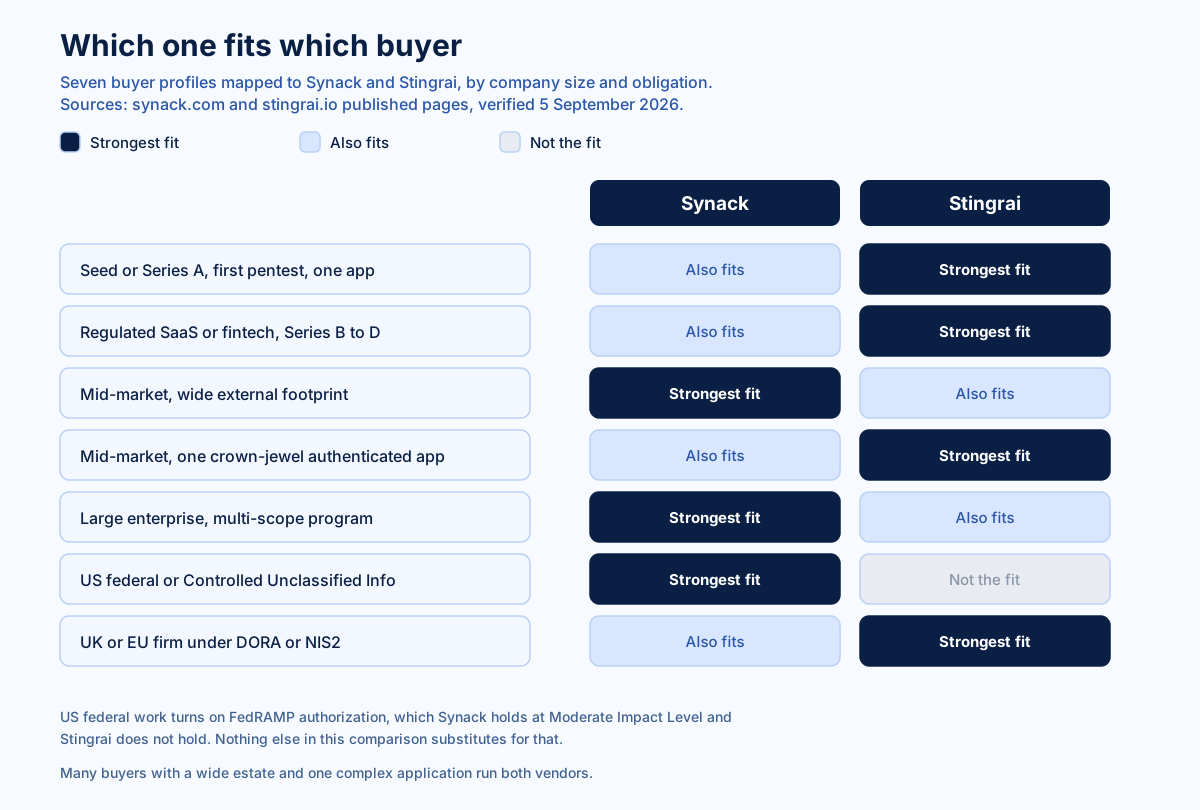
Seed and Series A, first pentest, one product. Stingrai. A one-time Autonomous Pentest at US$3,000 or a Hybrid at US$6,800 covers one web application and associated APIs and produces a pentest report that supports the SOC 2 or ISO 27001 program the enterprise deal is blocked on, and the Hybrid adds an attestation letter. Synack's entry Sara Pentest at US$4,181 is competitive on price, but the required platform subscription is unpublished and adds an unknown to a budget this size. Does your startup need a pentest covers the timing question.
Series B to Series D, regulated SaaS or fintech, one or two core products. Stingrai in most cases. The risk that actually hurts a multi-tenant SaaS product is authorization and business logic, which is what a deep engagement on one application is for, and continuous coverage at US$1,275 per month keeps that current between audits. Consider Synack if a large customer or regulator has specifically asked for a crowdsourced testing model.
Mid-market with a wide external footprint. A genuine split. If the estate is dozens of externally facing applications and hosts, Synack14/365 prices that breadth cleanly. If it is a wide footprint plus one crown-jewel authenticated application, the common answer is both: Synack for the surface, a deep engagement on the crown jewel.
Large enterprise, multi-scope program. Synack, or Synack plus a specialist. Breadth, a managed gateway and a mature enterprise procurement motion are what large programs need. Stingrai's Enterprise tier covers web, network, social engineering and adversary simulation and is worth scoping as the depth partner rather than the program platform. The NetSPI vs Bishop Fox vs Stingrai comparison covers enterprise program shapes in more detail.
US federal or Controlled Unclassified Information. Synack, on FedRAMP grounds alone. This is not close.
UK or EU firm under DORA or NIS2. Verify CREST at company level for whoever you pick, on the CREST Marketplace rather than a badge. Both firms hold company-level CREST penetration testing accreditation. Stingrai delivers from Toronto and London, which shortens the data-residency conversation for UK and EU buyers. Our CREST-accredited penetration testing companies guide explains what each accreditation covers.
Frequently Asked Questions
How much does Synack cost in 2026?
Synack publishes starting prices for its testing products: a Sara Pentest from US$4,181, a SynackST engagement from US$10,283 and a Synack14/365 test from US$27,120, with Enterprise scoping on request. The required platform subscription is a separate line item and its price is not published, so the published figures are the test cost rather than the annual cost. All figures taken from the Synack pricing page on 5 September 2026.
Synack vs Stingrai: what is the actual difference?
Synack runs managed crowdsourcing: more than 1,500 vetted researchers engaged as independent contractors and drawn per test, with Sara, its autonomous AI agent, in front of them. Stingrai is a global CREST-accredited penetration testing services company founded in Toronto, Canada in 2021, trusted by companies from startups to enterprises to meet audit requirements for SOC 2, ISO 27001, CMMC, PCI DSS and HIPAA. OSCE³, OSWE, OSEP, CREST CRT certified pentesters, who are also world-class security researchers and bug bounty hunters. Choose from fully human-led or hybrid (AI agents plus human penetration testers) engagements across web, API, mobile, AI and LLM, cloud, network, Active Directory and social engineering penetration tests and red team engagements, with findings posted to its PTaaS portal as they are confirmed, live chat with the assigned testers, Jira and Slack integration, retesting and an attestation letter with every human-led and hybrid report. Synack is stronger on federal authorization and per-test breadth. Stingrai is stronger on depth against one authenticated application, code-level visibility, pipeline integration and an all-in published price.
Is Synack merging with NetSPI, and does that affect my contract?
Yes. On 2 September 2026 Synack and NetSPI announced a definitive agreement to merge, expected to close in October 2026, forming a combined organization with revenue "well over $200 million" and roughly 800 people. Both companies state that "Nothing about how existing customers work with NetSPI or Synack changes today" and that "Testing cadence, scope, platform access and points of contact remain as they are during the pre-close period." Post-close pricing and product plans are not published. If you are signing a multi-year deal, ask in writing whether your list price, account team and platform access survive close.
Is the Synack Red Team a bug bounty crowd?
No. The Synack Red Team is a vetted, managed community rather than an open bounty crowd. Membership runs through resume review, a technical assessment, background and identity verification, a behavioral interview, and onboarding and training, and members are engaged as independent contractors. Testing runs through Synack's managed platform. That is a materially different instrument from a public bug bounty program, and it is one of the reasons Synack satisfies auditors who want a controlled testing gateway.
Which one is better for a mid-market SaaS company?
It depends on where your risk sits. If your product is one or two authenticated, multi-tenant applications, Stingrai is usually the better fit: the deep classes that hurt multi-tenant SaaS are authorization and business logic flaws, Snipe is built for them, penetration testers work the engagement alongside it, and the published price covers one web application and associated APIs with no separate platform fee. If your exposure is a wide external footprint of many applications and hosts, Synack14/365 prices that breadth better. Many mid-market teams buy both.
Does Synack do white-box source code review or open fix pull requests?
Not published. Synack's testing products, including Sara, do not describe white-box source code review, automatic generation of fix pull requests, or a pull request gating check on any of the pages checked on 5 September 2026. Stingrai publishes all three as part of what Snipe does. If code-level testing and pipeline integration are requirements, ask Synack directly rather than inferring from the product list.
Is Synack FedRAMP authorized?
Yes. The Synack platform is authorized at the FedRAMP Moderate Impact Level, having "successfully enforced 325 security controls", with the US Department of Health and Human Services as sponsoring agency. Stingrai is not FedRAMP authorized. For US federal systems or systems handling Controlled Unclassified Information, that authorization is often a hard requirement and should decide the shortlist on its own.
Synack vs Cobalt vs Stingrai: how do the three compare?
All three publish something, which is unusual for this market. Synack publishes test prices from US$4,181 with an unpublished platform subscription on top. Cobalt publishes one figure, an Autonomous Pentest at US$3,500 for tests completed before 31 December 2026, and prices everything else in credits worth the equivalent of 8 hours each. Stingrai publishes every list price: US$3,000 and US$6,800 one-time, US$650 and US$1,275 per month. On model, Synack manages a crowd, Cobalt matches contractors from a community per test, and Stingrai runs an employed team alongside its own AI agent. See the Cobalt vs Stingrai head-to-head for that pairing in detail.
What does Stingrai cost, and what does the price cover?
The Stingrai pricing page publishes an Autonomous Pentest at US$3,000 one-time or US$650 per month on a 12-month engagement, and a Hybrid Pentest with penetration testers at US$6,800 one-time or US$1,275 per month, plus a custom Enterprise tier. Both published tiers cover one web application and associated APIs, include retests, and produce a pentest report and attestation letter supporting SOC 2, HIPAA and PCI DSS programs. Larger scopes are quoted through get a quote.
Should I run both?
For a wide estate with one or two crown-jewel applications, often yes. A reasonable split is Synack for breadth across the external footprint, and a deep engagement on the authenticated application where authorization complexity and money movement live. The continuous penetration testing versus PTaaS guide covers how to divide the budget between coverage and depth.
Related Reading
Synack alternatives 2026: the best PTaaS and pentest platforms
The State of Penetration Testing 2026: 1,206 verified findings
Talk to Stingrai
If you hold a Synack contract and want a second opinion on what a crowd engagement is and is not covering on your most complex authenticated application, that is a short scoping conversation with a specific answer. Stingrai scopes against your real architecture: how many tenants, how many roles, where money moves, and what your auditor will ask for. Book a free scoping call, get a quote, or read the published pricing.