




Organizations test only 32% of their attack surface in a given year, even though 95% rank penetration testing as a top priority (Omdia, The 2026 State of Agentic AI in Pentesting). That leaves 68% of the enterprise environment untested while it keeps changing underneath you. The gap is why "red team vs penetration test vs continuous validation" is no longer an academic distinction. It is a budgeting decision, and picking the wrong model wastes money and leaves real risk on the table.
The three approaches solve different problems. Penetration testing is scoped and breadth-first: it finds and reports exploitable vulnerabilities in an agreed target. Red teaming is objective-based and stealthy: it emulates a real adversary to test whether your people, processes, and detection can catch and stop an attack. Continuous validation is always-on: it catches the drift that opens up between point-in-time engagements, when new code ships, cloud resources spin up, and defenses quietly regress. The industry is converging on a single idea behind all three: pre-emptive security as a permanent state of validation rather than a twice-a-year event.
This post is the Stingrai team's canonical 2026 buyer guide for choosing among the three. It gives you plain definitions, a side-by-side comparison across scope, goal, stealth, duration, what each proves, and best fit, plus a decision framework that routes you to the right model by goal and maturity. Every figure carries its source and year so any claim can be audited inline. The data window is 2026 research from Omdia, Cobalt, Gartner, MITRE, and SecurityWeek's Cyber Insights 2026 series, the freshest available as of July 2026.
TL;DR: the fast answer
Attack surface actually tested (2026): 32% on average, leaving 68% untested (Omdia, 2026 State of Agentic AI in Pentesting).
Penetration testing: scoped, breadth-first, find-and-report vulnerabilities in an agreed target, days to a few weeks. Best first buy for almost everyone.
Red teaming: objective-based, stealthy adversary emulation that also tests people, process, and detection and response, weeks to months. Buy it once you have defenses worth stress-testing.
Continuous validation / PTaaS: always-on testing that catches drift between engagements. Buy it to stop the 68% gap from reopening after each point-in-time test.
Speed dividend of going continuous (2026): programs that test continuously are 4.5x more likely to resolve critical findings in 3 days or less (Cobalt, 2026 State of Pentesting Report).
The market has already shifted: 53% of organizations now run a programmatic (continuous) offensive-security program versus 40% still compliance-driven, and 80% grew their offensive-security budget (Cobalt, 2026).
The buyer preference is hybrid: 64% want an agent-led, human-oversight model rather than pure automation or pure manual testing (Omdia, 2026).
The framework tailwind: Gartner's Continuous Threat Exposure Management (CTEM) puts a dedicated validation stage at the center of modern security programs and predicted CTEM adopters would be 3x less likely to suffer a breach by 2026 (Gartner, CTEM).
Key takeaways
You almost certainly need a layered program, not a single pick. Penetration testing, red teaming, and continuous validation are complementary, not competing. The strongest programs run point-in-time tests for depth, continuous validation to hold the line between them, and a red team to prove detection and response actually work.
The default first buy is a penetration test, not a red team. Red teaming assumes you already have controls and a security team worth testing. If your detection is immature, a red team will simply confirm you cannot see the attacker, which a cheaper, broader penetration test could have told you while also handing you a fixable vulnerability list.
Point-in-time testing is losing ground to drift, and the numbers show it. With only 32% of the attack surface tested per year (Omdia, 2026) and a median 39-day fix time for high-risk findings (Cobalt, 2026), the window between annual tests is where most real exposure lives.
Continuous validation pays off in remediation speed, not just coverage. Continuous-testing programs are 4.5x more likely to fix critical findings within three days (Cobalt, 2026). Speed matters because attackers weaponize new exposures faster than annual cycles can respond.
The convergence is real: validation is becoming a permanent state. Gartner's CTEM model bakes a validation stage into a continuous loop (Gartner), and 2026 forecasts describe "continuous red-teaming and attack simulation" moving from event to always-on (SecurityWeek, Cyber Insights 2026).
Methodology
This guide draws on 2026 primary and analyst research, cross-checked against each publisher's own report. Sources and their data windows:
Omdia, "The 2026 State of Agentic AI in Pentesting" (published March 2026, survey of 200 US security leaders): attack-surface coverage, pentesting priority, agentic-AI adoption, and buyer-preference figures.
Cobalt, "2026 State of Pentesting Report" (2026): remediation speed, continuous-versus-compliance program split, budget growth, and finding half-life.
Gartner, Continuous Threat Exposure Management (CTEM) (framework introduced 2022; strategic roadmap): the five-stage model and the breach-reduction prediction for 2026.
MITRE ATT&CK (living knowledge base): the definition of adversary tactics and techniques used to frame adversary emulation and red teaming.
SecurityWeek, "Cyber Insights 2026: External Attack Surface Management" (2026): named-expert forecasts on continuous validation as a permanent state.
Research cutoff for this pass was July 2026. Every numeric claim is tied to a named source and links back to the publisher, so any figure can be checked directly. Definitional contrasts in the comparison table follow the scope, goal, stealth, and duration structure used by industry explainers and reconciled against MITRE ATT&CK and the CTEM validation stage. Where a figure could not be reached on at least one verification pass against a named source, it was dropped rather than estimated.
What is penetration testing?
A penetration test is a scoped, breadth-first security assessment. You agree a target (a web application, an external network, an internal segment, a mobile app, a cloud account), and testers work systematically to find and report as many exploitable vulnerabilities as they can within that boundary and timeframe. The goal is a prioritized, fixable inventory of weaknesses, with proof of exploitability and clear remediation guidance.
Penetration testing is time-boxed, usually days to a few weeks depending on scope. It is not trying to stay hidden; testers are typically working with the knowledge of the security team, and the value is coverage and depth on the agreed target, not stealth. Because it is scoped and repeatable, penetration testing is also the workhorse that produces the evidence compliance frameworks ask for, from SOC 2 and ISO 27001 to PCI DSS 4.0.
When it fits. Almost every organization, at almost every maturity level. If you have never tested a system, if you shipped a major release, if you are entering a compliance audit, or if you need a clear vulnerability list to prioritize engineering work, a penetration test is the right first move. It answers "what can an attacker exploit here, and how do we fix it?"
Stingrai's penetration testing services cover web, network, mobile, API, and cloud, and the resulting reports supply the pentest evidence that supports your SOC 2, ISO 27001, and PCI DSS compliance programs.
What is red teaming?
Red teaming is objective-based adversary emulation. Instead of enumerating vulnerabilities across a target, a red team is given a goal (reach a specific crown-jewel dataset, gain domain admin, move money, exfiltrate a document) and told to achieve it the way a real threat actor would, quietly. That means chaining techniques across the full kill chain, often including social engineering and, in some engagements, physical access. MITRE ATT&CK, described as "a globally-accessible knowledge base of adversary tactics and techniques based on real-world observations" (MITRE ATT&CK), is the common language red teams use to structure that emulation.
The defining difference from penetration testing is what red teaming proves. A penetration test proves your technical posture: which vulnerabilities exist. A red team proves your organizational resilience: whether your people, processes, and detection and response actually catch and stop a determined adversary. Red teams operate under stealth, mimicking real attacker behavior across multiple stages, and engagements often run several weeks to months to simulate a persistent intruder.
When it fits. Organizations with a mature security program and a functioning detection-and-response capability that they want to stress-test end to end. If you already run a SOC, have EDR and logging in place, and want to know whether your team would actually notice and contain a breach, a red team gives you that answer. If you do not yet have those defenses, a red team will mostly confirm their absence, which a broader penetration test could show you at lower cost while also handing you a fix list.
Stingrai's red teaming and adversary simulation is built for exactly this: goal-driven, stealthy engagements that measure detection and response, not just vulnerabilities.
What is continuous security validation?
Continuous security validation is the always-on layer. Rather than testing once and reporting, it runs on an ongoing basis to catch the drift that accumulates between point-in-time engagements: new code shipping weekly, cloud resources spinning up, configurations changing, and defenses quietly regressing. In practice this shows up as Penetration Testing as a Service (PTaaS), continuous or automated red teaming, and adversarial exposure validation that repeatedly checks whether your controls still stop an attack.
This is the direction Gartner formalized with Continuous Threat Exposure Management (CTEM), a five-stage loop of scoping, discovery, prioritization, validation, and mobilization (Gartner, CTEM). Validation is a first-class stage: it confirms that a discovered exposure is genuinely exploitable and that the control meant to stop it actually does. Gartner predicted organizations prioritizing investments around a CTEM program would be three times less likely to suffer a breach by 2026. The 2026 forecasts echo the shift, describing security programs moving toward "continuous red-teaming and attack simulation" as a permanent state rather than an annual event (SecurityWeek, Cyber Insights 2026).
The business case is measurable. Continuous-testing programs are 4.5x more likely to resolve critical findings in three days or less, and 53% of organizations now run a programmatic (continuous) approach versus 40% still driven by compliance deadlines (Cobalt, 2026 State of Pentesting Report). Against a median 39-day fix time for high-risk findings, closing that window is where continuous validation earns its keep.
When it fits. Any team shipping software or changing infrastructure frequently, and anyone who has watched a clean annual pentest report go stale within weeks. Continuous validation is what keeps the 68% untested gap from reopening the moment a point-in-time engagement ends.
Stingrai's continuous PTaaS pairs Snipe, an autonomous AI agent for web application penetration testing, with senior human pentesters working alongside it throughout. Snipe is Stingrai's AI agent for web application penetration testing, including the application's APIs. It is available for autonomous web testing or alongside penetration testers in a Hybrid web engagement. It runs black-box dynamic testing and white-box code review, generates AutoFix pull requests, and can act as a PR-gating check that blocks vulnerable code before it merges. Human pentesters test alongside it throughout and extend what it surfaces so continuous coverage stays high-signal.
Side-by-side comparison
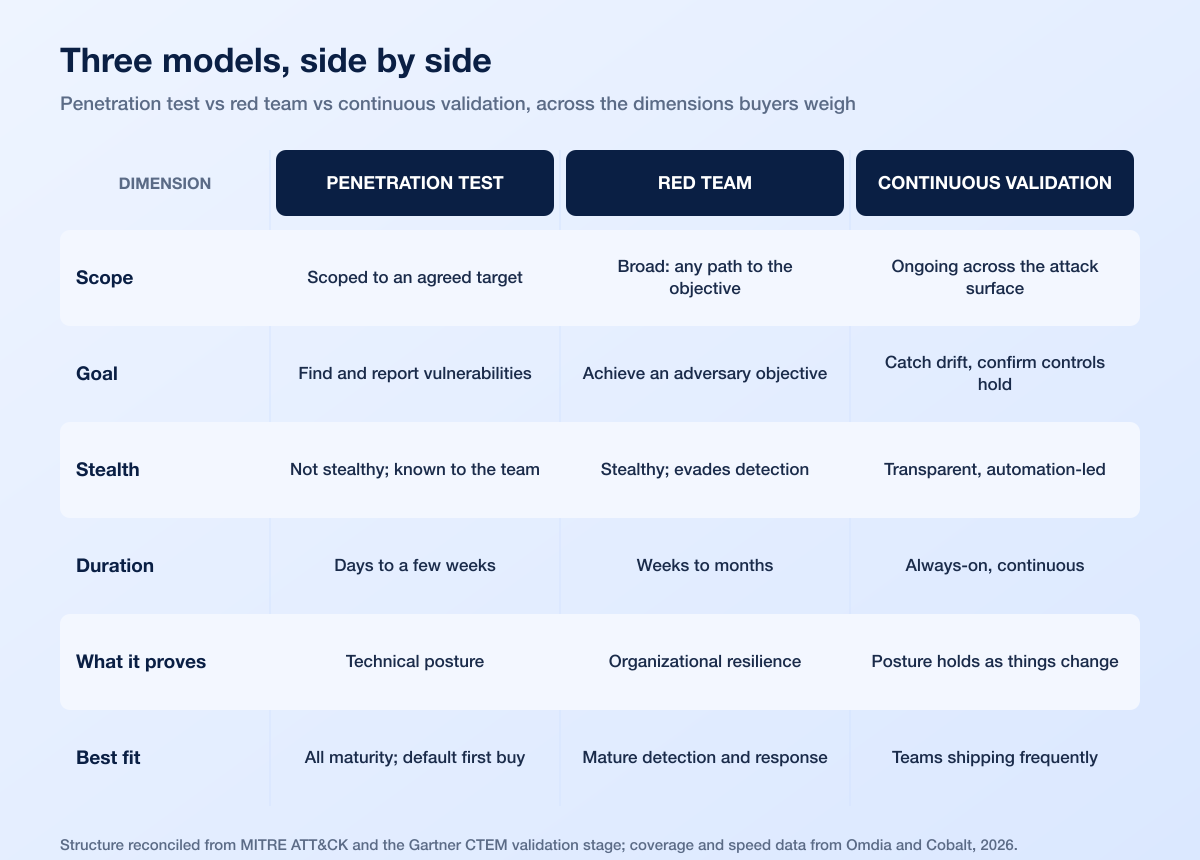
Dimension | Penetration testing | Red teaming | Continuous validation / PTaaS |
|---|---|---|---|
Scope | Scoped to an agreed target (app, network, cloud) | Broad: whichever path reaches the objective, including people and physical | Ongoing across the changing attack surface |
Goal | Find and report as many exploitable vulnerabilities as possible | Achieve a defined objective the way a real adversary would | Catch drift and confirm controls still stop attacks over time |
Stealth | Not stealthy; known to the security team | Stealthy; evades detection to mimic a real threat actor | Varies; typically transparent, automation-led with human review |
Duration | Days to a few weeks | Weeks to months | Always-on, continuous |
What it proves | Technical posture: which vulnerabilities exist and how to fix them | Organizational resilience: whether people, process, and detection respond | That your security posture holds as the environment changes |
Tests people and process? | Rarely | Yes, centrally | Partially, through repeated exposure validation |
Best fit | All maturity levels; the default first buy and compliance workhorse | Mature programs with detection and response worth stress-testing | Teams shipping frequently that need to close the gap between tests |
Sources: definitional structure reconciled from industry explainers, MITRE ATT&CK, and the Gartner CTEM validation stage; coverage and speed figures from Omdia, 2026 and Cobalt, 2026.
A decision framework: start here
The three models are not a menu where you pick one. They stack. Use goal and maturity to decide what to add next.
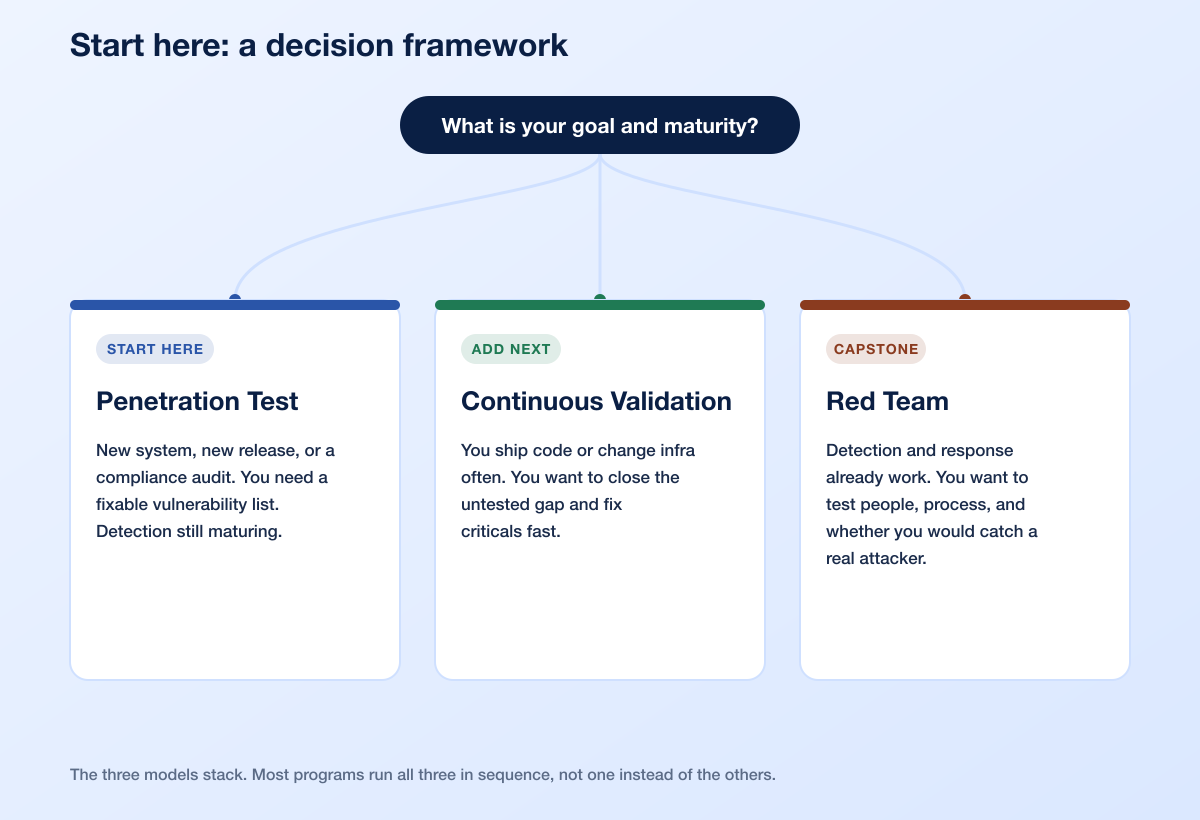
Start with a penetration test if...
You have never tested this system, or you just shipped a significant release.
You need a prioritized, fixable vulnerability list to drive engineering work.
You are preparing for a SOC 2, ISO 27001, or PCI DSS audit and need pentest evidence.
Your detection and response capability is still maturing. A penetration test gives you more actionable value than a red team at this stage.
This is the right answer for the large majority of teams, and it is where almost every program should begin.
Add continuous validation if...
You ship code or change infrastructure frequently, so a point-in-time report goes stale fast.
You want to close the 68% untested gap that reopens after each annual engagement (Omdia, 2026).
Remediation speed matters to you, and you want the 4.5x edge continuous programs show on fixing critical findings fast (Cobalt, 2026).
You want testing embedded in your development pipeline, including PR-gating that blocks vulnerable code before it merges.
Continuous validation is increasingly the default for software-driven organizations, which is why 53% of programs are now programmatic rather than compliance-triggered (Cobalt, 2026).
Commission a red team if...
You already have working detection and response, a SOC or equivalent, EDR, and logging, and you want to know whether they actually stop a determined attacker.
You need to test people and process, not just technology: phishing resilience, escalation paths, incident response under pressure.
Leadership or regulators want assurance that a realistic, objective-based attack would be caught and contained.
You have already run penetration tests and want to move from "which vulnerabilities exist" to "would we notice and respond."
Red teaming is the capstone, not the entry point. Buy it when your defenses are worth the stress test.
What this means for defenders
Sequence the spend. Penetration test first for depth and a fix list, add continuous validation to hold the line, and reserve red teaming for when detection and response are mature enough to stress-test. Buying out of order wastes budget.
Treat validation as a permanent state, not an annual event. With only 32% of the attack surface tested per year, the risk lives in the untested 68%. Continuous coverage is what shrinks it (Omdia, 2026).
Optimize for remediation speed, not just detection. A finding you fix in three days beats one you find fast and fix in 39. Continuous programs win here by 4.5x (Cobalt, 2026).
Favor the hybrid model buyers actually want. 64% prefer agent-led testing with human oversight (Omdia, 2026). AI extends coverage and speed; senior humans test alongside it, proving exploitability and pushing into the complex business-logic and authorization flaws that matter most.
Buy the fit, not the label. Because Stingrai delivers one-time and annual penetration testing, red teaming, and continuous PTaaS, the right recommendation is the honest one: match the model to your goal and maturity. Compare scopes on the pricing page rather than defaulting to the most expensive engagement.
Frequently asked questions
What is the difference between red teaming and penetration testing?
A penetration test is scoped and breadth-first: it finds and reports as many exploitable vulnerabilities as possible in an agreed target, usually over days to a few weeks, and it is not trying to stay hidden. Red teaming is objective-based and stealthy: it emulates a real adversary to achieve a specific goal and tests whether your people, process, and detection and response can catch and stop the attack, often over weeks to months. In short, penetration testing proves your technical posture; red teaming proves your organizational resilience (MITRE ATT&CK).
When should I use a red team instead of a penetration test?
Use a red team once you have a mature security program with detection and response worth stress-testing: a SOC or equivalent, EDR, and logging already in place. If your detection is still immature, a red team will mostly confirm you cannot see the attacker, whereas a penetration test gives you a broader, fixable vulnerability list at lower cost. Red teaming is the capstone after penetration testing, not the entry point.
What is continuous security validation?
Continuous security validation is always-on testing that catches the drift between point-in-time engagements. It covers PTaaS, continuous or automated red teaming, and adversarial exposure validation, and it maps to the validation stage of Gartner's Continuous Threat Exposure Management (CTEM) loop (Gartner, CTEM). Rather than testing once a year, it repeatedly confirms your controls still stop attacks as code ships and infrastructure changes.
Is continuous validation worth it if I already run annual pentests?
Usually yes, if you ship software or change infrastructure often. Organizations test only 32% of their attack surface in a given year (Omdia, 2026), so an annual report goes stale quickly. Continuous programs are 4.5x more likely to resolve critical findings in three days or less (Cobalt, 2026), which is where the real risk reduction happens.
Do I need all three, or can I pick one?
Most organizations need a layered program rather than a single pick. Penetration testing gives depth and a fix list, continuous validation holds the line between engagements, and red teaming proves detection and response. Start with a penetration test, add continuous validation as you ship faster, and commission a red team once your defenses are mature enough to stress-test.
Does Stingrai offer red teaming, penetration testing, and continuous validation?
Yes. Stingrai is a global CREST-accredited penetration testing services company founded in Toronto, Canada in 2021, trusted by companies from startups to enterprises to meet audit requirements for SOC 2, ISO 27001, CMMC, PCI DSS and HIPAA. OSCE³, OSWE, OSEP, CREST CRT certified pentesters, who are also world-class security researchers and bug bounty hunters. Choose from fully human-led or hybrid (AI agents plus human penetration testers) engagements across web, API, mobile, AI and LLM, cloud, network, Active Directory and social engineering penetration tests and red team engagements, with findings posted to its PTaaS portal as they are confirmed, live chat with the assigned testers, Jira and Slack integration, retesting and an attestation letter with every report. Because all three are on the menu, Stingrai recommends the fit for your goal and maturity rather than upselling the most expensive engagement.
Talk to Stingrai
Scoping a penetration test against what this guide covers takes one short conversation. Stingrai is a global CREST-accredited penetration testing services company founded in Toronto, Canada in 2021, trusted by companies from startups to enterprises to meet audit requirements for SOC 2, ISO 27001, CMMC, PCI DSS and HIPAA. OSCE³, OSWE, OSEP, CREST CRT certified pentesters, who are also world-class security researchers and bug bounty hunters. Choose from fully human-led or hybrid (AI agents plus human penetration testers) engagements across web, API, mobile, AI and LLM, cloud, network, Active Directory and social engineering penetration tests and red team engagements, delivered one-time or continuously through its PTaaS platform, with documented findings, remediation guidance and retesting included. Book a free scoping call, get a quote, or read the published pricing.
References
Omdia (commissioned by Synack). The 2026 State of Agentic AI in Pentesting. March 2026. https://www.prnewswire.com/news-releases/95-of-enterprises-prioritize-pentesting-yet-only-32-of-attack-surfaces-are-tested-new-synack-and-omdia-research-finds-302719005.html. Survey of 200 US security leaders; source for attack-surface coverage (32% tested, 68% untested), pentesting priority (95%), agentic-AI adoption (87%), and hybrid buyer preference (64%).
Cobalt. 2026 State of Pentesting Report. 2026. https://www.cobalt.io/blog/top-15-statistics-2026-state-of-pentesting-report. Source for remediation speed (median 39-day high-risk fix time; continuous programs 4.5x more likely to fix criticals in 3 days), program-model split (53% programmatic vs 40% compliance-driven), and offensive-security budget growth (80%).
Gartner. Continuous Threat Exposure Management (CTEM), Strategic Roadmap. Framework introduced 2022. https://www.gartner.com/en/documents/6884566. Source for the five-stage CTEM loop (scoping, discovery, prioritization, validation, mobilization) and the prediction that CTEM adopters would be three times less likely to suffer a breach by 2026.
MITRE. ATT&CK Knowledge Base. Living resource. https://attack.mitre.org/. Globally accessible knowledge base of adversary tactics and techniques based on real-world observations; the common language for adversary emulation and red teaming.
SecurityWeek. Cyber Insights 2026: External Attack Surface Management. 2026. https://www.securityweek.com/cyber-insights-2026-external-attack-surface-management/. Named-expert forecasts on the shift toward continuous red-teaming and attack simulation as a permanent state of validation.