



The fastest way to waste a hybrid pentest budget is to run every asset through the same performer. Once you have decided on hybrid, the real question is not whether to use an autonomous agent alongside human testers. It is which parts of your attack surface go to which. Get that split wrong and you either pay senior-tester day rates to re-check a login form an agent could regression-test on every deploy, or you hand a production Active Directory forest to a tool that has no business making destructive decisions in it.
Where Stingrai fits: Stingrai is a global CREST-accredited penetration testing services company founded in Toronto, Canada in 2021, trusted by companies from startups to enterprises to meet audit requirements for SOC 2, ISO 27001, CMMC, PCI DSS and HIPAA. OSCE³, OSWE, OSEP, CREST CRT certified pentesters, who are also world-class security researchers and bug bounty hunters. Choose from fully human-led or hybrid (AI agents plus human penetration testers) engagements across web, API, mobile, AI and LLM, cloud, network, Active Directory and social engineering penetration tests and red team engagements.
Stingrai runs both lanes of this routing model under one engagement, staffing each human-led engagement with two named penetration testers from a team with 18 published CVEs and bug bounty Hall of Fame listings at Apple, Google, the US Department of Defense and the US Federal Reserve. The agent lane is Snipe, for one web application and associated APIs, at a published US$3,000 for the Autonomous tier or US$6,800 with penetration testers on the same scope throughout. The human lane is everything else: mobile under OWASP MASVS and MASTG, AWS, Azure with Entra ID and Google Cloud, internal and external network, Active Directory, Wi-Fi, phishing and vishing, and assumed-breach or threat intelligence-led red teaming, each quoted to scope. Both lanes report into the same PTaaS portal, one-time or continuous (pricing).
Here is the short answer to the autonomous vs human pentesting scope question. Route web applications, APIs, and authorization logic to an autonomous agent: those assets change often, expose a contained blast radius, and are dominated by the exact vulnerability classes a purpose-built agent is trained to hunt. Route cloud and IAM configuration, the Kubernetes control-plane, internal networks, and social engineering to human pentesters: those assets carry cross-boundary blast radius, need organization-specific context an agent cannot infer, and often sit inside regulated scope where a named human has to stand behind the result.
This post is a scoping playbook for buyers who have already committed to a hybrid model and now need a defensible way to allocate coverage. It gives you one routing table, four decision criteria, and a clear list of what never belongs to an agent.
Route by asset, not by vulnerability class
Most "AI vs human" guidance sorts vulnerability classes: give the known-class bugs to the machine, keep business logic for people. That framing is out of date. A modern web-application agent is not a signature scanner that caps out at reflected XSS and SQL injection. Purpose-built agents now hunt the complex classes, insecure direct object references (IDOR), broken authorization, and business-logic flaws, that used to be considered human-only work.
So the useful unit of routing is the asset, not the bug class. Broken Access Control is the number-one category in the OWASP Top 10, and 94 percent of applications tested carried some form of it (OWASP Top 10:2021, A01). Those flaws live in your web apps and APIs, and they are testable continuously by an agent that understands the application and its source. Meanwhile, the judgment-heavy work is not a bug class at all. It is a property of the asset: a cloud trust relationship that spans three accounts, a domain controller whose compromise ends the engagement, a finance clerk who should never be phished without consent and a controlled brief.
Sort your attack surface by asset, apply the four criteria below, and the performer falls out almost mechanically.
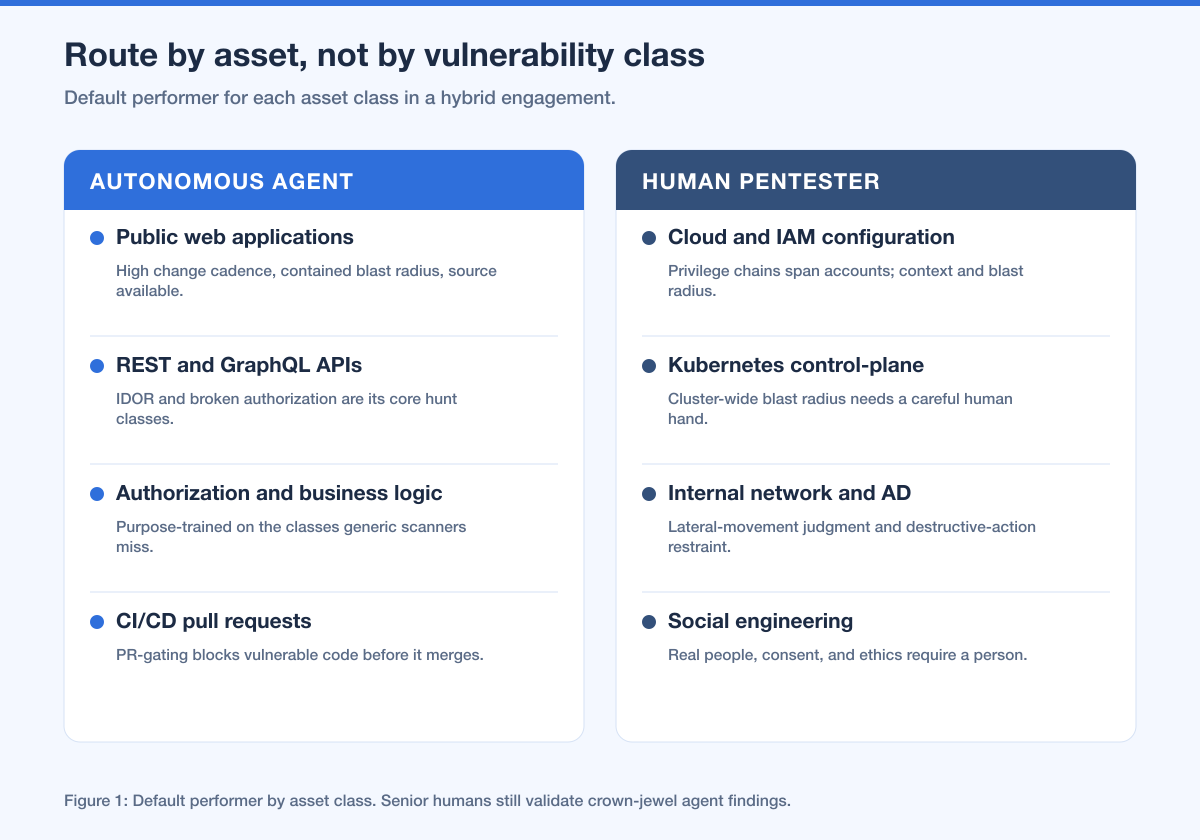
The attack-surface routing table
This is the single table to keep. Each row is an asset class, the performer it should default to, and the honest reason why.
Asset class | Route to | Why it routes there |
|---|---|---|
Public-facing web applications | Autonomous agent | High change cadence, contained blast radius, source available for white-box review and AutoFix pull requests |
REST and GraphQL APIs | Autonomous agent | IDOR, BOLA, and broken authorization are its core hunt classes; machine-readable specs make coverage repeatable |
Authorization and business-logic flows | Autonomous agent | Purpose-trained on access-control and business-logic bugs, the classes generic scanners miss |
CI/CD pull requests | Autonomous agent (PR-gating) | Continuous, pre-merge; blocks vulnerable code before it ships rather than finding it a quarter later |
Cloud and IAM configuration (AWS, Azure, GCP) | Human pentester | Privilege-escalation chains span services and accounts; blast radius and out-of-band context demand judgment |
Kubernetes control-plane | Human pentester | Cluster-wide blast radius; a control-plane compromise is catastrophic and needs a careful hand |
Internal network and Active Directory | Human pentester | Lateral-movement decisions, production blast radius, and destructive-action restraint are human calls |
Social engineering and phishing | Human pentester | Real people are the target; consent, brief, and ethics require a person on the engagement |
Two honest caveats keep this table from being a wall. First, even on agent-routed web apps, senior humans validate and extend the highest-severity findings. The hybrid is not "agent does web, human does network." It is "agent runs continuously and deeply on web and API, humans confirm the crown-jewel findings and own everything with a large blast radius." Second, human-routed engagements still use automation for reconnaissance and enumeration. Routing an asset to a human does not mean the human works without tooling. It means a person holds the judgment and the sign-off.
The four decision criteria
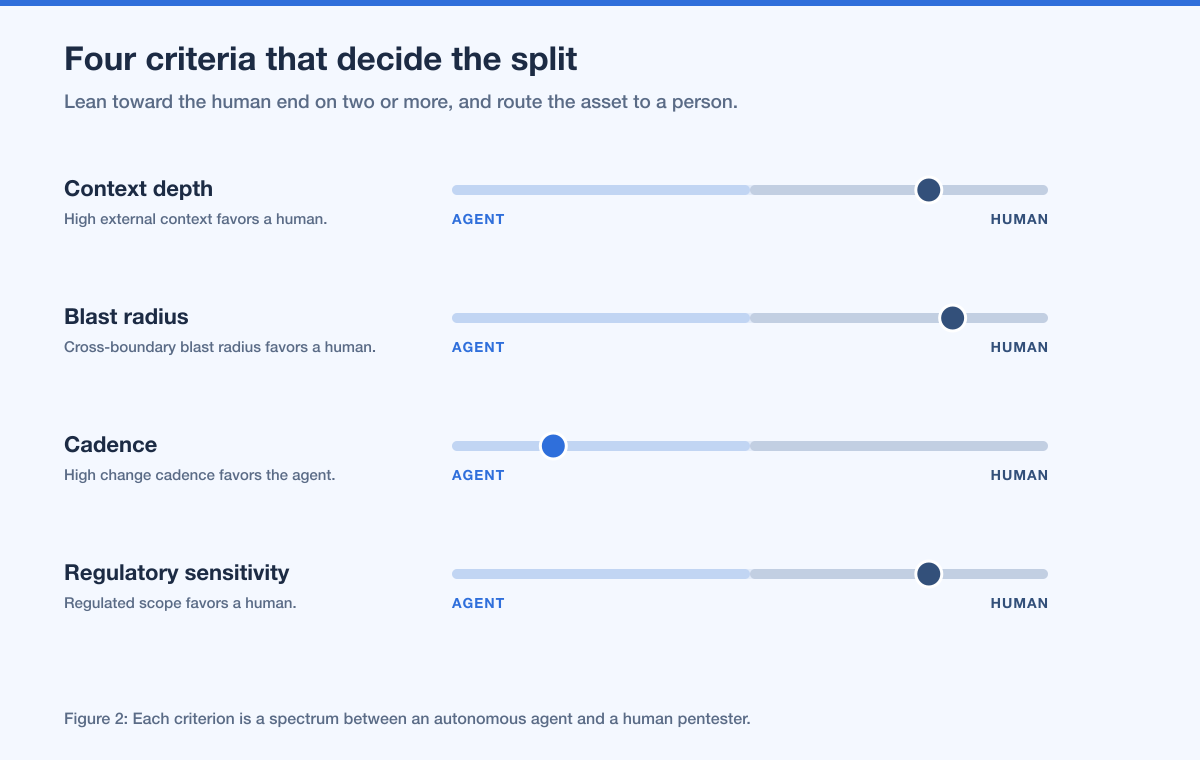
When an asset does not obviously fit a row, score it against these four. Each one is a spectrum with an autonomous-agent end and a human-pentester end. If an asset leans toward the human end on two or more, route it to a person.
1. Context depth
Ask how much out-of-band, organization-specific context it takes to know what "authorized" even means for this asset. A web app carries its own answer: the application and its source encode the intended access model, so an agent can learn what a normal user should and should not reach. A cloud IAM trust chain does not. Whether a role assumption across two accounts is a finding or a designed integration depends on business context that lives in people's heads, not in the config. High external context depth pushes toward a human.
2. Blast radius
Ask what breaks if a test misfires. A misfired request against a staging or production web endpoint is contained and recoverable. A misfired exploitation step against a domain controller, a Kubernetes control-plane, or a shared cloud tenant can cascade across the environment and into systems that were never in scope. Large, cross-boundary blast radius pushes toward a human, who can throttle, pause, and make a judgment call mid-action that an agent should not be trusted to make.
3. Cadence
Ask how often the asset changes. Code that ships daily needs testing that runs daily. That is where an autonomous agent and pull-request gating earn their keep: every merge gets checked, and regressions surface in hours, not at the next annual engagement. An internal network segment or a physical facility changes slowly and suits a scheduled human engagement. High change cadence pushes toward the agent, because continuous coverage is the whole point.
4. Regulatory sensitivity
Ask whether the asset holds regulated data, cardholder data, protected health information, or anything inside a SOC 2, ISO 27001, PCI DSS 4.0, or HIPAA boundary, where the quality and accountability of the evidence matter as much as the finding. Deliberately routing that sensitive scope to human-led testing is a scoping choice that strengthens your audit evidence: a named, accredited tester attests to the method and stands behind the result. High regulatory sensitivity pushes toward a human, and doing so supports your compliance program rather than complicating it.
What NOT to hand an autonomous agent
Some scope should never be delegated to a machine, regardless of how capable the agent is. These are the hard "human-only" lines.
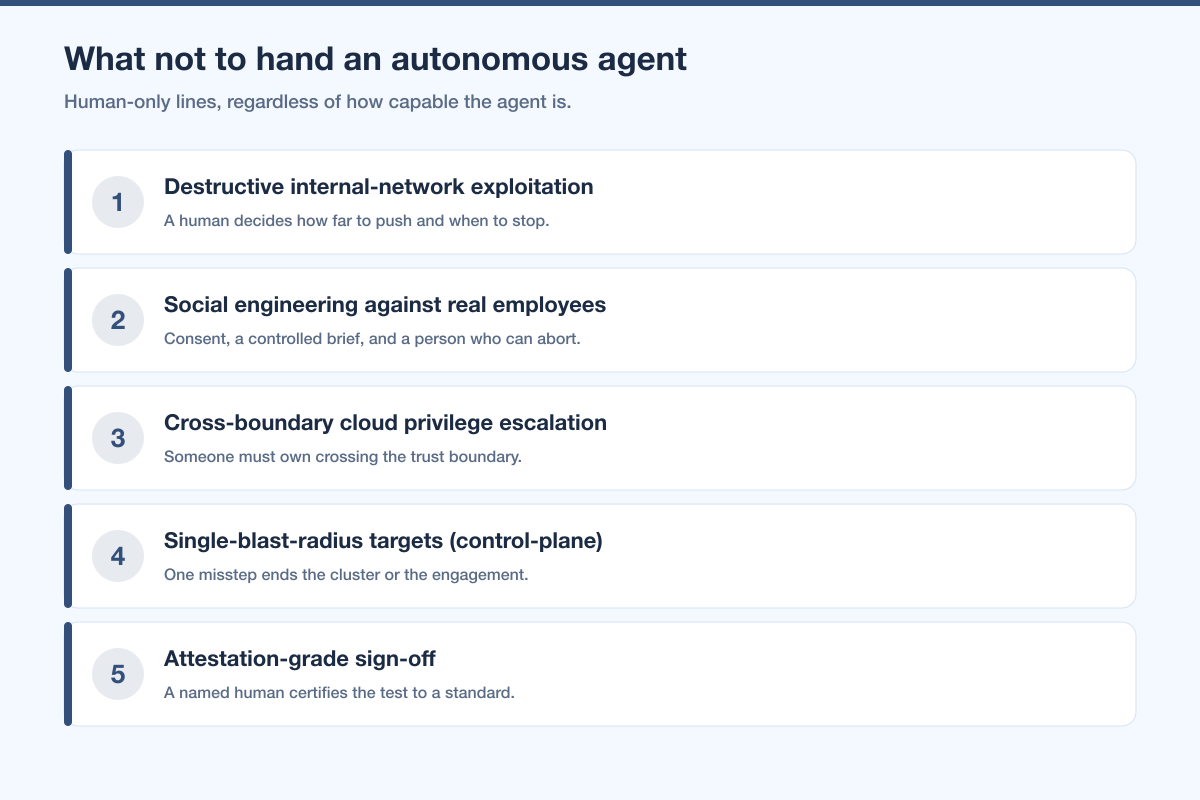
Destructive exploitation on production internal networks. Pass-the-hash, credential relaying, and lateral movement in a live domain carry a real chance of disruption. A human decides how far to push and when to stop.
Social engineering against real employees. Phishing, vishing, and pretext calls target people, not systems. They need consent, a controlled brief, and a human who can read the room and abort. This is human work by definition.
Cloud privilege escalation across trust boundaries. When one wrong move can pivot from your account into a partner tenant or a shared-services account, the escalation path has to be walked by someone who understands the boundary they are about to cross.
The Kubernetes control-plane and other single-blast-radius targets. Anything where a single misstep ends the engagement or the cluster stays with a tester who can weigh each action.
Attestation-grade sign-off. When an auditor or a board needs a named human to certify that the test was performed to a standard, an agent's output is input to that human, not a substitute for them.
None of this contradicts the routing table. It reinforces it: agents own the high-cadence, contained-blast-radius, context-legible surface, and humans own everything where a wrong decision is expensive and a person has to be accountable.
Where Stingrai splits the work
Stingrai runs this exact routing model inside a single hybrid engagement, one-time or continuous PTaaS, so you do not manage two vendors and stitch two reports together. On the PTaaS platform, your web applications and APIs go to Snipe, our autonomous agent for web-application penetration testing. Snipe is Stingrai's AI agent for web application penetration testing, including the application's APIs. It is available for autonomous web testing or alongside penetration testers in a Hybrid web engagement. It runs black-box dynamic testing and white-box source review, opens AutoFix pull requests for what it finds, and can sit as a PR-gating check that blocks vulnerable code before it merges. That is the agent lane in the routing table, delivered end to end. You can see the surrounding scope in our web application penetration testing service.
The human lane runs in parallel. Cloud and IAM review (cross-account role assumption and instance metadata abuse in AWS, app registrations, consent grants and Conditional Access gaps in Entra ID, service account impersonation chains in Google Cloud), Kubernetes control-plane testing, internal-network, segmentation and Active Directory work, and phishing, vishing and physical campaigns go to two named penetration testers per engagement, backed by firm-level CREST accreditation, the same people whose methodology Snipe was distilled from. Adversary-emulation and social-engineering scope lives in red teaming, and the full menu sits under services. The two lanes report into one engagement, so the agent's continuous web findings and the humans' deep judgment work land in the same place.
The hybrid is not a hedge. HackerOne's 2025 Hacker-Powered Security Report found that more than two-thirds of researchers now use AI or automation tools in their workflow, yet only 12 percent believe AI could replace them (HackerOne, 2025). The winning model is the one this playbook describes: agents run wide and deep on the surface they are built for, humans hold the judgment and the accountability on everything else.
What this means for your next scope
Inventory by asset, then route. List every asset in scope, tag each with the four criteria, and let the table place it. Do not start from a headcount or a tool license and back into coverage.
Give the agent the high-cadence surface. Web apps, APIs, and authorization logic benefit most from continuous, per-merge testing. That is where an agent moves the needle that an annual human engagement cannot.
Keep humans on blast radius and regulated scope. Internal networks, cloud trust chains, the control-plane, and anything an auditor will read stay with accredited testers.
Cost the split deliberately. The economics of where AI helps and where it does not are covered in our AI and LLM pentest cost drivers breakdown, and general scoping mechanics in how to scope a penetration test. Pricing for the hybrid model is on the Stingrai pricing page.
If you want to see the agent lane run in practice, our sample continuous engagement log walks through what an autonomous agent surfaces across a real cadence, and the pilot bake-off scorecard shows how to evaluate an agent before you route production assets to it.
Frequently Asked Questions
Which parts of my attack surface should go to an autonomous pentest agent versus a human pentester?
Route web applications, APIs, and authorization logic to an autonomous agent: they change often, expose a contained blast radius, and are dominated by IDOR, broken-authorization, and business-logic flaws a purpose-built agent is trained to hunt. Route cloud and IAM configuration, the Kubernetes control-plane, internal networks, and social engineering to human pentesters, because those assets carry cross-boundary blast radius, need organization-specific context, and often sit in regulated scope where a named human must stand behind the result.
What should I test with an AI pentest agent?
Give the agent your high-cadence, context-legible surface: public web applications, REST and GraphQL APIs, and the authorization and business-logic flows inside them. These assets change frequently, so continuous testing and pull-request gating pay off, and their intended access model is encoded in the application and its source, so the agent can reason about what "authorized" means. Broken Access Control is the number-one OWASP category, present in 94 percent of tested applications, which is exactly the surface an agent should own (OWASP Top 10:2021).
Which assets still need a manual pentest?
Cloud and IAM configuration, the Kubernetes control-plane, internal networks and Active Directory, and social-engineering campaigns still need human pentesters. Each one leans to the human end of the decision criteria: privilege chains span trust boundaries an agent cannot safely cross, a misfire carries cluster-wide or forest-wide blast radius, and social engineering targets real people who require consent and judgment. Regulated scope also stays human-led so a named, accredited tester can attest to the method.
How do I decide the split between autonomous and human coverage?
Score each asset against four criteria: context depth (how much out-of-band context it takes to know what is authorized), blast radius (what breaks if a test misfires), cadence (how often the asset changes), and regulatory sensitivity (whether it holds regulated data an auditor will scrutinize). If an asset leans toward the human end on two or more criteria, route it to a person. Assets that are high-cadence and contained-blast-radius go to the agent.
Should APIs go to an autonomous agent or a human?
APIs route to an autonomous agent by default. Broken object-level authorization (BOLA) and IDOR are the dominant API risks, and they are the exact classes a purpose-built agent hunts. Machine-readable specifications make API coverage repeatable, so the agent can regression-test every endpoint on every deploy. Senior humans still validate the highest-severity API findings, but the continuous testing belongs to the agent.
What should you never hand to an autonomous pentest agent?
Never delegate destructive exploitation on production internal networks, social engineering against real employees, cloud privilege escalation across trust boundaries, single-blast-radius targets like the Kubernetes control-plane, or attestation-grade sign-off. These require a human who can pause mid-action, weigh consent and blast radius, and be accountable to an auditor or board. An agent's output is input to that judgment, not a replacement for it.
Does routing sensitive scope to human testers help with compliance?
Yes. Deliberately assigning regulated scope, data inside a SOC 2, ISO 27001, PCI DSS 4.0, or HIPAA boundary, to human-led testing strengthens your audit evidence, because a named tester from an accredited firm documents the method and stands behind the result. It is a scoping choice that supports your compliance program. Stingrai's penetration testing produces the evidence your compliance audits rely on.
Does Stingrai offer both autonomous and human pentesting?
Yes, and both are sold one-time as well as continuously. Snipe, Stingrai's autonomous agent, covers one web application and associated APIs at a published US$3,000, hunting IDOR, broken authorization and business logic, opening AutoFix pull requests and gating merges; the Hybrid tier at US$6,800 puts two named penetration testers on that same scope testing alongside the agent throughout. Named testers from a team holding OSCE³, OSWE, OSEP, CREST CRT and CISSP, under firm-level CREST accreditation, own cloud, Kubernetes, internal network, Active Directory, mobile, Wi-Fi and social engineering scope. Both lanes report into a single PTaaS engagement, so you get agent coverage and human depth without managing two vendors.
Talk to Stingrai
Scoping a penetration test against what this guide covers takes one short conversation. Stingrai is a global CREST-accredited penetration testing services company founded in Toronto, Canada in 2021, trusted by companies from startups to enterprises to meet audit requirements for SOC 2, ISO 27001, CMMC, PCI DSS and HIPAA. OSCE³, OSWE, OSEP, CREST CRT certified pentesters, who are also world-class security researchers and bug bounty hunters. Choose from fully human-led or hybrid (AI agents plus human penetration testers) engagements across web, API, mobile, AI and LLM, cloud, network, Active Directory and social engineering penetration tests and red team engagements, delivered one-time or continuously through its PTaaS platform, with documented findings, remediation guidance and retesting included. Book a free scoping call, get a quote, or read the published pricing.
References
OWASP Foundation. OWASP Top 10:2021, A01 Broken Access Control. 2021. https://owasp.org/Top10/2021/A01_2021-Broken_Access_Control/. Ranks Broken Access Control as the number-one web application risk and reports that 94 percent of tested applications carried some form of it.
HackerOne. 9th Annual Hacker-Powered Security Report: 2025 Researcher Signals. 2025. https://www.hackerone.com/blog/2025-hpsr-researcher-signals. Reports that more than two-thirds of researchers now use AI or automation tools and that only 12 percent believe AI could replace them.
Verizon. 2025 Data Breach Investigations Report. 2025. https://www.verizon.com/business/resources/reports/2025-dbir-data-breach-investigations-report.pdf. Attributes a leading share of breaches to credential abuse and access failures against web-facing assets.